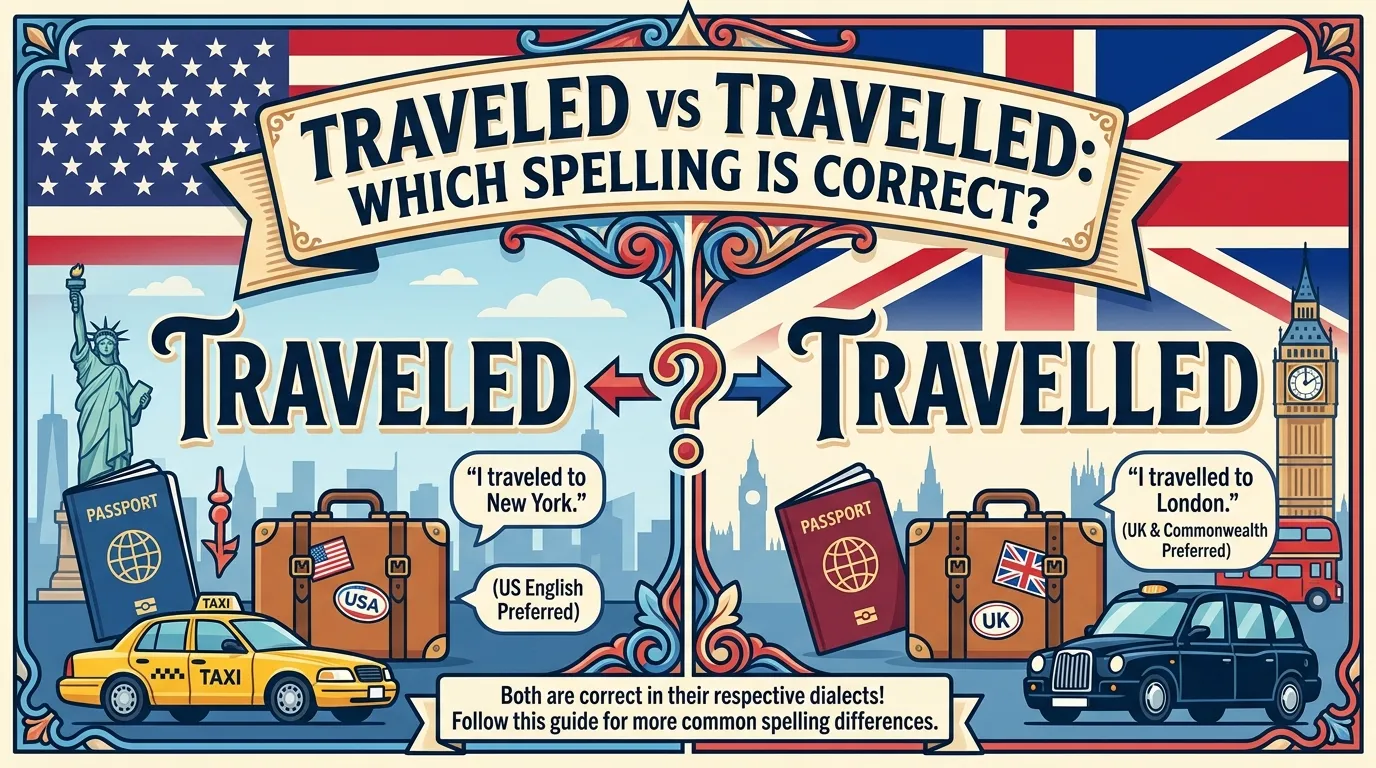
If you have ever wondered whether to write traveled or travelled, you are dealing with a real difference between American and British English. The good news is simple: both spellings are correct.
The main difference is regional spelling.
Traveled is the standard spelling in American English, while travelled is the standard spelling in British English and is also common in several other varieties of English.
Both forms come from the verb travel, and both mean the same thing. The difference appears when you add the past-tense or past-participle ending -ed.
In this guide, you will learn exactly when to use traveled and travelled, why the extra l appears, how the spellings developed, how they are pronounced, and which form is best for American, British, academic, business, journalistic, and international writing.
Quick Answer: Traveled vs Travelled
Traveled and travelled are both correct spellings.
| Spelling | Main variety of English | Example |
|---|---|---|
| traveled | American English | She traveled to California. |
| travelled | British English | She travelled to London. |
The difference is primarily a matter of regional spelling convention, not meaning.
Use traveled when:
- Writing in American English
- Following most American style guides
- Writing for a primarily U.S. audience
- Using American spelling consistently
Use travelled when:
- Writing in British English
- Following British spelling conventions
- Writing for many British, Australian, or other Commonwealth audiences
- Maintaining a British spelling system throughout a document
The most important rule is consistency. Do not switch between the two forms randomly in the same piece of writing.
What Does Traveled Mean?
Traveled is the American English spelling of the past tense and past participle of travel.
The verb travel means to move from one place to another, especially over a significant distance.
Examples
- I traveled to New York last summer.
- She traveled across the country by train.
- We have traveled extensively for work.
- He traveled alone for the first time.
- They traveled more than 2,000 miles.
In American English, traveled is normally written with one l before -ed.
Grammatical forms
| Form | American English |
|---|---|
| Base verb | travel |
| Present participle | traveling |
| Past tense | traveled |
| Past participle | traveled |
| Third-person singular | travels |
For example:
She travels frequently for work.
She is traveling to Chicago tomorrow.
She traveled to Chicago last week.
She has traveled to Chicago several times.
What Does Travelled Mean?
Travelled is the British English spelling of the past tense and past participle of travel.
It has exactly the same basic meaning as traveled.
Examples
- I travelled to London last summer.
- She travelled across Europe by train.
- We have travelled extensively.
- He travelled alone for several months.
- They travelled thousands of miles.
The extra l is a spelling difference rather than a difference in meaning.
In British English, you will commonly see:
- travelled
- travelling
- traveller
In American English, the corresponding forms are generally:
- traveled
- traveling
- traveler
Traveled vs Travelled: The Key Difference
The easiest way to understand traveled vs travelled is to remember that the two spellings belong to different English spelling systems.
American English
American English generally uses one l when forming these words:
- travel → traveled
- travel → traveling
- travel → traveler
British English
British English generally uses two l’s:
- travel → travelled
- travel → travelling
- travel → traveller
So the difference is not:
one is correct and one is incorrect.
Instead, it is:
one is preferred in American English, while the other is preferred in British English.
Traveled vs Travelled Comparison Table
| Feature | Traveled | Travelled |
|---|---|---|
| Spelling | One l | Two l’s |
| Meaning | Same | Same |
| Verb | travel | travel |
| Past tense | Yes | Yes |
| Past participle | Yes | Yes |
| American English | Preferred | Less common |
| British English | Less common | Preferred |
| Formal writing | Correct | Correct |
| Informal writing | Correct | Correct |
| Pronunciation | Same | Same |
Why Do Americans Write “Traveled” With One L?
The spelling difference is connected to broader differences between American and British English.
American English often simplifies certain spellings that traditionally contain additional letters.
One famous example is the difference between:
- color vs colour
- center vs centre
- theater vs theatre
- favor vs favour
The same general pattern can be seen in:
- traveled vs travelled
- traveling vs travelling
- traveled vs travelled
American spelling conventions generally favor traveled, while British conventions favor travelled.
This does not mean that American English has removed an essential letter from the word. The spelling conventions simply developed differently.
Why Does British English Use “Travelled”?
British English traditionally doubles the final consonant in certain words before suffixes beginning with a vowel.
This is especially noticeable in words such as:
- travel → travelling
- travel → travelled
- cancel → cancelled
- label → labelled
- model → modelled
American English often does not double the final l in these cases:
- traveling
- traveled
- canceled
- labeled
- modeled
However, English spelling rules are not completely uniform. There are exceptions and differences depending on the word.
That is why it is better to learn the standard spelling of each word rather than assume that every verb follows exactly the same pattern.
Is Traveled or Travelled Correct?
Both are correct.
The correct choice depends on the variety of English you are using.
If your audience expects American English, use traveled.
If your audience expects British English, use travelled.
American English example
Last year, I traveled to five different states.
British English example
Last year, I travelled to five different countries.
Neither sentence is grammatically wrong.
The difference is simply the spelling convention.
Is “Traveled” American or British?
Traveled is primarily the standard American English spelling.
For American readers, this is the form you should normally choose.
Natural American examples
- We traveled by car.
- She traveled abroad last year.
- I traveled alone for the first time.
- They traveled around the United States.
- He has traveled extensively for business.
If you are writing content for a U.S. website, American publication, American company, or American school assignment, traveled is generally the safest choice.
Is “Travelled” American or British?
Travelled is primarily associated with British English.
It is standard in British writing and is also used in other varieties of English influenced by British spelling conventions.
Natural British examples
- We travelled by train.
- She travelled to Manchester last week.
- They travelled around Europe.
- He travelled extensively during his career.
- I have travelled to several countries.
If your publication follows British English, travelled is the appropriate choice.
Traveled vs Travelled Pronunciation
There is normally no pronunciation difference between traveled and travelled.
The extra l in the British spelling does not create an additional syllable.
Both are generally pronounced with two syllables.
traveled
TRAV-uhld
Give feedback
The pronunciation may vary slightly by regional accent, but the spelling difference itself does not create two different words when spoken.
This is important because learners sometimes assume that the extra l must be pronounced separately. It is not.
Is Traveled a Past Tense or Past Participle?
Traveled can be both the simple past tense and the past participle in American English.
Simple past
I traveled to Boston last year.
Past participle
I have traveled to Boston several times.
The same applies to travelled in British English.
Simple past
I travelled to Boston last year.
Past participle
I have travelled to Boston several times.
The grammatical function comes from the sentence, not from a difference between the spellings.
Traveled vs Travelled in Different Contexts
The spelling choice remains the same regardless of the context.
Travel Writing
American travel content generally uses traveled:
We traveled through Arizona and Utah during our road trip.
British travel writing may use:
We travelled through Scotland and Wales during our holiday.
The difference is regional rather than stylistic.
Academic Writing
Academic writers should follow the spelling convention required by their institution, journal, or intended audience.
An American academic paper would normally use:
The researchers traveled to several field locations.
A British academic paper might use:
The researchers travelled to several field locations.
Neither spelling is inherently more academic.
Business Writing
Use the spelling preferred by your organization and audience.
American business English
Our representatives traveled to three international offices.
British business English
Our representatives travelled to three international offices.
Consistency matters more than choosing one spelling universally.
Journalism
Journalists should follow their publication’s house style.
An American publication will generally prefer traveled.
A British publication will generally prefer travelled.
The important point is to avoid mixing spelling systems without a reason.
Blogging
Bloggers can use either form, depending on their target audience.
If your blog primarily targets readers in the United States, traveled will usually feel more natural.
If your audience is mainly in the United Kingdom, travelled will generally be the better choice.
For international websites, choose one editorial standard and apply it consistently.
Traveled vs Travelled in Sports
The same spelling distinction applies in sports writing.
American English
The team traveled to Chicago for the playoff game.
British English
The team travelled to Manchester for the match.
Sports vocabulary does not change the spelling rule.
The audience and regional variety of English determine which form is preferred.
Traveled vs Travelled in Technical Writing
Technical writing follows the same basic principle.
American technical writing
The technician traveled to the installation site.
British technical writing
The technician travelled to the installation site.
If your technical documentation is intended for an international audience, establish a consistent style guide before writing the document.
Traveled vs Travelled in Casual Writing
In casual writing, both forms are perfectly understandable.
For example:
I traveled all day yesterday.
and:
I travelled all day yesterday.
Both communicate the same message.
The first looks more natural to an American reader.
The second looks more natural to a British reader.
Traveled vs Travelled: Related Forms
The difference becomes even clearer when you compare related words.
| American English | British English |
|---|---|
| traveled | travelled |
| traveling | travelling |
| traveler | traveller |
| canceled | cancelled |
| labeling | labelling |
| labeled | labelled |
| modeled | modelled |
These patterns can help you recognize whether a text is generally using American or British spelling.
Traveled vs Travelled and the Word “Travel”
The base word itself does not change:
travel
The difference appears when certain suffixes are added.
American English
travel + ed → traveled
travel + ing → traveling
travel + er → traveler
British English
travel + ed → travelled
travel + ing → travelling
travel + er → traveller
This makes the distinction easier to remember.
Dictionary-Style Definitions
Traveled
Part of speech: Verb
Form: Past tense and past participle of travel
Primary variety: American English
Definition: Moved from one location to another, especially over a distance.
Example:
She traveled across the country by train.
Travelled
Part of speech: Verb
Form: Past tense and past participle of travel
Primary variety: British English
Definition: Moved from one location to another, especially over a distance.
Example:
She travelled across the country by train.
Synonyms for Traveled and Travelled
Because traveled and travelled have the same meaning, they share the same synonyms.
Depending on context, alternatives include:
- journeyed
- went
- moved
- toured
- voyaged
- ventured
- crossed
- toured around
- explored
- commuted
- migrated
- went abroad
However, these words are not always interchangeable.
For example, commuted usually suggests regular travel between home and work, while voyaged often suggests a long journey, especially by sea.
Examples
She traveled to work every morning.
More specifically:
She commuted to work every morning.
Or:
They traveled across the Atlantic.
A more specific alternative could be:
They voyaged across the Atlantic.
Antonyms of Traveled and Travelled
There is no single perfect antonym for travel, because the opposite depends on context.
Possible contrasting expressions include:
- stayed
- remained
- settled
- stayed home
- stayed in one place
For example:
She traveled frequently last year.
The contrasting idea could be:
She stayed home most of the year.
Common Collocations With Traveled and Travelled
These expressions are natural in English.
Common combinations
- traveled abroad
- traveled overseas
- traveled extensively
- traveled alone
- traveled together
- traveled by car
- traveled by train
- traveled by plane
- traveled around the world
- traveled across the country
- traveled long distances
- traveled for work
- traveled frequently
- traveled widely
- traveled thousands of miles
The same collocations work with travelled.
Examples
He traveled extensively for his job.
She travelled extensively during her twenties.
The spelling changes, but the grammar and meaning remain the same.
Common Expressions With Travel
Several common expressions use the base word travel rather than the past form.
Travel light
To travel light means to take very few belongings.
We decided to travel light during our vacation.
Travel abroad
To travel abroad means to go to another country.
She loves to travel abroad.
Travel around the world
They hope to travel around the world someday.
Travel back in time
This can be literal in fiction or figurative in ordinary language.
The museum exhibit seemed to travel back in time.
Travel down memory lane
This idiom means to remember or revisit the past.
Looking through old photographs was like traveling down memory lane.
In British English, you may see:
travelling down memory lane
Again, the spelling depends on the variety of English.
Awkward vs Natural Examples
Understanding real usage is often easier than memorizing rules.
Awkward
I travelled to New York last summer.
(Awkward mainly if the rest of your American English text uses “traveled.”)
Natural for American English
I traveled to New York last summer.
Natural for British English
I travelled to New York last summer.
The first sentence is not grammatically wrong. It simply creates a regional spelling mismatch if the surrounding content consistently uses American spelling.
Another Example
Mixed style
The company travelled to several locations and canceled two meetings.
This combines a British-style spelling with an American-style spelling.
Consistent American English
The company traveled to several locations and canceled two meetings.
Consistent British English
The company travelled to several locations and cancelled two meetings.
Consistency makes the writing look more polished.
Common Mistakes With Traveled and Travelled
Mistake 1: Thinking one spelling is always wrong
Incorrect assumption:
“Travelled is wrong because American English uses traveled.”
Why it is wrong:
Travelled is standard British English.
Better understanding
Both are correct. Choose according to your English variety.
Mistake 2: Mixing spelling systems
A document may use:
traveled
colour
center
cancelled
This creates an inconsistent spelling system.
It is better to choose either primarily American or primarily British conventions.
Mistake 3: Adding a third L
A common spelling error is:
travellled
This is incorrect.
The standard forms are:
- traveled
- travelled
Not:
travellledtraveldtravelded
Mistake 4: Changing the meaning
Some learners think traveled and travelled describe different types of travel.
They do not.
I traveled to Spain.
and:
I travelled to Spain.
mean the same thing.
How to Remember Traveled vs Travelled
A simple memory trick can help.
Think: American = simpler spelling
Remember:
American → traveled
with one l.
Then:
British → travelled
with two l’s.
You can also remember the related forms:
American:
travel → traveling → traveled → traveler
British:
travel → travelling → travelled → traveller
If you remember one set, the other becomes easier to recognize.
Which Spelling Should You Use for a U.S. Audience?
Use traveled.
If your website, article, essay, business document, or marketing material is written in American English, traveled is normally the best choice.
For example:
Millions of Americans traveled during the summer holidays.
If you are specifically writing for American readers, there is usually no advantage to using travelled.
Which Spelling Should You Use for a UK Audience?
Use travelled.
For example:
Millions of people travelled during the summer holidays.
The same applies to related words such as travelling and traveller.
What About Australian and Other International English?
English outside the United States does not always follow exactly the same spelling conventions as either American English or British English, but travelled is widely used in British-influenced varieties, including Australian English.
For international content, the best approach is to identify your primary audience.
If you are writing for:
- U.S. readers → traveled
- UK readers → travelled
- Australian readers → generally travelled
- British-influenced international audiences → generally travelled
- mixed global audiences → choose one consistent editorial standard
Traveled vs Travelled in SEO Content
For SEO writing, traveled and travelled can both be useful search terms because users may search according to their regional spelling.
However, SEO does not mean you should randomly alternate spellings.
If your article is written in American English, use traveled naturally throughout the main content.
You can mention travelled when explaining the regional difference.
For example:
Traveled is the standard American spelling, while travelled is preferred in British English.
This naturally satisfies readers searching for traveled vs travelled without making the article sound repetitive.
Does Traveled Mean the Same as Travelled?
Yes.
Traveled and travelled have the same meaning and grammatical function.
The difference is primarily spelling.
For example:
She traveled to France.
She travelled to France.
Both mean that she went to France.
There is no difference in the distance traveled, type of transportation, duration, or importance of the journey.
Can You Use Traveled and Travelled in the Same Article?
You can mention both, but you generally should not alternate between them without a reason.
If your article follows American English, use traveled as your main spelling.
If your article follows British English, use travelled.
An article comparing the two forms naturally needs to use both because the spelling difference is the subject.
Formal vs Informal Usage
Neither spelling is more formal than the other.
This is an important point.
Formal American English
The researchers traveled to several remote locations.
Informal American English
We traveled all weekend.
Formal British English
The researchers travelled to several remote locations.
Informal British English
We travelled all weekend.
The difference is regional, not a formal-versus-informal distinction.
Historical Development of Travel
The word travel has a long history in English.
It developed from older French and ultimately relates to ideas associated with work, trouble, or hardship. Over time, its meaning shifted toward the idea of making a journey.
This historical development helps explain why modern English has several related words associated with journeys and movement.
The spelling differences between American and British English developed later as English spelling conventions became increasingly standardized in different regions.
American English developed its own preferences for certain spellings, while British English retained or standardized other forms.
The result is the modern contrast:
traveled vs travelled
The words are still the same verb.
Traveled vs Travelled: A Practical Style Guide
If you are unsure which spelling to use, follow this checklist.
Choose traveled if:
- Your audience is primarily American.
- Your publication uses American English.
- Your company style guide uses American spelling.
- Your academic institution expects U.S. English.
- Your website consistently uses forms such as color, center, and canceled.
Choose travelled if:
- Your audience is primarily British.
- Your publication uses British English.
- Your company follows British spelling.
- Your academic institution expects British English.
- Your document consistently uses forms such as colour, centre, and cancelled.
Quick Grammar Check
Consider these sentences.
1. I ___ to Canada last year.
American English:
I traveled to Canada last year.
British English:
I travelled to Canada last year.
2. She has ___ extensively.
American English:
She has traveled extensively.
British English:
She has travelled extensively.
3. They ___ by train.
American English:
They traveled by train.
British English:
They travelled by train.
In every case, the grammar stays the same.
Only the spelling changes.
Traveled vs Travelled: Final Comparison
| Question | Answer |
|---|---|
| Are both spellings correct? | Yes |
| Do they have the same meaning? | Yes |
| Is traveled American English? | Yes, primarily |
| Is travelled British English? | Yes, primarily |
| Is one more formal? | No |
| Is one pronounced differently? | Generally no |
| Can both be used as past tense? | Yes |
| Can both be past participles? | Yes |
| Which should Americans use? | Traveled |
| Which should British writers use? | Travelled |
| What matters most? | Regional consistency |
Frequently Asked Questions
1. Is “traveled” or “travelled” correct?
Both traveled and travelled are correct. Traveled is the standard American English spelling, while travelled is the standard British English spelling and is common in other British-influenced varieties of English.
2. Is “travelled” British or American?
Travelled is primarily British English. It is also commonly used in Australian and other varieties of English that follow British spelling conventions.
3. Is “traveled” American English?
Yes. Traveled is the standard American English spelling of the past tense and past participle of travel.
4. Do traveled and travelled mean the same thing?
Yes. They have the same meaning. Both are forms of the verb travel and describe moving from one place to another.
5. Why does British English have two Ls in travelled?
British English commonly doubles the final l in words such as travelled, travelling, and traveller. American English generally uses one l in these forms.
6. Is traveled more correct than travelled?
No. Neither is universally more correct. The appropriate spelling depends on the regional variety of English you are using.
7. How do you spell traveled in British English?
In British English, it is normally spelled travelled, with two l’s.
8. How do you spell travelled in American English?
In American English, it is normally spelled traveled, with one l.
9. Is there a pronunciation difference between traveled and travelled?
Generally, no. The extra l in travelled is a spelling difference and does not normally create an additional syllable or a separate pronunciation.
10. Which spelling should I use in an American English article?
Use traveled. If your content is intended for a U.S. audience, maintaining American spelling throughout the article is the clearest and most consistent approach.
Conclusion
The difference between traveled vs travelled is straightforward once you understand regional English spelling.
Traveled is the standard form in American English.
Travelled is the standard form in British English and is widely used in other varieties influenced by British spelling.
Both words:
- Have the same meaning
- Come from the verb travel
- Can function as the simple past
- Can function as the past participle
- Are grammatically correct
- Are pronounced essentially the same
The best choice depends on your audience and your overall spelling system.
For American English, write:
traveled, traveling, traveler
For British English, write:
travelled, travelling, traveller
Most importantly, stay consistent. If you choose American English, do not switch unnecessarily between American and British spellings. The same principle applies throughout professional, academic, business, journalistic, technical, sports, and online writing.
So, if you are writing for readers in the United States, choose traveled. If you are writing in British English, choose travelled. Neither spelling is wrong; they simply belong to different regional conventions.