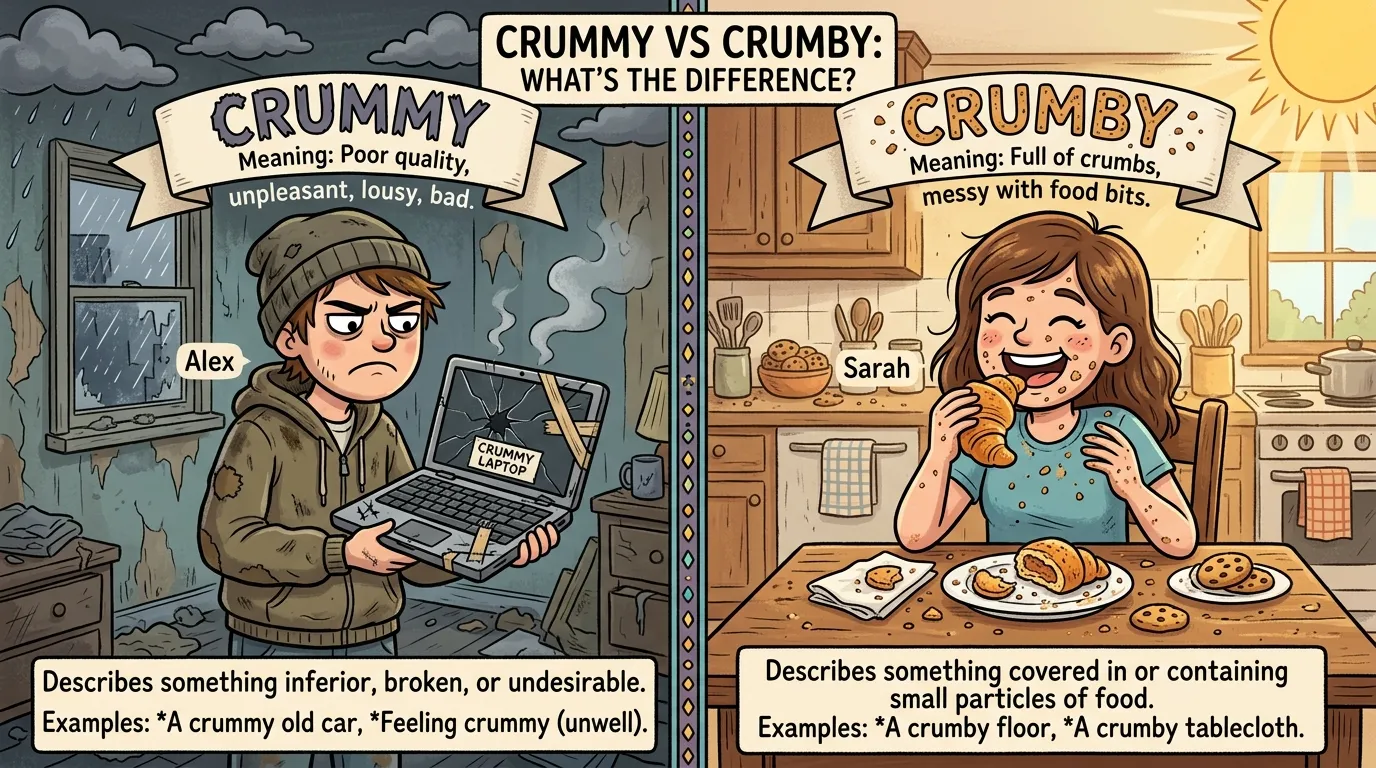
If you are wondering about crummy vs crumby, both spellings are real words, but they do not mean the same thing. The difference is simple once you connect each word to its origin.
Crummy usually means poor in quality, unpleasant, disappointing, or inferior. You might say, I had a crummy day or The hotel room was crummy.
Crumby usually means containing crumbs or resembling crumbs. It can describe something literally covered with crumbs, such as a crumby kitchen table. In some contexts, crumby can also mean like crumbs in texture or appearance.
The confusion happens because the two words sound alike in many varieties of English and differ by only one letter. In this guide, you will learn the meanings, pronunciation, grammar, history, regional usage, examples, common mistakes, and the easiest way to remember crummy vs crumby.
Quick Answer: Crummy vs Crumby
| Word | Main meaning | Example |
|---|---|---|
| crummy | Bad, poor, unpleasant, or disappointing | We stayed at a crummy hotel. |
| crumby | Full of crumbs or resembling crumbs | The counter was crumby after breakfast. |
The easiest rule
Use crummy when you mean bad or unpleasant.
Use crumby when you mean related to crumbs.
So:
- I feel crummy today. ✅
- I feel crumby today. ❌ if you mean you feel bad
- The table is crumby. ✅ if the table has crumbs on it
- The table is crummy. ✅ if you mean the table is poor or unpleasant
The two words are therefore both correct, but they belong to different meanings.
What Does Crummy Mean?
Crummy is an informal adjective that means bad, poor, unpleasant, low-quality, or disappointing.
It is commonly used in everyday American English.
For example:
We had a crummy experience at the restaurant.
This means the experience was bad or disappointing.
You can use crummy for many things:
- a crummy car
- a crummy job
- a crummy apartment
- a crummy movie
- a crummy excuse
- a crummy day
- a crummy feeling
- a crummy situation
- crummy weather
- crummy service
The word usually has a negative tone, but it is generally mild and informal.
Examples of crummy
- The weather was crummy all weekend.
- I had a crummy day at work.
- That was a crummy thing to do.
- They gave us a crummy room.
- My old laptop is pretty crummy.
- I got stuck in a crummy traffic jam.
- The movie had a crummy ending.
In each example, crummy expresses dissatisfaction or poor quality.
What Does Crumby Mean?
Crumby is an adjective connected to the noun crumb.
A crumb is a small piece of bread, cake, cookie, cracker, or another baked food.
Therefore, crumby can describe something that:
- contains crumbs
- is covered with crumbs
- produces many crumbs
- resembles crumbs
- has a crumb-like texture
For example:
The sofa was crumby after the children ate cookies.
Here, crumby means the sofa had crumbs on it.
Other examples include:
- The kitchen floor is crumby.
- My keyboard is getting crumby.
- The table became crumby after lunch.
- This old bread has a dry, crumby texture.
The word is much less common than crummy in everyday writing.
Crummy vs Crumby: The Key Difference
The main difference is meaning, not simply spelling.
Crummy describes something as bad or unpleasant.
Crumby describes something associated with crumbs.
Think of the words this way:
crummy → bad
crumby → crumbs
This distinction solves most spelling questions immediately.
Compare these sentences
The hotel was crummy.
The hotel was poor, unpleasant, or low-quality.
The hotel room was crumby.
The room had crumbs in it.
Those sentences describe completely different problems.
Are Both Crummy and Crumby Correct?
Yes. Both are legitimate English words.
However, they should not normally be used interchangeably.
If you are describing something as bad, crummy is the correct choice.
If you are describing something as covered in crumbs, crumby may be appropriate.
Correct usage
- That was a crummy movie. ✅
- I feel crummy after staying up all night. ✅
- The counter is crumby. ✅
- The floor became crumby after the kids ate crackers. ✅
Incorrect meaning
- That was a crumby movie. ❌ if you mean the movie was bad
- I had a crumby day. ❌ if you mean you had a bad day
The second examples would suggest a connection to crumbs, not poor quality.
Why Do People Confuse Crummy and Crumby?
There are several reasons.
They sound very similar
In many accents, crummy and crumby are pronounced almost identically.
That makes the spelling difficult when someone has only heard the word in conversation.
They look almost identical
The difference is just the spelling of the ending:
- crummy
- crumby
When typing quickly, it is easy to choose the wrong form.
Crummy is much more common
Most people encounter crummy in everyday speech far more often than crumby.
Someone may know the sound of crummy without knowing how it is spelled.
The connection to crumbs is easy to miss
The spelling crumby makes sense when you connect it with crumb.
For example:
crumb + y = crumby
That relationship provides a useful spelling clue.
Crummy vs Crumby Pronunciation
The pronunciation of these words can overlap heavily.
Crummy
IPA: /ˈkrʌmi/
It sounds roughly like:
KRUM-ee
Example:
That was a crummy day.
Crumby
IPA: /ˈkrʌmbi/
It sounds roughly like:
KRUM-bee
The b in crumby may be more noticeable depending on the speaker and accent.
Because pronunciation can vary, especially in casual speech, listening alone is not always enough to identify which spelling is intended.
The meaning and context are more reliable clues.
Crummy as an Informal Adjective
Crummy is primarily an adjective.
It modifies a noun or describes a condition.
Examples:
- a crummy job
- a crummy apartment
- a crummy excuse
- a crummy attitude
- a crummy vacation
- a crummy computer
It can also appear after a linking verb:
- The service was crummy.
- The weather is crummy.
- I feel crummy.
- The food was crummy.
Is crummy formal?
Usually, no.
Crummy is conversational and informal.
It works well in:
- casual conversations
- blogs
- personal writing
- social media
- informal emails
- dialogue
- everyday journalism
For formal academic, legal, scientific, or business writing, a more precise word is usually better.
Instead of:
The company’s software is crummy.
You might write:
The company’s software is unreliable.
Or:
The software has poor performance.
Crumby as an Adjective
Crumby is also an adjective.
Its meaning comes directly from crumb.
Examples:
- a crumby table
- a crumby floor
- a crumby countertop
- a crumby keyboard
- a crumby pastry texture
It is generally informal and descriptive.
In more formal writing, you may prefer:
- covered with crumbs
- full of crumbs
- crumb-covered
- crumb-filled
- crumb-like
For example:
The counter was covered with crumbs.
This is clearer and more natural in formal prose than:
The counter was crumby.
Crummy vs Crumby in American English
In American English, crummy is a familiar informal word meaning bad, poor, or unpleasant.
Examples:
- I had a crummy morning.
- This is a crummy way to treat someone.
- We got crummy seats at the game.
- The internet connection is crummy.
Crumby is less common and is usually understood literally in connection with crumbs.
For American writers, the practical rule is straightforward:
If you mean bad, use crummy.
If you mean full of crumbs, use crumby.
Crummy vs Crumby in British English
British English also uses crummy, although its frequency and exact associations can differ depending on region and context.
In British writing, crummy can still mean poor, unpleasant, or inferior, especially in informal language.
For the crumb-related meaning, expressions such as covered in crumbs or full of crumbs are often clearer than crumby.
This is an important point for international writers: although crumby is understandable, it is not always the most natural choice.
Is Crummy Slang?
Crummy is an informal word, and it can have a slang-like feel in casual conversation.
However, it is not usually considered highly offensive or extreme slang.
It is a mild way to express dissatisfaction.
Compare:
- crummy — mild and informal
- bad — neutral and broad
- poor — neutral/formal
- terrible — stronger
- awful — stronger
- horrible — stronger
For example:
The hotel was crummy.
This sounds less forceful than:
The hotel was absolutely terrible.
That makes crummy useful when you want to complain without sounding overly dramatic.
Can Crummy Describe a Person?
Yes, but context matters.
When crummy describes a person, it usually refers to their behavior, character, or actions, rather than their physical appearance.
For example:
He was a crummy friend.
This means he was a bad or unreliable friend.
You can also say:
- She was a crummy boss.
- He made a crummy decision.
- That was a crummy thing to say.
- Don’t be a crummy neighbor.
These are informal judgments.
For professional or sensitive writing, more precise language may be preferable:
- unreliable
- inconsiderate
- unfair
- ineffective
- irresponsible
- unprofessional
Can Crumby Describe Food?
Yes.
Crumby can describe food that has a crumbly or crumb-covered quality.
For example:
The pastry had a dry, crumby texture.
However, be careful with crumby and crumbly.
These words are related but not identical.
Crumby vs Crumbly
Crumby generally means containing or covered with crumbs.
Crumbly means easily breaking into small pieces or crumbs.
Compare:
The table was crumby.
The table had crumbs on it.
The cookie was crumbly.
The cookie easily broke apart into crumbs.
This is another common word-choice distinction.
Crummy vs Crumbly vs Crumby
These three words can be confusing.
| Word | Meaning | Example |
|---|---|---|
| crummy | Bad or unpleasant | It was a crummy day. |
| crumby | Full of or related to crumbs | The table was crumby. |
| crumbly | Easily breaking into crumbs | The cookie was crumbly. |
Memory trick
Think:
Crummy = lousy
Crumby = crumbs
Crumbly = breaks into crumbs
This three-word distinction is especially useful for ESL learners and anyone proofreading informal writing.
Dictionary-Style Definitions
Crummy
Part of speech: Adjective
Meaning: Informal; of poor quality; unpleasant; disappointing; inferior.
Typical use: Everyday conversation and informal writing.
Example:
The service at the restaurant was crummy.
Crumby
Part of speech: Adjective
Meaning: Containing, covered with, or resembling crumbs.
Typical use: Informal descriptive language.
Example:
The kitchen table was crumby after breakfast.
Word History and Etymology
The two words have different historical paths despite their similar appearance.
Where does crummy come from?
Crummy developed as an informal adjective meaning poor or inferior. Its history is associated with older uses of crummy connected to crumb, including the idea of something being composed of or associated with small pieces.
Over time, the word developed a separate figurative sense meaning of poor quality.
That figurative meaning is the one most people encounter today.
Where does crumby come from?
Crumby is more directly connected to the noun crumb.
The basic structure is:
crumb + -y → crumby
The suffix -y commonly creates adjectives meaning characterized by or containing something.
Examples include:
- cloud → cloudy
- dirt → dirty
- salt → salty
- mess → messy
- crumb → crumby
This makes crumby relatively easy to understand once you recognize its connection to crumb.
Crummy Synonyms
When you mean bad or unpleasant, you can replace crummy with several words.
Common synonyms
- bad
- poor
- lousy
- inferior
- unpleasant
- disappointing
- substandard
- miserable
- terrible
- awful
- low-quality
- inadequate
The best choice depends on tone.
Informal alternatives
- lousy
- rotten
- rough
- lousy
- terrible
- awful
More formal alternatives
- poor
- inferior
- inadequate
- substandard
- unsatisfactory
- unacceptable
For example:
The product had crummy quality.
A more professional version would be:
The product was of poor quality.
Crumby Synonyms
When you mean related to crumbs, possible alternatives include:
- crumb-covered
- crumb-filled
- covered in crumbs
- full of crumbs
- crumb-like
- crumbly
However, these are not always exact synonyms.
For example:
The couch was covered in crumbs.
is more precise than:
The couch was crumby.
Likewise:
The cake was crumbly.
describes its texture rather than simply saying it contained crumbs.
Antonyms of Crummy
Because crummy means bad or poor, its opposites include:
- excellent
- good
- great
- wonderful
- impressive
- high-quality
- outstanding
- satisfactory
- superior
- pleasant
Example:
We had a crummy experience.
Possible opposite:
We had an excellent experience.
Common Collocations With Crummy
A collocation is a combination of words that commonly appears together.
Some natural combinations with crummy include:
- crummy day
- crummy weather
- crummy job
- crummy apartment
- crummy hotel
- crummy service
- crummy car
- crummy excuse
- crummy attitude
- crummy feeling
- crummy situation
- crummy deal
- crummy movie
- crummy seats
- crummy luck
Example sentences
- I had a crummy day at work.
- We got crummy seats for the concert.
- The team had some crummy luck.
- That’s a crummy excuse.
- The apartment had crummy heating.
These combinations sound natural in informal American English.
Common Collocations With Crumby
Because crumby is less common, its collocations are more literal.
You might encounter:
- crumby table
- crumby counter
- crumby floor
- crumby kitchen
- crumby surface
- crumby keyboard
- crumby sofa
- crumby seat
For clarity, however, native speakers may often choose a phrase such as covered in crumbs.
For example:
The keyboard is covered in crumbs.
This is clearer than:
The keyboard is crumby.
Crummy vs Crumby in Business Writing
For business communication, crummy is usually too informal when you are evaluating a product, service, employee, process, or business result.
Instead of:
The customer received a crummy product.
Consider:
The customer received a defective product.
Or:
The product did not meet quality standards.
Similarly:
The company’s service is crummy.
could become:
The company’s service quality is below expectations.
Crumby is also uncommon in formal business writing unless you are literally discussing crumbs.
Crummy vs Crumby in Academic Writing
Academic writing generally favors precise and neutral vocabulary.
Instead of crummy, consider:
- poor
- inadequate
- inferior
- ineffective
- unsatisfactory
- substandard
Instead of:
The study had crummy data.
write:
The study used incomplete data.
Or:
The data quality was poor.
If you are discussing food contamination or cleanliness, crumby could theoretically appear, but containing crumbs is usually more precise.
Crummy vs Crumby in Journalism
Journalistic writing depends heavily on style and audience.
Crummy can work in:
- quotes
- opinion pieces
- features
- headlines with a conversational tone
- lifestyle writing
For example:
Residents describe the old apartments as crummy.
In a straight news report, a more specific term may be preferable:
Residents described the apartments as poorly maintained.
Crumby would normally be used only when the crumb-related meaning is relevant.
Crummy vs Crumby in Blogging and Social Media
Crummy works very naturally in casual blogs and social posts.
Examples:
- What a crummy Monday.
- I had a crummy flight home.
- This weather is crummy.
- We picked a crummy restaurant.
Its informal tone can make writing feel personal and conversational.
Crumby can also appear in casual posts when discussing food or messy surfaces:
My desk is officially crumby after snack time.
But covered in crumbs is often more natural.
Common Mistakes With Crummy and Crumby
Mistake: Using crumby to mean bad
Incorrect:
That was a crumby movie.
If you mean the movie was bad, write:
That was a crummy movie.
Mistake: Using crummy for crumbs
If you mean a surface contains crumbs, crumby may be the intended word.
The counter is crumby.
Or, more naturally:
The counter is covered in crumbs.
Mistake: Confusing crumby with crumbly
Incorrect:
The cookie was crumby.
if you mean the cookie easily breaks apart.
Better:
The cookie was crumbly.
Mistake: Using crummy in formal criticism
Informal:
The company’s product is crummy.
Professional:
The company’s product is unreliable.
The second version communicates the specific problem more effectively.
Awkward vs Natural Examples
| Awkward or incorrect | Better | Why |
|---|---|---|
| I had a crumby day. | I had a crummy day. | Crummy means bad. |
| The floor was crummy with bread pieces. | The floor was crumby. | Crumby relates to crumbs. |
| The cookie was crumby and fell apart. | The cookie was crumbly and fell apart. | Crumbly describes texture. |
| The service was crumby. | The service was crummy. | Crummy means poor. |
| The table was crummy with crumbs. | The table was covered in crumbs. | The latter is clearer. |
Formal vs Informal Alternatives
Instead of crummy
| Informal | More neutral/formal |
|---|---|
| crummy service | poor service |
| crummy results | poor results |
| crummy product | defective product |
| crummy conditions | poor conditions |
| crummy performance | poor performance |
| crummy excuse | weak excuse |
| crummy system | ineffective system |
Instead of crumby
| Informal | Clearer alternative |
|---|---|
| crumby table | table covered in crumbs |
| crumby floor | floor covered with crumbs |
| crumby keyboard | keyboard containing crumbs |
| crumby counter | counter covered in crumbs |
Is Crummy a Negative Word?
Yes.
Crummy almost always communicates a negative judgment.
However, it is usually mild rather than harsh.
Compare:
The hotel was crummy.
with:
The hotel was disgusting.
The first sounds like casual criticism. The second is much stronger.
Because of this, crummy can be useful when expressing annoyance without using profanity or extremely strong language.
Can Crummy Mean Feeling Sick?
Yes.
One common expression is:
I feel crummy.
This usually means:
- I feel bad.
- I feel unwell.
- I feel miserable.
- I do not feel good.
For example:
I think I’m coming down with a cold. I feel pretty crummy today.
Here, crummy describes the speaker’s physical or general condition.
It can also describe an emotional state:
I felt crummy after arguing with my friend.
The exact meaning comes from context.
Crummy vs Lousy
Crummy and lousy are often interchangeable in casual English.
Compare:
We had a crummy vacation.
We had a lousy vacation.
Both mean the vacation was disappointing or bad.
There can be slight differences in personal style and regional preference, but both are informal.
Other alternatives include rough, poor, awful, and terrible, although each has a slightly different strength.
Crummy vs Poor
Poor is much more versatile and formal than crummy.
You can use poor in professional and academic writing:
The company reported poor results.
Crummy would sound too casual:
The company reported crummy results.
The second sentence is possible in informal commentary but not ideal for a formal report.
So, when in doubt about professional tone, poor is usually safer.
A Simple Memory Trick for Crummy vs Crumby
Use this trick:
Crummy = yucky or bad
Both crummy and yucky describe something unpleasant.
Crumby = crumbs
The b reminds you of crumb.
So remember:
CRUM-B-Y → CRUMB
If you can replace the word with bad, choose crummy.
If you can replace it with covered in crumbs, choose crumby.
If you can replace it with easily breaking into crumbs, choose crumbly.
Quick Decision Guide
Ask yourself what you mean.
Do you mean bad or unpleasant?
Use crummy.
This is a crummy situation.
Do you mean containing crumbs?
Use crumby.
The table is crumby.
Do you mean easily breaking into crumbs?
Use crumbly.
The biscuit is crumbly.
This three-question test works in most everyday situations.
Real-World Examples of Crummy
Here are natural examples you might encounter in everyday American English:
- I had a crummy night’s sleep.
- My car has been giving me crummy mileage.
- We got stuck with a crummy seat.
- The internet has been crummy all morning.
- I feel crummy after that long flight.
- That’s a crummy way to treat your customers.
- The weather looks crummy today.
- He had a crummy attitude during the meeting.
- We made the mistake of booking a crummy hotel.
- She was having a crummy week.
Real-World Examples of Crumby
These examples use crumby in its literal sense:
- The kitchen counter is crumby.
- The children left the couch crumby after eating cookies.
- My laptop keyboard is getting crumby.
- The restaurant table was surprisingly crumby.
- The picnic blanket became crumby after lunch.
- The floor was crumby after everyone ate crackers.
- I need to clean this crumby countertop.
In many of these cases, covered in crumbs sounds more natural and precise.
Which Spelling Should You Use?
For most everyday situations, you will probably need crummy.
If you are saying something is bad, poor, disappointing, or unpleasant, choose crummy.
Use crumby only when the meaning has a direct relationship to crumbs.
Best practical rule
Bad → crummy
Crumbs → crumby
Breaks into crumbs → crumbly
This distinction is simple enough to use while writing, editing, texting, blogging, or speaking.
Crummy vs Crumby: Final Comparison Table
| Feature | Crummy | Crumby |
|---|---|---|
| Main meaning | Bad, poor, unpleasant | Related to crumbs |
| Part of speech | Adjective | Adjective |
| Tone | Informal | Informal |
| Commonness | Common | Less common |
| American English | Very familiar | Understandable but less frequent |
| Formal writing | Usually avoid | Usually avoid unless relevant |
| Related noun | — | crumb |
| Example | a crummy job | a crumby table |
| Main memory clue | Bad | Crumbs |
Frequently Asked Questions
Is crummy or crumby correct?
Both are correct, but they have different meanings. Crummy usually means bad, poor, or unpleasant. Crumby means containing or resembling crumbs.
Does crummy mean bad?
Yes. In informal English, crummy commonly means bad, poor-quality, unpleasant, or disappointing.
For example:
That was a crummy experience.
Does crumby mean full of crumbs?
Yes. Crumby can describe something that is covered with or contains crumbs.
For example:
The kitchen counter was crumby after breakfast.
However, covered in crumbs is often clearer.
Is crummy a slang word?
Crummy is informal and has a casual, slang-like quality. It is common in everyday conversation but is usually not the best choice for formal academic or professional writing.
Is crumby the same as crumbly?
No. Crumby relates to crumbs, while crumbly describes something that easily breaks apart into crumbs.
For example, a table can be crumby, while a cookie can be crumbly.
Is crummy an adjective?
Yes. Crummy is an adjective.
Examples include a crummy job, crummy weather, and a crummy apartment.
Can I say I feel crummy?
Yes. I feel crummy is a common informal expression meaning that you feel bad or unwell.
For example:
I feel crummy today, so I’m going to rest.
What is the difference between crummy and poor?
Both can describe something of low quality, but crummy is much more informal. Poor is suitable for formal, academic, business, and professional writing.
What is the easiest way to remember crummy vs crumby?
Remember:
Crummy = bad.
Crumby = crumbs.
And if something easily falls apart into crumbs, use crumbly.
Conclusion
The difference between crummy vs crumby is mainly a matter of meaning.
Crummy is the word you want when something is bad, unpleasant, disappointing, inferior, or low-quality. It is common in informal American English and works naturally in expressions such as crummy day, crummy job, crummy service, and I feel crummy.
Crumby is connected to crumbs. It can describe something covered with crumbs, filled with crumbs, or resembling crumbs. Because it is less common, phrases such as covered in crumbs are often clearer, especially in formal writing.
Also keep crumbly separate. A crumbly cookie breaks apart easily; a crumby table has crumbs on it.
The best memory rule is simple:
Crummy = bad.
Crumby = crumbs.
Crumbly = breaks into crumbs.
When writing for business, academic, technical, or professional audiences, choose more precise alternatives when possible. In casual conversation, however, crummy is a perfectly natural way to describe something unpleasant or low-quality.