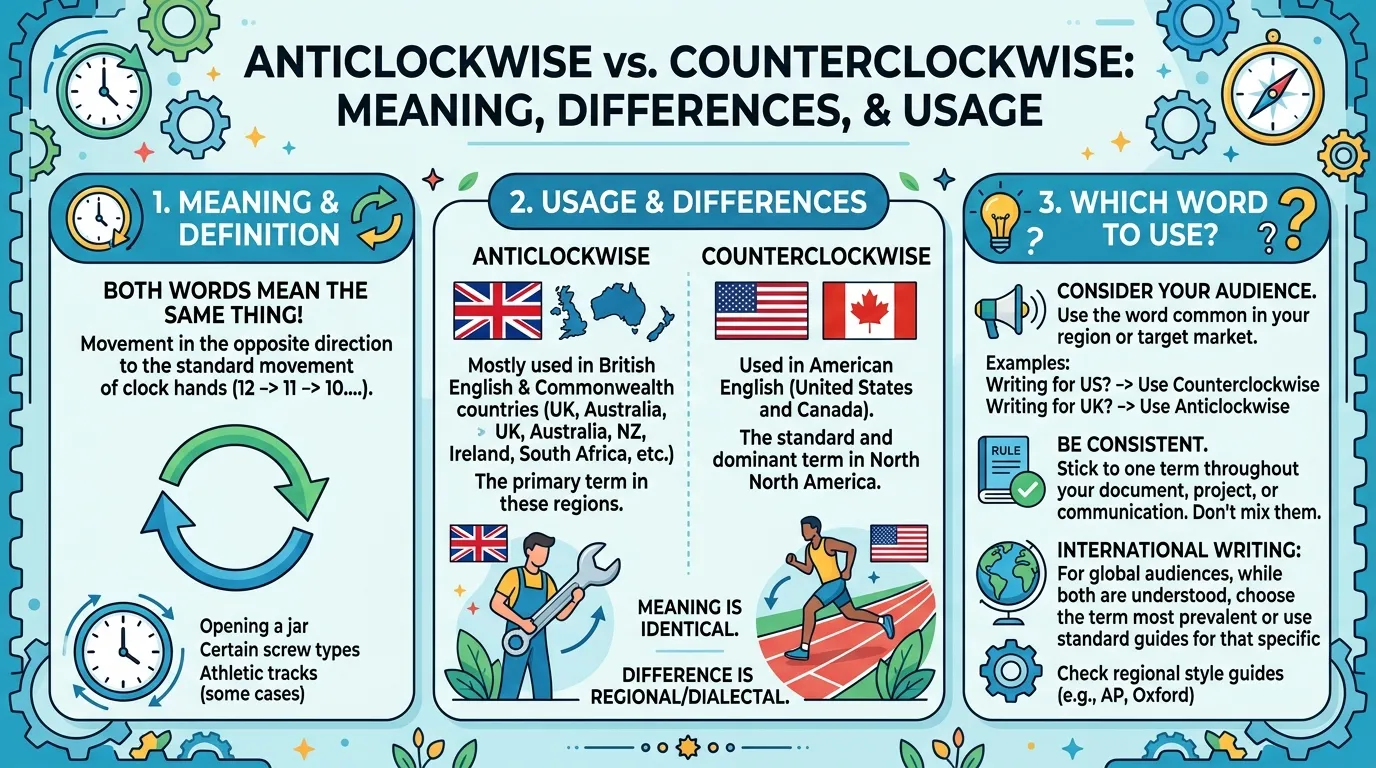
If you’ve ever wondered whether anticlockwise and counterclockwise mean different things, you’re not alone. The good news is simple: they mean the same thing. Both words describe movement in the direction opposite to the normal movement of clock hands.
The main difference is regional usage. Counterclockwise is the standard and more common term in American English, while anticlockwise is more common in British English and several other varieties of English.
For example:
- Turn the knob counterclockwise to loosen it. — American English
- Turn the knob anticlockwise to loosen it. — British English
Neither sentence is wrong.
In this guide, you’ll learn the difference between anticlockwise vs counterclockwise, how each word is pronounced and used, where the terms came from, which one sounds more natural in different countries, and how to avoid common mistakes.
Quick Answer: Anticlockwise vs Counterclockwise
Anticlockwise and counterclockwise have the same basic meaning: moving in the direction opposite to the movement of the hands of a clock.
| Word | Main meaning | Most common usage |
|---|---|---|
| Anticlockwise | Opposite the direction of clock hands | British English |
| Counterclockwise | Opposite the direction of clock hands | American English |
The easiest rule to remember
If you’re writing for an American audience, use counterclockwise.
If you’re writing for a British audience, use anticlockwise.
Both forms are grammatically correct.
What Does Anticlockwise Mean?
Anticlockwise is an adjective or adverb that describes movement in the direction opposite to the movement of a clock’s hands.
Imagine looking directly at a traditional analog clock.
The hands normally move:
12 → 1 → 2 → 3 → 4 → 5 → 6
and continue around the clock.
If something moves in the reverse direction:
12 → 11 → 10 → 9 → 8 → 7 → 6
it is moving anticlockwise.
Examples of anticlockwise
- Turn the dial anticlockwise.
- The wheel rotates anticlockwise.
- Move the piece anticlockwise around the circle.
- Rotate the lid anticlockwise to open it.
- The fan blades were spinning anticlockwise.
The word is especially common in British English.
You may see it in British instructions, textbooks, technical manuals, sports descriptions, and everyday conversation.
What Does Counterclockwise Mean?
Counterclockwise has exactly the same basic meaning.
It describes movement that goes in the opposite direction from the hands of a clock.
For example:
- Turn the handle counterclockwise.
- Rotate the knob counterclockwise.
- The wheel moves counterclockwise.
- Turn the screw counterclockwise to loosen it.
- The object rotates counterclockwise around the center.
Counterclockwise is the preferred term in American English.
It is also widely understood internationally, especially in technical, scientific, engineering, mathematical, and digital contexts.
Anticlockwise vs Counterclockwise: The Main Difference
The biggest difference isn’t meaning. It’s regional preference.
American English
American English generally prefers:
counterclockwise
For example:
Turn the dial counterclockwise.
British English
British English generally prefers:
anticlockwise
For example:
Turn the dial anticlockwise.
Are they interchangeable?
In most situations, yes.
You can replace one with the other without changing the basic meaning.
The important thing is to consider your audience.
If you’re writing a blog for readers in the United States, counterclockwise will usually sound more natural.
If you’re writing for readers in the United Kingdom, anticlockwise will usually fit better.
Why Do People Confuse Anticlockwise and Counterclockwise?
The confusion usually comes from the fact that English has two common ways to describe the same direction.
The words are built differently.
Anticlockwise
anti- + clockwise
The prefix anti- means against, opposite, or contrary to something.
So:
anticlockwise = opposite to clockwise
Counterclockwise
counter- + clockwise
The prefix counter- can mean opposite or contrary to something.
So:
counterclockwise = opposite to clockwise
The two words therefore use different prefixes to express essentially the same idea.
This is similar to other pairs in English where regional varieties choose different vocabulary for the same concept.
Anticlockwise vs Counterclockwise in American English
If your goal is to write natural American English, counterclockwise is usually the better choice.
For example:
Natural American English:
Turn the screw counterclockwise.
Less typical American English:
Turn the screw anticlockwise.
The second sentence isn’t grammatically wrong. It simply sounds more British or international.
You’ll often find counterclockwise in American:
- Instruction manuals
- School textbooks
- Mathematics
- Physics
- Engineering
- Construction
- Sports instructions
- Medical descriptions
- Everyday conversation
- Online content
American examples
- Rotate the image counterclockwise.
- Turn the steering wheel counterclockwise.
- The dancer moved counterclockwise.
- The gears rotate counterclockwise.
- Twist the cap counterclockwise.
- The arrow points counterclockwise around the circle.
Anticlockwise vs Counterclockwise in British English
British English commonly uses anticlockwise.
For example:
Turn the handle anticlockwise.
This is completely natural in British English.
British writers may also use counterclockwise, especially when discussing international scientific or technical material. However, anticlockwise remains a familiar and standard British choice.
British examples
- Turn the dial anticlockwise.
- Move around the track anticlockwise.
- Rotate the wheel anticlockwise.
- The pointer moved anticlockwise.
- Turn the tap anticlockwise to open it.
Anticlockwise vs Counterclockwise in International English
If you’re writing for a global audience, either term can work because both are widely understood.
However, counterclockwise often has an advantage in international digital and technical contexts because American English has strong influence on:
- Software
- Technology
- Online documentation
- Programming
- Mathematics
- Engineering
- Consumer electronics
Still, anticlockwise is not incorrect or outdated. It remains standard English.
Best approach for international writing
Choose one form and use it consistently.
Don’t write:
Turn the first knob counterclockwise and the second knob anticlockwise.
unless you’re deliberately discussing regional vocabulary.
Instead, choose one style:
Turn both knobs counterclockwise.
or:
Turn both knobs anticlockwise.
Consistency makes your writing cleaner.
Is Anticlockwise One Word?
Yes.
Anticlockwise is normally written as one word.
Correct:
Turn the wheel anticlockwise.
Incorrect or unusual:
Turn the wheel anti clockwise.
The same principle applies to counterclockwise, which is also normally written as one word.
Correct:
Rotate the disk counterclockwise.
Is Counterclockwise One Word?
Yes.
Counterclockwise is written as one word in standard American English.
Correct:
Turn the dial counterclockwise.
You generally shouldn’t separate the word into counter clockwise.
The established form is:
counterclockwise
Anticlockwise vs Counterclockwise as Adjectives and Adverbs
Both words can function as adverbs and adjectives.
As an adverb
An adverb tells us how something moves.
The wheel turned counterclockwise.
The wheel turned anticlockwise.
Here, the word describes the action turned.
As an adjective
An adjective describes a noun.
The counterclockwise motion was easy to see.
The anticlockwise movement continued for several seconds.
Here, the word describes motion or movement.
Dictionary-Style Definitions
Anticlockwise
Anticlockwise means:
Moving or directed in the opposite direction to the movement of the hands of a clock.
Part of speech: Adjective and adverb
Primary regional association: British English
Opposite: Clockwise
Counterclockwise
Counterclockwise means:
Moving or directed in the opposite direction from the movement of the hands of a clock.
Part of speech: Adjective and adverb
Primary regional association: American English
Opposite: Clockwise
Anticlockwise vs Counterclockwise Pronunciation
The two words are pronounced differently because their first parts are different, but clockwise is pronounced the same basic way in both.
Anticlockwise
The word has four main syllables:
an-ti-clock-wise
The main stress falls naturally toward the first part of the word.
Counterclockwise
This word can be broken into:
coun-ter-clock-wise
The stress falls naturally on the first part of counter.
Don’t worry too much about memorizing pronunciation symbols. The most useful thing is to hear and practice the words in complete sentences.
Anticlockwise vs Counterclockwise: Tone and Formality
Neither word is more formal than the other.
Both are standard vocabulary.
The difference is mainly regional, not formal versus informal.
For example:
Turn the wheel counterclockwise.
and
Turn the wheel anticlockwise.
Both can appear in formal instructions.
You can use either word in:
- Academic writing
- Technical writing
- Business documents
- Instruction manuals
- Journalism
- Educational materials
- Everyday conversation
The important question is which variety of English you’re using.
What Is the Opposite of Anticlockwise and Counterclockwise?
The opposite of both words is:
clockwise
Clockwise means moving in the same direction as the hands of a traditional clock.
For example:
Turn the knob clockwise to tighten it.
The basic direction pair is:
| Direction | Meaning |
|---|---|
| Clockwise | Same direction as clock hands |
| Anticlockwise | Opposite direction from clock hands |
| Counterclockwise | Opposite direction from clock hands |
So you can think of it as:
Clockwise ↔ Anticlockwise
or
Clockwise ↔ Counterclockwise
Anticlockwise vs Counterclockwise in Mathematics
Both terms are common when describing rotation.
In mathematics, counterclockwise is particularly common in American educational materials.
For example:
Rotate the shape 90 degrees counterclockwise.
A rotation of 90 degrees counterclockwise moves a point from one direction to the next in the opposite direction of clock-hand movement.
In coordinate geometry, positive rotations are often described as counterclockwise under the standard mathematical convention.
For example:
Rotate the triangle 90 degrees counterclockwise around the origin.
British mathematical writing may use anticlockwise instead.
The mathematical concept remains exactly the same.
Anticlockwise vs Counterclockwise in Science and Engineering
Both words are used to describe rotation in technical fields.
You might see them when discussing:
- Motors
- Gears
- Turbines
- Rotors
- Wheels
- Fans
- Mechanical systems
- Circular motion
- Torque
- Angular movement
For an American technical audience, counterclockwise is usually the natural choice.
For a British audience, anticlockwise may be preferred.
Example
American-style technical writing:
The rotor rotates counterclockwise when viewed from the front.
British-style technical writing:
The rotor rotates anticlockwise when viewed from the front.
The critical issue isn’t the word itself. It’s the viewpoint.
A rotating object can appear to move in opposite directions depending on where you’re standing.
Anticlockwise vs Counterclockwise in Sports
Sports often involve circular movement.
Examples include:
- Running tracks
- Cycling
- Racing
- Skating
- Dance
- Gymnastics
- Track events
- Racing circuits
You might read:
The runners moved counterclockwise around the track.
Or:
The skaters moved anticlockwise around the rink.
Again, both sentences describe the same direction.
Sports writers usually follow the regional style of their publication.
Anticlockwise vs Counterclockwise in Everyday Life
You probably encounter these words more often than you realize.
Think about:
Opening a jar
Turn the lid counterclockwise to open it.
Adjusting a dial
Rotate the dial counterclockwise.
Turning a knob
Turn the knob counterclockwise.
Using a compass or diagram
Move the pointer anticlockwise around the circle.
Rotating an image
Rotate the photo counterclockwise.
These are practical situations where the distinction is easy to understand.
Common Collocations With Anticlockwise and Counterclockwise
A collocation is a group of words that naturally appear together.
Common combinations include:
- turn counterclockwise
- rotate counterclockwise
- move counterclockwise
- spin counterclockwise
- rotate anticlockwise
- turn anticlockwise
- move anticlockwise
- spin anticlockwise
- counterclockwise direction
- anticlockwise direction
- counterclockwise rotation
- anticlockwise rotation
- counterclockwise motion
- anticlockwise motion
- counterclockwise movement
- anticlockwise movement
Natural examples
Turn the screw counterclockwise.
The wheel rotates counterclockwise.
The dancers moved anticlockwise.
The pointer spins counterclockwise.
Synonyms for Anticlockwise and Counterclockwise
There aren’t many perfect one-word synonyms because these terms describe a very specific direction.
Depending on context, you can use phrases such as:
- In the opposite direction
- In the reverse direction
- Against the clock
- Opposite the clock-hand direction
- In reverse around the circle
However, these aren’t always exact replacements.
For technical or precise writing, counterclockwise or anticlockwise is usually clearer.
Related Words You Should Know
Understanding related vocabulary can make these terms easier to remember.
Clockwise
Moving in the direction of clock hands.
Rotation
The act of turning around a central point or axis.
Circular
Having the shape of a circle or involving movement around a circle.
Rotate
To turn around a center or axis.
Spin
To turn around quickly or repeatedly.
Direction
The path or way in which something moves.
Reverse
To move or cause something to move in the opposite direction.
Anticlockwise vs Counterclockwise: Word History
Both words are built from the idea of clockwise movement.
The word clockwise developed from the direction in which the hands of a clock traditionally move.
Once clocks became common, people needed a simple way to describe the reverse direction.
English developed two related constructions:
anti- + clockwise
and
counter- + clockwise
The prefixes anti- and counter- both carry the idea of opposition.
This explains why the words developed the same basic meaning even though their forms differ.
Over time, regional English preferences helped establish anticlockwise as especially common in British English and counterclockwise as especially common in American English.
Common Mistakes With Anticlockwise and Counterclockwise
Mistake 1: Thinking they have different meanings
Incorrect assumption:
Anticlockwise means one type of rotation, while counterclockwise means another.
Correction: They normally mean the same direction.
Mistake 2: Treating anticlockwise as incorrect American English
Some writers assume anticlockwise is wrong because they are more familiar with counterclockwise.
That’s not true.
Anticlockwise is a standard English word.
It’s simply more strongly associated with British English.
Mistake 3: Treating counterclockwise as incorrect British English
The reverse assumption is also wrong.
Counterclockwise is a standard English word and is widely understood in Britain.
Regional preference doesn’t make a word grammatically incorrect.
Mistake 4: Writing anti clockwise
Incorrect:
Turn the dial anti clockwise.
Better:
Turn the dial anticlockwise.
Mistake 5: Writing counter clockwise
Incorrect:
Turn the handle counter clockwise.
Better:
Turn the handle counterclockwise.
Mistake 6: Mixing styles unnecessarily
Awkward:
Turn the first knob anticlockwise and the second one counterclockwise.
Better:
Turn both knobs counterclockwise.
Unless you’re specifically comparing regional usage, consistency is better.
Awkward vs Natural Examples
| Awkward | Natural |
|---|---|
| Turn it anti clockwise. | Turn it anticlockwise. |
| Move it counter clockwise. | Move it counterclockwise. |
| Anticlockwise and counterclockwise are different directions. | Anticlockwise and counterclockwise describe the same direction. |
| The circle moved opposite clockwise. | The circle moved counterclockwise. |
| Turn the dial in an anticlockwise way. | Turn the dial anticlockwise. |
The most natural form is usually the shortest clear form.
Formal vs Informal Alternatives
Formal or technical
- Rotate the component counterclockwise.
- Turn the control anticlockwise.
- The mechanism rotates counterclockwise.
- The object moves in an anticlockwise direction.
Everyday
- Turn it left.
- Turn the knob the other way.
- Twist the lid counterclockwise.
- Turn the dial backward.
Be careful with left and right. They aren’t always reliable replacements because the direction depends on your viewpoint.
For precise instructions, clockwise, anticlockwise, or counterclockwise is usually better.
Which One Should You Use?
Here’s the simplest recommendation.
Use counterclockwise when:
- You’re writing American English.
- Your audience is mainly in the United States.
- You’re writing American textbooks.
- You’re creating U.S.-focused instructions.
- You’re writing technical content for an American audience.
- You’re creating software or documentation using American English.
Use anticlockwise when:
- You’re writing British English.
- Your audience is mainly in the United Kingdom.
- You’re following a British style guide.
- You’re writing for a publication that prefers British vocabulary.
- You’re creating content specifically for British readers.
For global audiences
Either is acceptable.
Choose one and stay consistent.
Which Is More Common: Anticlockwise or Counterclockwise?
The answer depends heavily on the variety of English.
Counterclockwise is generally more common in American English.
Anticlockwise is generally more common in British English.
This means there isn’t a universal winner.
If you’re searching for the form that sounds most natural to an American reader, choose counterclockwise.
If you’re targeting British readers, choose anticlockwise.
Anticlockwise vs Counterclockwise in Writing and SEO
If you’re writing online content, your choice should match your target audience.
For a U.S.-focused website:
counterclockwise
is usually the better primary term.
For a U.K.-focused website:
anticlockwise
may be the better primary term.
You can still mention both forms naturally.
For example:
Anticlockwise and counterclockwise mean the same thing. Counterclockwise is more common in American English, while anticlockwise is more common in British English.
This approach helps readers who search for either spelling without making the article sound repetitive.
Don’t force both terms into every paragraph. Use them where they genuinely improve clarity.
A Simple Memory Trick
Here’s an easy way to remember the difference.
Think:
American = Counterclockwise
British = Anticlockwise
You can remember counterclockwise by connecting it with the American spelling counter.
For anticlockwise, remember that anti- means against or opposite.
And both are opposite to:
clockwise
So:
Clockwise = with the clock
Anticlockwise = against the clock
Counterclockwise = opposite the clock’s direction
Anticlockwise vs Counterclockwise Examples
Here are more examples to make the difference completely clear.
Everyday examples
- Turn the bottle cap counterclockwise.
- Rotate the handle anticlockwise.
- Move the arrow counterclockwise.
- Spin the wheel anticlockwise.
- Turn the dial counterclockwise.
Academic examples
- Rotate the figure 90 degrees counterclockwise.
- The particle follows an anticlockwise path.
- The vector rotates counterclockwise around the origin.
Technical examples
- Turn the adjustment screw counterclockwise.
- The motor rotates anticlockwise under these conditions.
- The gear moves counterclockwise when viewed from this side.
Business and workplace instructions
- Turn the control counterclockwise before removing the cover.
- Rotate the selector anticlockwise to reach the required setting.
Quick Comparison Table
| Feature | Anticlockwise | Counterclockwise |
|---|---|---|
| Meaning | Opposite clock-hand movement | Opposite clock-hand movement |
| Meaning difference | None in normal use | None in normal use |
| American English | Less common | Preferred |
| British English | Preferred | Also understood |
| Part of speech | Adjective/adverb | Adjective/adverb |
| Opposite | Clockwise | Clockwise |
| Spelling | One word | One word |
| Technical use | Common | Common |
| Mathematical use | Common | Very common in American English |
| Formality | Standard | Standard |
Is Anticlockwise More Correct Than Counterclockwise?
No.
Neither is inherently more correct.
Anticlockwise is correct English.
Counterclockwise is correct English.
The best choice depends on regional variety and audience.
It’s similar to many differences between American and British English. One form may sound more natural in one region while another form sounds more natural elsewhere.
The goal isn’t to find the one universally correct word. The goal is to choose the form that fits your audience and writing style.
Is Counterclockwise the American Spelling?
Yes.
Counterclockwise is the standard and preferred form in American English.
If you’re writing for a U.S. audience and want the most natural choice, use counterclockwise.
For example:
Turn the screw counterclockwise to loosen it.
Is Anticlockwise the British Spelling?
Yes.
Anticlockwise is the standard and preferred form in British English.
For example:
Turn the screw anticlockwise to loosen it.
British speakers and writers commonly understand counterclockwise, too, but anticlockwise is the traditional regional preference.
Can You Use Both Words in the Same Article?
Yes, but do so thoughtfully.
If you’re explaining the difference between American and British English, using both is useful.
For example:
In American English, counterclockwise is more common. British English generally prefers anticlockwise.
But if you’re writing a normal article for one specific audience, choose the regional form and stick with it.
This makes your writing feel more natural and polished.
What About Anticlockwise and Counterclockwise in Dictionaries?
Major English dictionaries recognize both forms as legitimate words.
The important distinction is usually regional labeling or usage preference, rather than correctness.
This is a useful lesson for English learners:
A word can be standard English even if it isn’t the most common word in your variety of English.
So don’t mark anticlockwise as wrong just because you’re learning American English.
Likewise, don’t mark counterclockwise as wrong because you’re learning British English.
Frequently Asked Questions
Is anticlockwise the same as counterclockwise?
Yes. Anticlockwise and counterclockwise have the same basic meaning. Both describe movement opposite to the direction of a clock’s hands. The main difference is regional preference: anticlockwise is more common in British English, while counterclockwise is more common in American English.
Which is correct: anticlockwise or counterclockwise?
Both are correct. Use counterclockwise for American English and anticlockwise for British English. Neither word is grammatically superior to the other.
Is counterclockwise American or British?
Counterclockwise is primarily associated with American English. It is also understood and used in other varieties of English, including British English, especially in technical and international contexts.
Is anticlockwise British English?
Yes. Anticlockwise is strongly associated with British English and is the usual choice in many British contexts. It is also standard in several other varieties of English.
What is the opposite of counterclockwise?
The opposite of counterclockwise is clockwise. Clockwise means moving in the same direction as the hands of a traditional clock.
What is the opposite of anticlockwise?
The opposite of anticlockwise is clockwise. Both terms describe directions of circular movement.
Should I use counterclockwise in American English?
Yes. If you’re writing for an American audience, counterclockwise is generally the most natural and familiar choice.
Should I use anticlockwise in British English?
Yes. Anticlockwise is the traditional and common British English choice. However, British readers will generally understand counterclockwise as well.
Are anticlockwise and counterclockwise interchangeable?
In most everyday, academic, mathematical, and technical contexts, yes. They describe the same direction. The main reason to choose one over the other is regional style and audience.
How do I remember the difference between anticlockwise and counterclockwise?
Remember this simple rule: counterclockwise = American English, while anticlockwise = British English. Both mean the opposite direction from clockwise.
Conclusion
The difference between anticlockwise vs counterclockwise is much simpler than it first appears.
They mean the same thing.
Both words describe movement in the direction opposite to the movement of clock hands.
The main difference is regional English usage:
- 🇺🇸 American English: counterclockwise
- 🇬🇧 British English: anticlockwise
- 🌎 International English: either can be understood
Both are standard. Both are grammatically correct. Both can be used as adjectives and adverbs. Both work in everyday speech, technical writing, mathematics, science, sports, instructions, and academic contexts.
If you’re writing for Americans, counterclockwise is the safest and most natural choice.
If you’re writing for British readers, anticlockwise is usually the better choice.
Most importantly, don’t treat one as a misspelling of the other. They’re simply two regional forms that developed from the same idea.
When in doubt, match your word choice to your audience and remain consistent throughout your writing. That’s the clearest way to handle anticlockwise and counterclockwise.