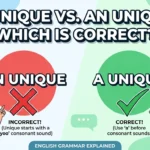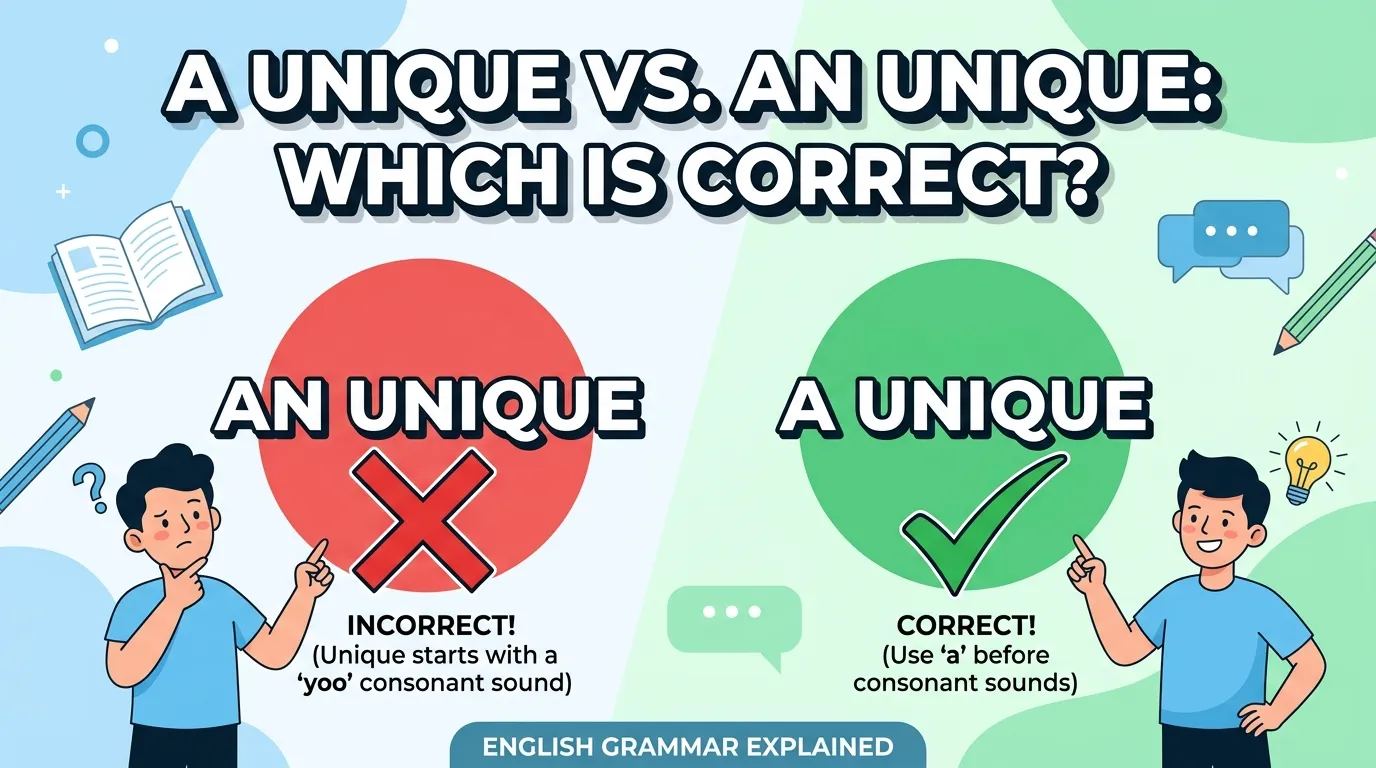
If you’ve ever wondered whether to write a unique or an unique, you’re not alone. The answer is simple: a unique is the standard and correct form in modern English.
You should write:
a unique idea
a unique opportunity
a unique experience
Not:
an unique idea
an unique opportunity
an unique experience
The reason is based on sound, not spelling. Although unique begins with the vowel letter u, it begins with a consonant sound: /juː/. That sound is similar to the beginning of you.
English uses a before a consonant sound and an before a vowel sound. Because unique starts with a /y/ sound, the correct article is a.
In this guide, you’ll learn why a unique is correct, why an unique sounds wrong to most modern English speakers, how pronunciation affects article choice, and how to avoid similar mistakes with words such as university, European, user, and usual.
Quick Answer: Is It A Unique or An Unique?
A unique is correct in standard modern English.
The correct phrase is:
- a unique person
- a unique situation
- a unique solution
- a unique opportunity
- a unique approach
The incorrect or generally nonstandard form is:
an unique personan unique situationan unique solution
Why?
The indefinite articles a and an depend on the sound that follows them, not simply the first written letter.
Unique is pronounced with an initial /j/ sound:
unique → /juːˈniːk/
Because /j/ is a consonant sound, we use a:
a unique
Think of it this way:
a + consonant sound = a unique
an + vowel sound = an apple
So even though u is a vowel, the beginning sound of unique is not a vowel sound.
Why Is A Unique Correct?
The main rule for indefinite articles is easy:
- Use a before a consonant sound.
- Use an before a vowel sound.
This rule explains why the spelling of a word can sometimes be misleading.
Consider these examples:
| Phrase | First Letter | First Sound | Correct Article |
|---|---|---|---|
| a unique idea | U | /y/ | a |
| a university | U | /y/ | a |
| a user | U | /y/ | a |
| a European country | E | /y/ | a |
| an apple | A | vowel sound | an |
| an umbrella | U | vowel sound | an |
| an hour | H | vowel sound | an |
| an honest person | H | vowel sound | an |
The important point is that English articles follow pronunciation.
That’s why:
a unique experience
is correct even though unique begins with the letter u.
The Pronunciation of Unique Explains Everything
The word unique begins with the sound /juː/.
That initial sound is similar to the sound in:
- you
- use
- useful
- university
- user
- usual
- union
The /j/ sound functions as a consonant sound.
Therefore, English speakers naturally say:
a unique
rather than:
an unique
Listen to the Difference
Compare:
a unique opportunity
with:
an unique opportunity
The first version flows naturally because a ends with a vowel sound and unique begins with a consonant-like /y/ sound.
The second version creates an awkward sound sequence that doesn’t match normal modern English grammar.
This is why pronunciation is more useful than simply looking at the first letter.
What Does Unique Mean?
Unique is an adjective meaning one of a kind, unlike anything else, or distinctive in an important way.
For example:
She has a unique talent.
This means her talent is unusual or unlike other people’s talents.
Another example:
The building has a unique design.
This means the design is distinctive or unlike ordinary designs.
Dictionary-Style Definition
Unique
Adjective
Meaning: Being the only one of its kind; unlike anything else; especially distinctive or unusual.
Example
The artist developed a unique style.
Here, unique describes the noun style.
A Unique vs. An Unique: The Key Difference
There is actually no difference in meaning between a unique and an unique.
The issue is grammar and pronunciation.
| Feature | A unique | An unique |
|---|---|---|
| Standard modern English | ✅ Yes | ❌ Generally no |
| Meaning | One of a kind/distinctive | Same intended meaning |
| Article type | Indefinite article | Indefinite article |
| Based on spelling | No | Often incorrectly assumed |
| Based on pronunciation | ✅ Correct | ❌ Incorrect in standard usage |
| American English | Preferred | Avoid |
| British English | Preferred | Avoid |
| Academic writing | Correct | Avoid |
| Business writing | Correct | Avoid |
| Casual writing | Correct | Usually avoid |
So if you’re choosing between the two, the answer is straightforward:
Use a unique.
Why Do People Say An Unique?
The confusion usually comes from the letter u.
Students often learn a basic rule:
Use an before a vowel.
Then they see:
unique
Since u is a vowel, they assume:
an unique
But the complete rule is actually:
Use an before a vowel sound.
That’s a major difference.
The letter itself doesn’t determine the article.
Compare These Words
U starts with a consonant sound:
- a unique idea
- a university
- a user
- a useful tool
- a usual problem
U starts with a vowel sound:
- an umbrella
- an uncle
- an unusual event
- an urgent request
Notice the difference between:
a unique idea
and:
an unusual idea
Both begin with u, but their opening sounds are different.
Unique begins with /juː/, while unusual begins with a vowel sound.
A Unique or An Unique in American English
In American English, the standard choice is:
a unique
Examples:
- a unique opportunity
- a unique business model
- a unique perspective
- a unique experience
- a unique challenge
An unique should generally be avoided in modern American English.
If you’re writing an essay, website article, email, business document, advertisement, resume, or social media post, use a unique.
A Unique or An Unique in British English
British English follows the same basic rule.
Standard British usage also prefers:
a unique
For example:
It was a unique opportunity to study abroad.
The difference between American and British English does not normally change the article here.
So you don’t need to worry about choosing a unique for American English and an unique for British English.
Use:
a unique
in both varieties of standard modern English.
What About International English?
English learners around the world may encounter an unique, particularly in older texts, non-native writing, or contexts where the article rule has been learned from spelling rather than pronunciation.
However, if you’re writing modern international English, the safest choice is:
a unique
This is especially important for:
- academic writing
- business communication
- websites
- blogs
- technical documents
- professional emails
- journalism
- educational materials
- formal applications
Using a unique keeps your writing natural and grammatically standard.
A Unique in a Sentence
Here are several natural examples:
We created a unique solution for the problem.
She brought a unique perspective to the discussion.
The company offers a unique service.
He had a unique opportunity to work with the team.
This restaurant has a unique atmosphere.
The museum contains a unique collection of artwork.
Every person has a unique story.
The software uses a unique approach to data analysis.
The athlete developed a unique training method.
The city has a unique cultural identity.
In every example, a comes before unique because unique begins with a consonant sound.
Common Mistakes With A Unique
Mistake 1: Using An Because U Is a Vowel
❌ an unique opportunity
✅ a unique opportunity
The mistake comes from focusing on spelling instead of pronunciation.
Mistake 2: Thinking Every Word Beginning With U Takes An
This is not true.
Compare:
❌ an university
✅ a university
❌ an user
✅ a user
❌ an useful tool
✅ a useful tool
But:
✅ an umbrella
✅ an uncle
✅ an urgent message
The sound determines the article.
Mistake 3: Applying the Rule Only to Unique
If you understand unique, apply the same pronunciation principle to similar words.
For example:
a union
a uniform
a useful resource
a European language
These words may begin with vowel letters, but their initial sounds are consonantal.
A Unique vs. An Unusual
This is one of the most useful comparisons for English learners.
Correct:
a unique idea
Correct:
an unusual idea
Why are the articles different?
Because their sounds are different.
Unique begins with a /y/ sound.
Unusual begins with a vowel sound.
So:
a unique
but:
an unusual
This is a perfect example of why English articles depend on pronunciation.
A Unique vs. A One-of-a-Kind
Unique and one-of-a-kind can often express similar ideas.
Compare:
She designed a unique dress.
She designed a one-of-a-kind dress.
Both suggest that the dress is distinctive and unlike others.
However, one-of-a-kind is often more conversational and emphatic.
Formal
The project uses a unique methodology.
Conversational
The project has a one-of-a-kind approach.
Both can work, depending on context.
Synonyms for Unique
Depending on the context, possible synonyms include:
- distinctive
- unusual
- original
- rare
- exceptional
- special
- uncommon
- individual
- exclusive
- unparalleled
- one-of-a-kind
- unprecedented
- remarkable
- innovative
- different
However, these words aren’t always perfect substitutes.
For example, rare means uncommon, while unique traditionally means one of a kind.
Example
This is a rare opportunity.
This means the opportunity doesn’t happen often.
This is a unique opportunity.
This emphasizes that the opportunity is special or unlike others.
Antonyms of Unique
Possible opposites include:
- common
- ordinary
- typical
- standard
- usual
- conventional
- ordinary
- commonplace
- familiar
- generic
For example:
The design is unique.
Opposite idea:
The design is conventional.
Related Words to Unique
Some useful related terms include:
- uniqueness
- uniquely
- uniqueness of design
- unique feature
- unique quality
- unique identity
- unique experience
- unique opportunity
- unique perspective
- unique approach
Examples
The uniqueness of the product attracted customers.
She uniquely combines traditional and modern techniques.
The product’s unique features make it stand out.
Common Collocations With A Unique
Certain combinations appear frequently in natural English.
A Unique Experience
Traveling alone gave me a unique experience.
A Unique Opportunity
The program provides a unique opportunity for students.
A Unique Perspective
Her background gave her a unique perspective.
A Unique Approach
The company uses a unique approach to customer service.
A Unique Solution
Engineers developed a unique solution to the problem.
A Unique Challenge
The project presents a unique challenge.
A Unique Identity
The brand has a unique identity.
A Unique Feature
The app includes a unique feature that competitors don’t offer.
These collocations are common in business, education, technology, marketing, and everyday English.
Is Unique a Formal or Informal Word?
Unique is a neutral word.
You can use it in both formal and informal contexts.
Casual
That’s a unique idea!
Professional
The company developed a unique approach to customer support.
Academic
The study presents a unique perspective on language development.
Journalistic
The town has a unique history that attracts visitors.
Technical
The system assigns a unique identification number to each record.
The word itself isn’t especially formal or informal. The surrounding vocabulary determines the overall tone.
A Unique in Academic Writing
A unique is completely acceptable in academic writing.
Examples:
The research provides a unique perspective on social behavior.
The study examines a unique set of historical records.
Researchers developed a unique framework for analyzing the data.
However, academic writers should be careful with the meaning of unique.
If something is simply unusual, unusual, distinctive, or rare may be more precise.
For example:
The researchers observed an unusual pattern.
may be more accurate than:
The researchers observed a unique pattern.
unless the pattern truly is one of a kind.
A Unique in Business Writing
Business writing frequently uses phrases such as:
- a unique selling point
- a unique value proposition
- a unique opportunity
- a unique solution
- a unique advantage
- a unique business model
- a unique customer experience
Examples:
Our product offers a unique advantage in the market.
The company has a unique business model.
This service gives customers a unique experience.
Remember: a, not an.
A Unique in Technical Writing
Technical English follows the same article rule.
Examples:
Each device receives a unique identifier.
The database generates a unique code.
Every account requires a unique username.
The software creates a unique record ID.
This is especially important because technical writing values consistency and precision.
A Unique in Journalism
Journalists may use unique when describing unusual situations, people, places, or events.
Examples:
The festival offers a unique blend of music and art.
The town has a unique history.
The athlete brings a unique style to the sport.
Again, the correct article is a.
A Unique in Sports Writing
Sports writers frequently use unique to describe playing styles, achievements, strategies, or circumstances.
Examples:
The quarterback has a unique playing style.
The team developed a unique strategy.
She has a unique approach to training.
The tournament offers a unique challenge for young players.
The grammar doesn’t change simply because the word appears in sports writing.
A Unique in Blogging and Content Writing
Bloggers often use unique to describe:
- ideas
- experiences
- products
- solutions
- perspectives
- strategies
- stories
- features
Examples:
Here’s a unique way to organize your workspace.
The destination offers a unique travel experience.
We found a unique solution to this common problem.
For SEO content, natural grammar is more important than forcing phrases into awkward forms.
Write:
a unique solution
not:
an unique solution
Is An Unique Ever Used?
You may occasionally encounter an unique in historical, literary, or older material.
English has changed over time, and article usage has not always followed exactly the same pronunciation patterns that dominate modern standard English.
You may also see an unique in nonstandard writing produced by learners or writers who are following the written letter rather than the spoken sound.
That doesn’t make it the recommended choice today.
For modern standard English, especially in professional and educational writing:
Use a unique.
If you’re editing contemporary content, an unique should normally be changed to a unique.
Why A and An Depend on Sound
The indefinite articles a and an are often taught as a spelling rule, but that can create confusion.
A better rule is:
Use A Before a Consonant Sound
- a dog
- a house
- a university
- a user
- a unique idea
- a European city
Use An Before a Vowel Sound
- an apple
- an orange
- an umbrella
- an hour
- an honest person
- an unusual event
Notice that hour starts with the letter H but takes an because the H is silent.
Similarly, European starts with E but takes a because it begins with a /y/ sound.
This shows that sound is more important than spelling.
Memory Trick: Think of Unique as Starting With You
Here’s an easy way to remember the rule.
The beginning of unique sounds like you.
You would naturally say:
a you…
not:
an you…
Therefore:
a unique
If you remember that unique starts with a /y/ sound, you’ll almost never make this mistake again.
Another Quick Trick
Ask yourself:
Does the word begin with a vowel sound?
If yes → an
If no → a
For unique, the answer is no.
So:
a unique
A vs. An: A Simple Decision Rule
When choosing between a and an, follow these steps:
Step 1: Look at the Whole Phrase
Don’t focus only on the first letter.
Step 2: Say the Word Out Loud
Listen to its first sound.
Step 3: Identify the Sound
Does it start with a consonant sound?
Use a.
Does it start with a vowel sound?
Use an.
Step 4: Apply It to Unique
Unique starts with a /y/ sound.
Therefore:
a unique
Awkward vs. Natural Examples
| Awkward/Incorrect | Natural/Correct |
|---|---|
| an unique idea | a unique idea |
| an unique opportunity | a unique opportunity |
| an unique experience | a unique experience |
| an unique solution | a unique solution |
| an unique person | a unique person |
| an unique feature | a unique feature |
| an unique approach | a unique approach |
| an unique challenge | a unique challenge |
| an unique design | a unique design |
| an unique perspective | a unique perspective |
The correction is simple in every case: replace an with a.
Common Questions About A Unique
Should I Say A Unique or An Unique?
Say a unique.
She has a unique talent.
Is An Unique Grammatically Correct?
In modern standard English, an unique is generally considered incorrect or nonstandard because unique begins with a consonant /y/ sound.
Why Is It A Unique If U Is a Vowel?
Because English articles depend on pronunciation, not just spelling. Unique begins with the consonant sound /j/, like the beginning of you.
Is A Unique Correct in American English?
Yes. A unique is the standard form in American English.
Is A Unique Correct in British English?
Yes. British English also uses a unique in standard modern usage.
Is An Unique Ever Acceptable?
You may encounter it in older or nonstandard writing, but it isn’t the recommended form for modern standard English.
Frequently Asked Questions
Is it a unique or an unique?
The correct form is a unique. The word unique begins with a /y/ consonant sound, so it takes a, not an.
Why do we say a unique instead of an unique?
We say a unique because articles are based on sound. Although unique starts with the vowel letter u, its first sound is /j/, a consonant sound.
Is an unique grammatically wrong?
In modern standard English, an unique is generally considered nonstandard and should be avoided in formal, academic, professional, and polished everyday writing.
Do you say a unique opportunity?
Yes. The correct phrase is:
a unique opportunity
For example:
This program gives students a unique opportunity to gain practical experience.
Do you say a unique experience?
Yes. The standard expression is:
a unique experience
For example:
Visiting the village was a unique experience.
Is unique pronounced with a Y sound?
Yes. Unique begins with a /y/-like sound, which is why it takes a.
Why is it a university but an umbrella?
Both words begin with u, but their sounds differ. University starts with a /y/ consonant sound, so we say a university. Umbrella begins with a vowel sound, so we say an umbrella.
Is a unique correct in British English?
Yes. Standard British English uses a unique, just like standard American English.
What is an easy way to remember a unique?
Think of the beginning of unique as sounding like you. Since you begins with a consonant sound, the correct article is a:
a unique
Final Conclusion
When deciding between a unique vs. an unique, the correct modern standard-English choice is clear:
a unique
The key isn’t the letter u. It’s the sound that begins the word.
Unique starts with a /y/ sound, which functions as a consonant sound. That’s why we say:
- a unique idea
- a unique opportunity
- a unique experience
- a unique solution
- a unique perspective
- a unique approach
The same pronunciation-based rule explains why we say a university, a user, and a European country, but an umbrella, an uncle, and an unusual event.
If you’re writing for an American, British, international, academic, business, technical, journalistic, or professional audience, a unique is the safest and most natural choice.
The easiest memory trick is simple: unique starts with a sound like “you,” not a pure vowel sound.
So when you’re unsure, don’t ask only:
What letter does the word start with?
Ask:
What sound does the word start with?
For unique, that answer leads directly to the correct grammar:
A unique — not an unique.