If you have ever paused while typing “tomorrow” and wondered whether it should actually be spelled “tommorow,” you are not alone. This is one of the most common English spelling mistakes because the word contains repeated letters and an unusual vowel pattern.
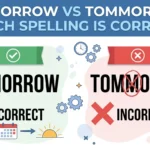
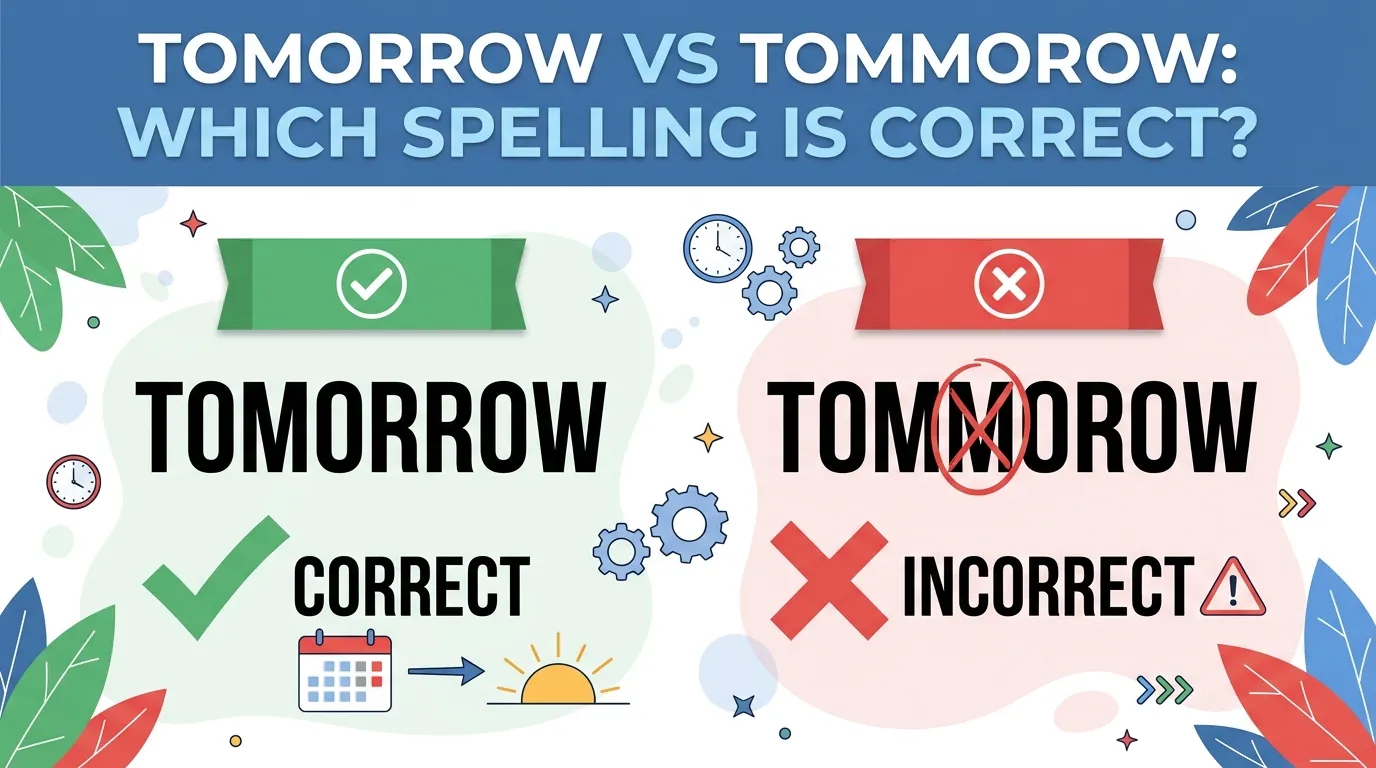
The correct spelling is tomorrow.
Tommorow is incorrect in standard English. It is a misspelling of tomorrow, not an alternative spelling used in American or British English.
The word tomorrow means the day after today. It can function as a noun or an adverb and appears in everyday conversation, academic writing, business communication, journalism, technical writing, and many other forms of English.
In this guide, you will learn the difference between tomorrow vs tommorow, how to remember the correct spelling, how to pronounce the word, where it comes from, how to use it naturally, and which common mistakes to avoid.
Quick Answer: Tomorrow or Tommorow?
Tomorrow is correct. Tommorow is incorrect.
| Spelling | Correct? | Meaning | Example |
|---|---|---|---|
| tomorrow | ✅ Yes | The day after today | I will call you tomorrow. |
| tommorow | ❌ No | Misspelling of tomorrow | ❌ I will call you tommorow. |
The easiest way to remember it is:
Tomorrow = one M + two R’s
Write:
t o m o r r o w
Not:
t o m m o r o w
The common mistake happens when writers accidentally place an extra m in the middle of the word.
What Does Tomorrow Mean?
Tomorrow refers to the day that comes immediately after today.
For example, if today is Monday, tomorrow is Tuesday. If today is December 10, tomorrow is December 11.
Dictionary-style definition
Tomorrow
Noun: the day after today.
Adverb: on or during the day after today.
Examples:
- Tomorrow is my birthday.
- We are leaving tomorrow.
- I have a meeting tomorrow morning.
- She promised to finish the work tomorrow.
The word is connected to the idea of the future, but it normally refers specifically to the next calendar day.
Why Is “Tommorow” Wrong?
Tommorow is simply a spelling error.
English spelling does not add a second m after the first syllable of tomorrow. The correct spelling contains:
- one m
- one o after the m
- two r’s
- one final w
So the structure is:
tom + or + row
This does not mean that you should pronounce the word as three separate pieces in normal conversation. It is simply a useful visual trick for remembering its spelling.
Correct
I will see you tomorrow.
Incorrect
I will see you tommorow.
The second version may still be understood by readers, but it is not standard English spelling.
Tomorrow vs Tommorow: The Key Difference
There is really only one essential difference:
Tomorrow is the standard English spelling, while tommorow is a misspelling.
Unlike pairs such as color and colour or center and centre, this is not a regional spelling difference.
You should not use tommorow in American English, British English, Canadian English, Australian English, or formal international English.
Comparison
| Feature | Tomorrow | Tommorow |
|---|---|---|
| Standard English | ✅ | ❌ |
| American English | ✅ | ❌ |
| British English | ✅ | ❌ |
| Formal writing | ✅ | ❌ |
| Academic writing | ✅ | ❌ |
| Business writing | ✅ | ❌ |
| Casual texting | ✅ | Usually considered a typo |
| Dictionary spelling | ✅ | ❌ |
| Meaning | Day after today | No separate standard meaning |
Why Do People Spell Tomorrow as “Tommorow”?
The mistake is easy to make for several reasons.
1. The double letters are confusing
English has many words with doubled consonants:
- common
- summer
- tomorrow
- recommend
- accommodate
- committee
Because mm is common in English spelling, people may instinctively write tommorow.
2. The pronunciation does not clearly reveal the spelling
English spelling and pronunciation do not always match perfectly.
When people hear tomorrow, they may not mentally identify each letter. As a result, they can reproduce the sound incorrectly when typing.
3. Fast typing causes mistakes
People frequently type tommorow when writing quickly on:
- phones
- social media
- messaging apps
- online forms
- emails
- search boxes
Autocorrect often fixes the mistake, but not every device or application catches it.
4. The word has an unusual spelling pattern
The sequence tomorrow is visually distinctive. It contains several vowels and two consecutive r’s, which makes it easy to rearrange letters.
How Do You Pronounce Tomorrow?
Tomorrow is commonly pronounced with the main stress on the second syllable.
In standard American English, the word is generally heard as three syllables.
The pronunciation may vary slightly by accent, especially in the final unstressed vowel, but the spelling remains tomorrow.
A useful pronunciation reminder is to avoid giving strong stress to every syllable. In natural speech, the middle portion receives the strongest emphasis.
Pronunciation in everyday speech
Examples:
- See you tomorrow.
- Are you working tomorrow?
- Tomorrow should be easier.
In fast conversation, the word may sound shorter or less distinct than it appears in writing. This is another reason learners sometimes struggle to spell it correctly.
Is Tomorrow a Noun or an Adverb?
Tomorrow can be both a noun and an adverb.
Tomorrow as a noun
When it refers to the actual day after today, it can function as a noun.
Tomorrow will be busy.
Tomorrow is another day.
Here, tomorrow identifies a day.
Tomorrow as an adverb
It can also tell us when an action will happen.
I will finish the report tomorrow.
We are meeting tomorrow.
She leaves tomorrow.
In these examples, tomorrow modifies the verb by telling us when the action occurs.
Tomorrow in Different Contexts
The basic meaning stays the same, but its use can change depending on context.
Everyday conversation
Tomorrow is extremely common in casual speech.
I’ll see you tomorrow.
What are you doing tomorrow?
Let’s talk about it tomorrow.
These sentences sound natural and conversational.
Business communication
Tomorrow is also perfectly appropriate in professional writing.
The revised document will be available tomorrow.
Our meeting is scheduled for tomorrow morning.
Please submit the final version by tomorrow.
For business writing, clarity is more important than replacing tomorrow with unnecessarily formal language.
Academic writing
Academic writers can use tomorrow when discussing an actual future day.
The students will submit their projects tomorrow.
However, academic writing often requires an exact date when timing could become unclear.
Instead of:
The experiment will continue tomorrow.
A more precise sentence might be:
The experiment will continue on September 9.
This is especially useful in research, reports, schedules, and documents that readers may access later.
Journalism
Journalists frequently use tomorrow when reporting upcoming events.
The team will announce its decision tomorrow.
However, news writing may also use the exact date to prevent ambiguity.
Technical writing
Technical documentation often favors precise dates and times, especially for deadlines, releases, maintenance windows, and scheduled events.
Instead of:
The update will be installed tomorrow.
A technical document might say:
The update will be installed on September 9 at 2:00 p.m.
The word itself is not informal. The choice depends on how much precision the context requires.
Tomorrow in American vs British English
There is no spelling difference between American and British English.
Both use:
tomorrow
Neither standard variety uses:
tommorow
The same applies to most major English varieties.
| English variety | Correct spelling |
|---|---|
| American English | tomorrow |
| British English | tomorrow |
| Canadian English | tomorrow |
| Australian English | tomorrow |
| New Zealand English | tomorrow |
| International English | tomorrow |
Regional accents can change pronunciation, but they do not make tommorow an accepted regional spelling.
Formal vs Informal Use of Tomorrow
The word tomorrow works in both formal and informal writing.
Informal
See you tomorrow!
I’ll text you tomorrow.
Let’s finish this tomorrow.
Neutral
The meeting will take place tomorrow.
We will review the results tomorrow.
Formal
The committee will issue its decision tomorrow.
The revised proposal is expected tomorrow.
There is no need to replace tomorrow simply because a sentence is formal.
However, formal documents sometimes use an exact date instead.
More precise alternative
The report is due tomorrow.
Highly specific alternative
The report is due September 9, 2026.
The second version is often better when the document will be read later.
Tomorrow vs the Day After Today
Tomorrow and the day after today have the same basic meaning.
However, tomorrow is much more natural in everyday English.
Compare:
I will call you tomorrow.
with:
I will call you on the day after today.
The second sentence is grammatically understandable but extremely unnatural in ordinary English.
Use tomorrow unless you have a specific reason to emphasize the literal calendar relationship.
Tomorrow vs Next Day
These expressions can overlap, but they are not always interchangeable.
Tomorrow specifically means the day after today.
The next day usually refers to the day following a previously mentioned day or event.
Compare:
I will leave tomorrow.
Here, tomorrow means the day after today.
Now consider:
We arrived on Monday. The next day, we visited the museum.
Here, the next day means Tuesday because Monday was the previously mentioned reference point.
This distinction is useful in storytelling and formal writing.
Tomorrow vs the Following Day
The following day is another alternative, but it is more common in formal writing and narratives.
Example:
The researchers completed the first test on Monday. The following day, they began the second test.
In casual conversation, most people would simply say:
We started the second test the next day.
Or, if the reference point is today:
We will start tomorrow.
Common Phrases With Tomorrow
Several everyday expressions use tomorrow.
Tomorrow morning
I’ll call you tomorrow morning.
Tomorrow afternoon
The appointment is tomorrow afternoon.
Tomorrow evening
We are having dinner tomorrow evening.
Tomorrow night
I have plans tomorrow night.
By tomorrow
This means no later than tomorrow.
Please send the document by tomorrow.
Until tomorrow
This refers to something continuing up to tomorrow.
The store will remain closed until tomorrow.
Starting tomorrow
This means something begins tomorrow.
Starting tomorrow, the office will open at 8 a.m.
See you tomorrow
A common farewell.
Thanks for your help. See you tomorrow!
Tomorrow morning at…
You can combine tomorrow with a specific time.
The interview is tomorrow at 10 a.m.
Common Expressions and Idioms With Tomorrow
The word also appears in well-known expressions.
“Tomorrow is another day”
This expression communicates the idea that a difficult day does not determine what happens next.
Today did not go as planned, but tomorrow is another day.
“Live for tomorrow”
This can mean planning or saving for the future rather than focusing only on the present.
“Put off until tomorrow”
To put something off until tomorrow means to delay it.
Don’t put off until tomorrow what you can do today.
This is closely related to the idea of procrastination.
“Tomorrow never comes”
This expression can suggest that people who continually postpone action may never actually reach the moment when they intend to act.
Synonyms and Related Expressions
Because tomorrow refers to a specific point in time, it has relatively few true synonyms.
Useful alternatives include:
- the next day
- the following day
- the day after today
- the coming day in limited contexts
- the next morning when specifically referring to morning
Not all of these can replace tomorrow in every sentence.
Example
I’ll see you tomorrow.
Natural alternatives:
I’ll see you the next day.
This can sound different depending on context. If you are speaking about today, tomorrow is usually the clearest choice.
Antonyms of Tomorrow
There is no perfect single-word antonym for tomorrow, but several time expressions contrast with it.
Today
Today means the current day.
I am working today.
Yesterday
Yesterday means the day before today.
I finished the task yesterday.
The basic time sequence is:
Yesterday → Today → Tomorrow
This is one of the easiest ways to remember the meaning.
Common Collocations With Tomorrow
A collocation is a combination of words that naturally appear together.
Common combinations with tomorrow include:
- tomorrow morning
- tomorrow afternoon
- tomorrow evening
- tomorrow night
- tomorrow’s meeting
- tomorrow’s deadline
- tomorrow’s schedule
- tomorrow’s event
- tomorrow’s weather
- by tomorrow
- until tomorrow
- starting tomorrow
- see you tomorrow
- available tomorrow
- arriving tomorrow
- leaving tomorrow
- returning tomorrow
Examples:
The package should arrive tomorrow.
Tomorrow’s meeting starts at nine.
We need the final draft by tomorrow.
Tomorrow’s: How to Use the Possessive Form
Tomorrow’s is the possessive form of tomorrow.
It often means belonging to or associated with tomorrow.
Examples:
Tomorrow’s meeting has been canceled.
Have you checked tomorrow’s schedule?
Tomorrow’s forecast looks better.
Notice the apostrophe:
tomorrow’s
Not:
tommorow’s
And not:
tomorrows when the possessive meaning is intended.
“Tomorrow” vs “Tomorrows”
The plural form tomorrows is possible, but it has a different meaning.
For example:
We cannot keep sacrificing today’s needs for endless tomorrows.
Here, tomorrows is being used as a plural noun referring figuratively to future days.
It is much less common than the singular tomorrow.
Common Spelling Mistakes With Tomorrow
Here are some mistakes worth watching for.
| Incorrect | Correct |
|---|---|
| tommorow | tomorrow |
| tommorrow | tomorrow |
| tomorow | tomorrow |
| tomarrow | tomorrow |
| tommorow’s | tomorrow’s |
| tomorrows | tomorrow’s when showing possession |
Mistake: tommorrow
Some writers add both an extra m and an extra r.
❌ I will finish it tommorrow.
✅ I will finish it tomorrow.
Mistake: tomorow
Others remember the single m but forget one of the two r’s.
❌ See you tomorow.
✅ See you tomorrow.
Awkward vs Natural Examples
Correct spelling alone does not guarantee natural usage. Context matters too.
Example 1
Awkward:
I will do it on tomorrow.
Natural:
I will do it tomorrow.
In standard English, tomorrow usually does not need on before it.
Example 2
Awkward:
We will meet at tomorrow.
Natural:
We will meet tomorrow.
Or:
We will meet tomorrow morning.
Example 3
Awkward:
The meeting is in tomorrow.
Natural:
The meeting is tomorrow.
Example 4
Natural:
I’ll send you the file tomorrow.
Example 5
Natural:
Tomorrow’s presentation starts at 10 a.m.
How to Remember the Correct Spelling
If you repeatedly write tommorow, use a simple memory trick.
Memory trick 1: One M, two R’s
Remember:
One M → two R’s
tomorrow
This is probably the most useful spelling rule for this word.
Memory trick 2: Think “tom + orrow”
Visually divide the word:
tom | orrow
This helps prevent the extra m.
Memory trick 3: Remember the ending
The ending is:
orrow
not:
orow
So make sure you include two r’s.
Memory trick 4: Use the three-day sequence
Think:
Yesterday → Today → Tomorrow
Then associate the correct spelling with the last word.
Is “Tommorow” Ever Correct?
No.
Tommorow is not a standard English word.
It may appear in:
- typos
- usernames
- informal posts
- comments
- unedited text
- search queries
- text messages
But its appearance online does not make it a correct spelling.
A brand, username, fictional name, or creative title could intentionally use Tommorow, but that would be a proper name or stylistic choice rather than standard English spelling.
Should You Correct Someone Who Writes “Tommorow”?
That depends on the situation.
In casual texting, correcting every spelling mistake may be unnecessary.
If someone writes:
See you tommorow!
The meaning is obvious.
But correction is useful in:
- school assignments
- resumes
- cover letters
- business emails
- academic papers
- professional websites
- reports
- published articles
In professional writing, spelling errors can affect how polished and credible the writing appears.
Is Tomorrow a Slang Word?
No. Tomorrow is a standard English word, not slang.
It can appear in casual speech, but that does not make it slang.
For example:
See you tomorrow!
is informal in tone but uses completely standard vocabulary.
This distinction is important because informal and slang are not the same thing.
Does Tomorrow Have a Figurative Meaning?
Yes, in some contexts.
Although its literal meaning is the next day, tomorrow can represent the future more generally.
For example:
We are building a better tomorrow.
Here, tomorrow does not necessarily mean the exact next calendar day. It represents a future time.
Similarly:
The technology of tomorrow is already changing the world.
Here, tomorrow is figurative and means the future.
This use is common in:
- advertising
- speeches
- politics
- business
- technology
- motivational writing
- journalism
Tomorrow in Business, Politics, and Technology
The figurative idea of tomorrow often appears in discussions about the future.
Business
Today’s decisions will shape tomorrow’s business.
Technology
Engineers are developing the tools of tomorrow.
Politics
Today’s policies can influence tomorrow’s economy.
Sports
The team’s young players could become tomorrow’s stars.
In these examples, tomorrow represents a broader future rather than literally the next day.
Practical Recommendations for Writers
If you are unsure how to use the word, follow these simple guidelines.
For American English
Use:
tomorrow
Avoid:
tommorow
For British English
Use:
tomorrow
The spelling does not change.
For academic writing
Use tomorrow when the next day is genuinely relevant. For important deadlines or research dates, consider giving the exact date.
For business writing
Use tomorrow when the context is immediate and clear.
For schedules, contracts, project plans, or records, an exact date may be better.
For journalism
Use an exact date when readers could encounter the article later and misunderstand which day tomorrow refers to.
For technical writing
Prefer exact dates and times when precision matters.
For casual writing
Tomorrow is completely natural.
See you tomorrow!
For blogging
Use tomorrow naturally and avoid forcing synonyms simply for SEO variation. Search engines and readers both benefit more from clear, natural language.
Quick Editing Checklist
Before publishing or sending your writing, check these points:
- Is it spelled tomorrow?
- Did you use only one m?
- Did you use two r’s?
- Is the apostrophe correct in tomorrow’s?
- Does the sentence need an exact date instead?
- Did you accidentally add on before tomorrow?
- Is your usage clear from the reader’s perspective?
A quick visual check can catch most errors.
Tomorrow vs Tommorow: Final Comparison
| Question | Tomorrow | Tommorow |
|---|---|---|
| Is it correctly spelled? | ✅ Yes | ❌ No |
| Does it mean the next day? | ✅ Yes | ❌ Not as a standard word |
| Used in American English? | ✅ Yes | ❌ No |
| Used in British English? | ✅ Yes | ❌ No |
| Appropriate in formal writing? | ✅ Yes | ❌ No |
| Appropriate in casual writing? | ✅ Yes | ❌ No |
| Is it a spelling variant? | No | No |
| Is it usually a typo? | No | Yes |
Frequently Asked Questions
Is “tomorrow” or “tommorow” correct?
Tomorrow is correct. Tommorow is a common spelling mistake. Standard English spells the word with one m and two r’s.
How do you spell tomorrow correctly?
The correct spelling is tomorrow:
t-o-m-o-r-r-o-w
A useful memory trick is one m and two r’s.
Why do people spell tomorrow as “tommorow”?
People often write tommorow because they expect a double consonant after the first syllable or because they are typing quickly. The pronunciation also does not make every letter obvious.
Is “tommorow” accepted in British English?
No. British English uses tomorrow, just like American English. Tommorow is not a standard British spelling.
Is “tommorow” accepted in American English?
No. The correct American English spelling is tomorrow.
Is tomorrow a noun or an adverb?
Tomorrow can be both a noun and an adverb. In “Tomorrow is Friday,” it functions as a noun. In “I will leave tomorrow,” it functions as an adverb.
What is the difference between tomorrow and the next day?
Tomorrow specifically means the day after today. The next day can refer to the day after another day or event mentioned in context.
What is the correct possessive form of tomorrow?
The possessive form is tomorrow’s.
Example:
Tomorrow’s meeting starts at nine.
Does tomorrow mean the future?
Literally, tomorrow means the day after today. Figuratively, it can represent the future more generally, as in “the leaders of tomorrow.”
What is an easy way to remember how to spell tomorrow?
Remember:
Tomorrow has one M and two R’s.
That simple pattern helps distinguish tomorrow from the common misspelling tommorow.
Conclusion
When comparing tomorrow vs tommorow, the answer is straightforward: tomorrow is the correct spelling, and tommorow is a misspelling.
The word tomorrow means the day after today and works naturally in American English, British English, academic writing, business communication, journalism, technical documents, casual conversations, and everyday messages.
Remember the spelling with one simple rule:
One M, two R’s: tomorrow.
You can also remember the time sequence:
Yesterday → Today → Tomorrow
Although tommorow may appear frequently online, it is not an accepted regional spelling or an alternative form. If you are writing something that needs to be accurate and polished, always choose tomorrow.
When precision matters, especially in professional, academic, technical, or published writing, consider using an exact date instead of tomorrow if the reader may not know when the document was written.
Most importantly, do not overthink the word. Once you remember one M and two R’s, the tomorrow vs tommorow spelling question becomes easy to solve.