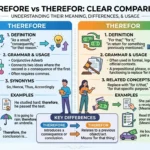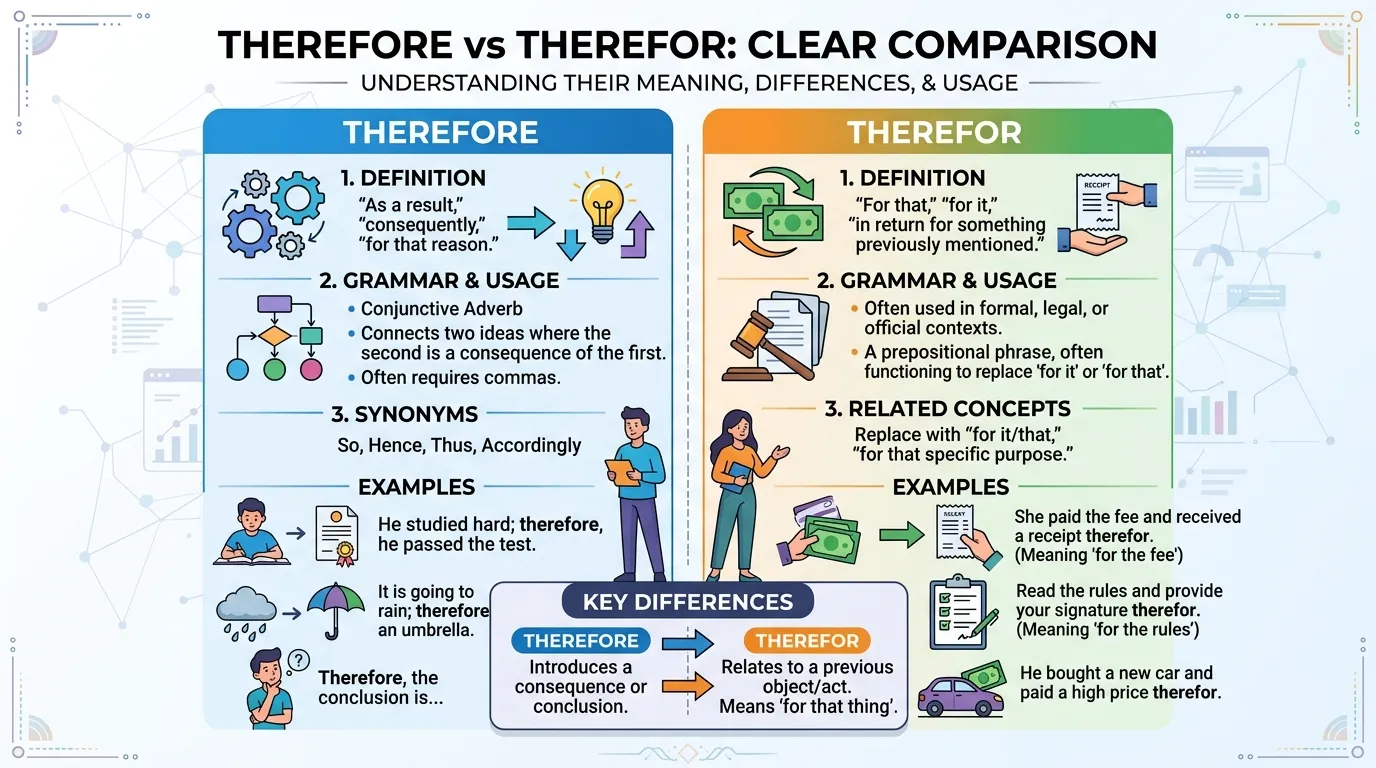
Therefore vs therefor is a confusing word-choice question because the two words look almost identical but have very different meanings and uses. In modern American English, therefore is the word you will use in almost every ordinary situation. It means “for that reason,” “as a result,” or “consequently.”
Therefor is a real English word, but it is rare and highly formal. It traditionally means “for that” or “for it.” You are most likely to see it in legal, contractual, or older formal writing rather than in everyday conversation.
For example:
- The store was closed; therefore, we went home.
- The tenant paid the fee and received a receipt therefor.
The first sentence uses therefore to show a result. The second uses therefor in the older/formal sense of “for that.”
This guide explains the difference between therefore and therefor, their meanings, grammatical roles, pronunciation, history, formal and informal usage, common mistakes, and practical examples. By the end, you should know exactly which word to choose in academic, business, legal, journalistic, technical, and everyday writing.
Quick Answer: Therefore vs Therefor
Therefore means “for that reason” or “as a result.” It is a common adverb used to connect a reason with its consequence.
Therefor means “for that” or “for it.” It is a rare, formal word mainly found in legal and contractual language.
| Word | Meaning | Grammatical role | Common use |
|---|---|---|---|
| Therefore | For that reason; as a result | Adverb | Everyday, academic, business, journalism |
| Therefor | For that; for it | Adverb | Legal, contractual, archaic/formal writing |
The easiest rule
If you mean “as a result,” use therefore.
If you mean “for that” or “for it,” especially in legal language, therefor may be correct.
For most writers, the practical rule is simple:
Use “therefore” unless you specifically need the rare legal/formal word “therefor.”
What Does “Therefore” Mean?
Therefore is an adverb that introduces or emphasizes a conclusion, result, or consequence.
Its basic meaning is:
- for that reason
- because of that
- as a result
- consequently
Examples of “therefore”
- The roads were flooded; therefore, the school closed.
- She studied hard and therefore passed the exam.
- The evidence was incomplete; therefore, the case was delayed.
- He forgot his passport and therefore could not board the flight.
- The product was defective and was therefore returned.
In each sentence, therefore connects an earlier fact or reason with a resulting action or situation.
Dictionary-style definition
Therefore: adverb — for that reason; as a consequence; consequently.
The word often answers the question “What happened because of that?”
For example:
The weather was dangerous. Therefore, the event was canceled.
The dangerous weather is the reason. The cancellation is the result.
What Does “Therefor” Mean?
Therefor is also an adverb, but its meaning is different.
It traditionally means:
“for that” or “for it.”
It does not normally mean “as a result.”
You may encounter it in phrases such as:
- payment therefor
- consideration therefor
- compensation therefor
- the services therefor
- any rights therefor
These expressions are particularly associated with legal and formal documents.
Example
The buyer agreed to pay the purchase price and any taxes therefor.
Here, therefor means approximately “for that”—referring back to something previously mentioned.
Another example:
The company provided the equipment and received payment therefor.
The meaning is essentially:
The company received payment for it.
This is why therefor can sound unusual to modern readers. Everyday English would normally say “for it” or “for that.”
Therefore vs Therefor: The Key Difference
The biggest difference is their meaning, not merely their spelling.
Therefore = as a result
Use therefore when you are showing a conclusion or consequence.
The machine was broken; therefore, production stopped.
Meaning:
The machine was broken; as a result, production stopped.
Therefor = for that
Use therefor when you mean “for that” or “for it.”
The contractor completed the work and received payment therefor.
Meaning:
The contractor received payment for it.
Side-by-side comparison
| Feature | Therefore | Therefor |
|---|---|---|
| Basic meaning | As a result | For that |
| Meaning similar to | Consequently | For it |
| Common today? | Yes | No, relatively rare |
| Everyday English | Natural | Usually unnatural |
| Academic writing | Common | Rare |
| Business writing | Common | Sometimes legal |
| Legal writing | Common | Traditional/legal |
| Casual conversation | Possible | Very unusual |
| Shows a result? | Yes | No |
| Refers back to something? | Sometimes | Yes, typically |
Why Do People Confuse Therefore and Therefor?
The confusion is understandable because the words differ by only one letter.
Both begin with there-, and both have similar visual patterns. Many writers learn therefore first and later encounter therefor in a legal document.
There is another source of confusion: therefor looks like a shortened form of therefore. It is not.
They developed with different grammatical functions.
Consider:
The evidence was insufficient; therefore, the claim was rejected.
versus:
The company received compensation therefor.
The first word means “as a result.” The second means “for that.”
Changing one word to the other can completely change the meaning.
Is “Therefor” a Correct Word?
Yes. Therefor is a legitimate English word.
However, being a correct word does not mean it is appropriate in every context.
Modern English strongly favors clearer alternatives in ordinary writing.
For example, this sentence is grammatically possible:
The employee received compensation therefor.
But most readers would find this more natural:
The employee received compensation for it.
Likewise, instead of:
The customer shall receive a refund therefor.
Modern plain English might say:
The customer shall receive a refund for it.
Therefor is therefore best understood as a specialized or formal word rather than a common alternative spelling of therefore.
When Should You Use “Therefore”?
Use therefore when you want to show a logical result, conclusion, or consequence.
In academic writing
Therefore is useful when presenting an argument.
The sample size was too small; therefore, the findings cannot be generalized.
The two variables were strongly related; therefore, further research is necessary.
In business writing
Sales declined during the quarter; therefore, the company revised its forecast.
The client did not approve the proposal; therefore, the project will remain on hold.
In journalism
The storm damaged several roads; therefore, authorities advised residents to avoid unnecessary travel.
In technical writing
The sensor detected excessive heat; therefore, the system automatically shut down.
In everyday writing
I missed the bus; therefore, I arrived late.
Although therefore can sound somewhat formal, it is perfectly grammatical in ordinary English.
When Should You Use “Therefor”?
Use therefor only when its specific meaning—“for that” or “for it”—is intended.
It is most common in:
- legal contracts
- statutes
- formal agreements
- older documents
- highly formal writing
- traditional legal phrases
Example
The purchaser shall pay the agreed price and all taxes therefor.
Here, therefor refers back to the item being paid for.
Another example
The parties shall execute the agreement and provide consideration therefor.
The word means “for it” or “for that.”
In modern plain English, however, a clearer alternative is often preferable.
Therefore vs Therefor in Legal Writing
This is one area where the distinction matters most.
Legal writing sometimes preserves older constructions that are uncommon in everyday English.
Therefor can appear because legal documents frequently need a concise way to refer back to something already mentioned.
For example:
The buyer shall pay the purchase price therefor.
A plain-English version could be:
The buyer shall pay the purchase price for the property.
The second version may be easier for ordinary readers to understand.
Important legal distinction
Do not assume that therefor means therefore just because it appears in a legal contract.
Compare:
The payment was not received; therefore, the contract was terminated.
Here, therefore means “as a result.”
The buyer received the goods and made payment therefor.
Here, therefor means “for the goods.”
Pronunciation of Therefore and Therefor
The two words can sound similar, especially in fast speech, but they are distinct words.
Therefore generally has the pronunciation associated with the phrase “there + fore.”
Therefor is also commonly pronounced with the same basic there-for sound.
This is one reason spelling and context are especially important.
Because the words can be nearly identical or identical in pronunciation for many speakers, you cannot always distinguish them by sound alone.
The sentence’s meaning tells you which spelling is appropriate.
Grammatical Role of Therefore
Therefore functions as an adverb, especially a conjunctive or sentence-level adverb.
It can connect an earlier idea to a conclusion.
Common patterns
Sentence; therefore, sentence.
The deadline passed; therefore, the application was rejected.
Sentence. Therefore, sentence.
The deadline passed. Therefore, the application was rejected.
Subject + therefore + verb
The company therefore decided to postpone the launch.
Verb + therefore
The company decided therefore to postpone the launch.
The last pattern is grammatically possible but often sounds less natural.
Grammatical Role of Therefor
Therefor is an adverb meaning “for that” or “for it.”
It generally refers back to something previously mentioned.
Example
The seller transferred ownership of the vehicle and received payment therefor.
Here:
- there points back to the vehicle or transaction.
- for means “for it.”
This construction is much less common than ordinary expressions such as for it, for that, or for the item.
Therefore vs Therefor in American English
In American English, therefore is by far the more common word.
American writers use it in:
- school essays
- research papers
- business reports
- news articles
- professional emails
- instructions
- technical documentation
- formal speeches
Therefor remains valid but is relatively uncommon outside specialized contexts.
If you are writing for a general American audience, therefore will almost always be the safer choice when expressing a result.
Therefore vs Therefor in British English
British English also uses therefore extensively to mean “as a result.”
Therefor has the same specialized meaning it has in American English, particularly in legal or formal contexts.
Therefore, the distinction is not mainly a British-versus-American spelling issue.
It is primarily a meaning and register issue.
Regional and International Usage
English learners around the world may encounter therefore frequently because it is common in formal and academic English.
You may see therefor in international contracts or legal documents influenced by traditional English legal language.
However, the safest international strategy is still:
- use therefore for results and conclusions;
- use therefor only when you genuinely mean “for that” or “for it.”
Formality and Tone
The two words differ significantly in register.
Therefore
Therefore can range from neutral-formal to formal.
The results were inconsistent; therefore, the experiment was repeated.
This is professional and natural.
In casual speech, however, people may prefer:
- so
- that’s why
- because of that
- as a result
Therefor
Therefor sounds highly formal, technical, or legal.
Payment therefor shall be made within thirty days.
A normal conversational version would be:
Payment for it must be made within thirty days.
This difference in tone is important for clear communication.
Therefore vs “So”
So is usually more conversational.
It was raining, so we stayed home.
Therefore sounds more formal or deliberate.
It was raining; therefore, we stayed home.
Both are correct.
Choose “so” when:
- writing casually
- texting
- talking to friends
- using conversational language
Choose “therefore” when:
- presenting an argument
- writing academically
- explaining a logical conclusion
- writing professionally
- emphasizing cause and effect
Therefore vs “Thus”
Thus and therefore can sometimes be synonyms.
The evidence was incomplete; therefore, the conclusion was uncertain.
The evidence was incomplete; thus, the conclusion was uncertain.
Both express a result.
However, thus can sometimes mean “in this way”, so context matters.
Therefore vs “Hence”
Hence can also mean “therefore” or “as a result.”
The road was blocked; hence, the delay.
Therefore is generally more familiar to modern readers.
In many situations:
The road was blocked; therefore, we were late.
is clearer than:
The road was blocked; hence, we were late.
Therefore vs “Thereby”
Do not confuse therefore with thereby.
Therefore = as a result.
Thereby = by that means or as a result of that action.
Compare:
She completed the course and therefore received a certificate.
She completed the course, thereby earning a certificate.
The meanings are related, but the grammatical relationship is different.
Common Collocations With “Therefore”
Some common combinations include:
- therefore necessary
- therefore important
- therefore likely
- therefore possible
- therefore impossible
- therefore required
- therefore concluded
- therefore decided
- therefore considered
- therefore recommended
Examples
The risk is high and is therefore considered unacceptable.
The information is outdated and is therefore not reliable.
The demand has increased and is therefore likely to continue.
Common Phrases With “Therefor”
There are fewer common expressions with therefor, but formal and legal writing may contain:
- payment therefor
- consideration therefor
- compensation therefor
- services therefor
- rights therefor
- obligations therefor
- costs therefor
These phrases can sound stiff because they belong to a traditional formal register.
Synonyms and Related Words
Synonyms for “therefore”
Depending on context, you can use:
- consequently
- thus
- hence
- as a result
- for that reason
- accordingly
- because of that
Synonyms for “therefor”
Depending on the sentence:
- for that
- for it
- in exchange for that
- in return for it
The exact replacement depends on what there refers to.
Antonyms
Neither therefore nor therefor has a direct, standard antonym.
However, when discussing logical relationships, opposite ideas might include:
- despite that
- nevertheless
- nonetheless
- regardless
- notwithstanding
These do not mean the direct opposite of therefore. Instead, they introduce contrast rather than consequence.
Compare:
The evidence was strong; therefore, the claim was accepted.
versus:
The evidence was weak; nevertheless, the claim was accepted.
Common Mistakes With Therefore and Therefor
Mistake 1: Using “therefor” to mean “therefore”
Incorrect:
The weather was dangerous; therefor, the game was canceled.
Correct:
The weather was dangerous; therefore, the game was canceled.
Why? Because the sentence needs “as a result.”
Mistake 2: Assuming “therefor” is a shortened spelling
Incorrect idea:
Therefor is just an informal version of therefore.
It is not.
They are separate words with different meanings.
Mistake 3: Using “therefore” when you mean “for it”
Awkward:
The customer purchased the product and received a refund therefore.
If you mean “for the product,” you need a different construction.
The customer purchased the product and received a refund for it.
In a highly formal legal context, therefor may be possible:
The customer received a refund therefor.
Awkward vs Natural Examples
| Awkward or incorrect | Better |
|---|---|
| The road was closed therefor we turned around. | The road was closed; therefore, we turned around. |
| She was tired; therefor, she went home. | She was tired; therefore, she went home. |
| He paid the fee therefore. | He paid the fee for it. |
| The company lost money; therefor, it reduced costs. | The company lost money; therefore, it reduced costs. |
| The buyer received payment therefore. | The buyer received payment for it. |
Punctuation With “Therefore”
Punctuation around therefore depends on how it functions in the sentence.
Between two independent clauses
A semicolon is often appropriate:
The experiment failed; therefore, the researchers repeated it.
You can also make two sentences:
The experiment failed. Therefore, the researchers repeated it.
Within a sentence
Commas may surround therefore when it functions as an interrupting adverb:
The researchers, therefore, repeated the experiment.
However, not every placement requires commas.
The researchers therefore repeated the experiment.
This version is often smoother and more concise.
Is a Comma Required Before “Therefore”?
Not always.
This is an important grammar point.
Correct
The test failed; therefore, we repeated it.
Also correct
The test failed. Therefore, we repeated it.
Also possible
The test failed and therefore had to be repeated.
The punctuation depends on the grammatical structure.
Do not automatically place a comma before therefore every time you use it.
Therefore in Academic Writing
Therefore is especially useful in academic writing because it makes logical relationships explicit.
Example
The participants reported higher stress levels. Therefore, the researchers recommended additional follow-up studies.
It can help readers understand:
evidence → reasoning → conclusion
Other useful academic alternatives include:
- consequently
- thus
- accordingly
- as a result
- for this reason
Still, avoid overusing any transition word.
Therefore in Business Writing
Business communication benefits from direct cause-and-effect language.
Example
Customer demand has increased; therefore, we recommend expanding production.
Another example:
The supplier missed the deadline and therefore caused a delay in distribution.
For less formal internal communication, so may be more natural:
The supplier missed the deadline, so we had to change the schedule.
Therefore in Journalism
Journalists often prefer straightforward language.
Therefore is appropriate when a clear conclusion follows from a reported fact:
The bridge remains unsafe; therefore, officials have closed it to traffic.
However, journalistic style often favors shorter constructions such as so or as a result when they improve readability.
Therefore in Technical Writing
Technical documents frequently need to describe cause and effect.
The voltage exceeded the recommended level; therefore, the device automatically shut down.
In instructions, however, simpler wording may be preferable:
If the temperature rises above the limit, the system shuts down automatically.
The goal is not to use sophisticated words. The goal is clarity.
Therefore in Sports Writing
Sports writing can use therefore when explaining consequences, although so, as a result, and which meant may sound more natural.
The team dominated possession and therefore created more scoring opportunities.
A sports article might instead say:
The team dominated possession, so it created more scoring opportunities.
Neither is wrong. The choice depends on tone.
Therefore in Blogging and Online Content
For blogs, clarity usually matters more than formality.
Therefore is correct, but don’t force it into every sentence.
Instead of:
The instructions were unclear; therefore, many readers made mistakes.
You could write:
The instructions were unclear, so many readers made mistakes.
Or:
The instructions were unclear. As a result, many readers made mistakes.
For SEO content, natural language is generally preferable to overly formal wording.
Therefore in Casual Conversation
People do use therefore in speech, but it can sound formal or playful depending on context.
Most people would naturally say:
I was tired, so I went home.
rather than:
I was tired; therefore, I went home.
Therefor, meanwhile, is extremely unusual in ordinary conversation.
Memory Tricks for Therefore vs Therefor
Here are several easy ways to remember the difference.
Memory trick 1: Think “result”
Therefore = result.
It rained. Therefore, the field was wet.
Memory trick 2: Think “for that”
Therefor = for that.
He received payment therefor.
Replace it mentally with “for that.”
If the sentence still makes sense, therefor may be appropriate.
Memory trick 3: Count the letters
Therefore has an e at the end.
Think:
there + fore = therefore
Therefor stops at for because it means “for that.”
Memory trick 4: Ask one question
Ask:
Does this word mean “as a result”?
If yes → therefore.
If no, ask:
Does it mean “for that” or “for it”?
If yes → therefor.
Real-World Examples
Example: School
Maria forgot to study; therefore, she was nervous about the exam.
Example: Weather
The forecast predicted severe storms; therefore, the event was postponed.
Example: Business
Costs increased significantly; therefore, the company adjusted its prices.
Example: Science
The temperature exceeded the safe limit; therefore, the experiment was stopped.
Example: Legal
The contractor completed the services and received payment therefor.
Example: Contract
The purchaser shall pay all fees associated therewith and compensation therefor.
The legal examples demonstrate why therefor still exists even though it is rare in general English.
Formal vs Informal Alternatives
| Intended meaning | Formal | Neutral | Casual |
|---|---|---|---|
| As a result | Therefore | As a result | So |
| Because of that | Therefore | Because of that | That’s why |
| Consequently | Consequently | As a result | So |
| For that | Therefor | For that | For it |
Choose based on your audience rather than trying to sound more sophisticated.
Which Word Is Better for American Writers?
For most American writers:
Use therefore when:
- showing a result
- introducing a conclusion
- explaining cause and effect
- writing an essay
- writing a report
- writing business content
- writing technical material
- writing professional communication
Use therefor only when:
- you mean “for that” or “for it”
- you are working with traditional legal language
- the context specifically requires that construction
If you are unsure, therefore is almost certainly the correct choice when your intended meaning is “as a result.”
Therefore vs Therefor: Quick Decision Guide
Use this checklist:
- Do you mean “as a result”?
- Use therefore.
- Do you mean “for that”?
- Therefor may be correct.
- Are you writing a normal essay, email, article, report, or post?
- Therefore is likely the word you need.
- Are you writing a legal document?
- Check whether therefor specifically refers back to an item or matter.
- Does the word sound unusually legal or archaic?
- Consider whether for it or for that would be clearer.
- Are you using therefor simply because it looks like a shorter version of therefore?
- That is almost certainly a mistake.
Frequently Asked Questions
Is there a difference between “therefore” and “therefor”?
Yes. Therefore means “as a result” or “for that reason.” Therefor means “for that” or “for it” and is mainly used in formal or legal contexts.
Is “therefor” a real word?
Yes. Therefor is a legitimate English word. It is simply much less common than therefore in modern general English.
Is “therefor” the same as “therefore”?
No. They are different words. Therefore expresses a result or conclusion, while therefor means “for that” or “for it.”
Should I use “therefore” in an essay?
Yes. Therefore is perfectly appropriate in academic writing when you need to show a conclusion or consequence. For example: “The evidence was limited; therefore, further research is needed.”
Why do lawyers use “therefor”?
Traditional legal writing often uses therefor as a compact way of saying “for that” or “for it.” It can refer to something previously mentioned in a contract or legal document.
Is “therefor” formal or informal?
Therefor is highly formal and specialized. It is most often associated with legal, contractual, or older writing. Therefore can also be formal, but it is much more common.
Can “therefore” mean “for it”?
No. Therefore normally means “for that reason” or “as a result.” If you mean “for it,” the word therefor may be appropriate in a formal context.
What is an easy way to remember therefore vs therefor?
Remember “therefore = result.” If you can replace the word with “as a result,” use therefore. Remember “therefor = for that.” If you can replace it with “for that” or “for it,” therefor may be correct.
Which is more common: therefore or therefor?
Therefore is far more common in modern English. It appears across everyday, academic, professional, technical, and journalistic writing. Therefor is comparatively rare.
Is “therefor” acceptable in modern English?
Yes, but its use is limited. It remains grammatically valid, especially in legal and highly formal contexts. In general writing, a clearer phrase such as “for it” or “for that” is often preferable.
Conclusion
The difference between therefore vs therefor becomes simple once you focus on meaning.
Therefore means “as a result,” “consequently,” or “for that reason.” It is the word you should normally use when connecting a cause with its result.
Therefor means “for that” or “for it.” It is a real word, but it is uncommon in modern everyday English and appears most often in legal, contractual, or highly formal writing.
The best rule for most writers is straightforward: if you mean “as a result,” choose therefore. If you genuinely mean “for that” or “for it,” therefor may be appropriate.
When writing for American readers, prioritize clarity over unnecessary formality. In essays, business documents, blogs, journalism, technical writing, and everyday communication, therefore is usually the natural choice. Reserve therefor for contexts where its specialized meaning is actually needed.
Once you remember “therefore = result” and “therefor = for that,” this commonly confused pair becomes much easier to use correctly.