If you have ever wondered whether the correct spelling is eyeing or eying, you are not alone. Both forms appear in English writing, and they can look equally reasonable at first glance. The good news is that the difference is mostly about spelling conventions and regional preference, not meaning.
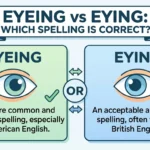
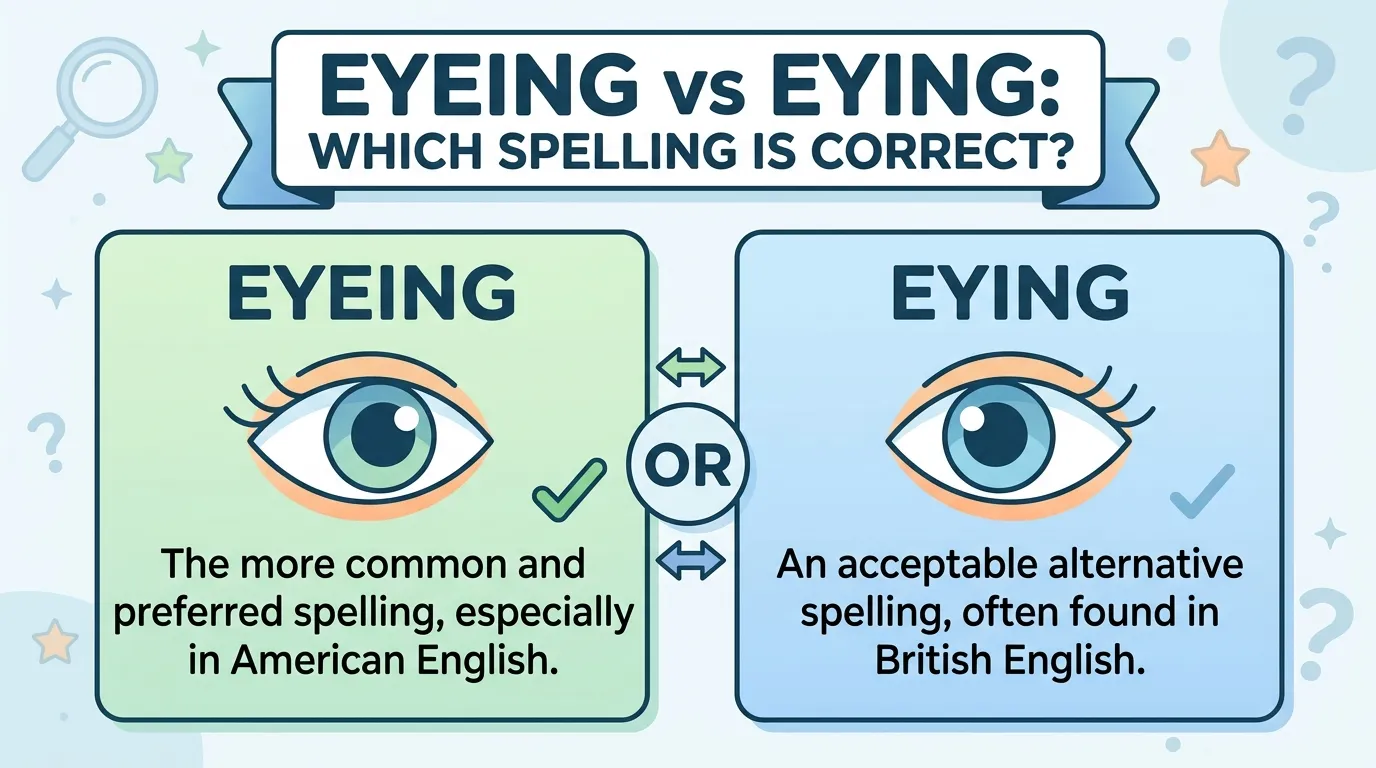
In standard American English, eyeing is the preferred spelling. Eying is also a recognized spelling, especially in British English and some other varieties of English. Both forms come from the verb eye, meaning to look at, watch, observe, or consider someone or something carefully.
For example:
- American English: She was eyeing the last piece of cake.
- British English: She was eying the last piece of cake.
The meaning is the same.
This guide explains eyeing vs eying in detail, including their definitions, pronunciation, grammar, regional differences, history, common mistakes, formal and informal usage, examples, synonyms, and practical recommendations for different types of writing.
Quick Answer: Eyeing vs Eying
Eyeing and eying are both accepted spellings of the present participle of the verb eye.
However, they are not equally common in every variety of English.
| Spelling | Correct? | Common preference | Meaning |
|---|---|---|---|
| eyeing | Yes | American English | Looking at or considering carefully |
| eying | Yes | British English and some other varieties | Looking at or considering carefully |
Which one should you use?
If you are writing for an American audience, use eyeing.
If you are following British English spelling, eying is a common choice.
The important rule is consistency. Do not switch between the two forms randomly in the same piece of writing.
What Does Eyeing Mean?
Eyeing is the present participle or gerund form of the verb eye.
As a verb, eye means to look at someone or something closely, carefully, or with particular interest.
For example:
The dog was eyeing the sandwich.
This does not simply mean that the dog happened to see the sandwich. It suggests that the dog was watching it with interest, perhaps because it wanted to eat it.
Another example:
Mark was eyeing the new laptop.
Here, Mark is looking at the laptop with interest. He may be considering buying it.
Dictionary-style definition
Eyeing: looking at, watching, observing, or considering someone or something with attention or interest.
Depending on context, eyeing can suggest:
- Interest
- Desire
- Suspicion
- Evaluation
- Attention
- Curiosity
- Observation
- Intention
What Does Eying Mean?
Eying has essentially the same meaning as eyeing.
It is also the present participle or gerund form of eye.
For example:
She was eying the expensive dress in the store window.
The sentence means that she was looking at the dress with interest.
The spelling eying is especially associated with British usage, although actual usage can vary by writer, publication, and style guide.
Important point
Eying does not represent a different action from eyeing.
The difference is primarily orthographic:
eye → eyeing
eye → eying
Both forms represent the same verb form.
Why Are Eyeing and Eying Confused?
The confusion comes from the unusual spelling of the base word eye.
Many English verbs form their present participle by adding -ing:
- make → making
- take → taking
- write → writing
- hope → hoping
Because eye ends with a silent e, some writers naturally assume that the final e should disappear:
- eye → eying
That follows a familiar English spelling pattern.
However, eye is also closely connected to the noun eye, the body organ. Keeping the e produces:
- eye → eyeing
This spelling makes the relationship with the base word immediately visible.
That is why both spellings developed and continue to appear.
Eyeing vs Eying: The Main Difference
The simplest way to understand the distinction is this:
Eyeing and eying have the same meaning but can reflect different spelling preferences.
There is no major grammatical or semantic distinction between them.
Compare:
The customer was eyeing the new phone.
and:
The customer was eying the new phone.
Both mean that the customer was looking at the phone with interest.
The practical difference
The main difference is regional and stylistic preference.
Eyeing is generally the safer choice for American English.
Eying is widely recognized in British English and other international English contexts.
Eyeing vs Eying in American English
For American English writing, eyeing is generally the preferred form.
Use it in:
- American blogs
- Business writing
- School assignments
- News articles
- Marketing copy
- Social media content
- General websites
- Professional communication
Examples:
Investors are eyeing the company’s latest expansion plan.
The player was eyeing a place in the starting lineup.
She was eyeing the chocolate cake.
The company is eyeing international markets.
For an American audience, eyeing is usually the most natural and recognizable choice.
Eyeing vs Eying in British English
British English commonly uses eying.
For example:
The club is eying a place in the final.
She was eying the new handbag.
Several companies are eying the growing market.
That said, eyeing is not necessarily incomprehensible or unusable in British writing. English spelling varies across publications and individual writers.
Therefore, the safest rule is not to think of one form as universally “right” and the other as universally “wrong.”
Instead, think of them as variant spellings.
Is Eyeing or Eying More Correct?
If your question is, “Which spelling should I use?” the answer depends on your audience.
For American English
Use:
eyeing
For British English
eying is a standard and common option.
For international English
Either may be understood, but eyeing is often a useful choice when your goal is to follow American English conventions.
For SEO content
Choose the spelling that matches your target audience and editorial style.
If your website primarily serves readers in the United States, use eyeing as your main spelling.
Eyeing vs Eying Pronunciation
Both spellings are pronounced the same way.
The spelling difference does not create a different pronunciation.
The word has two syllables, with the stress on the first syllable.
You can think of it as the sound of eye followed by an -ing ending.
Because eyeing and eying have the same pronunciation, you cannot hear the spelling difference in normal speech.
This is one reason the two forms can easily become confused in writing.
What Is the Grammatical Role of Eyeing?
Eyeing can function as a present participle or gerund.
Eyeing as a present participle
A present participle can be used with a form of be to create a progressive verb tense.
She is eyeing the new apartment.
They were eyeing the championship.
The cat is eyeing the bird.
In these examples, eyeing forms part of the verb phrase.
Eyeing as a gerund
A gerund is an -ing form that functions as a noun.
Eyeing the competition can help businesses understand market trends.
Here, eyeing the competition functions as the subject of the sentence.
Another example:
His constant eyeing of the clock made the meeting feel awkward.
In this sentence, eyeing is part of a noun phrase.
How Eyeing Is Used in Everyday English
The verb eye is very flexible.
It can describe a simple physical look, but it often suggests that the person is paying special attention to something.
Looking with interest
She was eyeing the shoes on the shelf.
Wanting something
The children were eyeing the cookies.
Considering an opportunity
The company is eyeing a major expansion.
Watching someone suspiciously
The security guard was eyeing the stranger.
Competing for something
Several teams are eyeing the final playoff spot.
The context tells you why the person is looking.
Literal vs Figurative Meaning of Eyeing
Literal meaning
The literal meaning involves physically looking at something.
The cat was eyeing the bird through the window.
The cat is actually watching the bird.
Figurative meaning
The word can also mean considering, targeting, or planning to obtain something.
The company is eyeing a larger share of the market.
The company is not literally staring at the market. It is considering or pursuing that goal.
Another example:
She is eyeing a promotion.
This means she wants or is considering pursuing a promotion.
This figurative use is especially common in journalism, business writing, sports reporting, and political reporting.
Eyeing in Business and Professional Writing
Eyeing is particularly common in business journalism.
Writers often use it to describe a company or investor considering a goal.
Common expressions include:
- eyeing expansion
- eyeing growth
- eyeing new markets
- eyeing a merger
- eyeing an acquisition
- eyeing higher profits
- eyeing international customers
- eyeing a larger market share
Examples:
The company is eyeing expansion across the Midwest.
Investors are eyeing higher returns next year.
The retailer is eyeing new markets in Asia.
In professional writing, eyeing can sound concise and active.
Eyeing in Sports Writing
Sports journalists frequently use eyeing to describe athletes or teams pursuing a goal.
Examples:
The team is eyeing its third championship.
The striker is eyeing a starting position.
The athlete is eyeing a return to competition.
Several teams are eyeing the talented young player.
Sports headlines often favor this construction because it communicates ambition in very few words.
Eyeing in Political Writing
Political and news writing also uses eyeing frequently.
Examples:
The senator is eyeing a presidential campaign.
The party is eyeing several competitive districts.
Leaders are eyeing a possible agreement.
The expression usually means considering, pursuing, targeting, or preparing for something.
In this context, eyeing is figurative rather than literal.
Eyeing in Technical Writing
Technical writing requires more care.
The literal verb eye is understandable, but technical documents often benefit from greater precision.
Instead of:
The engineer is eyeing the system for possible problems.
a technical document might say:
The engineer is inspecting the system for possible problems.
Or:
The engineer is evaluating the system for potential faults.
This does not mean eyeing is incorrect. It simply means that more precise verbs may be better in highly technical contexts.
Formal vs Informal Usage
Eyeing is neither strongly slang nor highly informal.
It works across a broad range of contexts.
| Context | Eyeing | Better alternative when precision matters |
|---|---|---|
| Casual conversation | Natural | Looking at |
| Blog writing | Natural | Considering |
| News | Very common | Monitoring |
| Business | Common | Considering |
| Academic writing | Acceptable but sometimes informal | Examining |
| Technical writing | Understandable | Inspecting |
| Legal writing | Less precise | Evaluating |
| Sports journalism | Very common | Pursuing |
The best choice depends on the intended tone.
Synonyms for Eyeing
The right synonym depends on the intended meaning.
When eyeing means looking at
- Looking at
- Watching
- Observing
- Viewing
- Inspecting
- Studying
- Examining
- Gazing at
When eyeing means considering
- Considering
- Contemplating
- Evaluating
- Assessing
- Exploring
- Weighing
When eyeing means wanting
- Wanting
- Coveting
- Desiring
- Targeting
- Pursuing
When eyeing means monitoring
- Watching
- Monitoring
- Tracking
- Following
- Observing
For example:
The company is eyeing a new market.
Possible alternatives include:
The company is considering a new market.
The company is targeting a new market.
The company is exploring a new market.
The exact synonym changes the tone and meaning slightly.
Antonyms of Eyeing
There is no single perfect antonym because eyeing has several meanings.
Depending on context, possible opposites include:
- Ignoring
- Overlooking
- Avoiding
- Neglecting
- Disregarding
- Dismissing
- Avoiding attention to
For example:
The manager was eyeing the problem.
Opposite:
The manager was ignoring the problem.
Common Collocations With Eyeing
A collocation is a group of words that commonly appears together.
Some natural combinations include:
- eyeing the prize
- eyeing a promotion
- eyeing a position
- eyeing a target
- eyeing an opportunity
- eyeing expansion
- eyeing growth
- eyeing a comeback
- eyeing victory
- eyeing the competition
- eyeing a purchase
- eyeing a new market
- eyeing a deal
- eyeing a championship
- eyeing a career change
Examples
The athlete is eyeing victory.
The company is eyeing expansion.
She is eyeing a promotion.
The team is eyeing the championship.
These expressions sound natural because eyeing often implies focused attention toward a desired result.
Common Expressions With Eye
The verb eye appears in several familiar expressions.
Keep an eye on
This means to watch or monitor something.
Please keep an eye on the children.
Keep your eyes open
This means to stay alert.
Keep your eyes open for any changes.
In the public eye
This means being widely known or watched by the public.
Celebrities often live in the public eye.
An eye for something
This means having a talent for noticing or selecting something.
She has an eye for design.
Catch someone’s eye
This means to attract someone’s attention.
The bright sign caught my eye.
These expressions are related to the broader idea of paying attention through sight.
Word History and Etymology
The noun eye is one of the oldest and most deeply established words in English.
It comes from Old English ēage, which referred to the organ of sight. It is related to similar words in other Germanic languages.
The verb eye developed from the noun. In English, using a body-part noun as a verb is not unusual.
For example:
- hand → to hand
- shoulder → to shoulder
- eye → to eye
The verb eye came to mean looking at something carefully or attentively.
The present participle then developed with the familiar -ing ending.
Because English spelling conventions have changed over time, both eyeing and eying have appeared in written English.
Why Does Eye Become Eyeing Instead of Eying?
This is one of the most interesting spelling questions surrounding the word.
Normally, English drops a final silent e before adding -ing:
- hope → hoping
- write → writing
- move → moving
That rule might suggest:
eye → eying
But English spelling is not completely mechanical. Some words retain letters to make their relationship with the base form clearer.
Eyeing preserves the visual identity of the word eye.
As a result, writers encounter both forms.
The spelling eyeing can be especially intuitive because it clearly contains the noun eye.
Eyeing vs Eying: Comparison Table
| Feature | Eyeing | Eying |
|---|---|---|
| Base verb | eye | eye |
| Meaning | Looking at or considering | Looking at or considering |
| Pronunciation | Same | Same |
| Grammar | Present participle/gerund | Present participle/gerund |
| American English | Preferred | Less common |
| British English | Used | Common/preferred by many writers |
| Informal use | Fine | Fine |
| Formal use | Fine | Fine |
| Meaning difference | None | None |
The central takeaway is simple: there is no difference in meaning.
Common Mistakes With Eyeing and Eying
Mistake 1: Saying one spelling is always wrong
Incorrect assumption:
“Eying is always misspelled.”
That is too broad.
Eying is an established spelling variant.
Mistake 2: Assuming they have different meanings
They do not normally have different meanings.
She was eyeing the cake.
and
She was eying the cake.
communicate the same basic idea.
Mistake 3: Mixing styles without a reason
A document might contain:
The company is eyeing expansion.
and later:
The team is eying a new player.
This is not necessarily grammatically wrong, but it creates an inconsistent spelling style.
Choose one convention and stick with it.
Mistake 4: Using eyeing when a more precise verb is needed
Consider:
The scientist was eyeing the chemical reaction.
If you mean the scientist was conducting a careful scientific observation, observing or monitoring may be more precise.
Awkward vs Natural Examples
Awkward
The company was eyeing at the new market.
Natural
The company was eyeing the new market.
The verb eye does not normally require at in this construction.
Awkward
She eyed on the expensive necklace.
Natural
She eyed the expensive necklace.
Again, eye generally takes the object directly.
Awkward
The player is eyeing to win the tournament.
More natural
The player is hoping to win the tournament.
Or:
The player is eyeing a tournament victory.
The structure eyeing + noun phrase is usually more natural than eyeing to + verb.
Eyeing vs Looking At
These words are related but not identical.
Looking at is neutral.
She was looking at the painting.
Eyeing often suggests stronger attention or a particular intention.
She was eyeing the painting.
The second sentence can suggest that she was evaluating it, considering buying it, admiring it, or otherwise paying special attention to it.
Eyeing vs Watching
Watching usually suggests sustained attention to something that is moving or changing.
We were watching the game.
Eyeing often focuses on a target.
The player was eyeing the goal.
This distinction is not absolute, but it helps explain why eyeing can sound more purposeful.
Eyeing vs Staring
Staring suggests looking continuously and often intensely.
Eyeing is usually less extreme.
Compare:
He was eyeing the door.
This may mean he was considering leaving.
He was staring at the door.
This emphasizes prolonged visual attention.
Eyeing vs Observing
Observing sounds more neutral, formal, and analytical.
The researcher was observing the participants.
Eyeing is more conversational and can imply personal interest or intention.
The researcher was eyeing the results.
For academic writing, observing, examining, or evaluating may often be preferable when precision matters.
Eyeing in Academic Writing
Academic writers should consider whether eyeing communicates the intended idea precisely.
For example:
Researchers are eyeing new approaches to climate modeling.
This is understandable, but a formal academic version might be:
Researchers are examining new approaches to climate modeling.
Or:
Researchers are evaluating new approaches to climate modeling.
For a general-interest academic article, eyeing can still be perfectly acceptable.
The issue is not correctness. It is register and precision.
Eyeing in Journalism
Eyeing is especially effective in headlines because it is short and energetic.
Examples:
Tech Firm Eyeing International Expansion
Rookie Quarterback Eyeing Starting Role
Investors Eyeing Rate Decision
Journalists often use the related base form eye in headlines because headlines favor concise language.
In regular prose, you may see:
Investors are eyeing the next interest-rate decision.
Eyeing in Blogging and Content Marketing
For blogs, eyeing is usually natural and reader-friendly.
Examples:
If you’re eyeing a new laptop, compare these features first.
Are you eyeing your dream job?
If you’re eyeing a career change, start by updating your résumé.
This use is often figurative and means considering or wanting something.
Eyeing in Casual Conversation
In everyday speech, eyeing is common and easy to understand.
Examples:
Why are you eyeing my fries?
I’ve been eyeing that jacket all week.
She’s eyeing the last cookie.
In casual English, the word can even sound playful.
I saw you eyeing that dessert!
The speaker is jokingly suggesting that someone wants the dessert.
Memory Trick for Eyeing vs Eying
If you are writing American English, use this simple memory trick:
The word eye keeps its eye in eyeing.
Think:
eye + ing = eyeing
If you are following British spelling conventions, remember that:
eying is also an accepted form.
The key is not to memorize one spelling as the only possible answer. Instead, remember the regional preference.
How to Choose the Right Spelling
Use this decision guide:
Choose “eyeing” when:
- Your audience is American.
- You are writing for a U.S. website.
- You are writing American school or business material.
- Your publication uses American English.
- You want the most familiar American spelling.
Choose “eying” when:
- You are following British English conventions.
- Your publication’s style guide prefers it.
- You are writing consistently in a British spelling system.
If you are unsure
For general American English, choose eyeing.
It is the clearest default for U.S.-focused writing.
Which Spelling Is Better for SEO?
For SEO, spelling should follow the language variety and search audience you are targeting.
If your website targets American readers, make eyeing your primary spelling.
You can still mention eying naturally because users may search for:
- eyeing vs eying
- is eyeing correct
- is eying a word
- eyeing meaning
- eying meaning
- eyeing definition
- eying vs eyeing
- eyeing spelling
- correct spelling of eyeing
Do not repeatedly force both spellings into every paragraph. Search engines are good at understanding related forms and search intent.
A useful article should answer the reader’s question naturally rather than repeat the keyword.
American vs British English: Practical Guide
| Writing situation | Recommended spelling |
|---|---|
| U.S. website | eyeing |
| American school assignment | eyeing |
| U.S. business email | eyeing |
| American news article | eyeing |
| British publication | eying is common |
| British-style content | eying is appropriate |
| International website | Choose one style consistently |
| Academic writing | Follow the required style guide |
| SEO content | Match target audience |
| Casual writing | Either, depending on regional style |
Real-World Sentence Examples
Here are examples showing the range of meanings.
Interest
The customer was eyeing the new smartphone.
Desire
The children were eyeing the cookies.
Business ambition
The company is eyeing international growth.
Sports ambition
The runner is eyeing another gold medal.
Career ambition
She is eyeing a management position.
Competition
Several teams are eyeing the young midfielder.
Suspicion
The guard was eyeing the visitor carefully.
Opportunity
Investors are eyeing opportunities in renewable energy.
Purchase
I’ve been eyeing that car for months.
Figurative target
The startup is eyeing a larger share of the market.
Better Alternatives to Eyeing in Formal Writing
If you need a more formal or precise expression, choose according to your meaning.
Instead of:
The researchers are eyeing new solutions.
You might write:
- The researchers are examining new solutions.
- The researchers are evaluating new solutions.
- The researchers are investigating new solutions.
- The researchers are considering new solutions.
Instead of:
The company is eyeing expansion.
You could write:
- The company is considering expansion.
- The company is planning expansion.
- The company is pursuing expansion.
- The company is exploring expansion opportunities.
However, do not replace eyeing automatically. In many contexts, it is concise, natural, and perfectly appropriate.
Frequently Asked Questions
Is “eyeing” the correct spelling?
Yes. Eyeing is a correct spelling, and it is generally the preferred form in American English. It means looking at, watching, considering, or showing interest in someone or something.
Is “eying” a real word?
Yes. Eying is an established spelling of the present participle of eye. It is particularly common in British English and some other varieties of English.
Is eyeing or eying preferred in American English?
Eyeing is generally preferred in American English. If you are writing for a U.S. audience, eyeing is the safest choice.
Is eying British or American?
Eying is strongly associated with British English usage, although English spelling preferences can vary among individual writers and publications.
Do eyeing and eying have different meanings?
No. They normally have the same meaning. Both mean looking at, watching, considering, or showing interest in something.
How do you pronounce eyeing?
Both eyeing and eying have the same pronunciation. The spelling difference does not normally change how the word is spoken.
Is “eyeing” formal or informal?
Eyeing works in both casual and professional contexts. It is especially common in journalism, business writing, sports reporting, and everyday conversation. In highly technical or academic writing, a more precise verb may sometimes be preferable.
Can I use eyeing in academic writing?
Yes, but consider the context. If you mean carefully studying something, examining, observing, or evaluating may be more precise. If you mean considering an opportunity or goal, eyeing can be natural.
Why does eye become eyeing?
English spelling does not always follow one perfectly consistent rule. Although many verbs drop a final silent e before -ing, eyeing retains the connection to the noun and verb eye. Eying also developed as a valid spelling variant.
Which should I use: eyeing or eying?
For American English, use eyeing. For British English, eying is a common choice. Above all, follow your publication or style guide and remain consistent.
Conclusion
The debate over eyeing vs eying is much simpler once you know the basic rule: both spellings are accepted, and both have the same meaning. The main difference is regional and stylistic preference.
For American English, eyeing is the recommended default. It clearly preserves the connection to the word eye and is familiar to U.S. readers. Eying, meanwhile, is an established alternative that is especially common in British English.
Both forms can mean looking at something with interest, watching something carefully, considering an opportunity, or pursuing a goal. You will see eyeing frequently in business, sports, journalism, blogging, and everyday conversation.
When choosing between them, think about your audience first. If you are writing for Americans, choose eyeing. If you are following British English conventions, eying may be the better fit. In either case, consistency matters more than trying to treat one spelling as universally correct.
The easiest American-English memory trick is simple: eye keeps its eye in eyeing. When in doubt, use eyeing for U.S.-focused writing, and you will have the spelling that best matches standard American usage.