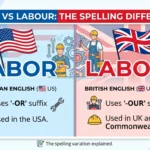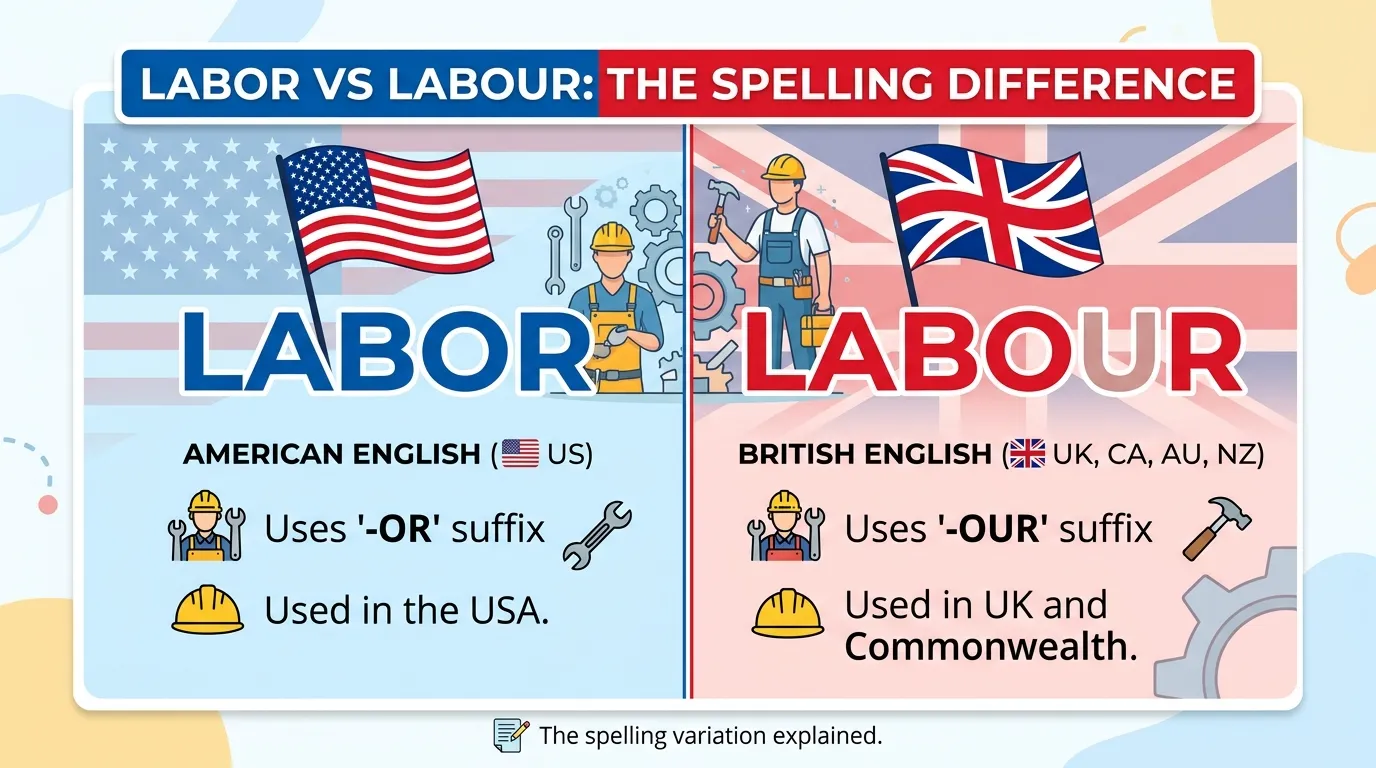
If you’ve ever wondered whether labor or labour is the correct spelling, the good news is that both are correct. The difference is mainly regional.
Labor is the standard spelling in American English, while labour is the standard spelling in British English and many other varieties of English, including Australian and Canadian English in many contexts.
The two words have the same basic meanings, pronunciation, grammatical roles, and history. What changes is the spelling preference used in different English-speaking regions.
For example:
- American English: The workers demanded better labor conditions.
- British English: The workers demanded better labour conditions.
The same distinction appears in related words:
- labor → American English
- labour → British English
- laborer → American English
- labourer → British English
- labor union → American English
- labour union → British English
In this guide, you’ll learn exactly when to use labor vs labour, what each word means, how the spellings developed, how they differ across countries, and which version you should choose in academic, business, professional, journalistic, and everyday writing.
Quick Answer: Labor vs Labour
Labor and labour mean the same thing. The main difference is English variety.
| Word | Main English Variety | Example |
|---|---|---|
| labor | American English | Physical labor can be difficult. |
| labour | British English | Physical labour can be difficult. |
The easiest rule to remember
Use “labor” for American English and “labour” for British English.
The meaning does not normally change because of the spelling.
So, if you are writing for a US audience, choose labor. If you are writing for a UK audience, choose labour.
What Does Labor Mean?
Labor is the American English spelling of the word. It can function as both a noun and a verb.
As a noun, labor can mean:
- Work or physical effort
- Human effort used to produce goods or services
- Workers considered as a group
- The process of giving birth
- Hard or difficult work
For example:
Building the house required months of hard labor.
Here, labor means physical work or effort.
It can also refer to workers:
The company is facing a shortage of skilled labor.
In medical contexts, labor refers to the process of childbirth:
She went into labor early in the morning.
As a verb, labor means to work hard or make a great effort.
They labored for years to complete the project.
What Does Labour Mean?
Labour is the spelling commonly used in British English.
It has the same basic meanings as labor.
As a noun:
The construction project required a lot of manual labour.
As a verb:
They laboured through difficult conditions to finish the work.
It can also refer to childbirth:
She went into labour during the night.
In both examples, labour means exactly what labor means in American English.
The extra u is a spelling difference, not a difference in meaning.
Labor vs Labour: Key Differences
The most important difference is where the spelling is preferred.
| Feature | Labor | Labour |
|---|---|---|
| American English | ✅ Standard | ❌ Usually not used |
| British English | ❌ Usually not used | ✅ Standard |
| Meaning | Work, effort, childbirth, workers | Same |
| Pronunciation | Same | Same |
| Part of speech | Noun and verb | Noun and verb |
| Related adjective | Labor-related | Labour-related |
| Worker | Laborer | Labourer |
| Union | Labor union | Labour union |
| Main difference | Spelling | Spelling |
There is no general difference in pronunciation.
There is also no major difference in the core dictionary meaning.
Why Do People Confuse Labor and Labour?
The confusion exists because English has developed into several major regional varieties.
American and British English share most of their vocabulary, but they developed different spelling conventions over time.
You may already know similar differences:
- color vs colour
- favor vs favour
- honor vs honour
- center vs centre
- organize vs organise
- traveling vs travelling
Labor vs labour belongs to the same general pattern.
American English often uses shorter spellings in words ending in -our, while British English often retains the u.
That is why American English uses labor, whereas British English generally uses labour.
Labor vs Labour in American English
If you’re writing in American English, use labor.
This applies to most types of writing:
- School assignments
- Business documents
- Websites
- Blogs
- News articles
- Reports
- Emails
- Technical writing
- Academic writing
- Marketing content
- Professional documents
American English examples
- The company needs more labor.
- Manual labor can be physically demanding.
- The factory has high labor costs.
- The project requires skilled labor.
- She went into labor at midnight.
- The company has a strong labor union.
- The labor market has changed significantly.
- They hired a laborer to help with construction.
If your target readers are primarily in the United States, labor is the safest and most natural choice.
Labor vs Labour in British English
If you’re writing for readers in the United Kingdom, use labour.
For example:
- Manual labour can be demanding.
- The company has rising labour costs.
- The country is experiencing changes in the labour market.
- The project requires skilled labour.
- She went into labour last night.
- The construction site needs more labourers.
British English also uses labour in formal and professional contexts.
For UK-focused content, consistently using labour makes your writing look natural and regionally appropriate.
Is Labor or Labour Correct?
Both are correct.
The correct choice depends on the variety of English you’re using.
Choose labor when:
- Writing for Americans
- Using US English
- Creating content for a US website
- Writing a US business report
- Completing an American school assignment
- Writing for American media
Choose labour when:
- Writing for British readers
- Using UK English
- Writing for a British publication
- Creating UK-focused content
- Following British spelling conventions
Neither spelling is inherently more correct than the other.
The key is consistency.
Labor vs Labour Pronunciation
Although the spelling is different, labor and labour are generally pronounced the same.
The difference is primarily visible in writing.
The word has two syllables, with the stress on the first syllable.
For labour, British pronunciation follows the same basic sound pattern.
The ending does not receive a separate spoken sound simply because British English keeps the u in the spelling.
This is similar to color and colour. The spelling changes, but the pronunciation remains essentially the same.
Labor vs Labour as a Noun
Both words can be nouns.
They can describe work, effort, workers, or childbirth, depending on context.
Work or physical effort
American:
The job requires heavy labor.
British:
The job requires heavy labour.
Workers as a group
American:
The company depends on skilled labor.
British:
The company depends on skilled labour.
Childbirth
American:
She was in labor for several hours.
British:
She was in labour for several hours.
The grammatical function and meaning remain the same.
Labor vs Labour as a Verb
Both spellings can also function as verbs.
The verb means to work hard, make a great effort, or sometimes struggle with something.
American English
They labored under difficult conditions.
British English
They laboured under difficult conditions.
Another example:
American:
He labored over the report for days.
British:
He laboured over the report for days.
Again, only the spelling changes.
Labor vs Labour in Childbirth
One important meaning of the word is the process of giving birth.
In American English, the spelling is:
labor
In British English, it is:
labour
Common American expressions
- Go into labor
- Be in labor
- Early labor
- Active labor
- Labor pains
- Labor contractions
Common British expressions
- Go into labour
- Be in labour
- Early labour
- Active labour
- Labour pains
- Labour contractions
For medical content, always consider the audience and style guide before selecting the spelling.
If your healthcare website targets US patients, labor is appropriate. For a UK audience, labour is generally preferred.
Labor vs Labour in the Workplace
Both spellings are common when discussing employment and workers.
Common phrases include:
American English
- Labor costs
- Labor force
- Labor market
- Labor shortage
- Labor productivity
- Labor dispute
- Labor rights
- Labor union
- Skilled labor
- Manual labor
British English
- Labour costs
- Labour force
- Labour market
- Labour shortage
- Labour productivity
- Labour dispute
- Labour rights
- Labour union
- Skilled labour
- Manual labour
Notice the pattern: the spelling changes, but the underlying phrase remains the same.
Labor vs Labour in Economics
Economics frequently uses this word to describe human work and employment.
For example:
Labor is an important factor of production.
In British English:
Labour is an important factor of production.
Common economic terms include:
- Labor market
- Labor supply
- Labor demand
- Labor productivity
- Labor force
- Labor costs
- Labor economics
- Labor mobility
British English generally writes these with labour.
American English generally writes them with labor.
Example
US English:
Changes in the labor market can affect wages.
UK English:
Changes in the labour market can affect wages.
Labor vs Labour in Politics
The word also appears in political contexts.
In American English, labor is often associated with workers, unions, and employment policy.
Examples include:
- Labor movement
- Labor rights
- Labor unions
- Labor policy
- Labor legislation
- Labor relations
However, Labour can also refer to the British political party known as the Labour Party.
This is an important contextual distinction.
American usage
The debate focused on labor rights.
British political usage
The Labour Party announced its policy.
Here, Labour is not simply a regional spelling choice. It is part of the official name of a political organization.
Therefore, proper names should retain their established spelling.
Labor vs Labour in Sports
The word is less common in everyday sports language, but it can describe physical effort.
For example:
The players labored through the final minutes of the game.
In American English, you would normally write:
The players labored through the final minutes of the game.
In British English:
The players laboured through the final minutes of the game.
It may also appear in phrases describing difficult work or effort:
- Labor through a difficult game
- Labor to maintain a lead
- Labor under pressure
In casual sports writing, simpler words such as work, struggle, or fight may sound more natural.
Formal vs Informal Usage
Labor/labour is a normal word in both formal and informal English, but its best alternative depends on context.
Formal
The company is experiencing rising labor costs.
More conversational
The company is spending more money on workers.
Formal
The project requires significant manual labor.
More conversational
The project takes a lot of physical work.
Neither labor nor labour is automatically too formal for everyday conversation.
However, work is often simpler and more natural in casual speech.
Labor vs Labour: Tone and Register
The spelling itself doesn’t make the word more formal or informal.
For example:
Hard labor can be exhausting.
and
Hard labour can be exhausting.
Both have the same tone. The difference is regional spelling.
However, phrases involving economics, employment law, or industrial relations can sound more formal because of the subject itself.
Compare:
He does a lot of labor around the house.
with:
The report analyzes labor productivity across several industries.
The second sentence is more formal because of its context, not because of the spelling.
Labor vs Labour: Dictionary-Style Definitions
Labor — noun
Definition: Work, especially physical or demanding work; human effort used to produce goods or services; workers collectively; or the process of childbirth.
Example:
The project required a large amount of labor.
Labor — verb
Definition: To work hard, make a great effort, or struggle to accomplish something.
Example:
They labored for months to finish the building.
Labour — noun
Definition: The British spelling of labor.
Example:
The project required a large amount of labour.
Labour — verb
Definition: The British spelling of labor.
Example:
They laboured for months to finish the building.
The History of Labor and Labour
Both spellings ultimately come from the same word family.
The English word developed from older forms connected to work, exertion, and effort. It has roots in Latin labor, meaning work, exertion, or hardship.
Over centuries, English spelling developed differently in different regions.
British English retained the -our spelling in words such as:
- labour
- colour
- honour
- favour
American English later favored shorter spellings in many of these words:
- labor
- color
- honor
- favor
The difference became strongly associated with American spelling practices, particularly through the influence of American dictionary and publishing traditions.
So labor and labour aren’t two different words that happen to look alike. They’re regional spellings of the same word.
Labor vs Labour and Related Words
The spelling difference continues into related vocabulary.
| American English | British English |
|---|---|
| labor | labour |
| laborer | labourer |
| laboring | labouring |
| labor-intensive | labour-intensive |
| labor force | labour force |
| labor market | labour market |
| labor union | labour union |
| labor costs | labour costs |
| labor relations | labour relations |
If you’re writing in one variety of English, don’t switch between forms randomly.
For example, using labor market and labour costs in the same US-focused article may look inconsistent unless you’re discussing regional differences.
Common Collocations With Labor and Labour
A collocation is a group of words that commonly appear together.
Knowing common collocations helps you sound more natural.
Common American English collocations
- Manual labor
- Physical labor
- Skilled labor
- Unskilled labor
- Cheap labor
- Forced labor
- Child labor
- Labor costs
- Labor market
- Labor force
- Labor shortage
- Labor dispute
- Labor union
- Labor rights
- Labor productivity
- Labor law
- Labor relations
British English equivalents
- Manual labour
- Physical labour
- Skilled labour
- Unskilled labour
- Cheap labour
- Forced labour
- Child labour
- Labour costs
- Labour market
- Labour force
- Labour shortage
- Labour dispute
- Labour union
- Labour rights
- Labour productivity
- Labour law
- Labour relations
Common Phrases With Labor/Labour
Here are some useful expressions.
Labor-intensive / labour-intensive
This describes something that requires a large amount of human work.
Farming can be a labor-intensive industry.
British:
Farming can be a labour-intensive industry.
Manual labor / manual labour
This refers to work that mainly involves physical effort.
Manual labor can be demanding.
Child labor / child labour
This refers to the employment of children, especially in conditions considered harmful or exploitative.
The organization works to prevent child labor.
Forced labor / forced labour
This refers to work performed under coercion or threats.
International organizations continue to fight forced labor.
Labor vs Labour: Synonyms
Depending on the context, you can replace labor/labour with several words.
Synonyms for work or effort
- Work
- Effort
- Exertion
- Toil
- Endeavor
- Activity
- Employment
- Occupation
Synonyms for workers
- Workforce
- Employees
- Staff
- Workers
- Personnel
- Employees
Be careful, though. These words aren’t always perfect substitutes.
For example, labor force and workforce are often similar, but technical definitions can differ depending on the context.
Antonyms of Labor/Labour
There isn’t one universal antonym because the word has several meanings.
When labor means work, possible opposites include:
- Rest
- Leisure
- Idleness
- Relaxation
- Inactivity
For example:
After months of labor, they finally took some time to rest.
Here, rest provides a natural contrast with labor.
Labor vs Labour: Common Mistakes
Mistake 1: Treating one spelling as wrong
❌ Labour is always incorrect.
✅ Labour is correct in British English and several other varieties.
❌ Labor is always incorrect.
✅ Labor is the standard American spelling.
Mistake 2: Mixing regional spellings
❌ The company analyzed the labor market and rising labour costs in the United States.
If you’re writing entirely in American English, use:
✅ The company analyzed the labor market and rising labor costs in the United States.
For British English:
✅ The company analyzed the labour market and rising labour costs in the United Kingdom.
Mistake 3: Changing the spelling based on pronunciation
Some writers assume labour must sound different because it contains an extra letter.
It generally doesn’t.
The u is a spelling difference, not a separate spoken syllable.
Mistake 4: Changing proper names
If you’re referring to an official name, don’t automatically change its spelling to match your preferred regional style.
For example, the Labour Party should retain its established name.
Awkward vs Natural Examples
Example 1
Awkward:
The US company is struggling with a shortage of skilled labour.
Natural for US English:
The US company is struggling with a shortage of skilled labor.
Example 2
Awkward for British English:
The UK economy is facing rising labor costs.
Natural:
The UK economy is facing rising labour costs.
Example 3
American English:
Manual labor is common in the construction industry.
British English:
Manual labour is common in the construction industry.
Both sentences are natural in their respective varieties.
Which Spelling Should You Use for SEO?
For SEO, use the spelling that matches your target audience.
Search engines understand that labor and labour are closely related variants. You don’t need to force both spellings repeatedly into an article.
If targeting the United States
Use:
- labor
- labor costs
- labor market
- labor law
- labor force
If targeting the United Kingdom
Use:
- labour
- labour costs
- labour market
- labour law
- labour force
If your article specifically targets the search query labor vs labour, however, it makes sense to discuss both spellings naturally.
Don’t create awkward sentences just to repeat the keyword.
Labor vs Labour for Bloggers and Content Writers
Bloggers should first identify their target audience.
If most readers are American, choose American spelling throughout the article.
If your audience is British, use British spelling.
For international websites, either variety can work. The most important thing is to establish a consistent editorial style.
For example, don’t write:
Our organization focuses on labor rights and colour discrimination.
That combination may be perfectly intentional in some international contexts, but it can look inconsistent if your site otherwise follows one spelling system.
A consistent style creates a more professional reading experience.
Labor vs Labour in Academic Writing
Academic writing should follow the spelling rules required by your institution, publisher, journal, or chosen style guide.
American academic writing
The study examines changes in the labor market.
British academic writing
The study examines changes in the labour market.
Don’t switch spelling simply because you see the alternative in another academic paper.
Follow the style of the publication you’re writing for.
Labor vs Labour in Business Writing
Businesses should generally match the language variety used by their audience.
US business writing
Rising labor costs have affected the company’s profit margins.
UK business writing
Rising labour costs have affected the company’s profit margins.
This applies to:
- Business reports
- Presentations
- Job descriptions
- Company websites
- HR documents
- Employment policies
- Internal communications
Consistency matters more than choosing one spelling as universally superior.
Labor vs Labour in Journalism
Journalists usually follow the spelling conventions of their publication.
A US newspaper will generally use labor.
A UK newspaper will generally use labour.
Journalistic organizations may also have internal style guides that determine preferred spellings.
If you’re writing for a publication, follow its house style rather than relying only on your personal preference.
Labor vs Labour in Technical Writing
Technical writers should prioritize clarity, consistency, and audience expectations.
For a US software or engineering company:
The system calculates labor requirements.
For a UK engineering company:
The system calculates labour requirements.
If the document is intended for international users, consider whether the audience needs a specific regional spelling.
A Simple Memory Trick for Labor vs Labour
Here’s an easy way to remember the difference:
🇺🇸 America = LABOR
Think:
America drops the U.
So:
labor
🇬🇧 Britain = LABOUR
Think:
Britain keeps the U.
So:
labour
You can also connect it with familiar pairs:
- color → colour
- honor → honour
- favor → favour
- labor → labour
If you remember one pattern, you’ll remember many.
Labor vs Labour: Which One Should You Choose?
Use this quick decision guide.
Choose labor if your audience is:
- American
- US-based
- Primarily using American English
- Reading a US publication
- Working with US business or academic materials
Choose labour if your audience is:
- British
- Primarily using British English
- Reading a UK publication
- Working with British institutions
- Following British spelling conventions
For international audiences
Pick one spelling system and use it consistently.
If your website mainly follows American English, use labor unless you’re discussing a proper name or quoting a source that uses labour.
Labor vs Labour: At-a-Glance Comparison
| Question | Answer |
|---|---|
| Are labor and labour the same word? | Yes, in most contexts. |
| Are both spellings correct? | Yes. |
| Which is American? | Labor |
| Which is British? | Labour |
| Is pronunciation different? | Generally no. |
| Is the meaning different? | Generally no. |
| Can both be nouns? | Yes. |
| Can both be verbs? | Yes. |
| Which should US writers use? | Labor |
| Which should UK writers use? | Labour |
| Which is better for SEO? | Use the regional form matching your audience. |
| Can you mix them? | You can, but consistency is usually better. |
Final Recommendation for Writers
When deciding between labor vs labour, don’t ask which word is more correct.
Ask:
Who am I writing for?
If you’re writing for Americans, use labor.
If you’re writing for British readers, use labour.
If you’re writing for an international audience, choose a consistent English variety based on your site’s editorial style and primary audience.
Most importantly, remember that the difference is spelling, not meaning.
Both words can refer to work, effort, workers, or childbirth. Both can function as nouns and verbs. Both have the same basic origin and are pronounced essentially the same way.
The extra u in labour doesn’t make it more formal, more traditional in every context, or more correct. It simply reflects a different spelling convention.
FAQs
Is labor or labour correct?
Both are correct. Labor is the standard American English spelling, while labour is the standard British English spelling. The two words generally have the same meaning and pronunciation.
What is the difference between labor and labour?
The primary difference is regional spelling. American English normally uses labor, while British English normally uses labour. The meaning is generally the same.
Is labor American or British?
Labor is the standard spelling in American English. British English normally uses labour.
Is labour British English?
Yes. Labour is the standard British English spelling. It is also used in other English varieties influenced by British spelling conventions.
Do labor and labour sound the same?
Yes, they are generally pronounced the same. The extra u in labour changes the spelling but does not normally create a different pronunciation.
Should I use labor or labour in an American article?
Use labor if you’re writing in American English. For example, write labor market, labor costs, and manual labor.
Should I use labor or labour in British English?
Use labour. For example, write labour market, labour costs, and manual labour.
Is Labour only used for work?
No. Labour can refer to work, physical effort, workers, or childbirth. It can also appear in political names, such as the Labour Party.
Why does American English spell labor without a U?
American English adopted spelling conventions that shortened several words traditionally ending in -our. This created forms such as labor, color, honor, and favor, while British English generally retained labour, colour, honour, and favour.
Can I use labor and labour in the same article?
You can when there is a clear reason, such as comparing American and British English or preserving an official name. Otherwise, it’s best to choose one regional spelling and use it consistently.
Conclusion
The difference between labor vs labour is simple once you know the regional spelling rule.
Labor is the standard American English spelling.
Labour is the standard British English spelling.
Both words can mean work, physical effort, human workers, or the process of childbirth. Both can be used as nouns and verbs, and their pronunciation is generally the same.
For American readers, write labor.
For British readers, write labour.
For international readers, select one English variety and stay consistent.
The best spelling isn’t the one that looks more familiar to you. It’s the one that fits your audience, publication, location, and style guide.
Once you remember American = labor and British = labour, you’ll have the key difference mastered.