If you have ever searched for resume vs CV, you are not alone. The two terms are often used as if they mean exactly the same thing, but they can describe different documents depending on the country, industry, and purpose.
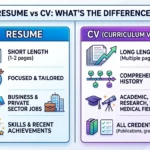
In the United States, a resume is usually a short, targeted document used when applying for jobs. A CV, or curriculum vitae, is typically a longer and more detailed record of academic, research, teaching, and professional achievements.
In the United Kingdom, Ireland, Australia, New Zealand, and some other countries, however, CV is commonly used for the document Americans call a resume. This regional difference is one of the main reasons people become confused.
So, resume and CV are both correct words, but they are not always interchangeable.
This guide explains the difference between a resume and a CV, their meanings, pronunciation, history, regional usage, grammar, common mistakes, examples, and practical advice for choosing the right term.
Quick Answer: Resume vs CV
The simplest answer is:
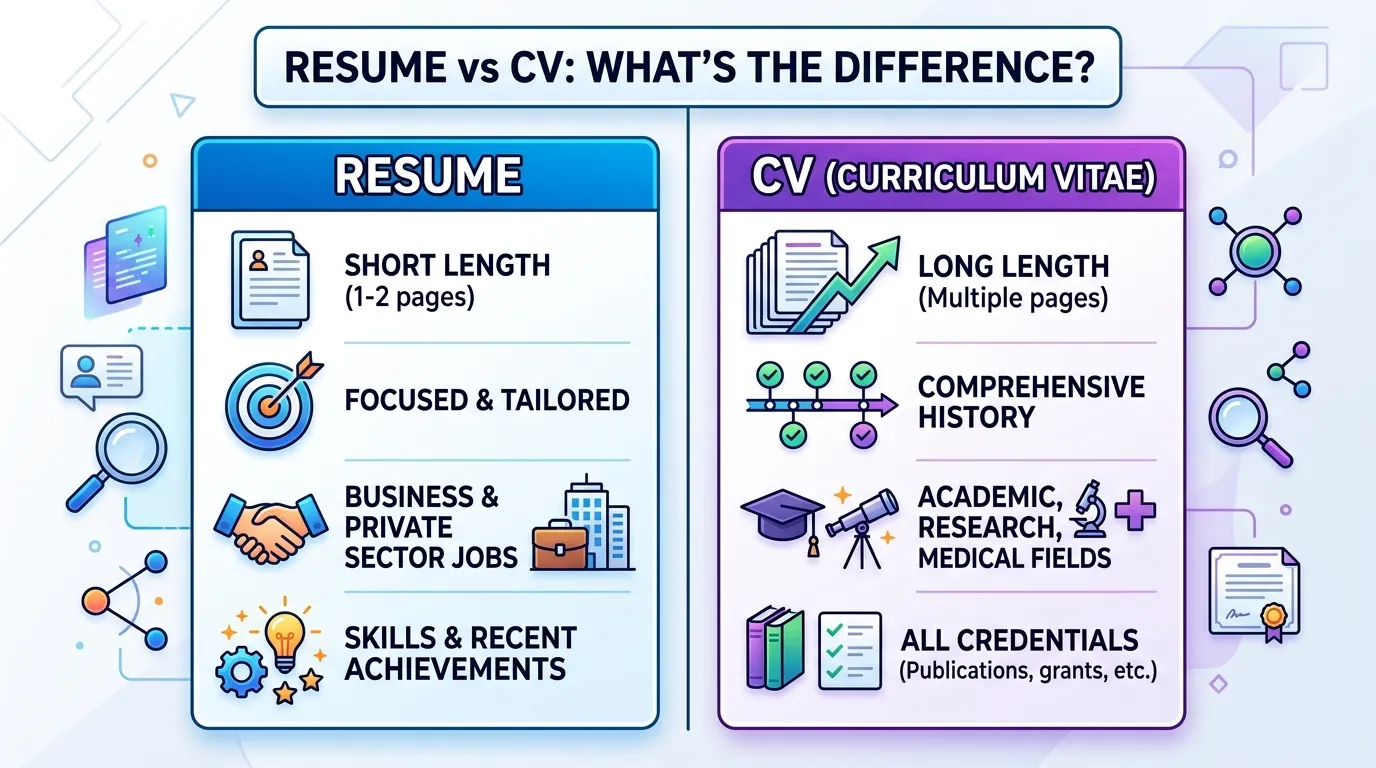
A resume is usually a short, job-focused summary of your experience and qualifications, while a CV can be a more comprehensive record of your academic and professional career.
However, the distinction depends heavily on location.
| Feature | Resume | CV |
|---|---|---|
| Main meaning in the U.S. | Job application document | Detailed academic/professional record |
| Common meaning in the U.K. | Less common term | Job application document |
| Typical length | 1–2 pages | Often several pages |
| Main purpose | Target a specific job | Present a broader career history |
| Common fields | Business, technology, sales, marketing | Academia, research, medicine |
| Focus | Relevant skills and achievements | Comprehensive qualifications and accomplishments |
| Spelling | Resume or résumé | CV |
| Origin | French résumé | Latin curriculum vitae |
The most important rule is simple: follow the terminology used by the country, employer, school, or organization you are dealing with.
What Does “Resume” Mean?
A resume is a document that summarizes a person’s education, work experience, skills, achievements, and qualifications for a particular employment opportunity.
In American English, the resume is usually designed to answer one question:
Why should this employer consider me for this job?
A strong resume does not normally include every detail of a person’s professional life. Instead, it highlights information that is relevant to the position.
For example:
- A marketing resume may emphasize campaign results and communication skills.
- A software developer resume may emphasize programming languages and projects.
- A teacher’s resume may highlight classroom experience and certifications.
- A sales resume may focus on revenue, customer growth, and performance targets.
Dictionary-style definition of resume
Resume, noun: A concise document presenting a person’s education, employment history, skills, qualifications, and achievements, especially for employment purposes.
The word can also have another meaning as a verb:
To resume means to begin again or continue after a pause.
For example:
- The meeting will resume at 2 p.m.
- She resumed work after lunch.
This creates an important distinction between the noun resume and the verb resume.
What Does “CV” Mean?
CV stands for curriculum vitae, a Latin phrase meaning approximately “course of life.”
A CV presents a person’s academic and professional background in greater detail.
In the United States, the term CV is especially common in academic, scientific, medical, research, and higher-education settings.
A CV may include:
- Education
- Research experience
- Academic positions
- Publications
- Conference presentations
- Grants
- Awards
- Teaching experience
- Professional memberships
- Certifications
- Research interests
- Scholarly projects
Unlike a targeted resume, an academic CV can continue growing throughout a person’s career.
Dictionary-style definition of CV
CV, noun: A detailed record of a person’s education, professional experience, academic accomplishments, publications, research, qualifications, and related achievements.
The plural is usually CVs.
For example:
The university asked all applicants to submit their CVs.
Why Do People Confuse Resume and CV?
The confusion exists largely because the terms have different meanings in different English-speaking countries.
An American employer may ask for a resume when applying for a corporate position.
A British employer may ask for a CV for essentially the same type of position.
Therefore, someone from the United States might think:
“A CV is an academic document.”
Someone from the United Kingdom might think:
“A CV is the normal document you send when applying for a job.”
Both interpretations can be correct within their regional contexts.
The biggest source of confusion
The word CV has a relatively stable academic meaning in American English, but its everyday employment meaning is much broader in British English.
That means you should never assume that CV and resume have exactly the same meaning everywhere.
Resume vs CV: The Key Differences
The biggest difference is purpose and level of detail.
A resume is usually selective. A CV is often comprehensive.
Resume
A resume typically:
- Focuses on a particular job
- Highlights relevant experience
- Uses concise descriptions
- Emphasizes measurable achievements
- Is relatively short
- Changes depending on the position
CV
A CV typically:
- Provides a broader professional history
- Gives more attention to academic achievements
- Lists publications and research
- Includes teaching and scholarly activities
- Can become quite long
- May remain relatively stable over time
Consider this example.
Someone applying for a corporate marketing manager position might use:
Resume
The same person applying for a university research position might use:
CV
The person’s career has not changed. The purpose of the document has changed.
Resume vs CV in the United States
In American English, the distinction is particularly useful.
When should you use a resume?
Use a resume for most standard employment applications, including:
- Business jobs
- Retail positions
- Marketing jobs
- Sales roles
- Technology positions
- Administrative jobs
- Customer service positions
- Finance careers
- Management positions
- Many government jobs
When should you use a CV?
A CV is more common for:
- University faculty positions
- Academic research
- Scientific research
- Medical careers
- Fellowships
- Graduate academic applications
- Research grants
- Certain professional or scholarly positions
For example:
Natural: Please attach your resume when applying for the marketing position.
Natural: Please submit your CV with your application for the research fellowship.
Resume vs CV in the UK
British English uses CV much more broadly.
A British employer may say:
Please send us your CV.
This does not necessarily mean that the employer wants an enormous academic document.
It may simply mean a standard job application document containing:
- Employment history
- Education
- Skills
- Qualifications
- Achievements
- Contact information
Therefore, if you are applying for a typical job in the U.K., CV is generally the safer term.
American vs British usage
| Situation | American English | British English |
|---|---|---|
| Standard job application | Resume | CV |
| Academic career | CV | CV |
| Research position | CV | CV |
| Corporate employment | Resume | CV |
| Academic publications | CV | CV |
The actual format can vary, so always read the employer’s instructions.
Resume vs CV in Other Countries
International English can be less predictable.
Many countries use CV as the standard term for employment applications. In some regions, resume is understood but less common.
For international applications, the safest approach is to follow the vocabulary used in the job advertisement.
If the employer says:
“Submit your CV.”
Submit a CV.
If the employer says:
“Upload your resume.”
Upload a resume.
This is more useful than trying to impose an American or British distinction on every situation.
Is “Resume” or “Résumé” Correct?
Both resume and résumé are accepted ways to write the employment-document noun.
The accented form résumé reflects its French origin.
In modern American English, however, resume without accent marks is extremely common.
You may see:
- Resume
- Résumé
- Resume writing
- Resume builder
- Resume format
- Resume examples
The important point is not to confuse the noun with the verb.
Compare the meanings
Resume as a noun:
I updated my resume yesterday.
Resume as a verb:
We will resume the meeting shortly.
The pronunciation and meaning differ.
How Do You Pronounce “Resume”?
The pronunciation depends on whether you mean the noun or verb.
The employment document resume is pronounced with stress on the final syllable.
The verb resume is also pronounced with final-syllable stress.
The spelling can cause confusion because English uses the same letters for different meanings and grammatical functions.
The accented spelling résumé can make the intended meaning clearer in writing.
What about “CV”?
CV is pronounced by saying the two letters individually.
This is an initialism rather than a word pronounced as one ordinary syllable.
Resume vs CV: Formality and Tone
Both words are professional.
Neither is inherently more formal than the other.
The difference comes mainly from context and regional convention.
For example:
Please send your resume before Friday.
is perfectly professional American English.
Likewise:
Please send your CV before Friday.
is perfectly professional British English.
Calling one word “more formal” than the other can therefore be misleading.
Professional tone depends more on the document itself
A polished resume should:
- Use clear headings
- Avoid unnecessary information
- Use consistent formatting
- Focus on accomplishments
- Match the job description
- Avoid spelling and grammar errors
A professional CV should follow the same basic principles while providing the level of detail expected in its field.
Grammatical Roles of Resume and CV
Resume as a noun
The employment-document meaning of resume is a noun.
Examples:
- I sent my resume.
- Her resume is impressive.
- Please review my resume.
- He created a new resume.
Resume as a verb
Resume can also function as a verb meaning “continue.”
Examples:
- Classes resume Monday.
- The discussion resumed after lunch.
- Work resumed after the interruption.
CV as a noun
CV is a noun.
Examples:
- I updated my CV.
- Her CV contains several publications.
- Please attach your CV.
- His CV is five pages long.
There is no common verb to CV in standard English.
Word History and Etymology
The word resume comes from French résumé, meaning something summarized or condensed. Its deeper linguistic history is connected with a Latin verb meaning “take up again” or “resume,” which explains why English also has the verb resume.
The employment-document sense developed from the idea of a summary of a person’s qualifications and experience.
Curriculum vitae is Latin for “course of life.” The phrase describes the idea of presenting the course or development of a person’s professional and academic life.
The abbreviation CV comes from the initial letters of curriculum vitae.
These histories explain an important semantic difference:
- Resume → a summary
- CV → a record of one’s professional or academic life
The distinction is not absolute today, but the historical meanings help explain why the words developed differently.
Resume vs CV: Length and Structure
There is no universal page limit for either document.
Still, typical patterns exist.
Resume structure
A resume often contains:
- Name and contact information
- Professional summary
- Work experience
- Skills
- Education
- Certifications
- Selected achievements or projects
The information should be relevant to the job.
CV structure
A CV may contain:
- Name and contact information
- Professional or academic profile
- Education
- Academic appointments
- Research experience
- Publications
- Presentations
- Teaching experience
- Awards
- Grants
- Professional memberships
- Certifications
- Other scholarly achievements
A CV can therefore become much longer as a person’s career develops.
Resume vs CV Examples
Here are some practical examples.
Example 1: Software developer
Better choice in the U.S.: Resume
A software developer applying to a technology company might emphasize:
- Programming languages
- Software projects
- Employment history
- Technical achievements
- Relevant certifications
Listing every conference presentation from the last decade would usually be unnecessary.
Example 2: University professor
Better choice in the U.S.: CV
A professor may need to document:
- Academic degrees
- Research
- Publications
- Teaching
- Grants
- Conferences
- Academic awards
A short one-page resume could leave out important evidence of scholarly work.
Example 3: Job application in Britain
Common choice: CV
A British employer may request a CV even for a standard office job.
In this context, CV generally means the document used to present your qualifications for employment.
Common Resume and CV Collocations
Collocations are words that frequently appear together.
Common resume collocations
- Resume writing
- Resume format
- Resume template
- Resume builder
- Resume summary
- Resume objective
- Resume skills
- Resume experience
- Resume examples
- Resume review
- Professional resume
- Updated resume
- Tailored resume
Common CV collocations
- CV writing
- CV format
- CV template
- CV example
- CV profile
- Academic CV
- Professional CV
- Updated CV
- Detailed CV
- Submit a CV
- Attach a CV
- Review a CV
These combinations are useful when writing naturally about employment documents.
Synonyms and Related Terms
There are several related expressions, although they are not always exact synonyms.
Terms related to resume
- Employment resume
- Professional resume
- Job application resume
- Career summary
- Professional profile
- Career summary document
Terms related to CV
- Curriculum vitae
- Academic CV
- Professional CV
- Career record
- Academic record
- Professional profile
In some contexts, people may also use bio, professional profile, or career portfolio, but these are not exact replacements.
For example, a professional bio is normally a paragraph or short piece of prose, not a complete resume.
Resume vs CV: Common Mistakes
Mistake 1: Assuming CV always means academic document
This is not true globally.
Better approach: Check the regional context.
Mistake 2: Assuming resume and CV are always identical
They can refer to similar documents, especially outside the U.S., but American professional usage often distinguishes them.
Mistake 3: Using “resume” as a verb when you mean the document
Incorrect:
I sent my resume to the company.
This sentence is correct.
But:
I will resume to the company.
is incorrect.
If you mean the document, use resume as a noun.
Mistake 4: Treating résumé as a completely different word
Résumé and resume can both refer to the employment document.
The accent marks are not what create the difference between the noun and verb in every modern context.
Mistake 5: Ignoring employer instructions
If a company specifically asks for a CV, don’t argue over terminology. Give the employer the document they requested.
Awkward vs Natural Examples
Example 1
Awkward:
I made a CV that includes only the jobs related to this position, although the company is American and asked for a resume.
More natural:
I created a targeted resume that highlights my most relevant experience.
Example 2
Awkward:
My resume has all my research papers, conference talks, and academic activities.
More natural for an academic context:
My CV includes my publications, conference presentations, and research experience.
Example 3
Natural American English:
Please attach your resume to the application.
Example 4
Natural British English:
Please attach your CV to the application.
Both examples are grammatically correct.
Formal vs Informal Alternatives
The words resume and CV are already professional terms.
In formal writing, you may use:
- Curriculum vitae
- Professional resume
- Academic CV
- Employment resume
In casual conversation, people may simply say:
- Resume
- CV
- Job application
- Work history
However, job application is broader than resume or CV. A job application can include a form, cover letter, resume, CV, references, and other materials.
Resume vs CV in Academic, Business, Technical, and Other Writing
Academic writing
CV is usually the stronger choice when discussing a scholar’s complete professional record.
The researcher updated her academic CV.
Business writing
In American business contexts, resume is generally preferred.
Please submit your resume to the hiring manager.
Technical writing
For technical jobs, the choice depends on region and purpose.
A U.S. software engineer generally submits a resume for a company job but may need a CV for an academic research position.
Medical writing
Doctors, researchers, and medical academics often use CV in the United States when documenting detailed professional and academic credentials.
Journalism
Journalists applying for newsroom jobs in the U.S. commonly use a resume, while British journalists may refer to the same type of document as a CV.
Sports
Athletes and sports professionals may use several different documents, depending on the situation.
A coach applying for employment might submit a resume or CV. A player may instead use a sports profile, athletic resume, player profile, or recruiting profile.
Blogging and casual writing
If you are writing a general article for an American audience, resume is normally the more familiar term for ordinary employment documents.
For a British audience, CV is usually more natural.
How to Choose Between a Resume and CV
Use this simple decision process.
Step 1: Identify the country
Ask:
Where is the employer, school, or organization located?
If it is in the U.S., the American distinction usually applies.
If it is in the U.K., CV is normally the standard employment term.
Step 2: Identify the purpose
Are you applying for:
- A corporate job?
- A research position?
- A university position?
- A fellowship?
- A grant?
- A medical academic position?
The purpose can matter more than the word itself.
Step 3: Read the instructions
If the advertisement says resume, use a resume.
If it says CV, follow that terminology.
Step 4: Match the expected level of detail
A targeted corporate application usually needs concise information.
An academic application may require extensive documentation of scholarly work.
A Simple Memory Trick
Remember:
Resume = summary.
CV = course of your career.
The word resume is closely associated with the idea of summarizing your most relevant qualifications.
The phrase curriculum vitae literally refers to the course of a person’s life.
Another easy trick:
R = Relevant
A resume focuses heavily on experience relevant to a particular job.
CV = Career View
Think of a CV as a broader view of your professional and academic career.
These are memory aids, not strict linguistic rules, but they can make the distinction easier to remember.
Is a CV Better Than a Resume?
No.
A CV is not automatically better than a resume, and a resume is not automatically more professional than a CV.
The best document is the one that fits the purpose, location, industry, and employer’s instructions.
A beautifully designed resume can be ineffective if it contains irrelevant information.
Likewise, an extremely detailed CV may be inappropriate for a corporate position that calls for a concise application document.
The goal is not to choose the “better” word.
The goal is to choose the right document.
Can a Resume Be More Than One Page?
Yes.
The common idea that every resume must be exactly one page is too rigid.
A one-page resume can be excellent for a student, recent graduate, or early-career applicant.
An experienced professional may reasonably need two pages to communicate important accomplishments.
The better rule is:
Be concise, but do not remove useful information simply to meet an arbitrary page count.
Every section should earn its place.
Can a CV Be One Page?
Yes.
The term CV does not automatically mean that a document must be long.
In countries where CV means a standard employment document, a one- or two-page CV may be completely normal.
Even an academic CV may be relatively short for someone at the beginning of their career.
Length should reflect the purpose and amount of relevant experience.
Resume vs CV: Which Word Should American Writers Use?
For most American professional writing, use resume when referring to the standard document submitted for employment.
Examples:
- Resume writing
- Resume template
- Resume examples
- Send your resume
- Update your resume
- Resume skills
Use CV when the context is academic, research-focused, or another setting where a detailed curriculum vitae is expected.
Examples:
- Academic CV
- Research CV
- Faculty CV
- Medical CV
- CV for a fellowship
If an American employer specifically requests a CV, follow the employer’s instructions.
Resume vs CV: Which Word Should British Writers Use?
For British English, CV is generally the standard term for an employment document.
Examples:
- Write your CV
- Update your CV
- Send your CV
- CV template
- CV examples
- CV skills
The word resume is understood, especially because of international influence, but it is not usually the default term for a standard British job application document.
Frequently Asked Questions
1. Is a resume the same as a CV?
Not always. In American English, a resume is usually a concise, job-focused document, while a CV is often a more detailed academic or professional record. In British English, however, CV commonly refers to the standard employment document Americans call a resume.
2. Which is better, a resume or a CV?
Neither is automatically better. Use the document requested by the employer or institution and follow the conventions of the country and industry.
3. Do Americans say CV or resume?
Americans commonly say resume for ordinary job applications. CV is especially common in academic, research, scientific, medical, and university settings.
4. Do British people say resume or CV?
British people generally use CV for the document submitted when applying for jobs.
5. Is “résumé” the correct spelling?
Yes. Résumé is an established spelling for the employment document, and resume without accents is also widely used in American English.
6. What does CV stand for?
CV stands for curriculum vitae, a Latin phrase meaning approximately “course of life.”
7. Is CV more formal than resume?
Not inherently. Both are professional terms. The appropriate choice depends on regional usage, industry, and context.
8. Can a resume be two pages?
Yes. A two-page resume can be appropriate when the applicant has enough relevant experience to justify the additional space.
9. Can I use the word CV in an American job application?
Yes, if the employer or institution uses that term or if you are applying for a position where a CV is standard. For most ordinary U.S. corporate jobs, however, resume is the more typical term.
10. What is the easiest way to remember resume vs CV?
Conclusion
The difference between resume vs CV is mainly about purpose, detail, and regional English.
In the United States, a resume is usually a concise document tailored to a specific job, while a CV is commonly a more comprehensive record used in academic, research, scientific, and similar professional settings.
In the United Kingdom and several other countries, CV is the normal term for the document used to apply for jobs.
Neither word is universally “more correct.” Both are legitimate English terms, but their meanings can change with context.
For American business writing, choose resume for most employment applications. Choose CV when discussing an academic or detailed professional record. For British audiences, CV is generally the natural choice.
Most importantly, follow the employer’s instructions and use terminology consistently throughout your application.
When in doubt, don’t focus only on the label. Focus on creating the document that presents your experience, qualifications, skills, and achievements clearly and appropriately for the opportunity.