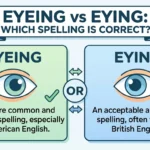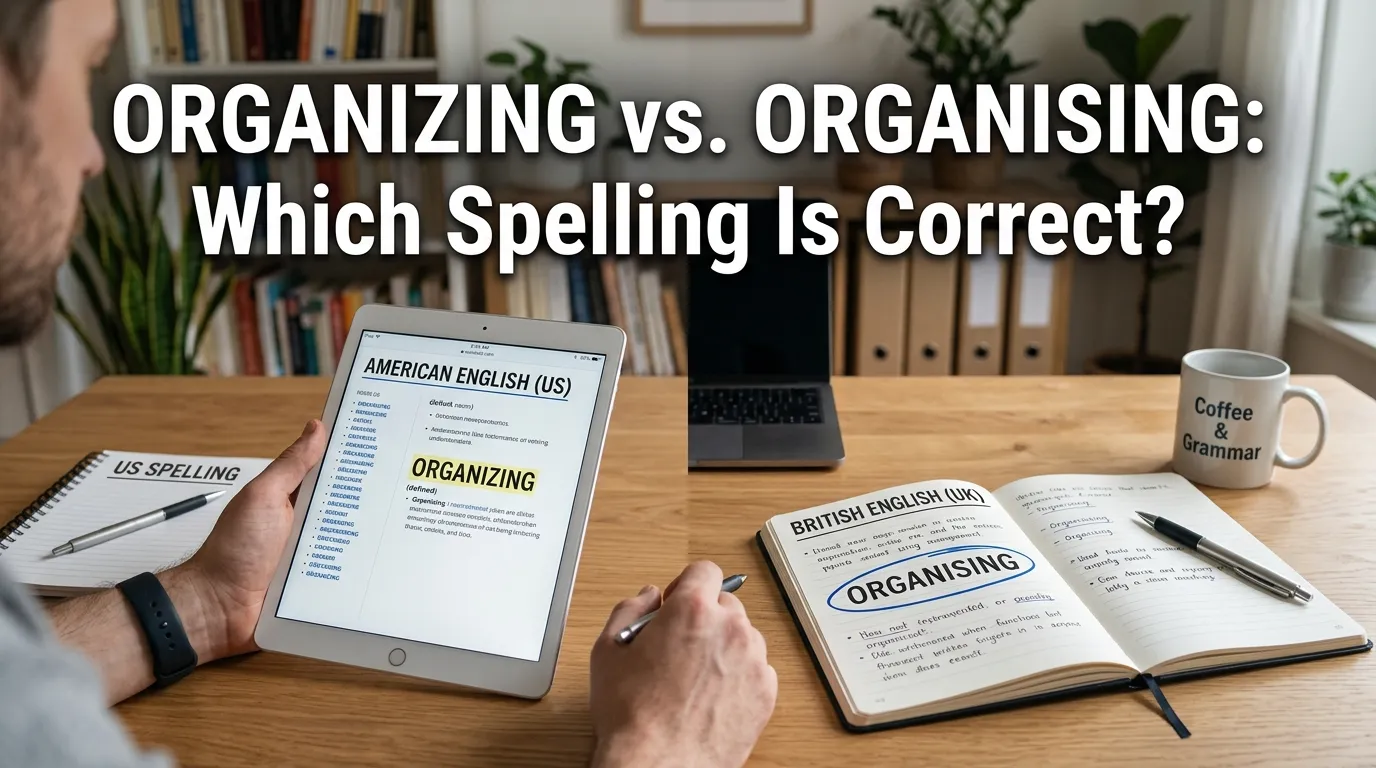
If you are wondering whether organizing or organising is correct, the answer is: both spellings are correct. The difference is mainly based on the variety of English being used.
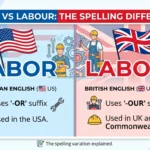
Organizing is the standard spelling in American English, while organising is the standard spelling in British English and is also common in many other English-speaking countries.
The two words have exactly the same basic meaning. Both are forms of the verb organize/organise, meaning to arrange things in an orderly way, plan an activity, or bring people or resources together for a purpose.
For example:
- American English: She is organizing a meeting.
- British English: She is organising a meeting.
Neither spelling is inherently more correct than the other. The important thing is to choose the spelling that matches your intended variety of English and then use it consistently.
In this guide, you will learn the difference between organizing and organising, how each spelling is pronounced, where each form is used, why the spelling differs, common mistakes, related words, useful expressions, and which form you should choose for school, work, business, academic writing, websites, and everyday communication.
Quick Answer: Organizing or Organising?
Organizing and organising are both correct spellings.
| Spelling | Main variety of English | Example |
|---|---|---|
| Organizing | American English | I am organizing the files. |
| Organising | British English | I am organising the files. |
| Organizing | Also accepted in some international contexts | The team is organizing an event. |
| Organising | Common in British-influenced varieties | They are organising a conference. |
The simplest rule
Use:
- organizing → American English
- organising → British English
The difference is the letter z versus s.
The pronunciation and meaning do not change.
What Does Organizing Mean?
Organizing is the present participle or gerund form of the verb organize.
It can mean several closely related things:
- Arranging things in a particular order.
- Planning an event or activity.
- Coordinating people or resources.
- Making something more structured or manageable.
- Creating a system for handling information, objects, or tasks.
Examples of organizing
- I am organizing my desk.
- She is organizing a birthday party.
- We spent Saturday organizing the garage.
- The manager is organizing the work schedule.
- He is organizing the documents by date.
In each example, organizing involves creating order, structure, or coordination.
What Does Organising Mean?
Organising has the same meaning as organizing.
The only major difference is the spelling.
For example:
- I am organising my desk.
- She is organising a birthday party.
- We spent Saturday organising the garage.
- The manager is organising the work schedule.
These sentences mean exactly the same thing as their American English versions.
The spelling organising is especially common in British English.
Organizing vs Organising: The Main Difference
The central difference is regional spelling preference, not meaning.
American English generally prefers -ize, while British English commonly uses -ise in words such as organize/organise.
Therefore:
- organize → organizing
- organise → organising
This pattern also appears in related words.
| American English | British English |
|---|---|
| organize | organise |
| organizing | organising |
| organized | organised |
| organization | organisation |
| organizer | organiser |
However, British English is not completely uniform. Some British dictionaries and style guides recognize -ize spellings as well. So it is more accurate to say that -ise is very common in British English, rather than claiming that -ize is always wrong in Britain.
Why Do People Confuse Organizing and Organising?
The confusion usually comes from differences between American and British English.
English does not have one universal spelling system. Different English-speaking regions developed different spelling preferences over time.
American English tends to favor forms such as:
- realize
- organize
- recognize
- analyze
British English commonly uses:
- realise
- organise
- recognise
- analyse
That means an American reader may see organising and assume it is misspelled. A British reader may see organizing and think it looks unusual.
In reality, both forms are established English spellings.
Is Organizing an American Spelling?
Yes.
Organizing is the preferred spelling in standard American English.
If you are writing for an audience in the United States, choose organizing.
American English examples
- I am organizing the conference.
- She is organizing her notes.
- They are organizing a fundraiser.
- We are organizing the files.
- The coach is organizing the players.
For American schools, businesses, newspapers, websites, and professional documents, organizing is normally the safest choice.
Is Organising a British Spelling?
Yes.
Organising is a common standard spelling in British English.
You will frequently encounter it in writing from the United Kingdom.
British English examples
- I am organising the conference.
- She is organising her notes.
- They are organising a fundraiser.
- We are organising the files.
- The coach is organising the players.
The meaning is unchanged.
American English vs British English
The difference between organizing and organising is similar to other spelling differences between American and British English.
| Meaning | American English | British English |
|---|---|---|
| Arrange | organizing | organising |
| Past form | organized | organised |
| Noun | organization | organisation |
| Person | organizer | organiser |
| Verb | organize | organise |
Which one should you use?
If your audience is mainly American, use organizing.
If your audience is mainly British, organising is a natural choice.
For international writing, either can work, but consistency is especially important.
Pronunciation of Organizing and Organising
Despite the different spellings, the two forms are normally pronounced the same.
A common pronunciation is approximately:
OR-guh-ny-zing
The International Phonetic Alphabet representation is approximately:
/ˈɔːrɡənaɪzɪŋ/
Depending on the speaker’s accent, the exact vowel sounds can vary.
The important point is that the z/s spelling difference does not create a major pronunciation difference here.
The -s- in organising is generally pronounced with a /z/ sound, not an /s/ sound.
So:
organising → OR-guh-ny-zing
not:
OR-guh-ny-sing
Organizing as a Verb
As a verb, organizing describes an action that is happening or continuing.
For example:
She is organizing the office.
Here, is organizing is the present progressive verb phrase.
Other examples include:
- We are organizing the schedule.
- They are organizing a charity event.
- I am organizing my study materials.
- The staff are organizing the conference.
- He is organizing the team’s equipment.
Organizing as a Gerund
Organizing can also function as a gerund, meaning it acts like a noun.
For example:
Organizing takes time.
Here, organizing is the subject of the sentence.
Another example:
I enjoy organizing my workspace.
The word describes an activity rather than simply functioning as a progressive verb.
This grammatical role is the same whether you spell it organizing or organising.
Organizing vs Organising in Formal Writing
Both spellings can be appropriate in formal writing.
The key is regional consistency.
American formal writing
Use:
The department is organizing a professional development seminar.
British formal writing
Use:
The department is organising a professional development seminar.
Neither sentence is less formal because of its spelling.
The choice depends on the English variety used by the publication, institution, company, or audience.
Organizing vs Organising in Academic Writing
Academic writers should normally follow the spelling system required by their university, journal, publisher, or style guide.
For an American academic audience:
The researchers are organizing the data into several categories.
For a British academic audience:
The researchers are organising the data into several categories.
Do not randomly switch between organizing and organising in the same document.
Consistency helps your writing look polished and professional.
Organizing vs Organising in Business Writing
Business communication also depends on the audience.
American business English
We are organizing the annual meeting for next month.
British business English
We are organising the annual meeting for next month.
If your company uses American English throughout its documents, keep organizing.
If your organization follows British English, use organising.
For multinational companies, the best practice is usually to follow the company’s established style guide.
Organizing vs Organising in Journalism
Journalists and editors generally follow the style rules of their publication.
An American publication will normally use:
organizing
A British publication may use:
organising
The same principle applies to newspapers, magazines, newsletters, and online publications.
The spelling should fit the publication’s established editorial style.
Organizing vs Organising in Blogging and SEO
For SEO content, your spelling should match your target audience.
If you are creating content primarily for readers in the United States, organizing is usually the better primary spelling.
For a British audience, organising is more natural.
For example, an American blog might use:
How to Start Organizing Your Home
A British blog might use:
How to Start Organising Your Home
Search engines can generally understand that the two spellings refer to the same concept, but human readers may expect the spelling associated with their regional variety.
The most important rule is to maintain consistency throughout the article.
Organizing vs Organising in Casual Writing
In texts, emails, social media posts, and casual conversations, both forms are acceptable depending on the writer’s variety of English.
An American might write:
I’m organizing my room today.
A British speaker might write:
I’m organising my room today.
Neither sounds strange to speakers familiar with that regional spelling.
Dictionary-Style Definition of Organizing
Organizing
Part of speech: Verb form / gerund / present participle
Base verb: organize
General meaning: The act of arranging, planning, coordinating, or structuring people, things, information, or activities.
Example:
She is organizing the books by subject.
Organising
Part of speech: Verb form / gerund / present participle
Base verb: organise
General meaning: The act of arranging, planning, coordinating, or structuring people, things, information, or activities.
Example:
She is organising the books by subject.
The definitions are essentially identical.
Word History and Etymology
The English verb organize/organise is connected to the noun organ, which ultimately comes from Greek organon, meaning an instrument or tool.
The word developed through Latin and French before entering English.
The basic idea behind the word is connected with arranging parts into a functioning whole.
That idea still appears in modern meanings of organize:
- organize a room
- organize information
- organize a company
- organize an event
- organize people around a cause
The spelling difference between -ize and -ise developed within broader English spelling traditions.
American English became strongly associated with -ize forms, while British usage commonly adopted -ise forms for many words.
Related Words
Understanding related words can make the spelling pattern easier to remember.
Organize / Organise
The base verb.
We need to organize the files.
Organized / Organised
The past tense and past participle.
She organized the event.
or:
She organised the event.
Organization / Organisation
The noun referring to an organized group or the process of organizing.
The organization helps local families.
or:
The organisation helps local families.
Organizer / Organiser
A person or thing that organizes.
She is the main organizer of the event.
or:
She is the main organiser of the event.
Common Collocations With Organizing
Organizing frequently appears with words such as:
- organizing an event
- organizing a meeting
- organizing a party
- organizing a conference
- organizing a fundraiser
- organizing files
- organizing information
- organizing documents
- organizing a schedule
- organizing a team
- organizing a campaign
- organizing a project
- organizing a workspace
- organizing a classroom
- organizing a tournament
Natural examples
We are organizing a conference for new employees.
She spends Sunday afternoons organizing her files.
The volunteers are organizing a food drive.
He is organizing the tournament schedule.
These collocations work equally well with organising in British English.
Common Expressions With Organizing
The word appears in many everyday expressions.
Organizing an event
They are organizing a large community event.
Organizing a meeting
I am organizing a meeting with the sales team.
Organizing information
The software helps users organize information.
Organizing your life
A simple calendar can help you organize your life.
Organizing your thoughts
Writing your ideas down can help you organize your thoughts.
Organizing a campaign
The group is organizing a campaign to raise awareness.
These expressions can use organising when British spelling is preferred.
Organizing vs Organising: Literal and Figurative Uses
Most uses are literal or practical, but the word can also describe abstract activities.
Literal use
She is organizing the books on the shelf.
This means physically arranging books.
Abstract use
He is organizing his thoughts before the presentation.
Here, no physical objects need to be moved. The meaning is to arrange ideas clearly.
Social or political use
The workers are organizing to improve workplace conditions.
Here, organizing means bringing people together around a shared goal.
Event use
The committee is organizing a festival.
Here, organizing involves planning and coordinating many activities.
Political and Social Usage
Organizing can have an important social or political meaning.
For example:
The volunteers are organizing a peaceful demonstration.
In this context, organizing means coordinating people and activities for a public purpose.
Another example is:
Community members are organizing around the issue.
This means people are coming together to support a shared cause.
The British spelling would be:
The volunteers are organising a peaceful demonstration.
Again, the meaning does not change.
Sports Usage
In sports, organizing can describe arranging players, tactics, schedules, or competitions.
Examples include:
- organizing a tournament
- organizing a training session
- organizing the defense
- organizing the midfield
- organizing a team
- organizing practice
For example:
The captain is organizing the defense.
In British English:
The captain is organising the defense.
Notice that defense/defence introduces a separate American-British spelling issue. Writers should keep regional spelling consistent across the entire piece.
Technical and Professional Usage
In technology, organizing often refers to arranging information, files, data, or systems.
Examples:
The application is organizing photos by date.
The database helps users organize customer records.
We are organizing the data into categories.
In professional settings, organizing can also refer to project management:
The project manager is organizing the team’s priorities.
For British audiences, replace organizing with organising.
Synonyms for Organizing
Depending on context, useful synonyms include:
- arranging
- planning
- coordinating
- structuring
- sorting
- classifying
- grouping
- scheduling
- managing
- preparing
- systematizing
- coordinating
- assembling
- categorizing
However, these words are not always exact replacements.
For example, sorting usually emphasizes putting things into an order, while organizing can include planning and coordination.
Example
She is organizing the conference.
Possible alternatives:
She is planning the conference.
She is coordinating the conference.
But these alternatives can emphasize different parts of the work.
Antonyms of Organizing
Depending on the intended meaning, possible opposites include:
- disorganizing
- disordering
- scattering
- disrupting
- confusing
- neglecting
- mismanaging
There is no single perfect antonym for every use.
For example:
He is organizing the files.
could contrast with:
He is scattering the files.
But when talking about a project, mismanaging may be a better contrast.
Common Mistakes With Organizing and Organising
Mistake 1: Treating one spelling as universally correct
Incorrect assumption:
Organising is always wrong because organize uses a z.
That is not true.
Organising is standard in many varieties of English.
Mistake 2: Assuming organising has a different meaning
It does not.
organizing
and
organising
have the same basic meaning.
Mistake 3: Mixing spelling systems
A document may contain:
organizing, organized, organisation, organiser
This can look inconsistent.
A better American English set is:
organizing, organized, organization, organizer
A common British set is:
organising, organised, organisation, organiser
Mistake 4: Changing spelling within one document
If you begin an American English article with organizing, do not randomly switch to organising later.
Choose one style and maintain it.
Awkward vs Natural Examples
Awkward
Our American company is organising the annual conference, but our American style guide uses organizing everywhere else.
More natural
Our American company is organizing the annual conference.
For British English:
Natural
Our British company is organising the annual conference.
The issue is not grammatical correctness. It is style consistency.
Formal vs Informal Alternatives
The word organizing itself works in both formal and informal writing.
Casual
I’m organizing my room this weekend.
Neutral
I am organizing the documents.
Formal
The committee is coordinating the arrangements for the conference.
Other formal alternatives include:
- coordinating
- arranging
- managing
- planning
- structuring
However, do not replace organizing simply to sound formal. In many situations, organizing is the clearest and most natural word.
A Simple Memory Trick
Remember this:
America → Z → organizing
Think of:
organize → organizing
British English commonly uses:
organise → organising
A second trick is to remember the whole family:
American:
organize → organized → organizing → organization
British:
organise → organised → organising → organisation
Learning the complete word family is easier than memorizing each spelling separately.
Which Spelling Should You Use?
For American English
Use organizing.
This is the best choice for:
- U.S. school assignments
- American business writing
- U.S. websites
- American blogs
- American journalism
- American academic writing
- U.S. professional communication
- American social media content
For British English
Use organising.
This is appropriate for:
- UK audiences
- British publications
- British schools and universities
- UK business communication
- British-focused websites
- British journalism
For international audiences
Either form can work.
However, choose a style based on your primary audience.
If most readers are American, use organizing.
If most readers are British or from countries that commonly follow British spelling, organising may be more natural.
What About Canada, Australia, and Other Countries?
English spelling varies across countries.
Canada uses a mixture of British and American spelling conventions, depending on the word and context. Both broader spelling traditions can appear, so local style guides matter.
Australia generally follows British spelling conventions and commonly uses organising.
New Zealand also generally follows British-based spelling conventions and commonly uses organising.
Other countries may follow British, American, or mixed English conventions.
Therefore, do not assume that every country outside the United States uses exactly the same spelling rules.
Organizing vs Organising Comparison Table
| Feature | Organizing | Organising |
|---|---|---|
| Meaning | Same | Same |
| Base verb | organize | organise |
| Common variety | American English | British English |
| Pronunciation | Essentially the same | Essentially the same |
| Present participle | Yes | Yes |
| Gerund | Yes | Yes |
| Formal writing | Correct | Correct |
| Casual writing | Correct | Correct |
| Business writing | Common in U.S. English | Common in British English |
| Academic writing | Use if following U.S. style | Use if following British style |
| SEO writing | Best for U.S. audience | Best for British audience |
How to Choose the Right Spelling
Before choosing between organizing and organising, ask three questions:
Who is your audience?
If your readers are mainly in the United States, choose organizing.
If they are mainly in the United Kingdom, choose organising.
What style guide are you following?
If a school, employer, publisher, or journal gives you a style guide, follow it.
The organization’s preferred style is more important than personal preference.
What spelling have you already used?
Consistency matters.
If your document already uses:
organization
then organizing is usually the logical companion in American English.
If it uses:
organisation
then organising is the natural companion in British English.
Frequently Asked Questions
Is organizing or organising correct?
Both are correct. Organizing is the common American English spelling, while organising is widely used in British English and other varieties influenced by British spelling.
Is organising British or American?
Organising is primarily associated with British English. It is also common in several other English-speaking regions that traditionally use British spelling conventions.
Is organizing American English?
Yes. Organizing is the standard and widely preferred spelling in American English.
Do organizing and organising mean the same thing?
Yes. They have the same meaning and grammatical function. The difference is primarily spelling based on regional English conventions.
How do you spell organizing in the UK?
In British English, organising is a very common spelling. Some British usage also accepts organizing, particularly in styles that favor the -ize spelling.
How do you spell organizing in American English?
In American English, the standard spelling is organizing, with a z.
Is organize with a Z American or British?
Organize is strongly associated with American English, but the -ize spelling is also used and accepted in some British English contexts. British English commonly uses organise as well.
Is organization or organisation correct?
Both are correct regional spellings. Organization is the standard American English form, while organisation is common in British English.
Should I use organizing or organising on a website?
Use the spelling that matches your target audience and your site’s overall English style. For a U.S.-focused website, choose organizing. For a UK-focused website, organising is usually more appropriate.
Can I use both organizing and organising in the same article?
Technically, readers will understand both, but it is best not to mix them unnecessarily. Pick one regional spelling system and use it consistently throughout the article.
Final Verdict
The choice between organizing and organising is not a question of right versus wrong. Both are established English spellings.
The main distinction is regional:
Organizing is the preferred spelling in American English.
Organising is widely preferred in British English and is common in other varieties influenced by British spelling.
Both forms mean arranging, planning, coordinating, or bringing things or people into an organized structure. They have the same pronunciation in ordinary usage and can perform the same grammatical roles.
For American readers, writers, students, businesses, bloggers, and publishers, organizing is generally the safest choice.
For British readers and publications, organising is a natural choice.
The most important rule is consistency. Once you choose an English variety, apply that choice across related words such as organized/organised, organization/organisation, and organizer/organiser.
So, if you are writing for a U.S. audience, remember:
organize → organizing → organized → organization
If you are following a British -ise style:
organise → organising → organised → organisation
When in doubt, focus on your audience and follow the style guide of the publication, school, company, or organization you are writing for. That will help your writing look natural, professional, and consistent.