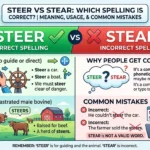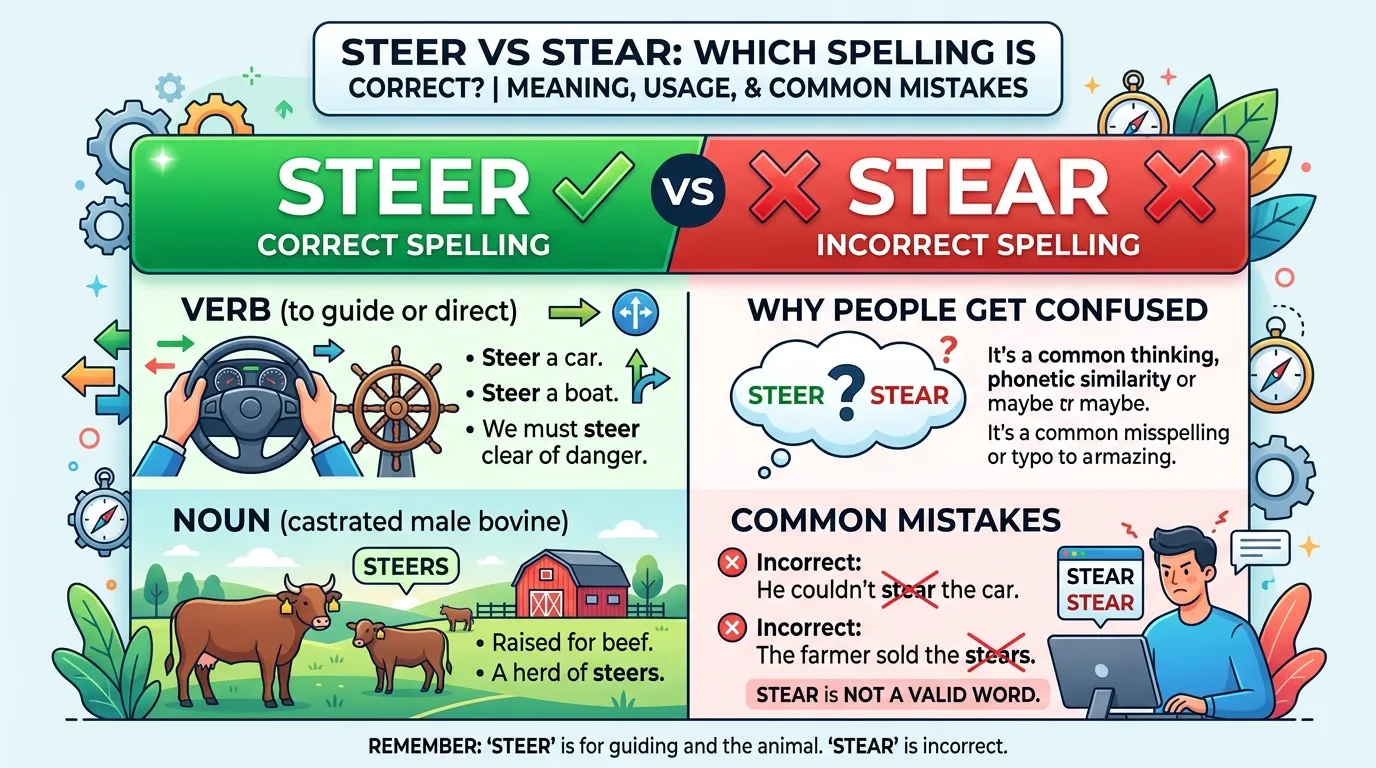
If you are wondering about steer vs stear, the correct spelling in standard modern English is usually steer. The word steer has several meanings, including to guide a vehicle or person, direct something toward a particular goal, or refer to a young male cattle animal. Stear, on the other hand, is not the standard spelling for these common meanings and is generally considered a misspelling.
The confusion is understandable because English contains many words where the letters -ear can produce different sounds and spelling patterns. People may also type “stear” because it looks similar to words such as tear, hear, and near.
In this guide, you will learn the difference between steer and stear, their meanings, pronunciation, grammar, history, common phrases, examples, mistakes, regional usage, and the best spelling to use in everyday, academic, business, technical, and professional writing.
Quick Answer: Is It Steer or Stear?
Steer is the correct spelling for the common English word.
- Steer = to guide, direct, or control something.
- Steer = a young male cattle animal, especially one raised for beef.
- Stear = generally an incorrect spelling when the writer means steer.
Correct:
Please steer the car carefully.
Incorrect:
Please stear the car carefully.
Another example:
She tried to steer the conversation toward the main topic.
Not:
She tried to stear the conversation toward the main topic.
If you are writing in modern American English, choose “steer.”
Steer vs Stear at a Glance
| Word | Standard English? | Main meaning | Example |
|---|---|---|---|
| Steer | Yes | Guide or direct | Steer the boat toward shore. |
| Steer | Yes | Young male cattle | The farmer raised a steer. |
| Stear | Usually no | Commonly a misspelling of steer | Avoid this spelling in standard writing. |
The simplest rule is:
If you mean “guide,” “direct,” or “young male cattle,” spell it “steer.”
What Does “Steer” Mean?
Steer is a versatile English word that can function as both a verb and a noun.
As a verb, it means to guide or control the direction of something.
For example:
He carefully steered the car around the corner.
It can also mean guiding a person, conversation, organization, or situation toward a particular direction.
The manager steered the discussion back to the main issue.
As a noun, steer can refer to a young male cattle animal, especially one raised for beef.
The rancher sold several steers at the market.
The word therefore has both a literal and figurative range of meanings.
What Does “Stear” Mean?
In ordinary modern English, stear is not the standard spelling of the common word steer.
If someone writes:
I need to stear the boat.
They almost certainly mean:
I need to steer the boat.
Likewise:
He tried to stear the conversation.
should be:
He tried to steer the conversation.
Because spellcheckers and dictionaries generally recognize steer as the standard word for these meanings, stear should normally be corrected to steer.
Why Does “Stear” Appear Online?
There are several possible reasons:
- A simple typing mistake
- Confusion about English vowel patterns
- Phonetic spelling
- Fast texting
- Autocorrect or keyboard errors
- Confusion with similarly spelled words
- A learner’s uncertainty about the correct spelling
In casual online communication, such mistakes are common. In professional or academic writing, however, use steer.
The Main Difference Between Steer and Stear
The key difference is simple:
Steer is the standard English spelling; stear is generally a misspelling when referring to the common word.
There is no normal modern-English distinction such as:
steer means one thing, while stear means something else.
Instead, steer covers the ordinary meanings people usually intend.
Compare These Sentences
Correct:
Turn the wheel and steer the vehicle.
Incorrect:
Turn the wheel and stear the vehicle.
Correct:
We need to steer the project in a new direction.
Incorrect:
We need to stear the project in a new direction.
Correct:
The rancher bought a young steer.
Incorrect:
The rancher bought a young stear.
Why Do People Confuse “Steer” and “Stear”?
English spelling is not always predictable. Several words use -ear, and their pronunciation can vary.
Consider:
- near
- hear
- fear
- clear
- bear
- wear
- tear
- learn
- heart
The same letters do not always produce the same sound.
This makes it understandable that someone might hear the sound of steer and wonder whether it should be spelled steer or stear.
Another reason is that stear looks visually plausible. English has many familiar words containing -ear, so an inexperienced writer may assume that stear follows a similar pattern.
However, standard spelling is determined by established usage, not simply by how logical a spelling looks.
How Do You Pronounce “Steer”?
Steer is pronounced with the long “ee” vowel sound.
It rhymes with words such as:
- near
- clear
- fear
- dear
- cheer
- hear
In American English, the pronunciation is generally represented in dictionaries as /stɪr/.
The spelling contains ee, which helps distinguish it from the incorrect stear spelling.
Example
Steer the car slowly.
The first sound is the st consonant cluster, followed by the long “ee” sound and ending with an r sound.
Is “Stear” a Different Pronunciation?
Usually, no.
When people type stear, they generally intend the pronunciation of steer. They are not normally trying to create a separate English word with a distinct pronunciation.
That is why correcting the spelling to steer is appropriate in most situations.
Steer as a Verb
The most common use of steer is as a verb meaning to guide or control the direction of something.
Literal Meaning
The literal meaning often involves transportation.
She steered the car into the driveway.
The captain steered the ship toward the harbor.
He steered his bicycle around the obstacle.
The driver carefully steered through the narrow street.
In each example, someone controls the direction of movement.
Figurative Meaning
Steer can also describe directing something that is not a physical object.
She steered the conversation toward education.
The CEO steered the company through a difficult period.
His advice helped steer me toward a better decision.
The teacher steered the students toward the right answer.
Here, steer means guide or influence rather than physically control a vehicle.
Steer as a Noun
Steer also has a completely different noun meaning.
A steer is a young male bovine, commonly a male cattle animal that has been castrated and is typically raised for beef.
Examples
The ranch has several steers.
The farmer moved the steer into another pasture.
The steer was prepared for market.
This meaning is especially common in farming, ranching, livestock, and agricultural contexts.
Grammatical Roles of “Steer”
Understanding its grammatical role can make the word easier to use.
Steer as a Verb
I steer the boat.
She steered the car.
They are steering the project.
He has steered the company successfully.
Steer as a Noun
The steer was standing near the fence.
Several steers were moved into the pasture.
Common Forms
| Form | Example |
|---|---|
| Steer | I steer the car. |
| Steers | She steers carefully. |
| Steered | He steered the boat. |
| Steering | They are steering the vehicle. |
Notice that the spelling remains based on steer, not stear.
Common Meanings of “Steer”
The word can be understood through several related meanings.
To Control Direction
Steer the vehicle to the left.
To Guide Someone
Her mentor steered her toward a successful career.
To Direct a Conversation
He steered the discussion away from politics.
To Influence an Outcome
The new policy steered the company toward greater efficiency.
A Young Male Cattle Animal
The rancher purchased a steer.
These meanings may look different, but they all use the established spelling steer.
Common Collocations With “Steer”
A collocation is a group of words that naturally appear together.
Some common combinations include:
- steer a car
- steer a boat
- steer a ship
- steer a vehicle
- steer a conversation
- steer a discussion
- steer a project
- steer a company
- steer a team
- steer someone toward
- steer someone away from
- steer clear of
- steer in the right direction
- steer the course
- steer the conversation
Learning these combinations can help you use steer naturally.
Common Expressions With “Steer”
Steer Clear of
Steer clear of means to avoid something or someone.
You should steer clear of unnecessary arguments.
She decided to steer clear of the crowded road.
It is one of the most common idiomatic uses of steer.
Steer Someone Toward Something
This means to guide someone toward a choice, action, or direction.
The counselor steered him toward a practical career.
Steer Someone Away From Something
This means to guide someone away from something.
Her parents tried to steer her away from bad influences.
Steer the Conversation
This means to guide the topic of a discussion.
He steered the conversation toward the upcoming project.
Steer vs Direct
Steer and direct can be synonyms, but they are not always interchangeable.
Direct often sounds more formal and authoritative.
The supervisor directed the employees to complete the task.
Steer can sound more gradual or strategic.
The supervisor steered the team toward a better solution.
In transportation, steer is usually much more natural.
Steer the car carefully.
You would not normally say:
Direct the car carefully.
Steer vs Guide
These words are closely related.
Guide emphasizes helping someone or something move toward a destination or goal.
She guided the child across the street.
Steer often emphasizes controlling or influencing direction.
He steered the boat toward the dock.
Figuratively, both can work:
The mentor guided me toward a new career.
The mentor steered me toward a new career.
The second version can suggest a stronger influence on the direction of the decision.
Steer vs Lead
Lead usually involves taking someone or something toward a goal.
She led the team to victory.
Steer emphasizes direction and adjustment.
She steered the team through a difficult transition.
The difference can be subtle, but both words are useful depending on the context.
Steer vs Drive
These words are sometimes confused because both can relate to cars.
Drive means operating a vehicle.
I drive to work every morning.
Steer specifically refers to controlling the direction.
Keep both hands on the wheel and steer carefully.
A person can drive a car and steer it at the same time.
Formal vs Informal Usage
Steer works well in both formal and informal English.
Casual
Just steer left at the next street.
Professional
The new strategy should steer the company toward sustainable growth.
Academic
Several factors may steer consumer behavior toward environmentally friendly products.
Journalistic
The policy could steer investment toward renewable energy.
Technical
The control system automatically steers the vehicle.
The word is therefore highly versatile.
Steer in Business Writing
In business English, steer is frequently used figuratively.
Examples include:
The new leadership team will steer the company through its next phase of growth.
The strategy is designed to steer customers toward digital services.
Management needs to steer the project back on schedule.
The consultant helped steer the organization toward a more efficient process.
This usage is professional and natural.
Steer in Politics
The word can also appear in political writing when discussing policy direction or leadership.
The administration plans to steer the economy toward greater investment.
Lawmakers are debating policies that could steer the country in a different direction.
The new leadership may steer the party toward a more moderate position.
Here, steer means influence or guide rather than physically control.
Steer in Sports
In sports, steer may describe physically directing movement or influencing play.
The player steered the ball toward the corner.
The goalkeeper tried to steer the shot away from the net.
It can also be used figuratively:
The captain steered the team through a difficult season.
Steer in Technical and Professional Contexts
Technical writing often uses steer when describing directional control.
Examples include:
- steering a vehicle
- steering a robot
- steering a drone
- steering a vessel
- steering a machine
- steering a mechanical system
- steering an autonomous vehicle
In these contexts, steering can refer to a specific control function.
For example:
The steering system allows the vehicle to change direction.
In engineering, automotive, robotics, and transportation contexts, steer is the standard spelling.
Regional Variations: American vs British English
The spelling steer is standard in both American and British English.
There is no major regional spelling difference in which Americans use steer while British speakers use stear.
American English
Steer the car toward the highway.
British English
Steer the car towards the motorway.
The spelling steer remains the same.
The main difference may be vocabulary surrounding it, such as toward/towards or highway/motorway, rather than the spelling of steer itself.
International English Usage
For international English, steer is the safest and most widely recognized spelling.
If you are writing for:
- international readers
- English learners
- business audiences
- academic readers
- websites
- news publications
- professional documents
use steer when you mean to guide or direct.
Avoid stear unless you have a very specific historical, technical, or proper-name reason to reproduce that spelling.
Word History and Etymology of “Steer”
The word steer has deep Germanic roots.
Its history is connected with Old English and other Germanic languages. The verb meaning to guide or control developed from older words associated with directing a course.
The noun steer, referring to cattle, has a separate historical development connected to an old Germanic term for a young male animal.
Over centuries, these forms became established in English as steer.
This history helps explain why modern English uses a spelling that may not seem completely predictable from pronunciation.
Synonyms for “Steer”
Depending on the context, synonyms include:
- guide
- direct
- control
- lead
- navigate
- maneuver
- influence
- manage
- channel
- point
- orient
- guide toward
- guide away from
The best synonym depends on whether you are talking about a vehicle, person, conversation, organization, or strategy.
Antonyms for “Steer”
Possible opposites include:
- follow
- misdirect
- ignore
- abandon
- lose control
- wander
- drift
There is no single perfect antonym in every context.
For example:
She steered the discussion toward the main issue.
A possible opposite is:
She allowed the discussion to drift away from the main issue.
Awkward vs Natural Examples
Example 1
Awkward:
Please stear the car carefully.
Natural:
Please steer the car carefully.
Example 2
Awkward:
The manager will stear the company toward growth.
Natural:
The manager will steer the company toward growth.
Example 3
Awkward:
She tried to stear the conversation away from the subject.
Natural:
She tried to steer the conversation away from the subject.
Example 4
Awkward:
The driver needs to stear around the obstacle.
Natural:
The driver needs to steer around the obstacle.
Common “Stear” Mistakes and Corrections
| Incorrect | Correct |
|---|---|
| stear the car | steer the car |
| stear the boat | steer the boat |
| stear the conversation | steer the conversation |
| stear the company | steer the company |
| stearing the vehicle | steering the vehicle |
| steared the ship | steered the ship |
| a young stear | a young steer |
The important point is that the steer spelling remains consistent across these forms.
“Stearing” or “Steering”?
The correct form is steering.
She is steering the car.
Not:
She is stearing the car.
When adding -ing to steer, the final e is retained:
steer → steering
Similarly:
- steer → steered
- steer → steers
“Steared” or “Steered”?
The correct past tense is steered.
He steered the boat toward the shore.
Not:
He steared the boat toward the shore.
This is an especially common spelling mistake because people may apply a general rule incorrectly.
The correct forms are:
steer → steered → steering
A Simple Memory Trick for “Steer”
A useful way to remember the spelling is to connect steer with steering wheel.
Think:
STEER → STEERING WHEEL
A steering wheel helps you steer a vehicle.
You can also remember:
“The steering wheel helps me steer.”
Both words share the same basic spelling.
Another Memory Trick
Think of the phrase:
Steer clear.
If you remember steer clear, you are also likely to remember the correct spelling of steer.
The phrase appears frequently in everyday English:
Steer clear of trouble.
How to Choose the Correct Word
When deciding between steer vs stear, ask yourself:
Are you talking about guiding something?
Use steer.
Steer the vehicle.
Are you talking about directing a conversation?
Use steer.
Steer the conversation toward the important issue.
Are you talking about influencing a decision?
Use steer.
The advice steered me toward a better choice.
Are you talking about cattle?
Use steer.
The farmer bought a steer.
Are you considering “stear” as the ordinary spelling?
Change it to steer.
Best Usage Recommendations by Context
| Context | Recommended spelling |
|---|---|
| American English | steer |
| British English | steer |
| International English | steer |
| Academic writing | steer |
| Business writing | steer |
| Journalism | steer |
| Technical writing | steer |
| Sports writing | steer |
| Blogging | steer |
| Casual texting | steer |
| Formal documents | steer |
| English learning | steer |
There is essentially no ordinary writing context where stear should replace standard steer.
When Should You Use “Steer”?
Use steer when you mean:
- To control the direction of a vehicle.
- To guide a boat, ship, bicycle, or other moving object.
- To guide a person toward a choice.
- To direct a conversation.
- To influence a project or organization.
- To guide something toward or away from an outcome.
- A young male cattle animal.
When Could “Stear” Appear?
Although stear is not the standard spelling for the common word, you may occasionally encounter it in specialized historical material, names, old records, or unusual proper nouns.
That does not make it the correct modern spelling of the everyday English verb steer.
If you are writing an ordinary sentence, article, email, school assignment, report, or social media post, steer is the appropriate choice.
Search Intent: “Steer vs Stear” Explained Simply
People searching “steer vs stear” are usually trying to answer one of several questions:
- Is stear a word?
- Is steer spelled with ee or ea?
- What is the correct spelling of steer?
- How do you spell the word for guiding a car?
- Is it steering or stearing?
- Is steared or steered correct?
- What does steer mean?
- What is the difference between steer and stear?
The answer to all these everyday spelling questions is straightforward:
Use “steer.”
For the related forms, use:
- steer
- steers
- steered
- steering
Frequently Asked Questions
Is “stear” a correct English word?
Stear is not the standard spelling of the common English word meaning “to guide” or “direct.” If you mean that word, the correct spelling is steer.
Is it “steer” or “stear” a car?
The correct expression is steer a car.
I need to steer the car carefully.
Stear is a spelling error in this context.
Is “steering” or “stearing” correct?
Steering is correct.
She is steering the vehicle.
The spelling stearing is incorrect when you mean the act of controlling direction.
Is “steered” or “steared” correct?
Steered is correct.
He steered the boat toward the dock.
The past-tense form of steer is steered, not steared.
What does “steer” mean?
As a verb, steer means to guide, control, or direct something or someone. As a noun, a steer is a young male cattle animal, usually raised for beef.
Does “steer” mean drive?
Not exactly. Drive means to operate a vehicle, while steer specifically means to control its direction.
For example, you can drive a car and steer it at the same time.
Is “steer” used in American English?
Yes. Steer is standard in American English and British English. There is no ordinary American-versus-British spelling difference between steer and stear.
Why do people spell “steer” as “stear”?
The error may come from English spelling patterns, pronunciation, typing mistakes, or confusion with other words containing -ear. Because stear looks plausible, it can be an easy mistake for English learners and fast typists.
What is the easiest way to remember “steer”?
Connect it with steering wheel. A steering wheel helps you steer a car. You can also remember the common expression steer clear, which uses the correct spelling.
Final Conclusion
When comparing steer vs stear, the choice is simple for standard modern English: steer is the correct spelling.
Use steer when you mean to guide, direct, control, or influence something. You can steer a car, steer a boat, steer a conversation, steer a company, or steer someone toward a decision. As a noun, steer can also refer to a young male cattle animal.
Stear is generally a misspelling when used in place of steer. The same rule applies to related forms: write steering, not stearing, and steered, not steared.
For American, British, academic, business, technical, journalistic, sports, blogging, and everyday writing, the safest recommendation is consistent: choose “steer.”
If you are ever unsure, remember the phrase “steer clear” or connect the word with a steering wheel. That simple association can help you avoid the common steer vs stear spelling mistake.