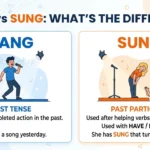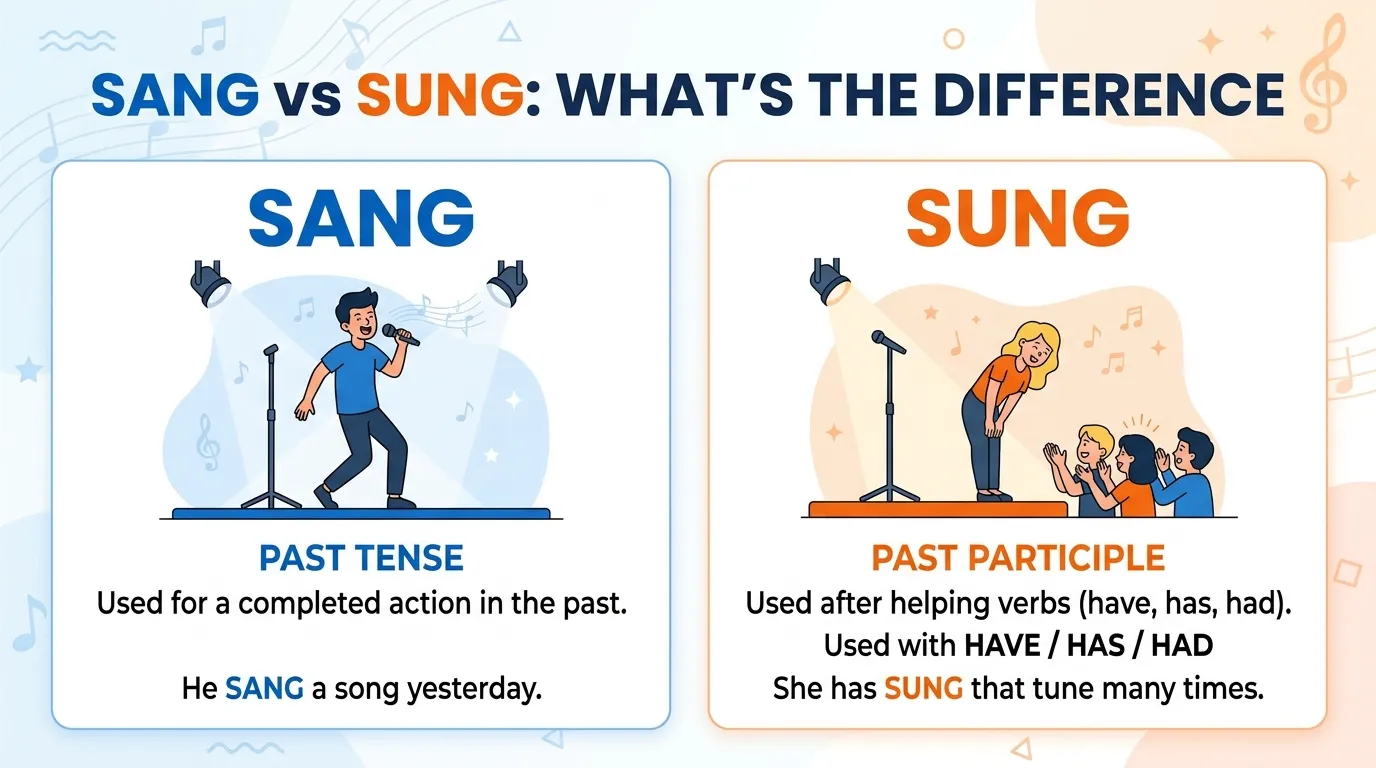
If you have ever wondered about sang vs sung, you are not alone. Both words come from the verb sing, but they are not interchangeable. The main difference is grammatical: sang is the simple past tense of sing, while sung is the past participle and normally appears with helping verbs such as has, have, had, or was.
For example, you can say, “She sang beautifully yesterday,” but you would say, “She has sung at this venue before.”
Understanding this small difference can make your writing and speaking much more natural. In this guide, you will learn the meanings of sang and sung, their grammar rules, pronunciation, sentence patterns, common mistakes, formal and informal usage, word history, synonyms, related expressions, and easy memory tricks.
Quick Answer: Sang vs Sung
Sang and sung are both correct forms of the irregular verb sing, but they have different grammatical roles.
| Word | Grammatical form | Example |
|---|---|---|
| Sing | Base form / present tense | I sing every day. |
| Sang | Simple past | I sang yesterday. |
| Sung | Past participle | I have sung many times. |
| Singing | Present participle / gerund | I am singing now. |
The easiest rule is:
- Use sang for a completed action in the simple past.
- Use sung after have, has, or had.
- Use sung with forms of be when forming passive constructions.
- Do not normally use sung alone as the simple past tense.
Correct: She sang at the concert last night.
Incorrect: She sung at the concert last night.
Correct: She has sung at several concerts.
Incorrect: She has sang at several concerts.
What Does “Sang” Mean?
Sang is the simple past form of sing. It describes an action that happened in the past.
Dictionary-style definition of sang
Sang: the simple past tense of sing, meaning to produce musical sounds with the voice at a particular time in the past.
Examples:
- He sang a beautiful song.
- We sang together at the party.
- Maria sang in the school choir.
- They sang the national anthem before the game.
- I sang my favorite song yesterday.
The word usually refers to a finished singing action.
Sang in different contexts
Everyday conversation:
“I sang karaoke last night.”
School:
“The students sang during the assembly.”
Music:
“The artist sang three songs during the show.”
Sports:
“The fans sang team chants throughout the match.”
Religious setting:
“The congregation sang hymns together.”
Literary writing:
“The birds sang as the sun rose.”
In each example, sang tells us that the singing happened in the past.
What Does “Sung” Mean?
Sung is the past participle of sing. Unlike sang, it usually needs a helping verb.
Common helping verbs include:
- has
- have
- had
- is
- was
- been
Examples:
- She has sung professionally for years.
- We have sung this song before.
- He had sung before the audience arrived.
- The song was sung by the entire class.
- She has never sung in public.
The most important point is that sung is not normally used by itself to express the simple past.
Why “I sung yesterday” is incorrect
The sentence:
“I sung yesterday.”
is not standard American English because yesterday calls for the simple past tense.
The correct sentence is:
“I sang yesterday.”
However:
“I have sung before.”
is correct because have requires the past participle sung.
Sang vs Sung: The Key Grammar Difference
The difference becomes much easier when you understand verb forms.
The verb sing is an irregular verb. It does not form its past tense by simply adding -ed.
Its main forms are:
sing → sang → sung → singing
Compare them:
| Verb form | Function | Example |
|---|---|---|
| Sing | Present/base form | I sing every morning. |
| Sang | Simple past | I sang yesterday. |
| Sung | Past participle | I have sung before. |
| Singing | -ing form | I am singing now. |
This pattern is similar to other irregular verbs:
- drink → drank → drunk
- ring → rang → rung
- swim → swam → swum
- begin → began → begun
- sink → sank → sunk
These pairs can help you see why sang and sung are not interchangeable.
When Should You Use “Sang”?
Use sang when the sentence uses the simple past tense.
A simple past sentence can stand on its own without have, has, or had.
Examples of sang
- I sang at the wedding.
- She sang beautifully.
- He sang a folk song.
- We sang all night.
- They sang together.
- The children sang in class.
- My grandmother sang to me when I was young.
You can often identify sang by looking for a specific past-time expression.
Common examples include:
- yesterday
- last night
- last week
- last year
- two days ago
- when I was young
- in 2020
- earlier
- this morning, when referring to a completed past event
For example:
“She sang at the festival last weekend.”
The action happened and ended in the past, so sang is appropriate.
When Should You Use “Sung”?
Use sung when grammar requires the past participle.
It most commonly appears with have, has, or had.
Present perfect
- I have sung this song before.
- She has sung professionally.
- They have sung together for years.
Past perfect
- He had sung before the guests arrived.
- We had already sung the first verse.
- She had never sung on stage before.
Passive voice
Sung can also appear in passive constructions.
- The anthem was sung by the students.
- The song was sung beautifully.
- The hymn was sung by the choir.
In these examples, sung is grammatically correct because it functions as a past participle.
Sang vs Sung in a Comparison Table
| Feature | Sang | Sung |
|---|---|---|
| Base verb | Sing | Sing |
| Verb form | Simple past | Past participle |
| Can normally stand alone as past tense? | Yes | No |
| Works with have/has/had? | No | Yes |
| Passive voice? | No | Yes |
| Example | She sang yesterday. | She has sung before. |
| Main meaning | Singing happened in the past | Singing has a connection to another time/action |
A simple way to remember the difference is:
Sang = past action.
Sung = participle with a helper.
Why Do People Confuse Sang and Sung?
There are several reasons people mix up these words.
They are forms of the same verb
Both words come from sing, so they naturally feel interchangeable.
English has many irregular verbs
English does not always follow predictable verb patterns. Learners must memorize forms such as:
- sing → sang → sung
- go → went → gone
- write → wrote → written
- take → took → taken
“Sung” sounds like a past-tense word
In casual speech, people sometimes use sung where standard grammar requires sang.
For example:
“She sung at the concert.”
This may be heard in informal or nonstandard speech, but standard edited American English uses:
“She sang at the concert.”
Other verb pairs create confusion
English speakers also hear:
- drank / drunk
- rang / rung
- swam / swum
- began / begun
Because these verbs have similar patterns, it is easy to confuse their forms.
Sang vs Sung Pronunciation
Although sang and sung look similar, their vowel sounds are different.
In standard American English:
- sang has the vowel sound found in words such as hang and bank.
- sung has the vowel sound found in words such as young and hung.
The final ng sound is similar in both words.
A useful pronunciation comparison is:
sang: rhymes closely with hang
sung: rhymes closely with hung
This difference is important because saying the wrong form can make a sentence sound unnatural even when the listener understands your meaning.
Is “Sang” More Correct Than “Sung”?
No. Neither word is more correct.
They are both standard English words, but they perform different grammatical jobs.
It is better to think of them as two different forms of the same verb rather than competing spellings.
Sang is correct:
“He sang beautifully.”
Sung is correct:
“He has sung beautifully.”
The mistake happens when one form is used in the grammatical position belonging to the other.
Common Mistakes With Sang and Sung
Mistake: Using sung as simple past
Incorrect:
She sung at the wedding yesterday.
Correct:
She sang at the wedding yesterday.
Mistake: Using sang after “has”
Incorrect:
She has sang this song before.
Correct:
She has sung this song before.
Mistake: Using sang after “had”
Incorrect:
He had sang the song already.
Correct:
He had sung the song already.
Mistake: Using sang in passive voice
Incorrect:
The song was sang by the choir.
Correct:
The song was sung by the choir.
Mistake: Adding “-ed”
Incorrect:
She singed a song at the concert.
Correct:
She sang a song at the concert.
Be careful here. Singed is actually a different English word. It means slightly burned or scorched.
For example:
“The fire singed his sleeve.”
That has nothing to do with singing.
Awkward vs Natural Examples
| Awkward or incorrect | Natural and correct |
|---|---|
| She sung yesterday. | She sang yesterday. |
| He has sang before. | He has sung before. |
| They had sang together. | They had sung together. |
| The song was sang by her. | The song was sung by her. |
| I sung at school last Friday. | I sang at school last Friday. |
| We have sang that song. | We have sung that song. |
Sang vs Sung in Everyday English
Here are some natural examples you might hear in daily conversation.
Talking about yesterday
“I sang karaoke last night.”
Talking about experience
“I have sung karaoke many times.”
Talking about childhood
“When I was a child, I sang in the school choir.”
Talking about a continuing experience
“She has sung in that choir for five years.”
Talking about something completed before another event
“They had sung two songs before the show ended.”
The tense depends on the relationship between the singing action and the time being discussed.
Formal vs Informal Usage
The grammatical distinction between sang and sung does not disappear in formal writing.
In professional, academic, journalistic, and business writing, standard grammar should be used.
Formal
“The national anthem was sung before the ceremony.”
Informal
“We sang our favorite song on the way home.”
Both are natural. The difference is grammatical context, not simply formality.
In edited writing, avoid using sung as a substitute for sang merely because it sounds more formal.
American vs British English
The distinction between sang and sung is essentially the same in standard American and British English.
American English:
“She sang beautifully.”
British English:
“She sang beautifully.”
American English:
“She has sung there before.”
British English:
“She has sung there before.”
Regional accents may change pronunciation slightly, but the basic grammatical rule remains stable.
The same applies to most international forms of standard English.
Academic and Professional Writing
In academic writing, choose the form based on tense and sentence structure.
Simple past:
“The participants sang the song during the experiment.”
Present perfect:
“Researchers have sung the song in several demonstrations.”
Passive construction:
“The song was sung by the participants.”
The same principle applies in reports, essays, presentations, business documents, and formal correspondence.
Sang vs Sung in Journalism
Journalists often use sang when reporting a completed event:
“The crowd sang the national anthem before the game.”
They may use sung when describing previous experience or a passive action:
“The anthem has been sung at the stadium for decades.”
The tense should match the timeline and meaning of the sentence.
Sang vs Sung in Sports
Sports writing frequently uses sang when describing fan behavior during a completed game.
Examples:
- “Fans sang throughout the match.”
- “Supporters sang team songs after the victory.”
- “The crowd sang loudly during the final minutes.”
For ongoing history or repeated experience:
- “Fans have sung the chant for generations.”
- “The song has been sung at home games for years.”
Literal and Figurative Meanings
The verb sing has both literal and figurative uses.
Literal meaning
The literal meaning involves producing musical sounds with the voice.
“She sang a beautiful melody.”
Figurative meaning
Sing can also describe something that makes a pleasant or distinctive sound.
“The kettle began to sing.”
It can also mean to express or reveal information, especially in an informal context.
“Under pressure, the suspect finally sang.”
Here, sang is figurative and means that the person revealed information.
Another figurative use appears in creative writing:
“The wind sang through the trees.”
In this sentence, the wind is not literally singing. The writer uses sing metaphorically to describe its sound.
The same tense distinction still applies:
“The wind sang through the trees.”
“The wind has sung through the valley for centuries.”
Idioms and Expressions Related to Sing
Several common English expressions contain sing.
Sing someone’s praises
To praise someone enthusiastically.
“Everyone sang her praises after the successful project.”
Sing a different tune
To change your attitude, opinion, or position.
“After seeing the evidence, he sang a different tune.”
Sing your heart out
To sing with great emotion or energy.
“She sang her heart out during the final performance.”
Sing for your supper
An idiom meaning that someone must earn a benefit through effort or performance.
Sing like a canary
An informal expression meaning to reveal information, often secrets.
These expressions can use different forms of sing depending on tense.
Synonyms for Sang and Sung
Because sang and sung are forms of sing, their synonyms depend heavily on context.
Possible alternatives include:
- performed
- vocalized
- chanted
- crooned
- hummed
- warbled
- intoned
- serenaded
- performed vocally
- delivered a song
However, these words are not always exact substitutes.
For example:
“She sang the national anthem.”
could become:
“She performed the national anthem.”
But performed is broader. It does not specifically mean singing.
Antonyms and Contrasting Words
There is no perfect one-word antonym for sing in every context.
Depending on the meaning, contrasting terms might include:
- remain silent
- speak
- whisper
- mute
- stop singing
- stay quiet
For example:
“The audience stopped singing.”
is a natural opposite of:
“The audience sang along.”
Common Collocations With Sang
A collocation is a group of words that naturally appear together.
Common combinations with sang include:
- sang a song
- sang beautifully
- sang loudly
- sang softly
- sang together
- sang along
- sang at a concert
- sang at a wedding
- sang in church
- sang on stage
- sang the anthem
- sang a hymn
- sang a melody
Examples:
“They sang along with the radio.”
“She sang beautifully at the wedding.”
Common Collocations With Sung
Common combinations with sung include:
- has sung
- have sung
- had sung
- been sung
- was sung
- beautifully sung
- traditionally sung
- commonly sung
- widely sung
- sung by the choir
- sung by the artist
- sung in English
Examples:
“The song has been sung by many artists.”
“The hymn was traditionally sung during the ceremony.”
How to Remember Sang vs Sung
One of the easiest memory tricks is:
Sang = did it.
Sung = have done it.
Think:
“Yesterday, I sang.”
But:
“I have sung before.”
Another useful trick is to remember the three main forms as:
Sing → Sang → Sung
You can connect them to:
Today → Yesterday → Have done
For example:
- Today: I sing.
- Yesterday: I sang.
- Before now: I have sung.
This simple pattern works for many everyday sentences.
A Simple Grammar Test
If you are unsure whether to use sang or sung, check for a helping verb.
Step 1: Look for “have,” “has,” or “had”
If one appears before the verb, use sung.
She has sung.
They had sung.
Step 2: Look for “was” or “were” in a passive construction
Use sung.
The song was sung by the choir.
Step 3: If the action is simple past without a helping verb
Use sang.
She sang yesterday.
This quick test solves most sang vs sung questions.
Real-World Examples
Family conversation
“Grandpa sang that song when we were kids.”
School
“The students sang during the graduation ceremony.”
Music review
“The singer sang with confidence and emotion.”
Workplace event
“The employees sang a birthday song for their manager.”
Religious service
“The congregation sang several hymns.”
Travel
“We sang songs during the long road trip.”
Social media
“She sang this song for her followers.”
Historical writing
“People have sung this folk song for generations.”
These examples show that the correct form depends on tense rather than topic.
Can “Sung” Ever Appear Without a Helping Verb?
Yes, but this requires a more advanced grammatical context.
Sung can function as a past participle used adjectivally:
“Her beautifully sung performance received applause.”
Here, sung describes the performance.
You may also encounter participial phrases:
“The song, sung by hundreds of people, echoed through the stadium.”
This is grammatically different from saying:
“She sung yesterday.”
The latter is incorrect in standard English because it attempts to use sung as the simple past tense.
Is “Sang” Ever Used With Helping Verbs?
In standard English, sang generally does not follow have, has, or had when the intended verb is sing.
Use:
“She has sung.”
not:
“She has sang.”
However, you may occasionally see sang in nonstandard speech or informal writing. Hearing it does not make it the preferred form for edited American English.
Word History and Etymology
The verb sing is an old Germanic word with roots stretching back into early forms of English and related Germanic languages.
Its irregular forms developed over centuries through changes in English vowel patterns. This is why modern English has the distinctive sequence:
sing → sang → sung
The changing vowel is not random. It reflects older patterns of Germanic verb formation.
The same historical pattern helps explain related verbs such as:
- ring → rang → rung
- drink → drank → drunk
- spring → sprang → sprung
- begin → began → begun
These forms are remnants of older English grammatical patterns that are still visible today.
Related Words From “Sing”
The word family around sing includes:
- sing
- sang
- sung
- singing
- singer
- song
- songbird
- singsong
- singable
- sing-along
Some related words have developed broader meanings.
For example, singer refers to a person who sings, while song refers to a musical composition or vocal piece.
Practical Recommendations for Writers
If you are writing an article, essay, email, report, caption, or social media post, use this checklist.
Use “sang” when:
- The action happened in the past.
- You are describing a completed event.
- There is no perfect-tense helping verb.
- You can naturally use words such as yesterday or last night.
Example:
“The children sang at the concert last night.”
Use “sung” when:
- It follows has, have, or had.
- It appears in a passive construction.
- It functions as a past participle.
- It describes a previous or completed experience connected to another time.
Example:
“The children have sung at several concerts.”
Quick Editing Checklist
Before publishing your writing, ask:
- Is the sentence in the simple past?
- If yes, use sang.
- Does the sentence contain has, have, or had?
- If yes, use sung.
- Is the sentence passive?
- If yes, sung is likely required.
- Does the sentence sound like “I sung yesterday”?
- Change it to I sang yesterday.
Sang vs Sung: Final Comparison
| Question | Sang | Sung |
|---|---|---|
| Is it a real English word? | Yes | Yes |
| Is it related to sing? | Yes | Yes |
| Is it simple past? | Yes | No |
| Is it a past participle? | No | Yes |
| Can it follow “has”? | No | Yes |
| Can it follow “have”? | No | Yes |
| Can it follow “had”? | No | Yes |
| Can it be used in passive voice? | No | Yes |
| Example | “She sang yesterday.” | “She has sung before.” |
FAQs
Is “sang” or “sung” correct?
Both sang and sung are correct. Sang is the simple past form of sing, while sung is the past participle. The correct choice depends on the grammar of the sentence.
Is it “I sang” or “I sung”?
The correct standard English form is “I sang.” For example, “I sang at the concert yesterday.” You would use sung with a helping verb: “I have sung at that concert before.”
Is “I have sang” grammatically correct?
No. In standard English, the correct form is “I have sung.” The verb have requires the past participle sung, not the simple past sang.
Is “she sung a song” correct?
Not in standard American English when you mean a simple past action. The preferred sentence is “She sang a song.” However, sung is correct in a sentence such as “She has sung a song.”
What is the past tense of sing?
The simple past tense of sing is sang. The past participle is sung. The main forms are sing, sang, sung, singing.
Is “sung” a past tense word?
Sung is a past participle, not the simple past form. It usually appears with helping verbs such as has, have, or had, as in “He has sung before.”
How do you remember sang vs sung?
Remember: sang = simple past, while sung = past participle. A helpful pattern is sing today, sang yesterday, have sung before.
Is “the song was sang” correct?
No. In a passive construction, use the past participle sung: “The song was sung.” For example, “The song was sung by the entire choir.”
Do American and British English use sang and sung differently?
The basic grammar is the same in standard American and British English. Both varieties use sang as the simple past and sung as the past participle.
What is the difference between “I sang” and “I have sung”?
“I sang” describes a completed past action using the simple past. “I have sung” uses the present perfect and connects a past singing experience to the present in some way. For example, “I sang yesterday” refers to a specific past event, while “I have sung there before” describes past experience.
Conclusion
The difference between sang vs sung is mainly a matter of verb form and tense. Sang is the simple past tense of sing, so use it for a completed action in the past: “She sang yesterday.” Sung is the past participle, so it normally appears with helping verbs such as has, have, and had, or in passive constructions: “She has sung before” and “The song was sung.”
When in doubt, look at the words around the verb. If you see has, have, or had, choose sung. If you are simply describing something that happened in the past, choose sang. This rule works across American, British, academic, professional, journalistic, and everyday English.
The easiest memory trick is simple: sing → sang → sung. Think today → yesterday → have done. Once you recognize that pattern, choosing between sang and sung becomes much easier.