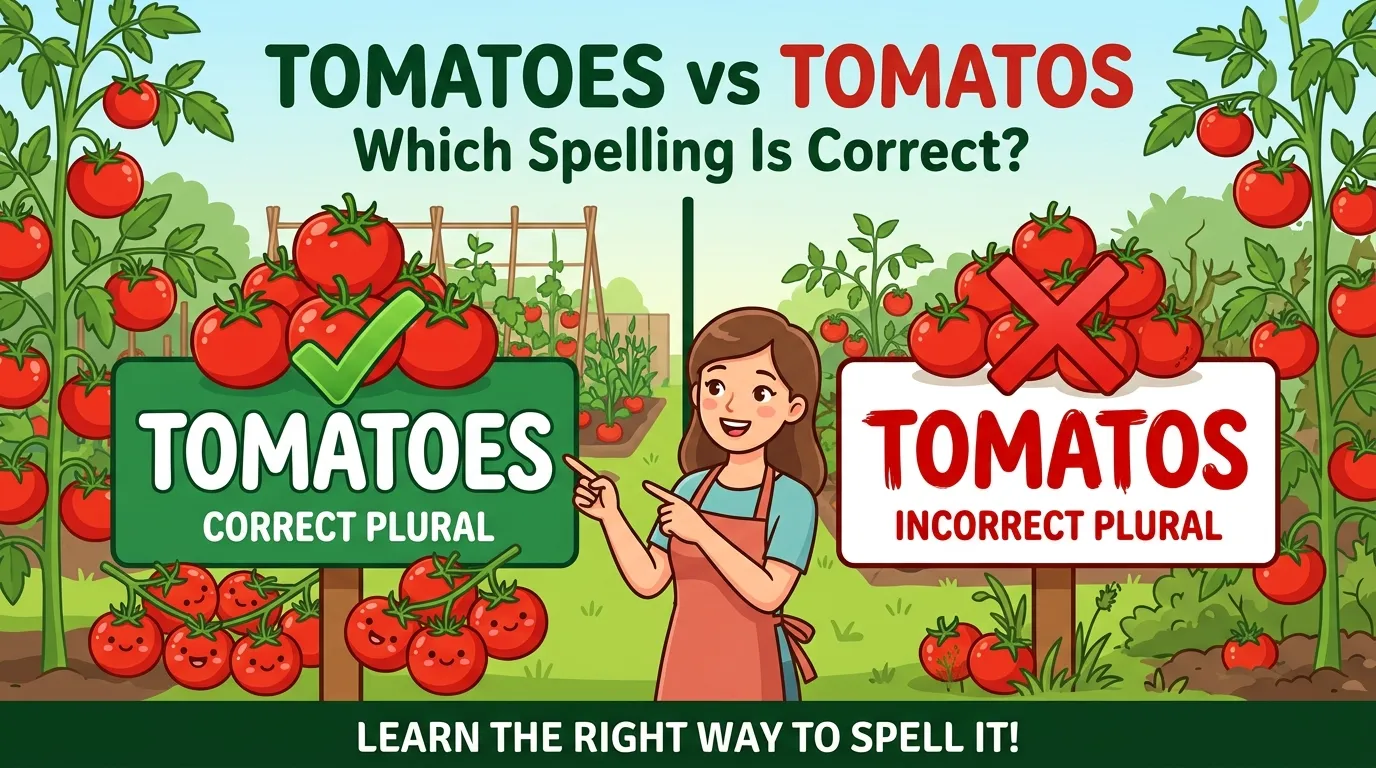
If you have ever wondered whether the plural of tomato is tomatoes or tomatos, the answer is straightforward: tomatoes is the standard and correct spelling in modern English. Tomatos is generally considered a misspelling.
The confusion happens because many English nouns simply add -s to form their plurals, such as book → books or car → cars. But tomato belongs to a group of nouns ending in -o that traditionally form their plural with -es.
In this guide to tomatoes vs tomatos, you will learn why tomatoes is correct, why tomatos appears so often, how the plural is pronounced, where the word comes from, and how to use it naturally in American and British English. We will also look at common mistakes, related words, example sentences, pronunciation, word history, and practical writing tips.
Quick Answer: Tomatoes or Tomatos?
Tomatoes is the correct standard plural form of tomato.
| Singular | Correct Plural | Incorrect Standard Form |
|---|---|---|
| tomato | tomatoes | tomatos |
Example
- Correct: I bought five tomatoes.
- Incorrect: I bought five tomatos.
The word tomatoes is used in both American English and British English. There is no standard regional spelling difference that makes tomatos correct.
So, if you are writing an email, school assignment, article, recipe, newspaper story, business document, or social media post, use tomatoes.
What Does “Tomatoes” Mean?
Tomatoes is the plural form of tomato.
A tomato is a fleshy fruit commonly used as a vegetable in cooking. It can be eaten raw or cooked and is widely used in salads, sauces, soups, sandwiches, pizzas, and many other dishes.
Dictionary-style definition
Tomato (noun): A usually round, edible fruit of the tomato plant, commonly red when ripe and widely used in cooking.
Tomatoes (plural noun): More than one tomato.
Examples
- She sliced two tomatoes for the salad.
- The garden produced dozens of tomatoes this summer.
- These tomatoes are perfectly ripe.
- We need three tomatoes for the sauce.
The meaning does not change when you move from tomato to tomatoes. The difference is simply singular versus plural.
Tomatoes vs Tomatos: The Key Difference
The main difference is spelling.
Tomatoes is the standard plural spelling.
Tomatos is usually a spelling error caused by applying the simple plural rule incorrectly.
The spelling pattern is:
tomato + es = tomatoes
Not:
tomato + s = tomatos
This is similar to other nouns that traditionally take -es when ending in certain letters or sounds.
Compare these examples
| Singular | Plural |
|---|---|
| tomato | tomatoes |
| potato | potatoes |
| hero | heroes |
| echo | echoes |
| torpedo | torpedoes |
However, English has many exceptions, which is one reason this pattern can be confusing.
For example:
| Singular | Plural |
|---|---|
| photo | photos |
| piano | pianos |
| radio | radios |
| video | videos |
So you cannot simply assume that every word ending in -o takes -es.
Why Is “Tomatoes” Spelled With -ES?
The spelling comes from the traditional pluralization pattern used with certain nouns ending in -o.
When tomato became established in English, its plural developed as tomatoes.
The ending -es also reflects a pronunciation pattern. Instead of simply attaching an /s/ sound, the plural ending is pronounced with an additional syllable.
For example:
tomato → approximately three syllables
tomatoes → approximately four syllables
The final part sounds roughly like “tohz”, depending on accent.
This is why tomatoes is not simply tomato + s in standard spelling and pronunciation.
Why Do People Write “Tomatos”?
There are several reasons people spell tomatoes as tomatos.
1. The regular plural rule
Many English plurals are formed by adding -s:
- apple → apples
- orange → oranges
- banana → bananas
- carrot → carrots
- pepper → peppers
A writer may naturally apply the same pattern to tomato.
2. Confusion about -O words
English contains both -os and -oes plurals.
For example:
- photo → photos
- piano → pianos
- tomato → tomatoes
- potato → potatoes
Because there is no single rule covering every English word ending in -o, learners often have to memorize individual forms.
3. Pronunciation
The pronunciation of tomatoes can make the spelling less obvious.
Someone who hears the word without seeing it written may not immediately know whether the ending is spelled -oes or -os.
4. Typing errors
Online writing also produces many accidental spellings. A person may type tomatos quickly without noticing the missing e.
Is “Tomatos” Ever Correct?
In standard modern English, tomatos is not the accepted plural spelling of tomato.
You may encounter it online, in informal writing, user-generated content, menus, social media posts, or old text. Its appearance does not make it a standard spelling.
If you are trying to write correctly, choose:
tomatoes
Use “tomatoes” in:
- Academic writing
- Business writing
- Journalism
- Blogging
- Recipes
- Product descriptions
- School assignments
- Professional communication
- Technical documents
- Websites
- Books
- Emails
There is no practical reason to choose tomatos in standard English.
Tomatoes vs Tomatos in American English
American English uses tomatoes as the standard plural.
American English examples
- I bought fresh tomatoes at the grocery store.
- The recipe calls for four tomatoes.
- The farmers grow organic tomatoes.
- She planted several tomatoes in her backyard.
American writers should therefore use tomatoes, not tomatos.
Tomatoes vs Tomatos in British English
British English also uses tomatoes.
There is no British spelling rule that changes tomatoes into tomatos.
British English examples
- We bought some fresh tomatoes.
- The salad contains tomatoes and cucumber.
- The greenhouse is full of ripe tomatoes.
So, unlike some words that have different American and British spellings, such as color/colour or center/centre, tomato/tomatoes does not have a standard US/UK plural spelling difference.
Tomato vs Tomatoes: Singular and Plural
The easiest way to remember the distinction is to identify whether you are talking about one or more than one.
Singular: tomato
Use tomato when referring to one.
I ate one tomato.
Plural: tomatoes
Use tomatoes when referring to two or more.
I ate two tomatoes.
More examples
- One tomato is on the counter.
- Three tomatoes are on the counter.
- She planted a tomato plant.
- She planted several tomato plants.
- This tomato tastes sweet.
- These tomatoes taste sweet.
How Do You Pronounce “Tomatoes”?
The pronunciation of tomatoes varies somewhat by English accent.
In common American English, tomato is often pronounced roughly like:
tuh-MAY-toh
The plural tomatoes is commonly pronounced:
tuh-MAY-tohz
In British English, the pronunciation of tomato is commonly:
tuh-MAH-toh
The plural becomes approximately:
tuh-MAH-tohz
The exact pronunciation can vary from speaker to speaker.
Important point
The spelling tomatoes represents the standard plural regardless of whether you pronounce tomato with the American “may” sound or the British “mah” sound.
Is “Tomatoes” a Noun?
Yes.
Tomatoes is a plural noun.
The singular noun is tomato.
Grammatical classification
- tomato = singular countable noun
- tomatoes = plural countable noun
Because tomatoes are countable, you can say:
- one tomato
- two tomatoes
- ten tomatoes
- several tomatoes
- many tomatoes
You can also use a tomato because tomato is a countable noun.
Examples
I need a tomato.
I need five tomatoes.
How “Tomatoes” Works in a Sentence
Tomatoes can perform several grammatical roles within a sentence.
As the subject
Tomatoes grow well in warm weather.
Here, tomatoes is the subject.
As the object
I bought tomatoes yesterday.
Here, tomatoes receives the action of bought.
After a preposition
The soup is made with tomatoes.
Here, tomatoes follows the preposition with.
With a plural verb
Tomatoes are rich in flavor.
Because tomatoes is plural, the verb is are, not is.
Common Mistakes With Tomatoes
Here are some frequent errors and their corrections.
| Incorrect | Correct |
|---|---|
| I bought three tomatos. | I bought three tomatoes. |
| These tomatos are fresh. | These tomatoes are fresh. |
| The recipe needs two tomatos. | The recipe needs two tomatoes. |
| We grow organic tomatos. | We grow organic tomatoes. |
| She chopped the tomatos. | She chopped the tomatoes. |
Remember
If you mean more than one tomato, write:
tomatoes
Awkward vs Natural Examples
Sometimes the issue is not just spelling. The sentence itself can also sound unnatural.
Awkward
I have much tomatoes.
Natural
I have many tomatoes.
Because tomatoes is a countable plural noun, many is appropriate.
Awkward
There is five tomatoes.
Natural
There are five tomatoes.
The plural subject tomatoes requires the plural verb are.
Awkward
I bought a tomatoes.
Natural
I bought a tomato.
Use a with the singular form.
Awkward
I need two tomato.
Natural
I need two tomatoes.
A number greater than one normally requires the plural form.
Tomatoes in Formal and Informal Writing
The spelling does not change according to formality.
Whether you are writing casually or professionally, the standard spelling is tomatoes.
Casual
I need to grab some tomatoes.
Professional
The shipment contains 500 fresh tomatoes.
Academic
The study examined the nutritional properties of tomatoes.
Journalistic
Farmers reported strong demand for locally grown tomatoes.
Business
The company supplies tomatoes to regional supermarkets.
The context changes, but the spelling remains the same.
Tomatoes in Recipes and Food Writing
Tomatoes appears frequently in food-related writing.
Common recipe phrases include:
- fresh tomatoes
- ripe tomatoes
- chopped tomatoes
- diced tomatoes
- sliced tomatoes
- canned tomatoes
- crushed tomatoes
- roasted tomatoes
- cherry tomatoes
- Roma tomatoes
- heirloom tomatoes
- sun-dried tomatoes
- green tomatoes
Examples
Add two cups of chopped tomatoes to the pan.
Garnish the dish with fresh tomatoes.
The sauce is made with ripe tomatoes.
Roast the cherry tomatoes until they begin to soften.
Common Collocations With “Tomatoes”
A collocation is a combination of words that naturally appear together.
Some common collocations involving tomatoes include:
Adjective + tomatoes
- fresh tomatoes
- ripe tomatoes
- red tomatoes
- green tomatoes
- canned tomatoes
- organic tomatoes
- juicy tomatoes
- sliced tomatoes
- roasted tomatoes
- cooked tomatoes
Verb + tomatoes
- grow tomatoes
- plant tomatoes
- harvest tomatoes
- pick tomatoes
- slice tomatoes
- chop tomatoes
- dice tomatoes
- roast tomatoes
- cook tomatoes
- peel tomatoes
- wash tomatoes
- eat tomatoes
Tomatoes + noun
- tomato plants
- tomato sauce
- tomato soup
- tomato salad
- tomato juice
- tomato paste
- tomato seeds
- tomato garden
Notice that tomato remains singular when it functions as an adjective before another noun:
tomato sauce
Not usually:
tomatoes sauce
This is an important grammar distinction.
Tomato vs Tomatoes in Compound Words
English often uses the singular form of a noun before another noun.
For example:
- tomato sauce
- tomato soup
- tomato plant
- tomato juice
- tomato paste
- tomato salad
- tomato seed
Even when the product contains many tomatoes, tomato can function as a noun modifier.
Example
We made homemade tomato sauce.
The sauce could contain several tomatoes, but tomato describes the type of sauce.
Compare:
We bought several tomatoes.
Here, tomatoes is the main plural noun.
What Are the Synonyms for “Tomatoes”?
Strictly speaking, tomatoes does not have many true synonyms because it refers to a specific food.
Depending on context, related expressions may include:
- tomato fruit
- fresh tomatoes
- garden tomatoes
- ripe tomatoes
- tomato varieties
- produce
However, these are not exact replacements in every sentence.
For example:
I bought some produce.
This could mean tomatoes, apples, lettuce, or many other foods.
Therefore, produce is a broader term, not a direct synonym.
Are There Antonyms for “Tomatoes”?
No direct antonym exists for tomatoes.
An antonym is a word with an opposite meaning, such as:
- hot / cold
- big / small
- early / late
A food item such as tomatoes does not naturally have an opposite word.
You could contrast tomatoes with another ingredient, but that would be a contrast, not an antonym.
For example:
tomatoes vs cucumbers
is a comparison between foods, not a pair of antonyms.
The History and Etymology of “Tomato”
The word tomato has a fascinating history.
English did not originate the word. It ultimately traces back to Indigenous languages of the Americas, with the Spanish form tomate playing an important role in its movement into European languages.
The tomato itself originated in the Americas and later became an important ingredient around the world.
As the word entered English, it developed into the familiar spelling tomato.
Its plural became tomatoes, following the established English pattern used for certain nouns ending in -o.
The history helps explain why the modern spelling may not seem completely predictable from today’s English plural rules.
Why Tomato and Potato Are Similar
One useful memory trick is to connect tomato with potato.
Both traditionally form their plurals with -es:
- tomato → tomatoes
- potato → potatoes
This makes them a useful pair to memorize.
Memory trick
Think:
One tomato, two tomatoes.
One potato, two potatoes.
Both add -es.
This is more reliable than trying to remember a complicated rule for every noun ending in -o.
But Not Every -O Word Uses -ES
This is one of the most important points.
English has many nouns ending in -o, and their plural forms are not completely consistent.
Words ending in -O that commonly take -ES
- tomato → tomatoes
- potato → potatoes
- hero → heroes
- echo → echoes
Words ending in -O that commonly take -S
- photo → photos
- piano → pianos
- radio → radios
- video → videos
- studio → studios
Therefore, saying “Every word ending in -o takes -es” would be incorrect.
English plural spelling is influenced by word history, pronunciation, usage, and convention.
Is “Tomatoes” a Regular Plural?
It depends on how you define “regular.”
It is a standard plural formation, but it does not follow the simplest add -s pattern.
Instead, the plural is formed with -es:
tomato → tomatoes
English grammar often groups this with nouns that take -es in the plural.
From a learner’s perspective, the most useful approach is simply to memorize:
tomato → tomatoes
Tomatoes in American Culture and Everyday Speech
Tomatoes are common in American food vocabulary.
You will see the word in contexts involving:
- burgers
- sandwiches
- salads
- pizza
- pasta
- salsa
- soups
- sauces
- gardening
- farming
- nutrition
- grocery shopping
Everyday examples
Can you pick up some tomatoes?
I forgot to buy tomatoes.
These tomatoes are too soft.
Do you want tomatoes on your sandwich?
The garden is producing lots of tomatoes.
These sentences sound natural in everyday American English.
Tomatoes in Journalism
News and journalistic writing may use tomatoes when discussing agriculture, food prices, farming, trade, or markets.
Examples
Local farmers harvested thousands of tomatoes this season.
Tomato prices increased after severe weather affected crops.
Farmers are experimenting with new tomato varieties.
The spelling remains exactly the same in professional journalism.
Tomatoes in Academic Writing
Academic writers may discuss tomatoes in research involving agriculture, botany, nutrition, food science, and biology.
Examples
The researchers examined several tomato varieties.
The experiment compared the growth rates of tomatoes under different conditions.
Fresh tomatoes contain several naturally occurring nutrients.
In formal writing, clarity and standard spelling are especially important, so tomatoes is the appropriate form.
Tomatoes in Business Writing
Businesses may use tomatoes in product descriptions, supply-chain documents, restaurant menus, invoices, and marketing materials.
Examples
Our supplier delivers fresh tomatoes every morning.
The restaurant uses locally grown tomatoes.
The shipment includes 200 boxes of tomatoes.
Using tomatos in these contexts could make the document look poorly edited or unprofessional.
Tomatoes in Blogging and Online Content
If you are writing a food blog, gardening article, recipe page, or SEO article, always use tomatoes.
Search engines understand common spelling mistakes, but that does not mean you should deliberately use an incorrect spelling.
Better approach
Use the correct spelling naturally:
Learn how to grow tomatoes in containers.
Instead of:
Learn how to grow tomatos in containers.
You can discuss the spelling mistake itself if it is relevant to your article:
Many people search for “tomatos,” but the standard spelling is tomatoes.
This lets you address search intent without presenting the misspelling as correct.
Common Search Queries About Tomatoes vs Tomatos
People may search for this topic in several ways:
- tomatoes vs tomatos
- tomato plural
- plural of tomato
- is tomatos correct
- is tomatoes correct
- how to spell tomatoes
- tomatos or tomatoes
- correct spelling of tomatoes
- tomato plural spelling
- tomatoes spelling
- why is tomato plural tomatoes
- how do you spell tomato plural
The answer is consistent:
The standard plural of tomato is tomatoes.
A Simple Rule for Remembering the Spelling
If you frequently forget the spelling, use this memory sentence:
Tomatoes and potatoes both end in -oes.
Then remember:
tomato → tomatoes
potato → potatoes
Another useful visual trick is to focus on the middle:
tomat + oes
The e comes before the final s.
Tomatoes vs Tomatos: Side-by-Side Comparison
| Feature | Tomatoes | Tomatos |
|---|---|---|
| Standard spelling | Yes | No |
| Plural of tomato | Yes | Intended, but misspelled |
| American English | Correct | Incorrect |
| British English | Correct | Incorrect |
| Formal writing | Use it | Avoid it |
| Academic writing | Use it | Avoid it |
| Journalism | Use it | Avoid it |
| Casual writing | Use it | Avoid it |
| Dictionary-standard plural | Yes | No |
| Meaning | More than one tomato | Intended to mean more than one tomato |
When Should You Use “Tomato” Instead?
Use tomato when you mean one individual fruit or when the singular form is being used as a modifier.
One individual
I ate one tomato.
General compound expression
I bought tomato sauce.
Before another noun
She planted a tomato plant.
Use tomatoes when you mean multiple individual tomatoes.
She planted six tomatoes.
More Correct Examples
Here are additional examples to reinforce the correct spelling.
- The tomatoes are ready to harvest.
- I washed the tomatoes before cutting them.
- These tomatoes taste delicious.
- We need fresh tomatoes for dinner.
- The farmer sells organic tomatoes.
- She grows tomatoes on her balcony.
- The recipe uses canned tomatoes.
- I bought a basket of tomatoes.
- The children helped pick the tomatoes.
- We stored the ripe tomatoes in the kitchen.
Common Mistakes to Avoid
Mistake 1: Writing “tomatos”
❌ The tomatos are ripe.
✅ The tomatoes are ripe.
Mistake 2: Using singular with a plural number
❌ I bought three tomato.
✅ I bought three tomatoes.
Mistake 3: Using “is” with a plural subject
❌ The tomatoes is fresh.
✅ The tomatoes are fresh.
Mistake 4: Using “a” with a plural
❌ I bought a tomatoes.
✅ I bought a tomato.
Mistake 5: Assuming every -o word follows the same rule
❌ Every -o word becomes -oes.
✅ English has several plural patterns, so individual words must sometimes be memorized.
Frequently Asked Questions About Tomatoes vs Tomatos
Is “tomatos” a correct spelling?
No. Tomatos is generally considered a misspelling. The standard plural form of tomato is tomatoes.
What is the plural of tomato?
The plural of tomato is tomatoes.
Example: One tomato, two tomatoes.
Why is tomato plural tomatoes instead of tomatos?
Tomato traditionally forms its plural with -es, giving tomatoes. This is an established standard English spelling.
Is “tomatoes” American or British English?
Tomatoes is standard in both American and British English. There is no normal US-versus-UK spelling difference for this plural.
How do you pronounce tomatoes?
In American English, tomatoes is commonly pronounced approximately tuh-MAY-tohz. British pronunciation commonly uses tuh-MAH-tohz.
Is tomato a singular or plural word?
Tomato is singular. Tomatoes is plural.
Why do some people spell tomatoes as tomatos?
The misspelling usually comes from applying the common English plural rule of simply adding -s, or from confusion about other nouns ending in -o.
Do potatoes and tomatoes follow the same spelling rule?
Yes. Both commonly form their plurals with -es:
- potato → potatoes
- tomato → tomatoes
Should I use “tomatoes” in formal writing?
Yes. Tomatoes is the correct standard spelling and should be used in academic, professional, journalistic, business, and formal writing.
Is “tomatos” ever acceptable in English?
It may appear as an informal spelling error or in user-generated text, but it is not the standard plural spelling. For correct English, use tomatoes.
Conclusion
When comparing tomatoes vs tomatos, there is one clear winner: tomatoes.
Tomatoes is the standard plural form of tomato in American English, British English, and standard international English. Tomatos is generally a misspelling.
The easiest way to remember it is to connect tomatoes with potatoes:
tomato → tomatoes
potato → potatoes
Although English has inconsistent plural patterns for words ending in -o, tomato is one of the words that traditionally takes -es.
So whether you are writing a recipe, school assignment, business document, news article, blog post, gardening guide, or casual message, choose tomatoes.
If you remember only one thing from this guide, remember this:
One tomato. Two tomatoes. Never “tomatos” in standard English.