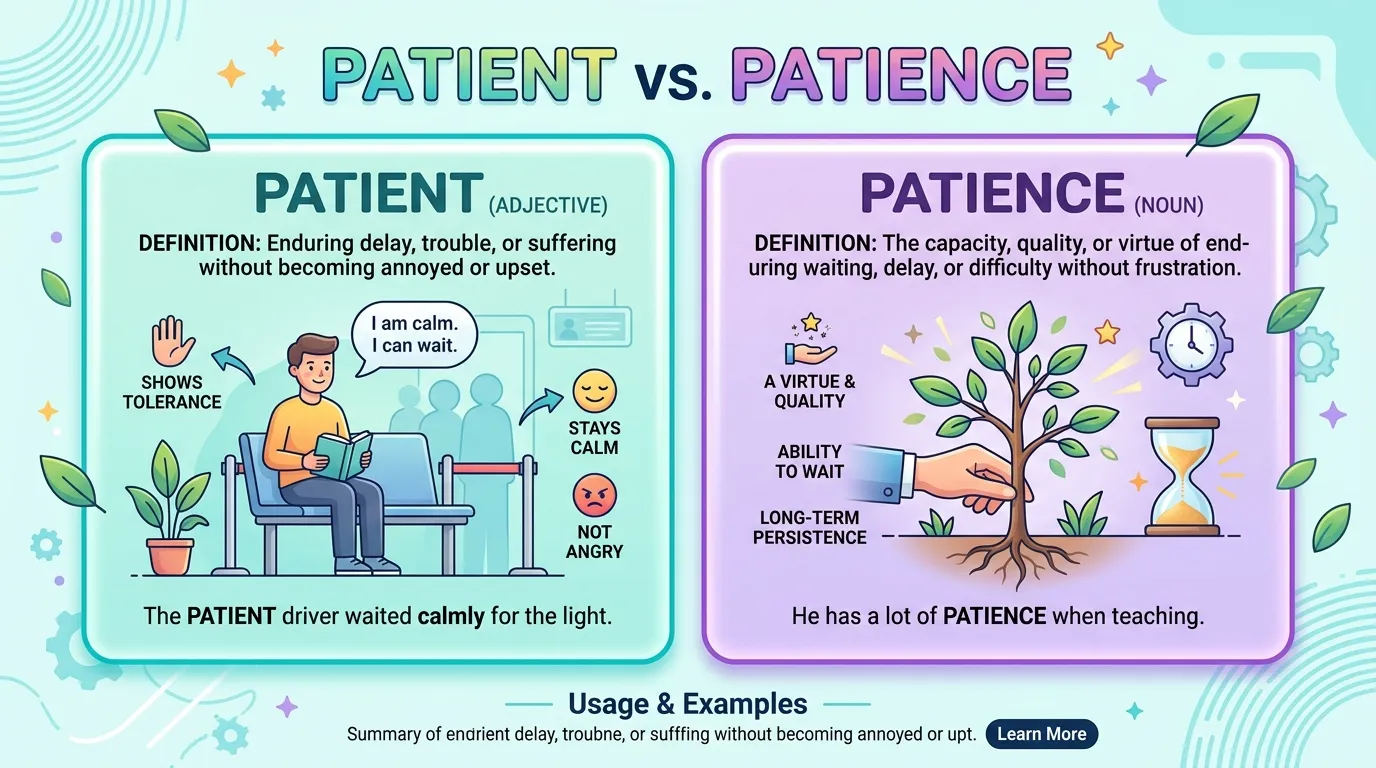
The words patient and patience look and sound similar, but they do very different jobs in English. If you have ever written I need more patient when you meant I need more patience, you are not alone. These words are closely related, which makes them easy to mix up, especially for English learners.
The simplest way to remember the difference is this: patient usually describes a person or refers to a person receiving medical care, while patience is the ability to remain calm and wait without becoming annoyed.
For example:
- She is very patient with children.
- She has a lot of patience with children.
- The patient is waiting for the doctor.
In the first sentence, patient is an adjective. In the second, patience is a noun. In the third, patient is a noun.
This guide explains patient vs patience in detail. You will learn their definitions, pronunciation, grammatical roles, word origins, synonyms, collocations, common expressions, formal and informal usage, regional differences, common mistakes, and practical examples.
Quick Answer: Patient vs Patience
Patient and patience are both correct English words, but they have different meanings and grammatical functions.
| Word | Part of Speech | Main Meaning | Example |
|---|---|---|---|
| patient | Adjective | Able to wait calmly without becoming annoyed | She is patient with her students. |
| patient | Noun | A person receiving medical treatment | The patient spoke with the doctor. |
| patience | Noun | The ability to wait calmly or tolerate difficulty | You need patience when learning a language. |
The easiest distinction
- Patient = describes someone or identifies someone receiving medical care.
- Patience = the quality of being patient.
Think of it this way:
A patient person has patience.
That one sentence captures the basic relationship between the two words.
What Does Patient Mean?
The word patient has two major meanings.
Patient as an adjective
As an adjective, patient describes someone who can wait, listen, or deal with difficult situations without becoming angry, frustrated, or upset.
For example:
- My teacher is very patient.
- Please be patient while we solve the problem.
- He was patient with his young son.
- You need to be patient when learning a new skill.
- The manager remained patient during the long meeting.
In these examples, patient describes a person’s behavior or attitude.
It can also describe an action or approach:
- She took a patient approach to the negotiation.
- The doctor gave the child a patient explanation.
- A patient investor may wait years for results.
Patient as a noun
Patient can also be a noun. In medical contexts, a patient is someone who is receiving medical care, treatment, examination, or observation.
Examples:
- The patient arrived at the hospital early.
- The doctor examined the patient.
- The nurse called the next patient.
- The patient was discharged after two days.
- Each patient received individual instructions.
Here, patient does not mean calm or tolerant. It refers to a person receiving healthcare.
This medical meaning is extremely common in American English and British English.
What Does Patience Mean?
Patience is a noun. It means the ability to remain calm while waiting, dealing with problems, or handling something difficult.
Examples:
- Learning a language requires patience.
- She showed great patience with her children.
- I am running out of patience.
- You need patience to complete this project.
- His patience helped him handle the difficult customer.
The word refers to a quality, ability, or state, not directly to the person who possesses it.
Compare:
- She is patient.
- She has patience.
Both sentences communicate a similar idea, but the grammar is different.
Patient is an adjective in the first sentence.
Patience is a noun in the second.
Patient vs Patience: The Key Difference
The biggest difference is grammatical.
Patient can be an adjective or a noun.
Patience is a noun.
When you want to describe someone, use patient.
He is patient.
When you want to talk about the quality or ability, use patience.
He has patience.
This distinction explains most mistakes involving these words.
Compare these sentences
Correct:
- She is very patient.
- She has a lot of patience.
- You need to be patient.
- You need patience.
- The patient is resting.
Incorrect:
- She has a lot of patient.
- You need more patient.
- He showed great patient.
- The patience is waiting for the doctor.
The incorrect examples use the wrong grammatical form.
Patient vs Patience Grammar
Understanding the parts of speech makes these words much easier to use.
Patient as an adjective
An adjective describes a noun or pronoun.
- She is patient.
- He is a patient teacher.
- They were patient during the delay.
- We need a patient approach.
The adjective can appear after linking verbs such as be, seem, remain, and become.
Examples:
- She is patient.
- He remained patient.
- They seemed patient.
- You should be patient.
Patient as a noun
As a noun, patient refers to someone receiving medical care.
Examples:
- The patient needs medication.
- The doctor called the patient.
- Several patients were waiting.
The plural is patients.
Patience as a noun
Patience names a quality or ability.
Examples:
- Her patience impressed everyone.
- Teaching young children requires patience.
- I appreciate your patience.
- His patience finally ran out.
Unlike patient, patience is not normally used as a plural noun when referring to the general quality.
You would normally say:
Thank you for your patience.
Not:
Thank you for your patiences.
Patient vs Patience Pronunciation
Although these words are related and similar in sound, their endings are different.
Patient
Patient is pronounced approximately:
PAY-shənt
IPA:
/ˈpeɪʃənt/
The final sound is similar to -shunt.
Example:
Please be patient.
Patience
Patience is pronounced approximately:
PAY-shəns
IPA:
/ˈpeɪʃəns/
The final sound is closer to -shuns.
Example:
Thank you for your patience.
Pronunciation trick
Focus on the ending:
- patient → -shənt
- patience → -shəns
The spelling also gives you a useful clue:
- patient
- patience
Why Do People Confuse Patient and Patience?
There are several reasons these words are frequently confused.
They look almost identical
Both begin with:
pati-
They also share the same general pronunciation at the beginning:
pay-sh…
They are closely related in meaning
A patient person demonstrates patience.
That close semantic relationship makes the words easy to connect incorrectly.
Their grammatical roles differ
English learners sometimes know the meaning but choose the wrong part of speech.
For example:
I need to be more patience.
The intended meaning is clear, but patience is a noun. After be, the adjective patient is needed.
Correct:
I need to be more patient.
However:
I need more patience.
is also correct.
Patient or Patience: Which One Should You Use?
Use patient when describing a person or when referring to someone receiving medical treatment.
Use patience when referring to the quality of remaining calm and tolerant.
Use patient with “be”
Common patterns include:
- be patient
- stay patient
- remain patient
- become patient
- seem patient
Examples:
- Be patient; your turn will come.
- Try to remain patient.
- She stayed patient despite the delay.
Use patience with “have”
Common patterns include:
- have patience
- show patience
- need patience
- require patience
- lose patience
- test someone’s patience
- appreciate someone’s patience
Examples:
- You need to have patience.
- He lost his patience.
- The situation tested her patience.
- Thank you for your patience.
Common Collocations With Patient
A collocation is a group of words that naturally occur together.
Common combinations with the adjective patient include:
- patient person
- patient teacher
- patient parent
- patient listener
- patient approach
- patient attitude
- patient manner
- patient response
- patient explanation
- patient behavior
- patient customer
- patient worker
- patient investor
Examples:
Maria is a patient teacher who explains difficult ideas clearly.
A patient listener does not interrupt unnecessarily.
The company took a patient approach to growth.
Common Collocations With Patience
Common expressions containing patience include:
- have patience
- show patience
- demonstrate patience
- need patience
- require patience
- practice patience
- develop patience
- learn patience
- lose patience
- run out of patience
- test someone’s patience
- try someone’s patience
- appreciate your patience
- thank you for your patience
Examples:
Learning to play the piano takes patience.
The delay really tested my patience.
We appreciate your patience while we investigate the issue.
Common Expressions With Patient
Some natural expressions use the adjective patient:
Be patient
This is one of the most common expressions.
Be patient. The results will come soon.
Patient with someone
Use patient with when describing tolerance toward a person.
She is very patient with her students.
Patient about something
You may also use patient about in certain contexts, although patient with and constructions involving waiting are often more natural.
Investors must be patient about short-term market changes.
A patient approach
This means an approach involving care, restraint, and willingness to wait.
The researcher took a patient approach to the investigation.
Common Expressions With Patience
Thank you for your patience
This is especially common in customer service, business, technology, and formal communication.
Thank you for your patience while we resolve this issue.
It sounds professional and polite.
Lose your patience
This means to stop being calm because something has become frustrating.
I lost my patience after waiting for two hours.
Run out of patience
This means that you no longer have the ability or willingness to tolerate something.
The customers were running out of patience.
Test someone’s patience
This means to make someone increasingly frustrated.
The constant delays tested everyone’s patience.
Have patience
This means to remain calm and wait.
Have patience; the process takes time.
Patience is a virtue
This traditional expression means that being able to wait calmly is a valuable quality.
Remember, patience is a virtue.
Patient vs Patience in Formal Writing
Both words are common in formal and informal English.
Business writing
Patience is particularly common in professional communication.
Thank you for your patience while we review your application.
We appreciate your patience during the system update.
The adjective patient is also useful:
Our team remained patient throughout the negotiation.
Academic writing
Academic writing often discusses patience as a human quality or behavior.
Successful language acquisition requires patience and consistent practice.
The adjective can describe an approach:
The researcher adopted a patient and systematic method.
Journalism
Both forms can appear naturally.
The coach urged fans to be patient.
The team’s patience eventually paid off.
Technical writing
Patience frequently appears in user-facing instructions and service messages.
Thank you for your patience while the software installs.
Technical documents may also use patient in healthcare contexts:
The device records the patient’s heart rate.
Patient vs Patience in Medical English
Medical writing creates an additional source of confusion because patient has a specialized noun meaning.
Consider:
The patient needs additional testing.
Here, patient means a person receiving healthcare.
Now consider:
The doctor showed great patience with the child.
Here, patience means calm tolerance.
These sentences could occur in the same medical setting, but the words perform completely different grammatical jobs.
Medical examples
- The patient arrived for a follow-up appointment.
- The nurse spoke calmly to the patient.
- The doctor was patient while explaining the diagnosis.
- The treatment process requires patience.
- The caregiver demonstrated remarkable patience.
American English vs British English
There is no major American-British spelling difference between patient and patience.
Both American English and British English use:
- patient
- patience
The meanings and basic grammatical rules are also essentially the same.
For example, both varieties naturally use:
Please be patient.
and:
Thank you for your patience.
One interesting regional usage is the noun patience as the name of a card game. In British English, patience can refer to a type of solitaire card game. In American English, solitaire is generally the more familiar term for the same broad type of game.
This is a vocabulary difference, not a spelling difference.
Patient vs Patience Word History
The two words are historically related.
Both ultimately trace back to Latin roots associated with suffering, enduring, or undergoing something. The Latin verb pati means to suffer or endure.
From this family came words connected with endurance and suffering, including forms that developed into English patient and patience.
This history helps explain why the words are so closely related.
Over time, English developed different grammatical forms:
- patient became associated with someone who endures calmly and, separately, someone receiving medical treatment.
- patience became the noun referring to the quality of being patient.
The medical sense of patient is historically connected to the idea of a person undergoing medical treatment.
Patient Synonyms
When patient means calm and tolerant, useful synonyms include:
- calm
- tolerant
- understanding
- composed
- unhurried
- persevering
- forbearing
- restrained
- accommodating
- long-suffering
The best synonym depends on context.
For example, calm does not always mean exactly the same thing as patient. A person can be calm but unwilling to wait.
Examples
She was patient with the child.
Possible alternative:
She was understanding with the child.
He remained patient during the delay.
Possible alternative:
He remained calm during the delay.
Patience Synonyms
Useful synonyms for patience include:
- tolerance
- endurance
- perseverance
- restraint
- composure
- persistence
- forbearance
- self-control
Again, these words are not perfect substitutes in every sentence.
For example:
Thank you for your patience.
The natural replacement is not necessarily:
Thank you for your tolerance.
The second sentence can sound as though the person had to tolerate something unpleasant.
Antonyms of Patient and Patience
The opposite of patient can include:
- impatient
- restless
- hurried
- intolerant
- irritable
The most direct antonym is impatient.
Examples:
He is very impatient.
She became impatient after waiting for an hour.
The antonym of patience can be expressed with nouns such as:
- impatience
- intolerance
- restlessness
- irritability
Example:
His impatience was obvious.
Notice the relationship:
patient → impatient
patience → impatience
Common Mistakes With Patient and Patience
Mistake: I need more patient
Incorrect:
I need more patient.
Correct:
I need more patience.
Why? Because you are talking about a quality.
Mistake: I need to be more patience
Incorrect:
I need to be more patience.
Correct:
I need to be more patient.
Why? Because be requires the adjective here.
Mistake: Thank you for being patience
Incorrect:
Thank you for being patience.
Correct:
Thank you for being patient.
You are describing someone’s behavior.
Mistake: Thank you for your patient
Incorrect:
Thank you for your patient.
Correct:
Thank you for your patience.
You are thanking someone for the quality they have demonstrated.
Mistake: The patience is waiting
Incorrect:
The patience is waiting for the doctor.
Correct:
The patient is waiting for the doctor.
A person receiving medical care is a patient.
Awkward vs Natural Examples
| Awkward or Incorrect | Natural Version |
|---|---|
| I need more patient. | I need more patience. |
| Please have patient. | Please have patience. |
| You should be more patience. | You should be more patient. |
| Thank you for your patient. | Thank you for your patience. |
| She has a patient with children. | She is patient with children. |
| The patience saw the doctor. | The patient saw the doctor. |
| His patient was running out. | His patience was running out. |
These mistakes often happen because the writer knows the intended meaning but chooses the wrong grammatical form.
Natural Everyday Examples
Here are practical examples you might hear in daily conversation.
At home
Please be patient with your brother.
Parenting requires a lot of patience.
At school
Our teacher is very patient.
Learning mathematics takes patience.
At work
Please be patient while we review the documents.
Thank you for your patience during the delay.
In customer service
We appreciate your patience.
Please be patient while your request is processed.
In relationships
A healthy relationship requires patience.
She is patient when her partner needs time to explain something.
In sports
Young athletes need to be patient with their development.
Building championship-level skills takes patience.
Patient vs Patience in Sports
Sports writing frequently uses both words.
Patient can describe a player’s strategy.
The batter took a patient approach at the plate.
The team played a patient game.
Patience describes the quality behind that behavior.
The team’s patience helped them control the match.
Good hitters often show patience when waiting for the right pitch.
In sports, patient often suggests discipline rather than simply waiting.
Patient vs Patience in Business
In business, patient can describe a person or strategy that does not demand immediate results.
The company needs patient investors.
Management took a patient approach to expansion.
Patience refers to the quality itself.
Building a successful company takes patience.
Investors need patience during periods of uncertainty.
The distinction remains the same.
Patient vs Patience in Blogging and Social Media
In casual online writing, both words are common.
Examples:
Be patient. The new post is coming soon!
Thanks for your patience while we fix the website.
A casual writer might use shortened or conversational expressions, but the spelling of these two words does not change.
Avoid replacing patience with patient just because the words sound similar.
Related Words You Should Know
Understanding related forms can reinforce the difference.
Patient
- patient
- patients
- impatient
- patiently
- patientness, though uncommon
Patience
- patience
- impatient
- impatience
- patiently
Notice an especially useful pair:
patiently is an adverb.
She waited patiently.
patience is a noun.
She showed great patience.
And:
patient is an adjective.
She is patient.
This creates a useful word family:
patient → patiently → patience
Patient, Patience, and Patiently
These three words are especially easy to mix up.
Patient
Adjective:
He is patient.
Patience
Noun:
He has patience.
Patiently
Adverb:
He waited patiently.
Compare all three:
She was patient during the delay.
She showed great patience during the delay.
She waited patiently during the delay.
All three are correct, but their grammatical functions differ.
A Simple Memory Trick for Patient vs Patience
Try this:
Patient = person or personality
Patience = quality
If you can replace the word with calm and tolerant, you probably need patient.
He is calm and tolerant.
→ He is patient.
If you can replace it with the ability to wait calmly, you probably need patience.
She has the ability to wait calmly.
→ She has patience.
Another quick trick is to remember:
A patient person has patience.
That sentence uses both words correctly.
How to Choose the Right Word
When you are unsure, ask yourself one question:
Am I describing someone, or am I naming a quality?
If you are describing someone:
She is patient.
If you are naming the quality:
She has patience.
If you mean someone receiving medical treatment:
The patient is waiting.
This three-part test handles most everyday situations.
Patient vs Patience: Comparison Table
| Feature | Patient | Patience |
|---|---|---|
| Part of speech | Adjective or noun | Noun |
| Pronunciation | /ˈpeɪʃənt/ | /ˈpeɪʃəns/ |
| Describes calm behavior | Yes | No |
| Refers to medical person | Yes | No |
| Refers to a quality | No | Yes |
| Means able to wait calmly | Yes | No, it names the ability |
| Common phrase | Be patient | Have patience |
| Another phrase | Patient with someone | Lose your patience |
| Related adverb | Patiently | — |
| Common antonym | Impatient | Impatience |
Which Is Correct: Patient or Patience?
Both are correct words. Neither is a misspelling of the other.
The correct choice depends on the sentence.
Use patient when:
- describing someone who can wait calmly
- telling someone to wait calmly
- describing a calm or tolerant approach
- referring to someone receiving medical care
Use patience when:
- naming the quality of calm endurance
- talking about tolerance
- discussing the ability to wait
- using expressions such as thank you for your patience
- saying someone has, loses, or needs patience
Formal and Informal Alternatives
In formal writing, patience is often used in polite expressions:
We appreciate your patience during this process.
In casual conversation, you may hear:
Hang on a second.
Give me a minute.
Just wait a little.
These expressions can sometimes replace be patient, depending on context.
However, patient and patience remain appropriate in both formal and informal English.
Professional
Thank you for your patience.
Casual
Just be patient.
More formal
We appreciate your continued patience while the matter is resolved.
Tips for English Learners
If English is not your first language, remember these patterns:
Pattern 1
be + patient
Please be patient.
Pattern 2
have + patience
You need to have patience.
Pattern 3
show + patience
She showed great patience.
Pattern 4
lose + patience
He lost his patience.
Pattern 5
patient + with
She is patient with children.
These patterns are more useful than trying to memorize isolated definitions.
SEO Search Intent: Common Questions About Patient vs Patience
People often search for this distinction using questions such as:
- patient vs patience difference
- patient or patience
- is it patient or patience
- what is the difference between patient and patience
- patient meaning
- patience meaning
- how to use patient in a sentence
- how to use patience in a sentence
- patient and patience examples
- patient vs patience pronunciation
- patient noun and adjective
- patience part of speech
- be patient or have patience
- thank you for your patience meaning
All of these questions point to the same central rule: patient describes or identifies a person, while patience names a quality or ability.
Frequently Asked Questions
Is patient and patience the same thing?
No. Patient and patience are related but grammatically and semantically different. Patient can be an adjective meaning calm and tolerant or a noun meaning a person receiving medical care. Patience is a noun meaning the ability to wait or tolerate difficulty calmly.
Should I say I need patient or I need patience?
Say I need patience when you mean you need the ability to remain calm.
For example:
I need more patience when working with beginners.
You could also say:
I need to be more patient.
Both are correct, but the grammar is different.
Is it be patient or be patience?
The correct expression is be patient.
Patient is an adjective, so it can follow be:
Please be patient.
Patience is a noun:
Please have patience.
Is patience a noun?
Yes. Patience is a noun. It refers to the ability to remain calm while waiting or dealing with difficulty.
Example:
Patience is important when learning a new skill.
Is patient a noun or adjective?
Patient can be either a noun or an adjective.
As an adjective:
She is patient.
As a noun:
The patient spoke with the doctor.
What is the difference between patient and patiently?
Patient is an adjective, while patiently is an adverb.
She is patient.
She waited patiently.
The adjective describes someone; the adverb describes how an action is performed.
What is the opposite of patience?
The most direct opposite of patience is impatience.
For example:
His impatience became obvious after the long delay.
The adjective opposite of patient is impatient.
He became impatient.
Is patient a medical term?
Yes. In healthcare, a patient is a person receiving medical examination, treatment, care, or observation.
For example:
The patient is waiting for the doctor.
This noun meaning is used widely in both American and British English.
Is patience formal or informal?
Patience is suitable in both formal and informal English. It is especially common in professional expressions such as Thank you for your patience and We appreciate your patience.
Final Takeaway: Patient vs Patience
The difference between patient and patience is simple once you focus on grammar.
Patient can be an adjective meaning calm, tolerant, or willing to wait. It can also be a noun meaning a person receiving medical care.
Patience is a noun meaning the ability to remain calm, wait, or tolerate difficulty without becoming frustrated.
Remember these three examples:
Be patient.
Have patience.
The patient is waiting for the doctor.
If you are describing someone, choose patient.
If you are talking about the quality, choose patience.
And if you are referring to someone receiving medical treatment, use patient as a noun.
The words are closely related, but they cannot be used interchangeably. Once you learn the common patterns—be patient, have patience, lose patience, show patience, and patient with someone—choosing the correct word becomes much easier.
For American English, British English, academic writing, business communication, journalism, healthcare, sports writing, blogging, and everyday conversation, the same basic distinction applies. The spelling does not change by region.
The best memory rule is short:
A patient person has patience.
Master that distinction, and you will avoid one of the most common word-choice mistakes in English.