If you have ever stopped while writing to wonder whether you should say “wait awhile” or “wait a while,” you are not alone. The difference between awhile vs a while is small in appearance but important in grammar.
The good news is simple: both “awhile” and “a while” are correct, but they do not work in exactly the same way.
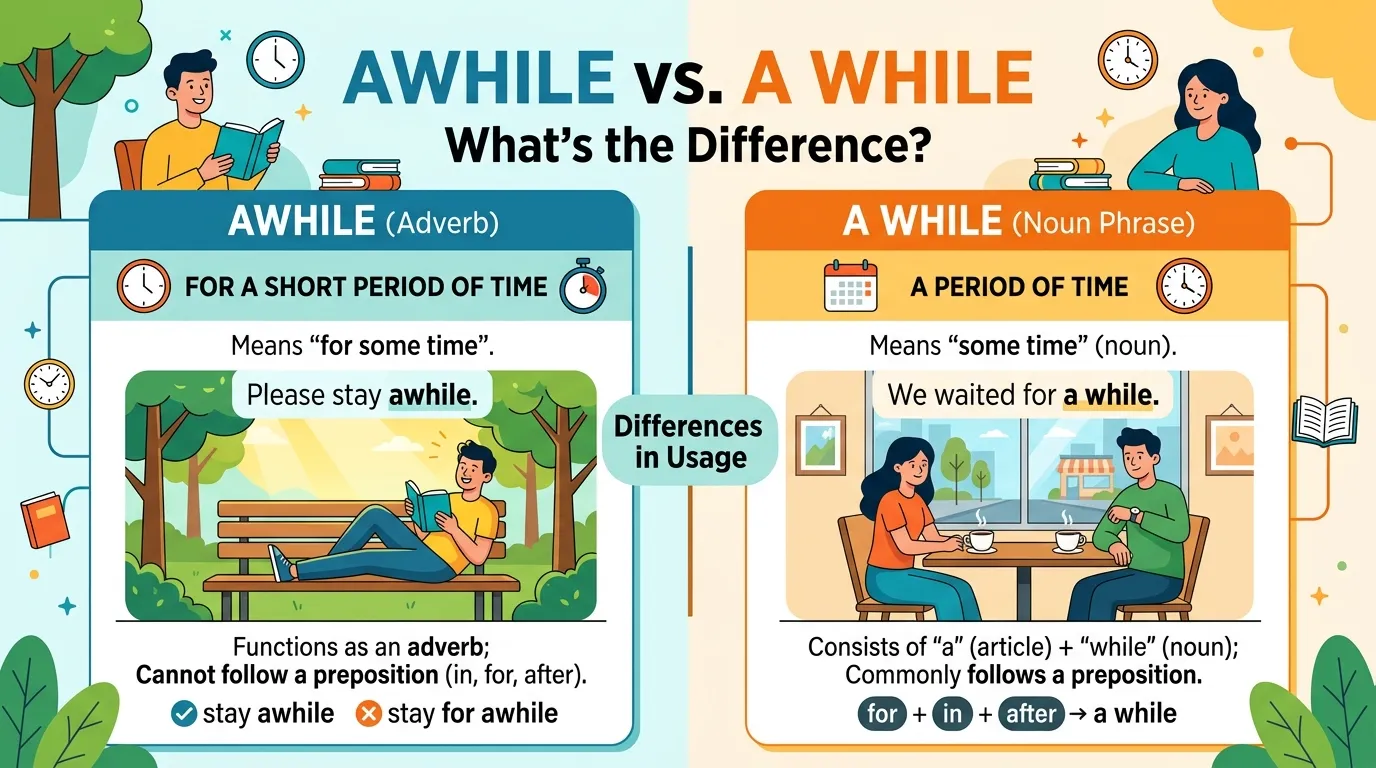
Awhile is an adverb that means “for a short time.” It normally comes directly after a verb.
Please stay awhile.
A while is a noun phrase made up of the article a and the noun while. It refers to a period of time and often appears after prepositions such as for, in, or after.
Please stay for a while.
So, if you are trying to decide between awhile vs a while, the easiest approach is to look at the grammatical role of the expression rather than its meaning alone.
This guide explains the difference in detail, including definitions, grammar rules, pronunciation, examples, common mistakes, formal usage, American and British English preferences, memory tricks, and practical recommendations.
Quick Answer: Awhile vs A While
The shortest answer is:
- Awhile = an adverb meaning for a short time.
- A while = a noun phrase meaning a period of time.
- Awhile usually follows a verb directly.
- A while commonly follows a preposition such as for or in.
- For awhile is generally considered incorrect in standard edited English. Use for a while instead.
- Wait awhile and wait a while can both be correct, depending on the grammatical construction.
- The safest choice in formal writing is to use a while when a preposition is present.
Compare these examples:
| Expression | Correct? | Why? |
|---|---|---|
| Wait awhile. | Yes | Awhile is an adverb modifying “wait.” |
| Wait a while. | Yes | A while is a noun phrase functioning as a period of time. |
| Wait for a while. | Yes | The preposition “for” takes the noun phrase “a while.” |
| Wait for awhile. | No in standard edited English | “For” should be followed by the noun phrase “a while.” |
| I stayed awhile. | Yes | “Awhile” modifies “stayed.” |
| I stayed for a while. | Yes | “A while” follows “for.” |
What Does “Awhile” Mean?
Awhile is an adverb. It means for a short period of time or for some time.
It describes the duration of an action.
Examples
- Sit awhile.
- Stay awhile.
- Rest awhile.
- Wait awhile.
- Come in and talk awhile.
- She remained there awhile.
- He worked awhile before taking a break.
In each sentence, awhile tells us how long the action happened.
You can often replace awhile with for a short time:
Stay awhile.
becomes:
Stay for a short time.
That substitution is a useful way to recognize the adverb.
Dictionary-style definition of “awhile”
Awhile: an adverb meaning for a short time or for some time.
It answers the question:
How long did the action happen?
For example:
We waited awhile.
The word awhile modifies the verb waited.
What Does “A While” Mean?
A while is different because it consists of two separate words:
- a = an article
- while = a noun
Together, a while means a period of time.
Examples
- We waited for a while.
- I have not seen her in a while.
- It happened a while ago.
- Come back after a while.
- They stayed for a while.
- I have been thinking about it for a while.
Here, while acts as a noun.
You can often replace a while with a period of time:
We waited for a while.
becomes:
We waited for a period of time.
That confirms that a while is functioning as a noun phrase.
Awhile vs A While: The Main Grammatical Difference
The most important distinction is grammatical.
Awhile is an adverb.
A while is a noun phrase.
Consider these sentences:
She stayed awhile.
She stayed for a while.
The meaning is almost identical, but the grammatical structures are different.
In the first sentence, awhile directly modifies stayed.
In the second sentence, for is a preposition, and a while is its object.
This is why the following sentence is not standard:
She stayed for awhile.
The preposition for needs a noun phrase here. The standard form is:
She stayed for a while.
A Simple Test for “Awhile”
Try removing the word and replacing it with “for a short time.”
If the sentence still works, awhile may be appropriate.
Example
Let’s wait awhile.
Try:
Let’s wait for a short time.
The sentence works naturally.
Another example:
Stay awhile.
becomes:
Stay for a short time.
Again, it works.
This makes awhile a useful choice when the expression directly modifies a verb.
A Simple Test for “A While”
If you can replace a while with “a period of time,” you probably need the two-word form.
Example
We talked for a while.
Replace it:
We talked for a period of time.
The grammar works.
Another example:
I haven’t visited in a while.
The two-word form is correct because a while is functioning as a noun phrase after in.
When Should You Use “Awhile”?
Use awhile when it functions as an adverb meaning for a short time.
It commonly follows verbs such as:
- wait
- stay
- sit
- rest
- remain
- talk
- work
- read
- sleep
- relax
- linger
Natural examples
Sit awhile and enjoy the view.
She stayed awhile after the meeting.
Let’s rest awhile before continuing.
He read awhile before going to bed.
They talked awhile about the project.
Please wait awhile.
The word can make a sentence sound slightly compact or literary, but it is perfectly standard.
When Should You Use “A While”?
Use a while when while functions as a noun.
This is especially common after prepositions and in time expressions.
Common structures
for a while
We talked for a while.
in a while
I haven’t heard from him in a while.
a while ago
She called a while ago.
after a while
After a while, everyone became comfortable.
once in a while
I eat dessert once in a while.
every once in a while
Every once in a while, we take a weekend trip.
“For Awhile” vs “For A While”
This is one of the most common points of confusion.
In standard American English, use:
for a while
Not:
for awhile
Why?
Because for is a preposition, and in this construction it is followed by the noun phrase a while.
Correct
I stayed there for a while.
She worked for a while.
Let’s sit for a while.
He rested for a while.
Avoid in formal or edited writing
I stayed there for awhile.
She worked for awhile.
Although you may see for awhile in casual writing, standard grammar guidance generally favors for a while.
“Wait Awhile” vs “Wait A While”
Both can be correct.
Wait awhile
Wait awhile before making a decision.
Here, awhile is an adverb modifying wait.
Wait a while
Wait a while before making a decision.
Here, a while is a noun phrase.
The meaning is nearly the same.
However, wait a while is extremely common in everyday American English, while wait awhile is also grammatical and can sound slightly more compact.
The safest everyday choice
If you are unsure, wait a while is an excellent general-purpose choice.
Why Do People Confuse “Awhile” and “A While”?
The confusion comes from three main factors.
1. They sound almost identical
In ordinary speech, awhile and a while are usually pronounced very similarly.
When you hear:
Stay awhile.
and:
Stay a while.
the difference is difficult to detect.
The distinction is mainly visible in writing.
2. Their meanings overlap
Both expressions can describe a period of time.
That means writers naturally assume they are interchangeable everywhere.
They are not.
Their grammatical roles are different even when their meanings are close.
3. “While” can serve different grammatical roles
The word while can function as a noun or as a conjunction.
For example:
I waited for a while.
Here, while is a noun.
But:
While I waited, she called.
Here, while is a conjunction introducing a dependent clause.
Understanding the grammatical role of while makes the distinction much easier.
Awhile vs A While Comparison Table
| Feature | Awhile | A while |
|---|---|---|
| Number of words | One | Two |
| Part of speech | Adverb | Noun phrase |
| Basic meaning | For a short time | A period of time |
| Common position | After a verb | Often after a preposition |
| “For” before it | Usually avoid | Correct |
| Example | Stay awhile. | Stay for a while. |
| Formal writing | Correct | Correct |
| Casual writing | Correct | Very common |
| Meaning | Duration | Period of time |
Pronunciation: Awhile vs A While
In most varieties of American English, awhile and a while sound nearly identical.
Awhile is commonly pronounced roughly like:
uh-WHILE
The phrase a while is also usually pronounced:
uh-WHILE
The important difference is therefore not pronunciation but grammar and spelling.
This is a classic example of why English can be difficult for learners: two expressions can sound almost exactly alike while functioning differently in written grammar.
Is “Awhile” One Word or Two?
Awhile is one word.
It is an adverb.
She stayed awhile.
A while is two words.
It is an article plus a noun.
She stayed for a while.
The visual difference is small, but the grammatical difference matters.
Is “Awhile” Formal or Informal?
Awhile is standard English, so it is not incorrect or inherently informal.
However, a while appears more frequently in many everyday constructions, particularly after prepositions.
For example:
I haven’t seen him in a while.
This sounds natural and familiar.
You would not normally replace it with:
I haven’t seen him in awhile.
The standard form is:
I haven’t seen him in a while.
In creative or literary writing, awhile may sometimes feel more concise:
She sat awhile beneath the old tree.
In business or academic writing, writers often choose the clearer phrase based on the sentence structure.
American English vs British English
The basic grammatical distinction between awhile and a while applies in both American and British English.
The major issue is not that one variety uses awhile and the other does not. Rather, usage depends on grammatical structure and writing style.
For international readers, the safest rule remains:
- Use awhile as an adverb.
- Use a while as a noun phrase.
- Use for a while, not for awhile, in standard edited writing.
This rule works well across major varieties of English.
“Awhile” in Academic and Professional Writing
Academic writing usually favors precision.
Instead of:
The researchers waited awhile before beginning the experiment.
You can write:
The researchers waited for a short time before beginning the experiment.
Or:
The researchers waited briefly before beginning the experiment.
In a less formal context, however:
The researchers waited awhile.
is grammatically acceptable.
Business writing
For business communication, clarity is more important than choosing the shorter form.
Compare:
Please wait awhile for a response.
This is awkward because the construction combines wait with a vague time expression.
A clearer version is:
Please wait a while for a response.
Or:
Please allow some time for a response.
For professional writing, consider the context and choose the expression that sounds most natural.
“A While” in Common Expressions
The two-word form appears in many established expressions.
For a while
We worked for a while.
Meaning: for some period of time.
In a while
I haven’t been there in a while.
Meaning: for some time up to now.
A while ago
He left a while ago.
Meaning: some time in the past.
Once in a while
We go hiking once in a while.
Meaning: occasionally.
Every once in a while
Every once in a while, I reread that book.
Meaning: occasionally or from time to time.
After a while
After a while, the noise stopped.
Meaning: after some period of time.
A little while
Give me a little while to finish.
Meaning: a short period of time.
Common Collocations With “Awhile”
Because awhile is an adverb, it naturally appears with verbs involving duration or activity.
Common combinations include:
- stay awhile
- wait awhile
- sit awhile
- rest awhile
- talk awhile
- work awhile
- read awhile
- remain awhile
- linger awhile
- relax awhile
Examples
Stay awhile and have some coffee.
She sat awhile by the window.
Let’s rest awhile.
He lingered awhile after everyone else left.
These combinations are grammatical because awhile modifies the action.
Common Mistakes With Awhile and A While
Mistake 1: “For awhile”
Incorrect in standard edited English:
We stayed for awhile.
Better:
We stayed for a while.
Mistake 2: “In awhile”
Incorrect in standard edited English:
I haven’t seen you in awhile.
Correct:
I haven’t seen you in a while.
Mistake 3: “A while ago” written as “awhile ago”
Avoid:
She called awhile ago.
Use:
She called a while ago.
Here, a while is a noun phrase meaning a period of time.
Mistake 4: Assuming “awhile” is always wrong
Some writers avoid awhile entirely because they have learned that a while is safer.
But awhile is a legitimate English word.
Stay awhile.
is correct.
Sit awhile.
is correct.
Rest awhile.
is correct.
The key is knowing its grammatical function.
Awkward vs Natural Examples
| Awkward or incorrect | Natural alternative |
|---|---|
| Wait for awhile. | Wait for a while. |
| I haven’t seen her in awhile. | I haven’t seen her in a while. |
| He left awhile ago. | He left a while ago. |
| We stayed awhile. | We stayed awhile. |
| Sit for awhile. | Sit for a while. |
| Stay awhile. | Stay awhile. |
| Come back after awhile. | Come back after a while. |
| We talked awhile. | We talked awhile. |
The important pattern is clear: preposition + a while is generally the structure you want.
Awhile vs A While in Everyday Conversation
In casual conversation, people usually do not think about the distinction.
You might hear:
Wait a while.
Wait awhile.
Both can communicate the same basic idea.
However, when writing, the distinction becomes visible.
For texting or social media, you may encounter nonstandard forms such as:
Haven’t seen you in awhile!
This is common online, but frequency does not automatically make a form standard in edited English.
If you are writing an article, school assignment, professional email, or formal document, choose:
I haven’t seen you in a while.
Awhile vs A While in Journalism and Blogging
Journalists and bloggers generally benefit from simple, conventional phrasing.
Consider:
The team waited for a while before making its announcement.
This is clear and natural.
A more concise version could be:
The team waited awhile before making its announcement.
Both can work, but the first may feel more familiar to a broad audience.
For SEO content, readability matters more than forcing one spelling throughout an article.
Use the form that fits the grammar of each sentence naturally.
Awhile vs A While in Sports Writing
Sports writing frequently describes short periods of waiting, resting, or playing.
Examples:
The players rested awhile before returning to the field.
The team waited for a while before the referee resumed play.
After a while, the crowd became quiet.
The goalkeeper stayed down for a while after the collision.
The choice depends on sentence structure, not the sport.
Awhile vs A While in Technical Writing
Technical documentation usually favors explicit language.
Instead of:
Let the device run awhile.
you might write:
Let the device run for a short time.
Or:
Allow the device to operate for several minutes.
Technical writing often specifies an exact duration when accuracy matters.
For example:
Allow the system to cool for 10 minutes.
is much clearer than:
Let the system cool awhile.
Awhile vs A While: Memory Tricks
Here are several easy ways to remember the difference.
Memory Trick 1: “For” loves “a while”
Remember:
for a while
If you see for, choose the two-word form.
Examples:
for a while
for a little while
for quite a while
Memory Trick 2: Awhile acts on an action
Think:
Verb + awhile
Examples:
wait awhile
stay awhile
rest awhile
sit awhile
This is not an absolute rule for every possible construction, but it is a useful practical shortcut.
Memory Trick 3: If you can say “a period of time,” use “a while”
for a while
→ for a period of time
after a while
→ after a period of time
That makes the noun function easy to recognize.
Can “Awhile” and “A While” Be Interchanged?
Sometimes, but not everywhere.
They can both work:
Stay awhile.
Stay a while.
But they cannot simply replace each other:
I haven’t seen him in a while.
Not:
I haven’t seen him in awhile.
And:
She called a while ago.
Not:
She called awhile ago.
So the expressions overlap in meaning, but they are not freely interchangeable.
Synonyms for “Awhile” and “A While”
Depending on context, you can replace these expressions with other time-related words.
Synonyms for “awhile”
- briefly
- temporarily
- for a short time
- for some time
- momentarily
- for a little time
Example:
Stay awhile.
Possible alternative:
Stay briefly.
Alternatives for “a while”
- a period of time
- some time
- a short period
- a little while
- some time ago
- a long time
Example:
We waited for a while.
Alternative:
We waited for some time.
Antonyms and Contrasting Expressions
There is no single perfect antonym for awhile or a while, but duration can be contrasted in several ways.
Short duration
- briefly
- momentarily
- for a short time
- awhile
Long duration
- for a long time
- for ages
- for years
- indefinitely
Compare:
She stayed awhile.
with:
She stayed for a long time.
The contrast is about duration rather than grammar.
The Word “While” Has Other Meanings
It is important not to assume that every use of while relates to a while.
While can also be a conjunction.
For example:
While I was cooking, the phone rang.
Here, while means something similar to during the time that.
It can also express contrast:
While I like coffee, my brother prefers tea.
In that sentence, while does not mean a period of time.
This is another reason context matters when deciding how to use the word.
Word History and Etymology
The word while has a long history in English. It comes from Old English hwīl, meaning a period or space of time.
Over centuries, while developed several grammatical functions.
The noun sense remains visible in expressions such as:
a while
for a while
after a while
The adverbial form awhile developed as a single-word expression meaning for a time.
The close relationship between the two forms explains why they have similar meanings while behaving differently in modern English grammar.
Is “Awhile” a Real Word?
Yes.
Awhile is a standard English word.
It is not a spelling error or a casual abbreviation.
The problem occurs when writers use it in places where standard grammar calls for a while.
For example:
Stay awhile.
Correct.
Stay for a while.
Correct.
Stay for awhile.
Generally avoided in standard edited English.
Which Is More Common: “Awhile” or “A While”?
The answer depends heavily on the sentence.
The phrase a while is extremely common because it appears in structures such as:
- for a while
- in a while
- after a while
- a while ago
- once in a while
- every once in a while
Awhile is more restricted because it functions as an adverb.
Therefore, you will often see a while more frequently in general writing.
That does not make awhile incorrect.
How to Choose the Correct Form Every Time
Use this simple process.
Step 1: Look for a preposition
If the sentence contains:
- for
- in
- after
and you are talking about a period of time, a while is usually the correct choice.
for a while
in a while
after a while
Step 2: Look at the verb
If you want a compact adverb meaning for a short time, awhile may work.
Wait awhile.
Stay awhile.
Rest awhile.
Step 3: Try the replacement test
Replace the expression with for a short time.
If it works naturally, awhile may be appropriate.
Replace it with a period of time.
If that works, a while is probably the better grammatical choice.
Step 4: When in doubt, rewrite
You can often avoid the issue completely.
Instead of:
Wait awhile.
write:
Wait for a short time.
Instead of:
She rested awhile.
write:
She rested briefly.
This is especially useful in highly formal writing.
Quick Reference: Correct Forms
Correct
- wait awhile
- wait a while
- wait for a while
- stay awhile
- stay for a while
- sit awhile
- sit for a while
- a while ago
- in a while
- after a while
- once in a while
- every once in a while
Usually avoid in standard edited writing
- for awhile
- in awhile
- after awhile
- awhile ago
10 Original Everyday Examples
- Stay awhile and tell me what happened.
- We sat for a while before ordering.
- I haven’t talked to her in a while.
- He left a while ago.
- After a while, the rain finally stopped.
- You should rest awhile before driving.
- We waited for a while at the station.
- Every once in a while, I like to take a long walk.
- She remained awhile to finish her work.
- Let’s sit here for a while and enjoy the evening.
FAQs About Awhile vs A While
Is “awhile” one word or two?
Awhile is one word. It is an adverb meaning for a short time. A while is two words and functions as a noun phrase meaning a period of time.
Is “for awhile” grammatically correct?
In standard edited English, for a while is preferred. The phrase a while functions as a noun phrase after the preposition for.
Is “wait awhile” correct?
Yes. Wait awhile is grammatically correct because awhile is an adverb modifying the verb wait.
Is “wait a while” correct?
Yes. Wait a while is also correct. Here, a while functions as a noun phrase. Both wait awhile and wait a while can express the idea of waiting for a short period.
Is “in awhile” correct?
In standard edited English, use in a while when referring to a period of time.
I haven’t seen him in a while.
Should I write “a while ago” or “awhile ago”?
Use a while ago.
She called a while ago.
The phrase contains the noun phrase a while, followed by ago.
Is “awhile” formal English?
Yes. Awhile is a legitimate standard English adverb. However, it is used in fewer grammatical constructions than a while, and some writers prefer the two-word form because it is more familiar.
What is the easiest way to remember “awhile vs a while”?
Remember “for a while.” If a preposition such as for, in, or after comes before the time expression, the two-word form is usually correct. When awhile directly modifies a verb, the one-word form may be correct.
Are “awhile” and “a while” pronounced differently?
Usually not. In most American English speech, they sound very similar or identical. The important distinction is their grammatical function and spelling, not pronunciation.
Conclusion: Awhile vs A While
The difference between awhile vs a while becomes much easier once you focus on grammar instead of meaning.
Awhile is an adverb meaning for a short time:
Stay awhile.
A while is a noun phrase meaning a period of time:
Stay for a while.
The most important rule to remember is that standard edited English generally uses a while after prepositions:
- for a while
- in a while
- after a while
- a while ago
At the same time, awhile is completely legitimate when it functions as an adverb:
- wait awhile
- stay awhile
- rest awhile
- sit awhile
When both forms are possible, such as wait awhile and wait a while, either can be grammatical. For everyday writing, wait a while is often the most familiar choice.
The best approach is not to memorize dozens of isolated examples. Instead, ask one simple question:
Is “while” acting as a noun referring to a period of time, or is “awhile” acting as an adverb modifying an action?
Once you recognize that difference, choosing between awhile and a while becomes straightforward.