If you have ever written “per say” when you meant “per se,” you are not alone. These two spellings sound almost identical in everyday speech, but only one is the standard English expression.
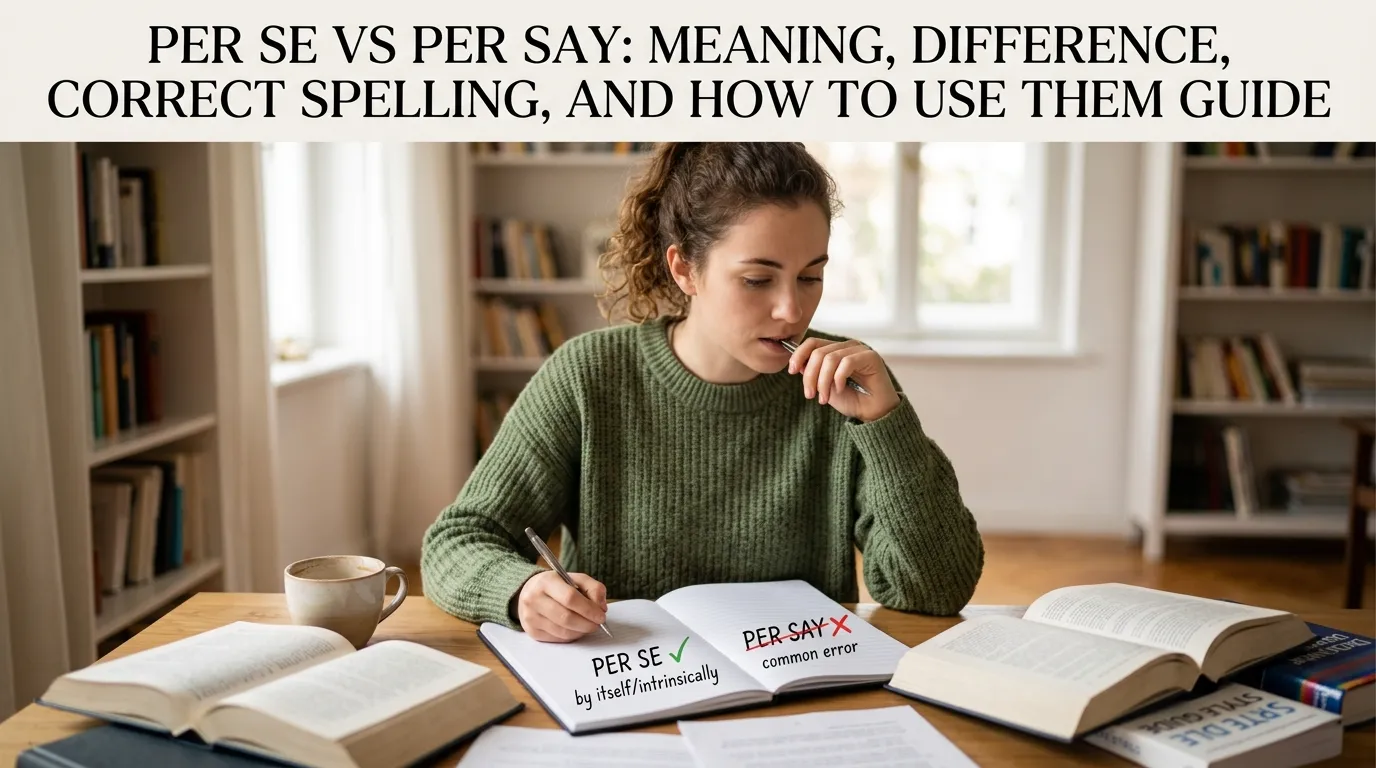
The correct form is per se. It is a Latin phrase meaning “by itself,” “in itself,” or “intrinsically.” The spelling per say is generally a misspelling that happens because per se is commonly pronounced in a way that resembles “per say.”
For example:
The job is not difficult per se, but it requires a lot of patience.
This means the job is not inherently difficult, although some part of it may make the situation challenging.
In this guide, you will learn the difference between per se vs per say, what per se means, how to pronounce it, where it came from, how to use it naturally, common mistakes to avoid, and what alternatives you can use when you want clearer everyday English.
Quick Answer: Per Se or Per Say?
Per se is the correct spelling.
Per say is usually incorrect when you are trying to use the Latin expression meaning “by itself” or “in itself.”
| Expression | Correct? | Meaning | Example |
|---|---|---|---|
| per se | ✅ Yes | By itself; in itself | The idea is not bad per se. |
| per say | ❌ Usually no | Common misspelling of per se | Avoid this spelling in standard writing. |
The easiest rule
Remember:
Per se = by itself / in itself
Per say = not the standard spelling of this expression
If you are writing an essay, business email, article, academic paper, report, or professional message, use per se.
What Does Per Se Mean?
Per se is a Latin expression that literally means “by itself” or “in itself.”
In modern English, it is used to describe something considered on its own, without taking related circumstances into account.
For example:
The restaurant isn’t expensive per se, but the portions are small.
The speaker does not necessarily mean the restaurant is cheap. Instead, they mean that the restaurant itself is not inherently expensive. Other factors may make the overall experience feel expensive.
Another example:
I’m not against social media per se; I just think people should use it carefully.
Here, the speaker is saying:
“I am not against social media itself.”
The phrase helps make a distinction between a thing itself and the circumstances surrounding it.
Dictionary-style definition
Per se
Adverb
Meaning: In itself; by itself; intrinsically; considered independently from other factors.
Simple synonyms
Depending on the sentence, per se can mean:
- in itself
- by itself
- intrinsically
- inherently
- essentially
- as such
- in its own nature
- considered alone
However, these words are not always interchangeable. Per se has a specific grammatical function that makes it especially useful when separating a thing from its surrounding circumstances.
Why Do People Confuse Per Se and Per Say?
The main reason is pronunciation.
When spoken naturally, per se sounds similar to “per say.” Someone who has heard the phrase but has never seen it written may reasonably assume that “say” is the correct spelling.
This is an example of a heard-word spelling mistake.
The problem becomes especially common because per se is borrowed directly from Latin. English speakers may recognize the sound without knowing the original Latin spelling.
Consider these other expressions:
- et cetera
- vice versa
- bona fide
- ad hoc
- status quo
- per se
Many English expressions have Latin origins, and their spelling is not always obvious from pronunciation.
The important distinction
Per se is a meaningful Latin phrase.
Per say does not normally function as the equivalent English phrase.
So if you mean “in itself,” choose per se.
Per Se vs Per Say: The Key Difference
The difference is simple:
Per se
Means “in itself” or “by itself.”
The plan isn’t unreasonable per se.
Per say
Is normally an incorrect spelling of per se.
The plan isn’t unreasonable per say. ❌
Correct it to:
The plan isn’t unreasonable per se. ✅
This distinction matters more in formal writing than in casual conversation.
Someone may understand what you mean when you write “per say,” but readers may notice the spelling error immediately.
Is Per Se a Word or a Phrase?
Per se is a phrase, not a single English word.
More specifically, it is a Latin phrase used in English.
It usually works as an adverbial phrase, modifying or qualifying an idea.
For example:
The technology isn’t dangerous per se.
Here, per se modifies the idea of the technology being dangerous.
It tells the reader that the technology is not inherently dangerous.
Another example
There is nothing wrong with competition per se.
The meaning is:
There is nothing wrong with competition in itself.
The surrounding circumstances might still create problems, but competition itself is not necessarily the problem.
How to Pronounce Per Se
Per se is generally pronounced similarly to “per say.”
That similarity explains why the spelling mistake is so common.
per se
pur SAY
Give feedback
The second part receives the main stress in ordinary English pronunciation.
Importantly, however, similar pronunciation does not mean identical spelling.
This is why you should remember the visual form:
per se
not:
per say
What Does Per Se Mean in a Sentence?
The best way to understand per se is to see how it separates an object or idea from other factors.
Example 1
The movie wasn’t bad per se, but it was too long.
Meaning:
The movie itself was not necessarily bad. Its length was the problem.
Example 2
I’m not opposed to the idea per se.
Meaning:
I am not opposed to the idea itself.
Example 3
The rule isn’t unfair per se, but it creates problems for new employees.
Meaning:
The rule itself is not inherently unfair, but its effects can create difficulties.
Example 4
Money isn’t the problem per se.
Meaning:
Money itself is not the problem.
Example 5
Working from home is not difficult per se.
Meaning:
Working from home itself is not inherently difficult.
Per Se Meaning in Simple English
If per se sounds too formal, translate it mentally as:
“in itself”
This simple substitution works in many situations.
For example:
The book isn’t boring per se.
Change it to:
The book isn’t boring in itself.
The meaning remains essentially the same.
Another:
I’m not criticizing the decision per se.
Becomes:
I’m not criticizing the decision itself.
This is one of the best ways to understand the expression.
When Should You Use Per Se?
Use per se when you want to distinguish something in itself from its effects, circumstances, consequences, or related factors.
It is particularly useful when you are making a qualification.
Common sentence pattern
A frequent structure is:
X is not [adjective] per se, but…
Examples:
The process isn’t complicated per se, but it takes time.
The neighborhood isn’t dangerous per se, but it can be noisy at night.
The job isn’t stressful per se, but the long hours can be exhausting.
The question isn’t difficult per se, but it requires careful reading.
This construction is extremely common in professional and analytical writing.
Per Se in Formal Writing
Per se is grammatically acceptable in formal writing, but its tone is somewhat sophisticated or formal.
You may see it in:
- academic writing
- legal writing
- business writing
- journalism
- professional reports
- philosophical discussions
- technical discussions
- analytical essays
For example:
The policy is not ineffective per se, but its implementation has been inconsistent.
This sounds appropriate in a professional report.
However, if your audience prefers plain English, “in itself” may be clearer.
Per Se in Academic Writing
In academic writing, per se can be useful when discussing an idea separately from its broader context.
For example:
The use of technology is not harmful per se; its effects depend on how it is implemented.
Or:
The theory does not reject tradition per se, but it challenges certain traditional assumptions.
The expression is especially helpful when an argument requires a distinction between an intrinsic quality and an external effect.
Academic alternatives
You could replace per se with:
- in itself
- in its own right
- intrinsically
- inherently
- considered independently
Choose the option that makes your argument easiest to understand.
Per Se in Business Writing
Business professionals sometimes use per se when making careful distinctions.
For example:
The product isn’t defective per se, but the packaging needs improvement.
Or:
The strategy isn’t wrong per se, but it may not work for this market.
Or:
The company doesn’t have a pricing problem per se; it has a communication problem.
These sentences distinguish the main issue from a related issue.
Should you use it in every business email?
No.
If you’re writing to a broad audience, plain language may be better:
The strategy isn’t wrong in itself, but it may not work for this market.
Per se is correct, but in itself may be easier for everyone to understand.
Per Se in Journalism
Journalists may use per se when explaining nuanced positions.
For example:
The policy isn’t controversial per se, but its timing has generated criticism.
This lets the writer clarify that the policy itself is not necessarily the source of controversy.
In general-interest journalism, though, in itself can be a more accessible choice.
Per Se in Technical Writing
Technical writers may use per se, especially when distinguishing a technical property from an application or consequence.
For example:
The software isn’t unreliable per se, but its performance depends heavily on system resources.
A simpler version would be:
The software isn’t unreliable in itself, but its performance depends heavily on system resources.
For user manuals and instructions, plain language is usually preferable.
For expert technical analysis, per se can be perfectly natural.
Per Se in Legal Language
The phrase is also found in legal English.
One familiar construction is “negligence per se.”
In legal contexts, per se can carry a more specialized meaning than the everyday phrase “in itself.”
This is important because legal expressions should not always be interpreted by simply replacing every instance with “by itself.”
Why context matters
In ordinary English:
The rule is not unfair per se.
In legal terminology:
negligence per se
may refer to a specific legal doctrine.
Therefore, when per se appears as part of an established legal expression, understand the entire phrase rather than interpreting the words individually.
Per Se in Politics
Political commentary often uses per se when a speaker wants to separate a political idea from its implementation.
For example:
The candidate isn’t opposed to immigration per se; the disagreement concerns how immigration policy should be managed.
Or:
The proposal isn’t controversial per se, but its potential cost has raised concerns.
This type of construction is useful because political discussions often involve complicated positions rather than simple yes-or-no opinions.
Per Se in Sports
You can also use per se when discussing sports, although it is less necessary in everyday sports conversation.
For example:
The team doesn’t have a talent problem per se; its biggest issue is consistency.
Or:
The player isn’t slow per se, but his reaction time needs improvement.
A sports writer might use the expression in analytical commentary, while a casual fan might simply say:
The team isn’t bad. It just lacks consistency.
Both are natural, but they have different levels of formality.
Per Se in Casual Conversation
You can use per se in casual conversation, but it may sound slightly formal depending on the speaker and setting.
For example:
I don’t hate the restaurant per se. I just don’t like the service.
This is perfectly understandable.
However, everyday speech might sound more natural as:
I don’t hate the restaurant itself. I just don’t like the service.
Or:
I don’t really have a problem with the restaurant. I just don’t like the service.
The best choice depends on your audience and tone.
Per Se vs In Itself
These expressions are often interchangeable.
| Per se | In itself |
|---|---|
| More formal | More conversational |
| Latin expression | Plain English |
| Common in analytical writing | Very clear to general readers |
| Can sound sophisticated | Usually sounds natural |
| Means “in itself” | Means “in itself” |
Compare:
The idea isn’t bad per se.
The idea isn’t bad in itself.
Both are correct.
The second sentence is usually easier for a broad audience.
Per Se vs Intrinsically
Intrinsically means something like “by its inherent nature.”
For example:
The material is not intrinsically dangerous.
This can be similar to:
The material is not dangerous per se.
But there is a subtle difference.
Intrinsically focuses strongly on an inherent quality.
Per se focuses on considering something independently or in itself.
So don’t automatically replace one with the other in every sentence.
Per Se vs Essentially
Essentially often means “basically” or “in essence.”
It is not always a direct synonym for per se.
Compare:
The problem isn’t the software per se.
This means:
The software itself isn’t the problem.
But:
The problem is essentially the software.
means something different.
The word essentially is therefore not a universal replacement for per se.
Per Se vs As Such
As such can sometimes perform a similar function, but it is not always interchangeable with per se.
For example:
The rule isn’t unfair per se.
Could potentially become:
The rule isn’t unfair as such.
But the second version may sound less precise depending on context.
Per se specifically emphasizes the thing considered in itself.
Common Collocations With Per Se
Some combinations occur naturally in English.
Common patterns include:
- not a problem per se
- not wrong per se
- not bad per se
- not harmful per se
- not difficult per se
- not illegal per se
- not dangerous per se
- not unusual per se
- not controversial per se
- not expensive per se
- not negative per se
- not positive per se
- not relevant per se
- not significant per se
- not important per se
Examples
The price isn’t high per se, but shipping is expensive.
The decision isn’t wrong per se, but it was poorly timed.
The technology isn’t dangerous per se, but improper use can create risks.
These patterns are useful because they naturally show the contrast between something itself and its broader circumstances.
Common Expressions With Per Se
Here are several useful sentence structures.
“Not X per se”
I’m not angry at him per se.
Meaning:
I’m not angry at him specifically or inherently; something related to the situation is bothering me.
“X isn’t the problem per se”
The workload isn’t the problem per se. The lack of planning is.
“Not necessarily X per se”
The issue isn’t necessarily the cost per se, but the value customers receive.
“X itself, per se”
This construction can be redundant:
The product itself per se is not the problem.
Usually, choose one:
The product itself is not the problem.
or:
The product is not the problem per se.
Is “Per Se” Redundant With “Itself”?
Sometimes.
Because per se already means “in itself,” combining it with itself can create unnecessary repetition.
Awkward
The idea itself per se isn’t harmful.
Better
The idea itself isn’t harmful.
Or:
The idea isn’t harmful per se.
Likewise:
Awkward
The policy in itself per se is reasonable.
Better
The policy in itself is reasonable.
Or:
The policy is reasonable per se.
Avoid stacking expressions that perform the same grammatical job.
Common Mistakes With Per Se
Mistake 1: Writing “per say”
❌ The idea isn’t bad per say.
✅ The idea isn’t bad per se.
Mistake 2: Writing “persay”
❌ The idea isn’t bad persay.
✅ The idea isn’t bad per se.
There is no standard English word persay meaning “in itself.”
Mistake 3: Writing “per-say”
❌ The decision isn’t wrong per-say.
✅ The decision isn’t wrong per se.
The expression is normally written as two separate words.
Mistake 4: Misusing “per se” to mean “personally”
❌ Per se, I don’t like the movie.
If you mean:
“Personally, I don’t like the movie.”
then personally is the better word.
Per se does not mean personally.
Mistake 5: Using it to mean “for example”
❌ There are many options, per se, such as…
Per se does not mean for example.
Use:
- for example
- such as
- for instance
instead.
Mistake 6: Using it to mean “according to”
Per se does not mean according to.
If you mean “according to the rules,” say:
According to the rules…
not:
Per se the rules…
Awkward vs Natural Examples
| Awkward or Incorrect | Natural |
|---|---|
| The idea isn’t bad per say. | The idea isn’t bad per se. |
| I don’t like it per say. | I don’t like it per se. |
| The policy is itself per se unfair. | The policy is unfair per se. |
| Per se, I disagree. | Personally, I disagree. |
| The movie was bad per se because it was boring. | The movie wasn’t bad per se; it was just boring. |
The last example illustrates an important point: per se normally helps qualify a statement.
Can Per Se Start a Sentence?
Yes, but this is usually less natural.
For example:
Per se, the proposal is reasonable.
This is grammatically possible, but many writers would prefer:
The proposal is reasonable per se.
Or:
The proposal is reasonable in itself.
Placing per se at the end of the sentence is often smoother.
Can Per Se Be Used With a Positive Statement?
Yes.
People often associate per se with negative constructions such as “not bad per se,” but it can also appear in positive statements.
For example:
The idea is valuable per se.
The discovery is significant per se.
The method is useful per se.
However, the phrase is particularly common when a writer is qualifying or limiting a claim.
Can You Use Per Se With People?
Yes, but the meaning depends on context.
For example:
I’m not criticizing Sarah per se; I’m questioning the decision she made.
This means the criticism is not directed at Sarah as a person, but at a particular action or decision.
However, in many everyday situations, herself, personally, or a more direct construction may sound clearer.
Does Per Se Have a Plural Form?
No.
Per se is an uninflected phrase.
You do not write:
- perses
- per ses
- per se’s
Use the expression exactly as:
per se
What Is the Origin of Per Se?
Per se comes from Latin.
The Latin phrase means “by itself” or “in itself.”
The expression entered English as part of a larger group of Latin terms that became established in educated, legal, academic, philosophical, and professional language.
The individual Latin components can be understood roughly as:
- per = by or through
- se = itself/himself/herself, referring back to the subject
English has retained the original spelling rather than changing it to match its pronunciation.
That is why the correct written form looks different from how many English speakers hear it.
Why Is “Per Say” So Common if It Is Wrong?
The answer is simple: English spelling is not always phonetic.
When people learn a word by hearing it first, they often create a spelling based on the sound.
This can happen with many expressions.
In the case of per se, the pronunciation closely resembles the words “per say.”
Someone may hear:
“per say”
and reasonably assume that the spelling is:
“per say”
But once you know the origin and meaning, the correct spelling becomes easier to remember.
A Simple Memory Trick for Per Se
Use this shortcut:
Per se = “itself.”
Whenever you want to say “in itself,” think:
per se
Another memory trick is:
SE = itself
You can mentally connect the expression to the idea of examining something on its own.
Quick test
Ask yourself:
Can I replace it with “in itself”?
If yes, per se may be appropriate.
For example:
The plan isn’t unreasonable per se.
Replace it:
The plan isn’t unreasonable in itself.
It works.
But:
Per se, I don’t like it.
Replace it:
In itself, I don’t like it.
The meaning does not work. You probably mean personally or in my opinion.
Per Se Synonyms and Alternatives
Depending on your sentence, you can replace per se with several expressions.
Formal alternatives
- intrinsically
- inherently
- in itself
- in its own right
- considered independently
Plain-English alternatives
- itself
- by itself
- on its own
- in itself
- as it is
Example
The job isn’t difficult per se.
Possible alternatives:
The job isn’t difficult in itself.
The job isn’t inherently difficult.
The job isn’t difficult on its own.
The exact meaning changes slightly, so choose based on context.
Per Se Antonyms
There is no single perfect antonym for per se because it is a contextual expression rather than a simple adjective.
However, concepts that contrast with “in itself” include:
- in context
- in relation to others
- externally
- because of surrounding factors
- in combination
- as a consequence
For example:
The technology isn’t harmful per se, but its use in certain environments can create problems.
Here, per se contrasts with considering the technology in a particular context.
Regional Differences: American vs British English
Per se is understood and used in both American and British English.
There is no major American-versus-British spelling difference here.
Both varieties use:
per se
The bigger difference is frequency and style.
Some speakers may find the expression formal or slightly intellectual, while others use it naturally in professional or everyday conversation.
If you are writing for an international audience, per se is widely recognizable, but in itself may still be easier for readers with intermediate English skills.
Per Se in International English
For global audiences, clarity should be your priority.
Consider:
The process isn’t difficult per se.
An experienced English speaker will probably understand it immediately.
But:
The process isn’t difficult in itself.
may be more accessible to readers who learned English as a second language.
If your goal is SEO content, customer communication, technical documentation, or public-facing information, choose the clearest expression for your audience.
Is Per Se Formal or Informal?
Per se is generally neutral-to-formal.
It is not slang.
It is not incorrect in casual English, but it can sound more polished than ordinary conversational alternatives.
More formal
The proposal isn’t problematic per se.
More conversational
The proposal isn’t really the problem itself.
Plainest
The proposal isn’t the problem.
Choose based on the tone you want.
Should You Use Per Se in SEO Content?
Yes, when it sounds natural.
There is no need to avoid per se simply because it is somewhat formal.
However, SEO writing should prioritize clarity and search intent rather than forcing sophisticated vocabulary.
If your readers are looking for an explanation of a grammar question, you can naturally discuss:
- per se vs per say
- per se meaning
- per say meaning
- is per say correct
- is per se correct
- how to use per se
- per se definition
- per se pronunciation
- per se example
- what does per se mean
- per se in a sentence
These related phrases address different aspects of the same search intent without unnecessary repetition.
Real-World Examples of Per Se
Here are additional examples across different contexts.
Work
The job isn’t difficult per se, but the deadlines are tight.
Education
The assignment isn’t complicated per se, but it requires careful research.
Technology
The software isn’t slow per se; the computer may simply need more memory.
Money
The service isn’t expensive per se, but the subscription adds up over time.
Relationships
I’m not upset with you per se. I’m upset about what happened.
Travel
The city isn’t expensive per se, but hotels can be costly during peak season.
Food
The dish isn’t spicy per se, but the sauce has a strong flavor.
Business
The company doesn’t have a sales problem per se; it has a customer-retention problem.
School
The subject isn’t boring per se, but the textbook makes it difficult to enjoy.
Sports
The team doesn’t lack talent per se; it lacks consistency.
When Not to Use Per Se
Avoid per se when a simpler word communicates your meaning more clearly.
Instead of:
I per se disagree with that opinion.
Say:
I personally disagree with that opinion.
Instead of:
Per se, this is my favorite option.
Say:
This is my favorite option.
Instead of:
The instructions are, per se, easy.
Say:
The instructions are easy.
The phrase should add meaning. If removing it does not change the intended meaning, you may not need it.
Per Se vs Per Say: A Complete Comparison
| Feature | Per se | Per say |
|---|---|---|
| Standard spelling | ✅ Yes | ❌ No |
| Latin expression | ✅ Yes | ❌ No |
| Means “in itself” | ✅ Yes | ❌ |
| Pronounced similarly to “per say” | ✅ Yes | N/A |
| Used in formal writing | ✅ Yes | ❌ |
| Used in academic writing | ✅ Yes | ❌ |
| Used in legal language | ✅ Yes | ❌ |
| Used in business writing | ✅ Yes | ❌ |
| Standard American English | ✅ Yes | ❌ |
| Standard British English | ✅ Yes | ❌ |
| Common misspelling | No | ✅ Yes |
Frequently Asked Questions
1. Is it per se or per say?
The correct expression is per se. It is a Latin phrase meaning “in itself” or “by itself.” Per say is generally a misspelling caused by the similar pronunciation.
2. What does per se mean in simple terms?
Per se means “in itself,” “by itself,” or “considered on its own.” For example, “The idea isn’t bad per se” means the idea itself isn’t bad, although some related aspect may be problematic.
3. Is per say ever correct?
If you mean the Latin expression meaning “in itself,” per say is not the standard spelling. Use per se instead.
4. How do you pronounce per se?
In common English pronunciation, per se sounds very similar to “per say.” The similar pronunciation is one of the main reasons people misspell it.
5. Is per se formal?
Yes. Per se is generally neutral to formal. It is common in academic, professional, legal, analytical, and journalistic writing, although it can also appear in casual conversation.
6. Can I use per se in academic writing?
Yes. Per se is appropriate in academic writing when you need to distinguish something considered by itself from its broader context or consequences. However, in itself may be clearer for a general audience.
7. What is a synonym for per se?
Common alternatives include in itself, by itself, intrinsically, inherently, in its own right, and considered independently. The best synonym depends on the sentence.
8. Is “per se” one word?
No. It is normally written as two separate words: per se. Do not write perse, persay, or per-say when you mean the Latin expression.
9. Can per se mean personally?
No. Per se does not mean personally. If you want to express your personal opinion, use personally, I think, in my opinion, or a similar phrase.
10. What is an easy way to remember per se vs per say?
Remember:
Per se = in itself.
Whenever you can replace the phrase with “in itself,” the spelling you want is per se.
Conclusion: Per Se vs Per Say
The difference between per se vs per say is ultimately straightforward.
Per se is the correct expression. It comes from Latin and means “in itself,” “by itself,” or “intrinsically.”
Per say is generally a spelling mistake that happens because the two expressions sound alike when spoken.
Use per se when you want to qualify a statement or consider something independently from its surrounding circumstances:
The plan isn’t bad per se, but it needs better execution.
For everyday readers, in itself can often be a clearer alternative. For academic, professional, legal, analytical, and formal writing, per se is completely acceptable when used naturally.
The most important rule is easy to remember:
If you mean “in itself,” write “per se,” never “per say.”
Once you connect per se with the meaning “itself,” the spelling becomes much easier to remember.