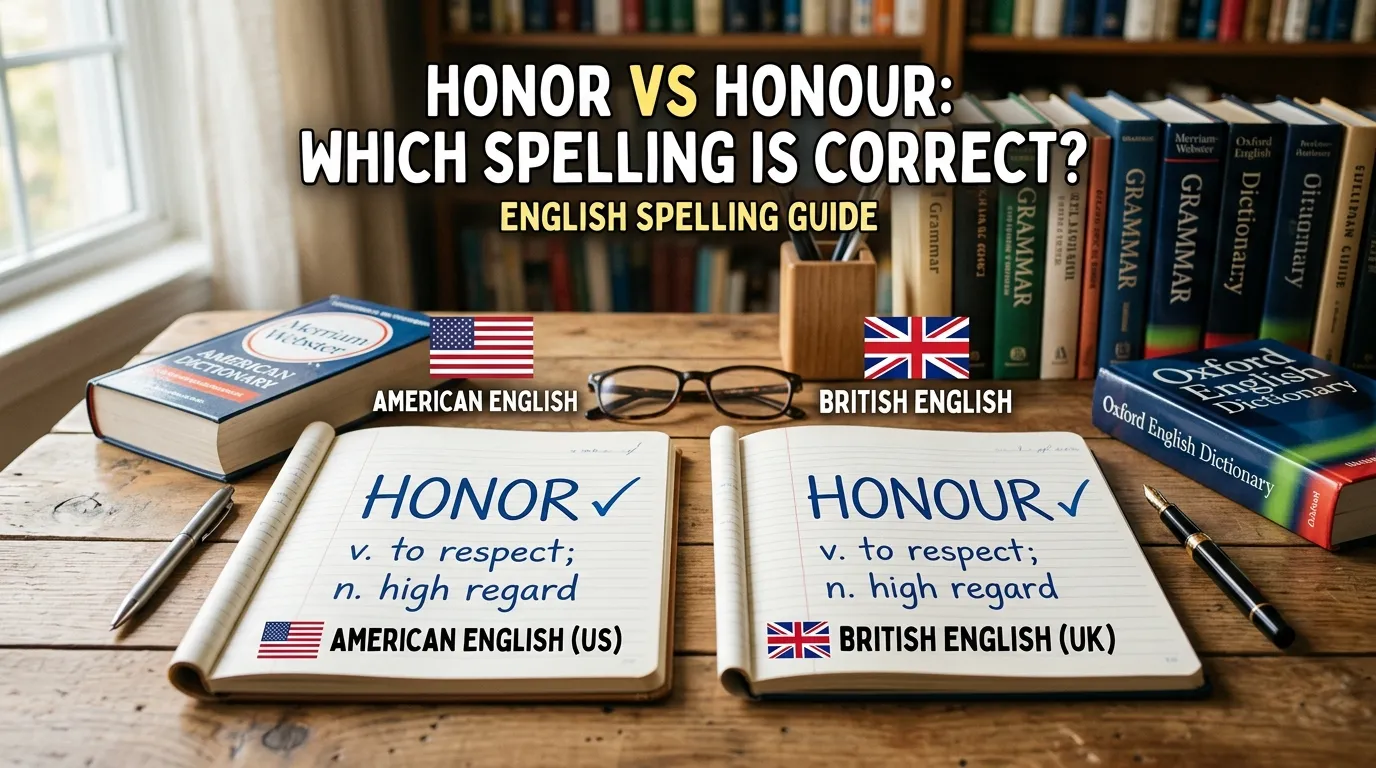
If you have ever wondered whether honor or honour is the correct spelling, the short answer is that both are correct. The difference is mainly regional spelling.
Honor is the standard spelling in American English, while honour is preferred in British English and is also common in Canadian, Australian, and other varieties of English. Both words have the same meaning, pronunciation, grammatical roles, and basic history.
For example:
- American English: I am honored to receive this award.
- British English: I am honoured to receive this award.
Neither sentence is grammatically wrong. The spelling simply follows a different English convention.
This guide explains honor vs honour in detail, including their meanings, pronunciation, history, regional differences, common expressions, related words, formal and informal usage, common mistakes, and practical advice for choosing the right spelling.
Quick Answer: Honor or Honour?
Honor is the preferred spelling in American English.
Honour is the preferred spelling in British English and several other English varieties.
| Feature | Honor | Honour |
|---|---|---|
| American English | ✅ Standard | ❌ Usually not preferred |
| British English | ❌ Usually not preferred | ✅ Standard |
| Canadian English | Used sometimes | ✅ Common |
| Australian English | ❌ Less common | ✅ Standard |
| Meaning | Same | Same |
| Pronunciation | Same | Same |
| Part of speech | Noun and verb | Noun and verb |
| Main difference | American spelling | British spelling |
The easiest rule is simple:
Use honor for American English and honour for British English.
What Does Honor Mean?
Honor means a strong sense of respect, dignity, integrity, or recognition.
As a noun, it can describe the respect someone receives because of their character, achievements, position, or actions.
Examples:
- It was an honor to meet the professor.
- She earned the honor through years of hard work.
- The award was a great honor.
- He acted with honor even when nobody was watching.
The word can also describe a person’s personal principles and moral character.
For example:
He kept his promise because he believed in honor.
As a verb, honor means to show respect, recognize someone, keep a promise, or fulfill an obligation.
Examples:
- We honor those who served their country.
- The company agreed to honor the original agreement.
- They gathered to honor her achievements.
In British English, these same meanings are normally written with honour.
What Does Honour Mean?
Honour has exactly the same basic meanings as honor.
It can mean:
- respect
- dignity
- moral integrity
- recognition
- distinction
- a privilege
- fulfillment of an obligation
Examples:
- It was an honour to receive the award.
- She defended her honour.
- The ceremony was held to honour the soldiers.
- The company agreed to honour the contract.
The difference is not meaning. It is spelling convention.
Honor vs Honour: The Main Difference
The most important difference is the letter u.
American English generally removes the u from several words that traditionally contain it in British English.
Compare:
| American English | British English |
|---|---|
| honor | honour |
| honored | honoured |
| honoring | honouring |
| honorable | honourable |
| humor | humour |
| color | colour |
| favor | favour |
| labor | labour |
| neighbor | neighbour |
This spelling pattern is especially useful for English learners because it appears in many common words.
Why Are Honor and Honour Spelled Differently?
The spelling difference developed as English evolved in different regions.
British English retained the u in words influenced by French spelling traditions. American English later developed a preference for shorter spellings in a number of these words.
American lexicographer Noah Webster played an important role in standardizing several American spellings. His dictionaries promoted forms that were often simpler or more distinct from British conventions.
This helped establish spellings such as:
- honor instead of honour
- color instead of colour
- labor instead of labour
- favor instead of favour
The result is not two different words. It is two regional spelling standards.
Is Honor or Honour More Correct?
Neither spelling is universally more correct.
The correct choice depends on the variety of English you are using.
If you are writing for an American audience, use:
honor
If you are writing for a British audience, use:
honour
The same principle applies to related forms.
American English
- honor
- honored
- honoring
- honorable
British English
- honour
- honoured
- honouring
- honourable
A spelling becomes problematic when it does not match the variety of English used throughout the rest of your writing.
Honor vs Honour in American English
In American English, honor is the normal spelling.
You will see it in:
- newspapers
- school assignments
- business writing
- government documents
- books
- websites
- academic writing
- professional communication
- everyday conversation
Examples:
It is an honor to be part of the team.
The school held a ceremony to honor the graduates.
She received the highest honor available.
We honor his contribution to the organization.
Writing honour in an American English article is not necessarily incomprehensible, but it can look like a British spelling choice.
For American writers, honor is the safest standard form.
Honor vs Honour in British English
British English normally uses honour.
Examples:
It was an honour to meet you.
The ceremony was held to honour the veterans.
She defended her honour.
He was awarded the highest honour in the field.
British English also keeps the u in related forms such as honourable and honoured.
If you are writing for readers in the United Kingdom, consistency matters.
Honor vs Honour in Canadian English
Canadian English can be more complicated because it contains influences from both British and American English.
Honour is widely accepted and traditionally preferred in Canadian English.
You may therefore encounter:
- honour
- honoured
- honourable
- honouring
Canadian usage can vary by context, institution, and individual preference. However, honour remains a common Canadian standard.
If you are writing specifically for Canada, following the style guide of the publication, school, organization, or client is a good approach.
Honor vs Honour in Australian English
Australian English generally follows the spelling honour.
Examples include:
- It was an honour.
- The organization will honour her service.
- He received an honour for his work.
Therefore, Australian readers are more likely to expect honour than honor.
Pronunciation of Honor and Honour
Despite their different spellings, honor and honour are normally pronounced the same way.
The first syllable contains the main vowel sound, and the final r may or may not be pronounced depending on the speaker’s accent.
In many American accents, the word is commonly pronounced with a noticeable final r sound. In many British accents, the final r is not pronounced unless it connects to a following vowel sound.
The spelling difference does not normally create a difference in pronunciation.
Is Honor a Noun or a Verb?
Honor can be both a noun and a verb.
Honor as a noun
As a noun, honor can mean respect, distinction, dignity, or a privilege.
Examples:
- It was an honor to receive the prize.
- His courage brought him great honor.
- The medal is one of the highest honors available.
Honor as a verb
As a verb, honor can mean to respect, recognize, or fulfill.
Examples:
- We honor her memory.
- The school honored the teacher.
- The store will honor the discount.
- He always honors his promises.
The British forms are:
- honour
- honours
- honoured
- honouring
Honor vs Honour in Past Tense
This is another area where regional spelling becomes visible.
American English:
She honored her commitment.
British English:
She honoured her commitment.
Notice two changes:
American: honored
British: honoured
The British form adds both the u and an additional r before the ed ending.
Honor vs Honour in the Present Participle
When adding ing, American English usually writes:
honoring
British English usually writes:
honouring
Examples:
The city is honoring local volunteers.
The city is honouring local volunteers.
Again, the meaning is identical.
Honor vs Honourable
The related adjective also follows the regional spelling pattern.
American English
honorable
Example:
She is known as an honorable person.
British English
honourable
Example:
She is known as an honourable person.
Both forms mean worthy of respect or characterized by moral integrity.
Honor vs Honour in Formal Writing
Both spellings work in formal writing, but your choice should match your target audience.
American formal writing
Use honor:
It is an honor to welcome our distinguished guests.
British formal writing
Use honour:
It is an honour to welcome our distinguished guests.
Neither version is more formal than the other.
The spelling itself does not determine formality.
Honor vs Honour in Academic Writing
Academic writers should follow the English variety required by their institution, publisher, or style guide.
For an American university paper, use:
The study examines how societies honor historical figures.
For British academic writing:
The study examines how societies honour historical figures.
The most important principle is consistency.
Do not casually switch between American and British spelling.
For example, this looks inconsistent:
The organization honored its volunteers and recognised their contribution.
If you are using American English, recognized would normally be expected.
A consistent American version would be:
The organization honored its volunteers and recognized their contribution.
A consistent British version would be:
The organisation honoured its volunteers and recognised their contribution.
Honor vs Honour in Business Writing
Business communication frequently uses the word in phrases involving agreements, commitments, and respect.
American examples:
- honor an agreement
- honor a contract
- honor a commitment
- honor a request
- honor a warranty
- honor a promise
British examples:
- honour an agreement
- honour a contract
- honour a commitment
- honour a request
- honour a warranty
- honour a promise
Which should businesses use?
Use the spelling expected by your customers and market.
An American company serving American customers should generally use honor.
A British company writing for a British audience should generally use honour.
International companies should establish a clear style guide and use one variety consistently for each market.
Honor vs Honour in Sports
The word appears often in sports writing.
Examples in American English:
- The team honored its retiring coach.
- She was honored before the game.
- He earned the honor of team captain.
- The player was honored for his outstanding season.
British English uses the corresponding honour forms.
Sports terms can also include expressions such as:
- highest honor
- team honors
- honor roll
- hall of honor
- honor someone for achievement
The spelling depends on the publication’s regional style.
Honor vs Honour in Political and Public Language
The word is common in speeches, public ceremonies, memorials, and discussions about civic duty.
Examples:
We gather today to honor those who served.
The memorial honors the people who lost their lives.
In British English:
We gather today to honour those who served.
Political, military, and civic contexts often use the word because it carries ideas of respect, service, duty, sacrifice, and recognition.
The spelling still depends on regional English.
Honor vs Honour in Military Contexts
The concept of honor has a long association with military service.
Common expressions include:
- military honor
- code of honor
- honor guard
- honorably discharged
- medal of honor
- honor a fallen soldier
In American English, honor guard and Medal of Honor use the American spelling.
British English uses honour in comparable general expressions.
Some official names, however, are fixed proper nouns. When referring to an official title, award, organization, or institution, use its established spelling rather than changing it to fit your preferred regional variety.
Common Collocations With Honor
A collocation is a group of words that naturally appear together.
Common collocations include:
- great honor
- highest honor
- special honor
- personal honor
- military honor
- public honor
- national honor
- sense of honor
- code of honor
- honor system
- honor roll
- honor guard
- honor someone
- honor a promise
- honor an agreement
- honor a request
- honor a commitment
- honor a tradition
British English changes the spelling but not the basic collocation.
For example:
a great honour
a sense of honour
honour a promise
Common Phrases and Expressions With Honor
Several expressions are especially common in American English.
It is an honor
This means something is a privilege.
It is an honor to work with you.
In honor of
This means something is done to show respect or recognition.
The event was held in honor of the founder.
British English usually writes:
The event was held in honour of the founder.
Honor system
An honor system is a system based on people’s honesty and personal responsibility.
Students are expected to follow the honor system during the examination.
Honor roll
An honor roll is a list recognizing students who achieve strong academic results.
Maya made the honor roll this semester.
British educational systems may use different terminology depending on the institution.
Code of honor
A code of honor is a set of principles concerning honorable behavior.
The group follows a strict code of honor.
Honor vs Honour: Synonyms
Depending on context, synonyms can include:
- respect
- dignity
- esteem
- recognition
- distinction
- prestige
- reputation
- integrity
- privilege
- admiration
However, these words are not always interchangeable.
For example, prestige usually refers to status or influence, while integrity focuses more strongly on moral character.
Antonyms of Honor
Depending on the meaning, possible opposites include:
- dishonor
- disrespect
- disgrace
- shame
- humiliation
- dishonesty
- contempt
The most direct noun opposite is often dishonor in American English and dishonour in British English.
Honor vs Dishonor
The spelling difference appears again in the opposite word.
American English:
honor → dishonor
British English:
honour → dishonour
Examples:
His actions brought dishonor to the organization.
His actions brought dishonour to the organisation.
This is another useful pattern for English learners.
Honor vs Honour: Related Words
Here are several related forms:
| American English | British English |
|---|---|
| honor | honour |
| honored | honoured |
| honoring | honouring |
| honorable | honourable |
| dishonor | dishonour |
| honorary | honorary |
| honorably | honourably |
| dishonorable | dishonourable |
Notice that honorary does not contain the same spelling contrast. It is normally spelled honorary in both varieties.
Common Mistakes With Honor and Honour
Mistake: Using honour in American English
It was an honour to meet you.
For standard American English, write:
It was an honor to meet you.
Mistake: Using honor in British English
It was an honor to meet you.
For standard British English, write:
It was an honour to meet you.
Mistake: Mixing regional spellings
The organisation honored its volunteers.
This mixes British organisation with American honored.
A consistent American version:
The organization honored its volunteers.
A consistent British version:
The organisation honoured its volunteers.
Mistake: Changing official names
Do not automatically change the spelling of an official name.
For example, an award or institution may have a fixed official title. Preserve the established name when it is being used as a proper noun.
Awkward vs Natural Examples
Example One
Awkward for an American audience:
It was a great honour to receive the award.
Natural American version:
It was a great honor to receive the award.
Example Two
Awkward for a British audience:
It was a great honor to receive the award.
Natural British version:
It was a great honour to receive the award.
Example Three
Inconsistent American English:
The organisation honored its founder.
Better American English:
The organization honored its founder.
Example Four
Inconsistent British English:
The organization honored its founder.
Better British English:
The organisation honoured its founder.
Everyday Examples of Honor
Here are natural American English examples:
It is an honor to be invited.
We gathered to honor her memory.
He always honors his promises.
The school gave him a special honor.
She accepted the award with honor.
The company promised to honor the agreement.
They honored the team’s achievements.
His actions showed a strong sense of honor.
In British English, replace the relevant forms with honour, honoured, and honouring.
Formal vs Informal Usage
Honor is not limited to formal language.
It can appear in casual conversation:
It was an honor meeting you.
It is also common in highly formal contexts:
We are deeply honored by your presence.
More casual alternatives may include:
- respect
- appreciate
- privilege
- admire
For example:
Formal:
It is an honor to have you here.
More conversational:
I’m really glad you could be here.
The best alternative depends on the intended tone.
Honor as a Name or Title
Honor can also appear in personal names, titles, organizations, awards, and official phrases.
When a word is part of an established proper name, do not change its spelling simply because you normally use another English variety.
For example, if an organization officially uses Honor in its name, retain that spelling.
Proper names follow their established form.
Honor in Technology and Professional Contexts
In technical and professional writing, honor may appear in phrases involving systems and rules.
Examples include:
- honor a request
- honor a transaction
- honor a policy
- honor a warranty
- honor an authorization
- honor a configuration
- honor a commitment
For example:
The system should honor the user’s selected preferences.
This usage means follow, respect, or comply with something.
British technical writing would normally use honour.
Honor in Blogging and Online Content
For bloggers and website owners, consistency is particularly important.
If your website targets American readers, choose:
honor
If your website targets British readers, choose:
honour
Search engines can understand both spellings, but readers expect the language variety used by the publication.
For SEO content, do not repeatedly alternate between honor and honour simply to target both keywords.
Instead, write naturally for your primary audience.
You can briefly mention the alternative spelling when it genuinely helps search intent:
In American English, the word is spelled honor, while British English uses honour.
That single explanation is usually enough.
Which Spelling Should ESL Learners Learn?
If you are learning American English, memorize:
honor
If you are learning British English, memorize:
honour
If you are learning English for international communication, learn that both forms are correct and understand the regional distinction.
This prevents you from mistakenly treating one spelling as a misspelling.
A Simple Memory Trick
Here is an easy way to remember the difference:
American English likes the shorter form: honor.
British English keeps the u: honour.
You can connect it with other pairs:
- color / colour
- favor / favour
- labor / labour
- neighbor / neighbour
- honor / honour
When you see a British spelling with our, remember that American English often removes the u.
Honor vs Honour in a Sentence
The following pairs show how the spelling changes while the meaning stays the same.
| American English | British English |
|---|---|
| It is an honor. | It is an honour. |
| We honor her work. | We honour her work. |
| He was honored yesterday. | He was honoured yesterday. |
| They are honoring the winner. | They are honouring the winner. |
| She has a strong sense of honor. | She has a strong sense of honour. |
| It was a great honor. | It was a great honour. |
Honor vs Honour: Quick Decision Guide
Use this checklist when you are unsure.
Choose Honor When:
- You are writing American English.
- Your audience is mainly in the United States.
- You are following an American style guide.
- You are writing for an American school or workplace.
- Your website targets U.S. readers.
- Your document already uses American spellings such as color and favor.
Choose Honour When:
- You are writing British English.
- Your audience is mainly in the United Kingdom.
- You are following a British style guide.
- You are writing for a British institution.
- Your publication uses British spelling.
- Your document already uses forms such as colour and favour.
For International Writing
Choose one variety and remain consistent.
Do not switch between American and British spelling without a reason.
A Practical Consistency Test
If you are unsure which spelling system your article uses, check several words.
If you write:
- color
- favor
- labor
- neighbor
you are probably using American English.
If you write:
- colour
- favour
- labour
- neighbour
you are probably using British English.
Then choose honor or honour accordingly.
This is much easier than memorizing every spelling individually.
Is Honour a Misspelling in American English?
Usually, no.
It is a recognized British spelling, not a random spelling error.
However, if an American assignment specifically requires American English, your teacher or editor may expect honor.
The same principle works in reverse. Honor is not an error in every English variety, but British style normally prefers honour.
Is Honor a Misspelling in British English?
No. It is the standard American spelling.
A British editor may change it to honour when editing for British English, but that does not mean the American spelling is inherently incorrect.
Honor vs Honour for SEO
If your primary keyword is honor vs honour, search intent usually comes from people trying to understand the spelling difference.
A useful SEO approach is to answer the main question early:
Honor is the American spelling, while honour is the British spelling. Both are correct.
Then explain the difference with examples and related forms.
Useful related search phrases include:
- honor vs honour difference
- honor or honour which is correct
- honor American spelling
- honour British spelling
- honor meaning
- honour meaning
- honor vs honour pronunciation
- honored vs honoured
- honoring vs honouring
- honorable vs honourable
- American vs British spelling
- is honor a word
- is honour a word
- honor definition
- honour definition
These phrases naturally reflect what readers want to know without requiring repetitive keyword use.
Honor vs Honour: Final Comparison
| Category | Honor | Honour |
|---|---|---|
| Main variety | American English | British English |
| Meaning | Respect, dignity, recognition, privilege | Same |
| Noun | Yes | Yes |
| Verb | Yes | Yes |
| Pronunciation | Generally the same | Generally the same |
| Past tense | honored | honoured |
| Present participle | honoring | honouring |
| Adjective | honorable | honourable |
| Opposite | dishonor | dishonour |
| Formality | Neutral to formal | Neutral to formal |
| Slang | Not primarily slang | Not primarily slang |
| Academic use | Standard in American English | Standard in British English |
| Business use | Standard in American English | Standard in British English |
| Sports use | Common | Common |
| Technical use | Common | Common |
FAQs
Is honor or honour correct?
Both are correct. Honor is the standard American English spelling, while honour is the standard British English spelling and is also widely used in other varieties such as Australian English.
Is honor American or British?
Honor is primarily the American English spelling. British English normally uses honour.
Is honour British spelling?
Yes. Honour is the traditional standard spelling in British English.
Do honor and honour sound the same?
Yes. The two spellings normally have the same pronunciation. The difference is primarily written rather than spoken.
Which spelling should I use in the USA?
Use honor in American English. Related forms include honored, honoring, and honorable.
Which spelling should I use in the UK?
Use honour in British English. Related forms include honoured, honouring, and honourable.
Why does British English have a U in honour?
The u reflects spelling traditions influenced by French and older English usage. American English later adopted shorter spellings for a number of words, helping establish forms such as honor.
Is honor more correct than honour?
No. Neither is universally more correct. Each spelling is standard in different regional varieties of English.
What is the difference between honored and honoured?
Honored is the American English spelling, while honoured is the British English spelling. Both mean the same thing.
What is the difference between honoring and honouring?
Honoring is the American spelling, while honouring is the British spelling. Both are the present participle or gerund form of the verb.
Conclusion
The difference between honor vs honour is simple once you understand regional English.
Honor is the preferred spelling in American English, while honour is preferred in British English and commonly used in several other English varieties. The words have the same core meanings and are normally pronounced the same way.
The difference also appears in related forms. American English uses honored, honoring, and honorable, while British English uses honoured, honouring, and honourable.
For American writing, choose honor. For British writing, choose honour. For international writing, identify your target audience and follow one spelling system consistently.
Most importantly, do not treat the alternative spelling as a simple typo. Honor and honour are both legitimate English spellings, and knowing when to use each one is an important part of mastering American and British English.