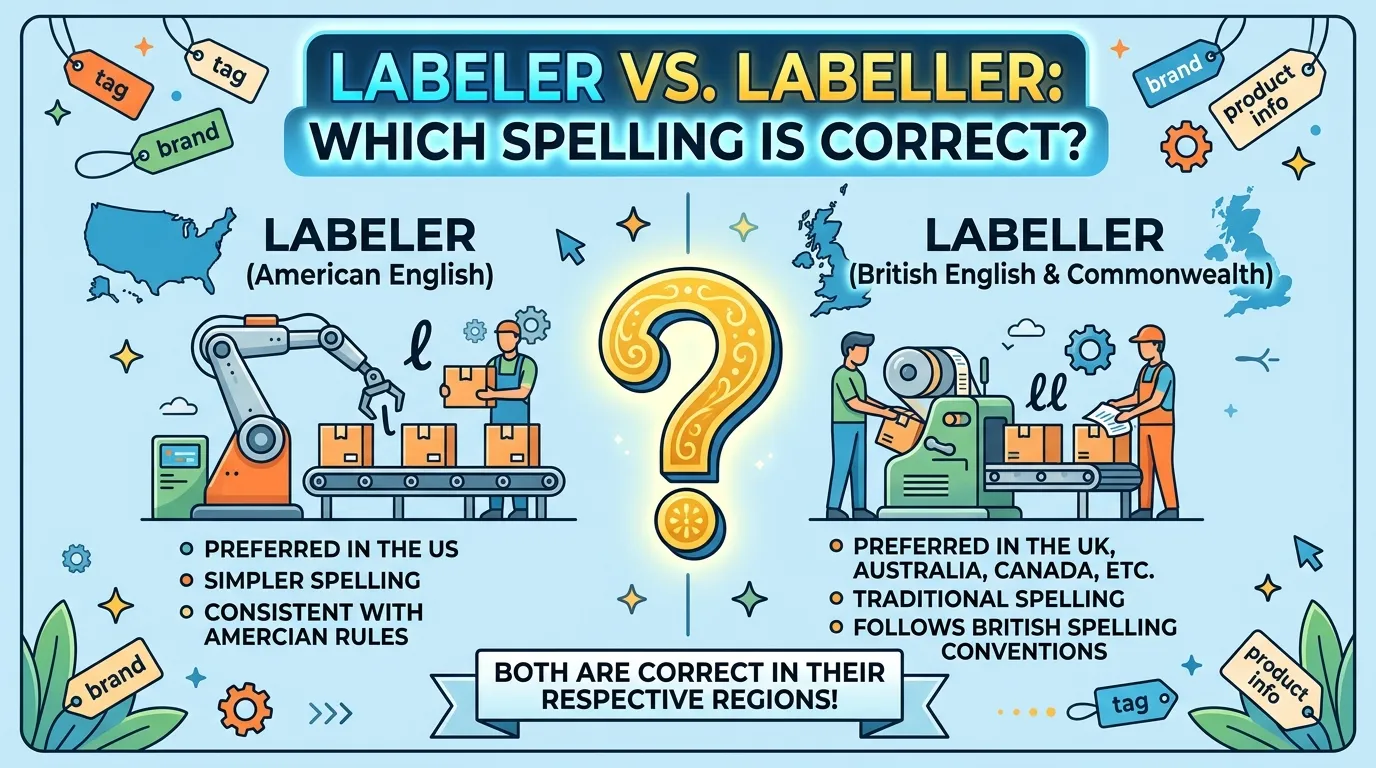
If you are wondering whether labeler or labeller is the correct spelling, the answer depends mainly on which variety of English you are using. Labeler is the standard spelling in American English, while labeller is the more common spelling in British English and several other varieties that follow British spelling conventions.
Both forms refer to a person, machine, or device that labels something. They have the same basic meaning and are pronounced the same way. The main difference is the spelling of the word.
The difference comes from regional spelling rules. American English generally keeps the final l before the suffix -er in words such as labeler, while British English commonly doubles the final l, producing labeller.
In this guide, you will learn the meaning, pronunciation, spelling rules, regional differences, etymology, common uses, examples, related words, and practical recommendations for choosing between labeler vs labeller.
Quick Answer: Labeler or Labeller?
Labeler is the preferred spelling in American English.
Labeller is the preferred spelling in British English and is also common in other English varieties influenced by British spelling.
| Word | Main variety | Correct? | Meaning |
|---|---|---|---|
| labeler | American English | Yes | A person or machine that labels something |
| labeller | British English | Yes | A person or machine that labels something |
The easiest rule to remember
- American English: labeler
- British English: labeller
- Canadian English: both may appear, but labeller is common
- Australian English: labeller is generally preferred
- New Zealand English: labeller is generally preferred
- International writing: Choose one spelling and use it consistently
So, if you are writing for an American audience, use labeler. If you are following British spelling conventions, use labeller.
What Does Labeler Mean?
A labeler is someone or something that puts labels on products, objects, containers, files, or other items.
The word can describe a human being, a machine, or another device that performs the action of labeling.
Dictionary-style definition
Labeler: a person, machine, or device that labels something.
For example:
- The labeler placed identification stickers on every package.
- The factory installed an automatic labeler.
- The employee works as a bottle labeler.
- The software acts as an image labeler for training data.
The word comes from the verb label plus the agent suffix -er.
Labeler in a sentence
The packaging line uses a high-speed labeler to mark each bottle.
Here, labeler refers to a machine rather than a person.
Another example:
The employee checked each box after the labeler finished its work.
Again, the word refers to equipment.
What Does Labeller Mean?
Labeller has the same meaning as labeler. The only major difference is the spelling.
It describes a person, machine, or device that labels something.
For example:
- The factory purchased a new automatic labeller.
- The labeller applies product information to each container.
- She works as a wine bottle labeller.
- The packaging company operates several industrial labellers.
The double l is characteristic of spelling conventions commonly associated with British English.
Labeler vs Labeller: The Key Difference
The central difference is regional spelling, not meaning.
Both words:
- are nouns
- describe an agent that labels something
- come from the verb label
- have the same basic pronunciation
- can refer to people or machines
- can be used in technical and everyday contexts
The important distinction is the spelling:
label + er = labeler
label + ler = labeller
The second form doubles the final l.
Simple comparison
| Feature | Labeler | Labeller |
|---|---|---|
| Meaning | Someone or something that labels | Someone or something that labels |
| Part of speech | Noun | Noun |
| Pronunciation | Same | Same |
| American English | Preferred | Less common |
| British English | Less common | Preferred |
| Australian English | Less common | Preferred |
| Canadian English | Both possible | Common |
| Spelling difference | One l before -er | Double l |
| Formality | Neutral | Neutral |
There is no difference in meaning or level of formality.
Why Do People Confuse Labeler and Labeller?
The confusion happens because English spelling rules differ between American English and British English.
Many English words change spelling when suffixes such as -er, -ed, or -ing are added.
For example:
- American English: labeled
- British English: labelled
Similarly:
- American English: labeling
- British English: labelling
This naturally leads to:
- American English: labeler
- British English: labeller
Learners may see both versions online and assume one must be a spelling mistake. In reality, both spellings are legitimate.
The important thing is to understand the regional convention.
Labeler vs Labeller in American English
In American English, labeler is the normal choice.
American spelling generally avoids doubling the final l in this type of word.
You will commonly see:
- labeler
- labeling
- labeled
For example:
The manufacturer bought a new automatic labeler.
The labeling process takes less than five minutes.
All labeled products must be inspected.
For an American audience, labeler will usually look more natural.
American English recommendation
Use:
labeler
rather than:
labeller
when writing:
- American business documents
- American academic papers
- American websites
- American product descriptions
- American technical documentation
- American news content
- American marketing material
- American school assignments
Labeler vs Labeller in British English
In British English, the spelling labeller is generally preferred.
British English commonly doubles the final l when certain suffixes are added.
This gives:
- label
- labelled
- labelling
- labeller
For example:
The company purchased an automatic labeller for its production line.
The labeller applies information to each package.
The operator checks the labeller before beginning production.
If you are writing for readers in the United Kingdom, labeller is usually the better choice.
Labeler vs Labeller in Canada, Australia, and New Zealand
Regional English becomes more interesting outside the United States and United Kingdom.
Canadian English
Canadian English contains influences from both American and British English. As a result, spelling can vary depending on the word, style guide, institution, and context.
You may encounter both labeler and labeller.
If you are writing professionally for a Canadian organization, follow that organization’s preferred style guide.
Australian English
Australian English generally follows British spelling conventions in words of this type.
Therefore, labeller is generally the safer choice.
New Zealand English
New Zealand English also tends to follow British spelling conventions.
Therefore, labeller is generally preferred.
International English
For international websites or documents, either form can work. However, consistency matters more than choosing one form universally.
If your document uses:
- labelled
- labelling
- colour
- organisation
then labeller will usually fit the spelling system.
If your document uses:
- labeled
- labeling
- color
- organization
then labeler will usually fit better.
Labeler vs Labeller Pronunciation
Both labeler and labeller are normally pronounced the same way.
A common pronunciation is approximately:
LAY-buh-ler
The pronunciation does not change simply because one spelling contains a second l.
The first part comes from label, while -er indicates a person or thing performing an action.
Pronunciation breakdown
labeler: LAY-buh-ler
labeller: LAY-buh-ler
The double l in labeller is primarily a spelling feature. It does not normally create an extra sound.
Is Labeler a Noun or Verb?
Labeler is a noun.
It identifies a person, machine, or device that performs the action of labeling.
The word label can function as both a noun and a verb.
Label as a noun
The label contains the product’s ingredients.
Label as a verb
Workers label every package before shipping.
Labeler as a noun
The labeler applies the labels automatically.
The suffix -er often forms nouns describing people or things that perform an action.
Compare:
- teach → teacher
- print → printer
- drive → driver
- operate → operator
- label → labeler
In British spelling, the last example becomes labeller.
Labeler vs Labeller: Grammatical Role
Both words function primarily as countable nouns.
You can use singular and plural forms.
American English
- one labeler
- two labelers
- the labeler
- several labelers
British English
- one labeller
- two labellers
- the labeller
- several labellers
Examples:
The labeler is malfunctioning.
Three labelers are operating on the production floor.
British version:
The labeller is malfunctioning.
Three labellers are operating on the production floor.
Human Labeler vs Labeling Machine
One useful feature of labeler and labeller is that the word can describe either a person or a machine.
A person
The labeler carefully checked every package.
Here, the word refers to a worker.
A machine
The automatic labeler processes hundreds of containers per hour.
Here, it refers to equipment.
A technical system
In modern technology, a labeler may also refer to a software tool or system that assigns labels to data.
For example:
The image labeler identifies objects in photographs.
This use is especially relevant to:
- machine learning
- artificial intelligence
- data annotation
- image classification
- text classification
- dataset preparation
Labeler in Technical and Industrial Writing
The word labeler is especially common in manufacturing and packaging contexts in American English.
A labeler can be part of an automated production system.
Common types include:
- bottle labeler
- automatic labeler
- industrial labeler
- pressure-sensitive labeler
- packaging labeler
- container labeler
- carton labeler
- product labeler
- barcode labeler
Examples:
The automatic labeler applies barcodes to each carton.
The company upgraded its bottle labeler.
The industrial labeler is connected to the packaging line.
In British English, these terms may use labeller instead.
Labeler in Technology and Data Science
The word has also developed useful modern applications in technology.
A data labeler is a person or system that assigns labels to information.
For example:
A data labeler marked each image according to the object it contained.
In artificial intelligence, labeled data can be used to train machine learning models.
Examples include:
- image labeler
- text labeler
- data labeler
- video labeler
- annotation labeler
In this context, labeler does not necessarily mean someone who puts a physical sticker on an object.
Instead, it can describe a person or software tool that assigns categories or tags to data.
Common Collocations With Labeler
A collocation is a combination of words that naturally appear together.
Some common combinations include:
- automatic labeler
- industrial labeler
- bottle labeler
- product labeler
- barcode labeler
- machine labeler
- packaging labeler
- data labeler
- image labeler
- manual labeler
- high-speed labeler
- commercial labeler
Examples:
We installed a high-speed automatic labeler.
The company needs a new bottle labeler.
The data labeler reviewed thousands of images.
The British equivalents may use labeller instead.
Related Words
Understanding related words can make the spelling distinction easier to remember.
Label
A label is a piece of information attached to something.
Read the label before using the product.
Labeling
Labeling is the act or process of putting labels on something or assigning a category.
American spelling:
labeling
British spelling:
labelling
Labeled
American spelling:
labeled
British spelling:
labelled
Relabel
Relabel means to label something again or give it a different label.
American English commonly uses:
relabeled
British English commonly uses:
relabelled
Relabeling
American English:
relabeling
British English:
relabelling
These related forms demonstrate the same regional spelling pattern.
Common Mistakes With Labeler and Labeller
Mistake: Assuming Labeller Is Always Wrong
Some American writers may see labeller and assume it is misspelled.
That is incorrect.
Labeller is a legitimate spelling used especially in British English and related varieties.
Mistake: Assuming Labeler Is Always Wrong
British English users may encounter labeler and think it is automatically incorrect.
It is not.
Labeler is the standard American spelling.
Mistake: Mixing Regional Spellings
A document can look inconsistent when it combines American and British spelling.
For example:
The machine is a high-speed labeler that uses coloured labels and automated labelling.
This mixes:
- labeler, which is American
- coloured, which is British
- labelling, which is British
A consistent American version would be:
The machine is a high-speed labeler that uses colored labels and automated labeling.
A consistent British version would be:
The machine is a high-speed labeller that uses coloured labels and automated labelling.
The exact style matters less than consistent usage.
Awkward vs Natural Examples
American English
Awkward for a consistent American document:
The labeller uses automated labeling technology.
More consistent:
The labeler uses automated labeling technology.
British English
Awkward for a consistent British document:
The labeler uses automated labelling technology.
More consistent:
The labeller uses automated labelling technology.
Again, neither mixed sentence is necessarily impossible to understand. The issue is style consistency.
Formal vs Informal Usage
There is no major difference in formality between labeler and labeller.
Both are neutral nouns.
They can appear in:
- formal reports
- technical manuals
- business writing
- academic writing
- product descriptions
- journalism
- casual writing
The choice depends primarily on the regional spelling system.
Formal example
The automated labeler must be inspected before each production cycle.
Casual example
The new labeler works much faster than the old one.
Both are grammatically natural in American English.
Labeler vs Labeller in Business Writing
For business writing, choose the spelling that matches your target market.
American business writing
Use:
labeler
Example:
Our automatic labeler improves packaging efficiency.
British business writing
Use:
labeller
Example:
Our automatic labeller improves packaging efficiency.
If your company operates internationally, establish a consistent house style.
Do not randomly switch between the two forms.
Labeler vs Labeller in Academic Writing
Academic writers should follow the spelling conventions required by their institution, publisher, journal, or style guide.
For an American university assignment:
The researchers used a data labeler to categorize the images.
For British academic writing:
The researchers used a data labeller to categorize the images.
If a particular organization specifies a style guide, follow that guide rather than relying on general assumptions.
Labeler vs Labeller in Journalism
Journalists should generally follow the editorial style of their publication.
An American publication will normally favor:
labeler
A British publication will generally favor:
labeller
The same principle applies to related words such as:
- labeling / labelling
- labeled / labelled
- color / colour
- organization / organisation
Labeler vs Labeller in Blogging and SEO
For bloggers, spelling should match the audience behind the search query and the geographic market being targeted.
If your website primarily serves American readers, use labeler consistently.
If your website targets British, Australian, or New Zealand readers, labeller may be more appropriate.
SEO does not require you to use both spellings repeatedly. Search engines can generally understand closely related spelling variants, but the reader experience should come first.
A practical approach is:
American audience: Use labeler as the primary spelling.
British audience: Use labeller as the primary spelling.
If your article specifically compares the two spellings, naturally mention both.
Memory Trick for Labeler vs Labeller
A simple memory trick is to connect the spelling with the related forms.
American pattern
Think:
labeled → labeling → labeler
All use one l after the e.
British pattern
Think:
labelled → labelling → labeller
The l is doubled.
You can remember it as:
American: labeler
British: labeller
Another useful trick is to remember that British spelling often doubles a final l before certain suffixes, while American spelling often does not.
Is Labeller a Misspelling of Labeler?
No.
Labeller is not simply a misspelling of labeler. It is a recognized regional spelling.
The same relationship appears in other spelling pairs.
For example:
| American English | British English |
|---|---|
| labeled | labelled |
| labeling | labelling |
| traveler | traveller |
| canceled | cancelled |
| modeled | modelled |
| labeler | labeller |
However, spelling rules are not perfectly identical across every word, so individual words should still be checked when precision matters.
Is Labeler a Misspelling of Labeller?
No.
Labeler is the standard American spelling and is widely understood internationally.
If you are writing in American English, there is no need to change labeler to labeller simply because British English uses the double l.
For example:
The labeler automatically applies shipping labels.
This is perfectly correct American English.
Antonyms and Opposites
Labeler and labeller do not have a simple direct antonym.
However, depending on context, an opposite role could be described using phrases such as:
- label remover
- unlabeling system
- label stripper
- person who removes labels
For example:
The labeler applies the labels, while the label remover takes them off.
These are contextual opposites rather than dictionary antonyms.
Synonyms for Labeler and Labeller
Depending on context, possible alternatives include:
- labeling machine
- labeling device
- labeling system
- packaging machine
- labeling operator
- data annotator
- annotation tool
- tagging system
- classification tool
However, these terms are not always exact synonyms.
For example, a data annotator may assign information to digital data, while a labeling machine physically applies labels to products.
Choose the alternative based on the actual meaning you want to communicate.
Common Expressions and Phrases
There is no major idiom built specifically around labeler or labeller.
The more common expressions use the related word label.
Examples include:
- label something clearly
- put a label on something
- remove a label
- attach a label
- product label
- warning label
- price label
- shipping label
- name label
- descriptive label
- apply a label
- print a label
- create a label
- barcode label
The word label can also be used figuratively.
For example:
It is unfair to label someone as a failure after one mistake.
Here, label means to categorize or describe someone, not to attach a physical sticker.
Literal and Figurative Uses of Label
The word labeler is usually literal, but its base word label has both literal and figurative meanings.
Literal
The machine labels every bottle.
Figurative
Critics labeled the proposal unrealistic.
In the figurative example, nobody is physically attaching a label. The verb means to describe or classify someone or something in a particular way.
A person who repeatedly assigns such descriptions could theoretically be described using the agent noun, but labeler is much more common in physical labeling and data annotation contexts.
Does Labeler Have a Slang Meaning?
No widely established slang meaning is associated with labeler or labeller.
The words are generally neutral and functional.
Their most common meanings relate to:
- physical labeling
- packaging
- manufacturing
- product identification
- data annotation
- categorization
Any unusual meaning would depend on a specific community or context rather than being a standard definition.
Labeler vs Labeller: Which One Should You Use?
Use the following guide:
Use labeler if:
- You are writing American English.
- Your audience is primarily in the United States.
- Your document uses labeled and labeling.
- You are writing American technical documentation.
- You are creating American product content.
- Your company follows American spelling.
Use labeller if:
- You are writing British English.
- Your audience is primarily in the United Kingdom.
- Your document uses labelled and labelling.
- You are writing for an Australian or New Zealand audience.
- Your organization follows British spelling conventions.
Use either carefully if:
- Your audience is international.
- You are writing for a multinational company.
- Your organization has its own editorial style.
- You are comparing American and British English.
The most important principle is consistency.
Practical Writing Recommendations
When choosing between labeler vs labeller, ask yourself three questions:
Who is your audience?
If your readers are mainly American, choose labeler.
If they are mainly British, choose labeller.
Which spelling system are you already using?
Look at related words.
If your document says:
labeled, labeling, color, organization
then labeler fits.
If it says:
labelled, labelling, colour, organisation
then labeller fits.
Does your organization have a style guide?
If you are writing professionally, the company, university, publisher, or client may have its own rules.
Follow those rules even if you personally prefer the other spelling.
Labeler vs Labeller Examples
Here are several examples showing how the two forms work.
American English examples
The factory installed a new automatic labeler.
The labeler applies the product information at high speed.
The company is testing a barcode labeler.
A data labeler reviewed the training images.
The machine operator repaired the labeler.
British English examples
The factory installed a new automatic labeller.
The labeller applies the product information at high speed.
The company is testing a barcode labeller.
A data labeller reviewed the training images.
The machine operator repaired the labeller.
The meaning remains essentially unchanged.
Labeler vs Labeller: Final Comparison
| Category | Labeler | Labeller |
|---|---|---|
| Standard American spelling | Yes | No, less preferred |
| Standard British spelling | Less common | Yes |
| Meaning | Person or machine that labels | Person or machine that labels |
| Pronunciation | LAY-buh-ler | LAY-buh-ler |
| Part of speech | Noun | Noun |
| Formality | Neutral | Neutral |
| Technical use | Common | Common in British contexts |
| Manufacturing use | Common | Common |
| Data annotation use | Common | Common in British contexts |
| Related American form | labeling | — |
| Related British form | — | labelling |
| Main difference | One l | Double l |
Frequently Asked Questions About Labeler vs Labeller
Is labeler or labeller correct?
Both are correct. Labeler is the preferred American English spelling, while labeller is preferred in British English and commonly used in other varieties that follow British spelling conventions.
What is the difference between labeler and labeller?
There is no significant difference in meaning. Both words describe a person, machine, or device that labels something. The main difference is regional spelling.
Is labeler American or British English?
Labeler is primarily the standard American English spelling.
Is labeller British English?
Yes. Labeller is the more common British English spelling.
Is labeler spelled with one L?
Yes. In American English, the usual spelling is labeler, with one l after the e.
Why does British English spell labeller with two Ls?
British English commonly doubles a final l before certain suffixes, producing spellings such as labeller, labelled, and labelling.
Is labeller a misspelling in American English?
It is not necessarily a misspelling, but labeler is the standard choice for American English. Labeller reflects a British style of spelling.
Are labeler and labeller pronounced differently?
Normally, no. They are generally pronounced the same way, approximately LAY-buh-ler.
What is the plural of labeler?
The American plural is labelers.
The British plural of labeller is labellers.
Should I use labeler or labeller in an international article?
Choose the spelling that matches your main audience. If the article is written in American English, use labeler. If it follows British English, use labeller. If you are specifically explaining the spelling difference, mention both forms.
Conclusion
The choice between labeler and labeller is mainly a matter of regional English spelling, not meaning.
Labeler is the preferred form in American English, while labeller is preferred in British English and commonly appears in Australian and New Zealand English.
Both words describe a person, machine, or device that labels something, and both are generally pronounced the same way.
If you are writing for an American audience, choose labeler. If you are following British spelling conventions, choose labeller.
The best way to avoid mistakes is to look at the surrounding spelling system. Labeler fits naturally with labeled and labeling, while labeller fits with labelled and labelling.
Most importantly, be consistent. Once you choose American or British spelling, use that system throughout your article, report, website, technical document, or business communication. That consistency makes your writing look polished, professional, and intentional.