If you often wonder whether to write past or passed, you are not alone. These two words sound very similar, but they have different meanings and grammatical jobs.
The simplest rule is this:
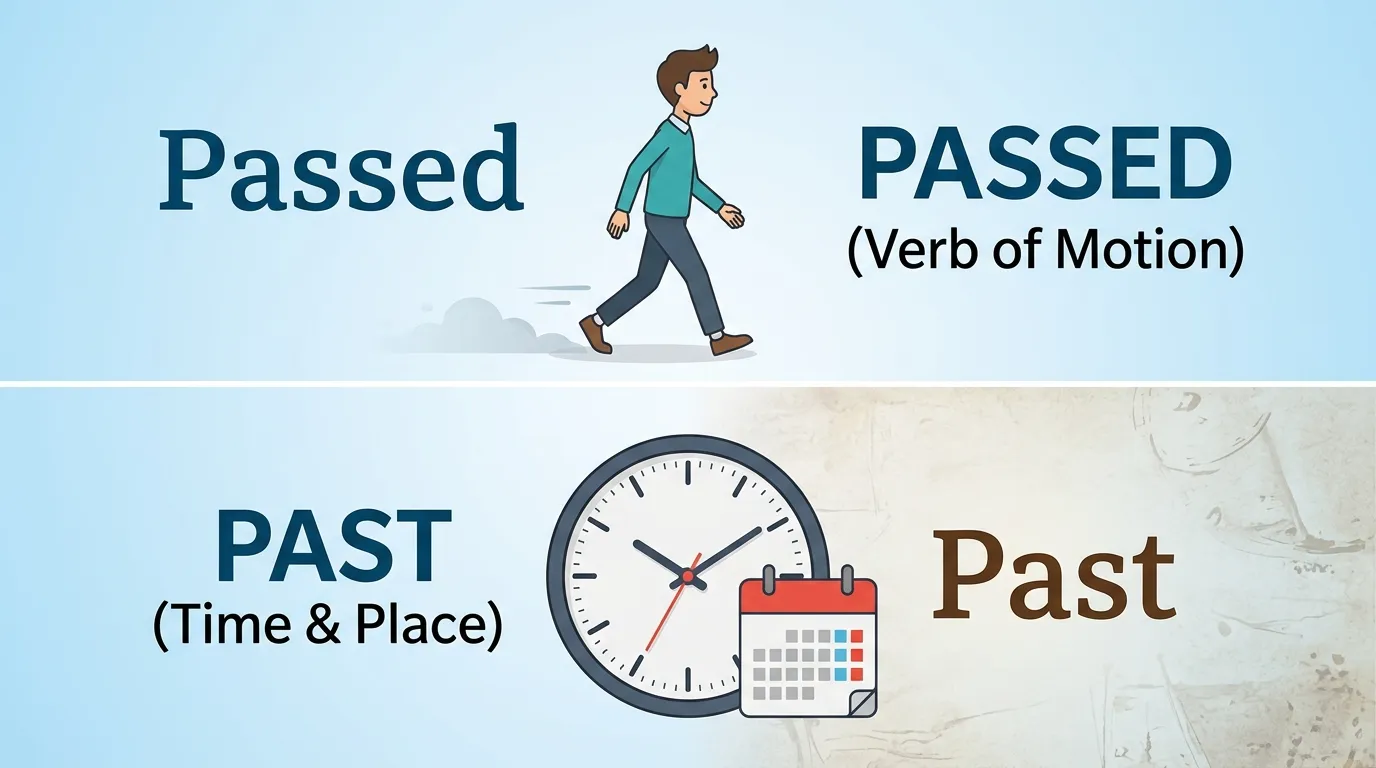
Past usually refers to an earlier time, while passed is usually the past tense of the verb pass.
For example:
- We talked about the past.
- She passed the exam.
- The car drove past my house.
- He passed me on the road.
Understanding past vs passed becomes much easier once you learn what role each word plays in a sentence. In this guide, you will learn the difference between past and passed, how to pronounce them, when to use each one, common mistakes, examples in everyday and formal English, and simple memory tricks that make the distinction easier to remember.
Quick Answer: Past vs Passed
Past is mainly used as a noun, adjective, adverb, or preposition. It commonly refers to a time that has already happened or describes movement beyond a particular point.
Passed is primarily the past tense and past participle of the verb “pass.” It describes an action that happened or was completed.
| Word | Main role | Basic meaning | Example |
|---|---|---|---|
| past | Noun, adjective, adverb, preposition | Earlier time; beyond | We cannot change the past. |
| passed | Verb | Moved, succeeded, handed, went beyond, etc. | She passed the test. |
Easy memory trick
If you are talking about time, think past.
If you are describing an action, think passed.
Past = time or position
Passed = action
What Does “Past” Mean?
The word past has several grammatical uses, but its central idea is something that is earlier than now or beyond a particular point.
1. Past as a noun
As a noun, past refers to an earlier period or events that have already happened.
Examples:
- We should learn from the past.
- She does not like talking about her past.
- The past cannot be changed.
- His past influenced his decisions.
Here, past is a thing or period rather than an action.
2. Past as an adjective
As an adjective, past describes something that happened earlier.
Examples:
- My past experiences shaped my career.
- We discussed the past year.
- Several past presidents attended the event.
- She learned from her past mistakes.
Common phrases include:
- past experience
- past mistakes
- past events
- past relationships
- past years
- past generations
- past problems
3. Past as a preposition
Past can describe movement beyond a particular person, place, or point.
Examples:
- He walked past the store.
- The bus went past our house.
- She drove past the school.
- I saw him walking past the office.
In these examples, past means something like beyond or by.
4. Past as an adverb
Past can also function as an adverb.
Examples:
- The train went past.
- She walked past without saying anything.
- The dog ran past.
What Does “Passed” Mean?
Passed is the past tense and past participle of the verb pass.
The verb pass has many meanings, so passed can have several meanings depending on the sentence.
Passed can mean moved beyond something
- The car passed our house.
- She passed me in the hallway.
- The train passed the station.
Passed can mean succeeded
- He passed his driving test.
- Maria passed the exam.
- I was nervous, but I passed.
Passed can mean handed something to someone
- She passed me the salt.
- He passed the note to his friend.
- I passed the documents to my manager.
Passed can mean that time went by
- Three hours passed quickly.
- A week passed before she called.
- Several years passed.
Passed can mean formally approved something
- Congress passed the bill.
- The committee passed the proposal.
- The board passed the motion.
The Main Difference Between Past and Passed
The easiest way to understand past vs passed is to focus on their grammatical roles.
Past is not normally the past tense of pass.
Passed is.
Compare:
The runner passed the finish line.
The word passed describes an action. The runner moved beyond the finish line.
Now compare:
The runner looked back at his past achievements.
Here, past refers to things that happened earlier.
Another pair:
She walked past me.
She passed me.
Both sentences can describe similar events, but their grammatical structures are different.
In “She walked past me,” past is a preposition describing where she walked.
In “She passed me,” passed is the verb describing the action.
Past vs Passed Examples
Seeing the words side by side can make the difference much clearer.
| Correct sentence | Why? |
|---|---|
| I cannot change the past. | Past refers to earlier time. |
| She passed the exam. | Passed is the verb pass. |
| We drove past the restaurant. | Past means beyond or by. |
| The car passed the restaurant. | Passed describes the action. |
| He has a difficult past. | Past refers to previous experiences. |
| Five minutes passed. | Passed means time went by. |
| They walked past the building. | Past describes movement beyond. |
| They passed the building. | Passed is the verb. |
Why Do People Confuse Past and Passed?
The biggest reason is pronunciation.
In standard American English, past and passed are normally pronounced the same. They are homophones: different spellings with the same pronunciation.
That means you cannot rely on sound alone when deciding which word to write.
You have to look at the sentence.
For example:
She passed the store.
and
She walked past the store.
When spoken aloud, the highlighted words sound the same. Their grammatical functions, however, are different.
This is why past vs passed is such a common English spelling problem.
Past vs Passed Pronunciation
Past and passed are generally pronounced alike in American English.
Both have the short vowel sound followed by the consonant sounds represented by st.
The important point for writers is that their spelling does not match their pronunciation difference because there usually isn’t a pronunciation difference.
This is similar to other English homophones such as:
- there / their / they’re
- your / you’re
- to / too / two
- hear / here
- right / write
The solution is not pronunciation. The solution is understanding meaning and grammar.
Is “Past” a Verb?
No.
Past is not the past tense of “pass.”
This is one of the most important points to remember.
The verb forms are:
- pass
- passes
- passed
- passing
So:
I pass the building every morning.
I passed the building yesterday.
Not:
I past the building yesterday.
However, past can be used in several other grammatical roles, including noun, adjective, adverb, and preposition.
Is “Passed” Always a Verb?
In standard English, passed is a form of the verb pass.
For example:
- She passed the test.
- He passed the ball.
- The years passed.
- They passed the house.
This makes passed relatively easy to identify.
If the word is describing an action performed by someone or something, passed may be the correct choice.
Past as a Time Word
One of the most common uses of past is to describe time that has already happened.
Examples:
- in the past
- the recent past
- the distant past
- past generations
- past events
- past mistakes
- past experience
Examples in sentences
People in the past did not have smartphones.
We should learn from the past.
Her past experiences made her more careful.
The company has faced similar problems in the past.
A useful test is to replace past with earlier or previous.
If the sentence still makes sense, past is probably correct.
Past for Movement
Another major use of past is to describe movement beyond something.
Examples:
Walk past the bank and turn left.
The child ran past his mother.
We drove past the stadium.
She walked past me without noticing.
Here, past means approximately beyond or by.
A useful substitution test
Try replacing past with beyond.
Walk past the school.
Walk beyond the school.
The meanings are close, so past works as a preposition.
Passed for Movement
Passed can also describe movement beyond something because pass itself can mean to move beyond or go by.
Compare:
The car drove past the house.
The car passed the house.
Both are grammatical.
The difference is structural.
In the first sentence, past tells us the relationship between the car’s movement and the house.
In the second sentence, passed is the main verb.
More examples
- The cyclist rode past us.
- The cyclist passed us.
- The plane flew past the mountain.
- The plane passed the mountain.
Both versions can be natural depending on what the writer wants to emphasize.
Past vs Passed in Time Expressions
This is an area where many writers make mistakes.
Correct
In the past, people communicated differently.
Correct
Several years passed before they met again.
These sentences express different ideas.
In the past = during an earlier period.
Years passed = years went by.
Compare:
Time passed quickly.
In the past, time seemed slower.
The first uses passed as an action.
The second uses past as a noun phrase referring to an earlier period.
“Passed Away” vs “Past Away”
The correct expression is:
passed away
“Passed away” is a polite expression meaning died.
Examples:
- Her grandfather passed away last year.
- His father passed away peacefully.
- We were saddened to hear that she had passed away.
Past away is incorrect in standard English.
Why?
Because passed away comes from the verb pass. The person has “passed” from life.
“Past Due” vs “Passed Due”
The correct expression is:
past due
It means something should have been paid, completed, or returned earlier but has not been.
Examples:
- Your payment is past due.
- The library book is past due.
- The invoice became past due yesterday.
Passed due is not the standard expression.
This is an important distinction in business, finance, billing, and professional writing.
“Past Tense” vs “Passed Tense”
The correct phrase is:
past tense
Examples:
- “Walked” is the past tense of “walk.”
- “Passed” is the past tense of “pass.”
- The sentence is written in the past tense.
Passed tense is incorrect.
Here, past describes a grammatical time category.
“Passed Time” vs “Past Time”
These expressions can have different meanings.
Passed time
Passed is a verb.
The hours passed quickly.
Here, time went by.
Past time
Past time can mean time that has already gone by or, in certain expressions, that something is overdue.
For example:
It is past time to leave.
This means the appropriate time to leave has already arrived or gone by.
The common expression “past time” should not automatically be replaced with “passed time.”
“Past” vs “Passed” in Sports
Sports writing uses both words frequently.
Passed
Use passed when describing an action involving passing.
The quarterback passed the ball.
She passed the defender.
He passed to his teammate.
Past
Use past when describing movement beyond something.
The runner sprinted past the defender.
The ball went past the goalkeeper.
The cyclist moved past the other riders.
A useful comparison
The quarterback passed the ball past the defender.
Both words can appear in the same sentence.
Passed = the action of sending the ball.
Past = the ball’s position or direction relative to the defender.
“Past” vs “Passed” in Business Writing
Professional writing requires particular care because spelling errors can affect clarity.
Use past for:
- past performance
- past experience
- past employees
- past customers
- past projects
- past results
- past records
Examples:
Our past performance does not guarantee future results.
She has five years of past experience in sales.
Use passed for actions:
- passed the review
- passed the inspection
- passed the audit
- passed the proposal
- passed the certification exam
Examples:
The product passed the safety inspection.
She passed the certification exam.
Past vs Passed in Academic Writing
Academic writing frequently uses both words.
Past
Researchers have examined similar cases in the past.
The study compares present behavior with past behavior.
Passed
The bill was passed by the legislature.
Several decades passed before the theory was widely accepted.
Academic writers should pay attention to grammatical context rather than relying on pronunciation.
Past vs Passed in Journalism
News writing often uses passed for actions:
The Senate passed the legislation.
The athlete passed the previous record.
The vehicle passed the checkpoint.
It uses past for time or position:
The event happened in the past.
The suspect drove past the building.
The country has struggled with similar issues in the past.
Past vs Passed in Casual Conversation
The same rules apply in everyday English.
You might hear:
I walked past your house yesterday.
I passed your house yesterday.
Both can be correct.
You might also say:
That happened in the past.
or:
A few years passed before we spoke again.
The difference is not formal versus informal. It is primarily meaning and grammar.
Common Mistakes With Past and Passed
Mistake 1: “I past the test.”
Incorrect:
I past the test.
Correct:
I passed the test.
Why?
Because passing an exam is an action. The past-tense form of pass is passed.
Mistake 2: “In the passed”
Incorrect:
In the passed, things were different.
Correct:
In the past, things were different.
Why?
The phrase refers to an earlier period, so the noun past is required.
Mistake 3: “Walk passed the store”
Incorrect:
Walk passed the store.
Correct:
Walk past the store.
Why?
Here, past is a preposition meaning beyond or by.
Mistake 4: “The past away”
Incorrect:
He past away last year.
Correct:
He passed away last year.
Why?
The expression comes from the verb pass, so its past form is passed.
Mistake 5: “Passed tense”
Incorrect:
This sentence is in the passed tense.
Correct:
This sentence is in the past tense.
Why?
Past tense is the established grammatical term.
Awkward vs Natural Examples
| Awkward or incorrect | Natural and correct |
|---|---|
| I past the exam. | I passed the exam. |
| In the passed, life was different. | In the past, life was different. |
| Walk passed the store. | Walk past the store. |
| He past away last month. | He passed away last month. |
| The passed tense is confusing. | The past tense is confusing. |
| We drove passed the school. | We drove past the school. |
| Five years past before they met. | Five years passed before they met. |
| Think about what happened passed. | Think about what happened in the past. |
How to Choose Between Past and Passed
When you are unsure, use these steps.
Step 1: Ask whether you mean earlier time
If yes, use past.
She lives in the past.
We discussed past events.
Step 2: Ask whether someone or something performed the action “pass”
If yes, use passed.
He passed the test.
The car passed us.
Time passed quickly.
Step 3: Ask whether “past” means beyond or by
If yes, use past.
Walk past the door.
She ran past me.
Step 4: Look at the surrounding grammar
If the word is functioning as a verb, passed is usually the answer.
If it is functioning as a noun, adjective, adverb, or preposition, past may be correct.
A Simple Memory Trick for Past vs Passed
Try this:
Past = place or time
Passed = performed an action
Think of past as pointing backward:
the past
past experiences
past the building
Think of passed as an action:
passed the test
passed the ball
passed the house
time passed
Another useful trick is:
Passed has “-ed” because it is a verb.
When you can identify an action, check whether passed fits.
Past vs Passed: Synonyms and Related Words
Synonyms for past
Depending on context, synonyms include:
- previous
- former
- earlier
- bygone
- preceding
- historical
- earlier period
- prior
Example:
Past experience
can sometimes become:
Previous experience
or:
Prior experience
Synonyms for passed
Depending on context:
- moved
- went by
- succeeded
- crossed
- handed
- transferred
- approved
- progressed
For example:
She passed the exam.
could become:
She succeeded on the exam.
But these synonyms do not work in every context.
Antonyms of Past and Passed
Because the words have different meanings, their opposites also depend on context.
Past as time
Possible opposites include:
- present
- current
- future
- upcoming
Example:
past events ↔ future events
Passed as an action
Depending on meaning, opposites can include:
- failed
- stopped
- remained
- stayed
- kept
- retained
For example:
She passed the exam.
The opposite is:
She failed the exam.
Common Collocations With “Past”
Some common expressions containing past include:
- in the past
- past tense
- past experience
- past mistakes
- past events
- past year
- past decade
- past few days
- past generations
- past behavior
- past relationships
- past records
- past due
- past midnight
- half past five
- ten past six
- move past something
Examples
We have learned from our past mistakes.
It is past midnight.
The payment is past due.
She wants to move past the disagreement.
Common Collocations With “Passed”
Common expressions with passed include:
- passed the test
- passed the exam
- passed the ball
- passed the message
- passed the law
- passed the bill
- passed away
- passed by
- passed through
- passed over
- passed down
- passed on
- passed along
- passed inspection
- passed the time
Examples:
The students passed the exam.
The legislature passed the bill.
She passed the message along.
The car passed by quickly.
“Passed By” vs “Past”
These can be especially confusing.
Passed by
Passed by comes from the verb pass.
He passed by my office.
Past
Past can also describe movement.
He walked past my office.
Both can be correct.
Compare:
Several cars passed by.
Here, passed is the verb.
Several cars drove past my house.
Here, past functions as a preposition.
“Half Past” and Clock Time
When telling time, use past, not passed.
Examples:
- half past three
- ten past four
- twenty past seven
- a quarter past nine
Correct:
It is half past six.
Incorrect:
It is half passed six.
The word past indicates that the specified number of minutes has gone beyond the hour.
“Past” in Idiomatic Expressions
Past appears in many common expressions.
Get past
We need to get past this problem.
Meaning: overcome or move beyond something.
Move past
She is trying to move past the disappointment.
Meaning: leave something behind emotionally or practically.
Past your prime
The athlete is considered past his prime.
Meaning: beyond the period of greatest ability.
A thing of the past
That technology is now a thing of the past.
Meaning: something no longer common or relevant.
Past its expiration date
The product is past its expiration date.
Meaning: beyond the date when it should normally be used.
Does British English Use Past and Passed Differently?
The fundamental distinction between past and passed is essentially the same in American and British English.
Both varieties use:
- past for earlier time and many positional uses
- passed as the past tense of pass
Examples remain the same:
She passed the exam.
He walked past the store.
We talked about the past.
There can be regional differences in vocabulary, spelling, pronunciation, and preferred expressions elsewhere in English, but this particular distinction is broadly consistent.
Past vs Passed in International English
For writers communicating with an international audience, the same basic rules are reliable.
Use past for:
- earlier time
- previous events
- movement beyond something
- expressions such as “past due” and “past tense”
Use passed for:
- the past tense of pass
- completing an exam
- moving beyond something as an action
- handing something to someone
- time going by
- approving something
These forms are widely understood across major varieties of English.
Formal vs Informal Usage
There is no major formality difference between past and passed.
Both are standard English words.
The important question is not:
Which one sounds more formal?
Instead, ask:
Which word has the correct grammatical function in this sentence?
For example:
Formal:
The committee passed the proposal.
Casual:
She passed the test.
Both use passed because both describe an action.
Formal:
The organization has learned from its past experience.
Casual:
Let’s forget the past.
Both use past because both refer to an earlier period or experience.
A Detailed Past vs Passed Comparison
| Feature | Past | Passed |
|---|---|---|
| Pronunciation | Usually same as passed | Usually same as past |
| Verb? | No | Yes |
| Refers to earlier time? | Yes | Sometimes, indirectly |
| Past tense of “pass”? | No | Yes |
| Can mean beyond? | Yes | Yes, through the verb pass |
| Can mean succeeded? | No | Yes |
| Can mean handed something? | No | Yes |
| Can describe previous events? | Yes | No |
| Example | the past | passed the exam |
A Quick Test You Can Use While Writing
Whenever you hesitate between past and passed, ask:
Does it mean “earlier”?
Use past.
Past generations
Does it mean “beyond”?
Use past.
Walk past the house.
Does it describe an action?
Use passed.
She passed the house.
Does it mean “succeeded”?
Use passed.
He passed the test.
Does it mean “went by”?
Use passed.
Three hours passed.
This five-question test solves most everyday cases.
Past vs Passed: More Everyday Examples
At school
I passed my math test.
We studied past mistakes before taking the test.
At work
The proposal was passed by the board.
We reviewed past projects.
While driving
We drove past the gas station.
The other driver passed us.
Talking about time
That happened in the past.
Several months passed.
Talking about death
Her uncle passed away.
Talking about deadlines
The payment is past due.
Talking about grammar
“Passed” is the past tense of “pass.”
“Past” can function as a noun, adjective, adverb, or preposition.
When Both “Past” and “Passed” Can Appear Together
There is nothing wrong with using both words in one sentence.
For example:
The runner passed past the slower group.
However, that sentence can sound awkward because the two constructions overlap.
More natural alternatives include:
The runner passed the slower group.
or:
The runner ran past the slower group.
Another natural example is:
She passed the building and continued past the bridge.
Here, each word has a clear function.
Passed = action of going beyond the building.
Past = location beyond the bridge.
How Writers Can Avoid Past vs Passed Errors
If you write blog posts, emails, reports, essays, social media posts, or professional documents, develop a simple proofreading habit.
Search for “past”
Every time you use past, ask:
Am I talking about earlier time, a previous situation, or something beyond a point?
If yes, past may be correct.
Search for “passed”
Ask:
Is this the verb “pass” in the past tense?
If yes, passed is correct.
This is especially useful when proofreading because spell-checkers may not catch the mistake. Both past and passed are correctly spelled words, so software cannot always determine which one you intended.
Frequently Asked Questions
Is it “past” or “passed”?
It depends on the sentence. Use past for earlier time or for something beyond a point. Use passed as the past tense of the verb pass.
We talked about the past.
She passed the exam.
Is “past” the past tense of “pass”?
No. The past tense of pass is passed.
Present: I pass the store.
Past: I passed the store.
Past is a separate word with its own meanings.
Is it “walk past” or “walk passed”?
The correct expression is walk past.
Walk past the bank and turn right.
Here, past is a preposition describing movement beyond the bank.
Is it “passed away” or “past away”?
The correct phrase is passed away.
Her grandmother passed away peacefully.
“Past away” is incorrect in standard English.
Is it “past due” or “passed due”?
The standard expression is past due.
Your payment is past due.
It means that the deadline has already arrived or gone by.
Is it “past tense” or “passed tense”?
The correct term is past tense.
“Passed” is the past tense of “pass.”
“Passed tense” is incorrect.
Are “past” and “passed” pronounced the same?
Yes, they are generally pronounced the same in American English. They are homophones, which means they have different spellings and meanings but the same pronunciation.
Can “past” be a verb?
In standard modern English, past is not normally used as the verb corresponding to pass. The verb is pass, and its past tense is passed.
She passed the store.
Not:
She past the store.
Is “passed” always about moving?
No. Passed has many meanings. It can mean succeeded, handed something to someone, moved beyond something, went by, or officially approved something.
Examples:
He passed the exam.
She passed me the book.
Time passed.
Congress passed the bill.
How can I remember the difference between past and passed?
Remember:
Past = time or position.
Passed = action.
If you are talking about something that happened before now, past is often correct. If you are describing an action involving pass, use passed.
Conclusion
The difference between past vs passed becomes much easier once you stop relying on pronunciation and focus on grammar.
Past is generally used for an earlier time, previous experiences, or something beyond a particular point.
We learned from the past.
She walked past the store.
Passed is the past tense and past participle of pass.
She passed the exam.
The car passed us.
Three hours passed.
The most useful rule is simple:
Past = time or position. Passed = action.
When proofreading, remember that both words are spelled correctly, so a spell-checker may not identify a past/passed error. Always check what the word is doing in the sentence.
If you mean earlier, previous, or beyond, choose past. If you mean an action performed by the verb pass, choose passed.
Once you learn that distinction, even tricky expressions such as past due, past tense, passed away, passed the test, and walked past become much easier to handle.