If you have ever paused before writing a sentence like “I need to ___ down,” you are not alone. The difference between lay vs lie confuses even fluent English speakers because the two verbs are closely related, and their past-tense forms make the problem even harder.
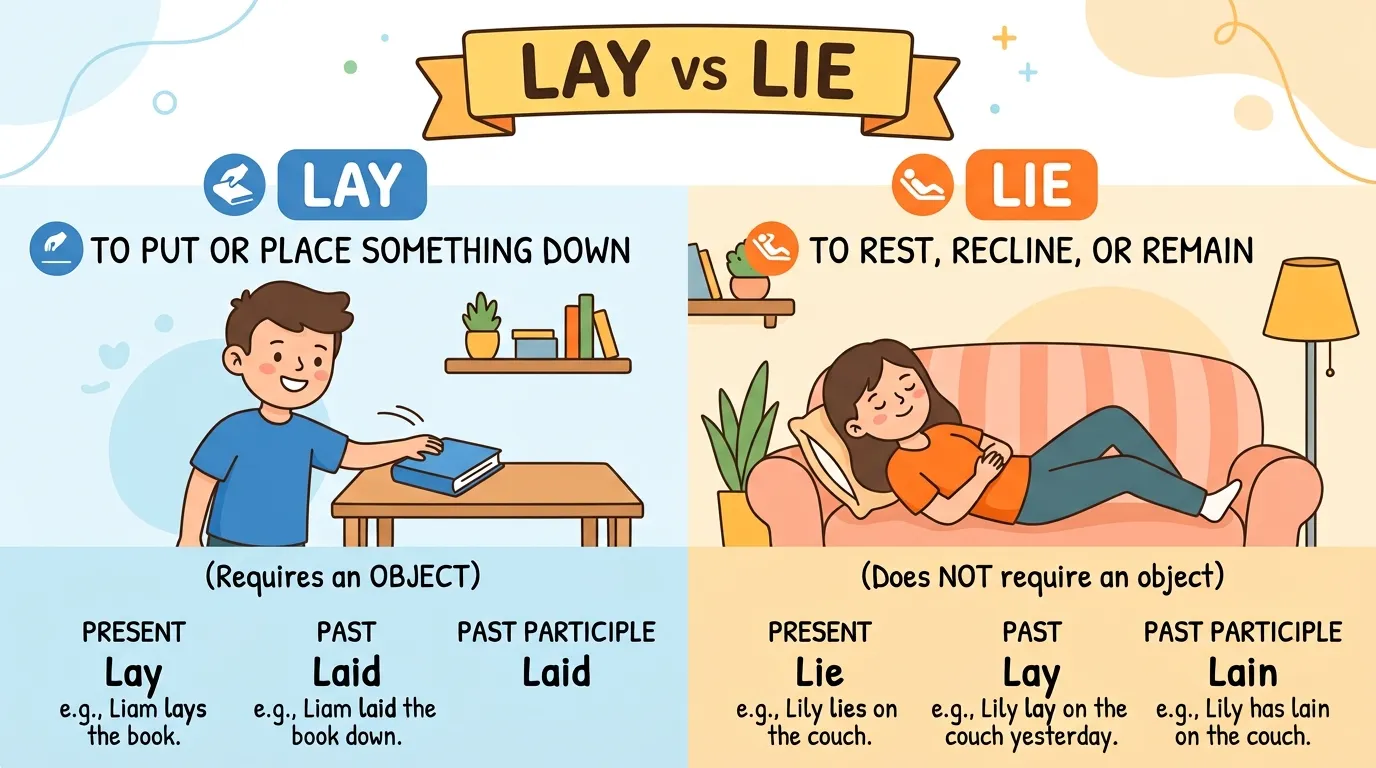
The good news is that the basic difference is simple: lie means to recline or rest, while lay usually means to put or place something somewhere. The tricky part comes from their different forms: lie → lay → lain and lay → laid → laid.
This guide explains lay vs lie in clear American English. You will learn their meanings, grammar rules, pronunciation, verb forms, common mistakes, formal and informal usage, idioms, regional differences, and practical memory tricks. By the end, you should be able to choose the correct word without guessing.
Quick Answer: Lay vs Lie
The fastest way to understand the difference is to ask whether there is a direct object.
- Lie = to recline or rest yourself.
- Lay = to put or place something somewhere.
- Lie does not normally take a direct object.
- Lay normally takes a direct object.
Compare these sentences:
- I want to lie on the couch.
- Please lay the book on the table.
- Yesterday, I lay on the couch.
- Yesterday, I laid the book on the table.
The confusion happens because lay is also the past tense of lie.
That gives us this important distinction:
| Meaning | Present | Past | Past Participle |
|---|---|---|---|
| Recline/rest | lie | lay | lain |
| Put/place | lay | laid | laid |
A simple rule to remember is:
You lie down, but you lay something down.
What Does Lie Mean?
The verb lie means to be in or move into a horizontal or resting position.
In this sense, the person or thing is not actively placing another object somewhere.
Examples
- I want to lie down.
- She likes to lie on the beach.
- The dog is lying under the table.
- He lay on the bed for an hour.
- They have lain awake all night.
The verb lie is generally intransitive, which means it does not require a direct object.
You can say:
- I lie on the bed.
But you would not normally say:
- I lie the bed.
That is where lay becomes necessary.
What Does Lay Mean?
The verb lay usually means to put, place, or set something down.
Because it describes an action performed on an object, it normally needs a direct object.
Examples
- Lay the keys on the counter.
- She laid the baby in the crib.
- Please lay your coat on the chair.
- He laid the papers on my desk.
- They have laid the foundation for the building.
Here, something is being placed somewhere.
A useful test is to ask:
What are you laying?
If you can answer that question, lay is probably the correct verb.
For example:
- Lay the book on the table.
- Lay the baby in the crib.
- Lay the cards on the desk.
Lay vs Lie Verb Forms
The verb forms are the main reason this grammar issue feels confusing.
Lie: Recline or Rest
| Tense/Form | Correct Form | Example |
|---|---|---|
| Present | lie | I lie down after work. |
| Present participle | lying | I am lying on the sofa. |
| Past | lay | I lay down yesterday. |
| Past participle | lain | I have lain here for hours. |
Lay: Put or Place
| Tense/Form | Correct Form | Example |
|---|---|---|
| Present | lay | I lay the phone here. |
| Present participle | laying | I am laying the phone here. |
| Past | laid | I laid the phone here. |
| Past participle | laid | I have laid the phone here. |
Notice the key difference:
Lie → lay → lain
Lay → laid → laid
The word lay appears in both sets, but it has different grammatical roles.
Why Do People Confuse Lay and Lie?
There are several reasons.
The past tense of lie is lay
This is the biggest problem.
Present:
- I lie down.
Past:
- Yesterday, I lay down.
But the present tense of the other verb is also lay:
- I lay the book down.
So one word, lay, belongs to two different verbs.
The past tense of lay is laid
This creates another important contrast:
- Today I lay the book on the table.
- Yesterday I laid the book on the table.
Many speakers incorrectly use “layed.” In standard English, layed is not the normal past tense of lay.
Correct:
- I laid it there.
Incorrect:
- I layed it there.
Lay vs Lie: The Most Important Difference
The easiest way to separate them is to focus on action and object.
Lie = you rest
The subject is reclining or resting.
I lie on the couch.
There is no direct object.
Lay = you place something
The subject puts an object somewhere.
I lay the blanket on the couch.
The object is the blanket.
Compare:
- I lie on the bed.
- I lay the pillow on the bed.
The first sentence describes your position.
The second describes what you put somewhere.
A Simple Object Test
When you are unsure whether to use lay or lie, try this test.
Ask:
Is someone or something being placed?
If yes, use lay.
If no, and the meaning is “recline” or “rest,” use lie.
Example
“I need to ___ down.”
What is being placed?
Nothing.
Therefore:
I need to lie down.
Now consider:
“I need to ___ the baby down.”
What is being placed?
The baby.
Therefore:
I need to lay the baby down.
This simple test solves many everyday grammar problems.
Lay vs Lie in Present Tense
In the present tense, the distinction is straightforward.
Use lie for resting
- I lie down every afternoon.
- She lies on the sofa.
- The cat lies near the window.
Use lay for placing
- I lay the newspaper on the table.
- She lays the clothes on the bed.
- He lays the keys beside the door.
Notice the third-person forms:
- lie → lies
- lay → lays
Examples in context
Natural:
After lunch, I usually lie down for a few minutes.
Natural:
I usually lay my phone on the desk after lunch.
The first describes a person’s position. The second describes placing an object.
Lay vs Lie in the Past Tense
This is where many writers make mistakes.
The past tense of lie is lay.
Yesterday, I lay on the couch.
The past tense of lay is laid.
Yesterday, I laid the book on the couch.
Therefore:
- I lay down yesterday.
- I laid the book down yesterday.
Not:
- I laid down yesterday. ❌
- I layed the book down yesterday. ❌
Lay vs Lie in Perfect Tenses
The past participle of lie is lain.
The past participle of lay is laid.
Lie
- I have lain here for an hour.
- She had lain awake all night.
- They have lain on the beach since noon.
Lay
- I have laid the book on the desk.
- She had laid the baby in the crib.
- They have laid the papers on the table.
Why “I have laid down” can be correct
You may hear:
I have laid down.
This is generally incorrect when the speaker means “I have reclined.”
The correct form is:
I have lain down.
However, laid down is correct when something is being placed:
I have laid down the book.
The object changes everything.
Lie vs Lay vs Laid vs Lain
Here is the full comparison in one place:
| Word | Meaning | Example |
|---|---|---|
| lie | recline/rest | I lie down at noon. |
| lay | put/place | I lay the book down. |
| lay | past of lie | Yesterday, I lay down. |
| laid | past of lay | Yesterday, I laid the book down. |
| lain | past participle of lie | I have lain here all morning. |
If you memorize only one table from this article, memorize this one.
“I’m Going to Lay Down” or “I’m Going to Lie Down”?
In standard American English, the traditional grammatical choice is:
I’m going to lie down.
Why?
Because you are describing yourself reclining. You are not placing an object.
However, “lay down” is extremely common in informal speech, especially in some American varieties. You may hear people say:
I’m going to lay down for a while.
Although this is common in everyday conversation, formal writing generally favors:
I’m going to lie down for a while.
For school, professional writing, academic work, journalism, and edited content, lie down is the safer choice when you mean “recline.”
“Lay in Bed” or “Lie in Bed”?
When you mean that someone is resting in bed, standard usage is:
I lie in bed when I am tired.
For a past event:
I lay in bed all morning.
For the perfect tense:
I have lain in bed all day.
But when you put something in the bed:
I laid the blanket on the bed.
The meaning determines the verb.
“Lay on the Floor” or “Lie on the Floor”?
Both can be correct, but they can mean different things.
Present action
I lie on the floor.
This means you are resting there.
Past action
I lay on the floor.
This means you rested there in the past.
Placing something
I lay the mat on the floor.
This means you put the mat there.
So the sentence “I lay on the floor” is not automatically wrong. It is the past tense of lie.
“Lay the Baby Down” vs “Lie the Baby Down”
The correct standard expression is:
Lay the baby down.
The baby is the object being placed.
You can also say:
The baby lies in the crib.
Compare:
- The mother lays the baby in the crib.
- The baby lies in the crib.
This contrast is one of the easiest ways to understand the grammar.
Pronunciation of Lay and Lie
In standard American English, lay and lie have different vowel sounds.
- lay rhymes with words such as day and say.
- lie rhymes with words such as my and sky.
The difference is easy to hear once you practice them in short sentences.
Practice pairs
- Lay the book down.
- Lie down.
- I laid the book there.
- I lay there yesterday.
- She lays the baby down.
- She lies on the bed.
The pronunciation difference can help, but grammar and meaning should remain your main guide.
Tone and Formality
The distinction between lay and lie is grammatical rather than a difference in politeness.
Still, the choice can affect how polished your writing sounds.
Formal and edited writing
Prefer traditional standard forms:
Please lay the documents on the desk.
I need to lie down for a moment.
She lay awake for several hours.
Casual conversation
You may hear nonstandard uses such as:
I’m gonna lay down.
This is common in speech, but it is not the best choice for formal writing when lie is intended.
American vs British English
The core distinction between lay and lie is broadly shared across American and British English.
Both varieties generally use:
- lie for reclining
- lay for placing something
However, informal speech can vary significantly by region and dialect. Some speakers use lay where traditional grammar expects lie, especially in expressions such as “lay down.”
For international, academic, business, and professional writing, following the standard distinction is the clearest approach.
Lay and Lie in Academic Writing
Academic writing benefits from grammatical precision.
Instead of:
The researcher laid on the examination table.
Write:
The researcher lay on the examination table.
If the researcher placed an object somewhere:
The researcher laid the instrument on the table.
Academic writing should avoid dialectal substitutions when a standard form is available.
Lay and Lie in Business Writing
Business communication usually benefits from direct and conventional wording.
Natural
Please lay the documents on the conference table.
Natural
The equipment has lain unused for several months.
Better alternative for clarity
Sometimes you can avoid the issue entirely:
Please place the documents on the conference table.
The verb place is especially useful in formal writing because it clearly communicates the action without creating confusion.
Lay and Lie in Journalism
Journalistic writing often favors short, clear constructions.
Instead of:
The injured player laid on the field.
Use:
The injured player lay on the field.
If describing a past placement:
The coach laid the equipment beside the bench.
Journalists should be particularly careful because small grammar errors can reduce credibility.
Lay and Lie in Sports Writing
Sports reporting frequently uses lie for players or objects occupying a position.
Examples:
The goalkeeper lay on the field after the collision.
The ball lay near the goal line.
But lay can describe placing something:
The player laid the ball on the tee.
Sports writing can also use specialized expressions where lie means “be situated.”
For example:
The ball lies just outside the penalty area.
Here, lies means “is located.”
Lie Can Also Mean “Be Located”
This is an important meaning that has nothing to do with resting.
The verb lie can mean to be situated or located.
Examples:
- The village lies between two mountains.
- The answer lies in the final paragraph.
- The problem lies in poor planning.
- The city lies near the coast.
In these examples, lie means “exist,” “be located,” or “be situated.”
Figurative examples
The solution lies in better communication.
The real challenge lies in finding enough time.
This usage is common in academic, journalistic, business, and formal writing.
Lie as “Tell an Untruth”
There is another verb spelled lie that means to make a false statement.
For example:
He lied about his age.
This verb is different from lie meaning “recline.”
Its forms are:
- lie
- lied
- lied
- lying
Compare the two verbs:
| Meaning | Present | Past | Past Participle |
|---|---|---|---|
| Recline | lie | lay | lain |
| Tell an untruth | lie | lied | lied |
This distinction is important.
Examples
I lay on the couch yesterday.
Here, lay means reclined.
I lied to my friend yesterday.
Here, lied means told an untruth.
Lay as a Verb for Eggs
Lay also means to produce or deposit an egg.
Examples:
- The hen lays an egg every morning.
- The turtle laid several eggs.
- The bird has laid three eggs.
The object is often the egg itself:
The hen laid an egg.
You would not use lie for this meaning.
Lay as a Noun
Lay can also appear as a noun in several contexts.
A layperson is someone who is not a professional or specialist in a particular field.
For example:
The report is written for a lay audience.
Here, lay means non-specialist or non-professional.
This meaning is unrelated to the common verb confusion between lay and lie.
Figurative Uses of Lay
The verb lay appears in many expressions involving establishing, preparing, or presenting something.
Examples include:
- lay the foundation
- lay the groundwork
- lay the blame
- lay charges
- lay an egg
- lay down the law
- lay out a plan
- lay out the facts
- lay something aside
These expressions often have figurative meanings.
Examples
The company laid the groundwork for expansion.
The report lays out the evidence clearly.
The manager laid down the law.
These are standard expressions, although some are more formal or idiomatic than others.
Figurative Uses of Lie
Lie also appears in many common expressions.
“The truth lies…”
The answer lies somewhere between the two explanations.
“Let sleeping dogs lie”
This means to avoid restarting an old problem.
“Lie low”
This means to remain unnoticed or avoid attention.
After the controversy, he decided to lie low.
“Lie in wait”
This means to wait secretly for someone or something.
“Let it lie”
This means to stop discussing or pursuing a matter.
These expressions are important because replacing lie with lay can change or destroy the intended meaning.
Common Collocations With Lie
Common combinations include:
- lie down
- lie in bed
- lie awake
- lie still
- lie flat
- lie on the floor
- lie on the couch
- lie in wait
- lie low
- lie beneath
- lie between
- lie ahead
- lie behind
Examples
I lay awake for hours last night.
The road lies ahead.
A small town lies between the two cities.
Common Collocations With Lay
Common combinations include:
- lay down
- lay out
- lay aside
- lay off
- lay the foundation
- lay the groundwork
- lay blame
- lay charges
- lay a trap
- lay an egg
- lay the table
- lay a hand on
Examples
She laid out the documents.
The project laid the groundwork for future growth.
The hen laid an egg.
Common Mistakes With Lay and Lie
Mistake: “I am going to lay down.”
Traditional standard English:
I am going to lie down.
Mistake: “I laid on the couch yesterday.”
Correct:
I lay on the couch yesterday.
Mistake: “I layed the book on the table.”
Correct:
I laid the book on the table.
Mistake: “I have laid there all morning.”
Correct:
I have lain there all morning.
Mistake: “She was laying on the bed.”
If she was reclining:
She was lying on the bed.
But:
She was laying the blanket on the bed.
The object makes the difference.
Awkward vs Natural Examples
| Awkward or Incorrect | Natural Standard English |
|---|---|
| I am going to lay down. | I am going to lie down. |
| I laid down yesterday. | I lay down yesterday. |
| I lay the baby down yesterday. | I laid the baby down yesterday. |
| I layed the book there. | I laid the book there. |
| She is laying on the couch. | She is lying on the couch. |
| He has laid there for hours. | He has lain there for hours. |
| Lay on the bed and rest. | Lie on the bed and rest. |
| The book lies on the table yesterday. | The book lay on the table yesterday. |
Everyday Examples of Lay vs Lie
At home
I usually lie down after dinner.
Please lay the remote on the table.
At work
The documents lie on my desk.
Please lay the reports on my desk.
With children
The child lay quietly in bed.
The parent laid the child in bed.
With pets
The dog lies beside the door.
I laid the blanket beside the dog.
At the beach
We lay on the sand all afternoon.
We laid our towels on the sand.
Memory Tricks for Lay vs Lie
Grammar rules are useful, but memory tricks can make them easier to remember.
Memory Trick 1: “Lie = recline”
Think:
Lie = relax.
If you are resting, use lie in the present tense.
I want to lie down.
Memory Trick 2: “Lay = place”
Think:
Lay = place.
If you are putting something somewhere:
Lay the book on the desk.
Memory Trick 3: Look for an object
If there is a direct object, lay is often correct.
Lay the phone here.
No object?
Lie down.
Memory Trick 4: Remember the weird past tense
Memorize this:
Lie – lay – lain
Then:
Lay – laid – laid
The word lay is the troublemaker because it belongs to both verbs.
A Five-Second Decision Method
When writing a sentence, follow these steps:
Step 1: Identify the meaning.
Does it mean “recline/rest”?
→ Use lie.
Step 2: Does it mean “put/place”?
→ Use lay.
Step 3: Check the tense.
If lie is past tense:
→ lay
If lay is past tense:
→ laid
Step 4: Check the perfect tense.
If lie follows has/have/had:
→ lain
If lay follows has/have/had:
→ laid
Example
“I ___ on the couch yesterday.”
Meaning: recline.
Tense: past.
Answer:
I lay on the couch yesterday.
Another example:
“I ___ the book on the couch yesterday.”
Meaning: place.
Tense: past.
Answer:
I laid the book on the couch yesterday.
Formal Alternatives That Avoid Confusion
Sometimes the easiest solution is to choose another verb.
Instead of lie
Depending on the meaning, you might use:
- recline
- rest
- remain
- be positioned
- be situated
Example:
I need to rest for a while.
Instead of lay
You might use:
- place
- put
- set
- position
- arrange
Example:
Please place the document on the desk.
These alternatives are especially useful in technical, academic, and professional writing when absolute clarity matters.
Lay vs Lie in Technical Writing
Technical writing often benefits from precise verbs.
For example:
The sensor lies beneath the protective casing.
This means the sensor is located beneath it.
But:
The technician laid the sensor beneath the protective casing.
This means the technician placed it there.
The distinction between state/location and placement/action is valuable in technical documentation.
Lay vs Lie in Blogging
Bloggers should generally follow standard grammar, especially when publishing educational or professional content.
Instead of:
If you’re tired, lay down and relax.
Use:
If you’re tired, lie down and relax.
But in conversational quotations or dialogue, dialectal wording may be appropriate when it reflects a speaker’s natural voice.
Lay vs Lie in Casual Conversation
Casual speech is more flexible than formal writing.
Many English speakers use lay instead of lie in everyday expressions, particularly “lay down.”
That does not mean the traditional distinction has disappeared from edited English.
If your goal is:
- professional writing
- school assignments
- academic papers
- resumes
- journalism
- business communication
- website content
the standard distinction remains the safest choice.
Related Words
Several words are closely connected to lay and lie.
Recline
Means to lean or rest backward.
He reclined in the chair.
Rest
Means to relax or stop activity.
She rested on the sofa.
Place
Means to put something somewhere.
Please place the file here.
Set
Can mean to put something in a particular position.
Set the glass on the table.
Position
Means to put something in a particular location or arrangement.
The technician positioned the equipment carefully.
These words can sometimes replace lay or lie, but their meanings are not always identical.
Synonyms and Antonyms
Synonyms for lie meaning “recline”
- recline
- rest
- lounge
- repose
- remain
- be situated
Antonyms for lie meaning “recline”
Depending on context:
- stand
- rise
- sit
- get up
Synonyms for lay meaning “place”
- put
- place
- set
- position
- arrange
- deposit
Antonyms for lay meaning “place”
Depending on context:
- remove
- take
- lift
- pick up
Historical Development of Lay and Lie
The confusion between lay and lie is not a modern problem. Both verbs have very old roots in English and Germanic languages.
The verb lie, meaning to recline, developed from an old Germanic verb associated with being in a resting or horizontal position.
The verb lay developed from a related causative idea: causing something or someone to be in a particular position.
In simple terms:
- lie = be in a position
- lay = cause something to be in a position
This historical relationship helps explain why the words are so closely connected.
Over centuries, their forms developed in ways that are irregular by modern English standards. The result is the familiar pattern:
lie → lay → lain
and:
lay → laid → laid
Because English has changed over time, the forms are not as predictable as regular verbs such as walk → walked → walked.
Why “Lay” Is So Tricky
The biggest problem is that lay has two jobs.
It can be:
- The present-tense verb meaning “put or place.”
- The past tense of lie meaning “reclined.”
Compare:
I lay the book on the table every morning.
Present tense of lay.
Yesterday, I lay on the couch.
Past tense of lie.
The surrounding words and meaning tell you which verb is being used.
Quick Comparison Chart
| Feature | Lie | Lay |
|---|---|---|
| Main meaning | Recline/rest | Put/place |
| Usually takes object? | No | Yes |
| Present | lie | lay |
| Past | lay | laid |
| Past participle | lain | laid |
| -ing form | lying | laying |
| Example | I lie down. | I lay the book down. |
The Most Useful Sentence Pairs
These pairs make the distinction easier to remember.
Present
I lie on the sofa.
I lay the blanket on the sofa.
Past
I lay on the sofa yesterday.
I laid the blanket on the sofa yesterday.
Present progressive
I am lying on the sofa.
I am laying the blanket on the sofa.
Present perfect
I have lain on the sofa for an hour.
I have laid the blanket on the sofa.
Notice how the forms change depending on whether you are resting or placing.
A Practical Rule for Editors and Content Writers
When editing a sentence containing lay or lie, do not immediately replace the word.
First determine:
- What does the verb mean?
- What tense is it?
- Is there a direct object?
- Is lie being used to mean “recline,” “be located,” or “tell an untruth”?
- Is the writing formal or conversational?
This prevents unnecessary corrections.
For example:
The village lies in a valley.
This is correct.
The village lays in a valley.
This is incorrect in standard English when lies means “is located.”
But:
The farmer lays the tools in the shed.
This can be correct if it describes a repeated present action.
Best Usage Recommendations
For American English
Use the standard distinction:
- lie = recline
- lay = place
For British English
The same core distinction applies.
For international English
Use standard forms to reduce ambiguity.
For academic writing
Use traditional standard forms consistently.
For business writing
Prefer precise forms and use place when it improves clarity.
For journalism
Use standard grammar and avoid unnecessary ambiguity.
For technical writing
Distinguish carefully between an object’s location and the action of placing it.
For sports writing
Use lie for something being situated and lay for placing something.
For blogs
Standard grammar is recommended, especially for educational and professional content.
For casual conversation
You may encounter nonstandard uses such as “lay down,” but recognizing the difference helps you write correctly.
Final Cheat Sheet
If you remember nothing else, remember these four sentences:
I lie down every day.
I lay the book down every day.
I lay down yesterday.
I laid the book down yesterday.
And for perfect tenses:
I have lain down.
I have laid the book down.
The first set describes reclining.
The second set describes placing something.
FAQs
Is it “lay down” or “lie down”?
When you mean “recline,” the standard form is lie down.
Example:
I need to lie down for a few minutes.
“Lay down” is common in informal speech in some dialects, but lie down is preferred in standard formal writing.
What is the difference between lay and lie?
Lie means to recline, rest, or be situated. Lay usually means to put or place something somewhere.
For example:
I lie on the bed.
I lay the book on the bed.
The main grammatical difference is that lay normally takes a direct object, while lie does not.
Is “I laid down” grammatically correct?
Usually not if you mean “I reclined.”
The standard sentence is:
I lay down yesterday.
However, laid down is correct when an object is being placed:
I laid down the book.
Is “I lay down” present or past tense?
It depends on the meaning.
If lay means “put or place,” it is present tense:
I lay the book on the table.
If lay is the past tense of lie, it means that someone reclined:
Yesterday, I lay on the sofa.
Context determines the meaning.
What is the past tense of lie?
When lie means “recline,” its past tense is lay.
Today I lie on the couch.
Yesterday I lay on the couch.
Its past participle is lain:
I have lain on the couch all afternoon.
What is the past tense of lay?
The past tense of lay is laid.
I lay the book on the desk every day.
Yesterday, I laid the book on the desk.
The past participle is also laid.
Is “layed” a word?
Layed is not the standard past tense of the common verb lay meaning “put or place.”
The correct form is:
laid
For example:
She laid the keys on the table.
Should I say “lying” or “laying”?
Use lying when someone or something is reclining or resting:
The dog is lying on the floor.
Use laying when someone is placing something:
She is laying the blanket on the bed.
The presence of an object often makes the difference.
Why is lay vs lie so confusing?
The main reason is that lay is both the present tense of one verb and the past tense of another.
The two patterns are:
lie → lay → lain
and:
lay → laid → laid
Once these two verb families are memorized, the distinction becomes much easier.
Conclusion
The difference between lay vs lie is confusing at first, but the core rule is straightforward. Lie generally means to recline, rest, or be situated, while lay means to put or place something somewhere.
Remember the two verb patterns:
Lie → lay → lain
Lay → laid → laid
When you are resting, you lie down. When you place an object somewhere, you lay it down. If you are talking about the past, lie becomes lay, while lay becomes laid.
For American English, academic writing, business communication, journalism, blogging, and other edited forms of writing, the best approach is to follow this standard distinction consistently. When in doubt, look for the object: if something is being placed, use lay; if someone is reclining or resting, use lie.
With a little practice, lay vs lie stops being a confusing grammar problem and becomes a simple matter of meaning, tense, and context.