If you’re unsure whether to write midday or mid-day, you’re not alone. Both forms appear in English, but they aren’t equally common in modern American writing.
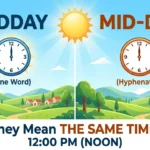
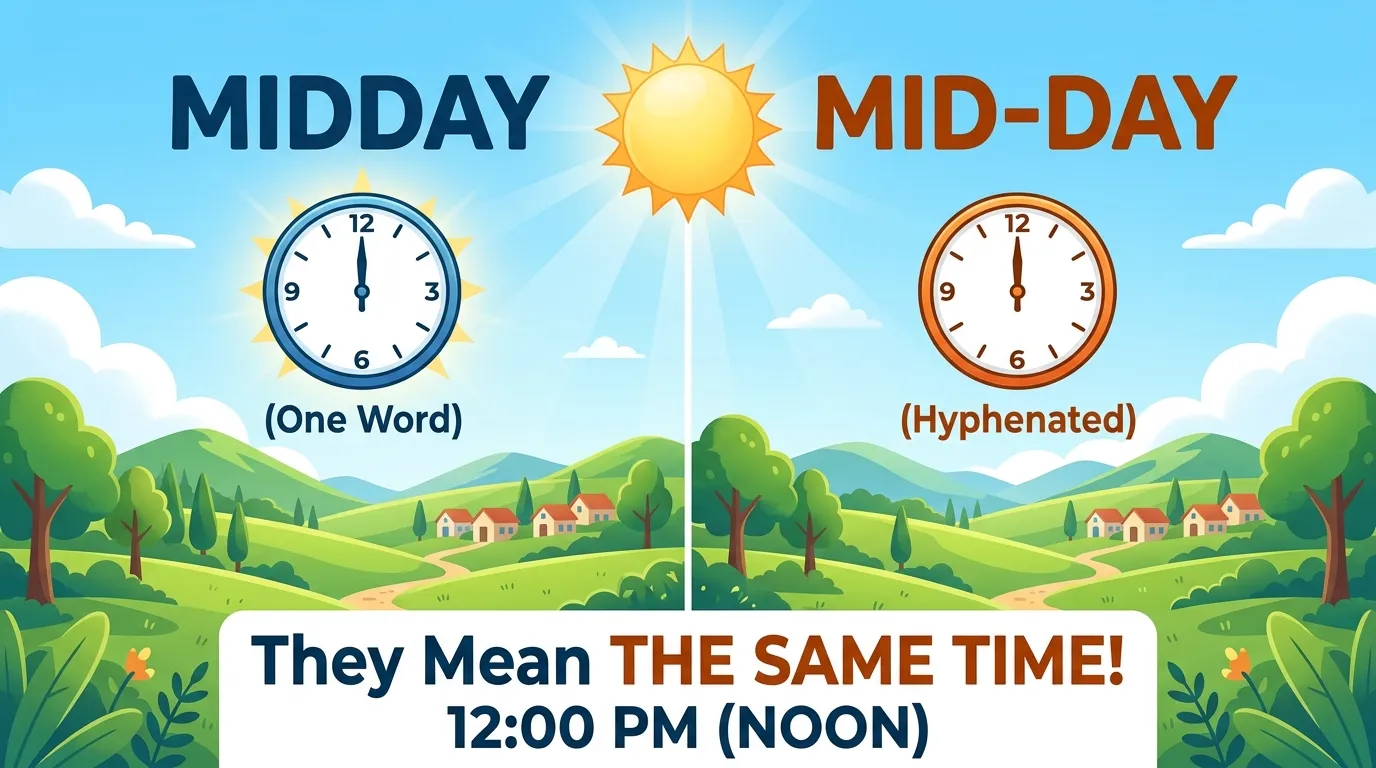
The short answer: midday is the standard and most widely preferred spelling, especially in American English. Mid-day is also understandable and has appeared in English usage, but the hyphenated form is much less common in contemporary writing.
Both forms refer to the middle of the day, usually around 12:00 noon. The main difference is spelling and style rather than meaning.
In this guide, you’ll learn exactly when to use midday and mid-day, whether either form is grammatically wrong, how dictionaries and modern usage treat the word, how it sounds, what it means in different contexts, and which spelling is best for professional, academic, business, journalistic, and casual writing.
Quick Answer: Midday vs Mid-Day
Here’s the simplest way to remember the difference:
| Form | Correct? | Common in Modern English? | Best Use |
|---|---|---|---|
| midday | Yes | Very common | General and professional writing |
| mid-day | Yes, but less common | Less common | Older, stylistic, or house-style usage |
| mid day | Usually not preferred | Uncommon | Generally avoid as the noun |
| noon | Yes | Very common | Precise reference to 12 p.m. |
The best choice
Use midday as one word in most situations:
- We’ll meet at midday.
- The temperature reaches its peak around midday.
- The store closes at midday.
- I usually take a break around midday.
If you’re writing for an American audience, midday is normally the safest and most natural choice.
What Does Midday Mean?
Midday means the middle part of the day, especially the time around noon.
It can refer specifically to approximately 12:00 p.m., but it can also describe a broader period around noon.
Dictionary-style definition
Midday (noun): The middle of the day; the time around noon.
Midday can also function as an adjective when it describes something associated with the middle of the day.
Examples as a noun
- We arrived at midday.
- The meeting starts at midday.
- Birds are less active during the heat of midday.
- By midday, the roads were crowded.
Examples as an adjective
- The midday sun was extremely bright.
- We avoided the midday heat.
- The park becomes busy during midday hours.
- She took a short midday break.
The exact meaning depends slightly on context. Sometimes midday means precisely noon. In other cases, it means the general period surrounding noon.
What Does Mid-Day Mean?
Mid-day has essentially the same basic meaning as midday: the middle part of the day or the period around noon.
The difference is primarily orthographic. The hyphen separates mid and day.
For example:
The event will begin at mid-day.
The sentence is understandable, but in modern general American English, most writers would naturally write:
The event will begin at midday.
The hyphenated spelling isn’t normally needed because midday is an established compound word.
Is Midday or Mid-Day Correct?
Midday is the preferred spelling in modern English, particularly in American English.
That doesn’t mean mid-day is impossible or automatically grammatically wrong. English has many compound words whose spelling has changed over time.
Words often develop through stages such as:
two separate words → hyphenated compound → closed compound
A similar process has happened with many English compounds.
Because midday is now well established as a single word, the closed spelling is generally the best choice.
Compare these examples
Preferred:
We should arrive by midday.
Less common:
We should arrive by mid-day.
Usually awkward:
We should arrive by mid day.
For everyday modern writing, choose midday.
Why Do People Confuse Midday and Mid-Day?
The confusion comes from the way English forms compound words.
The prefix mid- means middle or approximately in the middle of something.
When mid- combines with another word, the resulting compound can be written in different ways depending on the word, historical usage, and style conventions.
Consider:
- midday
- midnight
- midweek
- midyear
- midterm
- midseason
- midwinter
- midmorning
Most of these are commonly written as closed compounds.
That pattern makes midday look natural:
mid + day = midday
However, older texts and some style traditions may use mid-day, which helps explain why you may encounter both forms.
Midday vs Mid-Day: Key Differences
There is no major difference in basic meaning.
The main distinction is spelling, frequency, and style.
Midday
Midday is:
- One word
- The standard modern form
- Common in American English
- Natural in everyday speech and writing
- Suitable for professional writing
- Suitable for academic writing
- Suitable for journalism
- Suitable for websites and blogs
Mid-Day
Mid-day is:
- A hyphenated form
- Less common in modern general writing
- Still understandable
- Sometimes found in older writing
- Sometimes retained by a particular publication’s style
- Occasionally used for visual or stylistic reasons
In simple terms
Meaning: essentially the same
Pronunciation: essentially the same
Grammar: essentially the same
Modern preference: midday
Midday vs Mid-Day Pronunciation
Both spellings are normally pronounced the same way.
The word has two syllables, with the main stress on the first syllable.
The hyphen in mid-day does not normally create a different pronunciation.
Does the hyphen change the meaning?
No.
Compare:
- midday
- mid-day
The hyphen does not normally indicate a different time. Both refer to the middle of the day.
Is Midday Exactly 12:00 PM?
Not always.
This is an important distinction between midday and noon.
Noon usually refers specifically to 12:00 p.m.
Midday can refer to noon or to a wider period around noon.
For example:
The train arrives at noon.
This suggests a specific time.
But:
The train arrives around midday.
This gives a general time period.
Compare
| Expression | Meaning |
|---|---|
| noon | Usually exactly 12:00 p.m. |
| midday | Around the middle of the day |
| midday period | A broader period around noon |
| early afternoon | After noon |
| late morning | Before noon |
So, if you need exact scheduling, 12:00 p.m. or noon may be clearer.
If you’re describing a general part of the day, midday works well.
Midday as a Noun
The most common grammatical role of midday is as a noun.
It can act as the subject or object of a sentence.
Examples
- Midday is often the hottest part of the day.
- We arrived at midday.
- The workers stopped for lunch at midday.
- By midday, the weather had changed.
- She prefers to exercise before midday.
Notice that you don’t need a hyphen.
Common structures
You’ll often see midday after:
- at
- by
- before
- around
- near
- after
Examples:
- at midday
- by midday
- before midday
- around midday
- near midday
- after midday
Midday as an Adjective
Midday can also modify another noun.
For example:
- midday sun
- midday heat
- midday meal
- midday break
- midday traffic
- midday temperature
- midday light
- midday meeting
- midday service
Examples
The midday sun was too strong.
We took a midday break.
Midday traffic made the journey longer.
The photographer avoided the harsh midday light.
In these examples, midday tells us what kind of sun, heat, break, traffic, or light we’re talking about.
Midday vs Noon
Although these words overlap, they aren’t always interchangeable.
Noon
Noon is more precise.
The meeting begins at noon.
This generally means 12:00 p.m.
Midday
Midday is slightly broader.
The meeting begins around midday.
This could mean 11:30 a.m., 12:00 p.m., or another nearby time depending on context.
Which should you choose?
Use noon when precision matters.
Use midday when you’re talking about a general part of the day.
Midday vs Afternoon
These words describe different periods.
Midday centers around noon.
Afternoon normally begins after noon and continues until evening.
For example:
We met at midday.
This suggests around noon.
We met in the afternoon.
This suggests a later period after noon.
The boundary isn’t always rigid in ordinary conversation, but the words shouldn’t be treated as exact synonyms.
Midday vs Midmorning
These terms use the same basic pattern.
Midmorning means the middle portion of the morning.
Midday means the middle portion of the day.
Compare:
- midmorning
- midday
- midafternoon
- mid-evening
The closed form is common for these established compounds.
Examples
I’ll call you in midmorning.
Let’s meet at midday.
Temperatures rise during the midafternoon.
The restaurant gets quieter in the mid-evening.
Midday vs Midnight
These two words are opposites in terms of the day-night cycle.
Midday = around the middle of the daytime period
Midnight = the middle of the night
Both are normally written as one word.
Examples
The sun was high at midday.
The streets were empty at midnight.
This is also a useful memory trick:
midday and midnight are both closed compounds.
Formality and Tone: Is Midday Formal?
Midday is neutral.
It doesn’t sound overly formal or informal.
You can use it in:
Casual writing
I’ll call you around midday.
Business writing
The office will close at midday on Friday.
Academic writing
Measurements were collected around midday.
Journalism
Temperatures reached record levels by midday.
Technical writing
The system performs an automated check at midday.
Creative writing
By midday, the quiet village had come alive.
This flexibility makes midday a useful word across many types of writing.
Is Midday Used in American English?
Yes.
Midday is well established in American English and is the preferred spelling for most modern American writing.
If you’re creating:
- Blog posts
- Business documents
- School assignments
- Emails
- Reports
- News articles
- Website content
- Product descriptions
- Technical documentation
midday is usually the safest choice.
You generally don’t need to change it to mid-day unless a particular style guide, publication, or organization specifically prefers the hyphenated form.
Is Mid-Day Used in British English?
You may encounter mid-day in British English and in older British writing, but the closed form midday is also well established.
This is an important point: the difference isn’t as simple as saying one spelling is American and the other is British.
English spelling preferences can vary by:
- publication
- historical period
- dictionary
- editorial style
- individual writer
- compound-word conventions
So it’s better to describe midday as the widely preferred modern form rather than labeling mid-day as exclusively British.
Midday in International English
For an international audience, midday is a clear and widely understood choice.
It avoids unnecessary punctuation and follows the modern tendency to close familiar compounds.
If your content targets readers across countries, consistency matters more than trying to force a regional spelling.
Recommended international style
Use:
midday
Instead of:
mid-day
unless your publication has a specific reason for the hyphen.
The History of Midday
The word midday is built from two familiar English elements:
- mid — middle
- day — the period of daylight or the 24-hour day
Historically, English frequently created compounds from simple words like these.
The idea is very literal:
mid + day = middle of the day
The word has been used for centuries, and English spelling has not always followed today’s fixed rules for compounds.
Older English often showed greater variation in whether compounds appeared as:
- separate words
- hyphenated words
- closed compounds
Over time, many familiar compounds became standardized as one word.
Midday is an example of that development.
Common Collocations With Midday
A collocation is a group of words that commonly appear together.
Learning collocations can help you sound more natural in English.
Here are common combinations with midday:
- at midday
- around midday
- by midday
- before midday
- after midday
- midday sun
- midday heat
- midday meal
- midday break
- midday traffic
- midday temperature
- midday light
- midday hours
- midday period
- midday service
- midday meeting
- midday rest
- midday schedule
Natural examples
We’ll leave around midday.
The temperature was already high by midday.
Avoid direct sunlight during the midday hours.
The restaurant offers a special midday meal.
Common Expressions With Midday
There aren’t many fixed idioms containing midday, but several natural expressions are common.
At midday
The ceremony begins at midday.
Around midday
I’ll be home around midday.
By midday
We had finished the work by midday.
Before midday
Please send the report before midday.
After midday
The temperature began to fall after midday.
In the middle of the day
This is a longer alternative to midday.
We arrived in the middle of the day.
In many cases, midday is more concise.
Midday Synonyms
Depending on the context, you can replace midday with several related expressions.
Common synonyms and alternatives
- noon
- noontime
- twelve o’clock
- the middle of the day
- around noon
- noon period
- daytime center
However, these aren’t perfect synonyms in every sentence.
Example
We arrived at midday.
Could become:
We arrived at noon.
But:
The midday heat was intense.
Sounds more natural than:
The noon heat was intense.
Both can work, but midday often works better as a modifier.
Antonyms and Contrasting Time Expressions
There isn’t a perfect grammatical antonym for midday, but several time expressions contrast with it.
- midnight
- nighttime
- late night
- dawn
- early morning
- evening
- late afternoon
The most direct conceptual contrast is:
midday ↔ midnight
Example
The city is busy at midday but quiet at midnight.
Midday in Business Writing
Business writing usually benefits from clear, simple language.
Midday works naturally in:
- schedules
- meeting notices
- reports
- office announcements
- emails
- customer communications
Natural business examples
The meeting is scheduled for midday.
Please submit your documents by midday.
The office will reopen after midday.
Our delivery team typically arrives around midday.
Better when exact timing matters
If a business message requires precision, use an exact time:
Please submit the report by 12:00 p.m.
rather than:
Please submit the report by midday.
The choice depends on whether you want precision or general timing.
Midday in Academic Writing
Academic writing can use midday without any problem.
Examples include:
Samples were collected at midday.
The experiment was repeated during the midday period.
Solar radiation was strongest around midday.
However, scientific writing often benefits from exact timestamps when measurements are important.
Instead of:
Samples were collected around midday.
A research paper might say:
Samples were collected at 12:00 p.m.
when the exact time affects the results.
Midday in Journalism
News writing often uses midday because it is short and clear.
Examples:
The storm reached the coast by midday.
Officials held a press conference around midday.
Traffic remained heavy through midday.
The word also works well in headlines and short news summaries because it communicates a general time without adding unnecessary words.
Midday in Sports
Sports writing frequently uses midday when describing games, training sessions, broadcasts, or weather conditions.
Examples:
The team practiced in the midday heat.
The match begins at midday.
Fans began arriving before midday.
The midday game drew a large crowd.
For official schedules, however, the exact kickoff or start time is usually better.
Midday in Weather and Science
The word is especially common when discussing sunlight, temperature, and environmental conditions.
Examples:
- midday temperature
- midday sun
- midday solar radiation
- midday heat
- midday humidity
- midday light
Example
The temperature reached its highest point around midday.
Here, midday refers to a general time rather than necessarily exactly 12:00 p.m.
Midday in Casual Conversation
In everyday conversation, midday sounds perfectly natural.
You might say:
I’ll see you around midday.
What are you doing at midday?
We should be there by midday.
I usually eat lunch around midday.
However, noon is also extremely common in casual American English.
For example:
I’ll see you at noon.
That may sound slightly more direct when you’re referring to 12:00 exactly.
Common Mistakes With Midday
Mistake 1: Using mid day as the noun
❌ We arrived at mid day.
✅ We arrived at midday.
The closed form is normally preferred.
Mistake 2: Hyphenating it everywhere
❌ The meeting begins at mid-day.
✅ The meeting begins at midday.
The hyphen isn’t generally necessary in modern usage.
Mistake 3: Assuming midday always means exactly 12:00
❌ Midday always means precisely 12:00 p.m.
✅ Midday usually refers to the middle part of the day, often around noon.
If precision matters, specify the exact time.
Mistake 4: Treating midday and afternoon as identical
❌ The event happens in the midday, meaning any time after lunch.
✅ Midday generally refers to around noon.
The afternoon normally begins after midday.
Mistake 5: Thinking mid-day has a different pronunciation
❌ The hyphen changes how the word is pronounced.
✅ The two spellings are normally pronounced the same way.
Awkward vs Natural Examples
Example 1
Awkward:
I will meet you at mid day.
Natural:
I will meet you at midday.
Example 2
Less preferred:
The temperature was high at mid-day.
Preferred:
The temperature was high at midday.
Example 3
Wordy:
We arrived during the middle of the day.
Concise:
We arrived at midday.
Both are grammatically correct, but the second is more compact.
Example 4
Too vague for precise scheduling:
The meeting starts at midday.
More precise:
The meeting starts at 12:00 p.m.
Use the second version when exact timing matters.
Midday vs Mid-Day in Different Writing Situations
| Writing situation | Recommended form |
|---|---|
| American English | midday |
| British English | midday generally preferred; style may vary |
| International English | midday |
| Academic writing | midday |
| Business writing | midday |
| Journalism | midday |
| Technical writing | midday |
| Blogging | midday |
| Casual messages | midday |
| Creative writing | midday, unless style calls for otherwise |
| Historical reproduction | Follow the original spelling |
| Publication with a house style | Follow that style |
The central recommendation is simple: use midday unless you have a specific reason to retain mid-day.
When Should You Use Mid-Day?
There are situations where you may encounter or deliberately retain mid-day.
1. Following a house style
A publisher, organization, or editor may have a preferred spelling.
Consistency within the document matters.
2. Preserving historical text
If you’re quoting or reproducing older material, don’t silently modernize the spelling unless your editorial rules require it.
3. Matching an established name
A business, event, product, publication, or organization may use Mid-Day as part of its official name.
In that case, preserve the official spelling.
4. Deliberate stylistic formatting
A writer may use the hyphen for visual or rhetorical reasons, although this isn’t normally necessary.
Outside such contexts, midday is usually better.
Memory Trick: How to Remember Midday
Here’s an easy trick:
Think of midnight.
You almost certainly write:
midnight
not:
mid-night
Since midday follows the same compound pattern, remember:
midday + midnight = both one word
Another useful rule is:
If mid- and the following word form a familiar established compound, check whether the compound is normally written as one word.
For midday, the answer is yes.
Is Midday One Word or Two?
Midday is one word.
Correct:
midday
Less preferred:
mid day
Also seen:
mid-day
The one-word form is the standard choice in most modern contexts.
Is Midday Hyphenated?
Usually, no.
The standard modern spelling is:
midday
rather than:
mid-day
The hyphenated form is understandable but less common.
Should You Write Midday or 12 PM?
That depends on what you mean.
Use midday when you’re referring generally to the middle part of the day.
We’ll arrive around midday.
Use 12:00 p.m. when exact timing matters.
The meeting begins at 12:00 p.m.
Use noon when you want a natural, concise reference to 12:00.
The meeting begins at noon.
Best choice by purpose
General time: midday
Exact time: 12:00 p.m.
Natural reference to 12:00: noon
Midday vs Noontime
Noontime is another word that refers to the time around noon.
Compare:
We arrived at midday.
We arrived at noontime.
Both are correct.
However, midday is often more versatile, especially when used as an adjective:
midday heat
midday light
midday traffic
Noontime can sound slightly more descriptive or traditional depending on the context.
Frequently Asked Questions
Is midday one word or two?
Midday is one word. It is the preferred modern spelling in most English writing. The forms mid-day and mid day may appear in some contexts, but they are generally less preferred.
Is mid-day grammatically correct?
Yes, mid-day can be found in English and is understandable, but it is less common than midday in modern general usage. If you’re unsure which form to choose, use midday.
Is midday the same as noon?
Not exactly. Noon usually refers specifically to 12:00 p.m., while midday can refer to the broader period around the middle of the day.
Is midday formal or informal?
Midday is neutral. It works in casual conversation, business writing, academic writing, journalism, technical writing, and creative writing.
Do midday and mid-day have different meanings?
Normally, no. The two forms refer to essentially the same period: the middle part of the day. The main difference is spelling and stylistic preference.
Should I use midday in American English?
Yes. Midday is the safest and most natural choice for modern American English.
Can midday be an adjective?
Yes. For example, you can say midday sun, midday heat, midday meal, and midday break.
Does midday always mean exactly 12 p.m.?
No. It can mean approximately noon or the general middle portion of the day. If exact timing is important, provide a specific time.
Is mid day correct?
As a standard compound noun, mid day is generally not the preferred spelling. Use midday instead.
What is the difference between midday and afternoon?
Midday centers around noon, while the afternoon generally refers to the period after noon and before evening. They overlap at the boundary, but they aren’t exact synonyms.
Final Verdict
When choosing between midday vs mid-day, the best answer for most modern writers is straightforward:
Use midday.
Midday is the established one-word spelling and the best default for American English, international English, business writing, academic work, journalism, blogging, and everyday communication.
Mid-day isn’t meaningless or incomprehensible. You may still encounter it, especially in older material, specific editorial styles, or official names. But you generally don’t need the hyphen in ordinary modern writing.
Remember these three points:
- Midday = preferred modern spelling.
- Mid-day = understandable but less common variant.
- Noon = more precise when you mean 12:00 p.m.
If you’re writing a sentence such as We will meet at midday, you’re using the standard form.
When in doubt, choose the simple, closed compound:
midday
That spelling is clear, natural, concise, and appropriate for almost every modern English context.