If you have ever typed “peices” instead of “pieces,” you are not alone. These two spellings look almost identical, and the mistake is especially common because the word’s pronunciation does not clearly tell you which letters should come first.
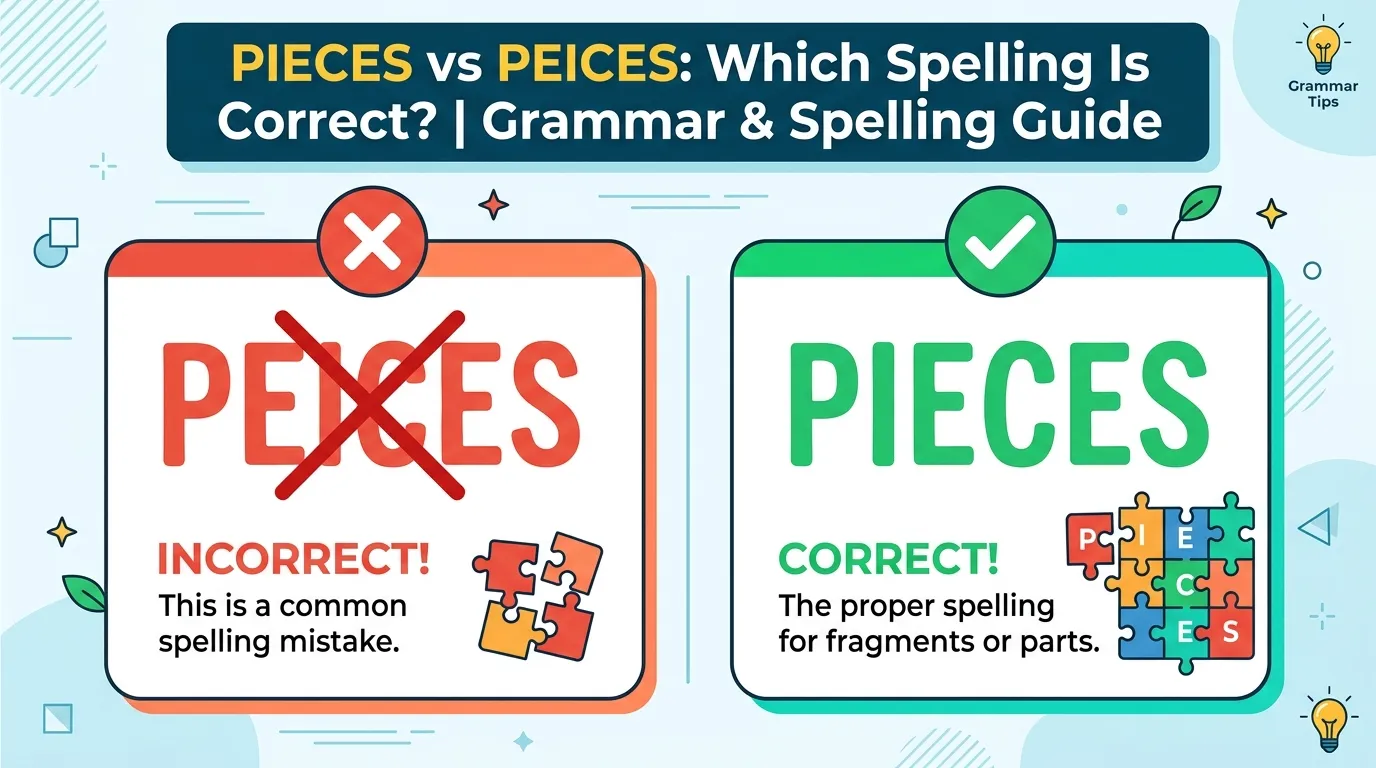
The important answer is simple: pieces is the correct spelling. Peices is a misspelling and should not be used in standard American English.
The word pieces is the plural form of piece, meaning separate parts, portions, objects, works, or items. For example, you can have pieces of cake, pieces of information, pieces of furniture, or pieces of a puzzle.
This guide explains the difference between pieces and peices, why people confuse them, how to remember the correct spelling, how to use pieces naturally, and which common mistakes to avoid.
Quick Answer: Is It Pieces or Peices?
Pieces is correct.
Peices is incorrect.
| Spelling | Correct? | Meaning |
|---|---|---|
| pieces | ✅ Yes | Plural of piece |
| peices | ❌ No | Common spelling mistake |
Correct examples
- I bought three pieces of fruit.
- The vase broke into several pieces.
- Please put the puzzle pieces together.
- She gave me two pieces of useful advice.
Incorrect examples
- I bought three peices of fruit. ❌
- The vase broke into several peices. ❌
- Put the puzzle peices together. ❌
The correct spelling always places ie after the p:
p + ie + ces = pieces
Not:
p + ei + ces = peices
What Does Pieces Mean?
Pieces is the plural form of the noun piece.
A piece is one individual part of something, one portion of something, or one item considered separately from a larger group.
When there is more than one, the plural form is pieces.
Dictionary-style definition
Piece: A part, portion, item, object, or individual example of something.
Pieces: More than one part, portion, item, object, or individual example.
For example:
- one piece of paper
- two pieces of paper
- one piece of chocolate
- several pieces of chocolate
The word can refer to physical objects, abstract ideas, creative works, furniture, food, games, and many other things.
Physical examples
- broken pieces of glass
- puzzle pieces
- pieces of wood
- pieces of metal
- pieces of paper
- pieces of clothing
Abstract examples
- pieces of information
- pieces of evidence
- pieces of advice
- pieces of knowledge
- pieces of a story
Why Is Peices Wrong?
Peices is simply a spelling error.
English has many words in which ie and ei create confusion. Writers often remember the general spelling pattern incorrectly and write ei when the word requires ie.
The problem becomes more understandable when you look at the pronunciation.
Pieces is pronounced with a long ee sound at the beginning. Because pronunciation does not directly reveal whether the spelling should contain ie or ei, it is easy to make a mistake.
However, standard English spelling requires:
pieces
The spelling peices is not an alternative English spelling. It does not represent a different meaning, pronunciation, dialect, or grammatical form.
Pieces vs Peices: The Key Difference
The difference between pieces and peices is entirely about spelling.
There is no meaning difference.
| Feature | Pieces | Peices |
|---|---|---|
| Standard English spelling | ✅ Yes | ❌ No |
| Plural of piece | ✅ Yes | ❌ No |
| Used in formal writing | ✅ Yes | ❌ No |
| Used in academic writing | ✅ Yes | ❌ No |
| Used in business writing | ✅ Yes | ❌ No |
| Standard dictionary form | ✅ Yes | ❌ No |
| Recommended spelling | ✅ Yes | ❌ No |
If you are writing an email, essay, report, article, résumé, school assignment, business document, or professional message, use pieces.
The Correct Spelling: Pieces
The spelling can be broken down like this:
P-I-E-C-E-S
The singular word is:
piece
Add s to make it plural:
piece → pieces
This is a regular plural formation.
Singular and plural
| Singular | Plural |
|---|---|
| piece | pieces |
| one piece | two pieces |
| a piece | several pieces |
Examples:
- I need one piece.
- I need two pieces.
- She found a piece of the puzzle.
- She found several pieces of the puzzle.
Why Do People Spell Pieces as Peices?
The pieces vs peices confusion usually comes from several factors.
1. The letters sound similar in memory
When people remember a word by sound rather than by visual spelling, they may not remember whether the vowel sequence is ie or ei.
2. English has many confusing spelling patterns
English contains words such as:
- believe
- receive
- ceiling
- field
- friend
- science
These words use different combinations of ie and ei, so learners cannot always rely on a simple spelling rule.
3. The pronunciation does not show the spelling
When you hear the word, you hear its sounds rather than its letters.
That means someone can pronounce pieces correctly while still spelling it incorrectly as peices.
4. Typing quickly encourages errors
When people type quickly, they may reverse adjacent vowels. This is especially common with familiar words.
A person may know the word perfectly but type peices automatically.
A Simple Memory Trick for Pieces
One of the easiest ways to remember pieces is to connect it to the singular form:
piece → pieces
Remember the middle of the word:
PIE
The first three letters are pie.
Think:
A piece of pie
Both piece and pie begin with pie.
So:
PIE + CE = PIECE
Then add S:
PIE + CES = PIECES
This is a useful visual memory trick.
Another memory trick
Think:
A piece has PIE inside it.
That gives you:
p + ie + ce
Therefore:
pieces, not peices.
How to Use Pieces in a Sentence
Pieces can function as a plural count noun in many contexts.
Food
- We ordered several pieces of chicken.
- She cut the cake into small pieces.
- He ate two pieces of chocolate.
Objects
- The toy broke into several pieces.
- I found the missing pieces under the sofa.
- The machine has many small pieces.
Puzzles and games
- We need all the puzzle pieces.
- Some of the chess pieces were missing.
- She arranged the game pieces on the table.
Writing and information
- I read several pieces of information about the topic.
- The editor selected three pieces for publication.
- These pieces of evidence support the argument.
Literal and Figurative Uses of Pieces
The word pieces can have both literal and figurative meanings.
Literal meaning
A literal piece is a physical part of something.
Examples:
- The plate broke into pieces.
- I cut the paper into four pieces.
- The furniture arrived in separate pieces.
Figurative meaning
A figurative piece can refer to a part of an idea, situation, story, or larger concept.
Examples:
- We are still missing important pieces of the story.
- Every conversation gave us new pieces of information.
- The report contains several important pieces of evidence.
In these examples, pieces does not necessarily mean physical objects.
Pieces as a Plural Noun
The most common grammatical role of pieces is a plural noun.
A noun names a person, place, thing, or idea.
In:
The puzzle pieces are on the floor.
Pieces is the plural noun referring to multiple parts of the puzzle.
Subject
The puzzle pieces are scattered across the table.
Object
She collected the puzzle pieces.
Object of a preposition
He looked under the table for the missing pieces.
Can Pieces Be a Verb?
Yes.
Pieces can also be the third-person singular present form of the verb piece.
The verb piece means to assemble, understand, or construct something from separate parts.
Examples:
- She pieces the clues together.
- He pieces together the story.
- The detective pieces together what happened.
This is different from the plural noun use.
Compare
Noun:
The puzzle pieces are missing.
Here, pieces means separate parts of a puzzle.
Verb:
She pieces the evidence together.
Here, pieces describes an action.
Pieces vs Piece
Understanding piece vs pieces makes the spelling easier.
Piece means one.
Pieces means more than one.
| Word | Number | Example |
|---|---|---|
| piece | Singular | I found one piece. |
| pieces | Plural | I found several pieces. |
Examples:
- one piece of paper
- five pieces of paper
- one piece of advice
- several pieces of advice
Notice an important point: some nouns are commonly used with piece of when referring to individual units.
For example:
a piece of advice
not:
an advice
And:
two pieces of advice
not:
two advices
Common Collocations With Pieces
A collocation is a group of words that naturally appear together.
Learning common collocations can help you use pieces more naturally.
Common phrases with pieces
- pieces of information
- pieces of advice
- pieces of evidence
- pieces of paper
- pieces of furniture
- pieces of equipment
- pieces of cake
- pieces of chocolate
- pieces of wood
- pieces of glass
- puzzle pieces
- chess pieces
- game pieces
- broken pieces
- small pieces
- large pieces
- missing pieces
- separate pieces
- individual pieces
- different pieces
Example sentences
The article contains several useful pieces of information.
We found the missing pieces of evidence.
Please move the furniture pieces carefully.
The children picked up the broken pieces.
Common Expressions With Pieces
The word pieces appears in many established expressions.
In pieces
This can mean broken into separate parts.
The old chair fell to pieces.
It can also be figurative.
After the stressful experience, she felt emotionally in pieces.
Pick up the pieces
This expression means to recover or rebuild after something difficult or damaging.
After the project failed, the team had to pick up the pieces and start again.
Piece by piece
This means gradually, one part at a time.
We built the model piece by piece.
Fall to pieces
This can mean physically break apart or figuratively lose control.
The old building began to fall to pieces.
Give someone a piece of your mind
This idiom means to strongly express anger or disagreement.
She decided to give her manager a piece of her mind.
Pieces in Formal and Informal Writing
Pieces is neutral English. It works in casual conversation and formal writing.
Casual
I found the missing pieces.
Professional
The report contains several key pieces of information.
Academic
These pieces of evidence support the proposed explanation.
Journalistic
Investigators are examining several pieces of evidence.
There is no need to replace pieces simply because your writing is formal.
Pieces in Academic Writing
Academic writers frequently use pieces in phrases such as:
- pieces of evidence
- pieces of information
- pieces of data
- pieces of research
- pieces of literature
However, writers should choose the noun that best fits the context.
For example, pieces of data may sound less precise than simply data in some technical contexts.
Compare:
The researchers collected several pieces of data.
with:
The researchers collected several data points.
The second version may be more precise depending on the subject.
Pieces in Business Writing
The word is also common in professional communication.
Examples:
Please review the attached pieces of documentation.
The shipment contains twenty separate pieces.
We received several pieces of customer feedback.
The team is working to connect the remaining pieces of the project.
For business writing, choose the most precise expression available rather than using pieces repeatedly.
Pieces in Technical Writing
In technical contexts, pieces may refer to physical components, parts, or units.
Examples:
The equipment arrived in several pieces.
Each machine consists of multiple pieces.
The replacement pieces were inspected before installation.
Depending on the field, words such as components, parts, units, or elements may be more precise.
Compare
General:
The device has several pieces.
Technical:
The device contains several components.
The second sentence may be preferable in an engineering document.
Pieces in Sports
Pieces appears in sports-related language, especially when discussing equipment, game components, or strategic elements.
Examples include:
- chess pieces
- game pieces
- pieces of equipment
- key pieces of a team
For example:
The coach added two important pieces to the roster.
Here, pieces is being used figuratively to describe players as parts of a larger team.
Pieces in Journalism and Media
Journalists may use piece and pieces to refer to published works.
For example:
The magazine published several opinion pieces.
She wrote three feature pieces this month.
In this context, piece can mean an individual article, story, essay, or other published work.
Pieces vs Peices in American English
In American English, pieces is the standard spelling.
Peices is not an accepted American spelling.
The same applies to standard British English and other major varieties of English.
There is no meaningful regional spelling distinction here.
American English
pieces ✅
British English
pieces ✅
Canadian English
pieces ✅
Australian English
pieces ✅
The spelling peices should therefore be treated as a misspelling rather than a regional variant.
Pronunciation of Pieces
The word pieces has a long ee vowel sound at the beginning.
The pronunciation is generally the same regardless of whether the word is used in casual, professional, or academic contexts.
The final sound is a z sound rather than a hard s sound.
This is similar to the plural ending heard in words such as roses and houses.
Word History and Etymology of Piece
The word piece has a long history in English.
It entered English through Old French, related to a word meaning a portion or part. Its deeper history connects it with the idea of a part or section of something larger.
Over time, piece developed a wide range of meanings.
It can now refer to:
- a physical part
- a portion of food
- an item
- a work of art
- an article
- a work of music
- a chess piece
- a part of an argument
- a part of a larger situation
The plural pieces simply developed through the ordinary English plural pattern.
Synonyms for Pieces
The best synonym depends on context.
When pieces means parts
- parts
- sections
- portions
- components
- elements
- fragments
- segments
- units
When pieces means items
- items
- objects
- articles
- units
- examples
When pieces means portions of food
- portions
- servings
- slices
- chunks
- portions
When pieces means published works
- articles
- works
- essays
- stories
- features
Be careful: these synonyms are not interchangeable in every sentence.
For example:
puzzle pieces
cannot always be replaced naturally with:
puzzle components
The meaning may remain understandable, but the expression becomes less natural.
Antonyms and Contrasting Words
There is no single perfect antonym for pieces because piece has many meanings.
Depending on context, contrasting terms may include:
- whole
- entirety
- complete unit
- total
- whole object
For example:
The vase was broken into pieces.
The opposite idea is:
The vase remained whole.
Related Words
Words related to pieces include:
- piece
- piecemeal
- piecework
- centerpiece
- masterpiece
- centerpiece
- piecewise
- piece together
- piece by piece
These words share the same basic word family but have different meanings and grammatical roles.
Piece together
To piece together something means to assemble separate parts or use clues to understand something.
We managed to piece together what happened.
Piecemeal
Piecemeal means done gradually, in separate parts.
The company introduced the changes piecemeal.
Common Spelling Mistakes With Pieces
Here are some frequent errors.
Mistake 1: Peices
❌ The puzzle has many peices.
✅ The puzzle has many pieces.
Mistake 2: Adding an unnecessary extra letter
❌ pieceses
✅ pieces
Mistake 3: Confusing piece with peace
Piece and peace sound alike in many varieties of English, but they have completely different meanings.
Piece = a part or portion.
Peace = a state without conflict.
Examples:
I need a piece of paper.
The country hopes to achieve peace.
Pieces vs Peace
This is a different spelling issue from pieces vs peices, but it is worth knowing.
| Word | Meaning | Example |
|---|---|---|
| piece | part or portion | I need a piece of cake. |
| peace | absence of conflict | They worked for peace. |
| pieces | plural of piece | I found several pieces. |
A useful way to remember them is to associate peace with calm and piece with part.
Awkward vs Natural Examples
Correct spelling is only one part of good writing. The expression should also sound natural.
Example 1
Awkward:
Give me some pieces of information.
More natural:
Give me some information.
Pieces of information is grammatically possible, but information is often more natural when individual units do not need to be emphasized.
Example 2
Awkward:
I bought pieces of furniture.
More natural:
I bought several pieces of furniture.
The word several makes the individual units clearer.
Example 3
Natural:
The puzzle pieces are scattered across the floor.
This is a standard and natural use.
Example 4
Natural:
The glass broke into tiny pieces.
This clearly describes physical fragments.
Common Mistakes and Corrections
| Incorrect | Correct |
|---|---|
| peices | pieces |
| one pieces | one piece |
| two piece | two pieces |
| pieces of advices | pieces of advice |
| peices of information | pieces of information |
| puzzle peices | puzzle pieces |
| broken peices | broken pieces |
Remember subject-verb agreement
Because pieces is plural, it normally takes a plural verb.
The pieces are on the table. ✅
Not:
The pieces is on the table. ❌
But piece is singular:
The piece is on the table. ✅
How to Proofread for the Pieces vs Peices Error
If you frequently make this spelling mistake, use a quick proofreading routine.
Step 1: Search for “peices”
Use your word processor’s Find function.
Step 2: Replace it with “pieces”
Check each occurrence rather than blindly replacing everything.
Step 3: Check the context
Make sure the word is actually intended to mean the plural of piece.
Step 4: Read the sentence again
Look for related errors involving singular and plural forms.
This is especially useful when proofreading long documents.
How Spellcheck Handles Peices
Most modern spellcheckers will flag peices as a spelling error.
However, spellcheck should not be your only proofreading method.
Some errors are valid words used in the wrong context, and automated tools can miss certain problems.
For example, if you accidentally type another legitimate word, spellcheck may not flag it.
Learning the correct spelling yourself is more reliable.
Pieces in Everyday English
You will encounter pieces in many ordinary situations.
Shopping
The set contains six pieces.
Cooking
Cut the vegetables into small pieces.
Home improvement
The shelf arrived in several pieces.
School
Please hand out the puzzle pieces.
Office work
I need these pieces of information before Friday.
Conversation
I’m still trying to put the pieces together.
Because the word is so common, learning its spelling is worthwhile for both everyday and professional writing.
Formal vs Informal Alternatives
Pieces itself works in both formal and informal writing. However, another word may sometimes be more precise.
| General phrase | Possible precise alternative |
|---|---|
| pieces of a machine | components |
| pieces of information | facts, details, information |
| pieces of a puzzle | parts |
| pieces of evidence | items of evidence |
| pieces of furniture | items of furniture |
| pieces of equipment | units, items |
| pieces of writing | articles, essays, works |
The right choice depends on what you mean.
Do not replace pieces just to make your writing sound more formal. Precision is more important than complexity.
A Practical Rule for Writers
When you are unsure whether to write pieces or peices, remember this:
The correct plural of piece is pieces.
There is no special American, British, academic, technical, or informal spelling that changes this.
Use pieces in:
- school assignments
- emails
- business documents
- blog posts
- academic papers
- reports
- social media posts
- journalism
- technical documentation
- professional communication
Avoid peices everywhere in standard English.
Quick Comparison: Pieces vs Peices
| Question | Pieces | Peices |
|---|---|---|
| Is it spelled correctly? | Yes | No |
| Is it an English word? | Yes | No, as a standard spelling |
| Is it the plural of piece? | Yes | No |
| Can I use it professionally? | Yes | No |
| Is it a British variant? | No distinction needed | No |
| Is it an American variant? | Standard | No |
| Should I use it in an essay? | Yes | No |
| Should I use it in an email? | Yes | No |
Frequently Asked Questions
1. Is it pieces or peices?
Pieces is the correct spelling. Peices is a common misspelling. The plural of piece is pieces.
2. Why do people spell pieces as peices?
People often reverse the ie sequence because English contains many words with confusing ie/ei patterns. Pronunciation also does not make the spelling obvious.
3. What is the plural of piece?
The plural of piece is pieces.
For example:
One piece, two pieces.
4. Is peices a word?
Peices is not the standard spelling of an English word. It is normally an error for pieces.
5. How do you remember the spelling of pieces?
Remember that piece contains pie at the beginning:
PIE + CE = PIECE
Then add S:
PIE + CES = PIECES
6. What does pieces mean?
Pieces means more than one part, portion, item, object, work, or individual unit. Its exact meaning depends on context.
7. Is pieces correct in American English?
Yes. Pieces is the standard spelling in American English.
8. Is peices ever correct in British English?
No. Peices is not a standard British spelling of pieces. British English also uses pieces.
9. What is the difference between piece and pieces?
Piece is singular, while pieces is plural.
I found one piece.
I found several pieces.
10. What is the difference between pieces and peace?
Pieces is the plural of piece, meaning parts or portions. Peace refers to a state of calm or the absence of conflict.
The toy broke into pieces.
Everyone wants peace.
Conclusion
When choosing between pieces vs peices, there is one clear answer: pieces is correct, while peices is a misspelling.
Pieces is the plural form of piece and can describe parts, portions, objects, fragments, creative works, puzzle parts, information, evidence, and many other things. It is appropriate in American English as well as other major varieties of standard English.
The easiest way to remember the spelling is to focus on ie:
piece → pieces
You can also remember that piece begins with pie.
If you are writing an email, essay, report, article, academic paper, business document, or casual message, choose pieces. Avoid peices, even though the incorrect version may look familiar.
When in doubt, remember the simple rule: There is a PIE in every PIECE.