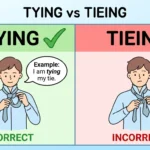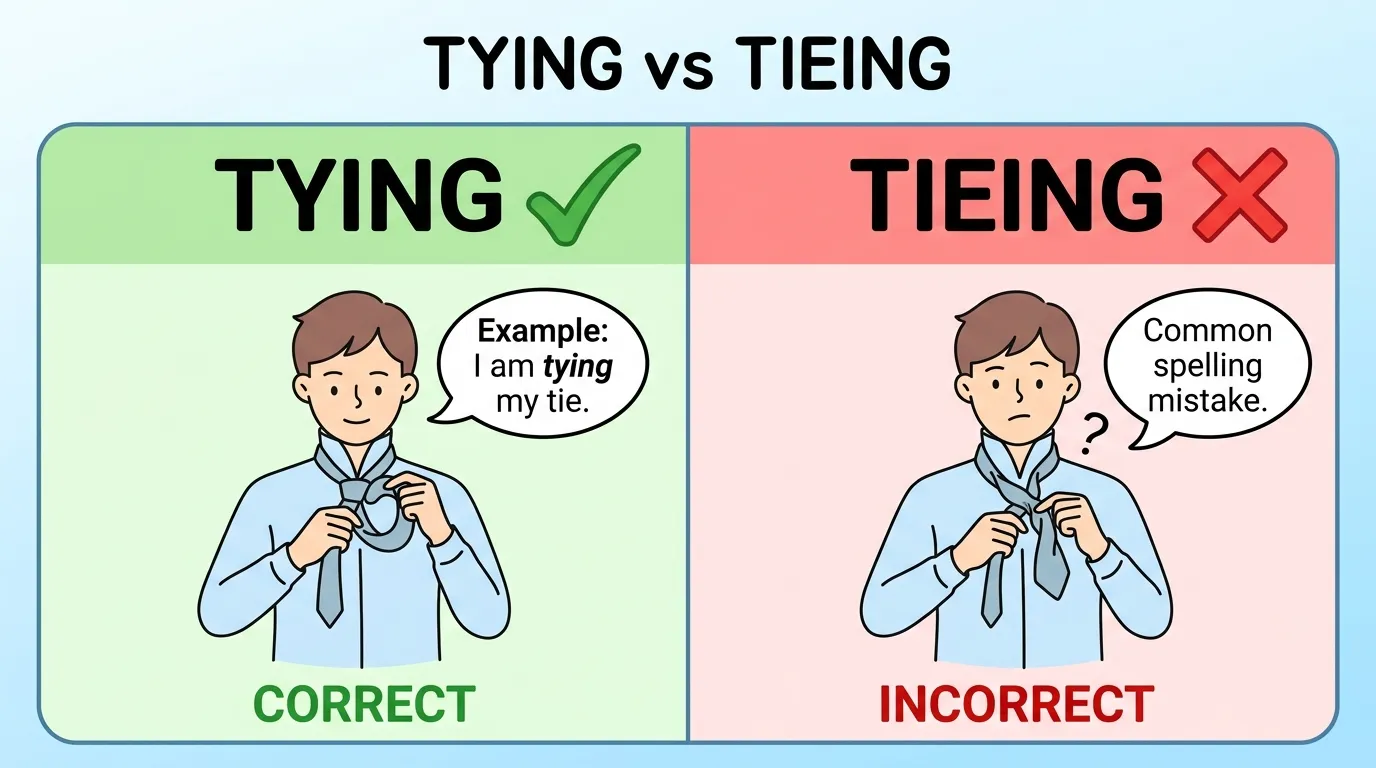
If you are wondering whether “tying” or “tieing” is correct, the answer is simple: “tying” is the standard and correct spelling in modern English. The form “tieing” is generally considered incorrect in standard American English.
The confusion happens because many English verbs form their present participle or gerund by adding -ing directly to the base verb. For example, play becomes playing, and help becomes helping. So it may seem logical that tie should become tieing. English spelling, however, has a few important rules that change what happens when a verb ends in a silent -e.
The correct form is:
- tie → tying
- tie → tied
- tie → ties
- tie → tying
Not:
tie → tieing
In this guide, you will learn why tying drops the final e, why tieing looks tempting but is normally wrong, how to use tying as a verb and noun, how it differs from related forms such as tied and tie, and how the spelling works in American and British English.
Quick Answer: Is It Tying or Tieing?
Tying is the correct spelling.
The verb tie becomes tying when the -ing ending is added.
| Base verb | Correct -ing form | Incorrect form |
|---|---|---|
| tie | tying | |
| die | dying | |
| lie | lying | |
| untie | untying |
Why?
When tie takes the -ing ending, the final e is removed, and the spelling changes from ie to y:
tie + ing → tying
This keeps the pronunciation and spelling pattern natural in English.
So if you are writing an email, school assignment, business document, article, social media post, or everyday message, use tying.
What Does “Tying” Mean?
Tying is the present participle and gerund form of the verb tie.
The verb tie means to fasten, secure, connect, bind, or attach something using a knot, string, rope, cord, ribbon, or another method.
For example:
She is tying her shoes.
Here, tying describes an action happening now.
The word can also have figurative meanings.
For example:
The two ideas are closely tying together.
More naturally, English speakers would often say:
The two ideas are closely tied together.
This illustrates an important point: tying is grammatically correct, but it is not always the most natural word for every context. The correct choice depends on what you want to express.
Common meanings associated with “tying”
Tying can refer to:
- fastening something
- making a knot
- securing an object
- connecting two things
- joining things together
- matching or equaling a score
- creating a connection
- restricting or limiting someone
- linking ideas or concepts
Examples
- He is tying his shoelaces.
- She spent five minutes tying the ribbon.
- They are tying the package with string.
- The team is tying the game.
- He is tying the branches together.
- The agreement is tying the two companies together.
Why Is “Tieing” Incorrect?
At first glance, tieing appears logical.
You might think:
tie + ing = tieing
That pattern works with some verbs, but English spelling does not simply attach -ing to every verb unchanged.
When a verb ends in a silent e, that e is often removed before adding -ing.
For example:
- make → making
- bake → baking
- write → writing
- drive → driving
- hope → hoping
- use → using
The same general principle applies to tie:
tie → tying
However, tie has an additional spelling change because simply removing the final e would produce:
ti + ing
English does not normally use that spelling for this word. Instead, the i changes to y:
tie → tying
This is why the correct spelling contains y.
The Spelling Rule Behind “Tying”
The spelling of tying is easier to understand when you compare it with similar verbs.
Words ending in -ie often change ie to y before adding -ing.
The basic pattern
-ie → -y + ing
Examples include:
| Base verb | -ing form |
|---|---|
| tie | tying |
| lie | lying |
| die | dying |
| vie | vying |
This is a useful spelling pattern to remember.
The memory rule
Think:
IE becomes Y before ING.
So:
- tie → tying
- lie → lying
- die → dying
- vie → vying
This simple rule can help prevent one of the most common spelling mistakes involving tie.
Tying vs Tieing: Key Difference
There is no meaningful difference in meaning between tying and tieing because tieing is not the standard spelling of the word.
The real distinction is:
- tying = standard English spelling
- tieing = nonstandard or misspelled form
Comparison
| Feature | Tying | Tieing |
|---|---|---|
| Standard spelling | Yes | No |
| Standard American English | Yes | No |
| Standard British English | Yes | No |
| Used in formal writing | Yes | No |
| Used in academic writing | Yes | No |
| Used in business writing | Yes | No |
| Meaning | Action of tying | Intended to mean tying |
| Recommended | Yes | No |
If you see tieing in casual online writing, it is usually simply a spelling error.
Tying as a Verb
Tying is commonly used as a verb form in continuous tenses.
Present continuous
I am tying my shoes.
She is tying the package.
They are tying the ropes together.
Past continuous
He was tying the knot when I arrived.
We were tying the decorations to the fence.
Future continuous
They will be tying the banners tomorrow.
With modal verbs
You should be tying the rope more securely.
He might be tying the two pieces together.
In these examples, tying describes an action or activity.
Tying as a Gerund
Tying can also function as a gerund, which means the -ing form acts like a noun.
For example:
Tying a complicated knot takes practice.
Here, tying is the subject of the sentence.
Another example:
I enjoy tying fishing knots.
In this sentence, tying functions as the object of the verb enjoy.
More examples
- Tying your shoes is a basic life skill.
- She enjoys tying ribbons.
- Tying the rope correctly is important.
- He learned tying techniques from his father.
- We practiced tying different knots.
This is one reason you may see tying in many different grammatical positions.
Tying vs Tie vs Tied
These three forms are related but serve different grammatical purposes.
| Word | Grammatical role | Example |
|---|---|---|
| tie | Base verb | I will tie the rope. |
| ties | Present-tense third-person singular | She ties her shoes. |
| tied | Past tense/past participle | He tied the rope. |
| tying | Present participle/gerund | He is tying the rope. |
Understanding these forms makes the spelling much easier.
Present
I tie my shoes every morning.
Third-person singular
She ties her shoes quickly.
Notice that tie changes to ties, not t ie s in a simple additive pattern.
Past
She tied the package.
Present participle
She is tying the package.
Why “Tying” Looks Unusual
One reason people misspell tying is that the word does not look like the base verb tie.
Compare:
tie → tying
The letters change noticeably.
This can make the correct form feel less intuitive than forms such as:
- walk → walking
- jump → jumping
- talk → talking
- clean → cleaning
But English has many spelling changes like this.
Consider:
- lie → lying
- die → dying
- run → running
- sit → sitting
- make → making
The spelling is influenced by established English spelling rules and conventions rather than simple letter addition.
Pronunciation of “Tying”
Tying is pronounced with one syllable.
The pronunciation is the same sound family as the word tie, followed by the -ing ending.
The important point for learners is that tying does not have an extra syllable created by the letters “ie.”
You can think of it as:
tie + ing
but the spelling changes to tying.
Common pronunciation mistake
Some learners may try to pronounce tying as if it contained multiple syllables because of its spelling.
In normal American English, tying is a one-syllable word.
Is “Tying” Correct in American English?
Yes.
Tying is the standard spelling in American English.
You should use it in:
- school assignments
- essays
- professional emails
- reports
- business documents
- websites
- blog posts
- social media
- technical writing
- journalism
- academic writing
- everyday communication
There is no American spelling rule that makes tieing preferable.
Is “Tying” Correct in British English?
Yes.
British English also uses tying.
The spelling does not normally change between American and British English.
This makes the word especially easy for international English learners.
American English
She is tying her shoes.
British English
She is tying her shoes.
Both use the same spelling.
Unlike words such as color/colour or organize/organise, tying does not have a standard American-versus-British spelling difference.
Formal vs Informal Use of “Tying”
Tying is a neutral word.
It is neither especially formal nor especially informal.
You can use it naturally in almost any context.
Casual
I’m tying my shoes.
Professional
The technician is tying the cables together.
Academic
The study examines factors tying economic growth to education.
Journalistic
The teams are tying for first place.
Technical
The operator is tying the cable securely to the support structure.
The word itself does not create a casual or formal tone. The surrounding vocabulary determines the register.
Common Collocations With “Tying”
A collocation is a group of words that commonly appear together.
Knowing common collocations makes your writing sound more natural.
Physical actions
- tying shoes
- tying a knot
- tying a rope
- tying a ribbon
- tying a bow
- tying a package
- tying a string
- tying a leash
- tying a cable
- tying a bandage
Sports and competition
- tying the game
- tying the score
- tying for first place
- tying the record
- tying the series
Figurative uses
- tying ideas together
- tying concepts together
- tying events together
- tying evidence together
- tying the story together
- tying two issues together
Examples
She is tying a bow on the gift.
The player scored just before halftime, tying the game.
The evidence is tying the suspect to the location.
The last example is especially important because tying can have a figurative meaning of connecting or associating something with something else.
“Tying” in Sports
The word tying is common in sports.
It usually means bringing two competing scores or records to the same level.
For example:
The home team scored late, tying the game.
This means the score became equal.
Another example:
She hit a three-pointer, tying the score.
You can also see:
The athlete is tying the record.
This means the athlete has achieved the same record or performance level as another athlete.
Common sports expressions
- tying the game
- tying the score
- tying the series
- tying the record
- tying for first
- tying for second
“Tying” in Business and Professional Writing
In professional writing, tying often has a figurative meaning.
It can describe relationships between ideas, actions, results, or organizations.
For example:
The report is tying customer satisfaction to employee training.
Here, tying means connecting or associating.
Another example:
The proposal focuses on tying performance goals to measurable outcomes.
This usage is common in:
- business reports
- management writing
- marketing
- economics
- project planning
- consulting
- organizational communication
A useful alternative
Depending on context, you may replace tying with:
- connecting
- linking
- associating
- relating
- combining
- joining
For example:
The report ties employee engagement to productivity.
Could become:
The report links employee engagement to productivity.
Both can be natural.
“Tying” in Technical Writing
Technical writers frequently use tying to describe physical connections.
For example:
The worker is tying the cable to the support frame.
It can also describe conceptual relationships:
The software uses a method for tying user permissions to account roles.
In technical writing, clarity matters more than variety. If tying is the most precise word, keep it.
Do not replace a perfectly clear word simply to avoid repetition.
Figurative Meaning of “Tying”
Not every use of tying involves an actual knot.
The word can describe connection, restriction, dependence, or association.
Connecting
The author does a good job of tying the examples to the main argument.
Meaning: connecting the examples to the argument.
Restricting
The long contract is tying the company to an expensive agreement.
Meaning: limiting or binding the company.
Associating
The evidence is tying the event to a larger pattern.
Meaning: connecting the event with the pattern.
Sports
The goal was enough for the team to tie the match.
Meaning: make the score equal.
“Tying” vs “Binding”
These words are related, but they are not always interchangeable.
Tying usually suggests fastening or connecting something with a knot, string, rope, or similar method.
Binding can suggest a stronger or more formal connection.
Compare:
She is tying the package with string.
The contract is binding on both parties.
You would not normally replace binding with tying in the second sentence.
Choose “tying” when:
- an actual tying action is involved
- a knot is involved
- something is being fastened
- two things are being connected informally
- a sports score is becoming equal
Choose “binding” when:
- something creates a formal obligation
- a legal agreement is involved
- something physically holds things together in a technical sense
Tying vs Linking
Tying and linking can overlap when discussing ideas.
The article is tying the issue to economic changes.
The article is linking the issue to economic changes.
Both can be correct.
However, linking often sounds more direct and neutral when describing an abstract relationship.
Tying can suggest that the writer is bringing several elements together into one explanation.
Tying vs Connecting
Again, both words can be correct.
The teacher is connecting the lesson to real-life examples.
The teacher is tying the lesson to real-life examples.
The second sentence can sound slightly more deliberate or integrated, while connecting is often more straightforward.
The best choice depends on context and style.
Common Mistakes With “Tying”
Mistake 1: Writing “tieing”
Incorrect:
She is tieing her shoes.
Correct:
She is tying her shoes.
Mistake 2: Assuming every verb keeps its spelling
Incorrect reasoning:
tie + ing = tieing
Correct pattern:
tie → tying
English spelling changes in several verb forms.
Mistake 3: Confusing “tying” with “tied”
Incorrect:
He is tied the rope.
Correct:
He is tying the rope.
Or:
He tied the rope.
Use tying for an ongoing action and tied for the past tense or past participle.
Mistake 4: Confusing “tying” with “ties”
Incorrect:
She tying her shoes every morning.
Correct:
She ties her shoes every morning.
But:
She is tying her shoes now.
The verb form depends on the grammatical structure.
Awkward vs Natural Examples
Example 1
Awkward:
He is tieing his shoes.
Natural:
He is tying his shoes.
Example 2
Awkward:
She was tieing the ribbon.
Natural:
She was tying the ribbon.
Example 3
Awkward:
They are tieing the cables together.
Natural:
They are tying the cables together.
Example 4
Awkward:
The goal resulted in the team tieing the game.
Natural:
The goal resulted in the team tying the game.
Example 5
Awkward:
The report is tieing these issues together.
Natural:
The report is tying these issues together.
Everyday Examples of “Tying”
Here are natural examples you may encounter in everyday English:
- I am tying my shoes.
- She is tying her hair back.
- He is tying a knot.
- We are tying the boxes together.
- They are tying balloons to the chairs.
- She is tying a ribbon around the gift.
- He is tying the dog’s leash.
- I need to practice tying knots.
- The player scored, tying the game.
- The two ideas are closely tied together.
Notice that the final example uses tied, not tying. Both words are related, but the grammatical structure determines which form belongs in the sentence.
Memory Trick: How to Remember “Tying”
Here is the easiest memory trick:
When -ie meets -ing, think Y.
So:
tie + ing → tying
You can remember the same pattern with:
- lie → lying
- die → dying
- vie → vying
A short mnemonic is:
IE changes to Y before ING.
Whenever you are unsure about tieing, stop and ask:
Does this verb end in -ie?
If yes, check whether the -ie → -y pattern applies.
For tie, it does.
A Simple Rule for Students and ESL Learners
If you are learning English, remember these four forms:
| Meaning | Form | Example |
|---|---|---|
| Base verb | tie | I will tie it. |
| Present tense, he/she/it | ties | She ties it. |
| Past tense | tied | She tied it. |
| -ing form | tying | She is tying it. |
A good practice sentence is:
I tie my shoes, she ties hers, yesterday we tied them, and now we are tying them again.
This sentence shows the major forms in context.
Word History and Etymology of “Tie”
The word tie is an old English word with Germanic roots. Over centuries, its meaning developed around ideas such as fastening, binding, connecting, and joining.
This history helps explain why tie has both literal and figurative meanings today.
Literal meaning
Tie the rope to the post.
Here, tie means physically fasten something.
Figurative meaning
The two events are tied together.
Here, tied means connected or closely related.
English has preserved both meanings, which is why tie can appear in physical, social, emotional, business, academic, and sports contexts.
Synonyms for “Tying”
The best synonym depends on the meaning.
When “tying” means fastening
- fastening
- securing
- knotting
- binding
- attaching
- wrapping
Example:
She is tying the rope.
Possible alternative:
She is fastening the rope.
When “tying” means connecting
- linking
- connecting
- relating
- associating
- joining
- combining
Example:
The study is tying sleep quality to productivity.
Possible alternative:
The study is linking sleep quality to productivity.
When “tying” means making a score equal
- equaling
- matching
- leveling
- drawing even
Example:
The goal is tying the game.
Possible alternative:
The goal is leveling the score.
Antonyms and Contrasting Words
There is no single opposite of tying in every context.
Depending on the meaning, possible contrasts include:
For fastening
- untying
- loosening
- releasing
- detaching
For connecting
- separating
- disconnecting
- dividing
- isolating
For sports
- losing
- falling behind
- taking the lead
The most direct opposite of tying in the physical sense is often untying.
She is tying the rope.
She is untying the rope.
Related Words
Here are some useful words from the same word family:
- tie
- ties
- tied
- tying
- untie
- untied
- untying
- tie-in
- tie-break
- tie-breaker
- necktie
- bow tie
Examples
He is untying the knot.
The players went into a tie-breaker.
She wore a bow tie to the event.
The spelling of tying remains consistent even when the broader word family becomes more complex.
Common Expressions With “Tie”
Although tying is the focus here, understanding common expressions with tie helps you recognize its broader meanings.
Tie the knot
This expression traditionally means to get married.
They decided to tie the knot next year.
Tie up
This can mean to fasten something, but it can also mean to occupy someone’s time or resources.
I need to tie up a few loose ends.
Tie in with
This means to connect or correspond with something.
The results tie in with earlier research.
Tie together
This means to connect different elements.
The conclusion ties the main ideas together.
Tie-breaker
A tie-breaker is a method used to determine a winner when competitors have equal scores.
“Tying” in Academic Writing
Academic writers may use tying when discussing relationships between concepts.
For example:
The researcher is tying social behavior to environmental conditions.
However, academic writing often favors precise verbs.
Depending on the sentence, you might use:
- linking
- associating
- connecting
- correlating
- relating
For example:
The study links sleep patterns to academic performance.
This may sound more precise than:
The study is tying sleep patterns to academic performance.
Neither is automatically wrong. Context and intended meaning matter.
“Tying” in Journalism
Journalistic writing may use tying in both literal and figurative contexts.
Sports reporting
The late goal was enough for the visitors to tie the match.
Political reporting
In political writing, tying can mean associating one issue with another:
The candidate is tying economic policy to job creation.
This is not a special political meaning. It is simply the ordinary figurative meaning of connecting or associating.
“Tying” in Blogging and Online Writing
For blogs, websites, and social media, tying is the correct spelling.
If you are writing an article, never intentionally use tieing as an alternative spelling unless you are specifically discussing the misspelling itself.
Good
These examples help in tying the main ideas together.
Incorrect
These examples help in tieing the main ideas together.
Search engines may encounter misspellings in user-generated content, but that does not make the misspelled form standard English.
For polished content, always use tying.
When Should You Use “Tying”?
Use tying when:
- You are describing an action happening over time.
- You need the -ing form of tie.
- You are using tie as a gerund.
- You are describing the act of fastening something.
- You are describing the act of connecting things.
- You are describing an equalizing sports score.
Examples
He is tying his shoes.
She enjoys tying knots.
They are tying the packages together.
The team is tying the game.
The article is tying several ideas together.
When Should You Use “Tied” Instead?
Use tied when the sentence calls for the past tense or past participle.
Past tense
She tied the rope yesterday.
Present perfect
She has tied the rope securely.
Past perfect
They had tied the boxes together before the truck arrived.
Adjective
The two issues are closely tied together.
Do not automatically choose tying simply because you are discussing the concept of connection.
A Practical Decision Guide
When writing tying vs tieing, follow these steps:
Step 1: Identify the base verb
The base verb is:
tie
Step 2: Add -ing
You need the present participle or gerund.
Step 3: Apply the spelling change
Change ie to y before -ing.
Step 4: Write the final form
tying
Step 5: Check the sentence
She is tying her shoes.
Correct.
She is tieing her shoes.
Incorrect.
This five-second check can prevent the mistake.
Quick Comparison: Tying, Tieing, Tied, and Ties
| Form | Correct? | Main use | Example |
|---|---|---|---|
| tie | Yes | Base verb | I will tie it. |
| ties | Yes | Present third-person singular | She ties it. |
| tied | Yes | Past/past participle | She tied it. |
| tying | Yes | -ing form | She is tying it. |
| tieing | No | Common misspelling | Avoid it. |
Does “Tieing” Ever Have a Legitimate Use?
In ordinary modern English, tieing is not the standard spelling of the -ing form of tie.
If you encounter it, it is usually a spelling error.
There can be unusual historical, specialized, or typographical appearances of nonstandard spellings in old texts or individual documents, but these do not make tieing an accepted modern spelling for general writing.
For practical purposes, use tying.
Tips for Better English Spelling
The tying rule is part of a larger lesson: English spelling often depends on patterns rather than simple addition.
Learn common groups together.
-ie verbs
- tie → tying
- lie → lying
- die → dying
- vie → vying
Silent-e verbs
- make → making
- write → writing
- drive → driving
- hope → hoping
Consonant doubling
- run → running
- sit → sitting
- stop → stopping
- plan → planning
Learning these groups is often easier than memorizing every word individually.
Final Recommendation: Tying or Tieing?
If you are choosing between tying and tieing, choose tying.
It is the standard spelling in modern English, including both American and British English.
Remember:
tie → tying
The form tieing may look logical because it appears to follow the simple verb + ing pattern, but it does not follow the established spelling convention for verbs ending in -ie.
For students, ESL learners, writers, bloggers, professionals, journalists, and anyone producing polished English, the safest rule is simple:
Use “tying.” Avoid “tieing.”
Once you remember that -ie changes to -y before -ing, the spelling becomes much easier.
Frequently Asked Questions
1. Is “tying” or “tieing” correct?
Tying is correct. The standard present participle and gerund form of tie is tying. Tieing is generally considered a misspelling in modern standard English.
2. Why is “tying” spelled with a y?
The spelling changes because verbs ending in -ie generally change ie to y before adding -ing.
For example:
- tie → tying
- lie → lying
- die → dying
- vie → vying
3. Is “tieing” ever correct in English?
For normal modern English writing, no. Use tying instead. Tieing is generally treated as a nonstandard spelling or spelling mistake.
4. Is “tying” correct in American English?
Yes. Tying is the standard American English spelling. It is appropriate in casual, professional, academic, technical, and journalistic writing.
5. Is “tying” correct in British English?
Yes. British English also uses tying. This is not one of the words that has different standard American and British spellings.
6. What is the past tense of “tie”?
The past tense is tied.
She tied her shoes.
The present participle is tying:
She is tying her shoes.
7. What is the difference between “tying” and “tied”?
Tying usually describes an ongoing action or functions as a gerund.
He is tying the rope.
Tied is the past tense or past participle and can also function as an adjective.
He tied the rope yesterday.
The two ideas are tied together.
8. How do you remember the spelling of “tying”?
Use this memory rule:
IE becomes Y before ING.
So:
tie → tying
The same pattern appears in:
lie → lying
die → dying
vie → vying
9. Is “tying” a verb or a noun?
It can be both, depending on how it is used. As a verb form, it describes an ongoing action:
She is tying her shoes.
As a gerund, it acts like a noun:
Tying knots requires practice.
10. What is the correct spelling: “tieing a knot” or “tying a knot”?
The correct spelling is:
tying a knot
For standard English, do not write tieing a knot.
Conclusion
The tying vs tieing question has a straightforward answer: tying is the correct spelling.
The confusion comes from the natural tendency to add -ing directly to a verb. With tie, however, English changes the ending from -ie to -y before -ing:
tie → tying
The same spelling pattern appears in lie → lying, die → dying, and vie → vying.
Use tying in American English, British English, academic writing, business communication, journalism, technical documents, blogs, and everyday messages. Use tied when you need the past tense or past participle, and ties for the third-person singular present tense.
The simplest rule to remember is:
IE + ING → YING.
So when you are choosing between tying and tieing, there is no need to hesitate. Choose tying.