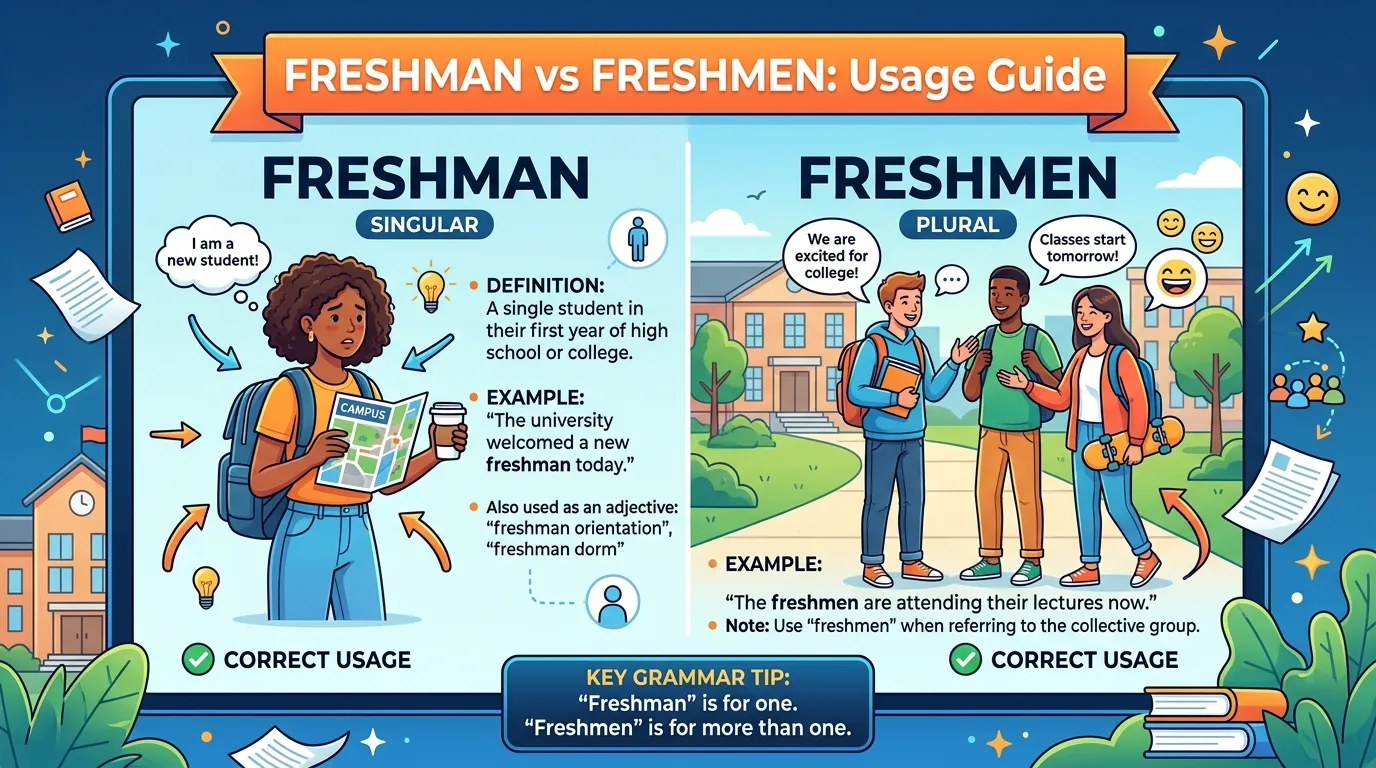
If you are wondering about freshman vs freshmen, the difference is simple: freshman is singular, while freshmen is plural. You use freshman when talking about one first year student, and freshmen when talking about two or more first year students.
For example, you would say, “My brother is a freshman in college,” but “The freshmen attended orientation on Monday.”
The two words look and sound similar, which is why English learners often mix them up. This guide explains the difference between freshman and freshmen, including their meanings, pronunciation, grammar, spelling, usage, history, common mistakes, regional differences, formal alternatives, and real world examples.
Quick Answer: Freshman vs Freshmen
Freshman is the singular noun for one first year student.
Freshmen is the plural noun for two or more first year students.
| Word | Number | Meaning | Example |
|---|---|---|---|
| freshman | Singular | One first year student | She is a freshman. |
| freshmen | Plural | Two or more first year students | The freshmen arrived early. |
Easy rule
One = freshman
More than one = freshmen
Do not add s to freshman to make the plural. The correct plural is freshmen.
Correct: Three freshmen joined the club.
Incorrect: Three freshmans joined the club.
What Does Freshman Mean?
Freshman is a noun that traditionally refers to a student in the first year of high school, college, university, or another educational program.
It can also be used as an adjective.
Freshman as a noun
When used as a noun, freshman identifies one first year student.
Examples:
- My sister is a freshman at the university.
- He became a freshman this fall.
- The freshman asked the professor a question.
- I met a friendly freshman at orientation.
Freshman as an adjective
Freshman can also describe something connected with first year students.
Examples:
- freshman class
- freshman orientation
- freshman dorm
- freshman year
- freshman seminar
- freshman student
Notice that the adjective remains freshman even when the noun it describes is plural.
For example:
The freshman students attended the meeting.
Not:
The freshmen students attended the meeting.
Although freshmen students may appear in informal usage, freshman students is generally the cleaner choice when freshman functions as an adjective.
What Does Freshmen Mean?
Freshmen is the plural form of freshman.
It refers to two or more first year students.
Examples:
- The freshmen attended orientation.
- Several freshmen joined the basketball team.
- The professor welcomed the new freshmen.
- Many freshmen live on campus during their first year.
- The school organized a special event for freshmen.
The important point is that freshmen already contains the plural meaning.
You do not need another plural ending.
Incorrect
The freshmen studentses attended the event.
Correct
The freshmen attended the event.
Freshman vs Freshmen: The Main Difference
The main difference is grammatical number.
Freshman refers to one person.
Freshmen refers to more than one person.
Compare these sentences:
Alex is a freshman.
Alex is one student.
Alex and Jordan are freshmen.
Alex and Jordan are two students.
This is the same basic pattern found in other English word pairs:
| Singular | Plural |
|---|---|
| man | men |
| woman | women |
| child | children |
| freshman | freshmen |
| spokesman | spokesmen |
The spelling changes rather than simply adding s.
Freshman vs Freshmen Pronunciation
The two words are pronounced differently because their final vowel sounds differ.
freshman
FRESH-mən
Give feedback
freshmen
FRESH-mən
Give feedback
In many varieties of American English, freshman and freshmen are pronounced almost identically. The spelling difference is therefore much easier to see than the pronunciation difference.
That similarity contributes to confusion when people hear the words rather than see them written.
Why Do People Confuse Freshman and Freshmen?
There are several reasons.
They have almost the same spelling
The only major spelling difference is the ending:
- freshman
- freshmen
They have nearly identical pronunciation
In ordinary American speech, the difference may be difficult to hear.
English has irregular plural forms
Learners may expect:
freshman → freshmans
But English follows the man → men pattern here.
The words are used in similar contexts
Both words commonly appear in conversations about:
- college
- universities
- high school
- orientation
- classes
- dorms
- sports
- student life
Because the context is almost identical, writers sometimes choose the wrong form.
Is Freshman Singular or Plural?
Freshman is singular.
Use it for one person.
Examples
- He is a freshman.
- My daughter is a freshman.
- One freshman won the award.
- A freshman asked for directions.
- That freshman plays soccer.
When the sentence refers to multiple students, use freshmen.
Examples
- The freshmen are studying.
- Five freshmen joined the club.
- The freshmen received their schedules.
- Several freshmen attended the meeting.
A useful test is to replace the word with one student or several students.
If you mean one student, use freshman.
If you mean several students, use freshmen.
Is Freshmen Singular or Plural?
Freshmen is plural.
It refers to two or more first year students.
Correct
The freshmen are in the cafeteria.
Incorrect
The freshmen is in the cafeteria.
The verb should normally agree with the plural noun.
Compare:
The freshman is nervous.
The freshmen are nervous.
This is an easy way to identify the difference when you are editing your writing.
Can Freshman Be an Adjective?
Yes. Freshman can work as a noun or an adjective.
As a noun:
She is a freshman.
As an adjective:
She joined the freshman class.
Here, freshman describes the class.
Other common adjective combinations include:
- freshman year
- freshman orientation
- freshman housing
- freshman seminar
- freshman dorm
- freshman class
- freshman experience
What about plural adjective phrases?
English compound nouns can be confusing here.
For example:
The university offers several freshman seminars.
Here, freshman describes seminars, so it remains singular in form.
You generally would not write:
freshmens seminars
or automatically change the modifier to freshmen simply because the following noun is plural.
Freshman Year vs Freshmen Year
This is one of the most common mistakes.
The correct expression is:
freshman year
Not:
freshmen year
Examples:
- I enjoyed my freshman year.
- Her freshman year was challenging.
- During my freshman year, I made many new friends.
- He learned a lot during his freshman year.
Why?
Because freshman is functioning as an adjective modifying year.
The phrase refers to the first year of school.
Freshman Class vs Freshmen Class
Both forms can occur in English, but they can serve slightly different grammatical roles.
Freshman class
This is commonly used when freshman functions as a modifier.
The freshman class meets tomorrow.
It means the class or group associated with first year students.
Freshmen
When used as a noun:
The freshmen meet tomorrow.
Here, freshmen directly refers to the students.
For straightforward writing, freshman class and the freshmen are both useful, depending on the sentence structure.
Freshman Student vs Freshmen Student
A freshman student means one first year student.
He is a freshman student.
However, in many contexts, simply saying freshman is more natural:
He is a freshman.
For multiple students:
They are freshmen.
You would not normally say:
They are freshmans.
The plural form is freshmen.
Freshman vs First Year Student
Freshman is especially common in American English.
First year student is a broader and more internationally understandable expression.
Compare:
| Expression | Common use |
|---|---|
| freshman | Common in American English |
| freshmen | American English plural |
| first year student | Widely understood internationally |
| first year students | Widely understood internationally |
| first year undergraduate | Academic and formal |
If you are writing for an international audience, first year student can sometimes be clearer.
For an American audience, freshman and freshmen are completely natural.
American English vs British English
This distinction is important.
In American English, freshman and freshmen are standard terms for first year students.
In British English, people commonly use expressions such as:
- first year student
- first year undergraduate
- first year
- new student
The American term freshman is understood in Britain, especially because of American media and education, but it is less central to everyday British educational vocabulary.
Therefore, if you are writing specifically for an American audience, freshman/freshmen is appropriate.
For a global audience, first year student/students may be more universally clear.
Freshman in High School
In the United States, freshman can refer to a student in the first year of high school.
For example:
My son is a high school freshman.
Or:
She started her freshman year of high school.
The same terminology can be used for college:
My brother is a college freshman.
Context tells the reader which level of education you mean.
Freshman in College
College and university are among the most common contexts for the word.
Examples:
- I am a college freshman.
- She started college as a freshman.
- Freshmen often attend orientation before classes begin.
- The university has a large freshman class.
- Many freshmen live in residence halls.
The phrase college freshman clearly identifies a first year college student.
Freshman in Sports
The word also appears frequently in American sports.
A freshman athlete is an athlete in the first year of a school or college program.
Examples:
- The freshman quarterback impressed the coaches.
- A freshman player scored the winning goal.
- The team has several talented freshmen.
- The freshman basketball player earned a starting position.
In sports reporting, freshman and freshmen are very common.
Freshman in Academic Writing
Academic writing should use the word according to its grammatical function.
Singular
The freshman completed the assignment.
Plural
The freshmen completed the assignment.
Adjective
The university introduced a new freshman seminar.
For formal academic writing, you should also consider whether first year student is more precise for your audience.
Freshman in Journalism
Journalists often use freshman and freshmen when reporting on schools, colleges, universities, and sports.
Examples:
The university welcomed more than 2,000 freshmen this fall.
A freshman student received the national scholarship.
In headlines, shorter expressions may be preferred because headlines value brevity.
Freshman in Business and Professional Writing
The word is less common in general business writing because businesses do not normally organize employees by academic year.
However, it can appear when discussing:
- university recruitment
- internships
- graduate programs
- student employment
- campus hiring
- educational partnerships
For example:
The company is expanding its internship program for college freshmen.
If the audience is international, first year students may be clearer.
Freshman in Casual Conversation
In everyday American conversation, freshman is very natural.
Examples:
My sister is a freshman.
Are you a freshman?
He’s only a freshman.
I met her during freshman orientation.
Among American students, the word is common and informal enough for ordinary conversation.
Freshman vs Freshmen: Grammar Table
| Feature | Freshman | Freshmen |
|---|---|---|
| Number | Singular | Plural |
| Refers to | One student | Multiple students |
| Noun | Yes | Yes |
| Adjective | Yes | Usually not used as the basic modifier |
| American English | Common | Common |
| British English | Less common | Less common |
| Example | A freshman arrived. | Freshmen arrived. |
Dictionary Style Definitions
Freshman
Part of speech: Noun and adjective
Definition: A student in the first year of a school, college, or university, especially in American English.
Singular example:
The freshman attended orientation.
Freshmen
Part of speech: Plural noun
Definition: More than one student in the first year of a school, college, or university.
Plural example:
The freshmen attended orientation.
Word History and Etymology of Freshman
The word freshman developed from the idea of a person who was new or inexperienced.
The first element, fresh, carried the sense of being new. The second element, man, historically referred to a person.
Over time, freshman became associated with students who were new to an educational institution.
The plural developed according to the irregular English pattern:
man → men
Thus:
freshman → freshmen
This is why freshmans is not the standard plural.
Why Is the Plural Freshmen Instead of Freshmans?
The answer comes from the history of English.
The word contains man, and the plural form follows the traditional vowel change found in:
- man → men
- woman → women
- spokesman → spokesmen
- freshman → freshmen
English has many irregular plurals that cannot be created simply by adding s.
That means you need to memorize:
freshman → freshmen
rather than trying to form the plural yourself.
Freshman vs Freshmen: Common Collocations
Learning common word combinations makes correct usage easier.
Common phrases with freshman
- freshman year
- freshman class
- freshman orientation
- freshman student
- freshman dorm
- freshman seminar
- freshman athlete
- college freshman
- high school freshman
Common phrases with freshmen
- incoming freshmen
- new freshmen
- college freshmen
- high school freshmen
- first year freshmen
- freshmen students
- freshmen athletes
- freshmen orientation
However, some expressions sound more natural when rewritten.
For example:
The freshmen attended orientation.
is often cleaner than:
The freshmen students attended orientation.
Common Expressions With Freshman
Here are several natural expressions:
Freshman year
My freshman year was exciting.
College freshman
She is a college freshman.
High school freshman
He is a high school freshman.
Freshman class
The freshman class has 500 students.
Freshman orientation
Freshman orientation begins next week.
Freshman athlete
The freshman athlete won the competition.
Synonyms for Freshman
The best synonym depends on the context.
Possible alternatives include:
- first year student
- first year student
- first year undergraduate
- newcomer
- new student
- beginner
However, these are not always exact synonyms.
For example, newcomer can refer to someone new to any environment, while freshman specifically identifies a first year student.
Synonyms for Freshmen
Depending on context, you can use:
- first year students
- first year undergraduates
- new students
- first year class
- incoming students
Again, context matters.
Incoming students can include students who have not yet started their program, while freshmen specifically refers to first year students.
Antonyms and Contrasting Terms
There is no single perfect antonym for freshman.
In American education, common contrasting terms include:
- sophomore
- junior
- senior
The typical four year college sequence is:
| Year | Term |
|---|---|
| First year | freshman |
| Second year | sophomore |
| Third year | junior |
| Fourth year | senior |
So if someone asks:
Is she a freshman or a sophomore?
they are asking whether she is in her first or second year.
Freshman vs Sophomore
These words are often confused by learners who are unfamiliar with the American education system.
Freshman means first year.
Sophomore means second year.
Examples:
Jake is a freshman.
He is in his first year.
Jake is a sophomore.
He is in his second year.
The plural forms are:
- freshmen
- sophomores
Freshman vs Junior vs Senior
The terms describe different stages of a traditional four year program.
Freshman
First year.
Sophomore
Second year.
Junior
Third year.
Senior
Fourth year.
For example:
The freshman is new to campus.
The sophomore has completed one year.
The junior is preparing for advanced courses.
The senior is getting ready to graduate.
Common Mistakes With Freshman and Freshmen
Mistake: Using freshmans
Incorrect:
There are twenty freshmans in the class.
Correct:
There are twenty freshmen in the class.
Mistake: Using freshmen for one person
Incorrect:
My brother is a freshmen.
Correct:
My brother is a freshman.
Mistake: Using freshman with a plural subject
Incorrect:
The freshman are waiting outside.
Correct:
The freshmen are waiting outside.
Mistake: Using freshmen year
Incorrect:
During my freshmen year, I made new friends.
Correct:
During my freshman year, I made new friends.
Mistake: Confusing freshman and first year
Incorrect:
She is a freshman students.
Better:
She is a freshman student.
Even more natural:
She is a freshman.
Awkward vs Natural Examples
| Awkward or Incorrect | Natural |
|---|---|
| He is a freshmen. | He is a freshman. |
| Five freshmans arrived. | Five freshmen arrived. |
| My freshmen year was hard. | My freshman year was hard. |
| The freshman are excited. | The freshmen are excited. |
| She is one of the freshman. | She is one of the freshmen. |
| The freshmen class met today. | The freshman class met today. |
The key is to determine whether freshman is being used as a noun or as a modifier.
How to Remember Freshman vs Freshmen
A simple memory trick can help.
Think: One man, many men
Remember:
man → men
Then apply the same pattern:
freshman → freshmen
Another trick is:
Freshman = one
Freshmen = many
You can also look at the final letters:
man = singular pattern
men = plural pattern
So:
fresh + man = freshman
fresh + men = freshmen
A Simple Editing Test
When proofreading, ask:
How many students am I talking about?
If the answer is one, choose freshman.
If the answer is two or more, choose freshmen.
Example
One student joined the club.
Change it to:
One freshman joined the club.
Now imagine ten students:
Ten freshmen joined the club.
This method works in almost every ordinary situation.
Is Freshman Gender Neutral?
Historically, freshman contains man, but in modern American English, freshman is commonly used as a gender neutral educational term.
You can say:
She is a freshman.
He is a freshman.
They are a freshman.
For a group:
They are freshmen.
Some institutions prefer terms such as first year student because they avoid gendered wording altogether.
For formal or inclusive institutional writing, first year student can therefore be a useful alternative.
Singular They With Freshman
Modern English commonly uses they as a singular gender neutral pronoun.
For example:
If a freshman has a question, they can speak with the advisor.
This is grammatically acceptable in contemporary English.
You do not need to change freshman merely because you are using singular they.
Formal Alternatives to Freshman and Freshmen
If you want a more neutral or international style, consider:
- first year student
- first year students
- first year undergraduate
- first year class
- new student
- incoming student
Example
American style:
Freshmen should complete the form.
More internationally neutral:
First year students should complete the form.
Both communicate the basic idea.
Freshman vs Freshmen in Blogging
For blog writing, use whichever form matches the intended audience.
If your article targets American students:
College freshmen often face major changes during their first year.
If you are writing for a worldwide audience:
First year students often face major changes when they begin university.
SEO writers should not force freshman or freshmen into every sentence. Use natural variations such as first year student, college student, and new student where appropriate.
Freshman vs Freshmen in Academic Essays
In an academic essay, accuracy matters more than simply choosing the most common word.
Compare:
Freshman often struggle with time management.
This is incorrect because freshman is singular.
Correct:
Freshmen often struggle with time management.
Or:
First year students often struggle with time management.
For one student:
A freshman may need time to adjust to college life.
Freshman vs Freshmen in Business and Reports
In professional reports involving education, clarity is important.
Instead of:
Freshmans were invited to the career event.
write:
Freshmen were invited to the career event.
For an international report:
First year students were invited to the career event.
The second version may be preferable when readers come from different education systems.
Freshman vs Freshmen in Sports Writing
Sports writers frequently use both forms.
Singular:
The freshman scored twice.
Plural:
The freshmen scored three goals.
As a modifier:
The freshman goalkeeper made an impressive save.
These distinctions remain the same regardless of whether the sport is football, basketball, baseball, soccer, swimming, or another activity.
Can You Say Freshman for a Group?
Generally, no, when freshman is being used as a noun to refer to multiple students.
Incorrect:
The freshman are waiting.
Correct:
The freshmen are waiting.
However, freshman can modify a plural noun:
The freshman players are waiting.
Here, freshman functions as a modifier rather than the main plural noun.
Can You Say Freshmen for One Person?
No.
Incorrect:
Maria is a freshmen.
Correct:
Maria is a freshman.
The ending men signals the plural form in this word.
Freshman vs Freshmen in a Nutshell
Here is the entire distinction in one table:
| Question | Answer |
|---|---|
| One first year student? | Freshman |
| Multiple first year students? | Freshmen |
| One freshman student? | Freshman |
| Five freshman students? | Freshman students or five freshmen |
| First year of college? | Freshman year |
| Plural first year students? | Freshmen |
| Correct plural of freshman? | Freshmen |
| Correct form: freshmans? | No |
| Common in American English? | Yes |
| Common British alternative? | First year student |
When Should You Use Freshman?
Use freshman when:
- You are referring to one first year student.
- You are describing something related to first year students.
- You are talking about freshman year.
- You are writing for an American audience.
- You are discussing American schools, colleges, or sports.
Examples:
She is a freshman.
He started his freshman year.
The freshman class is large.
When Should You Use Freshmen?
Use freshmen when:
- You are referring to multiple first year students.
- The word functions as a plural noun.
- You are discussing a group of American first year students.
Examples:
The freshmen attended orientation.
Several freshmen joined the club.
The university welcomed its freshmen.
Frequently Asked Questions
Is freshman singular or plural?
Freshman is singular. It refers to one first year student.
Example:
She is a freshman.
Is freshmen singular or plural?
Freshmen is plural. It refers to two or more first year students.
Example:
They are freshmen.
What is the plural of freshman?
The standard plural is freshmen, not freshmans.
Is it freshman year or freshmen year?
The standard expression is freshman year.
Example:
My freshman year was unforgettable.
Is freshman student correct?
Yes. Freshman student can be used to describe one first year student. However, simply saying freshman is often more natural.
Can freshman refer to a female student?
Yes. In contemporary American English, freshman is commonly used for students of any gender.
What is the British English equivalent of freshman?
British English commonly uses first year student or first year undergraduate instead of freshman.
Can I say freshmen students?
It can occur, but freshmen alone is often cleaner when you mean multiple first year students.
For example:
The freshmen attended the meeting.
Why is the plural freshmen and not freshmans?
Because freshman follows the historical man → men plural pattern.
What is the difference between freshman and sophomore?
A freshman is in the first year, while a sophomore is in the second year of a traditional four year American program.
Conclusion
The difference between freshman vs freshmen is mainly a matter of singular and plural grammar.
Use freshman for one first year student:
He is a freshman.
Use freshmen for two or more first year students:
The freshmen are studying.
Remember that freshman year is the correct phrase, while freshmen year is not the standard form. Also avoid freshmans, because freshmen is the established plural.
For American English, both freshman and freshmen are natural and widely understood. If you are writing for an international audience, first year student and first year students can provide greater clarity.
The simplest rule to remember is:
One = freshman. Many = freshmen.
Once you connect the pair to man → men, the spelling and grammar become much easier to remember.