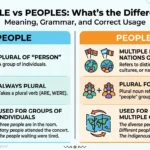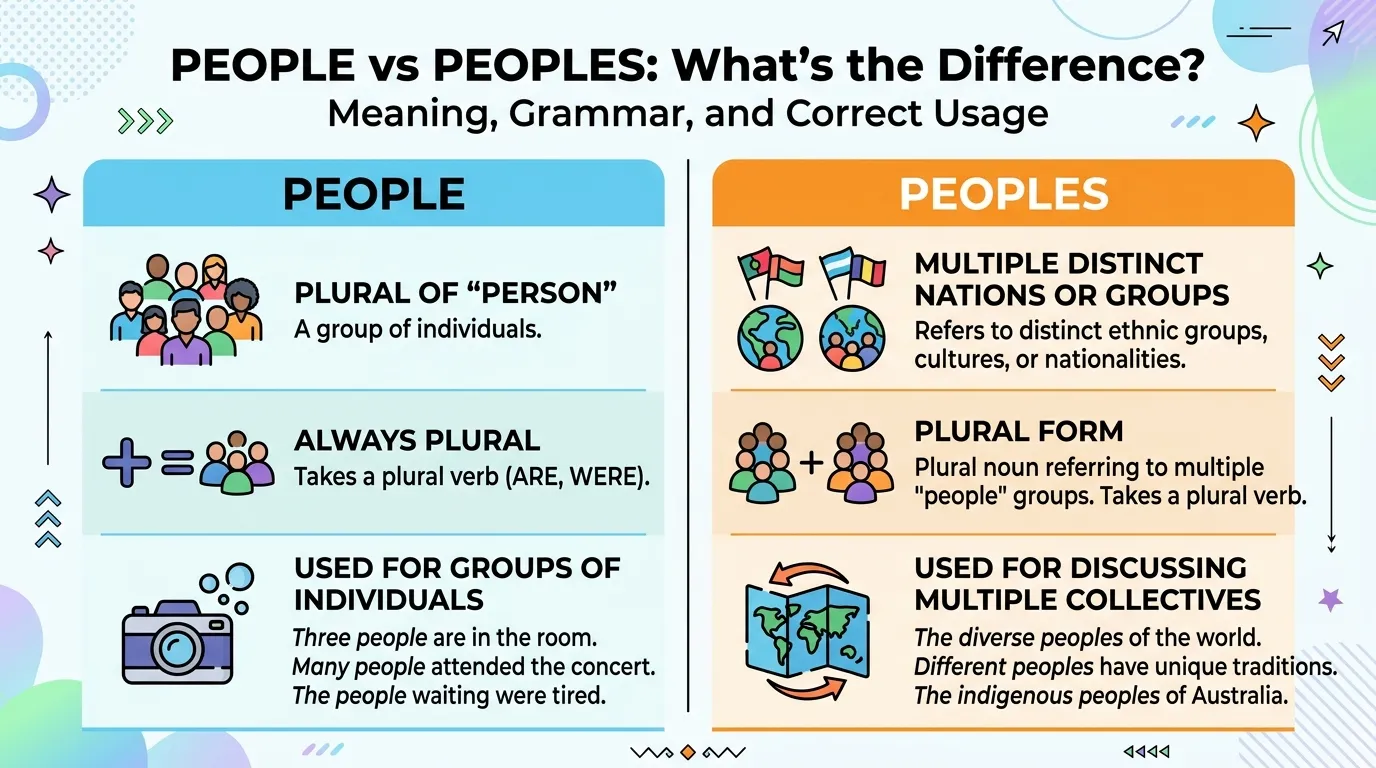
If you’re wondering about people vs peoples, the short answer is simple: people is the normal plural of person, while peoples is a special plural used when talking about different ethnic, cultural, national, or social groups as distinct populations.
For example:
- There were many people at the concert. ✅
- The peoples of the region have different traditions. ✅
- I saw several peoples at the mall. ❌ — People is the natural choice here.
The difference can seem small because adding -s usually makes a noun plural in English. But people already works as a plural noun, and peoples has a more specific meaning.
In this guide, you’ll learn exactly when to use people and peoples, how the words differ in grammar and meaning, why writers sometimes use peoples, and how to avoid common mistakes in everyday, academic, professional, historical, political, and journalistic writing.
Quick Answer: People vs Peoples
People is the standard plural form of person.
One person → two people
Peoples is used when referring to multiple distinct groups of people, especially groups that have separate cultures, ethnic identities, nations, communities, or historical identities.
The indigenous peoples of the Americas have diverse cultures.
The easiest rule
Use people when you mean individual human beings collectively.
Use peoples when you mean separate groups of people.
| Word | Main meaning | Example |
|---|---|---|
| People | More than one person | Many people attended. |
| Peoples | Distinct groups or populations | The peoples of Africa have diverse cultures. |
So, both words are correct, but they don’t normally mean the same thing.
What Does People Mean?
People is the most common plural form of person.
A person means one human being. When you talk about more than one human being, you normally use people.
Examples
- One person is waiting outside.
- Two people are waiting outside.
- Many people enjoy coffee.
- Several people joined the meeting.
- The people in the room were quiet.
In ordinary English, people is the word you want when you’re simply talking about multiple human beings.
People as a plural noun
The noun people normally takes plural verbs.
People are becoming more aware of the issue.
Not:
People is becoming more aware of the issue. ❌
More examples:
- People want better service.
- People have different opinions.
- People were waiting in line.
- People enjoy different kinds of music.
This is one of the most important grammar points to remember.
What Does Peoples Mean?
Peoples is also a real and correct English word, but its meaning is more specialized.
It usually refers to two or more distinct groups of people that are being considered separately.
These groups might be distinguished by:
- Culture
- Ethnicity
- Language
- National identity
- History
- Religion
- Territory
- Indigenous identity
- Political identity
- Social traditions
For example:
The peoples of the ancient world developed different writing systems.
Here, peoples doesn’t simply mean lots of individual humans. It refers to different groups or populations.
Another example:
The region is home to many indigenous peoples.
The focus is on distinct communities or cultural groups.
People vs Peoples: The Main Difference
The easiest way to understand the difference is to think about individuals vs groups.
People = individuals collectively
Thousands of people attended the festival.
The sentence focuses on the individual human beings who attended.
Peoples = distinct groups
The festival celebrates the traditions of several peoples.
Now the focus is on separate cultural or ethnic communities.
A simple comparison
People:
There are 500 people in the stadium.
This tells us how many individuals are present.
Peoples:
Several peoples have lived in this region for centuries.
This tells us about distinct communities or populations.
Why Do People Confuse People and Peoples?
The confusion comes from normal English plural rules.
Most English nouns form plurals by adding -s:
- book → books
- car → cars
- student → students
- country → countries
So it’s natural to assume:
person → peoples
But English doesn’t work that way here.
The normal plural of person is people, not peoples.
The extra -s in peoples changes the meaning rather than simply making the ordinary plural more emphatic.
Think of it like this:
person → people
but:
people → peoples
The second form treats people itself as a noun meaning a group or population.
Is People or Peoples Correct?
Both are correct.
The correct choice depends on what you mean.
Use people for multiple individuals
Many people live in the city.
Use peoples for multiple distinct groups
The peoples of the region speak several languages.
The mistake isn’t using peoples itself. The mistake is using it when you simply mean more than one person.
Incorrect
There were hundreds of peoples at the event. ❌
Natural
There were hundreds of people at the event. ✅
But:
The museum explores the history of several ancient peoples. ✅
Here, peoples is appropriate because the sentence refers to separate historical populations.
People as a Countable Noun
People can be used as a countable plural noun when it means individual human beings.
You can say:
- one person
- two people
- ten people
- 100 people
- millions of people
Examples:
Three people called this morning.
Fifty people attended the workshop.
Millions of people use smartphones every day.
In these cases, people is functioning as the plural of person.
Peoples as a Plural of Groups
Peoples can be understood as the plural of a different sense of people: a community, nation, or distinct population.
For example:
The people of Japan have a long cultural history.
Here, people refers to a population or nation collectively.
If you compare several such populations:
The peoples of East Asia have diverse histories.
The plural peoples emphasizes that you’re discussing separate populations.
This distinction is especially useful in historical, anthropological, political, and academic writing.
People vs Peoples in Everyday English
In everyday conversation, people is overwhelmingly more common.
If you’re talking about friends, coworkers, customers, students, neighbors, or strangers, use people.
Natural examples
- I met some interesting people yesterday.
- How many people are coming?
- People love this restaurant.
- There were too many people on the bus.
- Some people disagree with the decision.
- A lot of people watched the game.
Using peoples in these sentences would sound unnatural.
For example
I invited five peoples to dinner. ❌
Say:
I invited five people to dinner. ✅
The individuals aren’t separate ethnic or cultural populations. They’re simply five humans.
People vs Peoples in Academic Writing
Academic writing is one area where peoples appears more often.
Researchers may need to distinguish between different populations based on culture, ethnicity, history, language, or political identity.
Examples
The study examines the migration patterns of several indigenous peoples.
Ancient peoples developed complex systems of trade.
The region has been inhabited by different peoples over thousands of years.
Here, peoples helps the reader understand that the writer is discussing distinct communities, rather than an undifferentiated mass of individuals.
However, don’t use peoples just because your writing is formal.
Formal writing still uses people when that’s the correct meaning.
People vs Peoples in Historical Writing
Historical texts frequently use peoples because historians often discuss civilizations, tribes, ethnic communities, and populations.
Examples:
Several ancient peoples settled along the river.
The Roman Empire included many different peoples.
Archaeologists study the traditions of prehistoric peoples.
The word works because these sentences concern separate historical communities.
Compare:
Thousands of people died during the conflict.
Here, people is correct because the focus is on individuals.
People vs Peoples in Political Language
Political writing can use both forms.
People
People often refers to a population or citizens collectively.
The people voted in the election.
The government should listen to its people.
Peoples
Peoples may emphasize separate national, ethnic, or indigenous identities.
The agreement recognizes the rights of indigenous peoples.
Different peoples have claimed the territory throughout history.
The choice can therefore affect tone and emphasis.
People tends to be broader.
Peoples highlights distinct collective identities.
People vs Peoples in Indigenous Contexts
The plural peoples is particularly common when discussing Indigenous communities.
For example:
Indigenous peoples have diverse languages and traditions.
This wording emphasizes that Indigenous communities are not one single, culturally identical group.
The word peoples can therefore be important when the writer wants to recognize multiple distinct communities.
However, terminology varies by country, institution, and community. When writing about a particular group, it’s best to use the terminology that the group uses for itself.
People vs Peoples in Business Writing
For most business writing, people is the correct choice.
Examples
- Our company employs 500 people.
- We need more people on the project.
- Customers are people, not just numbers.
- Many people prefer online shopping.
- The survey included 2,000 people.
Peoples would usually be inappropriate in these contexts unless you’re specifically discussing different populations or communities.
Awkward
Our company serves many different peoples.
This could sound strange if you simply mean customers.
Better
Our company serves people from many different backgrounds.
If you’re actually discussing distinct cultural communities, peoples could be appropriate.
People vs Peoples in Journalism
Journalists commonly use people when referring to individuals or populations.
Examples:
Thousands of people gathered downtown.
Local people expressed concern about the project.
Peoples appears more often when the story involves distinct cultural, ethnic, or Indigenous communities.
The policy affects several Indigenous peoples.
Good journalism chooses the word that accurately describes the subject instead of using peoples merely to sound sophisticated.
People vs Peoples in Sports Writing
Sports writing almost always uses people for individuals.
Thousands of people watched the championship.
The players thanked the people who supported them.
Many people attended the game.
However, peoples could appear in historical or cultural writing connected to sports.
For example:
The tournament brings together athletes representing different peoples and cultures.
Here, the writer isn’t simply counting spectators. The focus is on distinct communities.
People vs Peoples in Technical Writing
Technical and scientific writing generally uses people when discussing human subjects.
Examples:
The device was tested on 100 people.
People with different levels of experience participated in the study.
Peoples is appropriate only when the technical context specifically involves distinct populations or communities.
For example:
The researchers compared the health traditions of several peoples.
Pronunciation of People and Peoples
The two words are pronounced similarly, but the final -s in peoples adds an extra sound.
People has two syllables.
Peoples also has two syllables.
The important difference is the ending:
- people ends with the sound represented by -ple
- peoples adds a final /z/ sound
The distinction is easy to hear in phrases such as:
many people
versus:
different peoples
When speaking, make sure the final sound in peoples is clear enough to distinguish it from people.
Is Peoples More Formal Than People?
Not exactly.
Peoples isn’t simply a more formal version of people.
This is an important point.
You shouldn’t replace people with peoples just to make your writing sound academic.
For example:
Many peoples use social media. ❌
This sounds incorrect if you mean many individual humans.
Better:
Many people use social media. ✅
But:
Different peoples have developed distinct cultural traditions. ✅
The difference is meaning, not just formality.
People vs Peoples: Tone and Style
The word people is:
- Neutral
- Common
- Conversational
- Professional
- Widely understood
- Appropriate in almost every type of writing
The word peoples is:
- More specialized
- Often academic
- Historical
- Anthropological
- Political
- Cultural
- Sometimes legal or institutional
This doesn’t mean peoples is always formal. It means its specific meaning makes it more common in certain subjects.
Dictionary-Style Definitions
People
People (noun)
Definition: More than one person; human beings considered collectively.
Example:
Many people enjoy traveling.
It can also mean a particular population or community:
The people of the country supported the proposal.
Peoples
Peoples (noun)
Definition: Two or more distinct populations, nations, ethnic groups, cultural communities, or other organized groups of people.
Example:
The region has been home to many different peoples.
The plural form is especially useful when separate groups are being compared or discussed individually.
The Word History of People
The history of people is older and more interesting than its modern spelling suggests.
English people ultimately traces back through French to Latin populus, meaning a population or people.
Over time, the word developed several related meanings involving:
- A population
- A community
- Citizens
- A nation
- Human beings generally
This helps explain why modern English can use people in different ways.
For example:
People are waiting outside.
Here it means individual human beings.
But:
The people demanded change.
Here it can refer to a population or community collectively.
The word therefore has more than one grammatical and semantic function.
The History of Peoples
The plural peoples developed naturally from the sense of people meaning a distinct community or population.
Once people could mean a group or nation, English could use peoples to refer to multiple groups or nations.
This usage became particularly useful in historical, political, anthropological, and cultural writing.
That’s why you may encounter phrases such as:
- ancient peoples
- Indigenous peoples
- tribal peoples
- neighboring peoples
- different peoples
- peoples of the region
The form isn’t a modern slang invention. It has a long history in English.
People vs Peoples: Common Collocations
Collocations are words that commonly appear together.
Common collocations with People
- many people
- young people
- older people
- ordinary people
- local people
- working people
- people today
- people around the world
- people in general
- people from different backgrounds
- people who live there
- people with disabilities
- people at work
Examples
Young people often communicate differently online.
Many people work remotely.
People from different backgrounds attended the event.
Common collocations with Peoples
- Indigenous peoples
- ancient peoples
- different peoples
- diverse peoples
- tribal peoples
- native peoples
- neighboring peoples
- traditional peoples
- distinct peoples
- peoples of the region
- peoples of the world
- Arctic peoples
Examples
Ancient peoples developed sophisticated trade networks.
The museum explores the history of Indigenous peoples.
Several peoples inhabited the area before the empire expanded.
Common Phrases With People
You’ll see people in countless everyday expressions.
Common examples
- people person
- people skills
- people power
- people watching
- people management
- people first
- the people
- ordinary people
- working people
- young people
- old people
- local people
- people around the world
Example
She’s a real people person.
Here, people is part of a fixed expression describing someone who enjoys interacting with others.
Common Expressions With Peoples
Because peoples has a narrower meaning, there are fewer everyday expressions.
It commonly appears in phrases involving cultural, historical, ethnic, or Indigenous communities.
Examples include:
- Indigenous peoples
- peoples of the world
- ancient peoples
- peoples of the region
- native peoples
- traditional peoples
These expressions generally emphasize groups as distinct communities.
People vs Peoples: Synonyms
Synonyms for People
Depending on context, possible alternatives include:
- humans
- individuals
- persons
- human beings
- citizens
- residents
- members
- individuals in a group
- population
Be careful, though. These aren’t always interchangeable.
For example:
Five people attended.
Could become:
Five individuals attended.
But:
Five humans attended.
is grammatically possible but sounds unnecessarily clinical in ordinary conversation.
Synonyms for Peoples
Depending on the context, possible alternatives include:
- communities
- populations
- nations
- ethnic groups
- cultural groups
- societies
- tribes
- communities of people
Again, context matters.
For example, tribe isn’t a universal synonym for people or peoples. It can carry specific historical and cultural meanings and shouldn’t be substituted casually.
Antonyms and Related Words
Neither people nor peoples has one perfect antonym.
Depending on the sentence, contrasting concepts might include:
- individual
- outsider
- foreigner
- nonmember
- solitude
- isolation
- uninhabited
But these aren’t direct dictionary antonyms.
Related words include:
- person
- population
- community
- society
- nation
- citizen
- humanity
- human
- individual
- group
- culture
- ethnicity
- civilization
People vs Peoples: Grammar Rules
Here are the core grammar rules to remember.
Rule 1: Person becomes people
One person
Two people
Rule 2: People can refer to a population
The people of the country voted.
Rule 3: Peoples refers to multiple distinct populations
The peoples of the region have different traditions.
Rule 4: People takes plural verbs when it means persons
People are happy.
Not:
People is happy. ❌
Rule 5: Peoples is already plural
Different peoples have different traditions.
Not:
Different peoples has different traditions. ❌
People vs Peoples in Questions
Use people when asking about a number of individuals.
How many people are coming?
How many people attended?
How many people work here?
Use peoples when asking about distinct groups.
Which peoples lived in this region?
Which peoples spoke these languages?
What peoples inhabited the area?
The second pattern is much less common in everyday conversation but completely grammatical.
People vs Peoples in Formal Writing
Here’s a useful rule for formal writing:
Don’t choose the more unusual word simply because it sounds sophisticated.
Good formal writing is precise.
Weak
The study examined different peoples using the internet.
This could be unclear.
Does peoples mean ethnic groups? Nations? Cultures?
Better if individuals are meant
The study examined how different people use the internet.
Better if distinct cultural groups are meant
The study examined internet use among different cultural groups.
Or, where appropriate:
The study examined internet use among different peoples.
Precision matters more than formality.
Awkward vs Natural Examples
| Awkward or Incorrect | Natural Version |
|---|---|
| Five peoples called me. | Five people called me. |
| Many peoples attended the meeting. | Many people attended the meeting. |
| I know several peoples at work. | I know several people at work. |
| Peoples often enjoy music. | People often enjoy music. |
| The city has 2 million peoples. | The city has 2 million people. |
| Several ancient people lived there. | Several ancient peoples lived there. |
| Different people had different cultures. | Different peoples had different cultures. |
Notice the last two examples.
Several ancient people lived there could mean individual people.
Several ancient peoples lived there means distinct historical populations.
That tiny -s can change the meaning considerably.
Common Mistakes With People and Peoples
Mistake 1: Using peoples as the regular plural of person
There were ten peoples in the room. ❌
Correction
There were ten people in the room. ✅
Mistake 2: Assuming peoples is always wrong
The museum studies the traditions of Indigenous peoples. ✅
Here, peoples is completely appropriate.
Mistake 3: Using people when separate groups matter
Several ancient people developed different languages.
This may be ambiguous.
Clearer
Several ancient peoples developed different languages.
The plural peoples makes the distinction between populations clearer.
Mistake 4: Treating peoples as a fancy synonym for people
Peoples around the world use smartphones.
Usually, this should be:
People around the world use smartphones.
Unless you’re specifically discussing distinct populations as groups, peoples isn’t necessary.
A Simple Memory Trick
Use this trick:
People = persons
If you’re counting individual humans, choose people.
10 people
100 people
many people
Peoples = populations
If you’re comparing distinct communities, cultures, nations, or ethnic groups, choose peoples.
several peoples
Indigenous peoples
ancient peoples
Think:
People = individuals
Peoples = groups
This isn’t a perfect rule for every possible sentence, but it’s an excellent shortcut for everyday writing.
People vs Peoples: A Practical Decision Guide
When you’re unsure, ask yourself one question:
Am I talking about individual human beings or distinct groups?
If you’re talking about individual human beings:
Use people.
If you’re talking about distinct groups:
Use peoples.
Example
There were 50 ______ at the conference.
You’re counting individual attendees.
Answer: people
The conference examined the traditions of several Indigenous ______.
You’re talking about distinct communities.
Answer: peoples
People vs Peoples in American English
In American English, people is the normal word for more than one person.
You’ll see peoples mainly in specialized contexts involving:
- Indigenous communities
- History
- Anthropology
- International relations
- Ethnicity
- Cultural studies
- Political science
- Legal or institutional language
American readers generally understand peoples, but it sounds unusual if used to mean ordinary individuals.
People vs Peoples in British English
British English follows essentially the same distinction.
People is the standard plural of person.
Peoples is used when discussing distinct populations or communities.
So this isn’t primarily an American-versus-British spelling difference.
Unlike words such as color/colour or organize/organise, the difference between people and peoples is mainly semantic, not regional.
Is Peoples a Slang Word?
No.
Peoples is not slang.
It’s a standard English plural noun with a specific meaning.
It can appear in formal academic, historical, political, and cultural writing.
However, you might occasionally see playful or incorrect uses of peoples online. Those don’t change the standard meaning.
Is Peoples Ever Used Figuratively?
Yes, depending on context.
A writer can use peoples broadly to describe distinct communities or populations.
For example:
The story brings together peoples from across the continent.
The phrase may have a cultural or rhetorical tone.
However, figurative use should still be clear. If your readers could interpret peoples as an error, groups, communities, or populations may be clearer.
People vs Peoples in Blogging and Content Writing
For bloggers and content creators, people will usually be the correct choice.
Use:
People love simple explanations.
Many people search for grammar tips online.
People often confuse these two words.
Use peoples only when your topic genuinely involves distinct groups.
For example:
The history of Indigenous peoples is complex and diverse.
Don’t add peoples simply because you’re trying to include a semantic keyword.
Good SEO writing prioritizes natural language and accurate meaning.
SEO-Friendly Usage: People vs Peoples
If you’re writing an article targeting searches about this distinction, naturally cover related phrases such as:
- people vs peoples
- people or peoples
- difference between people and peoples
- is peoples a word
- people plural
- plural of person
- plural form of people
- when to use peoples
- people vs peoples grammar
- people meaning
- peoples meaning
- people definition
- peoples definition
- people vs peoples examples
- is peoples grammatically correct
- people or peoples which is correct
Don’t force these phrases into every paragraph.
Search engines are better served by content that clearly explains the underlying concept and related language patterns.
Quick Comparison: People vs Peoples
| Feature | People | Peoples |
|---|---|---|
| Basic meaning | More than one person | Multiple distinct groups |
| Singular counterpart | Person | People, in the group/population sense |
| Common in conversation | Very common | Uncommon |
| Academic use | Very common | Common in certain fields |
| Historical use | Common | Common |
| Political use | Common | Common in specific contexts |
| Indigenous contexts | Common | Very common |
| Refers to individuals | Yes | Usually no |
| Refers to distinct groups | Sometimes | Yes |
| Slang | No | No |
| Standard English | Yes | Yes |
15 Everyday Examples of People
- Many people enjoy watching movies.
- I met some interesting people at work.
- People are waiting outside.
- How many people are coming?
- A lot of people use this app.
- Young people often spend time online.
- People have different opinions.
- The store was full of people.
- Several people asked the same question.
- We need more people for the project.
- Local people supported the event.
- People around the world celebrate holidays differently.
- The survey included 500 people.
- Some people prefer tea.
- People learn languages in different ways.
Every example refers to individuals or humans collectively.
15 Examples of Peoples
- The region is home to several Indigenous peoples.
- Ancient peoples built impressive cities.
- Different peoples developed unique traditions.
- Several peoples lived along the river.
- The museum documents the history of ancient peoples.
- The policy affects Indigenous peoples.
- Neighboring peoples exchanged goods.
- The empire incorporated many different peoples.
- Archaeologists study the remains of prehistoric peoples.
- Several peoples spoke related languages.
- The book explores the traditions of Arctic peoples.
- Different peoples have preserved their own languages.
- The region has been home to many peoples throughout history.
- The exhibition celebrates the art of several peoples.
- Historical records mention numerous peoples living in the area.
Here, the focus is on distinct populations or communities.
People vs Peoples: Which One Should You Use?
For most writers, the answer is easy.
Choose people when:
- You’re talking about individuals.
- You’re counting humans.
- You’re writing everyday English.
- You’re writing business content.
- You’re writing casual content.
- You’re talking about customers or employees.
- You’re describing a crowd.
- You’re discussing people generally.
Choose peoples when:
- You’re talking about distinct cultural groups.
- You’re discussing Indigenous communities.
- You’re writing about ancient populations.
- You’re comparing ethnic groups.
- You’re discussing separate nations or populations.
- You’re writing about anthropology or history.
- You’re emphasizing different collective identities.
Final Grammar Checklist
Before publishing your sentence, ask:
- Am I talking about individual humans?
- Am I counting people?
- Am I referring to one broad population?
- Am I comparing distinct communities?
- Am I discussing historical or Indigenous groups?
- Would groups, communities, or populations make the meaning clearer?
If you’re simply talking about human beings, people is almost certainly the right choice.
If you’re talking about multiple distinct populations, peoples may be the better choice.
FAQs
Is peoples a correct word?
Yes. Peoples is a correct standard English word. It is generally used to describe multiple distinct populations, cultural groups, ethnic communities, nations, or historical peoples.
Is people the plural of person?
Yes. People is the most common plural of person.
For example:
One person → two people.
Persons is also possible in certain formal, legal, or technical contexts, but people is the normal choice in everyday English.
What is the difference between people and peoples?
People usually means multiple individual human beings. Peoples usually means multiple distinct groups or populations.
Many people attended.
Several peoples lived in the region.
When should I use peoples instead of people?
Use peoples when you want to refer to distinct communities, ethnic groups, Indigenous populations, nations, or historical populations.
For ordinary individuals, use people.
Is peoples the plural of people?
Yes, but only when people is being used in the sense of a distinct population or community.
For example:
The people of the island
can become:
The peoples of several islands
when referring to multiple separate populations.
Can I say peoples in everyday conversation?
You can, but it isn’t common when talking about ordinary individuals. In everyday conversation, people is almost always the natural choice.
Is peoples more formal than people?
Not exactly. Peoples has a more specialized meaning, rather than simply being a more formal version of people. It is common in subjects such as history, anthropology, politics, and Indigenous studies.
Should I write people or peoples in American English?
Use people when you mean individuals. Use peoples when you mean distinct populations or communities. The distinction is essentially the same in American and British English.
Why do we say people instead of persons?
People is the normal plural of person in general English. Persons still exists and is used in certain formal, legal, administrative, or technical contexts, but people is much more common in everyday writing and speech.
Conclusion
The difference between people vs peoples comes down to one key idea: individuals versus distinct groups.
People is the normal plural of person. Use it when you’re talking about two or more human beings:
Many people attended the meeting.
Peoples is also correct, but it has a more specialized meaning. Use it when you’re referring to multiple distinct populations, cultural communities, ethnic groups, nations, or historical societies:
The region has been home to many different peoples.
The extra -s isn’t simply an ordinary plural ending. It helps distinguish multiple groups of people from multiple individual people.
For everyday American English, business writing, casual communication, blogging, and most general content, people will be your default choice.
When writing about history, anthropology, Indigenous communities, cultural identity, or distinct populations, peoples may be exactly what you need.
The best rule to remember is simple:
People = more than one person.
Peoples = more than one distinct group of people.
Once you understand that difference, choosing between people and peoples becomes much easier.