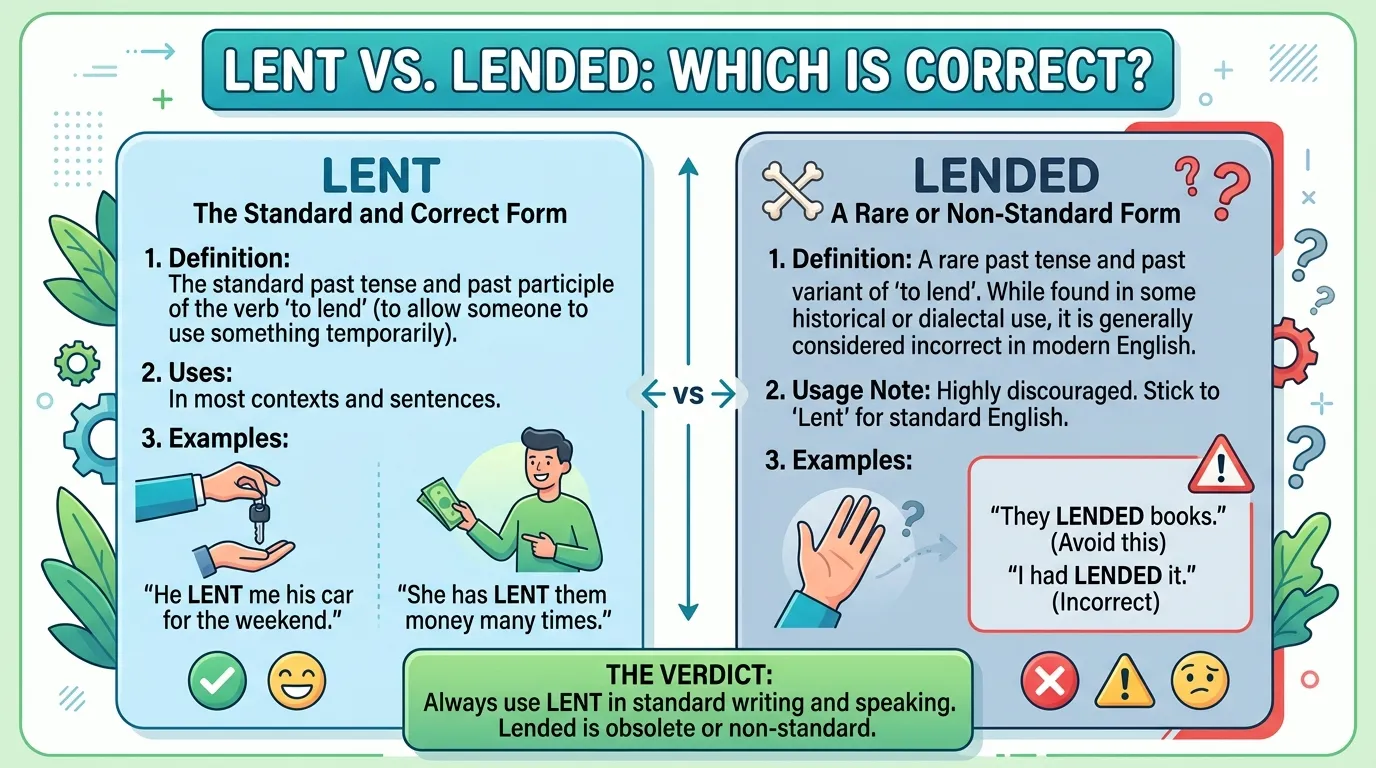
If you are unsure whether to say lent or lended, the short answer is simple: lent is the standard past tense and past participle of lend. In standard modern English, lended is generally incorrect when you mean the past tense of lend.
For example:
- Correct: I lent my friend some money.
- Incorrect: I lended my friend some money.
The confusion is understandable because many English verbs form their past tense by adding -ed, such as help → helped, call → called, and open → opened. But lend is an irregular verb, so its past form is lent, not lended.
This guide explains lent vs lended in detail. You will learn their meanings, grammar, pronunciation, history, common mistakes, natural examples, formal and casual usage, regional considerations, and the best way to remember which form to use.
Quick Answer: Is It Lent or Lended?
Lent is the correct standard form when you need the past tense or past participle of lend.
| Word | Standard English? | Grammatical role | Example |
|---|---|---|---|
| lend | Yes | Present/base form | I will lend you my book. |
| lent | Yes | Past tense/past participle | I lent you my book yesterday. |
| lended | Generally no | Nonstandard form | I lended you my book. ❌ |
The basic pattern is:
lend → lent → lent
Not:
lend → lended → lended
The easiest rule
If you are talking about something that was given temporarily with the expectation that it would be returned, use lent for the past.
She lent me her car.
He lent his brother $100.
They lent us some chairs.
What Does Lent Mean?
Lent is the past tense and past participle of the verb lend.
The verb lend means to give something to another person temporarily, usually with the expectation that it will be returned.
So:
- Present: I lend
- Past: I lent
- Past participle: I have lent
Examples of lent
- I lent my neighbor a ladder.
- Sarah lent me her notes.
- We lent our equipment to the school.
- He lent his jacket to his friend.
- The bank lent the company money.
In each example, something is temporarily provided to another person or organization.
What Does Lended Mean?
Lended is not the standard past tense of lend in modern English.
A person may write or say lended because they assume lend follows the regular -ed pattern. However, standard dictionaries and conventional English grammar use lent.
For example:
❌ He lended me his phone.
✅ He lent me his phone.
❌ The bank lended them money.
✅ The bank lent them money.
❌ She had lended her car to her sister.
✅ She had lent her car to her sister.
Why does lended appear online?
You may occasionally encounter lended in informal writing, learner English, regional speech, historical texts, or contexts where someone has incorrectly regularized the verb.
Its appearance does not make it the standard form.
For professional, academic, business, journalistic, and general American English, choose lent.
Lent vs Lended: The Key Difference
The main difference is grammatical rather than semantic.
Lent is the established past form of lend.
Lended is a nonstandard regularized form that some speakers or writers may produce.
Compare:
I lend money to my brother sometimes.
I lent money to my brother yesterday.
I have lent money to him before.
The form changes according to tense, but it never needs to become lended.
Verb forms of lend
| Tense/Form | Correct form | Example |
|---|---|---|
| Base form | lend | I lend books to friends. |
| Third-person singular | lends | She lends books to students. |
| Present participle | lending | He is lending me his laptop. |
| Simple past | lent | She lent me her laptop. |
| Past participle | lent | She has lent me her laptop. |
This pattern is important because lent serves two grammatical functions: simple past and past participle.
Why Do People Confuse Lent and Lended?
The confusion comes mainly from English verb patterns.
Many verbs form the past tense by adding -ed:
- walk → walked
- talk → talked
- borrow → borrowed
- return → returned
- help → helped
Because lend ends in a consonant and looks like an ordinary verb, learners may naturally expect:
lend → lended
But English contains many irregular verbs whose past forms must be learned individually.
For example:
- send → sent
- spend → spent
- build → built
- feel → felt
- keep → kept
- leave → left
- lend → lent
The similarity between lend → lent, send → sent, and spend → spent can help you remember the correct form.
Is Lent a Verb?
Yes. Lent is a verb form.
It is both:
- The simple past tense of lend
- The past participle of lend
Lent as simple past
I lent him my bicycle yesterday.
The action happened in the past.
Lent as a past participle
I have lent him my bicycle several times.
Here, lent follows the auxiliary verb have.
Another example:
She had lent her notes to a classmate.
Here, lent follows had.
Lent vs Borrowed
Another common source of confusion is lend vs borrow.
These words describe the same temporary exchange from different perspectives.
Lend means you give something temporarily.
Borrow means you receive something temporarily.
For example:
I lent Tom my book.
Tom borrowed my book.
The person giving the item lends it.
The person receiving it borrows it.
Compare the meanings
| Situation | Correct verb |
|---|---|
| I give you my pen temporarily. | I lend you my pen. |
| You receive my pen temporarily. | You borrow my pen. |
| I gave you my pen yesterday. | I lent you my pen. |
| You received my pen yesterday. | You borrowed my pen. |
This distinction is especially useful in everyday conversations.
Lent vs Loaned
Lent and loaned can sometimes have the same basic meaning.
For example:
She lent me $500.
She loaned me $500.
Both can be grammatical.
However, lend is especially common in everyday English, while loan can sound somewhat more formal in certain contexts. In American English, loan is also widely used as a verb, especially in financial and business contexts.
Examples
Casual:
Can you lend me your charger?
Financial:
The bank loaned the company $2 million.
Still, lend works in many formal contexts:
The bank lent the company $2 million.
How to Pronounce Lent
Lent is pronounced:
/lɛnt/
It rhymes with words such as:
- sent
- bent
- went
- tent
- meant
The vowel sound is similar to the vowel in bed.
Pronunciation example
She lent me her pen.
Think:
lent = sent with an L
That can be a useful pronunciation and spelling reminder.
Is Lended Ever Correct?
For modern standard English, lended should not be used as the ordinary past tense of lend.
There can be unusual historical, dialectal, or specialized appearances of forms that differ from contemporary standard English. But if your goal is clear, conventional English, lent is the form to use.
This matters particularly in:
- school assignments
- resumes
- business writing
- academic papers
- journalism
- professional emails
- websites
- formal reports
- published content
If you see lended in one of these settings, it is usually best treated as a mistake unless there is a specific historical or dialectal reason for the form.
Why Is Lend an Irregular Verb?
English has a large group of irregular verbs inherited from older stages of the language.
The past form of lend developed as lent, rather than following the regular -ed pattern.
This is not unusual. English has many common verbs whose past forms do not follow the standard -ed rule.
Consider:
- bend → bent
- send → sent
- spend → spent
- lend → lent
These verbs share a useful spelling pattern.
Instead of memorizing lend in isolation, you can connect it to this family:
bend → bent
lend → lent
send → sent
spend → spent
That makes the irregular form easier to remember.
Dictionary-Style Definition of Lend
Lend — verb
Basic meaning: To give something to another person temporarily, with the expectation that it will be returned.
Past tense: lent
Past participle: lent
Common grammatical patterns
lend + someone + something
She lent me her book.
lend + something + to + someone
She lent her book to me.
Both patterns are correct.
How to Use Lent in a Sentence
There are several common sentence patterns involving lent.
Lent + person + object
My sister lent me her laptop.
John lent his friend some money.
The teacher lent us a dictionary.
Lent + object + to + person
My sister lent her laptop to me.
John lent some money to his friend.
The teacher lent a dictionary to us.
Both structures communicate the same basic idea.
Lent with money
I lent him $50.
She lent her cousin some money.
The company lent funds to the organization.
Lent with physical objects
He lent me his car.
She lent her jacket to a friend.
We lent our tools to the neighbors.
Common Collocations With Lent
A collocation is a combination of words that commonly appear together.
Here are some natural combinations involving lend/lent:
- lent money
- lent a hand
- lent support
- lent assistance
- lent credibility
- lent authority
- lent his name
- lent her voice
- lent an ear
- lent a book
- lent a car
- lent equipment
- lent resources
- lent support to a cause
Some of these uses are literal, while others are figurative.
Figurative Uses of Lend and Lent
Lend does not always mean physically giving something.
It can also mean providing support, qualities, attention, or influence.
Lend a hand
This means help someone.
Maria lent me a hand when I was moving.
Past form:
Maria lent me a hand yesterday.
Lend support
The organization lent support to the project.
This means the organization supported the project.
Lend credibility
His experience lent credibility to the proposal.
Here, nothing physical was handed over. The experience made the proposal seem more trustworthy.
Lend a voice
The campaign lent a voice to people who felt ignored.
This means it helped people express their concerns or be heard.
Lend an ear
Please lend me an ear for a few minutes.
This means to listen carefully or sympathetically.
Lent in Formal Writing
Lent is completely acceptable in formal English.
For example:
The university lent its facilities to the research team.
The foundation lent financial support to the program.
The committee lent credibility to the proposal by endorsing it.
There is no need to replace lent simply because the writing is formal.
However, depending on context, alternatives such as provided, offered, granted, or loaned may be more precise.
Lent in Business English
Business writing frequently uses lent in financial and figurative contexts.
Examples include:
The bank lent the company $5 million.
The investor lent funds to the startup.
Her reputation lent credibility to the new brand.
The manager lent support to the proposal.
In financial contexts, loaned is also common:
The bank loaned the business $5 million.
Both lent and loaned can work depending on the sentence and style.
Lent in Academic Writing
In academic writing, lent is the standard past form.
Examples:
The study lent support to the researchers’ hypothesis.
Historical evidence lent credibility to the argument.
The institution lent its archives to the research team.
Avoid lended in academic work.
Awkward
The evidence lended support to the theory.
Natural
The evidence lent support to the theory.
Lent in Journalism
Journalists commonly use lent in both literal and figurative contexts.
For example:
The announcement lent credibility to the report.
The museum lent several paintings to the exhibition.
The former official lent his support to the campaign.
The word is concise and natural in news writing.
Lent in Sports Writing
Sports writers may use lent in figurative expressions.
The veteran player lent experience to the young team.
His leadership lent confidence to the squad.
The coach lent his support to the players.
In sports reporting, lent generally works the same way as it does in other forms of standard English.
Lent in Technical Writing
Technical writing can also use lent when describing temporary transfers of equipment, resources, or support.
The laboratory lent equipment to the research team.
The department lent computing resources to the project.
However, technical documents may prefer more precise verbs such as:
- transferred
- supplied
- allocated
- provided
- assigned
- authorized
The best choice depends on whether the resource is actually expected to be returned.
Lent vs Gave
Lent and gave are not interchangeable.
If you give something away, you generally do not expect to receive the same item back.
If you lend something, you normally expect its return.
Compare:
I gave Sarah my old phone.
This usually means Sarah now owns the phone.
I lent Sarah my phone.
This means Sarah has it temporarily and should return it.
This distinction is crucial in everyday communication.
Lent vs Rented
Lent and rented can also describe temporary possession, but they are different.
Lend generally describes giving something temporarily, often without payment.
Rent normally involves payment for temporary use.
Compare:
My brother lent me his car.
You might not pay him.
I rented a car from the airport.
You normally pay the rental company.
Lent vs Leant
This is another spelling issue worth knowing.
Lent is the past tense of lend.
Leant is a past form of lean, meaning to tilt or rest against something. It is especially common in British English, although leaned is also widely used.
Compare:
She lent me her book.
She leant against the wall.
These words sound different in meaning even though their spellings are similar.
In American English, leaned is generally more common than leant.
Common Mistakes With Lent
Mistake: Using lended as the past tense
❌ I lended him my car.
✅ I lent him my car.
Mistake: Using lend for a completed past action
❌ Yesterday, I lend her my notes.
✅ Yesterday, I lent her my notes.
Mistake: Confusing lend and borrow
❌ Can I lend your calculator?
If you mean you want to receive it, say:
✅ Can I borrow your calculator?
If you are offering it to someone:
✅ Can I lend you my calculator?
Mistake: Confusing lend and loan
Both can be verbs, but use the word that best fits your intended tone and context.
The bank lent him money.
The bank loaned him money.
Both are possible.
Incorrect vs Correct Examples
| Incorrect | Correct |
|---|---|
| I lended him my book. | I lent him my book. |
| She lended me money. | She lent me money. |
| They had lended us equipment. | They had lent us equipment. |
| He lended his support. | He lent his support. |
| We lended our car to them. | We lent our car to them. |
| The bank lended money. | The bank lent money. |
Awkward vs Natural Examples
Awkward
I lended my friend a jacket.
Natural
I lent my friend a jacket.
Awkward
The company lended financial support.
Natural
The company lent financial support.
Awkward
She has lended me her notes.
Natural
She has lent me her notes.
Awkward
He lended credibility to the argument.
Natural
He lent credibility to the argument.
Memory Trick for Lent vs Lended
A simple trick is to remember:
Lend sounds like send.
And:
send → sent
lend → lent
You would never normally say:
I sended the letter.
You say:
I sent the letter.
In the same way:
I lent the book.
Not:
I lended the book.
Another useful pattern is:
bend → bent
lend → lent
send → sent
spend → spent
Learning these together can make the pattern easier to recall.
What Is the Past Tense of Lend?
The past tense of lend is lent.
Present: I lend books.
Past: I lent books.
Present perfect: I have lent books.
Past perfect: I had lent books.
Future: I will lend books.
There is no need to add -ed.
What Is the Past Participle of Lend?
The past participle is also lent.
Examples:
I have lent him my car.
She has lent me her notes.
They had lent their equipment to us.
The structure is:
have/has/had + lent
Not:
have/has/had + lended
Can You Say I Have Lended?
In standard English, no.
Use:
I have lent him my book.
Not:
I have lended him my book.
This is especially important in perfect tenses because learners sometimes add -ed automatically.
Can You Say I Was Lended Something?
This construction is also unnatural in standard English.
Instead, restructure the sentence.
Instead of:
I was lended a car.
Use:
I was lent a car.
Or more naturally:
Someone lent me a car.
The active construction is often clearer.
Natural Everyday Examples
Here are some examples you might hear in ordinary conversation:
I lent him my charger.
She lent me her umbrella.
Can you lend me $20?
I already lent my car to my brother.
He lent me a hand with the boxes.
We lent them some chairs.
Who lent you that jacket?
I think Sarah lent it to you.
My neighbor lent us a ladder.
Have you lent him the money yet?
These examples demonstrate how naturally lent works in everyday English.
Formal Alternatives to Lent
Depending on the context, you may use other verbs.
| Instead of | Possible alternative |
|---|---|
| lent money | provided funds |
| lent support | supported |
| lent assistance | assisted |
| lent equipment | supplied equipment |
| lent credibility | strengthened credibility |
| lent resources | provided resources |
| lent a vehicle | provided a vehicle temporarily |
| lent funds | financed / provided funds |
However, do not replace lent just to sound more formal. Simple and accurate wording is usually better.
Synonyms of Lend
Depending on context, synonyms can include:
- loan
- provide temporarily
- advance
- supply
- furnish
- offer
- contribute
- provide
- extend
The exact synonym depends on what is being lent.
For example:
The bank advanced the money.
is appropriate in a financial context, while:
She loaned me her bicycle.
works for a physical object.
Antonyms and Contrasting Words
There is no single perfect antonym for lend, but several words express an opposite or contrasting action.
- take
- keep
- withhold
- reclaim
- receive
- borrow
Borrow is particularly important because it describes the opposite side of a lending relationship.
Common Expressions With Lend
Lend a hand
Meaning: help someone.
Can you lend me a hand?
Lend an ear
Meaning: listen.
He was willing to lend an ear.
Lend support
Meaning: support something or someone.
She lent her support to the project.
Lend credibility
Meaning: make something appear more trustworthy.
His experience lent credibility to the claim.
Lend one’s voice
Meaning: publicly support or speak for a cause.
Several artists lent their voices to the campaign.
Lend itself to
Meaning: be suitable for a particular use or purpose.
The format lends itself to online learning.
Notice that this last expression uses lends, not lends in the past.
Past:
The format lent itself to online learning.
Does American English Use Lent?
Yes. Lent is the standard form in American English.
American English does not normally use lended as the past tense of lend.
For American readers and writers, the safest rule is:
Use lend in the present and lent in the past.
Does British English Use Lent?
Yes. Lent is also the standard past form in British English.
Therefore, this is not a major American-versus-British spelling difference.
Both varieties use:
lend → lent
Regional English differences do not normally change the answer.
What About International English?
For international English, especially in education, business, publishing, and professional communication, lent is the appropriate form.
If you are writing for a global audience, use:
The organization lent its equipment to the school.
rather than:
The organization lended its equipment to the school.
Is Lent Formal or Informal?
Lent is neutral.
It works in:
- casual conversations
- text messages
- emails
- school writing
- academic writing
- business writing
- journalism
- technical documents
- professional communication
For example:
Casual:
I lent you my charger.
Business:
The bank lent the company additional funds.
Academic:
The findings lent support to the proposed explanation.
There is no register problem with lent.
Does Lent Have a Slang Meaning?
In ordinary contemporary English, lent does not have a major slang meaning as the past tense of lend.
Its figurative expressions, such as lent a hand, lent support, and lent credibility, are standard English rather than slang.
If you see lent used online in an unusual way, the meaning should be determined from the surrounding context.
Is Lent Related to the Religious Word Lent?
Yes, but the two uses should be distinguished.
Lent can mean the past tense of lend:
She lent me a book.
It can also refer to Lent, the Christian season traditionally associated with preparation for Easter.
Christians observe Lent before Easter.
These are different meanings of the same spelling.
The grammatical form lent comes from the verb lend, while the religious term Lent has a different historical origin.
Lent vs Lended: A Complete Comparison
| Feature | Lent | Lended |
|---|---|---|
| Standard English | Yes | Generally no |
| Base verb | Lend | Lend |
| Past tense | Yes | No |
| Past participle | Yes | No |
| American English | Standard | Nonstandard |
| British English | Standard | Nonstandard |
| Academic writing | Recommended | Avoid |
| Business writing | Recommended | Avoid |
| Casual writing | Recommended | Avoid |
| Meaning | Past form of lend | Nonstandard attempted past form |
| Example | She lent me money. | She lended me money. ❌ |
When Should You Use Lent?
Use lent whenever you are describing a completed action involving the verb lend.
Use it when:
- something was temporarily given
- money was provided as a loan
- support was offered
- help was provided
- credibility was added
- a resource was temporarily made available
Examples:
I lent him my car.
The bank lent her money.
The evidence lent support to the theory.
He lent a hand.
The organization lent its support.
When Should You Use Lend Instead?
Use lend when talking about the present, general habits, infinitives, or future actions.
Examples:
I often lend books to friends.
Can you lend me your pen?
She will lend us her car.
They want to lend support to the project.
I am happy to lend a hand.
When Should You Use Lending?
Use lending as the present participle or gerund.
She is lending me her laptop.
Lending money to friends can sometimes be complicated.
The bank specializes in lending to small businesses.
Again, the correct family is:
lend → lending → lent
A Simple Decision Guide
When choosing between lent and lended, ask yourself:
Is the sentence using the past tense of lend?
If yes, choose lent.
Yesterday, I lent him my bike.
Does the sentence describe a current or future action?
Use lend.
I will lend him my bike tomorrow.
Does it describe an ongoing action?
Use lending.
I am lending him my bike.
This three-form pattern solves most usage questions:
lend — lending — lent
Frequently Asked Questions
Is lent the correct past tense of lend?
Yes. Lent is the standard past tense of lend. For example: I lent her my book yesterday.
Is lended a real word?
You may encounter lended in nonstandard or unusual usage, but it is not the standard modern past tense of lend. In normal English writing, use lent.
Is it lent or lended money?
The correct expression is lent money.
The bank lent him money.
Is it I lent or I lended?
The correct form is I lent.
I lent my friend $50.
What is the past participle of lend?
The past participle is lent.
I have lent him my car.
Why isn’t lended correct?
Because lend is an irregular verb. Its established past and past participle forms are lent, not lended.
Is lent used in both American and British English?
Yes. Lent is the standard past form in both American and British English. This is not normally a regional spelling difference.
What is the difference between lent and borrowed?
Lent describes the person giving something temporarily, while borrowed describes the person receiving it.
I lent him my book.
He borrowed my book.
Is loaned the same as lent?
Often, yes. Both can describe providing something temporarily. Loaned is particularly common in financial contexts, while lent is extremely common in everyday English.
Final Takeaway
The answer to lent vs lended is straightforward: lent is the correct standard form.
The verb forms are:
lend → lent → lent
Use lend for the base or present form:
I will lend you my notes.
Use lent for the past tense:
I lent you my notes yesterday.
Use lent as the past participle:
I have lent you my notes before.
Avoid lended in standard American English, British English, academic writing, business communication, journalism, technical writing, and professional content.
The easiest memory trick is to connect lend with send:
send → sent
lend → lent
Once you remember that pattern, lent vs lended becomes an easy choice. When in doubt, choose lent. It is clear, natural, grammatically correct, and accepted across standard varieties of English.