Have you ever stopped while writing a sentence and wondered whether you should use onto or on to? You are not alone. These two forms look almost identical, sound nearly the same in many sentences, and are often confused even by experienced writers.
The good news is that the difference between onto vs on to is much easier to understand once you know what each form is doing in a sentence.
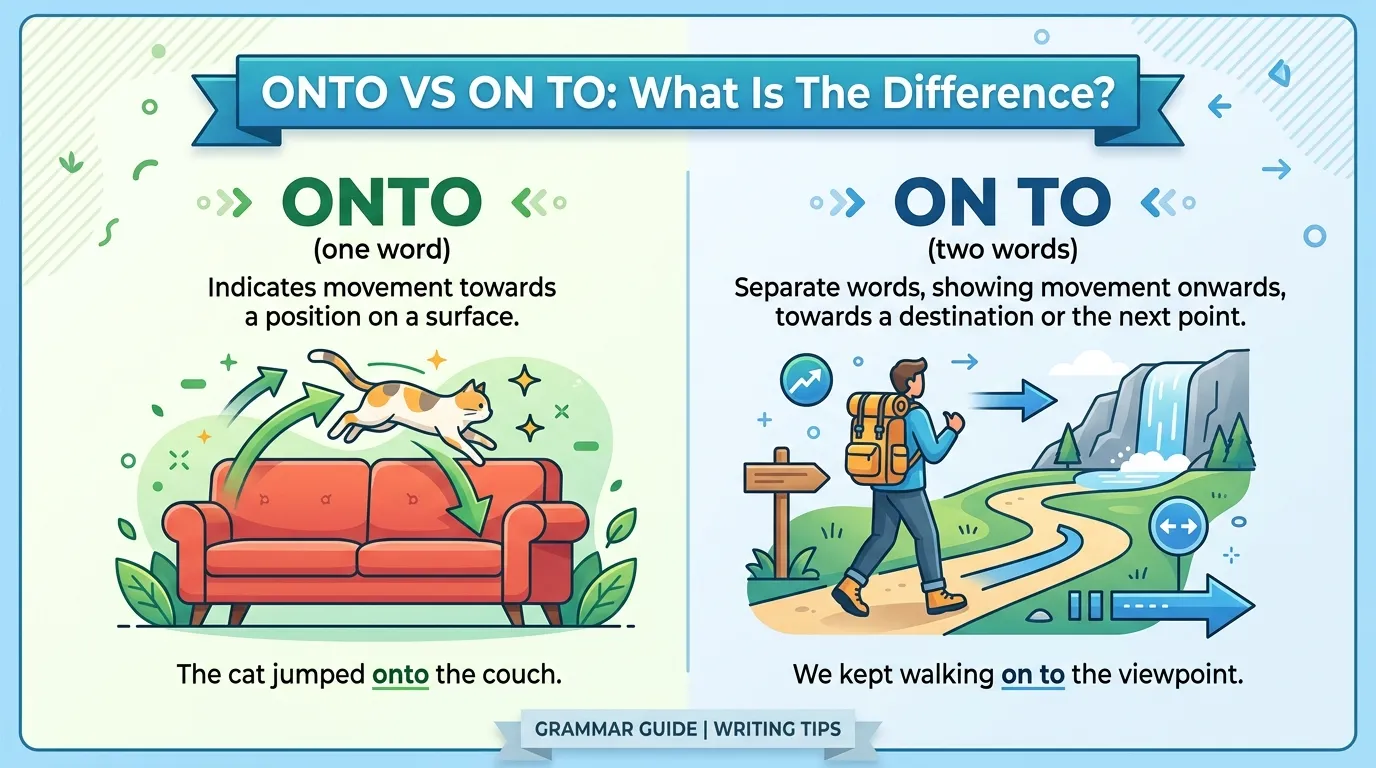
In general, onto is usually a preposition that means movement to a position on or on top of something. For example, “The cat jumped onto the table.” On to, written as two separate words, occurs when on and to perform separate grammatical jobs. For example, “She moved on to the next chapter.”
The important point is that these forms are not simply interchangeable spelling choices.
This guide explains onto vs on to, including their meanings, grammatical roles, pronunciation, history, common expressions, formal and informal usage, American and British preferences, common mistakes, and practical ways to remember the difference.
Quick Answer: Onto vs On To
Here is the simplest way to remember the distinction:
| Form | General meaning | Example |
|---|---|---|
| onto | Movement toward or to a position on something | The child climbed onto the bed. |
| on to | on and to have separate meanings or grammatical functions | We moved on to the next question. |
Use onto when:
- Something moves to a position on something.
- You can reasonably think of the phrase as “to a position on.”
- The word functions as a single preposition.
Example:
“The bird flew onto the roof.”
Use on to when:
- On belongs with the preceding verb, adjective, or phrase.
- To introduces a destination, object, infinitive, or new stage.
- The two words have separate grammatical functions.
Example:
“She held on to the railing.”
Here, on belongs to the phrasal verb hold on, while to introduces “the railing.”
A useful test is to ask: Does “to a position on” make sense? If yes, onto is often appropriate. If not, keep on and to separate.
What Does Onto Mean?
Onto is primarily a preposition used to describe movement toward and arrival at a position on a surface, object, or area.
Dictionary-style definition of onto
Onto means:
Moving or being moved to a position on, over, or upon something.
Consider these examples:
- The dog jumped onto the sofa.
- She stepped onto the stage.
- The boy climbed onto the roof.
- The ball rolled onto the sidewalk.
- He placed the box onto the counter.
In each example, there is movement from one position to another.
The important idea is movement toward a position on something.
Onto can also describe contact
Sometimes onto emphasizes that something comes into contact with a surface:
- Water spilled onto the floor.
- The child dropped the toy onto the carpet.
- Snow fell onto the car.
The movement does not have to involve a person physically climbing or jumping.
What Does On To Mean?
On to consists of two independent words: the preposition or adverb on and the word to.
Because the words have separate grammatical functions, they should remain separate.
For example:
“She held on to her mother’s hand.”
The phrase hold on means to maintain a grip. The word to then identifies what she held.
Another example is:
“Let’s move on to the next topic.”
Here, move on means to continue, while to introduces the next topic.
Common examples of on to
- Hold on to your ticket.
- Let’s move on to the next lesson.
- He went on to become a doctor.
- She passed the information on to her colleague.
- The team advanced on to the final round.
- They carried on to the next stage of the journey.
In these sentences, replacing on to with onto would either change the meaning or make the sentence awkward.
The Key Difference Between Onto and On To
The main difference is grammatical function.
Onto usually acts as one preposition.
On to contains two separate words that happen to appear next to each other.
Compare:
The cat jumped onto the chair.
The cat moved to a position on the chair.
Now compare:
The cat held on to the chair.
Here, held on is the relevant expression, and to the chair identifies what the cat held.
The spelling changes because the grammar changes.
Another simple comparison
Onto:
The athlete stepped onto the track.
Movement toward a position on the track.
On to:
The athlete went on to win the race.
The phrase went on means continued, and to win introduces what happened next.
Why Do People Confuse Onto and On To?
The confusion exists for several reasons.
1. They sound similar
In everyday speech, onto and on to can sound almost identical.
When people speak, there is no visible space between the words. Writers therefore have to determine the correct form from grammar and meaning.
2. Both involve the word on
The word on can have many roles in English.
It can describe:
- Position
- Movement
- Continuation
- Attachment
- Contact
- Progression
- A phrasal verb
This makes the distinction less obvious.
3. English contains many phrasal verbs
Expressions such as hold on, move on, go on, carry on, and pass on can be followed by to.
That creates combinations such as:
- hold on to
- move on to
- go on to
- pass on to
- carry on to
These are not automatically spelled onto.
4. Style varies in some contexts
There are sentences where both forms may appear in published English, particularly when the distinction between physical movement and a separate grammatical construction is subtle.
For careful writing, however, understanding the grammatical structure is more reliable than relying on appearance.
When Should You Use Onto?
Use onto when something moves to a position on something else.
Physical movement
- The cat jumped onto the table.
- The child climbed onto the chair.
- She stepped onto the bus.
- The skier moved onto the slope.
- The bird landed onto the branch.
A useful question is:
Where did the person, animal, or object move?
If the answer is “to a position on something,” onto may be the right choice.
Movement toward a surface
- The ball bounced onto the pavement.
- The glass fell onto the floor.
- The leaves drifted onto the porch.
- The rain splashed onto the window.
Movement to a platform or area
- The singer walked onto the stage.
- The player ran onto the field.
- The truck drove onto the bridge.
- The train moved onto the main track.
When Should You Use On To?
Use on to when on and to have separate grammatical functions.
After phrasal verbs
This is one of the most important situations.
Consider:
She held on to the rope.
The verb phrase is held on. The word to introduces the object.
Another example:
He passed the message on to his manager.
The phrase pass on means to transmit or transfer something. The word to identifies the recipient.
When talking about the next stage
Use on to in expressions involving progression:
- Move on to the next question.
- Let’s go on to the next chapter.
- The discussion moved on to another issue.
- She went on to study law.
- The team advanced on to the championship game.
Here, on communicates continuation or progression.
Onto vs On To Examples
Seeing the two forms side by side makes the distinction easier.
| Sentence | Correct form | Why? |
|---|---|---|
| The cat jumped ___ the bed. | onto | Movement to a position on the bed |
| We moved ___ the next subject. | on to | “move on” + “to” |
| She climbed ___ the roof. | onto | Physical movement |
| Hold ___ your receipt. | on to | “hold on” + “to” |
| The actor walked ___ the stage. | onto | Movement onto a surface |
| He went ___ become a successful writer. | on to | “went on” + infinitive |
| The bird landed ___ the fence. | onto | Movement to a position on the fence |
| She passed the document ___ her supervisor. | on to | “pass on” + recipient |
Onto vs On To in Phrasal Verbs
Phrasal verbs are one of the biggest sources of confusion.
Hold on to
Hold on to means to keep or maintain a grip on something.
Hold on to the railing.
You should hold on to your receipts.
Do not automatically change this to onto.
Move on to
Move on to means to proceed to another subject, activity, or stage.
Let’s move on to the next example.
After discussing the problem, we moved on to possible solutions.
Go on to
Go on to can mean to continue and then do something else.
She went on to become a respected journalist.
After college, he went on to study engineering.
Pass on to
Pass on to means transfer something to another person or place.
Please pass the message on to Sarah.
The teacher passed the instructions on to the students.
These examples show why identifying the phrasal verb can solve the problem.
Onto vs On To: A Simple Grammar Test
If you are unsure which form to use, try these tests.
Test 1: Replace onto with “to a position on”
Consider:
The child climbed onto the bed.
You can think of this as:
The child climbed to a position on the bed.
That works.
Now try:
Let’s move onto the next subject.
Replacing it gives:
Let’s move to a position on the next subject.
That makes no sense.
Therefore, on to is better:
Let’s move on to the next subject.
Test 2: Look for a phrasal verb
Ask whether the word on belongs to the verb.
For example:
Hold on to your bag.
The expression is hold on.
Therefore, keep on and to separate.
Another example:
Go on to the next page.
The expression is go on, followed by to.
Again, use two words.
Test 3: Ask what “to” is doing
If to introduces a destination or object after a phrase such as hold on, move on, or go on, it usually remains separate.
Can Onto and On To Ever Both Be Correct?
Yes, depending on the intended meaning.
The spelling can sometimes affect the interpretation of a sentence.
Consider:
The dog jumped onto the sofa.
This describes physical movement to a position on the sofa.
Now consider:
The dog went on to the sofa.
This could potentially be understood as the dog continued onward to the sofa, although the wording is less natural than simply saying:
The dog went to the sofa.
This illustrates an important writing principle: grammar and natural meaning should work together.
Even when a construction can technically be defended, choose the form that makes your intended meaning immediately clear.
Is Onto One Word or Two?
Onto is normally written as one word when it functions as the preposition describing movement to a position on something.
Examples:
- jump onto
- climb onto
- step onto
- crawl onto
- land onto
- fall onto
However, on to must remain two words when on and to have independent grammatical roles.
Examples:
- hold on to
- move on to
- go on to
- pass on to
- carry on to
Onto in Figurative and Informal English
Onto is not limited to physical movement.
It can also have figurative meanings.
Discovering or suspecting something
In informal English, someone may be described as being onto something when they have discovered an important clue or idea.
I think you’re onto something.
This means:
I think you have discovered or identified something important.
Another example:
The detective knew he was onto something.
Here, onto does not describe physical movement. It expresses figurative discovery or progress toward the truth.
Getting onto someone
In some contexts, get onto someone can mean to confront, criticize, or speak firmly to them.
The manager got onto him about the missed deadline.
This usage can vary by region and context and may sound more natural in British or Australian English than in some American contexts.
Onto in Technical and Professional Writing
Onto appears frequently in technical, scientific, engineering, and professional contexts.
Examples include:
- data transferred onto a server
- information uploaded onto a platform
- material applied onto a surface
- a device mounted onto a frame
- a component fitted onto a structure
However, technical writers should choose wording based on the exact relationship being described.
For example:
The software uploads the file onto the server.
This emphasizes movement or transfer to the server.
In many modern technical contexts, however, to the server may sound simpler and more natural:
The software uploads the file to the server.
Good technical writing favors precision over unnecessary complexity.
Onto vs On To in American English
In American English, onto is widely accepted as a standard preposition.
Examples:
- Get onto the bus.
- Step onto the platform.
- Jump onto the bed.
- The bird flew onto the roof.
American writers also commonly use on to when the words have separate grammatical roles.
- Hold on to your belongings.
- Let’s move on to the next question.
- She went on to earn a degree.
The key distinction is grammatical rather than simply American versus British.
Onto vs On To in British English
British English also uses onto as a preposition.
For example:
The child climbed onto the table.
British usage can sometimes show greater flexibility in whether onto is treated as one word in certain constructions, especially where meaning and style overlap.
For international writing, the safest approach is to preserve the distinction between:
onto = movement to a position on something
and
on to = separate words with separate grammatical functions.
This approach is clear to both American and British readers.
Pronunciation of Onto and On To
In many sentences, onto and on to sound very similar.
Onto
The usual pronunciation is approximately:
ON-too
On to
In connected speech, on to can also sound like:
ON-too
This is why pronunciation cannot reliably tell you which spelling to choose.
When writing, use grammar and meaning, not pronunciation.
Tone and Formality
Neither onto nor on to is inherently formal or informal.
Both can appear in:
- Academic writing
- Business writing
- Journalism
- Technical documents
- Everyday conversation
- Creative writing
- Online content
The difference is grammatical, not primarily one of tone.
For example:
Business:
Please move on to the next item on the agenda.
Academic:
The study then moved on to a second research question.
Sports:
The team advanced on to the final round.
Everyday conversation:
The dog jumped onto the couch.
Common Mistakes With Onto and On To
Mistake 1: Using onto after “hold”
Incorrect or questionable in the intended meaning:
Hold onto your ticket.
In standard careful writing, especially when hold on is the phrasal verb, write:
Hold on to your ticket.
Mistake 2: Using onto for progression
Less appropriate:
Let’s move onto the next topic.
Clearer:
Let’s move on to the next topic.
The phrase move on means continue, and to introduces the next topic.
Mistake 3: Using on to for physical movement
Less natural:
The cat jumped on to the table.
When the meaning is clearly movement to a position on the table, the conventional form is:
The cat jumped onto the table.
Mistake 4: Treating every “on to” combination as onto
Not every appearance of on followed by to creates the preposition onto.
For example:
She went on to become a lawyer.
Changing this to:
She went onto become a lawyer.
is incorrect.
Awkward vs Natural Examples
| Awkward or incorrect | Natural version | Reason |
|---|---|---|
| Hold onto the handle. | Hold on to the handle. | “Hold on” is the phrasal verb |
| Move onto the next question. | Move on to the next question. | “Move on” means continue |
| She went onto become a doctor. | She went on to become a doctor. | “Go on to” + verb |
| The child jumped on to the bed. | The child jumped onto the bed. | Physical movement |
| The bird flew on to the roof. | The bird flew onto the roof. | Movement to a surface |
Common Collocations With Onto
Common combinations include:
- jump onto
- climb onto
- step onto
- move onto
- get onto
- fall onto
- land onto
- crawl onto
- place something onto
- put something onto
- load something onto
- transfer something onto
Example sentences
The child climbed onto the playground equipment.
The bird landed onto the branch.
She stepped onto the platform.
They loaded the boxes onto the truck.
Common Collocations With On To
Common combinations include:
- hold on to
- hang on to
- cling on to
- move on to
- go on to
- pass on to
- carry on to
- press on to
- advance on to
Example sentences
Hang on to your keys.
The students moved on to the next exercise.
She went on to publish several books.
The team advanced on to the semifinals.
Onto vs On To: Memory Tricks
Here are some easy ways to remember the difference.
Memory trick #1: Think “surface”
If something moves to a surface, think onto.
Jump → onto the bed.
Step → onto the stage.
Climb → onto the roof.
Memory trick #2: Find the phrasal verb
If on belongs to a verb, keep on and to separate.
hold on to
move on to
go on to
pass on to
Memory trick #3: Ask “What happened?”
If something physically moved onto a surface, use onto.
If someone continued, progressed, transferred, or held something, on to may be correct.
Synonyms and Related Words
Synonyms or alternatives for onto
Depending on context, alternatives can include:
- upon
- to
- on top of
- toward
- over
Examples:
The cat jumped onto the chair.
Possible alternative:
The cat jumped on top of the chair.
However, these alternatives are not always interchangeable. Onto is usually the most concise choice for movement to a position on something.
Alternatives for on to
Depending on the sentence, you may be able to rewrite the expression using:
- toward
- next
- continue to
- proceed to
- transfer to
- pass to
- advance to
For example:
Let’s move on to the next topic.
Could become:
Let’s proceed to the next topic.
But on to often sounds more natural and conversational.
Related Words: On, In, Into, Upon, and Onto
These prepositions are sometimes confused.
On
Usually describes position or contact.
The book is on the table.
Onto
Usually describes movement to a position on something.
Put the book onto the table.
In
Describes position inside something.
The keys are in the drawer.
Into
Describes movement from outside to inside.
She walked into the room.
Upon
A more formal or literary alternative to on in some contexts.
Upon arrival, please contact the office.
Understanding onto becomes easier when you compare it with into:
into = movement inside
onto = movement to a position on
Onto vs Into
This distinction is particularly useful.
The child climbed onto the roof.
The child moved to a position on the roof.
The child climbed into the attic.
The child moved inside the attic.
Think:
- onto = on
- into = in
This simple connection can help you remember the difference.
Onto vs Upon
Upon and onto are related but are not identical.
Upon can mean on or immediately after, depending on context.
Upon arrival, call me.
Here, upon means “when” or “immediately after.”
Onto usually expresses movement to a position on something.
She stepped onto the stage.
Replacing onto with upon would sound unnatural in ordinary American English.
Does Onto Always Mean Physical Movement?
No.
Although physical movement is the most familiar use, onto can have figurative meanings.
For example:
I think we’re onto something.
This means the speakers believe they have discovered a useful idea or clue.
Another example:
The reporter knew she was onto an important story.
Here, onto means approaching or discovering something significant.
So, the basic idea of movement can extend into a figurative idea of moving toward a discovery.
Onto in Sports Writing
Sports writing uses onto and on to differently depending on meaning.
Physical movement
The quarterback stepped onto the field.
Advancement
The team moved on to the championship game.
Progression
The winner advanced on to the next round.
The second and third examples describe progress from one stage to another, so on to is appropriate.
Onto in Business Writing
Business documents often use both forms.
Physical or technical transfer
The equipment was moved onto the loading platform.
Progression
We can now move on to the implementation stage.
Transfer
Please pass the request on to the appropriate department.
For professional writing, choose the spelling that accurately reflects the grammatical structure.
Onto in Academic Writing
Academic writers frequently use on to when describing the progression of an argument or research process.
The researchers then moved on to the second phase.
The discussion goes on to examine the effects of the policy.
But onto is appropriate for literal movement:
The sample was placed onto a glass slide.
Always prioritize meaning over a desire to make the expression shorter.
Onto in Journalism and Blogging
Journalists and bloggers often need concise language.
For physical movement:
The protesters climbed onto the platform.
For progression:
The investigation moved on to a new phase.
For discovery:
Investigators realized they were onto something important.
The distinction can improve clarity and prevent readers from misinterpreting the sentence.
A Practical Editing Checklist
When proofreading, use this checklist.
Step 1: Identify the verb
Look at the verb before on/to.
Is it:
- jump?
- climb?
- step?
- land?
- fall?
These often describe physical movement and may take onto.
Or is it:
- hold on?
- move on?
- go on?
- pass on?
- carry on?
These commonly require on to.
Step 2: Identify the meaning
Ask whether the sentence means:
“to a position on something”
If yes, onto is likely correct.
If it means:
“continue to,” “hold,” “transfer,” or another separate function
then on to may be correct.
Step 3: Read the sentence aloud
Although pronunciation does not determine the answer, hearing the sentence can help you identify the underlying phrase.
Step 4: Look for a phrasal verb
If on belongs to the verb, do not automatically combine it with to.
Frequently Asked Questions About Onto vs On To
Is “onto” one word or two?
Onto is normally one word when it functions as a preposition meaning movement to a position on something.
Example:
The cat jumped onto the table.
However, on to is two words when on and to have separate grammatical functions.
Example:
Let’s move on to the next topic.
Which is correct: “hold onto” or “hold on to”?
Hold on to is the preferred form when hold on is functioning as a phrasal verb.
Example:
Hold on to your belongings.
The two words on and to have separate grammatical roles.
Which is correct: “move onto the next topic” or “move on to the next topic”?
Move on to the next topic is the clearer choice when you mean to continue to another subject.
Example:
Let’s move on to the next topic.
Here, move on means continue.
Is “onto” formal English?
Yes. Onto is a standard English preposition and is appropriate in formal, academic, business, technical, and everyday writing.
Does American English use onto?
Yes. Onto is standard in American English.
For example:
The child climbed onto the chair.
American English also uses on to when the words have separate grammatical functions.
Is “on to” always two words?
When on and to have separate grammatical functions, yes.
Examples include:
hold on to
move on to
go on to
pass on to
Can onto have a figurative meaning?
Yes. For example:
I think you’re onto something.
This means that someone may have discovered an important idea, clue, or possibility.
How do I remember the difference between onto and on to?
Use the surface test.
If something moves to a position on something, use onto:
The dog jumped onto the couch.
If on belongs to a phrase such as hold on, move on, or go on, use on to:
She moved on to the next question.
Are onto and on to pronounced differently?
They are often pronounced very similarly, especially in normal conversational speech. Because pronunciation may not distinguish them clearly, use grammar and meaning to choose the correct written form.
Conclusion: Onto vs On To Made Simple
The difference between onto vs on to comes down to grammar and meaning rather than pronunciation.
Use onto when it functions as a single preposition, especially when something moves to a position on a surface, object, platform, or area:
The cat jumped onto the table.
Use on to when on and to perform separate grammatical jobs:
We moved on to the next topic.
The most useful rule is simple:
Onto = movement to a position on something.
On to = on + to, with separate grammatical functions.
When you are unsure, look at the verb. If you see a phrasal verb such as hold on, move on, go on, or pass on, the phrase will often be on to. If you are describing movement toward a position on a surface, onto is usually the natural choice.
For American English, academic writing, business communication, journalism, technical writing, blogging, and everyday writing, the best approach is to focus on the intended meaning and grammatical structure rather than simply choosing the shorter-looking form.
Once you recognize the difference, onto vs on to becomes much easier: onto describes a destination or position on something, while on to often describes continuation, progression, transfer, or a phrasal-verb construction.