Have you seen someone describe a person, outfit, restaurant, or lifestyle as bougie or boujee and wondered whether the two words mean the same thing? The short answer is: they are closely related, but they are not always used in exactly the same way.
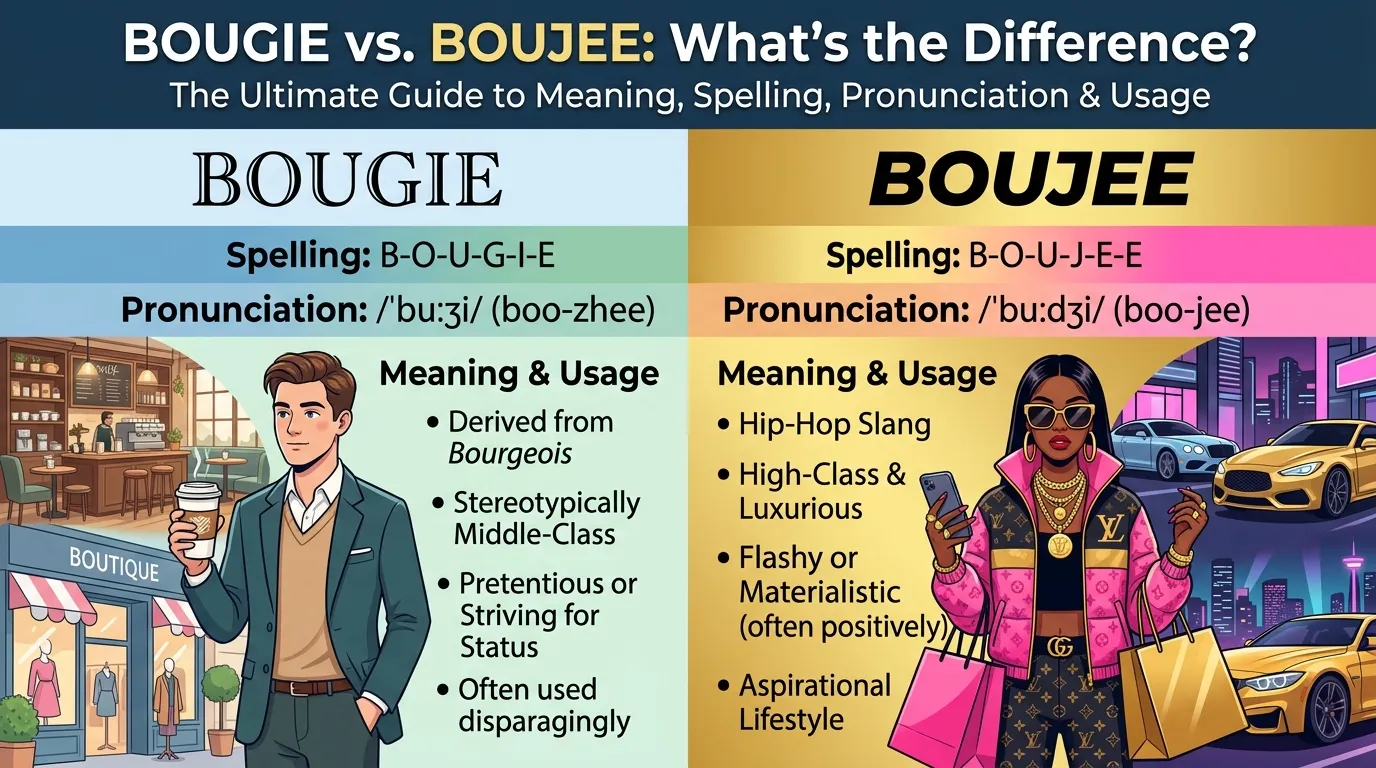
Both bougie and boujee can describe someone or something associated with luxury, expensive tastes, status, or a desire to appear wealthy. However, bougie is the older and more established spelling in English, while boujee is a newer slang spelling that became especially popular through modern hip-hop, social media, and internet culture.
The difference also involves tone, context, and cultural usage. Calling someone bougie can mean they enjoy upscale things, act snobbish, or have fancy tastes. Boujee often has a stronger modern slang feel and may suggest a flashy, glamorous, or luxury-focused lifestyle.
In this guide, you will learn the bougie vs. boujee meaning, correct spelling, pronunciation, history, usage differences, tone, examples, common mistakes, synonyms, and the best word to use in casual, professional, academic, and international writing.
Quick Answer: Bougie vs. Boujee
| Word | Main Meaning | Best Used In | Tone |
|---|---|---|---|
| Bougie | Fancy, upscale, snobbish, or associated with middle-class values | General and informal writing | Informal; sometimes critical or playful |
| Boujee | Modern slang for flashy, luxurious, fashionable, or high-maintenance | Social media, music, texting, and casual speech | Very informal and trendy |
The simplest rule
- Use bougie when you want the more established spelling.
- Use boujee when referring to modern slang, internet culture, hip-hop culture, or a playful luxury-focused style.
- Do not use either word in highly formal academic or business writing unless you are directly discussing slang or popular culture.
Correct: She has bougie taste in coffee.
Correct: Their vacation photos looked totally boujee.
Correct: The restaurant offers a bougie dining experience.
Less suitable in formal writing: The company has adopted a boujee corporate strategy.
Are Both Bougie and Boujee Correct?
Yes, both bougie and boujee are recognized in modern usage, but they have different histories and levels of formality.
Bougie is the more traditional and established form. It developed as an informal shortening connected to bourgeois and bourgeoisie, French terms historically related to the middle class.
Boujee is a phonetic and slang-influenced spelling. It became much more visible in modern popular culture, particularly in the 2010s. Today, many people use it online to describe an expensive-looking, glamorous, fashionable, or luxury-loving lifestyle.
So, this is not a simple case of one word being right and the other being wrong.
Instead, think of them this way:
Bougie is the established informal word. Boujee is the modern slang spelling with a stronger pop-culture flavor.
What Does Bougie Mean?
Bougie usually means fancy, upscale, pretentious, snobbish, or overly concerned with expensive things and social status.
The exact meaning depends heavily on context and tone.
Dictionary-style meaning of bougie
Bougie (adjective, informal):
Someone or something that has expensive, refined, or pretentious tastes, often associated with luxury, status, or an attempt to appear sophisticated.
It can also describe a person whose preferences seem unusually fancy or demanding.
Examples of bougie
- She only drinks sparkling water, so her friends call her bougie.
- We went to a bougie brunch place downtown.
- My brother has become bougie about coffee.
- That hotel is way too bougie for my budget.
- They brought imported cheese to a casual picnic. Very bougie.
- I feel bougie when I buy fresh flowers for my apartment every week.
Notice that bougie is not always an insult. It can be playful, teasing, affectionate, or critical.
Bougie as playful teasing
You brought your own fancy pillow to the hotel? You are so bougie.
Here, the speaker is probably joking.
Bougie as criticism
He refuses to eat anywhere without a dress code because he thinks ordinary restaurants are beneath him.
In this context, bougie may suggest snobbery or pretension.
What Does Boujee Mean?
Boujee generally refers to a luxurious, stylish, flashy, fashionable, or expensive lifestyle. It is strongly associated with modern slang and popular culture.
Dictionary-style meaning of boujee
Boujee (adjective, slang):
Displaying or enjoying luxury, expensive tastes, glamour, fashion, or a high-status lifestyle, often in a playful, trendy, or aspirational way.
The word can describe:
- A person
- Clothing
- Food
- Travel
- Home decor
- Beauty products
- A lifestyle
- An event
- Social media content
Examples of boujee
- She booked a boujee hotel with a rooftop pool.
- We had a boujee girls’ night with fancy desserts.
- His birthday party was extremely boujee.
- These candles make my apartment feel boujee.
- I want a boujee vacation without spending too much money.
- That outfit looks so boujee.
Boujee often focuses more on the appearance or enjoyment of luxury than on traditional class identity.
Someone can say I am feeling boujee today simply because they ordered an expensive coffee or wore a stylish outfit.
Bougie vs. Boujee: The Main Difference
The biggest difference is not pronunciation. It is history, tone, and context.
| Feature | Bougie | Boujee |
|---|---|---|
| Spelling style | More established | Modern slang spelling |
| Main background | Connected to bourgeois and bourgeoisie | Influenced by modern slang and pop culture |
| Tone | Informal, sometimes critical | Very informal, playful, trendy |
| Can suggest snobbery | Often | Sometimes |
| Focus on glamour | Sometimes | Often |
| Common in social media | Yes | Very common |
| Suitable for academic writing | Only when discussing the term | Only when discussing slang |
| Suitable for formal business writing | Usually no | No |
| Pronunciation | Usually BOO-zhee | Usually BOO-zhee |
A useful comparison
Bougie:
You care too much about fancy things.
Boujee:
You enjoy looking, feeling, or living fancy.
This is a general distinction, not an absolute rule. Real-life usage often overlaps.
Why Do People Confuse Bougie and Boujee?
People confuse these words for several reasons.
They sound the same
Both are commonly pronounced:
BOO-zhee
IPA: /ˈbuːʒi/
Because the pronunciation is identical or nearly identical, people often choose a spelling based on what they have seen online.
Their meanings overlap
Both words can describe:
- Luxury
- Expensive tastes
- Fancy experiences
- Stylish living
- High-maintenance preferences
- Status-conscious behavior
For example:
That restaurant is bougie.
and
That restaurant is boujee.
Both may communicate that the restaurant feels expensive or upscale. However, boujee sounds more modern and slang-heavy.
Social media changed the spelling people see
Many people first encounter boujee in:
- TikTok videos
- Instagram captions
- Song lyrics
- Memes
- Influencer content
- Casual texting
As a result, they may assume boujee is the standard spelling in every situation.
How to Pronounce Bougie and Boujee
Both words are usually pronounced:
BOO-zhee
IPA: /ˈbuːʒi/
Break it into two parts:
- bou = boo
- gie or jee = zhee
The zh sound is like the sound in:
- measure
- vision
- pleasure
Pronunciation examples
- bougie lifestyle → BOO-zhee lifestyle
- boujee vacation → BOO-zhee vacation
- bougie restaurant → BOO-zhee restaurant
Do not pronounce bougie like boo-gee with a hard G sound.
The History and Etymology of Bougie
The history of bougie is connected to French social-class vocabulary.
From bourgeois to bougie
The word bourgeois originally referred to a member of the middle class, especially in historical European society. Bourgeoisie refers to the middle class as a social group.
Over time, bourgeois developed broader meanings. Depending on context, it could suggest:
- Conventional middle-class values
- Materialism
- Concern with social status
- Comfort and respectability
- A narrow or overly conventional lifestyle
In English, bougie developed as an informal shortened form associated with bourgeois.
Its meaning later expanded. In modern American English, bougie can describe someone who seems:
- Fancy
- Pretentious
- Snobbish
- Materialistic
- Particular about quality
- Interested in luxury
The meaning changed over time
This is important: modern bougie does not always mean exactly what bourgeois means.
Language changes with culture.
Today, someone might say:
I bought the expensive ice cream because I was feeling bougie.
That sentence is playful. It does not require a serious discussion of social class.
The Modern Rise of Boujee
Boujee became highly visible through contemporary Black American slang, hip-hop, popular music, and online culture.
Its modern use helped expand the word’s association with:
- Luxury
- Glamour
- Fashion
- Money
- Success
- High-end experiences
- Looking expensive
- Enjoying the finer things
The spelling boujee also visually matches its common pronunciation, making it especially natural for informal online writing.
Today, phrases such as these are common:
- boujee on a budget
- boujee lifestyle
- stay boujee
- feeling boujee
- boujee vibes
- boujee brunch
- boujee girl
- boujee aesthetic
Because the term has cultural roots and different communities may use it with different shades of meaning, it is best to pay attention to context rather than treating it as a simple formal synonym for luxurious.
Bougie vs. Boujee in Different Contexts
Casual conversation
Both are possible.
Bougie: You are so bougie about bottled water.
Boujee: This picnic turned out so boujee.
Bougie may sound more teasing. Boujee may sound more playful and trendy.
Social media
Boujee is especially common.
Examples:
- Weekend boujee vibes ✨
- Living boujee on a budget
- A little boujee never hurt anybody
- My boujee coffee order
Blogging and lifestyle writing
Choose based on your audience and brand voice.
Bougie works well for topics such as:
- Why Is Everyone So Bougie About Coffee?
- 10 Bougie Habits That Feel Surprisingly Affordable
Boujee works well for:
- How to Create a Boujee Bedroom on a Budget
- 15 Boujee Party Ideas for Your Next Celebration
Both can work in lifestyle blogs, but consistency matters.
Business writing
Neither word is usually appropriate in formal business communication.
Instead of:
Our brand offers a boujee customer experience.
Use:
Our brand offers a premium customer experience.
Other alternatives include:
- Upscale
- Premium
- Luxury
- High-end
- Sophisticated
- Exclusive
Academic writing
Avoid using either word unless your topic is specifically about language, culture, slang, music, or social identity.
Instead of:
Consumers prefer boujee products.
Write:
Consumers may prefer products associated with luxury, status, or premium quality.
Journalism
Use the term when relevant to the subject or when accurately reflecting a person’s language, but provide context if readers may not understand it.
For general reporting, clearer alternatives may include:
- Luxury-oriented
- Upscale
- Status-conscious
- Affluent-looking
- High-end
Technical and professional writing
Neither bougie nor boujee belongs in technical documentation unless you are quoting a user or discussing language.
Technical writing values precise descriptions.
Instead of:
The new design looks boujee.
Write:
The new design uses premium materials and decorative finishes.
Sports writing
Neither term has a standard technical sports meaning.
However, in casual sports commentary, someone might jokingly call an athlete’s travel habits, fashion, or celebrations bougie.
The team traveled in style with a pretty bougie pregame setup.
This is conversational, not formal sports terminology.
Is Bougie an Adjective, Noun, or Something Else?
In modern everyday English, bougie is mainly used as an adjective.
Adjective
- a bougie restaurant
- bougie taste
- a bougie lifestyle
- bougie coffee
- bougie decor
Predicative adjective
- That place is bougie.
- She is bougie.
- This feels bougie.
Boujee is also primarily used as an adjective.
- boujee clothes
- a boujee vacation
- This looks boujee.
- They are feeling boujee.
Can you use them as nouns?
Not usually in standard grammar.
Avoid:
She is a bougie.
This can sound unnatural or context-dependent.
A more natural sentence is:
She is bougie.
or:
She has a bougie lifestyle.
Common Collocations With Bougie and Boujee
A collocation is a word combination that sounds natural because speakers commonly use the words together.
Common bougie collocations
- bougie lifestyle
- bougie taste
- bougie restaurant
- bougie brunch
- bougie coffee
- bougie habits
- bougie neighborhood
- bougie attitude
- bougie decor
- bougie version
Common boujee collocations
- boujee vibes
- boujee lifestyle
- boujee aesthetic
- boujee vacation
- boujee party
- boujee brunch
- boujee outfit
- boujee hotel
- boujee experience
- boujee on a budget
Natural expressions
- feeling bougie
- stay bougie
- a little bougie
- extra bougie
- too bougie for me
- bougie on a budget
- living the boujee life
These expressions are highly informal.
Synonyms for Bougie and Boujee
The best synonym depends on the meaning you want.
When you mean luxurious or expensive
- Luxurious
- Upscale
- High-end
- Premium
- Fancy
- Exclusive
- Elegant
- Lavish
When you mean stylish or glamorous
- Chic
- Glamorous
- Fashionable
- Stylish
- Sophisticated
- Trendy
When you mean pretentious or snobbish
- Pretentious
- Snobbish
- Posh
- Status-conscious
- Self-important
Be careful: these words are not exact synonyms.
For example, luxurious is usually neutral or positive. Pretentious is clearly negative.
Antonyms of Bougie and Boujee
Possible antonyms include:
- Simple
- Basic
- Modest
- Casual
- Plain
- Down-to-earth
- Unpretentious
- Low-key
- Budget-friendly
Examples:
Bougie: an upscale, expensive dinner
Low-key: a simple dinner at home
Boujee: glamorous vacation plans
Modest: practical, affordable travel plans
Bougie vs. Boujee: Tone and Formality
The tone of a word can completely change how a sentence feels.
| Context | Bougie | Boujee |
|---|---|---|
| Friendly conversation | Good | Good |
| Text messages | Good | Excellent |
| Social media | Good | Excellent |
| Music and pop culture | Good | Excellent |
| Lifestyle blog | Good | Good |
| Product marketing | Sometimes | Rarely |
| Business email | Avoid | Avoid |
| Academic essay | Avoid unless discussing slang | Avoid unless discussing slang |
| News analysis | Context-dependent | Context-dependent |
| Technical document | Avoid | Avoid |
Which one sounds more negative?
Often, bougie can sound more critical because of its connection to pretension, snobbery, and social status.
Boujee often sounds more playful or aspirational.
Compare:
He is too bougie to eat fast food.
This may criticize him.
We are getting boujee tonight.
This sounds more like excitement about enjoying something fancy.
Again, context and speaker intent matter.
Bougie vs. Boujee Around the World
Both terms are strongly associated with informal American English and global internet culture.
American English
Both are understood, especially by younger speakers and people familiar with online culture.
Bougie has broader recognition as an established informal word.
Boujee has a stronger connection to current slang and popular culture.
British English
British English speakers may understand both terms through global media and social media. However, other words may be more natural depending on the meaning:
- Posh
- Fancy
- Swanky
- Flash
- Snobbish
For example:
That restaurant is quite posh.
may sound more naturally British than:
That restaurant is boujee.
However, language is changing quickly, and boujee is increasingly recognizable internationally.
International English
If your audience includes readers from many countries, consider clarity.
Instead of bougie or boujee, use a direct word when possible:
- Luxury
- Expensive
- Upscale
- Stylish
- High-end
- Pretentious
This is especially helpful in professional and educational writing.
Common Mistakes With Bougie and Boujee
Mistake: Assuming boujee is the formal spelling
Incorrect assumption: Boujee is the standard spelling everywhere.
Better: Use bougie for the more established informal term. Use boujee when the modern slang tone is intentional.
Mistake: Using the words in formal reports
Awkward: The organization introduced a boujee pricing strategy.
Better: The organization introduced a premium pricing strategy.
Mistake: Using bougie when you mean only expensive
Bougie can imply more than price. It may also suggest attitude, taste, status, or pretension.
Less precise: The laptop is bougie.
Clearer: The laptop is high-end and expensive.
Mistake: Thinking bougie always means rich
A person does not need to be wealthy to act or feel bougie.
I bought the fancy chocolate as a treat. I feel bougie today.
The speaker may simply be enjoying a small luxury.
Mistake: Treating bougie and bourgeois as perfect synonyms
They are related historically, but they are not interchangeable in modern English.
Bourgeois has stronger historical, political, social, and theoretical meanings.
Bougie is usually modern informal speech.
Awkward vs. Natural Examples
Example 1
Awkward: Our company is very boujee in its approach to customer satisfaction.
Natural: Our company provides a premium customer experience.
Example 2
Awkward: The professor presented a boujee analysis of economics.
Natural: The professor presented a sophisticated analysis of economics.
Example 3
Awkward: Please attend the boujee corporate meeting at 9 a.m.
Natural: Please attend the executive meeting at 9 a.m.
Example 4
Natural casual use: We made the living room look boujee with candles and fresh flowers.
Example 5
Natural social media use: Creating boujee vibes without spending a fortune.
How to Choose Between Bougie and Boujee
Use this simple decision guide.
Choose bougie when:
- You want the more established spelling.
- You are describing fancy or pretentious tastes.
- You are teasing someone about being high-maintenance.
- You are writing informal lifestyle content.
- You want a slightly broader and less trend-specific term.
Example: My friends think I am bougie because I only buy fancy cheese.
Choose boujee when:
- You want a modern slang tone.
- You are writing for social media.
- You are describing glamorous or luxury-focused vibes.
- You are discussing pop culture.
- You want the word to feel playful and trendy.
Example: We turned a simple dinner into a boujee celebration.
Choose neither when:
- You are writing a formal report.
- You are writing an academic paper unrelated to slang.
- You need precise technical language.
- Your international audience may not understand the slang.
Use:
- upscale
- luxury
- premium
- high-end
- sophisticated
- fashionable
- pretentious
depending on your exact meaning.
A Comparison Table for Everyday Use
| Situation | Best Choice | Example |
|---|---|---|
| Fancy coffee preferences | Bougie | She is bougie about coffee. |
| Glamorous social media post | Boujee | Boujee brunch vibes all weekend. |
| Luxury hotel description | High-end or luxury | We stayed at a luxury hotel. |
| Teasing a picky friend | Bougie | You are too bougie for regular popcorn. |
| Playful party description | Boujee | They threw a boujee birthday party. |
| Business brochure | Premium or upscale | Enjoy our premium services. |
| Academic paper | Precise formal language | The study examines luxury consumption. |
| International website | Luxury or upscale | Discover upscale dining options. |
Memory Tricks for Bougie vs. Boujee
Here are two easy ways to remember the difference.
Bougie = the established choice
Think:
Bougie begins with the spelling pattern connected to bourgeois.
If you want the older, more established informal form, choose bougie.
Boujee = extra trendy spelling
Think:
Boujee has the extra modern slang feel.
The spelling looks more like the spoken ending jee, which can help you remember its strong connection to internet and pop-culture usage.
Another quick memory trick:
Bougie = established. Boujee = trendy.
The meanings overlap, but the tone is different.
Everyday Examples of Bougie
- My dog has a bougie bed that costs more than mine.
- She is bougie about skincare products.
- We found a small but bougie bakery near the office.
- His bougie taste in water includes three different brands.
- I did not know camping could be this bougie.
- They turned a backyard dinner into a bougie event.
- That grocery store has a surprisingly bougie cheese section.
- My bougie side comes out when I travel.
- She wants a bougie wedding but has a realistic budget.
- This is the bougie version of a grilled cheese sandwich.
Everyday Examples of Boujee
- We had a boujee movie night with fancy snacks.
- Her apartment has a clean, boujee aesthetic.
- I am trying to have a boujee vacation on a budget.
- This little café feels surprisingly boujee.
- They arrived at the party looking completely boujee.
- I bought a fancy dessert because I was feeling boujee.
- Our picnic became boujee after someone brought a charcuterie board.
- She loves boujee hotels with spa services.
- The decorations gave the room a boujee vibe.
- Tonight calls for a boujee dinner.
Formal Alternatives to Bougie and Boujee
When writing for work, school, journalism, or professional audiences, replace slang with a word that clearly matches your intended meaning.
| Informal Meaning | Better Formal Alternative |
|---|---|
| Fancy and expensive | Luxurious, high-end, upscale |
| High quality | Premium, sophisticated |
| Stylish | Fashionable, elegant |
| Glamorous | Luxurious, refined |
| Pretentious | Ostentatious, pretentious |
| Status-focused | Status-conscious |
| Picky about quality | Discerning, particular |
| Expensive-looking | Premium-looking, upscale |
Example conversions
Casual: Her house is so boujee.
More formal: Her home has a luxurious and sophisticated design.
Casual: He has bougie taste.
More formal: He has expensive and refined tastes.
Casual: This is a boujee restaurant.
More formal: This is an upscale restaurant.
Related Words You Should Know
Bourgeois
A word with historical and social meanings related to the middle class. It can also describe conventional or materialistic attitudes, depending on context.
Bourgeoisie
A noun referring historically to the middle class, especially in social, economic, and political discussions.
Posh
Especially common in British English. It often means stylish, expensive, or associated with wealth and high social status.
Fancy
A broad, common word for something expensive, decorative, elaborate, or high-quality.
Swanky
Informal. Stylish, fashionable, and expensive-looking.
Pretentious
Trying to appear more important, sophisticated, wealthy, or knowledgeable than is genuine.
These words overlap with bougie, but each has its own tone.
Practical Writing Recommendations
For American writers
Use bougie for the more established informal spelling.
Use boujee when the modern slang tone is intentional.
For British writers
Consider whether posh, fancy, or swanky would sound more natural for your audience. Bougie and boujee are understandable but more strongly tied to American and global internet slang.
For international audiences
Avoid both if clarity is important. Choose a direct word such as luxurious, upscale, or expensive.
For bloggers
Both can work well in informal lifestyle content.
For example:
- Bougie Travel on a Budget
- Boujee Bedroom Ideas
- Bougie Coffee Habits
- How to Create a Boujee Aesthetic
Choose one spelling based on your brand voice and stay consistent within the article unless you are specifically comparing the terms.
For businesses
Avoid slang in formal brand communication unless the target audience is young and the brand intentionally uses a casual voice.
For students and academic writers
Do not use bougie or boujee as replacements for precise academic vocabulary.
If discussing social class, luxury consumption, slang, or language, define the term and use it carefully.
For journalists
Use the word only when it accurately reflects the subject, cultural context, or quoted language. Avoid slang when a clearer neutral term better communicates the meaning.
Frequently Asked Questions
Is bougie or boujee the correct spelling?
Both are used, but bougie is the more established spelling. Boujee is a newer slang spelling strongly associated with modern popular culture, social media, and casual language.
Do bougie and boujee mean the same thing?
Their meanings overlap, but their tone can differ. Bougie often suggests fancy, upscale, pretentious, or snobbish tastes. Boujee more often suggests a glamorous, stylish, luxurious, or trendy lifestyle.
Is boujee a real word?
Yes. Boujee is widely used as modern slang, especially in casual conversation, social media, music, and pop culture. It is not usually suitable for formal academic or business writing.
How do you pronounce bougie and boujee?
Both are commonly pronounced BOO-zhee, with the IPA pronunciation /ˈbuːʒi/.
Does bougie mean rich?
Not necessarily. Bougie can describe someone who enjoys fancy or expensive things, even if they are not wealthy. It can also refer to a person acting particular, upscale, or pretentious.
Is bougie a compliment or an insult?
It can be either. The meaning depends on context and tone. Friends may use it playfully, while critics may use it to suggest snobbery, materialism, or pretension.
What does feeling boujee mean?
Feeling boujee usually means enjoying or pretending to enjoy a fancy, luxurious, stylish, or high-end experience. It is often said jokingly or playfully.
What is boujee on a budget?
Boujee on a budget means creating or enjoying a luxurious-looking lifestyle without spending a large amount of money. The phrase is common in lifestyle blogs and social media.
Can I use bougie in a formal essay?
Usually, no. Unless your essay is specifically discussing slang, culture, or the word itself, use a more precise formal term such as upscale, luxurious, status-conscious, or pretentious.
Which is better for social media: bougie or boujee?
Both can work, but boujee usually sounds more current, playful, and slang-focused. Bougie may feel slightly more established and can carry a stronger teasing or critical meaning.
Conclusion
The difference between bougie vs. boujee is mainly about history, spelling preference, tone, and context. Both words can describe fancy tastes, luxury, expensive experiences, stylish living, or an interest in high-end things.
Bougie is the more established informal form and may suggest upscale, picky, pretentious, or snobbish behavior. Boujee is a newer, highly informal slang spelling that often feels more playful, glamorous, trendy, and connected to modern pop culture.
For everyday American English, choose bougie when you want the more established term. Choose boujee when you want a strong social media, slang, or luxury-vibes tone. For formal, academic, business, technical, or international writing, choose a clearer alternative such as luxurious, upscale, premium, high-end, elegant, or pretentious, depending on your meaning.
The best final rule is simple: match the word to your audience and purpose. Bougie and boujee may sound the same, but understanding their subtle differences will help your writing sound more natural, accurate, and confident.