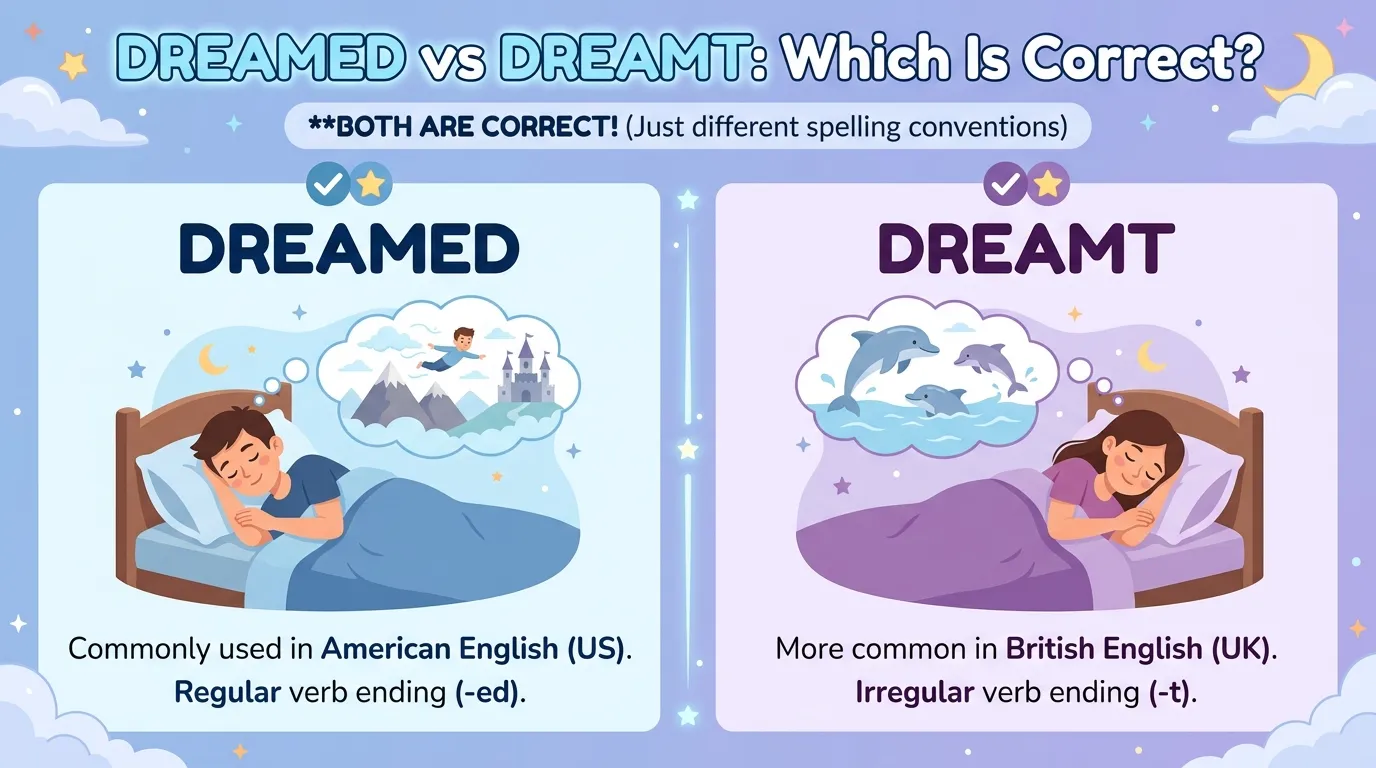
When you are writing about something that happened while you were asleep, should you say dreamed or dreamt? The good news is that both words are correct. They are two past forms of the verb dream.
The main difference is regional usage and style. In American English, dreamed is much more common. In British English and some other varieties of English, dreamt is widely used and sounds completely natural. Both forms can mean that someone experienced a dream while sleeping or strongly imagined or hoped for something.
For example:
- I dreamed about my childhood last night.
- I dreamt about my childhood last night.
- She dreamed of becoming a doctor.
- She dreamt of becoming a doctor.
All four sentences are grammatically correct.
This guide explains dreamed vs dreamt, including their meanings, pronunciation, grammar, regional preferences, word history, common expressions, mistakes, formal and informal usage, and practical recommendations for different types of writing.
Quick Answer: Is Dreamed or Dreamt Correct?
Both dreamed and dreamt are correct past-tense and past-participle forms of dream.
The most important difference is frequency and regional preference:
| Word | Correct? | Common in American English? | Common in British English? |
|---|---|---|---|
| dreamed | Yes | Very common | Common |
| dreamt | Yes | Less common | Very common |
The simple rule
Use dreamed if you are writing primarily in American English and want the most natural, widely familiar choice.
Use dreamt if you are writing in British English or want a style associated with British usage.
Neither spelling is a mistake.
What Does Dreamed Mean?
Dreamed is the simple past tense and past participle of dream.
It can refer to an experience during sleep:
I dreamed about flying over the ocean.
It can also describe an imagined possibility, hope, ambition, or desire:
She dreamed of owning her own business.
The word can therefore have both a literal and a figurative meaning.
Dictionary-style definition of dreamed
Dreamed: the past tense and past participle of dream, meaning to experience images, thoughts, or feelings during sleep, or to imagine, hope for, or strongly desire something.
Examples of dreamed
- I dreamed about my old school.
- He dreamed that he was walking through a forest.
- We dreamed of traveling around the world.
- She had always dreamed of becoming a writer.
- They dreamed about what life might be like in the future.
In American English, dreamed is usually the safest choice.
What Does Dreamt Mean?
Dreamt is another past-tense and past-participle form of dream.
Its meaning is essentially the same as dreamed.
For example:
I dreamt about my grandfather last night.
This means the same thing as:
I dreamed about my grandfather last night.
Likewise:
He dreamt of becoming an astronaut.
means the same thing as:
He dreamed of becoming an astronaut.
Dictionary-style definition of dreamt
Dreamt: the past tense and past participle of dream, referring to experiencing a dream during sleep or imagining, hoping for, or desiring something.
The important point is that dreamt is not an incorrect spelling of dreamed.
It is a legitimate form of the verb.
Dreamed vs Dreamt: The Key Difference
The central difference is not meaning. It is primarily regional preference, frequency, and style.
Dreamed
Dreamed is especially common in American English.
Examples:
- I dreamed about you last night.
- She dreamed of opening a restaurant.
- We dreamed that we were back in school.
Dreamt
Dreamt is especially common in British English.
Examples:
- I dreamt about you last night.
- She dreamt of opening a restaurant.
- We dreamt that we were back in school.
Both forms are grammatical.
At a glance
| Feature | Dreamed | Dreamt |
|---|---|---|
| Part of speech | Verb form | Verb form |
| Base verb | Dream | Dream |
| Past tense | Yes | Yes |
| Past participle | Yes | Yes |
| Meaning | Dreamed | Same |
| American English | Preferred | Less common |
| British English | Common | Very common |
| Formal writing | Acceptable | Acceptable |
| Casual writing | Very common | Common in British usage |
| Pronunciation | Usually /driːmd/ | Usually /drɛmt/ |
Why Do People Confuse Dreamed and Dreamt?
The confusion comes from the unusual way dream forms its past tense.
Many English verbs have predictable -ed endings:
- walk → walked
- talk → talked
- play → played
- work → worked
Following that pattern, dream → dreamed makes perfect sense.
However, English also has many verbs with alternative or irregular past forms:
- learn → learned / learnt
- burn → burned / burnt
- smell → smelled / smelt
- spell → spelled / spelt
- dream → dreamed / dreamt
This creates a pattern in which some speakers naturally choose the shorter form ending in -t.
There is also a regional element. British English frequently preserves forms such as dreamt, while American English generally favors forms ending in -ed.
Dreamed vs Dreamt Pronunciation
The two forms are pronounced differently.
How to pronounce dreamed
Dreamed is generally pronounced like:
dreemd
The pronunciation is approximately /driːmd/.
The ending is compressed into the final d sound rather than being pronounced as a separate syllable.
dreamed = dream + d
It is usually one syllable.
How to pronounce dreamt
Dreamt is generally pronounced approximately:
dremt
Its pronunciation is represented as /drɛmt/.
It also has one syllable.
Pronunciation comparison
| Word | Approximate pronunciation | Syllables |
|---|---|---|
| dream | dreem | 1 |
| dreamed | dreemd | 1 |
| dreamt | dremt | 1 |
The vowel changes slightly between the two forms.
Are Dreamed and Dreamt Both Past Tense?
Yes.
Both can function as the simple past tense of dream.
I dreamed about my vacation.
I dreamt about my vacation.
Both describe something that happened in the past.
They can also both function as the past participle.
I have dreamed about this moment for years.
I have dreamt about this moment for years.
Therefore, the difference is not grammatical tense.
Dreamed vs Dreamt in American English
If your goal is to write natural American English, dreamed is generally the better choice.
This is particularly true for:
- American school assignments
- Business writing
- American news writing
- Professional communication
- Academic writing
- Websites targeting U.S. readers
- General American English content
- Everyday conversation
For example:
I dreamed about the house again.
This sounds natural to an American reader.
Dreamt is still correct in American English, but it may sound somewhat more literary, old-fashioned, poetic, or influenced by British English depending on the context.
Recommended American usage
Prefer:
She dreamed of becoming a scientist.
over:
She dreamt of becoming a scientist.
This does not mean the second sentence is wrong. It simply means dreamed is usually the more natural American choice.
Dreamed vs Dreamt in British English
British English commonly uses dreamt.
For many British speakers, sentences such as these sound perfectly ordinary:
I dreamt about you last night.
She dreamt that she was flying.
He dreamt of becoming a professional musician.
Dreamed is also used in British English, so British speakers are not limited to dreamt.
The choice can depend on the speaker, writing style, and context.
Which Is More Formal: Dreamed or Dreamt?
Neither is inherently more grammatically formal.
However, dreamt can sometimes sound more literary or traditional, especially to American readers.
Compare:
The child dreamed of becoming a pilot.
The child dreamt of becoming a pilot.
The first sounds neutral and straightforward in American English. The second may have a slightly more literary or British flavor.
In British English, however, dreamt does not necessarily sound formal. It can be completely ordinary.
Practical recommendation
For neutral American professional writing, choose dreamed.
For British writing, choose whichever form fits your established style.
Dreamed vs Dreamt in Academic Writing
Both forms are grammatically acceptable in academic writing.
However, academic writers should prioritize consistency.
If your paper follows American English conventions, dreamed is usually the more natural option.
Example:
Participants reported that they dreamed about their previous experiences.
If your publication or institution follows British English, dreamt may be preferred:
Participants reported that they dreamt about their previous experiences.
Do not switch randomly between the two forms.
Good academic practice
Choose one regional variety of English and maintain it throughout your work.
Dreamed vs Dreamt in Business Writing
Business writing usually benefits from clarity and familiar vocabulary.
For an American audience, dreamed is generally preferable.
The founder dreamed of building a company that would serve small businesses.
For a British audience, dreamt can sound natural:
The founder dreamt of building a company that would serve small businesses.
In either case, the choice is stylistic rather than grammatical.
Dreamed vs Dreamt in Journalism
Both forms can appear in journalism.
The preferred form usually depends on the publication’s regional style.
An American publication may write:
The athlete dreamed of winning an Olympic medal.
A British publication may write:
The athlete dreamt of winning an Olympic medal.
The same meaning is communicated.
Dreamed vs Dreamt in Casual Conversation
In American conversation, dreamed is generally more common:
I dreamed about work last night.
In British conversation, dreamt may be very natural:
I dreamt about work last night.
Neither form changes the meaning.
Dreamed and Dreamt With About
Both forms commonly appear with about when describing the subject of a dream.
Examples with dreamed
- I dreamed about my childhood.
- She dreamed about her old friends.
- He dreamed about being back at school.
- We dreamed about living near the ocean.
Examples with dreamt
- I dreamt about my childhood.
- She dreamt about her old friends.
- He dreamt about being back at school.
- We dreamt about living near the ocean.
The grammatical pattern is identical.
Dreamed and Dreamt With Of
Both forms are also commonly followed by of.
Dream of can describe either a sleeping dream or a hope, ambition, or desire.
Examples:
She dreamed of becoming a doctor.
She dreamt of becoming a doctor.
The figurative meaning is especially common.
Dream of vs Dream about
There can be a slight difference in typical usage.
Dream about often introduces the subject or events experienced in a dream:
I dreamed about a strange city.
Dream of often describes a hope, ambition, or strong desire:
I dreamed of becoming a pilot.
But this distinction is not absolute.
Common Collocations With Dreamed and Dreamt
A collocation is a group of words that commonly occur together.
Here are useful combinations:
Dreamed about
- dreamed about home
- dreamed about work
- dreamed about school
- dreamed about the future
- dreamed about a person
- dreamed about flying
Dreamed of
- dreamed of success
- dreamed of becoming famous
- dreamed of owning a house
- dreamed of a better life
- dreamed of winning
- dreamed of traveling
Dreamt about
- dreamt about home
- dreamt about school
- dreamt about the future
- dreamt about flying
- dreamt about an old friend
Dreamt of
- dreamt of success
- dreamt of becoming a writer
- dreamt of freedom
- dreamt of winning
- dreamt of a better future
Common Expressions With Dream
The choice between dreamed and dreamt also appears in familiar expressions.
Dreamed of a better life
They dreamed of a better life for their children.
Dreamed of becoming
She dreamed of becoming a teacher.
Dreamed about
I dreamed about the trip last night.
Dream come true
This expression does not use either past form:
Winning the championship was a dream come true.
Beyond your wildest dreams
The success was beyond her wildest dreams.
In your dreams
You think he will agree? In your dreams!
This can be humorous or sarcastic.
Literal and Figurative Meanings
The verb dream has two major areas of meaning.
Literal meaning
The literal meaning relates to mental experiences during sleep.
I dreamed that I was swimming in a huge lake.
Here, the person actually experienced a dream while sleeping.
Figurative meaning
The figurative meaning involves imagining, hoping, or strongly wanting something.
She dreamed of becoming a successful artist.
Here, dreamed does not necessarily refer to sleep. It describes an ambition.
Both dreamed and dreamt work in these contexts.
Is Dreamt an Old-Fashioned Word?
Not necessarily.
Dreamt may sound old-fashioned to some American English speakers, but it remains a normal and widely used form in British English.
For example, a British speaker might naturally say:
I dreamt about it last night.
There is nothing outdated about that sentence.
The perception of dreamt depends heavily on the variety of English the reader is accustomed to.
Word History and Etymology of Dream
The word dream has a long history in English.
The modern noun and verb developed from older Germanic forms. The meaning of dream has changed and expanded over time, eventually covering both experiences during sleep and imaginative hopes or aspirations.
The verb developed competing past forms, including the modern dreamed and dreamt.
The -ed form follows the regular pattern of English past-tense formation, while the shorter -t form belongs to a broader group of verbs that developed alternative forms ending in -t.
This helps explain why English has pairs such as:
- dreamed / dreamt
- learned / learnt
- burned / burnt
- smelled / smelt
- spelled / spelt
The exact popularity of these alternatives varies by region.
Dreamed vs Dreamt: Grammatical Roles
Both words can serve the same grammatical functions.
Simple past
I dreamed about my old house.
I dreamt about my old house.
Present perfect
I have dreamed about this many times.
I have dreamt about this many times.
Past perfect
She had dreamed of success since childhood.
She had dreamt of success since childhood.
Passive-like participial constructions
The past participle can appear in constructions requiring a participle:
He had often dreamed of the opportunity.
He had often dreamt of the opportunity.
Common Mistakes With Dreamed and Dreamt
Mistake: Thinking dreamt is incorrect
Incorrect assumption:
Dreamt is a spelling mistake.
Correction:
Dreamt is a correct past form of dream.
Mistake: Thinking dreamed is only American
Incorrect assumption:
British English cannot use dreamed.
Correction:
British English can use dreamed. Dreamt is simply a particularly common alternative.
Mistake: Mixing regional styles unnecessarily
A piece of writing may use dreamed in one paragraph and dreamt in another without any reason.
This is not necessarily a grammatical error, but it can make the style feel inconsistent.
Better approach: Pick the form that matches your intended variety of English and use it consistently.
Mistake: Using dream instead of dreamed for a past event
Yesterday, I dream about my old school.
Better:
Yesterday, I dreamed about my old school.
Or:
Yesterday, I dreamt about my old school.
Awkward vs Natural Examples
Example 1
Awkward for most American readers:
I dreamt about the meeting last night.
More natural American English:
I dreamed about the meeting last night.
The first sentence is still grammatically correct.
Example 2
Natural British English:
I dreamt about my childhood.
Also correct:
I dreamed about my childhood.
Example 3
Natural American English:
She dreamed of becoming a singer.
Also correct:
She dreamt of becoming a singer.
Example 4
Incorrect:
She dreamt of became a doctor.
Correct:
She dreamed of becoming a doctor.
or
She dreamt of becoming a doctor.
After dreamed of or dreamt of, use the -ing form when describing an activity or goal.
Formal vs Informal Alternatives
Sometimes you may want to avoid either form, especially if you are trying to make your meaning more precise.
Instead of dreamed about
You could say:
- experienced a dream about
- had a dream about
- imagined
- envisioned
For example:
I had a dream about the ocean.
Instead of dreamed of
You could use:
- hoped to
- aspired to
- wished to
- envisioned
- longed to
- wanted to
For example:
She aspired to become a doctor.
This can sound more precise in formal writing.
However, dreamed of becoming a doctor is perfectly natural and does not need replacing simply because the writing is formal.
Synonyms for Dreamed and Dreamt
The best synonym depends on the intended meaning.
When referring to sleep
Possible alternatives include:
- imagined while sleeping
- experienced a dream
- saw in a dream
Example:
He experienced a dream about his childhood.
When referring to ambition
Possible alternatives include:
- hoped
- wished
- aspired
- envisioned
- imagined
- desired
- longed
- planned
Example:
She hoped to become a scientist.
When referring to imagination
Possible alternatives include:
- imagined
- envisioned
- pictured
- conceived
Antonyms and Related Words
There is no perfect direct antonym for dreamed because its meaning changes with context.
For the sleep-related meaning, related ideas include:
- woke
- awakened
- stayed awake
For the ambition-related meaning, possible contrasting ideas include:
- abandoned
- rejected
- gave up
- accepted reality
Related words include:
- dream
- dreaming
- dreamer
- dreamy
- dreamlike
- daydream
- daydreaming
- dreamworld
- dreamscape
- dreamer
Is Dreamed More Common Than Dreamt?
For American English, yes. Dreamed is generally the more common choice.
For British English, dreamt is highly established and often preferred.
Therefore, asking which word is universally “more correct” is the wrong question.
A better question is:
Which form best fits my audience and variety of English?
For U.S. readers, choose dreamed in most situations.
For U.K. readers, dreamt is perfectly natural.
Dreamed vs Dreamt in International English
International English can be more complicated because English is used by people from many regions.
If you are writing for a broad international audience and have no specific regional style guide, dreamed is a clear and widely recognized option.
This is especially useful for:
- websites
- educational materials
- international business
- software documentation
- general blogs
- global marketing
Still, dreamt is easy for most proficient English speakers to understand.
Dreamed vs Dreamt in Technical Writing
Technical writing rarely needs the verb dream unless the subject involves psychology, artificial intelligence, human behavior, sleep research, simulation, or figurative language.
If you do use it, clarity is more important than choosing one form over the other.
For an American technical audience:
The participants reported that they dreamed during the experiment.
For a British audience:
The participants reported that they dreamt during the experiment.
Both are grammatically sound.
Dreamed vs Dreamt in Sports Writing
Sports writing often uses dreamed of to describe an athlete’s ambitions.
American style:
The young player dreamed of winning a championship.
British style:
The young player dreamt of winning a championship.
Both communicate the same idea.
Sports headlines and feature articles may also use dream as a noun:
It was a dream season.
Dreamed vs Dreamt in Blogging
For a blog targeting American readers, dreamed is usually the smoother choice.
For example:
Have you ever dreamed about the same place repeatedly?
A British-oriented blog might naturally write:
Have you ever dreamt about the same place repeatedly?
If your website has a defined audience, follow that audience’s regional English consistently.
A Useful Memory Trick
Remember this simple rule:
America → dreamed
Britain → dreamt is especially common
You can also connect dreamed with other regular -ed forms:
dreamed
learned
burned
spelled
And remember that British English often uses alternative -t forms:
dreamt
learnt
burnt
spelt
These are tendencies, not absolute rules.
How to Choose Between Dreamed and Dreamt
Use this checklist before choosing.
Choose dreamed when:
- You are writing for an American audience.
- You want the most familiar American form.
- You are writing a U.S. academic paper.
- You are creating American business content.
- You want a straightforward neutral style.
- Your existing document consistently uses American English.
Choose dreamt when:
- You are writing in British English.
- Your publication uses British spelling conventions.
- You are writing dialogue for a British character.
- You prefer the established British style.
- Your surrounding text already uses similar -t forms such as learnt and burnt.
Most important rule
Consistency matters more than choosing one form as universally correct.
Dreamed vs Dreamt Comparison Table
| Question | Dreamed | Dreamt |
|---|---|---|
| Is it correct? | Yes | Yes |
| Is it a form of dream? | Yes | Yes |
| Can it describe sleeping? | Yes | Yes |
| Can it describe ambition? | Yes | Yes |
| Can it be a past tense? | Yes | Yes |
| Can it be a past participle? | Yes | Yes |
| Common in American English? | Yes | Less common |
| Common in British English? | Yes | Yes |
| Meaning different? | No | No |
| Suitable for formal writing? | Yes | Yes |
| Suitable for casual writing? | Yes | Yes |
| Main difference | Regional preference | Regional preference |
More Everyday Examples
Here are examples showing how both forms work naturally.
Sleeping dreams
I dreamed about my childhood home.
I dreamt about my childhood home.
She dreamed that she was flying.
She dreamt that she was flying.
We dreamed about being on a tropical island.
We dreamt about being on a tropical island.
Goals and ambitions
He dreamed of becoming a professional athlete.
He dreamt of becoming a professional athlete.
She dreamed of opening her own store.
She dreamt of opening her own store.
Hopes
They dreamed of a better future.
They dreamt of a better future.
I dreamed of traveling the world.
I dreamt of traveling the world.
What About Dreamed vs Dreamt in Past Participles?
Both can follow have, has, and had.
American English
I have dreamed about this many times.
She had dreamed of success.
They have dreamed of moving abroad.
British English
I have dreamt about this many times.
She had dreamt of success.
They have dreamt of moving abroad.
The grammar remains the same.
Frequently Asked Questions About Dreamed vs Dreamt
Is dreamed or dreamt correct?
Both dreamed and dreamt are correct. They are alternative past-tense and past-participle forms of dream. Dreamed is generally preferred in American English, while dreamt is particularly common in British English.
Is dreamt American or British?
Dreamt is used in both American and British English, but it is much more strongly associated with British English. American English generally favors dreamed.
Is dreamed a real word?
Yes. Dreamed is the regular past-tense and past-participle form of dream and is extremely common, especially in American English.
Is dreamt grammatically correct?
Yes. Dreamt is grammatically correct. It can be used as both the simple past and past participle of dream.
Should Americans use dreamed or dreamt?
Americans will generally sound most natural using dreamed. For example, I dreamed about you last night is the usual American phrasing. Dreamt is still correct but is less common.
Do British people say dreamed?
Yes. British English uses both dreamed and dreamt. However, dreamt is a particularly common British form.
What is the past tense of dream?
The past tense of dream can be dreamed or dreamt. Both forms are correct.
What is the past participle of dream?
The past participle can also be dreamed or dreamt.
For example:
I have dreamed about it.
I have dreamt about it.
Does dreamed mean something different from dreamt?
No. In most contexts, dreamed and dreamt have the same meaning. The main difference is regional preference and style.
Which is better for SEO content targeting Americans?
For content written in American English, dreamed is generally the better default. It is familiar to American readers and fits standard U.S. usage. If the content targets British readers, dreamt may be the more natural choice.
Final Conclusion: Dreamed vs Dreamt
The answer to dreamed vs dreamt is simple: both are correct.
Dreamed and dreamt are alternative past-tense and past-participle forms of dream. They can both describe a dream experienced during sleep or a hope, ambition, or desire.
The biggest difference is regional usage. Dreamed is the usual choice in American English, while dreamt is especially common in British English. British speakers can also use dreamed, and American speakers can use dreamt.
If you are writing for a U.S. audience, dreamed is the safest and most natural choice:
I dreamed about my old home.
If you are writing for a British audience, dreamt may sound more natural:
I dreamt about my old home.
Neither spelling should be treated as a mistake. The best approach is to know your audience, choose the appropriate regional form, and remain consistent throughout your writing.