Drier vs dryer is a common English word-choice question because the two words sound almost identical and share the same ending. However, they have different meanings and are used in different situations.
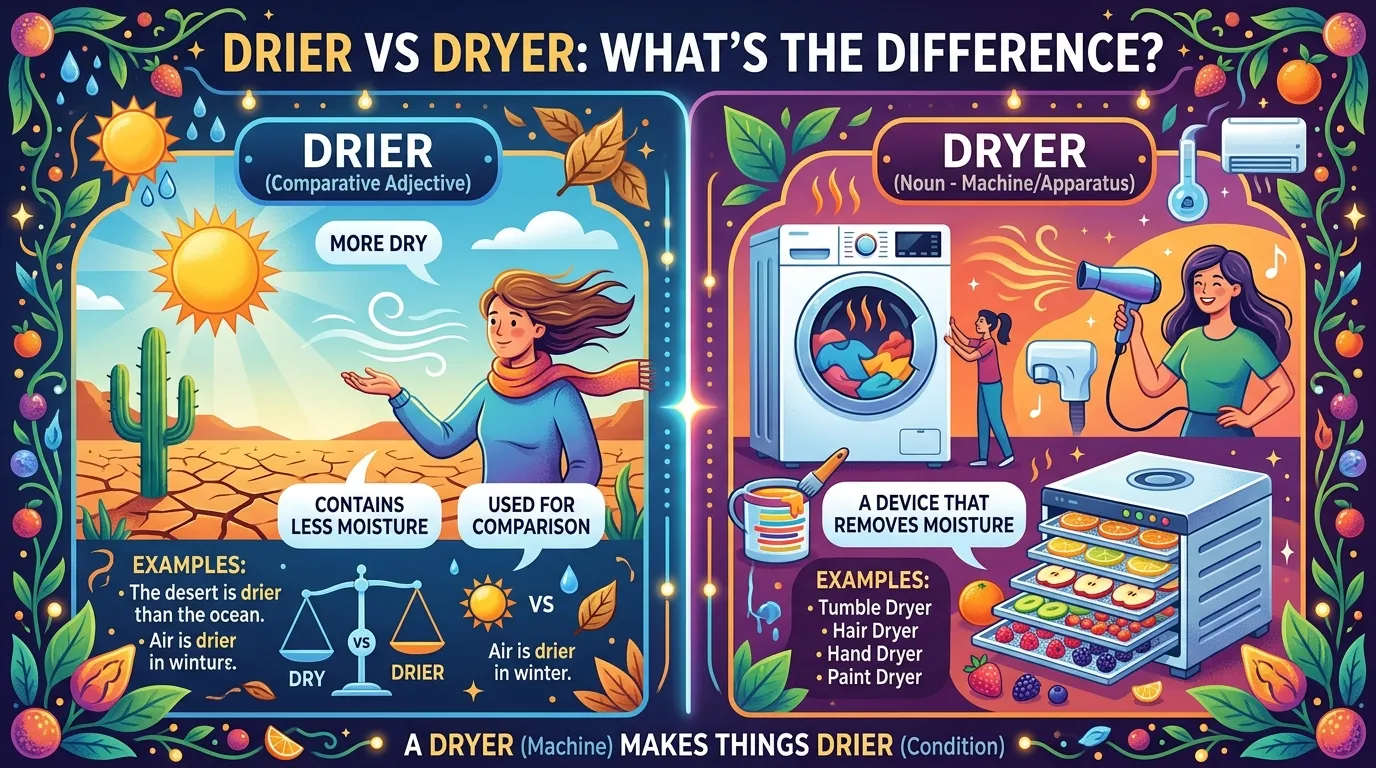
The simplest rule is this: drier is usually the comparative form of dry, while dryer is usually a noun referring to a machine or device that removes moisture. For example, you might say, “The weather is getting drier,” but “Put the clothes in the dryer.”
The confusion becomes stronger because dryer can also appear as a comparative form in some contexts, especially when speakers use dry with the suffix -er. In modern American English, however, drier is the standard comparative spelling when comparing something that is dry.
In this guide, you will learn exactly when to use drier and dryer, how they are pronounced, why they are confused, how they developed, and how they work in everyday, professional, academic, technical, and casual writing. You will also see practical examples and common mistakes so you can choose the correct word with confidence.
Quick Answer: Drier vs Dryer
Here is the easiest way to remember the difference:
| Word | Main meaning | Typical grammatical role | Example |
|---|---|---|---|
| Drier | More dry | Comparative adjective | “This climate is drier than ours.” |
| Dryer | A machine or device that dries something | Noun | “The clothes are in the dryer.” |
| Dryer | A person or thing that dries | Noun | “The hair dryer stopped working.” |
| Drier | Comparative form of dry | Adjective | “The towel feels drier now.” |
The basic rule
Use drier when you mean more dry.
“The desert is drier than the forest.”
Use dryer when you mean a device or machine used for drying.
“I need to buy a new clothes dryer.”
A useful memory trick is:
Drier = more dry
Dryer = a thing that dries
What Does “Drier” Mean?
Drier is most commonly the comparative form of the adjective dry.
The adjective dry describes something that contains little or no moisture. When you compare two things and say that one contains less moisture than the other, you use drier.
Examples of drier
- “Today is drier than yesterday.”
- “This towel is drier than that one.”
- “The soil becomes drier during summer.”
- “Arizona has a drier climate than many eastern states.”
- “My skin feels drier in cold weather.”
- “The bread became drier after sitting out overnight.”
In each sentence, drier means more dry.
Drier as a comparative adjective
The word follows the normal comparative pattern:
dry → drier
The final y changes to i before the comparative ending -er.
Similar examples include:
- happy → happier
- easy → easier
- busy → busier
- noisy → noisier
- messy → messier
- dry → drier
This is why drier is generally the preferred spelling when comparing degrees of dryness.
What Does “Dryer” Mean?
Dryer is commonly a noun for a machine or device that removes moisture.
The most familiar example is a clothes dryer, an appliance that uses heat and airflow to dry clothing.
Examples of dryer as a noun
- “The washing machine is finished, so I will use the dryer.”
- “The dryer is making a strange noise.”
- “Please empty the dryer.”
- “We bought a new electric dryer.”
- “The towels need another cycle in the dryer.”
The word also appears in names for other drying devices.
Hair dryer
A hair dryer is a device used to dry and style hair.
“She used a hair dryer before leaving the house.”
Hand dryer
A hand dryer is a machine commonly found in public restrooms.
“The restroom has an automatic hand dryer.”
Food dryer
A food dryer or dehydrator removes moisture from food.
“We use a food dryer to preserve fruit.”
In these examples, dryer names a device.
Drier vs Dryer: The Key Difference
The easiest distinction is grammatical and semantic.
Drier usually describes something.
Dryer usually names something.
Compare these sentences:
“The air is drier today.”
Here, drier describes the air.
“The dryer is running.”
Here, dryer names an appliance.
This distinction solves most usage questions.
A simple test
Ask yourself:
Am I saying “more dry”?
If yes, use drier.
“The climate is drier.”
You could rewrite this as:
“The climate is more dry.”
If you are talking about an appliance or object that dries something, use dryer.
“The clothes are in the dryer.”
Why Do People Confuse Drier and Dryer?
The confusion comes from the spelling and pronunciation.
Both words are connected to the word dry, and both use the comparative-looking ending -er. In many varieties of American English, they can also sound extremely similar.
That makes the distinction harder to notice in speech.
For example:
“The air is drier.”
and
“The air purifier has a dryer.”
The context usually tells you which word is intended.
Another reason is that English spelling does not always perfectly reflect pronunciation. People often write what they hear, especially when two words are pronounced similarly.
Drier vs Dryer Pronunciation
The pronunciation can vary slightly depending on accent and speaker.
In standard American English, drier is generally pronounced approximately like:
DRY-er
Dryer is also commonly pronounced:
DRY-er
Because they can sound alike or nearly alike, context becomes especially important.
This is an example of why English spelling can be difficult for learners. Two words can have different meanings and spellings while sounding very similar.
How pronunciation affects writing
If you are speaking, listeners can usually understand the intended meaning from context.
If you are writing, spelling becomes important.
Compare:
“The desert is drier than the coast.”
with:
“The desert has a clothes dryer.”
The spelling immediately signals the intended meaning.
Is “Drier” or “Dryer” Correct?
Both are correct words, but they are not normally interchangeable.
Use drier as the comparative form of dry.
Use dryer as a noun for a device or thing that dries.
Correct
“This winter has been drier than usual.”
Correct
“The dryer is full of clothes.”
Incorrect for standard comparative usage
“This winter has been dryer than usual.”
Although you may encounter dryer used this way, especially in informal writing or speech, drier is the clearest and most conventional spelling when the intended meaning is “more dry.”
Why Is “Drier” Spelled With an I?
The spelling follows a common English spelling rule.
When an adjective ends in a consonant followed by y, the y usually changes to i before adding -er.
For example:
dry → drier
easy → easier
busy → busier
happy → happier
The same pattern explains why drier is preferred over dryer when forming the comparative adjective.
However, dryer has an independent noun use. It is not simply a spelling mistake.
Can “Dryer” Ever Mean “More Dry”?
Yes, you may encounter dryer as a comparative form of dry, but drier is generally the preferred form in standard edited English.
This distinction matters most in formal writing.
For example:
“The climate is becoming drier.”
is a clear and conventional choice.
If you are writing an academic paper, professional report, news article, website, or formal document, drier is usually the safer choice when you mean “more dry.”
Drier vs Dryer in American English
In American English, drier is commonly used as the comparative adjective.
Examples include:
- drier climate
- drier conditions
- drier weather
- drier soil
- drier air
- drier skin
- drier season
Meanwhile, dryer is extremely common as a noun:
- clothes dryer
- hair dryer
- hand dryer
- electric dryer
- gas dryer
American English recommendation
For American writers:
Use “drier” for comparison.
Use “dryer” for an appliance or drying device.
This simple distinction will work in most everyday situations.
Drier vs Dryer in British English
British English follows essentially the same distinction.
Drier is commonly used as the comparative adjective:
“The weather is becoming drier.”
Dryer is used as a noun for a drying appliance.
However, regional vocabulary can differ. For example, British speakers commonly use tumble dryer for the appliance that Americans often call a clothes dryer.
American vs British terminology
| American English | British English |
|---|---|
| clothes dryer | tumble dryer |
| hair dryer | hairdryer |
| dryer | tumble dryer, depending on context |
| drier | drier |
The comparative adjective drier remains useful in both varieties.
Drier vs Dryer in Formal Writing
When writing formally, precision matters.
Use drier when discussing:
- climate
- weather
- soil
- materials
- skin
- food
- environmental conditions
- scientific observations
Examples:
“The region experiences drier conditions during the summer.”
“The samples became drier after exposure to heat.”
“The western section has a drier climate.”
Use dryer when referring to a device:
“The laboratory uses a specialized dryer to remove moisture from the samples.”
Drier vs Dryer in Academic Writing
Academic writing often compares physical conditions, measurements, or environments.
Therefore, drier appears frequently in scientific and environmental contexts.
Examples:
“The northern region has a drier climate.”
“Plants adapted to drier conditions may require less water.”
“The experimental material became drier after prolonged heating.”
When referring to equipment, however, dryer is appropriate:
“The samples were placed in a laboratory dryer.”
The difference depends on meaning, not the field of study.
Drier vs Dryer in Business Writing
Business writing may use both words.
Drier
Use drier when describing conditions:
“The company expects drier weather to increase outdoor sales.”
Dryer
Use dryer when discussing products or equipment:
“The retailer introduced a more energy-efficient dryer.”
In product descriptions, technical specifications, and sales materials, dryer often refers to an appliance.
Drier vs Dryer in Technical Writing
Technical writing requires especially careful word choice.
Drier describes a state or condition.
“The material becomes drier as temperature increases.”
Dryer identifies equipment.
“The dryer removes moisture from the material.”
This distinction can be important because confusing a condition with a machine can change the meaning of a technical sentence.
Drier vs Dryer in Journalism
News and journalistic writing commonly uses drier when reporting weather and climate.
Examples:
“Forecasters expect drier conditions next week.”
“The region could experience drier weather this summer.”
Journalists may use dryer when reporting on appliances, manufacturing, or consumer products.
“The company recalled several models of its electric dryer.”
Drier vs Dryer in Casual Writing
Casual writing follows the same basic rules, but people may be less careful with spelling.
You might see:
“It’s getting dryer outside.”
when the writer means:
“It’s getting drier outside.”
The first version can appear in informal communication, but drier is the standard choice when the intended meaning is “more dry.”
Grammatical Roles of Drier and Dryer
Understanding grammar makes the distinction easier.
Drier as an adjective
Drier is normally a comparative adjective.
“The towel is drier.”
“The climate is drier.”
“The soil is drier.”
It describes a noun.
Dryer as a noun
Dryer is commonly a noun.
“The dryer is broken.”
“Put the clothes in the dryer.”
“The hair dryer is on the counter.”
It names a thing.
Dryer as a modifier
The word dryer can also appear in compound nouns.
Examples:
- dryer vent
- dryer sheet
- dryer door
- dryer cycle
- dryer lint
- dryer repair
- dryer filter
In these expressions, dryer refers to the appliance or drying device.
Dictionary-Style Definitions
Drier
Drier
Adjective
Definition: More dry; containing less moisture than something else.
Example:
“The soil is drier this year than it was last year.”
Dryer
Dryer
Noun
Definition: A device or machine designed to remove moisture from something.
Example:
“The dryer finished the clothes in about an hour.”
Dryer as a broader noun
A dryer can refer to any device designed to dry something, depending on context.
Examples include:
- hair dryer
- clothes dryer
- hand dryer
- nail dryer
- industrial dryer
- food dryer
Word History and Etymology
Both words ultimately come from the adjective dry, an old English word with Germanic roots.
The basic concept of dryness has been part of English for centuries. From dry, English developed related forms such as dryness, drying, drier, and dryer.
The comparative form drier follows the traditional English pattern of changing y to i before adding -er.
The noun dryer developed from the verb dry plus the agentive ending -er, which can indicate a person or thing that performs an action.
The same pattern appears in words such as:
- heater
- washer
- cleaner
- mixer
- toaster
- blender
A dryer, therefore, is literally something that dries.
Synonyms for Drier
Because drier means “more dry,” several alternatives may work depending on context.
Common alternatives
- less moist
- less humid
- more arid
- moisture-free
- dehydrated
- parched
- moisture-depleted
These are not perfect substitutes in every sentence.
For example:
“The climate is drier.”
could become:
“The climate is more arid.”
But arid is stronger and more specific than drier.
Synonyms for Dryer
When dryer means an appliance, possible alternatives include:
- drying machine
- drying unit
- drying device
- clothes dryer
- tumble dryer
- hair dryer
- dehydrator
The correct alternative depends on the type of device.
For example, a food dryer may be called a dehydrator, while a clothes dryer should not normally be called a dehydrator in everyday American English.
Antonyms and Related Words
The natural opposite of drier is often wetter.
“The southern region is wetter, while the northern region is drier.”
Other related words include:
- dry
- drying
- dryness
- dried
- damp
- dampness
- wet
- moisture
- humidity
- arid
- dehydration
- dehydrated
These terms belong to the same semantic field but do not always have identical meanings.
Common Collocations With “Drier”
A collocation is a group of words that commonly appear together.
Common expressions include:
- drier weather
- drier climate
- drier conditions
- drier air
- drier soil
- drier season
- drier environment
- drier skin
- drier surface
- drier material
- drier regions
- drier months
Example sentences
“Farmers are preparing for drier conditions.”
“The area has a drier climate than the coast.”
“Winter air can leave your skin drier.”
Common Collocations With “Dryer”
Common expressions include:
- clothes dryer
- electric dryer
- gas dryer
- hair dryer
- hand dryer
- industrial dryer
- dryer vent
- dryer sheet
- dryer lint
- dryer cycle
- dryer door
- dryer filter
- dryer repair
- dryer settings
Example sentences
“Clean the dryer vent regularly.”
“The hair dryer has two heat settings.”
“The dryer cycle is almost finished.”
Common Mistakes With Drier and Dryer
Mistake 1: Using dryer for “more dry”
Incorrect or less preferred:
“The air is getting dryer.”
Better:
“The air is getting drier.”
Mistake 2: Using drier for an appliance
Incorrect:
“Put the clothes in the drier.”
Correct:
“Put the clothes in the dryer.”
Mistake 3: Confusing “dryer” with “drier” in weather reports
Less standard:
“Expect dryer conditions tomorrow.”
Preferred:
“Expect drier conditions tomorrow.”
Mistake 4: Treating spelling as pronunciation
Because the words can sound similar, listening alone may not tell you which spelling is appropriate.
Always consider the meaning and grammatical role.
Awkward vs Natural Examples
| Awkward or incorrect | Natural |
|---|---|
| “The weather is dryer today.” | “The weather is drier today.” |
| “Put the shirt in the drier.” | “Put the shirt in the dryer.” |
| “The soil is dryer than before.” | “The soil is drier than before.” |
| “My dryer skin needs lotion.” | “My drier skin needs lotion.” |
| “The dryer climate affects crops.” | “The drier climate affects crops.” |
| “The clothes are in the drier.” | “The clothes are in the dryer.” |
Everyday Examples of Drier
Here are natural examples you might use in everyday conversation:
“My hands are drier in winter.”
“This towel is drier than the other one.”
“The grass looks drier this week.”
“The air feels drier today.”
“The paint is getting drier.”
“The bread became drier after being left uncovered.”
Everyday Examples of Dryer
Here are common examples using dryer:
“Did you turn off the dryer?”
“The dryer is still running.”
“I need to clean the dryer filter.”
“My hair dryer is broken.”
“The dryer takes too long to finish.”
“Can you move the clothes from the washer to the dryer?”
Formal vs Informal Alternatives
Sometimes you may want to replace drier or dryer with a more specific term.
Instead of drier
Informal:
“The air is drier.”
Formal or technical:
“The air has lower moisture content.”
Climate-related:
“The region has more arid conditions.”
Instead of dryer
Everyday:
“Put it in the dryer.”
Technical:
“Place the material in the drying unit.”
British English:
“Put the clothes in the tumble dryer.”
The best choice depends on your audience and context.
Memory Tricks for Drier vs Dryer
If you regularly confuse these words, use one of these tricks.
Trick 1: Think “drier = comparative”
Remember:
dry → drier
Just like:
happy → happier
easy → easier
busy → busier
Trick 2: Think “dryer = device”
A dryer is a device.
Both words contain the idea of something doing an action:
dryer = something that dries
Trick 3: Ask “more dry or machine?”
If you mean more dry, choose drier.
If you mean a machine, choose dryer.
This simple question handles most cases.
Drier vs Dryer: A Practical Decision Guide
When you are unsure, follow these steps:
- Identify the meaning.
- Ask whether you mean more dry.
- If yes, write drier.
- If you mean a machine or device, write dryer.
- Check the surrounding sentence for context.
- In formal writing, prefer drier for the comparative adjective.
- Use the specific type of dryer when clarity matters.
Example
Suppose you want to write:
“The climate is ___ than it was last year.”
You are comparing two levels of dryness.
The answer is:
drier
Now consider:
“The clothes are in the ___.”
You are naming an appliance.
The answer is:
dryer
Are “Drier” and “Dryer” Homophones?
They can function as near-homophones or homophones for many speakers because their pronunciation is very similar.
However, pronunciation varies among speakers and accents.
The important point for writing is that similar pronunciation does not make the words interchangeable.
English contains many word pairs that sound alike or nearly alike but have different spellings and meanings.
Does the Difference Matter in SEO and Blogging?
Yes.
For SEO writing, correct word choice improves clarity, professionalism, and reader trust.
If your article discusses climate, weather, humidity, or moisture, drier is usually the appropriate term when you are making a comparison.
For example:
“Why Is the Air Drier in Winter?”
But if your content discusses home appliances, use dryer:
“How to Clean a Clothes Dryer Vent”
Using the correct spelling also helps you target search intent accurately.
Search phrases involving drier
People may search for:
- drier weather meaning
- drier climate meaning
- drier vs dryer
- why is air drier
- drier conditions meaning
- drier skin meaning
Search phrases involving dryer
Common searches include:
- clothes dryer
- dryer not heating
- dryer vent cleaning
- hair dryer
- best dryer
- dryer troubleshooting
- electric dryer
- gas dryer
The intended meaning is usually clear from the surrounding keywords.
Does “Drier” Have a Figurative Meaning?
Yes. Drier can be used figuratively when dry has a nonliteral meaning.
For example, dry can describe humor.
“Her humor became drier as the conversation continued.”
Here, drier does not refer to moisture. It refers to a more restrained, understated, or deadpan style of humor.
Another example:
“His writing became drier in the later chapters.”
This could mean that the writing became less emotional, more factual, or less entertaining.
Dry humor
In expressions such as:
- dry humor
- dry wit
- dry delivery
- dry sarcasm
the word dry has a figurative meaning.
The comparative form remains drier:
“Her humor is drier than his.”
Can “Dryer” Be Figurative?
Occasionally, dryer can appear in creative or technical language when it retains the basic idea of something that dries.
However, it does not normally have the same figurative comparative meaning as drier.
For example, if someone says:
“His humor is dryer than hers.”
the intended meaning is likely “drier,” meaning more understated or deadpan.
In edited writing, drier is the better choice.
Are There Idioms With Drier or Dryer?
There are no major common English idioms built specifically around the distinction between drier and dryer.
However, the base word dry appears in many expressions.
Examples include:
- dry spell
- dry run
- dry humor
- dry wit
- dry eye
- dry goods
- dry season
- dry land
- dry out
- run dry
When these expressions are changed grammatically, the appropriate form depends on meaning.
For example:
“The region experienced a drier spell this year.”
Here, drier means more dry.
Which One Should You Use?
For most writers, the recommendation is simple:
Use drier when:
- Comparing levels of dryness
- Describing weather
- Describing climate
- Describing soil
- Describing air
- Describing skin
- Describing materials
- Describing food
- Comparing figurative “dryness,” such as humor
Use dryer when:
- Referring to a clothes dryer
- Referring to a hair dryer
- Referring to a hand dryer
- Referring to industrial drying equipment
- Referring to another device that dries something
Quick Reference Chart
| Situation | Correct word | Example |
|---|---|---|
| More dry weather | drier | “The weather is drier.” |
| More dry soil | drier | “The soil is drier.” |
| More dry air | drier | “The air is drier.” |
| More dry humor | drier | “His humor is drier.” |
| Clothes appliance | dryer | “The dryer is running.” |
| Hair appliance | dryer | “Use the hair dryer.” |
| Hand appliance | dryer | “The hand dryer is automatic.” |
| Industrial machine | dryer | “The factory uses a large dryer.” |
Frequently Asked Questions
Is it “drier” or “dryer” when you mean more dry?
Use drier. It is the standard comparative form of dry.
“The air is drier today.”
Is a clothes drier or dryer?
The standard spelling for the appliance is dryer.
“The clothes are in the dryer.”
Is “dryer” a correct comparative form of “dry”?
You may encounter dryer used as a comparative, but drier is the standard and clearer choice when you mean “more dry,” especially in edited or formal writing.
Why is drier spelled with an i?
Because dry changes its final y to i before the comparative ending -er:
dry → drier
This follows a common English spelling pattern.
Are drier and dryer pronounced the same?
They can be pronounced the same or very similarly in many accents, particularly in American English. Context and spelling distinguish them in writing.
What is the difference between drier and dryer?
Drier normally means more dry and works as a comparative adjective. Dryer normally refers to a machine or device that dries something.
Is “drier weather” correct?
Yes. Drier weather is the standard expression when you mean weather with less moisture or precipitation than another period.
Is “dryer weather” correct?
If you mean more dry weather, drier weather is the preferred spelling. Dryer is normally reserved for the noun referring to a drying device.
What is the easiest way to remember drier vs dryer?
Remember:
Drier = more dry.
Dryer = machine or device.
If you can replace the word with “more dry,” use drier.
Conclusion: Drier vs Dryer
The difference between drier vs dryer becomes simple once you focus on meaning.
Drier is normally the comparative form of dry. It means more dry or containing less moisture than something else. You use it for weather, climate, air, soil, skin, materials, food, and even figurative ideas such as humor.
Dryer is normally a noun that refers to a machine or device that dries something. Common examples include a clothes dryer, hair dryer, and hand dryer.
The most reliable rule is:
If you mean “more dry,” use drier. If you mean a machine or device, use dryer.
For American English, British English, academic writing, business communication, journalism, blogging, and most professional contexts, this distinction provides a clear and dependable guide.
When in doubt, ask yourself one question: Am I describing something that is more dry, or am I naming something that dries?
If it is more dry, choose drier. If it is a drying device, choose dryer. Once you remember that difference, this commonly confused word pair becomes much easier to use correctly.