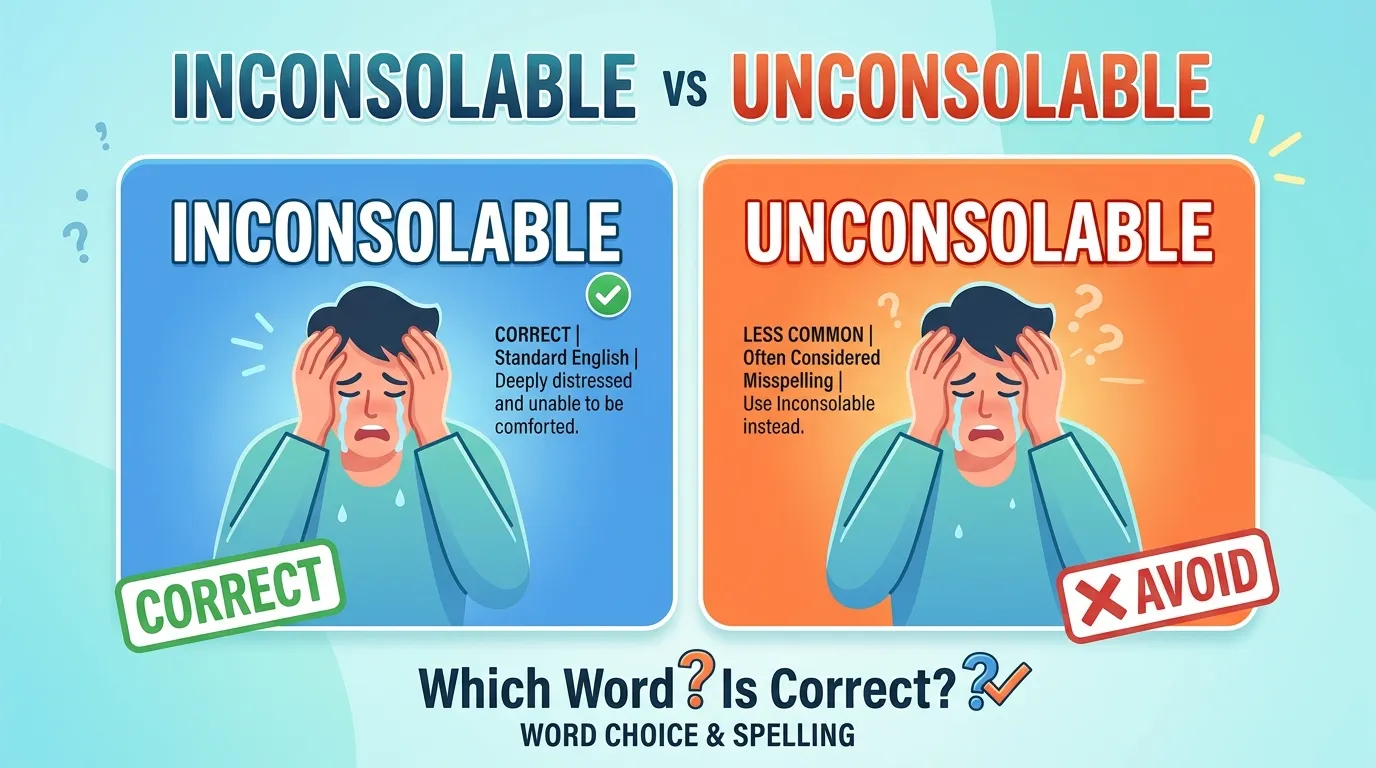
Inconsolable is the standard and widely accepted word in modern American English for someone who cannot be comforted or made less sad. Unconsolable is understandable and has appeared occasionally in English, but it is rare and nonstandard in most modern usage. If you are writing an email, essay, article, report, story, or professional document, inconsolable is the safer and more natural choice.
The confusion comes from the fact that English uses both in and un as negative prefixes. Because unconsolable looks like a logical combination of un + consolable, some writers assume it must be the preferred form. However, established English usage favors inconsolable.
In this guide, you will learn the meaning, pronunciation, grammar, etymology, tone, usage, synonyms, antonyms, common mistakes, regional considerations, and practical differences between inconsolable vs unconsolable. You will also see natural examples that show exactly when to use each form.
Quick Answer
Inconsolable is the standard word and the best choice for modern English.
| Word | Status | Meaning | Recommendation |
|---|---|---|---|
| inconsolable | Standard and common | Unable to be comforted | Use this |
| unconsolable | Rare and uncommon | Unable to be comforted | Usually avoid it |
The easiest rule to remember
Use inconsolable when you mean impossible or extremely difficult to comfort.
For example:
- The child was inconsolable after losing her favorite toy.
- He became inconsolable when he heard the news.
- She was inconsolable with grief.
The sentence She was unconsolable may be understandable, but it sounds unusual to most modern American English speakers.
What Does Inconsolable Mean?
Inconsolable is an adjective that describes a person who is so upset, sad, distressed, or grief stricken that other people cannot comfort them.
The word is especially common when describing intense emotional pain.
Dictionary style definition
Inconsolable: unable to be comforted, consoled, or reassured because of intense sadness, grief, distress, or emotional pain.
Examples
- The mother was inconsolable after hearing the tragic news.
- The little boy was inconsolable after his dog died.
- She was inconsolable with grief.
- His friends tried to comfort him, but he remained inconsolable.
- The baby became inconsolable and would not stop crying.
The word does not simply mean sad. It suggests a much stronger emotional state.
Someone can be sad and still accept comfort. Someone who is inconsolable is portrayed as being beyond the reach of ordinary comfort at that moment.
What Does Unconsolable Mean?
Unconsolable can be understood as meaning unable to be consoled or comforted, just like inconsolable.
However, there is an important usage issue.
Although English speakers can easily understand how unconsolable was formed, it is very uncommon in contemporary standard English. Many readers will find it awkward, unusual, or possibly mistaken.
The established adjective is inconsolable.
Compare these sentences
Natural:
She was inconsolable after the loss.
Unusual:
She was unconsolable after the loss.
The second sentence communicates the intended idea, but the first sounds much more natural and idiomatic.
Inconsolable vs Unconsolable: The Key Difference
The primary difference is standard usage and frequency, not meaning.
Both forms are built around the idea of being unable to receive comfort, but inconsolable is the established modern form.
Inconsolable
- Standard modern English
- Commonly used in American English
- Widely understood
- Appropriate in formal and informal writing
- Common in journalism and literature
- Natural in everyday speech
- Strongly associated with grief and emotional distress
Unconsolable
- Rare
- Much less familiar
- Morphologically understandable
- Can sound awkward or invented
- Generally not the preferred choice in modern writing
Therefore, if your goal is correct, natural, polished English, choose inconsolable.
Why Do People Confuse Inconsolable and Unconsolable?
The confusion mainly comes from English prefix patterns.
English frequently uses un to create an opposite or negative adjective:
- happy → unhappy
- kind → unkind
- known → unknown
- able → unable
- comfortable → uncomfortable
Because consolable appears to be a possible adjective, writers may naturally think:
consolable → unconsolable
That formation seems logical.
However, English vocabulary is not always created by applying a negative prefix according to a simple mathematical rule. Many words have developed historically with particular prefixes, and established usage determines which form becomes standard.
In this case, inconsolable became the normal English adjective.
Is Consolable a Word?
Yes. Consolable is a real word, although it is much less common than inconsolable.
Consolable means capable of being consoled or comforted.
For example:
After a few minutes, the child became consolable.
However, most speakers are more likely to say:
After a few minutes, the child could be comforted.
The existence of consolable makes unconsolable seem even more logical, but it does not make it the preferred opposite.
The established pair is:
consolable → inconsolable
rather than:
consolable → unconsolable
Meaning of Consolable vs Inconsolable
Understanding the base word makes the distinction easier.
Consolable
Someone is consolable when comfort can help them feel better.
The upset child was eventually consolable.
Inconsolable
Someone is inconsolable when comfort does not seem to help.
The child was inconsolable after losing her mother.
This is a difference of degree as well as meaning. Inconsolable usually describes intense emotional suffering.
Pronunciation of Inconsolable
The standard American English pronunciation of inconsolable is approximately:
in-kuhn-SOH-luh-buhl
Its pronunciation can be represented as:
/ˌɪnkənˈsoʊləbəl/
The main stress falls on SOH.
Break it into parts
in + con + so + la + ble
The important part to remember is that the word does not sound like in-CON-solable with the strongest emphasis on the second syllable.
A natural pronunciation is closer to:
in-kuhn-SOH-luh-buhl
Pronunciation of Unconsolable
If unconsolable is used, it would normally be pronounced approximately:
un-kuhn-SOH-luh-buhl
The pronunciation is not the main problem with the word. The problem is its rarity and unusual status in modern usage.
A reader may understand it immediately but still wonder whether the writer meant inconsolable.
Is Inconsolable an Adjective?
Yes. Inconsolable is an adjective.
It describes a person or, in some contexts, an emotional state.
Before a noun
The inconsolable child cried for hours.
After a linking verb
The child was inconsolable.
With an adverb
She was completely inconsolable.
He became almost inconsolable.
Common verbs used with inconsolable include:
- be
- become
- remain
- seem
- appear
- look
Examples
- She remained inconsolable.
- He became inconsolable.
- The child seemed inconsolable.
- The family was inconsolable after the loss.
Common Collocations With Inconsolable
A collocation is a combination of words that naturally occur together.
Some useful collocations with inconsolable include:
- inconsolable grief
- inconsolable sadness
- inconsolable sorrow
- inconsolable child
- inconsolable baby
- inconsolable mother
- inconsolable father
- inconsolable widow
- inconsolable after the loss
- inconsolable with grief
- completely inconsolable
- almost inconsolable
- remain inconsolable
- become inconsolable
- leave someone inconsolable
Natural examples
The family was inconsolable with grief.
The baby became inconsolable during the flight.
She was completely inconsolable after the breakup.
He remained inconsolable for several hours.
These combinations sound natural because they match common English patterns.
Inconsolable and Emotional Context
Inconsolable is especially associated with powerful emotions.
The most common contexts include:
Grief
She was inconsolable after her father’s death.
Loss
He became inconsolable after losing his home.
Bereavement
The family was inconsolable following the funeral.
Disappointment
The young athlete was inconsolable after missing the winning shot.
Romantic heartbreak
She was inconsolable after the relationship ended.
Fear or distress
The frightened child became inconsolable during the storm.
The word can describe different emotions, but it usually communicates extreme distress.
Can Inconsolable Be Used for Babies and Children?
Yes. This is one of its very common uses.
When a baby is inconsolable, it means the baby cannot easily be soothed.
For example:
The baby was inconsolable despite being fed and rocked.
Parents, caregivers, doctors, and journalists may use the word this way.
However, in everyday conversation, people often use simpler expressions such as:
- The baby would not stop crying.
- The baby could not be calmed.
- The baby would not settle down.
- Nothing seemed to comfort the baby.
Inconsolable is slightly more formal and descriptive.
Inconsolable vs Unconsolable in Formal Writing
For formal writing, inconsolable is clearly the better choice.
Academic writing
The participants described feelings of profound grief and were initially inconsolable.
Journalistic writing
The victim’s family was inconsolable after receiving the news.
Business communication
The word is less common in ordinary business writing because workplace communication usually favors neutral language.
Instead of:
The team was inconsolable after the failed project.
A professional report might say:
The team was deeply disappointed by the project’s outcome.
Medical or professional contexts
In clinical or professional writing, precision matters. Depending on the situation, alternatives such as unable to be comforted, extremely distressed, or persistently crying may be more precise than inconsolable.
Inconsolable in Casual Writing
Inconsolable can also work perfectly well in casual writing.
For example:
I was inconsolable when my favorite show ended.
My little brother was inconsolable after his team lost.
She was absolutely inconsolable over the breakup.
The word can sound dramatic, humorous, or exaggerated depending on context.
For example:
I was inconsolable when they ran out of pizza.
Here, the speaker is probably being playful rather than describing serious emotional trauma.
Can Inconsolable Be Used Figuratively?
Yes.
The word can be used literally for serious emotional suffering or figuratively for exaggerated sadness.
Literal use
The widow was inconsolable after her husband’s death.
Figurative use
I was inconsolable when my favorite restaurant closed.
The figurative use is common in informal writing, social media, blogs, and humorous conversations.
Context tells the reader how seriously to interpret the word.
Is Inconsolable a Slang Word?
No. Inconsolable is not slang.
It is a standard English adjective.
However, people can use it casually or humorously.
For example:
I was inconsolable when my team lost.
The word itself remains standard vocabulary even when the situation is informal.
Inconsolable in Sports Writing
Sports writers sometimes use inconsolable to describe athletes or fans after a painful defeat.
For example:
The goalkeeper was inconsolable after conceding the final goal.
The young player was inconsolable after missing the penalty.
Fans were inconsolable after the team suffered a last minute defeat.
Sports journalism often uses emotionally strong language, so this adjective fits naturally.
Inconsolable in Political Writing
The word is not specifically political, but it can appear in political journalism when describing people affected by a major event.
For example:
Supporters were inconsolable after the unexpected result.
The candidate’s family was inconsolable after the tragedy.
However, responsible journalism should avoid exaggerating people’s emotions without evidence. Inconsolable is strongest when the writer has a clear basis for describing someone that way.
Inconsolable in Literature
The adjective has a strong place in literary writing because it quickly communicates intense emotion.
For example:
She sat beside the window, inconsolable after the letter arrived.
It creates a vivid emotional image without requiring a long explanation.
Writers can also choose alternatives depending on the mood:
- devastated
- heartbroken
- grief stricken
- distraught
- sorrowful
- crushed
- overwhelmed
- despondent
Synonyms for Inconsolable
The best synonym depends on the exact emotional situation.
Strong emotional synonyms
- distraught
- devastated
- heartbroken
- grief stricken
- overcome with sorrow
- deeply distressed
- despondent
- miserable
More neutral alternatives
- unable to be comforted
- unable to be consoled
- extremely upset
- deeply saddened
- very distressed
- unable to calm down
Important distinction
These words are not always perfect substitutes.
For example, distraught means extremely upset or worried, but it does not necessarily mean that comfort is impossible.
Inconsolable specifically emphasizes the inability to provide effective comfort.
Antonyms of Inconsolable
Possible opposites include:
- consolable
- comforted
- calm
- reassured
- content
- peaceful
- composed
- comforted by others
For example:
She was inconsolable at first but eventually became calm.
Related Words
Understanding related vocabulary can help you remember the word.
Console
Console is a verb meaning to comfort someone who is experiencing sadness or disappointment.
Her friends tried to console her.
Consolation
Consolation is comfort received during a difficult experience.
His family offered him consolation after the loss.
Consoling
Consoling means providing comfort.
She offered some consoling words.
Consolable
Consolable means capable of being comforted.
The child eventually became consolable.
Inconsolable
Inconsolable means unable to be comforted.
The child remained inconsolable.
Word History and Etymology of Inconsolable
Inconsolable is formed from console and the negative prefix in.
The verb console ultimately comes from Latin roots associated with providing comfort or encouragement. English adopted console through French, and inconsolable developed as the negative form describing someone who cannot be consoled.
The prefix in in this word carries a negative sense, similar to its function in words such as:
- incomplete
- incapable
- invisible
- ineffective
- insufficient
The history helps explain why inconsolable, rather than unconsolable, became the established form.
Why In Does Not Always Mean the Same Thing as Un
This is an important English vocabulary lesson.
Both in and un can create negative meanings, but they are not freely interchangeable.
Consider:
- visible → invisible
- possible → impossible
- complete → incomplete
- formal → informal
- happy → unhappy
- fair → unfair
- known → unknown
You cannot simply choose the prefix that seems logically appropriate.
English word formation is shaped by history, pronunciation, convention, and established usage.
That is why:
consolable → inconsolable
is the standard pattern.
Common Mistakes With Inconsolable
Mistake 1: Using unconsolable in formal writing
Less natural:
The family was unconsolable after the tragedy.
Better:
The family was inconsolable after the tragedy.
Mistake 2: Thinking inconsolable means only sad
Inconsolable describes much more than ordinary sadness.
Better understanding:
Inconsolable means unable to be comforted because of intense sadness or distress.
Mistake 3: Using inconsolable for every minor disappointment
This can make your writing sound exaggerated.
Awkward:
I was inconsolable because the store was out of my favorite chips.
Possible in humorous writing, but inappropriate in a serious report.
Better:
I was disappointed because the store was out of my favorite chips.
Mistake 4: Confusing inconsolable with inconsolate
Inconsolable is the normal modern adjective.
Do not replace it with unusual forms simply because they look related.
Awkward vs Natural Examples
| Awkward or uncommon | Natural |
|---|---|
| She was unconsolable after the loss. | She was inconsolable after the loss. |
| He became unconsolable with grief. | He became inconsolable with grief. |
| The baby was unconsolable all night. | The baby was inconsolable all night. |
| They remained unconsolable. | They remained inconsolable. |
| His family was unconsolable after the news. | His family was inconsolable after the news. |
The main improvement in each case is simply replacing unconsolable with inconsolable.
Everyday Examples of Inconsolable
Here are natural examples from different situations:
The child was inconsolable after losing her stuffed animal.
He was inconsolable when he learned that his friend had moved away.
She became inconsolable after the breakup.
The puppy was inconsolable when its owner left.
The fans were inconsolable after the championship loss.
His parents tried everything, but he remained inconsolable.
She was inconsolable with grief.
The family was deeply affected and inconsolable.
The little girl was inconsolable until her mother returned.
After the accident, he was too distressed to speak and appeared inconsolable.
Formal vs Informal Alternatives
Choose your wording according to the situation.
| Situation | Recommended wording |
|---|---|
| Formal essay | inconsolable |
| Academic writing | unable to be comforted / deeply distressed |
| News article | inconsolable |
| Business report | deeply distressed / devastated |
| Casual conversation | inconsolable / very upset |
| Social media | inconsolable |
| Storytelling | inconsolable |
| Children’s writing | unable to be comforted |
| Professional report | extremely distressed |
| Sports article | inconsolable |
The key is not simply choosing the most sophisticated word. It is choosing the word that fits the audience and context.
American English vs British English
There is no major American versus British spelling difference here.
Inconsolable is the standard form in both American and British English.
For example:
American English:
She was inconsolable after the loss.
British English:
She was inconsolable after the loss.
The spelling remains the same.
The unusual form unconsolable is not a preferred regional alternative that you need to switch to when writing British English. If you are writing for an international audience, inconsolable remains the safest choice.
Is Unconsolable Ever Acceptable?
There is a difference between understandable and recommended.
Because unconsolable follows a recognizable English word formation pattern, readers can understand it. Historical and occasional uses of uncommon formations can also occur.
But if your question is:
Which word should I use today?
The answer is:
Use inconsolable.
There is little practical benefit to choosing unconsolable when the established word is available.
If you encounter unconsolable in an old text, creative work, or unusual source, you can generally understand it as meaning inconsolable. But that does not make it the preferred form for your own modern writing.
Memory Trick: Inconsolable Has In
A simple memory trick can help.
Think:
If someone is IN need of comfort but cannot receive it, they are INconsolable.
Or remember the pair:
console → inconsolable
You can also connect it to familiar words beginning with in:
- unable
- incapable
- incomplete
- invisible
- inconsolable
The important point is that inconsolable is the established spelling.
How to Choose the Right Word
Before using either form, ask yourself three questions:
Are you describing someone who cannot be comforted?
Use:
inconsolable
Are you writing something formal or public?
Use:
inconsolable
Are you wondering whether unconsolable sounds unusual?
It probably does. Replace it with:
inconsolable
This simple approach will solve the problem in almost every modern writing situation.
Inconsolable vs Unconsolable: Final Comparison
| Feature | Inconsolable | Unconsolable |
|---|---|---|
| Basic meaning | Unable to be comforted | Intended to mean unable to be comforted |
| Part of speech | Adjective | Adjective when used |
| Modern standard usage | Yes | Rare |
| American English | Preferred | Uncommon |
| British English | Preferred | Uncommon |
| Formal writing | Excellent choice | Avoid |
| Casual writing | Natural | Sounds unusual |
| Journalism | Common and appropriate | Rare |
| Academic writing | Acceptable | Generally avoid |
| Emotional writing | Very natural | Awkward |
| Pronunciation | in-kuhn-SOH-luh-buhl | un-kuhn-SOH-luh-buhl |
| Best recommendation | Use it | Usually avoid it |
What Is the Best Word for Different Situations?
If you are writing about severe grief, use inconsolable.
The family was inconsolable after the tragedy.
If you are writing about ordinary sadness, consider sad, upset, or disappointed.
She was upset about the cancellation.
If you are describing someone who is extremely worried or disturbed, consider distraught.
He was distraught after hearing the news.
If you want a simple phrase that everyone understands, use:
unable to be comforted
This is especially useful for beginner English learners.
SEO and Writing Tip: Do Not Force the Uncommon Form
People who are researching inconsolable vs unconsolable may be tempted to use both spellings repeatedly to target the search phrase.
That is unnecessary.
A strong article should explain the uncommon form once or twice and then use the standard form naturally.
For normal writing, the priority should be:
clarity → correctness → natural usage
rather than trying to include every possible spelling variation.
Frequently Asked Questions
Is inconsolable the correct word?
Yes. Inconsolable is the standard and widely accepted word for someone who cannot be comforted because of intense sadness, grief, or distress.
Is unconsolable a real word?
Unconsolable has appeared as an uncommon formation, and its meaning is understandable, but it is rare in modern English. It is not the preferred choice when inconsolable is available.
What is the difference between inconsolable and unconsolable?
They are intended to express essentially the same meaning, but inconsolable is the established modern form. Unconsolable is much rarer and can sound incorrect or awkward.
How do you spell inconsolable?
The correct standard spelling is:
I N C O N S O L A B L E
It begins with in, not un.
What does inconsolable mean?
Inconsolable means unable to be comforted or consoled, usually because someone is experiencing very strong sadness, grief, or emotional distress.
Is inconsolable a formal word?
Yes. Inconsolable is a standard adjective that works in both formal and informal contexts. It is especially common in literature, journalism, storytelling, and descriptions of grief.
Can you say a baby is inconsolable?
Yes. An inconsolable baby is a baby who cannot easily be soothed or calmed. For example: The baby was inconsolable for several hours.
What is a synonym for inconsolable?
Depending on context, synonyms include distraught, devastated, heartbroken, grief stricken, deeply distressed, and unable to be comforted. These words are not always exact replacements because each emphasizes a slightly different emotion.
Is inconsolable used in American English?
Yes. Inconsolable is natural and standard in American English. There is no need to replace it with unconsolable.
What is the opposite of inconsolable?
Possible opposites include consolable, comforted, calm, reassured, and composed. The best choice depends on the sentence.
Conclusion
When choosing between inconsolable vs unconsolable, the safest and most natural answer is clear: use inconsolable.
Inconsolable is the established modern English adjective meaning unable to be comforted or consoled. It works in American English, British English, international English, journalism, literature, casual conversation, and many formal contexts.
Unconsolable is understandable because English often uses un as a negative prefix, but it is uncommon and can make otherwise polished writing sound awkward.
Remember the simple rule:
Console → inconsolable
When someone is experiencing such intense grief, sadness, or distress that comfort does not seem to help, they may be described as inconsolable.
If you want your writing to sound natural, professional, and grammatically reliable, choose inconsolable and avoid unconsolable unless you have a specific historical or stylistic reason to reproduce the uncommon form.