If you have ever written minuscule and wondered whether it should actually be spelled miniscule, you are not alone. These two spellings look almost identical, sound similar, and are often confused—even by experienced writers.
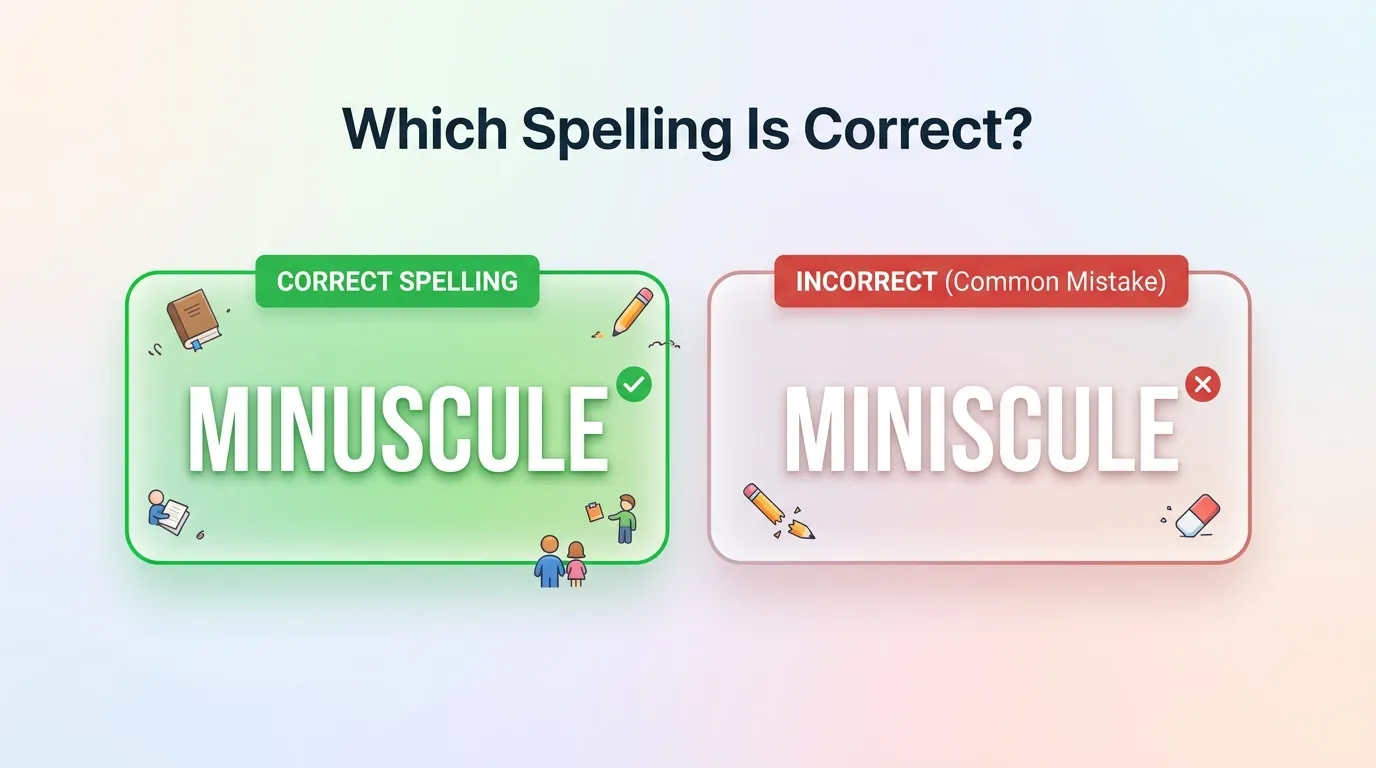
The short answer is simple: minuscule is the standard and preferred spelling in modern English. Miniscule is a common variant, but many dictionaries and style guides treat it as a nonstandard or less-preferred spelling, especially in careful formal writing.
The word minuscule generally means extremely small or tiny. It can describe something physical, such as a minuscule amount of dust, or something abstract, such as a minuscule chance of success.
This guide explains minuscule vs miniscule in detail. You will learn their meanings, pronunciation, history, grammatical uses, differences in American and British English, common mistakes, synonyms, antonyms, collocations, and examples for everyday, academic, business, technical, journalistic, and casual writing.
Quick Answer: Minuscule or Miniscule?
Minuscule is the recommended spelling.
| Spelling | Status | Recommended? | Meaning |
|---|---|---|---|
| minuscule | Standard spelling | ✅ Yes | Extremely small |
| miniscule | Common variant/nonstandard spelling in many dictionaries | ⚠️ Usually avoid in formal writing | Extremely small |
The safest rule
When you mean extremely small, write:
The difference was minuscule.
Not:
The difference was miniscule.
Although miniscule appears frequently in real-world writing, minuscule is the established standard form and is the better choice for school, professional, academic, journalistic, and formal writing.
What Does Minuscule Mean?
Minuscule is an adjective meaning extremely small, tiny, or insignificant in size or amount.
For example:
- The insect was minuscule.
- There was only a minuscule amount of sugar left.
- The company made a minuscule profit.
- She noticed a minuscule crack in the glass.
- The error had a minuscule effect on the final result.
The word can describe both physical size and abstract quantities.
Physical meaning
When describing something physical, minuscule means very tiny.
A minuscule seed was hidden inside the fruit.
The scientist examined a minuscule particle under a microscope.
Figurative meaning
Minuscule can also describe something that is extremely small in degree, importance, amount, or probability.
The team had a minuscule chance of winning.
The price increase had a minuscule impact on sales.
In these examples, the thing being described is not necessarily physically tiny.
Is Minuscule or Miniscule Correct?
Minuscule is the preferred standard spelling.
The confusion exists because miniscule looks logical. English speakers may associate the word with mini, meaning small. That makes miniscule seem like a natural spelling.
However, minuscule has a different historical origin. Its spelling comes from the Latin word minusculus, meaning rather small or somewhat small.
So, although mini- is associated with smallness, it is not the reason the word is spelled minuscule.
Why minuscule is preferred
Use minuscule when you are writing:
- School assignments
- Academic papers
- Business documents
- Professional emails
- News articles
- Technical documents
- Websites
- Formal reports
- Applications
- Resumes and cover letters
- Published content
You may encounter miniscule in informal writing, online content, books, advertisements, and other sources, but its widespread use does not make it the preferred spelling.
Why Do People Confuse Minuscule and Miniscule?
The two spellings are easy to confuse for several reasons.
The pronunciation is similar
Both spellings are commonly pronounced approximately:
/ˈmɪnəskjuːl/
In simple terms, you can think of the pronunciation as:
MIN-uh-skool
Because the spoken forms do not clearly reveal the spelling, writers must remember which form is standard.
Mini suggests small
The word mini is strongly associated with small size:
- miniature
- minivan
- miniskirt
- minicomputer
- mini-fridge
As a result, people sometimes naturally write miniscule, imagining that the word begins with mini-.
But minuscule did not originate from the modern English word mini.
The middle vowels are easy to overlook
The standard spelling is:
m-i-n-u-s-c-u-l-e
The commonly confused form is:
m-i-n-i-s-c-u-l-e
The difference is the u versus i after the first three letters.
A useful visual reminder is:
minUScule = extremely small
Minuscule vs Miniscule: Key Difference
The central difference is spelling and standard usage, not meaning.
Minuscule and miniscule are generally used with the same intended meaning: extremely small.
The important distinction is that minuscule is the established standard spelling, while miniscule is a common alternative that is generally best avoided in careful writing.
| Feature | Minuscule | Miniscule |
|---|---|---|
| Meaning | Extremely small | Extremely small |
| Standard spelling | Yes | Generally no |
| Common in modern writing | Yes | Yes, but less preferred |
| Formal writing | Recommended | Avoid |
| Academic writing | Recommended | Avoid |
| Casual writing | Recommended | Sometimes encountered |
| Pronunciation | /ˈmɪnəskjuːl/ | Usually pronounced the same |
| Etymological spelling | Matches historical origin | Influenced by spelling patterns such as mini- |
Minuscule as an Adjective
The most common grammatical role of minuscule is as an adjective.
An adjective modifies a noun.
Examples include:
- a minuscule amount
- a minuscule detail
- a minuscule error
- a minuscule particle
- a minuscule room
- a minuscule difference
- a minuscule possibility
- a minuscule increase
Examples in sentences
The laboratory detected a minuscule quantity of the chemical.
We found a minuscule flaw in the design.
The two measurements showed a minuscule difference.
His contribution made only a minuscule change to the final score.
Can Minuscule Describe Abstract Things?
Yes.
This is an important point because minuscule does not have to describe physical objects.
It can describe:
- chances
- differences
- amounts
- effects
- changes
- risks
- benefits
- profits
- losses
- improvements
- errors
- percentages
For example:
There is a minuscule chance that the plan will fail.
The update produced a minuscule improvement in performance.
The policy had a minuscule effect on consumer behavior.
Here, minuscule means very small in degree or amount.
Minuscule Pronunciation
The standard pronunciation of minuscule is:
IPA: /ˈmɪnəskjuːl/
A simple pronunciation guide is:
MIN-uh-skool
The first syllable receives the primary stress.
Does Minuscule Sound Like Miniscule?
Usually, yes.
The spelling difference does not normally create a major difference in pronunciation. This is one reason the words are easily confused.
If you hear someone say the word, you may not be able to determine which spelling they have in mind.
That makes remembering the standard written form especially important.
The History and Etymology of Minuscule
The history of minuscule helps explain why the spelling contains -us- rather than -is-.
The word comes ultimately from Latin minusculus, meaning somewhat small or rather small.
It is related to Latin minus, meaning less.
The word later became associated with small handwriting and small letters.
In the history of writing, minuscule refers to a type of lowercase handwriting or lettering. This historical sense is still found in specialized contexts.
From handwriting to general English
The word developed beyond its historical writing-related meaning and became associated with things that are very small.
Modern English therefore commonly uses minuscule to mean:
Extremely small in size, quantity, degree, or importance.
This historical development also explains why spelling the word as miniscule based solely on mini is misleading.
Minuscule Has a Specialized Writing Meaning
Although most people encounter minuscule as a synonym for tiny, the word also has a technical historical meaning.
In paleography and the history of writing, minuscule can refer to a style of small-letter handwriting.
This is related to the development of lowercase forms in historical manuscripts.
You may encounter terms such as:
- Carolingian minuscule
- Caroline minuscule
- Greek minuscule
- manuscript minuscule
For example:
The manuscript was written in Carolingian minuscule.
In this context, minuscule is not simply an adjective meaning tiny. It is part of specialized terminology concerning handwriting and scripts.
Minuscule vs Lowercase
The historical writing sense can sometimes overlap with the idea of lowercase letters, but the two concepts are not identical in every context.
Lowercase is the normal modern term for letters such as:
a, b, c, d
Minuscule can refer to historical small-letter writing systems or styles.
For ordinary modern writing, use lowercase when discussing capitalization.
For historical or paleographic discussions, minuscule may be the appropriate technical term.
Minuscule vs Tiny
These words are close in meaning, but they have slightly different tones.
Tiny is common and conversational.
Minuscule is more formal and can emphasize that something is exceptionally small.
Compare:
The apartment has a tiny kitchen.
The laboratory measured a minuscule quantity of the substance.
Both are grammatical, but the second sounds more technical or precise.
Other synonyms for minuscule
Depending on context, synonyms include:
- tiny
- very small
- microscopic
- miniature
- minute
- slight
- insignificant
- negligible
- diminutive
- infinitesimal
- microscopic in size
- barely noticeable
These words are not always interchangeable.
For example, negligible focuses more on importance or effect than physical size.
The error was negligible.
This means the error was not significant, not necessarily that it was physically tiny.
Minuscule vs Minute
Minute is one of the closest synonyms of minuscule, but it has an important pronunciation issue.
When minute means extremely small, it is pronounced:
/maɪˈnjuːt/
When it means a unit of time, it is pronounced:
/ˈmɪnɪt/
Examples:
The scientist observed a minute particle.
Wait one minute.
Because of this ambiguity, minuscule can sometimes be clearer when the intended meaning is extremely small.
Minuscule vs Microscopic
These words are also related.
Microscopic literally suggests something too small to be seen clearly without a microscope, although it is also commonly used figuratively.
The organism is microscopic.
Minuscule simply means extremely small and does not necessarily imply that a microscope is needed.
The difference was minuscule.
The difference could be visible but extremely small.
Minuscule vs Negligible
These words are frequently used together in analytical and business writing.
Minuscule emphasizes size or amount.
Negligible emphasizes lack of importance or practical effect.
Compare:
The company experienced a minuscule increase in revenue.
The increase had a negligible effect on the company’s overall performance.
The first describes the size of the increase. The second describes its significance.
Common Collocations With Minuscule
A collocation is a group of words that commonly appear together.
Common combinations with minuscule include:
- minuscule amount
- minuscule quantity
- minuscule difference
- minuscule detail
- minuscule chance
- minuscule risk
- minuscule error
- minuscule increase
- minuscule decrease
- minuscule particle
- minuscule organism
- minuscule fraction
- minuscule profit
- minuscule benefit
- minuscule impact
- minuscule effect
- minuscule change
- minuscule portion
- minuscule figure
- minuscule margin
Natural examples
There is only a minuscule amount of evidence available.
The two products have a minuscule difference in weight.
She had a minuscule chance of catching the last train.
The software produced a minuscule error during testing.
The treatment caused a minuscule improvement in the measured result.
Common Phrases With Minuscule
There are no major fixed idioms built around minuscule, but several natural phrases are common.
A minuscule amount
Only a minuscule amount of paint was needed.
A minuscule fraction
The defect affected a minuscule fraction of the products.
A minuscule chance
There is still a minuscule chance that the package will arrive today.
A minuscule difference
There was a minuscule difference between the two readings.
Minuscule compared with
The potential cost is minuscule compared with the long-term benefit.
Minuscule in Formal and Informal Writing
Minuscule works in both formal and informal English.
Its tone is somewhat more polished than everyday words such as tiny.
Academic writing
The study identified a minuscule difference between the two groups.
Business writing
The proposed change would result in a minuscule increase in operating costs.
Technical writing
The sensor detects minuscule variations in temperature.
Journalism
The candidate won by a minuscule margin.
Casual conversation
That’s a minuscule piece of cake.
In casual conversation, tiny may sound more natural, but minuscule is perfectly acceptable.
Minuscule in American English
In American English, minuscule is the preferred spelling.
For American writers, there is little practical reason to choose miniscule.
Use:
a minuscule amount
a minuscule error
a minuscule chance
a minuscule difference
This applies to American:
- academic writing
- business writing
- journalism
- technical writing
- online publishing
- professional communication
Minuscule in British English
Minuscule is also the standard spelling in British English.
Therefore, unlike words such as color/colour or analyze/analyse, this is not primarily an American-versus-British spelling difference.
British writers can safely use:
minuscule
The same recommendation applies in both major varieties of English.
Is Miniscule Ever Acceptable?
You will certainly see miniscule in published and online material.
It is a real, widely encountered spelling variant. However, its presence in actual usage does not mean it is the best choice for formal writing.
If your goal is correctness, clarity, and conformity with standard edited English, choose:
minuscule
A useful distinction is:
Commonly seen does not always mean preferred.
English contains many spellings that appear frequently even though editors and dictionaries may recommend another form.
Minuscule vs Miniscule in Professional Writing
Professional writing benefits from using the standard form.
Instead of:
We observed a miniscule improvement.
Write:
We observed a minuscule improvement.
Instead of:
The cost represents a miniscule portion of the budget.
Write:
The cost represents a minuscule portion of the budget.
This is especially important when writing documents that may be reviewed by editors, teachers, employers, clients, or professional organizations.
Common Mistakes With Minuscule
Mistake: Using miniscule because of mini
Incorrect or less-preferred:
The machine made a miniscule adjustment.
Preferred:
The machine made a minuscule adjustment.
Mistake: Assuming the pronunciation determines the spelling
Because the word sounds like MIN-uh-skool, writers may guess the spelling.
Remember that pronunciation does not always reveal English spelling.
Mistake: Treating minuscule as only a physical-size word
You can use it for abstract concepts.
Correct:
The policy had a minuscule impact.
Mistake: Confusing minuscule with miniature
The two words overlap, but they are not identical.
Miniature often means something made as a smaller representation of another object.
He collects miniature cars.
Minuscule simply means extremely small.
The print was minuscule.
Awkward vs Natural Examples
| Awkward or less-preferred | Natural and preferred |
|---|---|
| The change was miniscule. | The change was minuscule. |
| We found a miniscule amount. | We found a minuscule amount. |
| She had a miniscule chance. | She had a minuscule chance. |
| The error was miniscule. | The error was minuscule. |
| It caused a miniscule increase. | It caused a minuscule increase. |
The main correction is straightforward: replace miniscule with minuscule.
Everyday Examples of Minuscule
Here are practical examples you might encounter in ordinary English:
- A minuscule scratch appeared on the screen.
- The puppy had a minuscule collar.
- There was a minuscule amount of coffee left.
- The difference in price was minuscule.
- A minuscule insect landed on the table.
- He made a minuscule adjustment to the settings.
- The typo was so minuscule that nobody noticed it.
- The chance of rain was minuscule.
- The package contained a minuscule component.
- She made a minuscule change to the design.
Formal Alternatives to Minuscule
Sometimes another word will fit your sentence better.
For formal writing, consider:
- extremely small
- negligible
- minimal
- slight
- insignificant
- infinitesimal
- microscopic
However, each carries a slightly different meaning.
Minimal
Usually means the smallest amount or degree necessary.
The project required minimal effort.
Negligible
Means so small that it has little or no practical importance.
The difference was negligible.
Infinitesimal
Means extremely, almost unimaginably small.
The calculation involved an infinitesimal change.
Slight
Means small in degree.
There was a slight increase in demand.
Antonyms of Minuscule
The opposite of minuscule depends on context.
Possible antonyms include:
- huge
- enormous
- gigantic
- massive
- immense
- large
- substantial
- considerable
- significant
- major
- vast
Examples:
The difference was minuscule, not significant.
The company moved from a minuscule operation to a massive enterprise.
Minuscule in Business and Finance
Business writers often use minuscule to describe small financial changes.
Examples:
The company reported a minuscule increase in quarterly revenue.
The fee represents a minuscule percentage of the total cost.
The difference between the two bids was minuscule.
Be careful, however, when using the word to describe financial information. Minuscule is descriptive, while terms such as 0.2% provide measurable precision.
For professional reports, it is often best to give the exact figure when one is available.
Minuscule in Science and Technology
The word is particularly useful in technical contexts because scientific and technological processes often involve very small quantities.
Examples:
The instrument can detect minuscule changes in pressure.
Researchers observed minuscule particles suspended in the solution.
The processor experienced a minuscule delay.
A minuscule variation in temperature affected the experiment.
In technical writing, however, avoid using minuscule when an exact measurement would be more useful.
Instead of:
The component expanded by a minuscule amount.
A technical document may be clearer with:
The component expanded by 0.02 millimeters.
Minuscule in Sports Writing
Sports journalism often uses the word to describe extremely narrow margins.
Examples:
The runner won by a minuscule margin.
The teams were separated by a minuscule difference in points.
A minuscule error cost the player the match.
In sports, minuscule margin is especially natural when discussing close competitions.
Minuscule in Journalism
Journalists may use minuscule when describing close elections, narrow victories, small changes, or limited effects.
Examples:
The mayor won by a minuscule margin.
The latest report showed a minuscule rise in unemployment.
The proposal received only a minuscule amount of additional funding.
For objective journalism, concrete figures are often preferable when available.
Minuscule in Academic Writing
Minuscule is acceptable in academic writing, but writers should use it carefully.
Academic prose generally benefits from precision.
Compare:
The researchers observed a minuscule difference between the groups.
with:
The researchers observed a 0.03% difference between the groups.
The second sentence is more precise if the exact measurement matters.
Use minuscule when you are emphasizing relative size rather than reporting a technical measurement.
Minuscule in Political Language
There is no special political meaning of minuscule.
Political writers may use it in its ordinary sense to describe:
- a narrow margin
- a small vote share
- a limited effect
- a tiny percentage
- a small policy change
For example:
The candidate won by a minuscule margin.
This is descriptive rather than political slang.
Is Minuscule a Slang Word?
No.
Minuscule is not slang.
It is a standard English adjective used in everyday, professional, academic, literary, and technical contexts.
If someone uses minuscule in casual conversation, that does not make it slang.
It simply gives the sentence a slightly more formal or emphatic tone than words such as tiny or small.
Memory Trick for Minuscule
A simple way to remember the preferred spelling is:
MINUScule = tiny
Focus on the US in minuscule.
You can also connect it to its historical relationship with Latin minus, meaning less.
Think:
minus → minuscule → very small
This is more reliable than connecting the word to modern mini.
A Simple Rule for Writers
If you are unsure between minuscule and miniscule, use this rule:
Always choose minuscule in careful writing.
You do not need to change your writing style, sentence structure, or meaning. Simply remember the standard spelling.
Correct forms
- minuscule amount
- minuscule change
- minuscule difference
- minuscule chance
- minuscule error
- minuscule detail
- minuscule particle
- minuscule risk
- minuscule increase
- minuscule effect
Avoid
- miniscule amount
- miniscule change
- miniscule difference
- miniscule chance
Minuscule vs Miniscule: Final Comparison
| Question | Answer |
|---|---|
| Which spelling is standard? | Minuscule |
| What does it mean? | Extremely small |
| Is miniscule commonly seen? | Yes |
| Is miniscule the preferred formal spelling? | No |
| Are they usually pronounced differently? | No |
| Is minuscule used in American English? | Yes |
| Is minuscule used in British English? | Yes |
| Is it slang? | No |
| Can it describe abstract ideas? | Yes |
| Can it be used in technical writing? | Yes |
| Is it an adjective? | Yes |
| Can it have a historical writing-related meaning? | Yes |
Frequently Asked Questions
Is minuscule or miniscule correct?
Minuscule is the standard and preferred spelling. Miniscule is a common variant, but it is generally best avoided in formal and carefully edited writing.
Why is minuscule spelled with a u?
The spelling comes from the word’s historical origin in Latin minusculus, meaning somewhat small. It was not formed from the modern English word mini.
Is miniscule a misspelling?
Miniscule is a widely used variant spelling, so it is not an accidental typo in every context. However, minuscule is the established standard spelling and is the safer choice for formal writing.
Do minuscule and miniscule mean the same thing?
Yes. When people use miniscule, they almost always intend the same meaning as minuscule: extremely small.
How do you pronounce minuscule?
Minuscule is commonly pronounced MIN-uh-skool, with the IPA pronunciation /ˈmɪnəskjuːl/.
Is minuscule formal or informal?
Minuscule works in both formal and informal English. It is somewhat more formal and emphatic than tiny, making it especially common in professional, academic, technical, and journalistic writing.
What is the opposite of minuscule?
Common opposites include huge, enormous, massive, immense, substantial, significant, and considerable, depending on the context.
Is minuscule the same as microscopic?
Not exactly. Both can mean extremely small, but microscopic can specifically suggest something too small to see clearly without magnification. Minuscule simply means extremely small and does not necessarily imply microscopic size.
Can minuscule describe a chance or possibility?
Yes. Minuscule chance and minuscule possibility are natural expressions.
For example:
There is a minuscule chance that the old computer will start.
Conclusion
When choosing between minuscule vs miniscule, the safest answer is clear: use minuscule.
Minuscule is the standard spelling for the adjective meaning extremely small, tiny, slight, or insignificant in size or amount. It works naturally in American and British English and is suitable for casual, professional, academic, technical, journalistic, and business writing.
Miniscule is frequently encountered because the word resembles mini, and its pronunciation does not reveal the spelling difference. However, its widespread appearance should not be confused with the preferred standard form.
Remember the key distinction:
minuscule = standard spelling
miniscule = common but less-preferred variant
When in doubt, choose minuscule. If you are writing for school, work, publication, or a professional audience, that choice gives you the clearest and most conventional spelling.
The easiest memory trick is to connect minuscule with Latin minus, meaning less. Think minus → minuscule → extremely small.
Once you remember that pattern, the minuscule vs miniscule spelling problem becomes much easier to avoid.