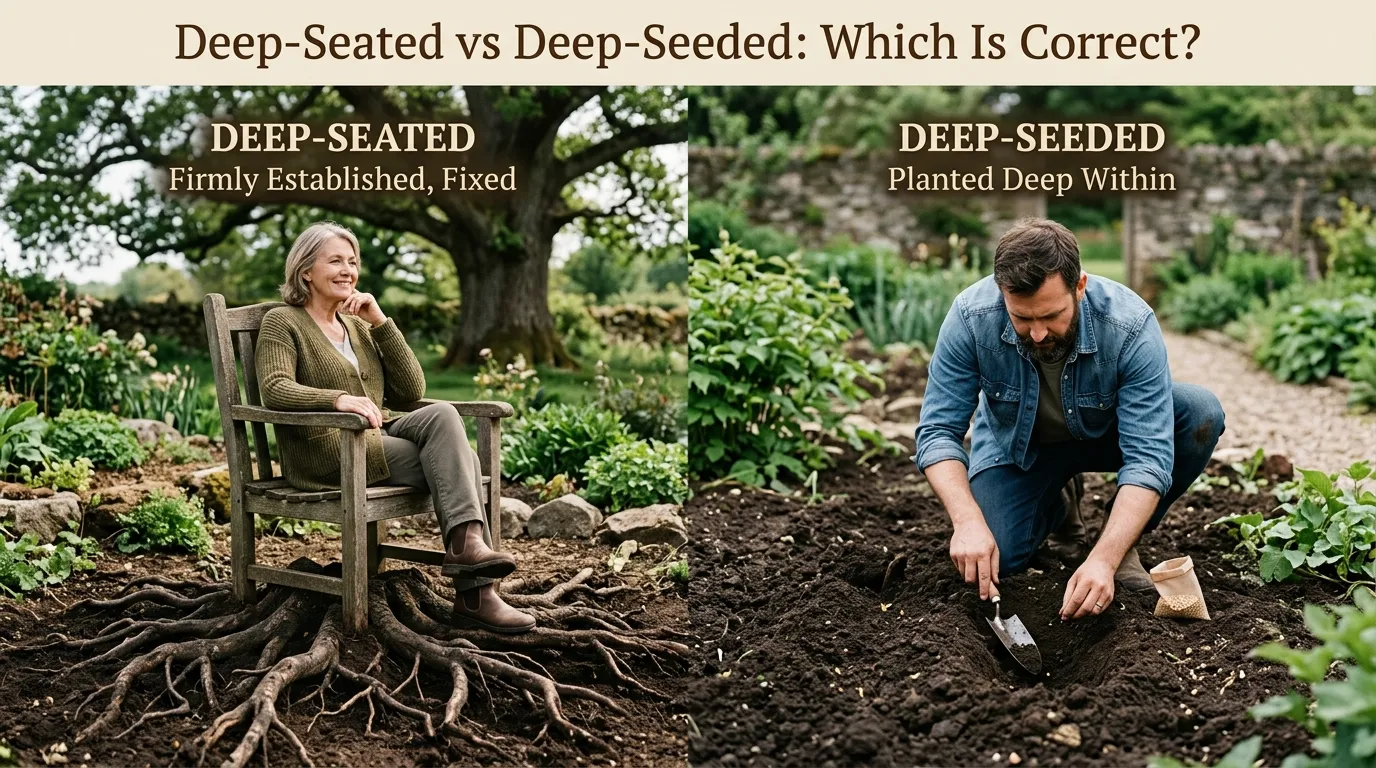
If you have ever written a sentence such as “She has a deep-seeded fear of failure,” you may have wondered whether deep-seeded is actually correct. The answer is simple: deep-seated is the standard and correct expression when you mean something that is firmly established, strongly rooted, or difficult to change.
Deep-seeded is usually a spelling mistake or a mistaken variation of deep-seated. The confusion is understandable because the expression is often used figuratively to describe something that has become deeply rooted in a person’s mind, emotions, beliefs, habits, or society.
In this guide, we will explain deep-seated vs deep-seeded, including their meanings, pronunciation, grammar, history, common uses, synonyms, examples, and the reason people confuse them. You will also learn when to use deep-seated beliefs, deep-seated fears, deep-seated resentment, and similar expressions.
Whether you are writing an email, school assignment, article, business document, news story, academic paper, or casual message, knowing the difference will help you choose the standard form with confidence.
Quick Answer: Deep-Seated or Deep-Seeded?
Deep-seated is the correct standard expression.
It describes something that is firmly established, deeply rooted, or strongly fixed, especially an attitude, belief, emotion, habit, problem, or feeling.
Deep-seeded is generally considered a misspelling or mistaken form of deep-seated.
| Expression | Standard English? | Meaning |
|---|---|---|
| deep-seated | Yes | Firmly established or deeply rooted |
| deep-seeded | No, in this meaning | Usually a mistaken spelling of deep-seated |
Correct examples
- She has a deep-seated fear of public speaking.
- The organization has a deep-seated commitment to quality.
- There is deep-seated resentment between the two groups.
- He has a deep-seated belief that hard work matters.
Incorrect examples
- She has a deep-seeded fear of public speaking.
- The company has a deep-seeded problem with communication.
- He expressed deep-seeded resentment toward his former employer.
In standard American English, use deep-seated.
What Does Deep-Seated Mean?
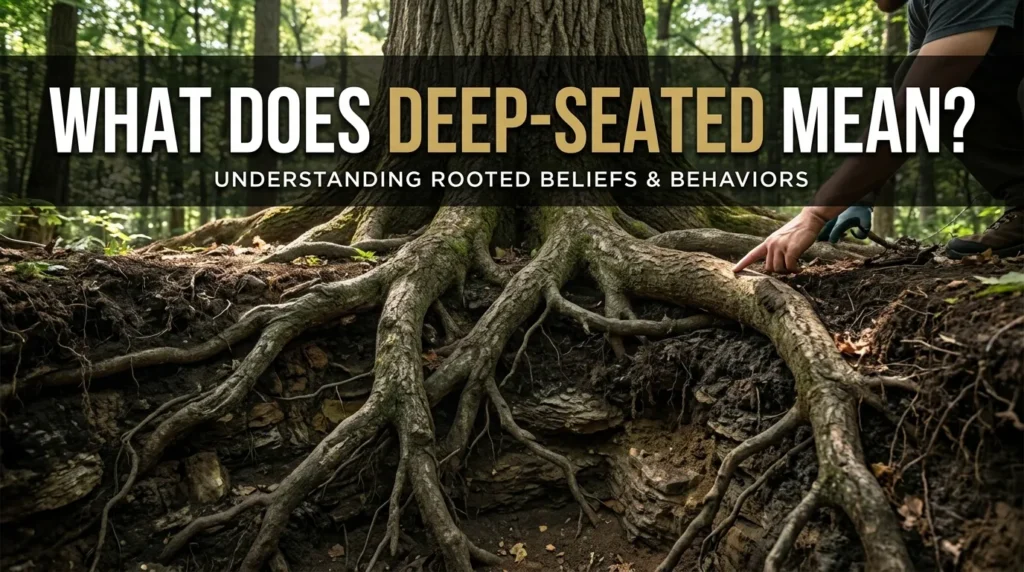
Deep-seated is an adjective meaning firmly established, deeply rooted, or strongly fixed.
The expression is usually used for something that has existed for a long time or has become firmly established in someone’s thoughts, emotions, behavior, beliefs, or circumstances.
For example:
She has a deep-seated fear of failure.
This does not simply mean that she is afraid of failing today. It suggests that the fear is strongly established within her and may be difficult to overcome.
Another example is:
The community has a deep-seated distrust of the government.
The distrust is not temporary. It has become firmly established over time.
Common things described as deep-seated
You can use deep-seated with many nouns, including:
- beliefs
- fears
- feelings
- emotions
- attitudes
- prejudices
- resentment
- hatred
- distrust
- traditions
- habits
- problems
- conflicts
- concerns
- values
- assumptions
- convictions
- biases
- anxieties
The word generally emphasizes depth, permanence, and resistance to change.
Why Is It Deep-Seated?
The expression becomes easier to understand when you look at the word seat.
A seat can refer to a place where something rests or is firmly positioned. The original idea behind deep-seated is something that is deeply fixed in a particular place.
Over time, English speakers began using the expression figuratively.
Instead of saying something is physically fixed deep in a place, we can say a feeling or belief is deep-seated in a person’s mind.
For example:
His deep-seated anger affected his relationships.
The anger is not literally sitting somewhere inside him. It is firmly established within his emotional life.
This figurative use is now completely standard.
What Does Deep-Seeded Mean?
Deep-seeded is generally not the correct form when you mean “deeply rooted” or “firmly established.”
The mistake probably occurs because of the word seeded.
A seed can be planted deeply in soil. Because of that literal image, deep-seeded may seem logical.
For example:
The farmer planted the seeds deep in the soil.
That sentence is perfectly meaningful because it describes actual seeds.
However, deep-seeded is not the standard expression for an established belief, emotion, or problem.
So these two ideas should be kept separate:
- Seeds can be deeply planted in soil.
- Beliefs and emotions can be deep-seated.
Deep-seeded can appear in literal contexts
There is an important distinction here.
The phrase deep-seeded can theoretically be understood literally when referring to seeds that have been planted deeply. However, this is not the established idiom that people normally mean when they write “deep-seeded fear” or “deep-seeded belief.”
If you are describing a person’s fear, belief, resentment, attitude, or emotional response, deep-seated is the appropriate choice.
Deep-Seated vs Deep-Seeded: The Main Difference
The simplest way to remember the distinction is:
Deep-seated = deeply established
Deep-seeded = associated with seeds, usually as a mistaken spelling of deep-seated
Consider these examples:
She has a deep-seated fear of dogs.
The fear is firmly established.
The farmer planted deep-seeded crops.
Here, the intended meaning would need to involve actual seeds, although a more natural construction would usually be deeply seeded, deeply planted, or a more specific description.
The key point is that deep-seated is the idiomatic adjective.
Deep-Seated vs Deep-Seeded Pronunciation
Deep-seated is normally pronounced as two words with the primary stress falling naturally on the important parts of the compound.
The spelling can help you remember that seated contains seat, not seed.
Think:
seat → seated → deep-seated
Not:
seed → seeded → deep-seeded
When speaking, the two expressions may sound different enough that the spelling mistake is not always obvious. In writing, however, the difference matters.
Deep-Seated as an Adjective
Grammatically, deep-seated functions as an adjective.
It modifies a noun.
Examples
- a deep-seated belief
- a deep-seated fear
- a deep-seated concern
- a deep-seated conflict
- a deep-seated habit
- a deep-seated prejudice
- a deep-seated problem
It can also appear after a linking verb:
Her fear is deep-seated.
The conflict appears to be deep-seated.
Because it is an adjective, it describes the nature or condition of something.
Deep-Seated Meaning in Different Contexts
The meaning stays essentially the same across contexts, but what is being described can change.
Deep-Seated Beliefs
A deep-seated belief is a belief that someone strongly holds and has probably held for a long time.
He has a deep-seated belief that everyone deserves a second chance.
This suggests that the belief is part of his basic outlook.
Deep-Seated Fears
A deep-seated fear is a strong fear that is deeply established.
She has a deep-seated fear of being abandoned.
This phrase often appears in discussions of emotions, psychology, personal experiences, and relationships.
Deep-Seated Resentment
Deep-seated resentment refers to anger or bitterness that has existed for a long time.
Years of unfair treatment created deep-seated resentment among employees.
Deep-Seated Problems
A deep-seated problem is a problem that is not superficial or temporary.
The organization needs to address its deep-seated financial problems.
This suggests that simply treating the visible symptoms will not solve the underlying issue.
Deep-Seated Beliefs in Politics
The expression is also common in political writing.
The proposal challenged some of the country’s deep-seated political assumptions.
Here, deep-seated emphasizes beliefs or attitudes that have become established over time.
Political journalists may also write about:
- deep-seated divisions
- deep-seated distrust
- deep-seated disagreements
- deep-seated political beliefs
- deep-seated social tensions
The phrase itself is not inherently political. It simply describes something firmly established.
Deep-Seated in Business and Professional Writing
Deep-seated works well in professional writing when discussing underlying problems, attitudes, organizational habits, or beliefs.
Examples
The company has a deep-seated culture of innovation.
The audit revealed deep-seated weaknesses in the internal process.
Management must address the deep-seated causes of employee turnover.
The department has a deep-seated commitment to customer service.
The expression can sound more precise than simply saying big, serious, or long-term.
However, business writers should avoid using it simply to make ordinary problems sound dramatic.
For example:
We have a deep-seated issue with the printer.
This sounds unnecessarily dramatic if the printer simply stopped working.
A better sentence would be:
We have a technical problem with the printer.
Use deep-seated when the problem is genuinely established, persistent, or difficult to change.
Deep-Seated in Academic Writing
The phrase is appropriate in academic and formal writing, particularly when discussing social attitudes, historical patterns, psychological factors, cultural beliefs, or persistent problems.
Examples include:
The conflict was influenced by deep-seated cultural differences.
The study examined deep-seated attitudes toward education.
These policies failed to address the country’s deep-seated economic problems.
Academic writing often benefits from more precise language, so deep-seated can be useful when the evidence supports the idea of something being firmly established.
Avoid using it as a synonym for simply important.
A problem can be important without being deep-seated.
Deep-Seated in Journalism
Journalists frequently use deep-seated when describing long-standing conflicts, public attitudes, political divisions, or social problems.
Common combinations include:
- deep-seated divisions
- deep-seated tensions
- deep-seated distrust
- deep-seated anger
- deep-seated conflict
- deep-seated concerns
For example:
The negotiations were complicated by deep-seated mistrust between the two sides.
This tells readers that the mistrust is not a new development.
Deep-Seated in Sports Writing
Sports writers also use the expression figuratively.
Examples:
The rivalry is fueled by deep-seated resentment.
The team has a deep-seated belief in its defensive system.
The loss exposed deep-seated problems within the organization.
It is especially useful when describing long-running rivalries, team culture, confidence issues, or organizational problems.
Deep-Seated in Casual Conversation
You can use deep-seated in everyday speech, but it can sound somewhat formal.
For casual conversation, people may prefer:
- strong
- deep
- long-standing
- deeply rooted
- hard-to-shake
For example:
More formal:
I have a deep-seated fear of flying.
More conversational:
I’m really afraid of flying.
Both are natural, but they serve different tones.
Common Collocations With Deep-Seated
A collocation is a combination of words that naturally appear together.
Some of the most common combinations with deep-seated are:
| Collocation | Example |
|---|---|
| deep-seated belief | She has a deep-seated belief in fairness. |
| deep-seated fear | He has a deep-seated fear of failure. |
| deep-seated resentment | The decision created deep-seated resentment. |
| deep-seated hatred | The groups have deep-seated hatred toward one another. |
| deep-seated distrust | There is deep-seated distrust between them. |
| deep-seated prejudice | The organization is trying to eliminate deep-seated prejudice. |
| deep-seated concern | Parents expressed deep-seated concerns. |
| deep-seated problem | The company faces a deep-seated problem. |
| deep-seated conflict | The region has a deep-seated conflict. |
| deep-seated tradition | The practice is based on a deep-seated tradition. |
| deep-seated habit | Breaking a deep-seated habit can take time. |
| deep-seated attitude | The campaign challenged deep-seated attitudes. |
These combinations are useful because they show how native English commonly uses the expression.
Deep-Seated Synonyms
Depending on the context, several words and phrases can replace deep-seated.
Common synonyms
- deeply rooted
- firmly established
- ingrained
- entrenched
- longstanding
- persistent
- fixed
- established
- habitual
- embedded
- deeply held
However, these words are not always interchangeable.
For example:
a deep-seated belief
can become:
a deeply held belief
But:
a deep-seated problem
might be better replaced by:
an entrenched problem
or:
a longstanding problem.
Choose the synonym that best matches the context.
Deep-Seated Antonyms
Possible opposites include:
- temporary
- superficial
- short-lived
- recent
- fleeting
- weak
- changeable
- uncertain
- unsettled
For example:
Her concern was temporary rather than deep-seated.
Or:
The disagreement was superficial, not a deep-seated conflict.
The exact antonym depends on what you are describing.
Deep-Seated vs Deep-Rooted
Another expression that often appears in the same contexts is deep-rooted.
In many cases, deep-rooted and deep-seated can be used interchangeably.
Deep-seated
Emphasizes something firmly established or fixed.
He has a deep-seated fear of failure.
Deep-rooted
Emphasizes something that has developed strong underlying roots.
The country has deep-rooted cultural traditions.
Both can describe beliefs, attitudes, conflicts, and social problems.
However, deep-seated fear and deep-seated resentment are especially common combinations.
Deep-Seated vs Deeply Rooted
These expressions are also closely related.
Compare:
She has a deep-seated belief in justice.
Her belief in justice is deeply rooted.
Both sentences communicate a similar idea.
The grammatical structure is different:
- deep-seated is an adjective.
- deeply rooted is a participial phrase.
This distinction matters when rewriting sentences.
Deep-Seated vs Entrenched
Entrenched often suggests that something is difficult to change because it has become firmly established.
The company has an entrenched bureaucracy.
Deep-seated is often more natural for internal feelings and beliefs:
She has a deep-seated fear of rejection.
You can sometimes use either word for social or institutional problems, but the emotional tone can differ.
Deep-Seated vs Ingrained
Ingrained means deeply established through habit, repetition, or long experience.
Checking his phone every few minutes had become an ingrained habit.
Deep-seated can describe habits, but it is especially common with emotions and beliefs.
He has a deep-seated distrust of authority.
Why Do People Write Deep-Seeded?
The mistake has a very understandable logic.
People know that seeds are planted deep in the ground. They may therefore associate the idea of something being deeply established with seeded.
There is also a semantic connection between rooted and seeded.
Consider these expressions:
- deeply rooted
- planted firmly
- deeply planted
- seeded
- deep-seated
Because several expressions use plant imagery, it is easy to blend them together.
The important point is that English idioms are not always predictable from their individual parts.
You cannot always create a standard expression simply because its literal meaning seems logical.
Deep-seated is the established idiom.
Common Mistakes With Deep-Seated
Mistake 1: Using Deep-Seeded for Feelings
Incorrect:
She has a deep-seeded fear of failure.
Correct:
She has a deep-seated fear of failure.
Mistake 2: Using Deep-Seated When You Mean Literally Planted
Incorrect or unclear:
The farmer used deep-seated seeds.
Better:
The farmer planted the seeds deeply.
Or:
The seeds were planted deep in the soil.
Deep-seated is mainly useful for the figurative sense.
Mistake 3: Writing Deep Seated Without a Hyphen
When the compound adjective appears before a noun, deep-seated is normally hyphenated.
a deep-seated belief
When the phrase follows the noun, style can vary depending on the construction, but the established compound remains deep-seated.
For consistency, especially in polished professional writing, retain the standard spelling.
Awkward vs Natural Examples
Example 1
Awkward:
The company has a deep-seeded problem.
Natural:
The company has a deep-seated problem.
Example 2
Awkward:
His deep-seeded beliefs shaped his decisions.
Natural:
His deep-seated beliefs shaped his decisions.
Example 3
Awkward:
She developed a deep-seeded distrust of politicians.
Natural:
She developed a deep-seated distrust of politicians.
Example 4
Awkward:
The conflict comes from deep-seeded differences.
Natural:
The conflict comes from deep-seated differences.
Example 5
Natural alternative:
The conflict comes from deeply rooted differences.
This alternative works because deeply rooted is also a standard expression.
Formal vs Informal Alternatives
Depending on your audience, you may want a simpler phrase.
| Formal | More conversational |
|---|---|
| deep-seated fear | strong fear |
| deep-seated concern | serious concern |
| deep-seated belief | strong belief |
| deep-seated resentment | long-term resentment |
| deep-seated problem | long-standing problem |
| deep-seated distrust | strong distrust |
| deep-seated habit | hard-to-break habit |
For academic, business, journalistic, and professional writing, deep-seated is perfectly appropriate.
For casual writing, a simpler alternative may sound more natural.
Is Deep-Seated American or British English?
Deep-seated is standard in both American and British English.
There is no major regional spelling difference between American and British English in this expression.
You can safely use deep-seated in:
- American English
- British English
- Canadian English
- Australian English
- international English
The important distinction is not regional preference. It is the difference between the standard idiom deep-seated and the commonly mistaken form deep-seeded.
Is Deep-Seated Formal?
Deep-seated is moderately formal but widely understood.
It appears in:
- newspapers
- books
- academic writing
- business reports
- essays
- speeches
- interviews
- everyday conversation
It does not sound excessively formal, but alternatives such as deep, strong, or long-standing may be more conversational.
Is Deep-Seated Always Negative?
No.
Although deep-seated is frequently used for negative emotions and problems, it can describe positive or neutral ideas as well.
Negative
deep-seated fear
deep-seated resentment
deep-seated hatred
Positive
deep-seated commitment to service
deep-seated respect for others
deep-seated appreciation of art
Neutral
deep-seated cultural traditions
deep-seated assumptions
deep-seated beliefs
So the expression itself is neutral. The noun determines whether the overall meaning is positive, negative, or neutral.
Memory Trick: Seat, Not Seed
Here is the easiest way to remember the spelling:
A belief sits deep.
If something is firmly established, imagine it sitting deeply in the mind.
That gives you:
deep + seat + ed = deep-seated
You can also remember this contrast:
Seeds are planted. Beliefs are seated.
If you are talking about a fear, belief, attitude, resentment, habit, or problem, choose deep-seated.
Practical Writing Checklist
Before publishing or submitting your writing, ask:
- Am I describing a belief, feeling, attitude, habit, or established problem?
- Do I mean that the thing is firmly established or deeply rooted?
- If yes, use deep-seated.
- Have I accidentally written deep-seeded?
- Is the expression being used as a compound adjective?
- Would deeply rooted, ingrained, or longstanding sound more natural in this particular sentence?
If the answer is that something is firmly established, deep-seated is almost certainly the form you want.
20 Correct Examples of Deep-Seated
Here are additional examples to reinforce the correct usage:
- She has a deep-seated fear of heights.
- He has a deep-seated belief in personal responsibility.
- The dispute reflects deep-seated differences between the groups.
- Years of conflict created deep-seated resentment.
- The company needs to solve its deep-seated financial problems.
- His deep-seated insecurity affected his relationships.
- The policy was designed to address deep-seated social problems.
- They have a deep-seated distrust of large institutions.
- Her deep-seated commitment to education inspired her students.
- The community has a deep-seated attachment to the tradition.
- The team’s rivalry is based on deep-seated hostility.
- The experience left him with a deep-seated concern about safety.
- The reform challenged deep-seated assumptions about leadership.
- His deep-seated habits were difficult to change.
- The region continues to face deep-seated political tensions.
- She developed a deep-seated respect for her mentor.
- The argument exposed a deep-seated disagreement.
- The organization is working to eliminate deep-seated bias.
- He has a deep-seated desire to help others.
- The problem is more deep-seated than it first appeared.
10 Examples Showing the Difference Clearly
1. Fear
Correct: She has a deep-seated fear of spiders.
Incorrect: She has a deep-seeded fear of spiders.
2. Belief
Correct: He has a deep-seated belief in honesty.
Incorrect: He has a deep-seeded belief in honesty.
3. Resentment
Correct: Years of unfair treatment created deep-seated resentment.
Incorrect: Years of unfair treatment created deep-seeded resentment.
4. Distrust
Correct: The scandal created deep-seated distrust.
Incorrect: The scandal created deep-seeded distrust.
5. Habit
Correct: Breaking a deep-seated habit can be difficult.
Incorrect: Breaking a deep-seeded habit can be difficult.
6. Problem
Correct: The organization has a deep-seated structural problem.
Incorrect: The organization has a deep-seeded structural problem.
7. Conflict
Correct: The negotiations were affected by deep-seated conflict.
Incorrect: The negotiations were affected by deep-seeded conflict.
8. Attitude
Correct: Education can challenge deep-seated attitudes.
Incorrect: Education can challenge deep-seeded attitudes.
9. Prejudice
Correct: The program aims to address deep-seated prejudice.
Incorrect: The program aims to address deep-seeded prejudice.
10. Commitment
Correct: She has a deep-seated commitment to helping children.
Incorrect: She has a deep-seeded commitment to helping children.
Deep-Seated vs Deep-Seeded: Final Comparison
| Feature | Deep-Seated | Deep-Seeded |
|---|---|---|
| Standard idiom | Yes | No |
| Common in American English | Yes | Usually a spelling error |
| Common in British English | Yes | Usually a spelling error |
| Describes beliefs | Yes | No |
| Describes fears | Yes | No |
| Describes resentment | Yes | No |
| Describes established problems | Yes | No |
| Connected figuratively with roots | Yes | No |
| Related literally to seeds | No | Possible literal interpretation |
| Best choice for polished writing | Yes | No |
FAQs About Deep-Seated vs Deep-Seeded
1. Is it deep-seated or deep-seeded?
The correct standard expression is deep-seated. It means firmly established, deeply rooted, or difficult to change. Deep-seeded is generally a misspelling when used with words such as fear, belief, resentment, or problem.
2. What does deep-seated mean?
Deep-seated means something is firmly established or deeply rooted. It is commonly used for beliefs, emotions, fears, attitudes, habits, conflicts, and persistent problems.
3. Is deep-seeded ever correct?
It can make literal sense when discussing seeds that have been placed deeply, but it is not the standard idiom for describing deeply established emotions, beliefs, or attitudes. In most cases where people write “deep-seeded fear” or “deep-seeded belief,” they mean deep-seated.
4. Why do people confuse deep-seated and deep-seeded?
People often confuse them because seeded relates to planting seeds, and something planted deeply can seem metaphorically similar to something deeply rooted. The established English expression, however, is deep-seated.
5. Is deep-seated one word or two words?
Deep-seated is a hyphenated compound adjective. The standard spelling includes a hyphen when the expression functions as the compound adjective.
6. Is deep-seated formal English?
Yes, deep-seated is appropriate for formal and informal contexts, although it has a somewhat polished or formal tone. It is common in academic, professional, journalistic, and everyday English.
7. What is another word for deep-seated?
Depending on the context, alternatives include deeply rooted, firmly established, ingrained, entrenched, longstanding, persistent, and deeply held.
8. Can you say deep-seated fear?
Yes. Deep-seated fear is one of the most common uses of the expression. It refers to a fear that is strongly established and may be difficult to overcome.
9. Can deep-seated describe positive things?
Yes. Although it often appears with negative emotions or problems, it can describe positive qualities or commitments. For example, someone can have a deep-seated respect, deep-seated commitment, or deep-seated appreciation.
10. What is the easiest way to remember deep-seated?
Remember the word seat. Something that is deep-seated is figuratively sitting deep and firmly in someone’s mind, emotions, beliefs, or behavior. Think: beliefs are seated, seeds are planted.
Conclusion: Deep-Seated Is the Standard Choice
The difference between deep-seated vs deep-seeded is straightforward once you understand the idiom.
Deep-seated is the standard expression. It means firmly established, deeply rooted, or strongly fixed. It commonly describes fears, beliefs, attitudes, emotions, habits, prejudices, resentment, distrust, conflicts, traditions, and persistent problems.
Deep-seeded is generally a mistaken spelling when used in those contexts. The confusion probably comes from the familiar image of seeds being planted deeply in the ground, but the established figurative expression uses seated, not seeded.
So if you are writing:
- deep-seated fear
- deep-seated belief
- deep-seated resentment
- deep-seated distrust
- deep-seated problem
- deep-seated conflict
- deep-seated habit
- deep-seated prejudice
you are using the standard form.
For American English, British English, academic writing, journalism, business communication, blogging, and professional content, the safest recommendation is simple:
Use “deep-seated” when you mean deeply rooted or firmly established.
When in doubt, remember the easiest rule:
Seeds are planted. Feelings and beliefs are deep-seated.
That single memory trick can help you avoid one of the most common spelling mistakes involving this useful English expression.