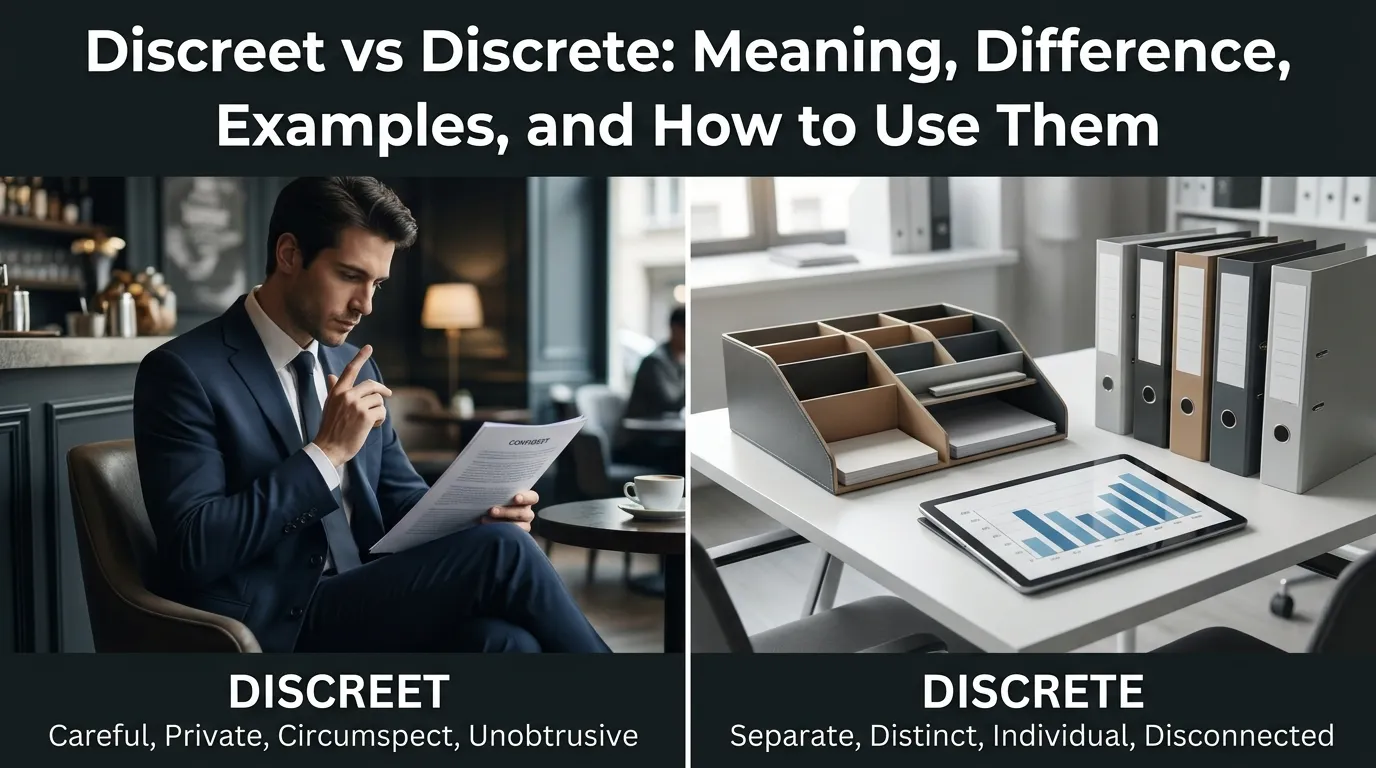
If you have ever wondered whether something should be discreet or discrete, you are not alone. These two words look almost identical and sound very similar, but they have different meanings and are used in different situations.
The easiest way to remember the difference is this:
- Discreet means careful, tactful, or not attracting attention.
- Discrete means separate, distinct, or individually different.
For example, you might ask a friend to be discreet about a private conversation. But a scientist might divide a sample into discrete parts.
Both discreet and discrete are correct English words. Neither is a misspelling of the other. The challenge is choosing the right word for the meaning you want.
This guide explains discreet vs discrete in detail, including their definitions, pronunciation, grammar, etymology, common collocations, synonyms, antonyms, professional usage, regional differences, common mistakes, and plenty of practical examples.
Quick Answer: Discreet vs Discrete
| Word | Main meaning | Example |
|---|---|---|
| Discreet | Careful, tactful, private, or unobtrusive | Please be discreet about the matter. |
| Discrete | Separate, distinct, or individually identifiable | The report contains three discrete sections. |
The simple rule
Think:
Discreet = secret or subtle
Discrete = separate
A discreet person knows how to avoid unwanted attention.
A discrete object or group is separate from another object or group.
Are Both Discreet and Discrete Correct?
Yes. Both words are standard English words, but they do not have the same meaning.
The confusion comes from their nearly identical spelling and pronunciation.
Consider these sentences:
She was discreet about her friend’s personal information.
Here, discreet means that she was careful not to reveal private information.
The machine has five discrete operating modes.
Here, discrete means that the five modes are separate and distinct.
Replacing one word with the other would change the meaning and, in many cases, make the sentence incorrect.
What Does Discreet Mean?
Discreet is an adjective meaning careful about what you say or do, especially when dealing with private, sensitive, or embarrassing information.
It can also describe something that is unobtrusive or designed not to attract attention.
Dictionary-style definition of discreet
Discreet: Careful, tactful, prudent, or intentionally unobtrusive, especially in situations involving privacy or sensitive information.
Examples
- Please be discreet about the surprise party.
- The doctor was discreet when discussing the patient’s situation.
- She gave him a discreet signal to leave.
- We need a discreet way to discuss the issue.
- The security camera is small and discreet.
In all of these examples, the idea involves privacy, tact, subtlety, or avoiding attention.
What Does Discrete Mean?
Discrete is an adjective meaning separate, distinct, or individually identifiable.
It is especially common in academic, scientific, mathematical, technical, and professional writing.
Dictionary-style definition of discrete
Discrete: Separate or distinct from other things; individually distinguishable rather than continuous or blended together.
Examples
- The study examined three discrete age groups.
- The program consists of several discrete modules.
- The machine has four discrete settings.
- These are discrete categories rather than one continuous scale.
- The company operates through several discrete divisions.
Here, the important idea is separation.
The Key Difference Between Discreet and Discrete
The biggest difference is meaning.
Discreet is about behavior, privacy, tact, and subtlety.
Discrete is about separation, distinction, and individuality.
Compare:
The employee was discreet when handling confidential information.
The employee behaved carefully.
The database contains discrete records for each customer.
The records are separate units.
An easy memory trick
Look at the spelling:
discreet has ee.
You can remember:
Discreet = keep it quietly.
The double e can remind you of keeping something private.
For discrete, think:
Discrete = distinct.
Both words begin with dis-, but discrete contains the idea of something being distinct or separate.
Discreet vs Discrete Pronunciation
The two words are pronounced almost exactly alike.
Discreet
IPA: /dɪˈskriːt/
It sounds like:
dih-SKREET
Discrete
IPA: /dɪˈskriːt/
It also sounds like:
dih-SKREET
This is one reason the words are frequently confused in speech.
When someone says the word aloud, you usually need to rely on context to determine whether they mean discreet or discrete.
Discreet: Meaning and Usage
The word discreet is often used when talking about how someone behaves.
It suggests good judgment, tact, and an awareness of privacy.
Discreet behavior
Someone can be discreet when they:
- avoid revealing confidential information
- do not draw unnecessary attention
- handle sensitive situations carefully
- respect another person’s privacy
- communicate something subtly
For example:
The assistant was discreet when handling the confidential documents.
The assistant did not behave carelessly or attract attention to the documents.
Discreet objects or actions
Discreet can also describe something designed to be unobtrusive.
For example:
- a discreet security camera
- a discreet microphone
- a discreet entrance
- discreet lighting
- a discreet notification
Here, the meaning is closer to subtle or inconspicuous.
Discrete: Meaning and Usage
Discrete is more concerned with things that can be viewed as separate units.
It is common in technical and formal writing.
Discrete categories
The survey divided participants into four discrete groups.
The groups are separate.
Discrete objects
The collection contains several discrete pieces of equipment.
Each piece can be identified separately.
Discrete stages
The process occurs in three discrete stages.
The stages are distinct rather than being treated as one continuous process.
Discreet vs Discrete in Mathematics
Discrete has a particularly important meaning in mathematics.
A discrete quantity consists of separate, countable values rather than a continuously varying range.
For example:
The number of students in a classroom is a discrete variable.
You can have 20 or 21 students, but not normally 20.5 students.
This contrasts with a continuous variable, such as height or temperature, which can take values across a continuous range.
Common mathematical terms
You may encounter:
- discrete mathematics
- discrete variables
- discrete data
- discrete probability
- discrete structures
- discrete values
- discrete functions
- discrete systems
The spelling here is always discrete, not discreet.
Discrete vs Continuous
This is one of the most important technical uses of discrete.
Something discrete is made up of separate values or units.
Something continuous changes without distinct breaks between values.
For example:
The number of books sold is discrete data.
The exact weight of a book is a continuous measurement.
This distinction appears in statistics, mathematics, computer science, engineering, and data analysis.
Discreet vs Discrete in Business
Both words can appear in business writing, but they have very different functions.
Discreet in business
Use discreet when discussing confidentiality, tact, or avoiding attention.
- discreet negotiations
- discreet communication
- discreet handling of information
- discreet inquiries
- discreet arrangements
Example:
The executive requested a discreet discussion before announcing the merger.
Discrete in business
Use discrete when describing separate departments, products, operations, or categories.
Example:
The company has three discrete business units.
Here, the units are distinct from each other.
Discreet vs Discrete in Professional Writing
In professional communication, choosing the correct word matters because the two meanings can be quite different.
Consider:
Please be discreet with the client’s information.
This means keep the information private.
Now compare:
The report separates the client’s information into discrete categories.
This means the information is divided into separate categories.
One word describes conduct. The other describes structure or separation.
Discreet vs Discrete in Academic Writing
Discrete is much more common in academic writing, especially in scientific and mathematical contexts.
Examples include:
- discrete variables
- discrete populations
- discrete categories
- discrete observations
- discrete intervals
- discrete systems
Discreet is more likely to appear when an academic writer discusses privacy, interpersonal conduct, or sensitive information.
Researchers were discreet when discussing confidential participant information.
Discreet vs Discrete in Journalism
Journalists may use discreet when describing privacy or subtle behavior.
The reporter made a discreet inquiry.
They may use discrete when describing separate categories or entities.
The investigation focused on four discrete allegations.
Again, the distinction is between tact/subtlety and separation/distinction.
Discreet vs Discrete in Technical Writing
Discrete is strongly associated with technical language.
Common phrases include:
- discrete signal
- discrete data
- discrete component
- discrete event
- discrete system
- discrete input
- discrete output
- discrete state
- discrete unit
For example:
The software processes each discrete input separately.
Using discreet here would be incorrect because the intended meaning is separate or distinct.
Discreet vs Discrete in Casual English
In everyday conversation, discreet is usually used for privacy or tact.
For example:
Can you be discreet about this?
This means:
Can you keep this private?
Discrete is less common in casual speech unless the topic involves categories, technical concepts, or separate objects.
You might say:
Let’s treat these as two discrete issues.
That means:
Let’s treat these as two separate issues.
Common Collocations With Discreet
A collocation is a group of words that commonly appear together.
Common combinations with discreet include:
- discreet manner
- discreet person
- discreet conversation
- discreet inquiry
- discreet approach
- discreet signal
- discreet gesture
- discreet location
- discreet service
- discreet communication
- discreet handling
- discreet arrangement
- discreet operation
- discreet surveillance
- discreet design
Examples
He made a discreet inquiry about the job.
The hotel provides discreet service to high-profile guests.
She gave me a discreet gesture to indicate that we should leave.
Common Collocations With Discrete
Common combinations with discrete include:
- discrete units
- discrete categories
- discrete groups
- discrete elements
- discrete components
- discrete stages
- discrete events
- discrete values
- discrete variables
- discrete systems
- discrete data
- discrete signals
- discrete structures
- discrete entities
- discrete sections
Examples
The experiment used five discrete categories.
The device contains several discrete components.
The software records discrete events.
Synonyms for Discreet
Depending on context, synonyms for discreet include:
- tactful
- careful
- prudent
- diplomatic
- subtle
- private
- unobtrusive
- inconspicuous
- circumspect
- restrained
- cautious
- reserved
However, these words are not always interchangeable.
For example, tactful focuses on avoiding offense, while discreet often focuses on privacy or avoiding attention.
Antonyms for Discreet
Possible opposites include:
- indiscreet
- careless
- obvious
- conspicuous
- loud
- intrusive
- tactless
- revealing
- imprudent
The best antonym depends on the context.
Synonyms for Discrete
Common synonyms include:
- separate
- distinct
- individual
- independent
- detached
- divided
- isolated
- different
- distinguishable
- self-contained
For example:
The report contains four discrete sections.
Could become:
The report contains four separate sections.
Antonyms for Discrete
Depending on context, opposites include:
- continuous
- connected
- combined
- unified
- merged
- attached
- integrated
- continuous
In mathematics and statistics, continuous is often the most important antonym.
Discreet vs Discrete Word History
The two words have related historical roots, which helps explain their similar spelling.
Both ultimately trace back to Latin discernere, meaning to separate, distinguish, or discern.
Over time, English developed two related forms with different meanings.
Discrete retained the sense of something being separate or distinct.
Discreet developed toward the idea of showing good judgment, especially in choosing what to say or do.
So although the words are different in modern English, their historical connection helps explain why they look so similar.
Discreet vs Discrete: Grammar
Both discreet and discrete are adjectives.
They modify nouns.
Discreet
a discreet employee
a discreet conversation
discreet behavior
Discrete
a discrete category
discrete units
discrete values
a discrete system
Neither word is normally used as a noun in standard modern English in these meanings.
Common Mistakes With Discreet and Discrete
Mistake: Using discreet for separate
Incorrect:
The report contains five discreet sections.
If you mean the sections are separate, use discrete.
Correct:
The report contains five discrete sections.
Mistake: Using discrete for private
Incorrect:
Please be discrete about my personal situation.
If you mean someone should keep the information private, use discreet.
Correct:
Please be discreet about my personal situation.
Mistake: Confusing discreet with discrete in technical writing
Incorrect:
The experiment measured several discreet variables.
Correct:
The experiment measured several discrete variables.
Variables that consist of separate values are discrete variables.
Awkward vs Natural Examples
Sometimes a sentence can technically contain a word but still sound unnatural.
Privacy
Awkward:
Please be discrete with this information.
Natural:
Please be discreet with this information.
Separate groups
Awkward:
The researchers created three discreet groups.
Natural:
The researchers created three discrete groups.
Subtle design
Natural:
The camera has a discreet design.
Here, the camera does not attract much attention.
Separate components
Natural:
The device uses several discrete components.
Each component is a separate part.
Everyday Examples of Discreet
Here are natural examples you may encounter in everyday life:
- Please be discreet about my new job.
- She was discreet when asking about his personal life.
- He gave me a discreet nod.
- The waiter was discreet when handling the complaint.
- We found a discreet place to talk.
- The company offers discreet delivery.
- She made a discreet exit.
- The message was sent through a discreet channel.
Everyday Examples of Discrete
Although less common in casual conversation, these are natural:
- The project has three discrete parts.
- These are two discrete problems.
- The system has several discrete settings.
- The classes are divided into discrete groups.
- Each button controls a discrete function.
- The collection consists of discrete items.
- The process can be divided into discrete steps.
Formal vs Informal Alternatives
Sometimes you can replace these words with simpler language.
Alternatives for discreet
Formal:
The manager handled the matter discreetly.
Simple:
The manager handled the matter carefully and privately.
Alternatives for discrete
Formal:
The study examined four discrete populations.
Simple:
The study examined four separate populations.
In general, discreet and discrete are perfectly appropriate in both formal and everyday writing when they express the exact meaning you need.
Regional Differences: American vs British English
There is no major American-versus-British spelling difference between these words.
American English uses:
- discreet
- discrete
British English also uses:
- discreet
- discrete
The distinction in meaning remains essentially the same across major English varieties.
So you do not need to choose one spelling based on whether your audience is American or British.
The important issue is meaning, not region.
Is Discreet More Common Than Discrete?
In ordinary, nontechnical conversation, discreet may feel more familiar because people often use it when discussing privacy, secrets, or tact.
However, discrete is extremely common in specialized fields such as:
- mathematics
- statistics
- computer science
- engineering
- electronics
- data science
- linguistics
- research
Frequency therefore depends heavily on the subject and context.
Discreetly vs Discretely
The confusion continues with the adverbs.
Discreetly
Discreetly means in a careful, private, or unobtrusive way.
She discreetly left the room.
He discreetly asked whether everything was okay.
Discretely
Discretely means separately or distinctly.
It is less common in everyday English but can occur in technical or formal contexts.
The data points were analyzed discretely rather than continuously.
In many ordinary contexts, writers would simply say separately.
Discreetness vs Discreteness
The same distinction appears in their noun forms.
Discreetness
Discreetness refers to the quality of being discreet.
Her discreetness helped protect the client’s privacy.
Discreteness
Discreteness refers to the quality of being discrete or separate.
The discreteness of the categories made the data easier to analyze.
These nouns are much less common than the adjectives themselves.
Discreet vs Discrete in Politics
Both words can appear in political writing, but again their meanings remain distinct.
Discreet in politics
The leaders held a discreet meeting before the announcement.
The meeting was private or intentionally low-profile.
Discrete in politics
The proposal addresses three discrete policy areas.
The areas are separate and distinct.
Political context does not change the basic definition of either word.
Discreet vs Discrete in Sports
Discreet can describe quiet or unobtrusive actions.
The coach gave the player a discreet signal from the sideline.
Discrete can describe separate categories or units.
The tournament has five discrete competition levels.
Again:
Discreet = subtle behavior
Discrete = separate categories or units
Discreet vs Discrete in Blogging and Online Writing
Bloggers and content writers should be especially careful because both words can sound natural in a sentence.
Compare:
Be discreet when sharing personal information online.
Correct if the meaning is be careful and private.
The article divides the topic into four discrete sections.
Correct if the sections are separate.
A useful editing trick is to replace the word with private or separate.
If private works, choose discreet.
If separate works, choose discrete.
A Simple Replacement Test
When you are unsure, ask what you mean.
Can you replace it with private or tactful?
Use discreet.
Please be discreet.
→ Please be private/careful.
Can you replace it with separate or distinct?
Use discrete.
The study has four discrete groups.
→ The study has four separate groups.
This test solves most cases quickly.
Discreet vs Discrete Comparison Table
| Feature | Discreet | Discrete |
|---|---|---|
| Part of speech | Adjective | Adjective |
| Core meaning | Careful, tactful, unobtrusive | Separate, distinct |
| Main idea | Privacy or subtlety | Separation |
| Common context | Personal, professional, confidential | Academic, scientific, technical |
| Pronunciation | /dɪˈskriːt/ | /dɪˈskriːt/ |
| Common synonym | Tactful | Separate |
| Common antonym | Indiscreet | Continuous |
| Technical use | Limited | Very common |
| Example | Be discreet about the news. | Use discrete categories. |
Discreet vs Discrete: Quick Memory Trick
Use this two-word rule:
Discreet = secret
Both are connected with keeping something quiet.
Discrete = distinct
Both point toward separation and difference.
So:
Discreet → secret, subtle, tactful
Discrete → distinct, separate, individual
If you remember only one thing, remember:
Discreet keeps things quiet. Discrete keeps things separate.
Frequently Asked Questions
Is it discreet or discrete when you mean private?
The correct word is discreet.
For example:
Please be discreet about our conversation.
Here, discreet means careful, private, and tactful.
Is it discreet or discrete when you mean separate?
The correct word is discrete.
For example:
The report contains three discrete sections.
Here, discrete means separate or distinct.
Are discreet and discrete pronounced the same?
Yes. In standard American English, both are generally pronounced /dɪˈskriːt/.
Their pronunciation is one major reason they are easy to confuse.
What is the difference between discreet and discrete in mathematics?
Discrete refers to separate, countable values or structures. It is widely used in mathematics, statistics, and computer science.
For example, the number of people in a room is a discrete quantity because people are counted as individual units.
Is discreet a synonym for secret?
Not exactly. Discreet can describe behavior intended to protect privacy or avoid attention, so it can overlap with the idea of keeping something secret. However, discreet more broadly means careful, tactful, or unobtrusive.
Is discrete the opposite of continuous?
In many mathematical and technical contexts, yes. Discrete describes separate values or units, while continuous describes something that varies without distinct breaks.
Is discreet more formal than discrete?
Neither word is simply more formal than the other. Discreet is common in everyday and professional English, while discrete is especially common in academic, mathematical, scientific, and technical writing.
How can I remember discreet vs discrete?
Remember:
Discreet = secret or subtle.
Discrete = distinct or separate.
If you are talking about privacy or tact, choose discreet. If you are talking about separate things or categories, choose discrete.
Can discreet and discrete be used interchangeably?
No. They have different meanings and should not normally be substituted for each other.
Be discreet with confidential information.
means something very different from:
Divide the information into discrete categories.
Final Takeaway
The difference between discreet vs discrete becomes easy once you focus on the core meanings.
Discreet describes someone or something that is careful, tactful, private, subtle, or unobtrusive.
Discrete describes things that are separate, distinct, individual, or clearly divided.
Use discreet when the sentence is about privacy:
She was discreet about the confidential information.
Use discrete when the sentence is about separation:
The researchers studied three discrete groups.
There is no meaningful American-versus-British spelling difference to worry about. Both forms are standard in English, and both are pronounced essentially the same.
For a quick final memory aid:
Discreet = secret.
Discrete = separate.
When editing your writing, ask whether you mean private or separate. That simple test will help you choose the correct word almost every time.