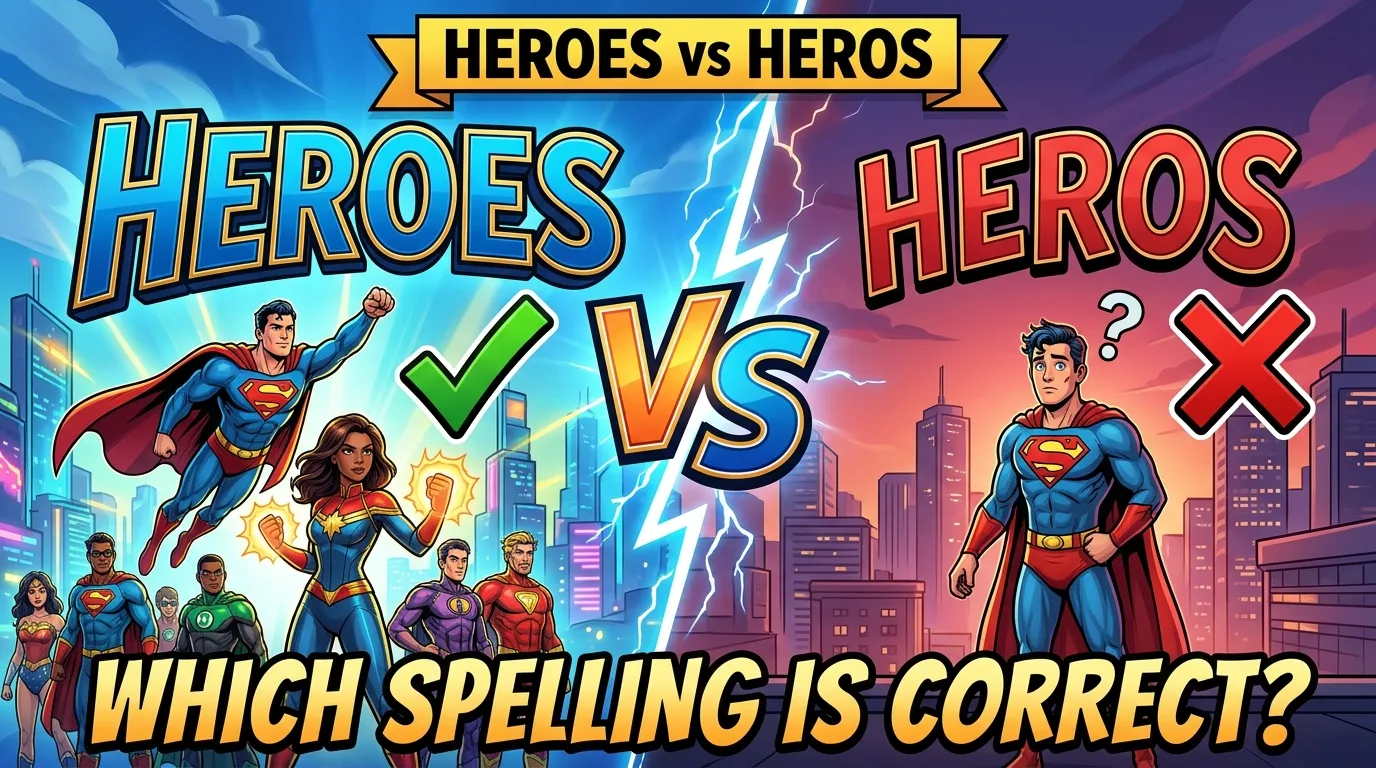
If you are wondering whether the correct plural of hero is heroes or heros, the answer is simple: heroes is the standard and correct plural spelling in English. Heros is generally considered a misspelling when you mean more than one hero.
For example:
- Correct: The firefighters were celebrated as heroes.
- Incorrect: The firefighters were celebrated as heros.
The confusion happens because many English nouns form their plurals by simply adding -s. For example, car → cars and book → books. However, hero follows a different pattern. In standard English, nouns ending in a consonant + o often take -es in the plural, although English has exceptions.
In this guide, you will learn the difference between heroes and heros, how to pronounce heroes, why heros is confusing, how the plural works, the history of the word, common expressions, possessive forms, regional usage, and practical examples for school, work, journalism, sports, social media, and everyday conversation.
Quick Answer: Heroes or Heros?
Heroes is the correct standard plural of hero.
| Word | Correct? | Meaning |
|---|---|---|
| hero | ✅ Yes | One person admired for courage, achievement, or noble qualities |
| heroes | ✅ Yes | More than one hero |
| heros | ❌ Usually no | Nonstandard spelling when intended as the plural of hero |
| hero’s | ✅ Yes | Singular possessive form |
| heroes’ | ✅ Yes | Plural possessive form |
The basic rule
Hero → heroes
Not:
Hero → heros
Examples:
- One hero saved the child.
- Two heroes saved the child.
- The hero’s story became famous.
- The heroes’ actions inspired the community.
If you are writing in standard American English, British English, academic English, business writing, journalism, or formal communication, use heroes.
What Does Hero Mean?
A hero is a person who is greatly admired for courage, bravery, outstanding achievement, selflessness, or an important positive contribution.
The word can describe someone who performs a dramatic act of bravery, but it can also be used more broadly.
For example:
- The firefighter was called a hero after rescuing the family.
- Her mother is her hero.
- The athlete became a national hero after winning the championship.
- The doctor was praised as a hero during the crisis.
The word can also be used figuratively. Someone does not necessarily have to save a life to be called a hero.
A person might be a hero because they:
- Stand up for others
- Overcome extraordinary difficulties
- Make an important discovery
- Help their community
- Inspire other people
- Show unusual courage
- Accomplish something remarkable
The plural form is heroes.
Why Is the Plural Heroes Instead of Heros?
The spelling heroes follows a traditional English plural pattern.
Many nouns ending in -o form their plural with -es, particularly words that entered English through older linguistic patterns.
For example:
- hero → heroes
- potato → potatoes
- tomato → tomatoes
- echo → echoes
- veto → vetoes
However, English plural rules are not completely predictable. Some words ending in -o simply take -s:
- photo → photos
- piano → pianos
- radio → radios
- video → videos
- studio → studios
This mixture of patterns is one reason learners may write heros.
The spelling looks logical because hero + s would produce heros. But standard English has established heroes as the plural form.
Heroes vs Heros: The Key Difference
The most important difference is grammatical and orthographic rather than semantic.
Heroes is the standard plural noun.
Heros is not normally accepted as the plural spelling of hero in standard English.
Consider these sentences:
The soldiers were remembered as heroes.
Correct.
The soldiers were remembered as heros.
Incorrect in standard English.
The pronunciation also changes slightly from the singular.
- hero: /ˈhɪroʊ/
- heroes: /ˈhɪroʊz/
The final -es in heroes does not create a separate syllable in normal pronunciation in American English. It sounds approximately like HEE-rohz.
Heroes: Dictionary-Style Definition
Heroes is the plural form of hero.
Hero
Part of speech: Noun
Definition: A person admired for courage, noble qualities, exceptional achievements, or important actions.
Heroes
Part of speech: Plural noun
Definition: Two or more people who are regarded as heroes.
Example:
The rescue workers became heroes after saving dozens of people.
The word can refer to real people, fictional characters, historical figures, athletes, activists, professionals, or ordinary individuals who perform extraordinary acts.
How to Pronounce Heroes
In American English, heroes is generally pronounced:
/ˈhɪroʊz/
A simple pronunciation guide is:
HEE-rohz
The singular hero is:
/ˈhɪroʊ/
So the plural adds a final z sound.
Pronunciation examples
- hero → HEE-roh
- heroes → HEE-rohz
Do not pronounce heroes as if it were spelled her-oh-es with three separate syllables in ordinary American speech.
British English pronunciation
British English commonly uses a pronunciation closer to:
/ˈhɪərəʊz/
The vowel quality differs somewhat from American English, but the spelling remains heroes.
The spelling is not changed to heros in standard British English.
Is Heros Ever Correct?
For ordinary English writing, heros is not the standard plural of hero.
There can be unusual situations in which Heros appears as a proper name, brand, title, username, surname, or other specialized name. In those cases, it may be intentionally spelled that way.
For example, if a fictional character is officially named Heros, the spelling may be correct for that particular name.
But if you are talking about several people who are heroes, write:
heroes
not:
heros
This distinction matters because proper names can have spellings that do not follow ordinary English grammar.
Heroes in American English
In American English, heroes is the normal plural form.
You will find it in:
- Newspapers
- Books
- School assignments
- Government writing
- Sports reporting
- Business communication
- Academic writing
- Advertising
- Fiction
- Everyday conversation
- Social media
Examples:
The first responders were praised as local heroes.
Comic-book heroes often have extraordinary abilities.
The team’s veterans became heroes after their dramatic victory.
Teachers can become everyday heroes in their communities.
There is no standard American English situation in which heros should replace heroes as the ordinary plural.
Heroes in British English
British English also uses heroes.
For example:
The rescue workers were hailed as heroes.
Many historical heroes are remembered for their courage.
The spelling does not change between American and British English.
This is useful to remember because some English words have different regional spellings, such as:
- color / colour
- center / centre
- traveled / travelled
But hero → heroes is not one of those differences.
Why Do People Write Heros?
There are several reasons people make this mistake.
Adding -s automatically
English learners often learn the basic plural rule:
singular noun + s = plural
That works for many words:
- dog → dogs
- house → houses
- teacher → teachers
So it may seem natural to write:
hero → heros
But English contains many irregular and pattern-based plurals.
Confusion with words like photos
People may notice that these words take -s:
- photo → photos
- piano → pianos
- radio → radios
- video → videos
They may assume that hero follows the same pattern.
It does not.
The conventional standard plural is heroes.
Pronunciation does not clearly reveal the spelling
When someone hears heroes, they cannot necessarily determine whether it is spelled heroes or heros.
English spelling is often less predictable than pronunciation.
Typing quickly
On social media, text messages, comments, and informal posts, people frequently type words based on sound or memory. A quick typo can turn heroes into heros.
That does not make heros the standard spelling.
Hero, Heroes, Hero’s, and Heroes’ Explained
These four forms are easy to confuse.
Hero
Use hero for one person.
The firefighter is a hero.
Heroes
Use heroes for two or more people.
The firefighters are heroes.
Hero’s
Use hero’s for possession involving one hero.
The hero’s actions inspired everyone.
This means the actions belong to or are associated with one hero.
Heroes’
Use heroes’ for possession involving multiple heroes.
The heroes’ actions inspired everyone.
Here, the actions belong to or are associated with several heroes.
Comparison
| Form | Grammatical function | Example |
|---|---|---|
| hero | Singular noun | He is a hero. |
| heroes | Plural noun | They are heroes. |
| hero’s | Singular possessive | The hero’s story was inspiring. |
| heroes’ | Plural possessive | The heroes’ stories were inspiring. |
Notice that heroes’ already ends in -s, so the apostrophe comes after the s.
Common Mistakes With Heroes
Here are some frequent errors and their corrections.
Mistake: Heros
❌ The firefighters were heros.
✅ The firefighters were heroes.
Mistake: Heroes’s
❌ The heroes’s stories were inspiring.
✅ The heroes’ stories were inspiring.
When a plural noun already ends in -s, its possessive form normally uses an apostrophe after the s.
Mistake: Hero’s for plural
❌ The hero’s arrived at the ceremony.
✅ The heroes arrived at the ceremony.
An apostrophe does not normally make a noun plural.
Mistake: Heroes when you mean one person
❌ My father is one of my heroes, but he is my favorite heroes.
✅ My father is one of my heroes, but he is my favorite hero.
Heroes in Different Contexts
The word heroes works in many fields and situations.
Literature
In literature, heroes are central characters who face challenges or conflicts.
The novel follows three heroes on a dangerous journey.
The term does not always mean the character is morally perfect.
A literary hero may have flaws, make mistakes, or struggle with difficult choices.
Movies and television
Superheroes are one of the most familiar modern uses.
The movie features several superheroes.
Other examples include:
- action heroes
- unlikely heroes
- tragic heroes
- fictional heroes
- comic-book heroes
Sports
Sportswriters often call successful players or teams heroes.
The goalkeeper became a hero after saving the final penalty.
A player who performs exceptionally well in an important game may be described as a game hero or simply a hero.
Journalism
News reports may use heroes for people who perform brave or selfless acts.
Neighbors described the rescuers as heroes.
However, professional journalism generally benefits from precise language. Calling someone a hero is evaluative, so journalists may distinguish between direct descriptions of actions and subjective praise.
Business and professional writing
The word can be used in professional settings, especially for recognition.
The organization honored its volunteers as community heroes.
In formal reports, however, a more specific term may sometimes be better:
- contributors
- volunteers
- first responders
- rescue workers
- innovators
- leaders
Instead of simply calling someone a hero, explain what they did.
Academic writing
In academic writing, heroes is grammatically acceptable, but the meaning should be clear.
For example:
The study examines how national heroes are represented in historical narratives.
This is more precise than using heroes without explaining who qualifies as one.
Heroes in Sports, Politics, and Public Life
The word hero can carry strong emotional or cultural meaning.
A historical figure may be called a national hero because of military service, political leadership, social reform, scientific achievement, or another major contribution.
However, the label is not always universally accepted.
Different communities may view the same historical figure differently.
Therefore, when writing about politics or history, context matters. If the term is contested, neutral wording can be safer and more precise.
For example:
The figure is regarded as a national hero by many supporters.
This is more carefully framed than:
The figure is unquestionably a national hero.
The plural heroes works the same way.
Heroes as a Figurative Expression
A hero does not have to be someone who performs a dramatic rescue.
The word is often used figuratively.
Someone might say:
My parents are my heroes.
This usually means the speaker deeply admires their parents.
Another person might say:
Our teacher was a hero during a difficult year.
This could mean the teacher provided exceptional support rather than literally saving someone from danger.
Common figurative combinations include:
- everyday heroes
- unsung heroes
- personal heroes
- local heroes
- community heroes
- childhood heroes
- national heroes
- real-life heroes
Common Expressions With Heroes
Unsung heroes
Unsung heroes are people whose valuable contributions receive little public recognition.
The hospital staff were the unsung heroes of the recovery effort.
Everyday heroes
Everyday heroes are ordinary people who perform helpful, brave, or selfless acts.
The campaign celebrates everyday heroes in local communities.
Superheroes
Superheroes are fictional characters, usually possessing extraordinary abilities or powers.
Examples include characters from comic books, movies, television, and games.
Heroes and villains
This common contrast describes opposing forces or characters.
The story presents a classic conflict between heroes and villains.
My heroes
This phrase refers to people a speaker personally admires.
My grandparents have always been my heroes.
Synonyms for Heroes
The best synonym depends on the context.
Possible alternatives include:
- champions
- role models
- rescuers
- saviors
- defenders
- leaders
- pioneers
- icons
- legends
- idols
- achievers
- protectors
- brave people
- courageous individuals
These words are not perfect substitutes in every situation.
For example, role model emphasizes someone whose behavior others want to imitate, while rescuer emphasizes someone who saves another person.
Champion can mean a successful competitor or someone who strongly supports a cause.
Antonyms and Contrasting Terms
There is no single perfect antonym for hero, but contextually contrasting terms include:
- villain
- coward
- antagonist
- wrongdoer
- betrayer
- enemy
In storytelling, hero and villain are particularly common opposites.
However, real people are rarely as simple as fictional heroes and villains.
Collocations With Heroes
A collocation is a combination of words that commonly appear together.
Common expressions involving heroes include:
- national heroes
- local heroes
- American heroes
- fictional heroes
- real-life heroes
- everyday heroes
- unsung heroes
- fallen heroes
- military heroes
- war heroes
- sports heroes
- childhood heroes
- cultural heroes
- comic-book heroes
- unlikely heroes
- legendary heroes
- modern heroes
Examples:
The museum honors fallen heroes.
She grew up admiring sports heroes.
The book explores the lives of historical heroes.
Heroes vs. Superheroes
These terms are related but not identical.
A hero can be a real person or a fictional character admired for courage or achievement.
A superhero is generally a fictional character with extraordinary abilities, powers, technology, or other exceptional capabilities.
For example:
The firefighter is a hero.
Superman is a superhero.
A superhero can certainly be called a hero, but not every hero is a superhero.
Is Hero Gender-Neutral?
In modern English, hero is increasingly used as a gender-neutral term.
Traditionally, English sometimes used hero for a male central character and heroine for a female one.
Today, many writers use hero for people of any gender, especially in general discussion.
For example:
The story’s hero is a young woman.
This is completely natural in contemporary English.
Heroine still exists and is understood, but hero is often preferred when the writer wants gender-neutral language.
The plural heroes can therefore refer to a group containing people of different genders.
The History and Etymology of Hero
The word hero has a long history.
English received the word through forms influenced by Latin and French, ultimately tracing back to the ancient Greek hērōs, meaning a hero or person of exceptional stature.
In ancient Greek culture, heroes could occupy a special position between ordinary humans and gods in mythology.
Figures such as Heracles became famous for extraordinary strength, courage, and accomplishments.
Over time, the meaning of hero broadened.
It came to refer not only to legendary figures but also to:
- Brave people
- Important historical figures
- Literary protagonists
- People admired for achievements
- People who perform selfless acts
The modern meaning is therefore much broader than its ancient mythological background.
Why Hero Has the Plural Heroes
The plural spelling developed as part of the conventional English treatment of the word.
Although English has many nouns ending in -o that simply take -s, hero belongs to the group traditionally written with -es.
Therefore:
hero + es = heroes
This spelling has become firmly established in standard dictionaries, edited publications, education, and formal writing.
It is best treated as a word that simply needs to be remembered rather than as a spelling that can be reliably predicted from every other noun ending in o.
Memory Trick: Hero Has More Than One Hero
A simple way to remember the spelling is:
A hero needs extra help to become heroes.
Think:
hero + ES = heroes
You can also remember the sentence:
Heroes need an extra E.
That extra e is the easiest visual clue.
If you see heros, stop and check whether you actually mean heroes.
Awkward vs Natural Examples
Example 1
Awkward:
The rescue workers were heros.
Natural:
The rescue workers were heroes.
Example 2
Awkward:
These heros helped the community.
Natural:
These heroes helped the community.
Example 3
Incorrect possessive:
The heros’ story was inspiring.
Natural:
The heroes’ story was inspiring.
If you mean one hero:
The hero’s story was inspiring.
Example 4
Incorrect plural:
She is one of my favorite heros.
Natural:
She is one of my favorite heroes.
Formal vs Informal Usage
The spelling heroes should be used in both formal and informal English.
There is no need to replace it with another spelling in casual communication.
Formal
The organization recognized the volunteers as community heroes.
Informal
Those guys are absolute heroes!
Both use heroes.
The difference is tone, not spelling.
Heroes in Academic Writing
If you are writing an essay, thesis, research paper, or academic article, heroes is the correct form.
Examples:
The essay examines how heroes are portrayed in ancient literature.
Historical heroes often become symbols of national identity.
The novel challenges traditional ideas about heroes.
Academic writing may also require you to define what hero means in your particular discussion.
For example, a literary scholar may distinguish among:
- Classical heroes
- Tragic heroes
- Epic heroes
- Antiheroes
- Modern heroes
Heroes and Antiheroes
An antihero is a central character who lacks some of the traditional qualities associated with a conventional hero.
An antihero may be selfish, morally uncertain, cynical, or flawed.
The plural is:
antiheroes
not antiheros.
Examples:
Modern novels often feature antiheroes.
The film follows several complex antiheroes.
This provides another useful spelling pattern:
hero → heroes
antihero → antiheroes
Heroes vs Heros: Practical Writing Recommendations
Use heroes whenever you mean the plural of hero.
For American English
Use:
heroes
For British English
Use:
heroes
For international English
Use:
heroes
For academic writing
Use:
heroes
For journalism
Use:
heroes, while making sure the label is appropriate and supported by the context.
For business writing
Use:
heroes when recognition or praise is appropriate.
For technical writing
Use heroes if the word is relevant. In specialized fields, consider whether a more precise term communicates the meaning better.
For sports writing
Use heroes naturally:
The team’s late-game heroes secured the victory.
For blogging
Use heroes. If the article targets learners, explaining the common heroes vs heros spelling mistake can be useful.
For social media
Informal writing may contain heros as a typo, but standard spelling remains heroes.
Common Search Queries About Heroes vs Heros
People often search for variations of this spelling question, including:
- Is it heroes or heros?
- Is heros a word?
- What is the plural of hero?
- How do you spell heroes?
- Why is the plural of hero heroes?
- Heroes plural form
- Hero plural spelling
- Hero or heroes
- Heros vs heroes
- Is heroes grammatically correct?
- How do you spell multiple hero?
- What is the correct spelling of heroes?
The answer to all of these ordinary spelling questions is consistent:
The standard plural of hero is heroes.
A Simple Rule to Remember
When you have more than one hero, write:
heroes
When you have only one:
hero
When you are showing possession:
hero’s = belonging to one hero
heroes’ = belonging to multiple heroes
This four-form pattern solves most spelling and grammar questions:
| Meaning | Correct form |
|---|---|
| One person | hero |
| More than one | heroes |
| Belonging to one | hero’s |
| Belonging to several | heroes’ |
Frequently Asked Questions About Heroes vs Heros
Is heroes or heros correct?
Heroes is correct when you mean the plural of hero. Heros is generally a misspelling in standard English.
What is the plural of hero?
The plural of hero is heroes.
Example:
One hero arrived first, but several heroes followed.
Is heros a real word?
Heros is not the standard plural spelling of hero. It may appear as a proper name, brand, username, title, or other specialized term, but ordinary English uses heroes.
Why does hero become heroes?
The established English plural is formed as hero + -es = heroes. Although some nouns ending in -o take only -s, hero traditionally takes -es.
How do you pronounce heroes?
In American English, heroes is commonly pronounced approximately HEE-rohz, with the IPA pronunciation /ˈhɪroʊz/.
Is heroes correct in British English?
Yes. British English also uses heroes as the plural of hero. The pronunciation may differ slightly from American English, but the spelling is the same.
Is hero’s the plural of hero?
No. Hero’s is the singular possessive form. For example, the hero’s decision means the decision of one hero.
The plural is heroes.
What is the possessive form of heroes?
The plural possessive form is heroes’.
Example:
The heroes’ efforts saved the town.
Can hero refer to a woman?
Yes. In modern English, hero can be gender-neutral and can refer to a person of any gender. The word heroine also exists, but many modern writers use hero as a general term.
What is the plural of antihero?
The standard plural is antiheroes.
For example:
The novel contains several complicated antiheroes.
Final Verdict
When choosing between heroes vs heros, there is a clear winner in standard English:
Heroes is correct.
Use hero for one person and heroes for two or more people.
Remember the basic forms:
- hero — singular
- heroes — plural
- hero’s — singular possessive
- heroes’ — plural possessive
The spelling heros may look logical because many English plurals are formed by adding -s, but hero follows the established -es plural pattern.
This rule applies across American English, British English, academic writing, journalism, business communication, sports writing, and everyday conversation. The pronunciation may vary somewhat between regions, but the spelling heroes remains standard.
If you are unsure, use the simple memory trick:
Hero + ES = Heroes.
So whether you are writing about fictional characters, firefighters, athletes, teachers, historical figures, community leaders, or people you personally admire, call them heroes, not heros.