When you are choosing between two options, you may say either. When you mean that two options are both excluded, you use neither. The difference sounds simple, but these two words cause confusion because they can work as determiners, pronouns, conjunctions, and adverbs.
For example:
- Either answer is acceptable.
- Neither answer is correct.
- You can choose either of the two.
- Neither of them called me.
- I don’t like either option.
- Neither John nor Sarah came.
So, what exactly is the difference between either vs neither? When should you use each word? Are both grammatically correct? Does pronunciation change between American and British English? And why do phrases such as either…or and neither…nor work differently?
This guide explains everything you need to know about either and neither, including their meanings, grammatical roles, pronunciation, formal and informal usage, common mistakes, natural examples, regional differences, and easy memory tricks.
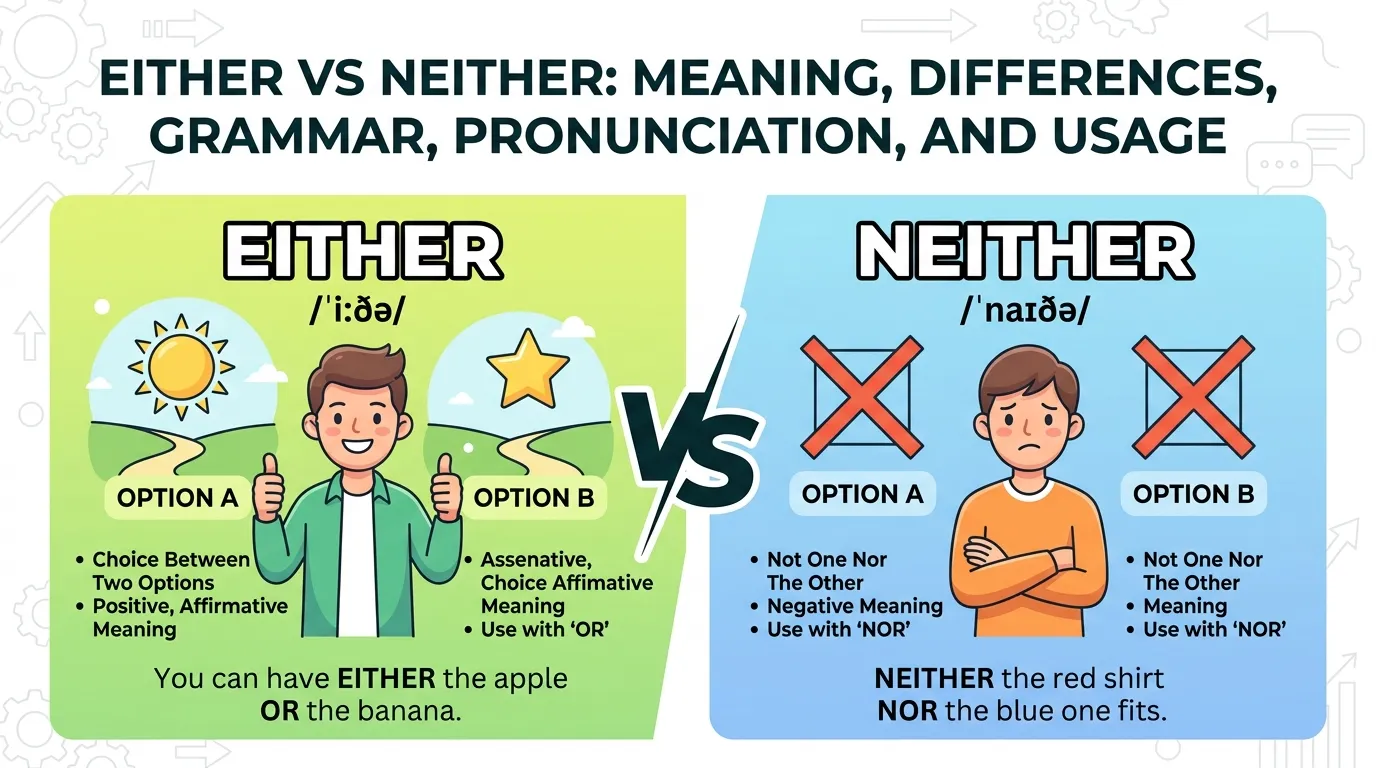
Quick Answer: Either vs Neither
The simplest distinction is:
Either means one of two choices or options.
Neither means not one and not the other.
| Word | Basic meaning | Example |
|---|---|---|
| Either | One of two | You can take either road. |
| Neither | Not one or the other | Neither road is open. |
Think of them this way:
- Either = A or B
- Neither = not A and not B
- Both = A and B
Compare these sentences
Either restaurant is fine.
→ Restaurant A is fine, and Restaurant B is fine. You can choose one.
Neither restaurant is open.
→ Restaurant A is not open, and Restaurant B is not open.
Both restaurants are open.
→ Restaurant A and Restaurant B are open.
This three-way comparison makes the meaning much easier to understand.
What Does “Either” Mean?
Either generally refers to one of two people, things, choices, or possibilities.
It can mean “one or the other” without specifying which one.
Examples
- You can sit on either side.
- Either answer could be correct.
- Take either bus.
- We can meet on either Monday or Tuesday.
- You can choose either color.
In these examples, there are two possible choices.
Importantly, either does not necessarily mean that both choices are selected. It presents two possibilities and allows one of them to be chosen.
Dictionary-style definition of either
Either can be understood as:
One or the other of two people or things.
It can also introduce alternatives, especially in the construction either…or.
What Does “Neither” Mean?
Neither means not one and not the other of two people or things.
It is the negative counterpart of either.
Examples
- Neither answer is correct.
- Neither student was ready.
- Neither option works for me.
- Neither restaurant is open.
- Neither of them called.
If there are two choices, neither rejects both.
Dictionary-style definition of neither
Neither means:
Not one or the other of two people or things.
It is normally used when there are exactly two items under consideration.
Either vs Neither: The Main Difference
The key difference is choice versus exclusion.
Either leaves one of two possibilities open.
Neither rejects both possibilities.
Consider this example:
You can choose either shirt.
This means Shirt A and Shirt B are available as choices.
Now compare:
Neither shirt fits me.
This means Shirt A does not fit and Shirt B does not fit.
The basic formula
Either = one of two
Neither = zero of two
This is one of the easiest ways to remember the distinction.
Either vs Neither vs Both
Understanding both makes the difference even clearer.
| Word | Meaning | Example |
|---|---|---|
| Either | One of two | Either answer is acceptable. |
| Neither | Not one or the other | Neither answer is acceptable. |
| Both | The two together | Both answers are acceptable. |
Imagine two doors: Door A and Door B.
Either door is safe.
→ You may choose Door A or Door B.
Neither door is safe.
→ Door A is unsafe, and Door B is unsafe.
Both doors are safe.
→ Door A and Door B are safe.
Is “Either” a Correct Word?
Yes. Either is a standard and widely accepted English word.
It is used in American English, British English, academic writing, business communication, journalism, everyday speech, and formal writing.
Examples
- Either candidate could win.
- You may select either option.
- Either explanation makes sense.
- We can use either method.
There is nothing informal or incorrect about either.
The important issue is using it with the correct grammatical structure.
Is “Neither” a Correct Word?
Yes. Neither is also a standard English word.
It is especially useful when you want to reject two choices.
Examples
- Neither explanation is convincing.
- Neither candidate received enough votes.
- Neither plan solves the problem.
- Neither answer matches the question.
Like either, it is suitable for both everyday and formal English.
How to Use “Either” Correctly
Either has several grammatical functions.
Either as a Determiner
When either comes before a singular noun, it means one of two.
Examples
- Either choice is acceptable.
- Either student can answer.
- Either route will take you downtown.
- Either candidate could win.
Notice that the noun is normally singular:
Either option is fine.
Not:
Either options are fine.
When either directly modifies a noun, use a singular noun.
Either as a Pronoun
Either can stand alone instead of being followed by a noun.
Examples
- Which dress do you want? Either.
- You can take either of these.
- Either will work.
- I don’t want either.
In these cases, the word represents one of the two choices.
Either in “Either…Or”
One of the most common structures is:
either A or B
This presents two alternatives.
Examples
- You can either call me or send an email.
- We can either stay home or go out.
- Either John or Mark will drive.
- You can choose either tea or coffee.
The construction is useful when you want to emphasize alternatives.
A common mistake
Avoid unnecessary repetition:
You can either call me or you can send me an email.
This is grammatically possible, but it can sound wordy.
A smoother version is:
You can either call me or send me an email.
How to Use “Neither” Correctly
Neither can also function as a determiner, pronoun, and conjunction.
Neither as a Determiner
When neither comes before a singular noun, it means not one and not the other.
Examples
- Neither answer is correct.
- Neither candidate impressed me.
- Neither car is available.
- Neither plan seems practical.
Again, the noun is normally singular.
Correct:
Neither option works.
Incorrect in standard usage:
Neither options work.
Neither as a Pronoun
Neither can stand alone.
Examples
Which movie did you enjoy?
Neither.
Or:
Which of the two plans should we choose?
Neither.
It means that the speaker rejects both choices.
Either of vs Neither of
Both either of and neither of are common structures.
Either of
Either of the two plans could work.
Meaning: Plan A could work, or Plan B could work.
Neither of
Neither of the two plans works.
Meaning: Plan A does not work, and Plan B does not work.
Examples
- Either of the candidates could win.
- Neither of the candidates has experience.
- Either of these computers would be suitable.
- Neither of these computers is powerful enough.
When using either of or neither of before a plural noun or pronoun, standard formal English commonly uses a singular verb.
Neither of the answers is correct.
Either of the options is acceptable.
In casual speech, plural verbs are sometimes heard, especially with neither of. However, singular agreement is a safe choice in formal writing.
Either…Or vs Neither…Nor
These are two important paired conjunctions.
Either…Or
Use either…or to present alternatives.
Either we leave now or we miss the train.
The structure gives two possibilities.
More examples:
- Either call me or text me.
- Either Sarah or Emily will attend.
- We can either drive or take the train.
- You can either accept the offer or decline it.
Neither…Nor
Use neither…nor to reject both alternatives.
Neither Sarah nor Emily attended.
This means Sarah did not attend, and Emily did not attend.
More examples:
- Neither John nor Mark knows the answer.
- Neither the manager nor the assistant was available.
- She likes neither coffee nor tea.
- Neither option is affordable.
Side-by-side comparison
| Positive alternative | Negative alternative |
|---|---|
| Either A or B | Neither A nor B |
| Either John or Mark came. | Neither John nor Mark came. |
| Either answer is acceptable. | Neither answer is acceptable. |
| Either plan could work. | Neither plan could work. |
Either vs Neither in Negative Sentences
This is where many English learners become confused.
Consider:
I don’t like either movie.
This means:
I like neither movie.
The two sentences can communicate essentially the same idea.
Example
I don’t like either option.
= I like Option A and Option B.
I like neither option.
= I don’t like Option A or Option B.
However, the structures feel slightly different.
I don’t like either is extremely natural in everyday American English.
I like neither sounds somewhat more formal or deliberate.
“Me Either” vs “Me Neither”
This is one of the most common questions about either and neither.
When someone makes a negative statement, American English commonly uses:
Me neither.
Example:
“I don’t like spicy food.”
“Me neither.”
This means:
“I don’t like spicy food either.”
What about “Me either”?
Me either is heard in some varieties of English, but me neither is the safer standard expression when agreeing with a negative statement.
For formal writing, avoid both conversational forms and use:
I don’t like it either.
or:
Neither do I.
“Either” Pronunciation
Either has two widely accepted pronunciations in English.
It can sound like:
- EE-ther
- EYE-ther
Both are standard.
Examples
“Either option is fine.”
Depending on the speaker, either may begin with an “ee” sound or an “eye” sound.
Neither pronunciation is inherently incorrect.
“Neither” Pronunciation
Neither also has two common pronunciations:
- NEE-ther
- NYE-ther
Both occur in standard English.
The important point is that pronunciation can vary by speaker, region, family background, and personal preference.
You do not need to change your pronunciation simply because another speaker uses the alternative.
American English vs British English
Both either and neither are standard in American and British English.
The biggest differences are usually related to pronunciation, conversational preferences, and agreement patterns rather than the basic meanings.
American English
You will commonly hear:
- either = EE-ther or EYE-ther
- neither = NEE-ther or NYE-ther
- Me neither.
- I don’t like it either.
British English
British speakers also use both pronunciations, although individual preferences may differ.
Both varieties use:
- either…or
- neither…nor
- either of
- neither of
So you generally do not need separate vocabulary for American and British English.
Either vs Neither: Formality and Tone
Neither word is automatically formal or informal.
However, some constructions have different tones.
More conversational
I don’t like either one.
Me neither.
More formal
I like neither option.
Neither option is suitable.
Neither candidate meets the requirements.
In business, academic, or professional writing, complete sentences are usually preferable to conversational responses such as me neither.
Either and Neither in Academic Writing
Both words are common in academic English.
Examples
- Either explanation could account for the results.
- Neither hypothesis fully explains the findings.
- Either method may be used under these conditions.
- Neither study provides sufficient evidence.
They are particularly useful when comparing two theories, methods, arguments, or outcomes.
Academic tip
Be precise about the number of choices.
If you are discussing more than two alternatives, either and neither may not be the best choices.
For example:
You can choose any of the three options.
is better than:
You can choose either of the three options.
When there are three or more possibilities, any is usually the natural choice.
Either and Neither in Business Writing
These words are useful in professional communication.
Examples
Either proposal could meet the client’s needs.
Neither proposal includes the required budget.
Either date works for our team.
Neither date is convenient for the client.
For professional writing, choose the word based on the actual meaning rather than trying to sound formal.
Either and Neither in Journalism
News writing often uses these words when presenting two competing possibilities or rejecting two explanations.
Examples
Either candidate could secure the nomination.
Neither side agreed to the proposed terms.
The words are concise and useful when the writer wants to clearly establish a two-way contrast.
Either and Neither in Sports
Sports writing also uses both words naturally.
Examples
- Either team could win the final.
- Neither team scored in the first half.
- Either player could take the final shot.
- Neither goalkeeper made a mistake.
In sports contexts, either often emphasizes uncertainty, while neither emphasizes that both sides failed to meet a condition.
Either and Neither in Casual Conversation
In everyday speech, these words appear constantly.
Examples
“Which one should I get?”
“Either one.”
“Did you like the movie?”
“Neither one.”
“I don’t want pizza.”
“Me neither.”
“We can either stay home or go out.”
These are natural conversational patterns.
Common Collocations With Either
A collocation is a combination of words that commonly appears together.
Common combinations include:
- either way
- either one
- either option
- either choice
- either side
- either answer
- either of them
- either of these
- either…or
- on either side
- at either end
Examples
Either way, we’ll finish today.
You can choose either one.
The store is located on either side of the road.
Either option would work.
Common Collocations With Neither
Common combinations include:
- neither one
- neither option
- neither choice
- neither answer
- neither side
- neither of them
- neither of these
- neither…nor
- neither way
Examples
Neither option is affordable.
Neither of them replied.
Neither side accepted the proposal.
Neither answer explains the problem.
Useful Expressions With Either
Either Way
Either way means that the outcome or decision will be the same regardless of the two possibilities.
We can drive or take the train. Either way, we’ll arrive before noon.
It can also mean “regardless of which option is chosen.”
On Either Side
This means on both sides when referring to two sides.
There were trees on either side of the road.
Here, either side refers to the two sides individually.
Useful Expressions With Neither
Neither…Nor
This is the most important fixed construction with neither.
Neither the manager nor the employee knew about the change.
It means both people lacked the information.
Neither One
Neither one is available.
This means the first choice is unavailable and the second choice is also unavailable.
Either vs Neither: Memory Tricks
If you regularly confuse these words, use one of these simple tricks.
Memory Trick 1: Either = Choice
Think:
Either = an option.
If you are choosing between two things, either is often appropriate.
Memory Trick 2: Neither = Negative
Both words begin differently, but neither can remind you of:
Not either.
Neither means not one and not the other.
Memory Trick 3: Look at the Pair
Remember these pairs:
Either…or
Neither…nor
If you see or, think either.
If you see nor, think neither.
Common Mistakes With Either and Neither
Mistake 1: Using “Neither” With a Negative
Avoid unnecessary double negatives in standard English.
Incorrect:
I don’t like neither option.
Better:
I don’t like either option.
Or:
I like neither option.
The first version uses not + either. The second uses neither by itself.
Mistake 2: “Either of the Options Are”
In formal standard English, when either of refers to two choices, singular agreement is generally preferred.
Less formal:
Either of the options are acceptable.
Standard formal choice:
Either of the options is acceptable.
Mistake 3: “Neither of Them Were”
In formal writing:
Neither of them was available.
is generally preferred over:
Neither of them were available.
Because neither is singular in standard formal agreement.
Mistake 4: Using Either for More Than Two
If there are three or more choices, either may be inappropriate.
Less natural:
You can choose either of these three plans.
Better:
You can choose any of these three plans.
Use either when the intended choice is between two alternatives.
Awkward vs Natural Examples
| Awkward or incorrect | Better |
|---|---|
| I don’t like neither. | I don’t like either. |
| Neither options work. | Neither option works. |
| Either options are fine. | Either option is fine. |
| Either of the choices are good. | Either of the choices is good. |
| Neither of them were there. | Neither of them was there. |
| You can choose either of three. | You can choose any of the three. |
These rules are especially useful in formal writing, school assignments, professional documents, and edited content.
Synonyms, Antonyms, and Related Words
Synonyms for Either
Depending on context, related expressions include:
- one or the other
- one of two
- whichever of two
- any one of two
These are not always exact replacements, so context matters.
Related Words for Neither
Related expressions include:
- not either
- not one or the other
- neither one
- none of the two
Again, neither is generally the most concise option when exactly two choices are involved.
Antonyms and Contrasts
The clearest contrast is:
- either ↔ neither
- neither ↔ both, depending on the context
- either ↔ both when discussing selection
For example:
Either answer is acceptable.
versus:
Neither answer is acceptable.
versus:
Both answers are acceptable.
Either vs Neither in Real-World Examples
At a restaurant
You can order either chicken or fish.
You have two choices.
Neither chicken nor fish is available.
Both choices are unavailable.
At work
Either employee can handle the task.
One of the two employees can do it.
Neither employee is available today.
Both employees are unavailable.
At school
Either answer could be correct.
Two answers are possible.
Neither answer is correct.
Both answers are wrong.
While traveling
You can take either route.
There are two possible routes.
Neither route is open.
Both routes are closed.
When Should You Use “Either”?
Use either when:
- You are referring to one of two choices.
- You are presenting alternatives.
- You want to say that both options are acceptable individually.
- You are using the pattern either…or.
- You are saying that something does not apply to one of two choices in a negative sentence.
Examples
- Either answer is acceptable.
- Either road will take you there.
- Choose either color.
- You can either stay or leave.
- I don’t want either one.
When Should You Use “Neither”?
Use neither when:
- You are rejecting both of two choices.
- Neither option satisfies a condition.
- You are using neither…nor.
- You want a concise alternative to not…either.
- Both choices are negative or excluded.
Examples
- Neither answer is correct.
- Neither candidate won.
- Neither option is affordable.
- Neither John nor Sarah came.
- I like neither movie.
A Simple Decision Test
When you are unsure, ask yourself:
Are there two choices?
If yes, continue.
Are you selecting one of them?
Use either.
Either option will work.
Are you rejecting both?
Use neither.
Neither option will work.
Are you presenting alternatives?
Use:
Either…or
Are you rejecting both alternatives?
Use:
Neither…nor
This simple test solves most either vs neither questions.
Frequently Asked Questions
Is either positive and neither negative?
Generally, yes. Either presents one of two possibilities or choices, while neither excludes both. However, either can also appear in negative sentences, such as “I don’t like either.”
Is neither the opposite of either?
In many contexts, yes. Either means one or the other of two, while neither means not one and not the other.
Is “either” singular or plural?
When either directly modifies a noun, it normally takes a singular noun and singular verb: “Either option is acceptable.” In either of + plural noun, formal standard English generally uses a singular verb: “Either of the options is acceptable.”
Is “neither” singular or plural?
Neither is traditionally singular and normally takes a singular verb in formal standard English: “Neither answer is correct” and “Neither of them was available.”
Can I say “either of them”?
Yes. Either of them means one of the two people or things.
Either of them can help you.
Can I say “neither of them”?
Yes. Neither of them means not one and not the other.
Neither of them was available.
Which is correct: “either or” or “neither nor”?
Both are correct, but they serve different purposes.
Either…or presents two alternatives.
Either call me or text me.
Neither…nor rejects both alternatives.
Neither John nor Mark called me.
Is “me either” grammatically correct?
Me either is used in some varieties of spoken English, but me neither is the more established response to a negative statement in American conversational English. In formal writing, use a complete construction such as “I don’t either” or “Neither do I.”
Can either be used for more than two things?
Traditionally, either refers to two alternatives. When there are three or more choices, any is usually the better word.
You can choose any of these four options.
Can neither be used for more than two things?
In traditional standard usage, neither refers to two. For three or more items, none is generally more appropriate.
None of the three options is available.
What is the easiest way to remember either vs neither?
Remember:
Either = one of two.
Neither = not one and not the other.
Also remember the pairs:
Either…or
Neither…nor
Conclusion
The difference between either vs neither becomes much easier once you focus on the basic idea.
Either refers to one of two choices or possibilities. It often gives you an option:
Either answer is acceptable.
Neither means not one and not the other. It rejects both:
Neither answer is acceptable.
The most useful patterns are:
- either A or B = one alternative or the other
- neither A nor B = not A and not B
- either of them = one of the two
- neither of them = not one and not the other
- I don’t like either = I like neither
- Me neither = agreement with a negative statement
For formal and professional writing, pay attention to subject-verb agreement, especially with either of and neither of. Also remember that either and neither are generally used when discussing two, while any and none are usually better when discussing three or more.
Finally, don’t worry if you hear EE-ther and EYE-ther, or NEE-ther and NYE-ther. These pronunciation differences are normal varieties of English.
If you remember just one rule, make it this:
Either gives you one of two choices. Neither gives you none of the two.
That simple distinction will help you use both words naturally and confidently in everyday conversation, academic writing, business communication, and professional English.