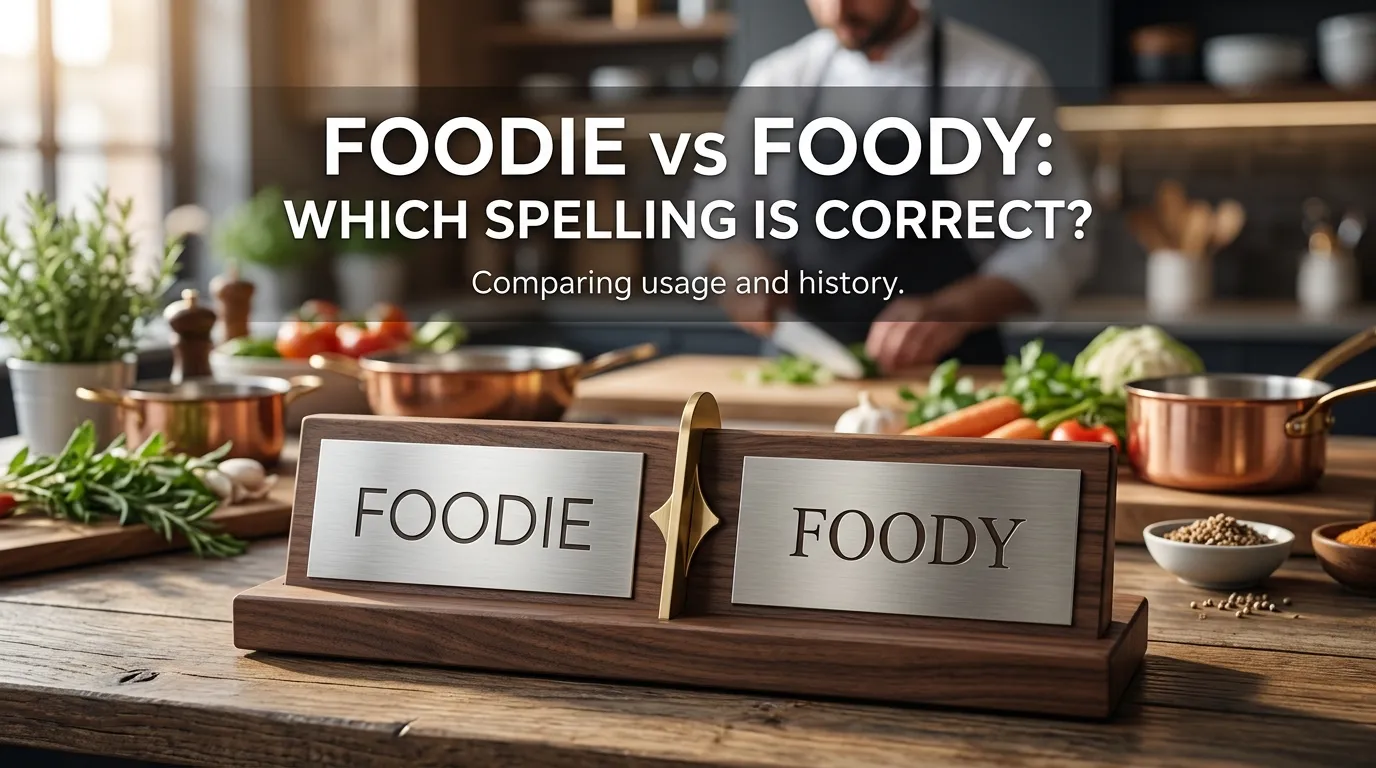
If you are wondering about foodie vs foody, the short answer is simple: foodie is the standard and much more widely accepted spelling when you mean a person who loves, enjoys, or knows a lot about food. For example, you would normally write, She is a serious foodie.
Foody is not the usual choice for this meaning. It may appear in informal writing, creative branding, regional usage, or as a descriptive form related to food, but it is far less common and can look like a misspelling of foodie.
This distinction matters because the two spellings look almost identical and are sometimes used interchangeably online. In this guide, you will learn the difference between foodie and foody, how each word is pronounced, where the words come from, how they function grammatically, and which spelling you should use in American English, British English, professional writing, blogs, social media, and everyday conversation.
Quick Answer: Foodie vs Foody
| Word | Common meaning | Standard choice for a food lover? | Typical use |
|---|---|---|---|
| foodie | A person who is very interested in food | ✅ Yes | Everyday and professional writing |
| foody | An uncommon informal or descriptive form related to food | ⚠️ Rare | Informal, creative, regional, or specialized usage |
The safest rule
Use foodie when you are talking about a person who loves food or is especially interested in food.
- ✅ My brother is a foodie.
- ✅ She loves trying new restaurants and considers herself a foodie.
- ❌ My brother is a foody. — This looks unusual to most American English readers.
If you mean related to food, however, adjectives such as food-related, culinary, gastronomic, or simply food are usually clearer than foody.
What Does Foodie Mean?
Foodie is an informal noun for someone who has a strong interest in food, cooking, restaurants, ingredients, dining experiences, or food culture.
A foodie does not necessarily have to be a professional chef. The word can describe anyone who takes particular pleasure in discovering, preparing, discussing, or learning about food.
Dictionary-style definition of foodie
Foodie
Part of speech: Noun
Meaning: A person who has a strong interest in good food, cooking, restaurants, ingredients, or culinary experiences.
Register: Informal but widely accepted
Pronunciation: /ˈfuːdi/
Examples:
- I’m a foodie who loves trying new restaurants.
- Her Instagram account is popular with local foodies.
- We found a great café that every foodie should visit.
- He became a foodie after learning how to cook.
The word can suggest enthusiasm rather than simply hunger.
Someone who enjoys eating lunch is not automatically a foodie. A foodie usually has a special interest in food itself.
They may care about:
- New restaurants
- Regional cuisines
- Cooking techniques
- Specialty ingredients
- Fine dining
- Street food
- Coffee
- Wine and beverages
- Food photography
- Restaurant reviews
- Culinary traditions
- Food trends
What Does Foody Mean?
Foody is much less common than foodie, and its meaning depends heavily on context.
In some informal or regional usage, foody can be used as a descriptive word meaning related to food, involving food, or having qualities associated with food. It can also appear as an alternative spelling or informal form of foodie.
However, this usage is not nearly as established or recognizable as foodie.
For most American English readers, writing foody when you mean a person who loves food may look like a spelling mistake.
For example:
- ⚠️ She’s a foody.
- ✅ She’s a foodie.
The second sentence is much more natural.
Why is foody confusing?
The confusion comes from the way English forms words.
The word foodie combines food with the suffix-like ending -ie, producing a noun for a person associated with food.
Because English also uses -y to form adjectives, some writers naturally assume that foody should be the correct spelling.
Compare:
- taste → tasty
- health → healthy
- fun → funny
- food → foody
The last formation seems logical, but English vocabulary is not always created according to a predictable spelling formula. Foodie became the established word for the person.
Foodie vs Foody: The Main Difference
The biggest difference is standard usage and grammatical function.
Foodie is primarily a noun
Foodie identifies a person.
- Lisa is a foodie.
- The restaurant attracts foodies.
- Foodies will appreciate the handmade pasta.
Here, foodie functions like other nouns naming people.
Foody is uncommon and context-dependent
When foody is used, it can function more like an informal adjective in some contexts.
For example, someone might informally describe a place as having a foody atmosphere.
However, this is not always the clearest or most natural choice in standard American English.
Better alternatives include:
- food-focused
- culinary
- food-related
- gastronomic
- centered around food
- known for its food
Therefore, foodie and foody are not simply two equally acceptable spellings of the same word.
Foodie vs Foody: Comparison Table
| Feature | Foodie | Foody |
|---|---|---|
| Standard spelling for a food lover | ✅ | ❌ Usually not |
| Common in American English | ✅ | Rare |
| Common in everyday speech | ✅ | Rare |
| Refers to a person | ✅ | Sometimes used this way informally |
| Can describe food-related qualities | Not normally | Sometimes |
| Suitable for professional writing | Yes, depending on context | Usually avoid |
| Suitable for academic writing | Sometimes, if relevant | Usually avoid |
| Common on social media | Very common | Occasionally seen |
| Pronunciation | /ˈfuːdi/ | Usually /ˈfuːdi/ when used as an alternative form |
| Best general recommendation | Use it | Avoid unless context requires it |
Why Do People Confuse Foodie and Foody?
Several factors make these words easy to mix up.
Similar spelling
Both words begin with food-, so the difference is only one letter.
- foodie
- foody
That small difference is easy to overlook while typing.
English has many -y adjectives
English commonly forms adjectives with -y.
For example:
- cloud → cloudy
- dirt → dirty
- salt → salty
- spice → spicy
So foody can look perfectly logical at first glance.
But foodie has developed as a separate noun.
Informal internet writing
Social media, blogs, captions, forums, and comments often contain unconventional spellings.
A word can appear thousands of times online without being the preferred spelling in edited English.
This is especially important for foody. Seeing the spelling online does not necessarily mean it is the standard form you should use.
Pronunciation does not help
In common usage, foodie is pronounced roughly like FOO-dee.
Some uses of foody have the same pronunciation, so you cannot reliably distinguish the spellings by listening.
How Do You Pronounce Foodie?
Foodie is pronounced:
/ˈfuːdi/
A simple pronunciation guide is:
FOO-dee
The first syllable sounds like food, and the second sounds like the ending in candy or city in many varieties of English.
Example
She’s a foodie.
You would say:
FOO-dee
Not:
- food-eye
- food-ee-uh
- fud-dee
The pronunciation is straightforward once you recognize the connection with the word food.
Is Foodie a Noun or an Adjective?
Foodie is primarily a noun.
It names a person who is especially interested in food.
Singular
- He is a foodie.
Plural
- They are foodies.
Possessive
- A foodie’s favorite restaurant may change often.
Plural possessive
- Foodies’ opinions can influence restaurant trends.
You can use foodie as a modifier before another noun in informal English:
- foodie culture
- foodie destination
- foodie community
- foodie event
- foodie guide
In these combinations, the word still relates to the noun foodie, even though it is functioning attributively.
Is Foody a Correct Word?
The answer requires some nuance.
Foody can be found in informal and regional English usage, but it is not the standard replacement for foodie when referring to a food enthusiast.
So if your question is:
Is foody the correct spelling of a person who loves food?
The safest answer is no; use foodie.
If your question is:
Can foody ever appear in English?
Yes. Uncommon words, regional forms, informal formations, and creative uses can appear in real-world English.
The important distinction is between possible usage and recommended standard usage.
For general American English writing, foodie is the clear choice.
Foodie in American English
In American English, foodie is extremely familiar.
You will see it in:
- Restaurant articles
- Food blogs
- Travel writing
- Lifestyle magazines
- Social media
- Restaurant marketing
- Everyday conversation
- Food journalism
- Culinary discussions
Examples:
- New York is a dream destination for foodies.
- The guide is perfect for foodies visiting Chicago.
- I’m becoming more of a foodie as I learn to cook.
- The festival attracts thousands of foodies every year.
It is informal, but it is not generally considered strange or incorrect.
Foodie in British English
Foodie is also well established in British English.
British speakers and writers commonly use the word for someone enthusiastic about food.
Examples:
- She’s a real foodie.
- The city has become popular with foodies.
- Foodies can find everything from traditional dishes to modern cuisine.
There is no need to change foodie to foody simply because you are writing for a British audience.
Foodie in International English
For international readers, foodie is generally much more recognizable than foody.
If your website, article, app, restaurant, or marketing campaign targets an international audience, foodie is the safer choice.
This is particularly important for:
- Travel websites
- Restaurant guides
- Food blogs
- Tourism content
- International publications
- Social media campaigns
A globally familiar word reduces unnecessary confusion.
Foodie vs Food Lover
Although foodie and food lover are similar, they are not always identical.
Food lover
Food lover is broad and straightforward.
It simply means someone who loves food.
He is a food lover who enjoys homemade meals.
Foodie
Foodie often suggests a deeper or more active interest.
She’s a foodie who searches for small restaurants and studies different cuisines.
A foodie might actively explore food culture, while a food lover may simply enjoy eating.
Foodie vs Gourmet
These words are also related but should not be treated as exact synonyms.
Foodie
A foodie is a person who is enthusiastic about food.
Gourmet
Gourmet can refer to high-quality or sophisticated food, or to someone with refined knowledge of food and drink.
For example:
- She’s a foodie.
- The restaurant serves gourmet dishes.
You can be a foodie without eating expensive food.
A person who loves food trucks, homemade bread, spicy noodles, or local diners can absolutely be a foodie.
Foodie vs Food Enthusiast
Food enthusiast is a more formal alternative to foodie.
Compare:
The event is popular with foodies.
with:
The event attracts food enthusiasts.
The first sounds conversational and modern.
The second sounds more formal and descriptive.
For a business report, academic paper, or formal publication, food enthusiast may sometimes be preferable.
Synonyms for Foodie
Depending on context, possible alternatives include:
- food lover
- food enthusiast
- culinary enthusiast
- gourmet
- gastronome
- food connoisseur
- dining enthusiast
- culinary fan
- restaurant enthusiast
- food aficionado
These words are not perfect substitutes in every situation.
Foodie
Informal and broad.
Food enthusiast
Neutral and slightly formal.
Food connoisseur
Suggests expert knowledge or refined judgment.
Food aficionado
Suggests strong enthusiasm and often sounds more sophisticated.
Gastronome
A relatively uncommon, formal word for someone knowledgeable about or devoted to good food.
Antonyms of Foodie
There is no single perfect opposite of foodie.
Depending on what you mean, possible contrasting descriptions include:
- picky eater
- indifferent eater
- uninterested diner
- non-food enthusiast
- person with little interest in cuisine
Be careful with picky eater, though. A picky eater may still love food; they simply dislike many foods.
Therefore:
Foodie ≠ simply the opposite of picky eater.
Common Collocations With Foodie
A collocation is a group of words that commonly occur together.
Some natural combinations include:
- foodie culture
- foodie community
- foodie destination
- foodie guide
- foodie experience
- foodie heaven
- foodie friend
- foodie adventure
- foodie scene
- foodie tour
- foodie travel
- local foodie
- serious foodie
- self-described foodie
- dedicated foodie
Examples
- The city has a thriving foodie scene.
- We planned a foodie tour of the neighborhood.
- She’s a self-described foodie.
- The coastal town is a popular foodie destination.
These combinations are especially common in lifestyle and travel writing.
Common Expressions With Foodie
Several informal expressions use foodie naturally.
A serious foodie
Someone who takes their interest in food seriously.
My sister is a serious foodie and knows every new restaurant in town.
A self-described foodie
Someone who personally identifies as a foodie.
As a self-described foodie, he never visits a city without researching its restaurants.
Foodie heaven
An informal expression for a place with many appealing food choices.
The market is foodie heaven.
Foodie destination
A location known for interesting or high-quality food.
Tokyo is often described as a major foodie destination.
Foodie culture
The social interest surrounding food, restaurants, cooking, and culinary experiences.
Social media has helped create a global foodie culture.
Formal vs Informal Usage
Foodie is informal, but it is widely accepted.
That means it works well in everyday communication and many forms of online and lifestyle writing.
Casual
I’m such a foodie.
Blog writing
This guide is for foodies looking for affordable places to eat.
Journalism
The neighborhood has become a popular destination for foodies.
Business writing
A restaurant marketing team might write:
Our menu is designed for adventurous foodies.
That is perfectly natural in promotional writing.
Academic writing
In academic writing, the word may be appropriate when discussing food culture, consumer behavior, tourism, or social trends, but a more precise term may be preferable.
Instead of:
Foodies spend more money at restaurants.
A research paper might use:
Consumers with a strong interest in culinary experiences may spend more on dining.
The best word depends on the level of formality and the purpose of the text.
Awkward vs Natural Examples
Understanding incorrect or awkward usage is one of the fastest ways to remember the distinction.
| Awkward or uncommon | Natural |
|---|---|
| She is a foody. | She is a foodie. |
| He’s a big foody. | He’s a big foodie. |
| The restaurant is full of foodies. | The restaurant is full of foodies. |
| I’m becoming a foody. | I’m becoming a foodie. |
| This is a foody neighborhood. | This is a food-focused neighborhood. |
| It is a foody event. | It is a food festival. |
| Foody travelers love this city. | Food-loving travelers love this city. |
Notice that the final examples do not require replacing foody with foodie. Sometimes the best correction is a completely different adjective.
Common Mistakes With Foodie and Foody
Mistake: Using foody for a food lover
Incorrect or nonstandard for general American English:
My sister is a foody.
Better:
My sister is a foodie.
Mistake: Assuming foody is the adjective form of foodie
English does not require every noun to have a simple -y adjective form.
If you want to describe something connected with food, choose a clearer expression.
Instead of:
a foody website
Use:
a food website
a food-focused website
a culinary website
Mistake: Treating foodie as a synonym for chef
A chef is a professional cook, while a foodie is a person who is enthusiastic about food.
A chef can be a foodie, but the terms describe different things.
Foodie vs Foody in Blogging and SEO
For bloggers and content creators, choosing the familiar spelling matters.
If your target audience searches for information about people who love food, foodie is the natural keyword.
Examples include:
- foodie meaning
- what does foodie mean?
- foodie definition
- foodie vs foody
- what is a foodie?
- foodie meaning in English
- foodie meaning in American English
- foodie meaning in British English
- food lover vs foodie
- foodie synonyms
Using foody as the primary spelling may confuse readers if you actually mean foodie.
For SEO content, clarity should come before forcing an unusual spelling into every paragraph. You can mention foody when discussing the spelling comparison, but use foodie when referring to the standard noun.
Foodie in Social Media and Casual Writing
Foodie is particularly common online.
You may see:
- #foodie
- #foodies
- foodie life
- foodie adventures
- foodie finds
- foodie travel
- foodie goals
- foodie date
- foodie weekend
Examples:
Weekend foodie adventure!
Looking for the best foodie spots in the city.
My foodie side is very happy today.
These are informal but natural.
Foody may also appear in usernames, brand names, hashtags, or creative content. In those cases, the unusual spelling may be intentional.
A brand can choose an unconventional spelling for marketing purposes without making that spelling the standard English form.
Does Foodie Have a Plural Form?
Yes.
The plural of foodie is:
foodies
Examples:
- The restaurant is popular with foodies.
- Foodies often enjoy discovering hidden restaurants.
- The festival brought together foodies from across the country.
The spelling changes from foodie to foodies, not foodieses.
Word History and Etymology of Foodie
Foodie is an informal English formation based on the word food.
The ending -ie is commonly used in informal English to create familiar or personal nouns. Similar formations include words such as:
- sweetie
- groupie
- rookie
- techie
The modern sense of foodie developed as a way to describe people especially interested in food and dining.
The term became increasingly visible in modern food culture, particularly as restaurants, food journalism, culinary travel, television cooking shows, and food-focused media expanded.
Today, foodie is firmly established in everyday English.
Its popularity has also grown alongside:
- Restaurant review culture
- Food blogs
- Instagram food photography
- Culinary tourism
- Cooking shows
- Farmers’ markets
- Specialty coffee culture
- Food festivals
- Online restaurant communities
Does Foodie Mean Someone Who Eats a Lot?
No.
Being a foodie is about interest and enthusiasm, not simply quantity.
Someone can eat small portions and still be a serious foodie.
For example:
She rarely eats large meals, but she’s a passionate foodie who loves learning about regional cuisines.
Likewise, someone who eats a lot is not automatically a foodie.
The defining idea is an enthusiastic interest in food.
Can a Chef Be a Foodie?
Yes.
A chef can also be a foodie, but the two words have different meanings.
Chef describes a profession or culinary role.
Foodie describes a person’s enthusiasm for food.
For example:
The chef is also a passionate foodie who enjoys exploring other cuisines.
This sentence uses both words correctly.
Is Foodie a Positive or Negative Word?
Usually, foodie is neutral to positive.
It often communicates enthusiasm, curiosity, and appreciation.
For example:
She’s a foodie who loves discovering family-owned restaurants.
However, context can influence tone.
Someone might use foodie humorously to describe a person who constantly posts restaurant photos or talks about meals.
Even then, the word is generally lighthearted rather than insulting.
When Should You Avoid the Word Foodie?
Although foodie is useful, it may not be the best choice in every context.
Use a more precise term when you need professional accuracy.
For example:
In scientific writing
Use:
- consumer
- participant
- dietary researcher
- culinary consumer
depending on the actual meaning.
In professional culinary contexts
Use:
- chef
- culinary professional
- restaurateur
- sommelier
- food critic
- culinary specialist
depending on the person’s role.
In formal business writing
Instead of:
Our product is perfect for foodies.
you might write:
Our product is designed for consumers who value premium culinary experiences.
The second version is more formal and specific.
Memory Trick: How to Remember Foodie
Use this simple rule:
A foodie is a person who loves food.
Think of the ending -ie as identifying a person.
You can also remember:
Food + ie = foodie
If you are describing someone:
foodie
If you are describing something related to food:
food-related, culinary, or food-focused
This avoids most confusion.
Foodie vs Foody: Practical Recommendations
Here is the simplest guide for different types of writing.
| Writing situation | Recommended word |
|---|---|
| American English | foodie |
| British English | foodie |
| International English | foodie |
| Everyday conversation | foodie |
| Social media | foodie |
| Food blog | foodie |
| Travel article | foodie |
| Restaurant marketing | foodie |
| News article | foodie, depending on tone |
| Academic writing | food enthusiast or more precise term when appropriate |
| Technical writing | Usually avoid both unless relevant |
| Describing food-related material | food-related / culinary / food-focused |
| Creative branding | Either may be intentionally chosen |
| Referring to a person who loves food | foodie |
Frequently Asked Questions About Foodie vs Foody
Is foodie or foody correct?
Foodie is the standard and widely accepted spelling when you mean a person who is very interested in or enthusiastic about food. Foody is much less common and should generally be avoided for this meaning in standard American English.
Is foody a real word?
Foody can appear in informal, regional, or creative English, but it is not the usual spelling for a person who loves food. In most everyday contexts, foodie is the better choice.
What is a person who loves food called?
A person who has a strong interest in food is commonly called a foodie. Other possibilities include food lover, food enthusiast, food aficionado, and, in more specialized contexts, gourmet or gastronome.
What is the difference between foodie and food lover?
A food lover is anyone who loves food, while foodie often suggests a more active interest in food, cooking, restaurants, ingredients, or culinary culture. The terms overlap considerably.
Is foodie informal?
Yes. Foodie is an informal noun, but it is very well established in modern English. It is common in conversation, journalism, blogs, travel writing, restaurant marketing, and social media.
How do you pronounce foodie?
Foodie is pronounced /ˈfuːdi/, approximately FOO-dee. It begins with the same sound as the word food.
Can foodie refer to a chef?
Yes, but foodie and chef are not synonyms. A chef is a professional cook or culinary professional. A foodie is someone who is especially enthusiastic about food. A chef can certainly be a foodie.
Is foodie an adjective?
Foodie is primarily a noun. It can also appear before another noun in informal combinations such as foodie culture, foodie guide, and foodie destination. When you need a straightforward adjective meaning related to food, use terms such as culinary, food-related, or food-focused.
Why do people spell foodie as foody?
The spelling foody may seem logical because English frequently uses -y to create adjectives, such as salty and spicy. Online writing, regional usage, and creative branding can also spread alternative spellings. However, foodie is the established spelling for a food enthusiast.
Should I use foodie or foody in an article?
Use foodie when referring to a person who loves or is highly interested in food. If you need to describe something connected with food, choose a clearer expression such as food-related, culinary, or food-focused. Use foody only when a particular name, quotation, brand, or regional context specifically requires it.
Final Verdict
When comparing foodie vs foody, the safest and most useful rule is straightforward:
Use foodie when you mean a person who loves, enjoys, studies, or is especially interested in food.
She is a foodie. ✅
The city is popular with foodies. ✅
He considers himself a serious foodie. ✅
Foody can be encountered in informal, regional, descriptive, or creative usage, but it is not the normal spelling you should choose when writing standard American English.
If you are writing for a broad audience—especially in a blog, article, business page, travel guide, social media post, or general publication—foodie is the clear recommendation.
Remember the distinction this way:
Foodie = a person who loves food.
Foody = uncommon and context-dependent; usually avoid it when you mean foodie.
When in doubt, choose foodie. It is familiar, natural, widely understood, and appropriate across both American and British English.