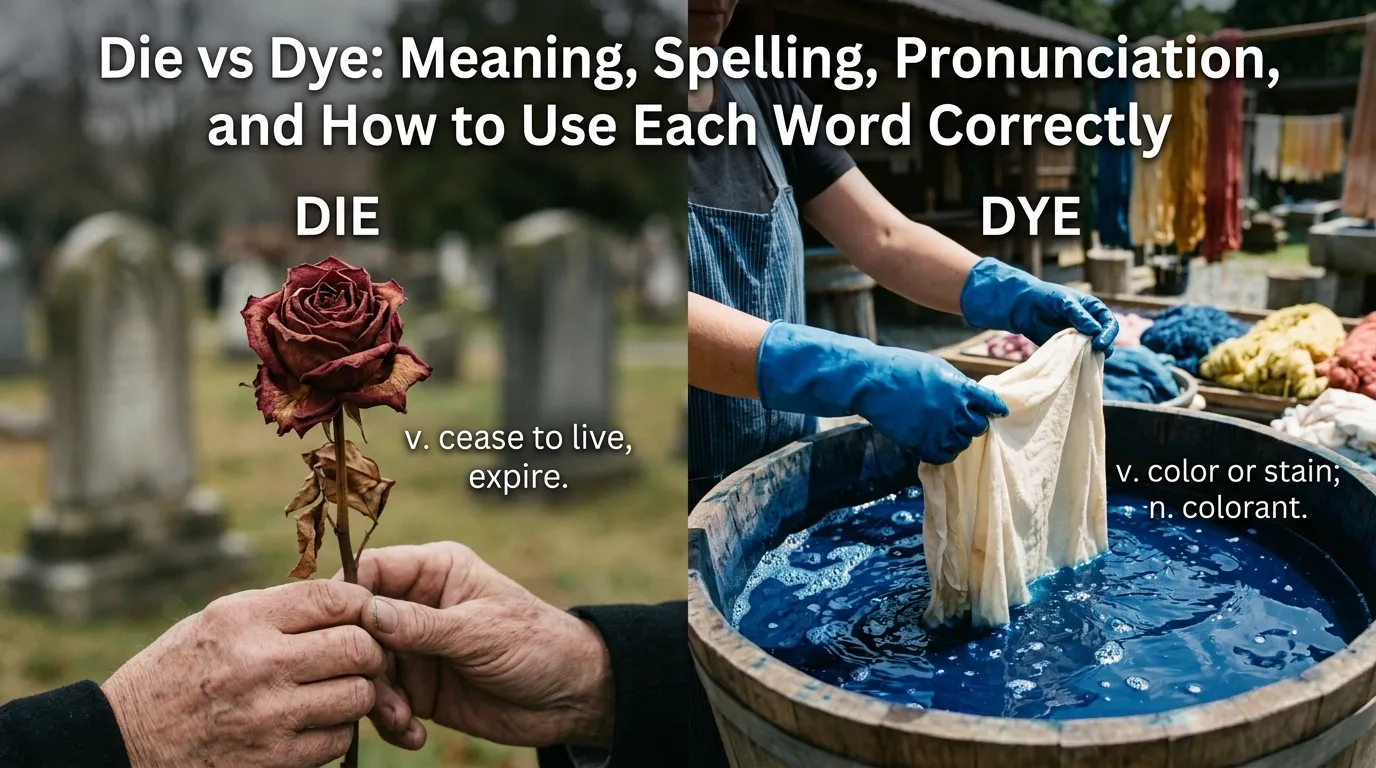
If you are wondering about die vs dye, you are looking at two correctly spelled English words with completely different meanings. Die usually means to stop living, while dye means a substance used to add color to something or the act of coloring it. Although they are pronounced the same in standard American English, their meanings, grammatical roles, and uses are very different.
For example, you can say, The flowers will die without water, but you cannot use dye in that sentence. On the other hand, She used blue dye to color the fabric requires dye, not die.
This guide explains the difference between die and dye, including their meanings, pronunciation, word history, grammar, common phrases, figurative uses, examples, common mistakes, and practical memory tricks. By the end, choosing the correct word should feel much easier.
Quick Answer: Die vs Dye
| Word | Meaning | Part of Speech | Example |
|---|---|---|---|
| die | To stop living; to cease to exist or function | Verb, noun | Plants may die without sunlight. |
| dye | A substance used to color something; to color something | Noun, verb | She used red dye on the fabric. |
The easiest way to remember the difference
Die = life or stopping
Dye = color
If you are talking about death, life, failure, or something coming to an end, use die.
If you are talking about changing the color of hair, fabric, clothing, or another material, use dye.
Are Die and Dye Both Correct Words?
Yes. Die and dye are both standard English words, but they are not interchangeable.
The spelling depends entirely on the meaning.
Consider these sentences:
- The old tree may die during the drought.
- She wants to dye her hair brown.
- The battery will die soon.
- The artist mixed blue dye with the water.
Changing one word for the other changes the meaning and usually makes the sentence incorrect.
This is an example of homophones. Homophones are words that sound alike but have different spellings and meanings.
In American English, die and dye are generally pronounced the same way: /daɪ/.
That means you cannot always identify the correct spelling by hearing the word. You need to understand the context.
What Does Die Mean?
The most common meaning of die is to stop living.
It can describe people, animals, plants, and other living things.
Examples of die as a verb
- Many plants die without enough water.
- The bird died after becoming sick.
- Everyone eventually dies.
- The fish may die if the water becomes polluted.
- The flowers died during the extreme heat.
However, die has many meanings beyond physical death.
It can also mean that something stops functioning, disappears, weakens, or comes to an end.
Die can describe things that stop working
- My phone battery is about to die.
- The car engine died at the traffic light.
- The computer suddenly died.
- The fire began to die down.
- The sound slowly died away.
Here, die does not mean that a living thing has stopped living. Instead, it means something has stopped operating or gradually disappeared.
What Does Dye Mean?
Dye refers to a substance used to give something a particular color.
It can also function as a verb meaning to change the color of something by using a dye.
Dye as a noun
- The fabric was treated with a blue dye.
- This dye produces a bright red color.
- The manufacturer uses natural dye.
- The artist bought several bottles of fabric dye.
Dye as a verb
- She wants to dye her hair black.
- We plan to dye the shirts green.
- They dyed the cloth yellow.
- He dyed the fabric using plant-based materials.
The word usually relates to coloring materials, including textiles, hair, leather, paper, and other objects.
Die vs Dye: The Key Difference
The simplest distinction is:
Die is connected with life or ending. Dye is connected with color.
Think of these two categories:
Die
- Death
- Life
- Plants
- Animals
- People
- Batteries
- Machines
- Fires
- Sounds
- Feelings
- Trends
- Systems
Dye
- Hair
- Fabric
- Clothing
- Textiles
- Leather
- Materials
- Color
- Pigments
- Coloring processes
The meanings can sometimes become figurative, but the central distinction remains the same.
Die vs Dye Pronunciation
One reason people confuse these words is that they are homophones.
In standard American English:
- die = /daɪ/
- dye = /daɪ/
Both sound like the word eye with a d sound at the beginning.
Examples
Die
I don’t want the plant to die.
Dye
I want to dye my shirt.
The pronunciation alone does not tell you which spelling to use. Context does.
This is similar to other English homophones such as:
- right / write
- sea / see
- flower / flour
- pair / pear
- their / there / they’re
Die vs Dye: Grammar and Parts of Speech
Both words can function as verbs, but dye can also function as a noun.
Die as a verb
The verb die describes the process of stopping life or functioning.
Common forms include:
| Form | Example |
|---|---|
| Base form | die |
| Third person | dies |
| Past tense | died |
| Present participle | dying |
| Past participle | died |
Examples:
- Plants die without water.
- The plant dies quickly in extreme heat.
- The plant died last week.
- The plant is dying.
- Several plants have died.
Notice an important spelling point: dying is spelled with die changing to dying, not dieing.
Dye as a verb
Common forms include:
| Form | Example |
|---|---|
| Base form | dye |
| Third person | dyes |
| Past tense | dyed |
| Present participle | dyeing |
| Past participle | dyed |
Examples:
- I want to dye my shirt.
- She dyes fabric professionally.
- They dyed the cloth blue.
- She is dyeing her hair.
- We have dyed several pieces of fabric.
The spelling dyeing is particularly useful because it distinguishes the word from dying.
Dying vs Dyeing: Another Common Confusion
The words dying and dyeing are different.
Dying
Dying is the present participle of die.
- The tree is dying.
- The battery is dying.
- The flowers are dying.
Dyeing
Dyeing is the present participle of dye.
- She is dyeing her hair.
- They are dyeing the fabric.
- The workers are dyeing the wool.
This distinction is important because the missing e changes the meaning.
Memory trick
Think:
Die → dying
Dye → dyeing
The second word keeps the e because it is related to dye.
Why Do People Confuse Die and Dye?
There are several reasons.
They sound identical
The strongest reason is pronunciation. In standard American English, both are pronounced /daɪ/.
Their spellings are visually similar
Both words begin with d and contain the long i sound.
English has many homophones
English spelling often preserves historical differences even when pronunciation changes over time.
Context is essential
When you hear:
She wants to /daɪ/ her hair.
You need the context to know that the correct spelling is dye.
When you hear:
The plant might /daɪ/.
The correct spelling is die.
Die: Literal and Figurative Meanings
The literal meaning of die is to stop living.
But English speakers also use the word in many figurative contexts.
Die meaning stop functioning
- My laptop died during the presentation.
- The car died on the highway.
- The battery died before I reached home.
Die meaning gradually disappear
- The music died away.
- The excitement died down.
- The conversation eventually died out.
Die meaning lose popularity
- That trend has died out.
- The old tradition is slowly dying.
- Interest in the product died after the controversy.
Die meaning strongly desire something
The expression die for can be figurative.
- I would die for a cup of coffee right now.
- She is dying for a vacation.
- They were dying to hear the news.
In these expressions, the word does not usually refer to literal death.
Common Expressions With Die
The word die appears in many familiar expressions.
Die down
To become less strong or less intense.
- The wind finally died down.
- The argument died down after everyone calmed down.
Die out
To disappear gradually.
- Some traditions are dying out.
- The species could die out without protection.
Die away
To gradually become quieter or weaker.
- The music died away in the distance.
- Her voice died away.
Die for
To want something very strongly.
- I’m dying for some ice cream.
Die laughing
To find something extremely funny.
- I nearly died laughing at his story.
Die-hard
A die-hard fan is someone extremely loyal or enthusiastic.
- He is a die-hard basketball fan.
- She is a die-hard supporter of the team.
Common Expressions With Dye
Dye is less common in idioms, but it appears frequently in everyday phrases related to coloring.
Hair dye
- She bought permanent hair dye.
- The stylist recommended a darker hair dye.
Fabric dye
- We need blue fabric dye.
- Natural fabric dye can come from plants.
Food dye
- The recipe calls for a small amount of food dye.
- Some products use natural food coloring instead of artificial dye.
Dye your hair
- He decided to dye his hair blonde.
- She regularly dyes her hair red.
Dye the fabric
- We will dye the fabric before sewing the clothes.
- The workers dyed the fabric a deep green.
Die vs Dye in Different Contexts
Everyday conversation
Both words are common, but they appear in completely different situations.
- My phone is going to die.
- I need to dye my hair.
Academic writing
In academic writing, die can appear in biology, history, medicine, environmental science, and other fields.
Examples:
- Cells may die when exposed to extreme conditions.
- Certain species may die out because of habitat loss.
Dye is common in chemistry, biology, materials science, textiles, and laboratory contexts.
- The researchers used a fluorescent dye to identify the cells.
- The textile sample was treated with a synthetic dye.
Business writing
Both words can appear in professional writing, although die is sometimes replaced by more precise language.
Instead of:
The system died.
A formal technical report might say:
The system failed.
Instead of:
The color died.
A professional description might say:
The color faded.
Journalism
Journalists may use die in reports about deaths, disasters, accidents, trends, and social changes.
For example:
- Several people died in the accident.
- The tradition is slowly dying out.
Dye is used when reporting on fashion, manufacturing, art, science, or cosmetics.
Sports
Die can appear in sports through figurative language.
- The team’s playoff hopes died after the loss.
- The crowd’s excitement died down.
Dye is less common in sports but may appear when discussing uniforms or equipment.
- The team decided to dye the fabric for its new uniforms.
Formal vs Informal Usage
Die
Die is a standard word in both formal and informal English.
However, some figurative expressions are more conversational.
Informal:
My phone died.
More formal:
My phone battery was depleted.
Informal:
The project died.
More formal:
The project was discontinued.
Dye
Dye is standard in both formal and informal contexts.
Informal:
I’m going to dye my hair.
Formal:
The treatment uses a chemical dye to alter the hair’s color.
The difference is usually not the word itself but the surrounding vocabulary.
Word History and Etymology
The histories of die and dye are unrelated despite their similar pronunciation.
History of die
The verb die has roots in Old Norse and related Germanic languages. It developed through Middle English before reaching its modern form.
Over time, die became associated not only with literal death but also with the ending or disappearance of things.
That explains expressions such as:
- die out
- die down
- die away
These figurative meanings developed naturally from the basic idea of something coming to an end.
History of dye
Dye comes from the history of coloring and coloring substances. It is related to the older English verb deagian, meaning to color or make something colored.
The modern spelling and pronunciation developed over centuries.
Today, dye remains strongly connected with the process of giving color to materials.
Die vs Dye: Synonyms
Synonyms for die
Depending on context, possible alternatives include:
- perish
- expire
- pass away
- cease to live
- succumb
- fail
- stop
- shut down
- fade
- disappear
- end
These are not perfect replacements in every sentence.
For example:
My phone died.
can mean:
My phone stopped working.
But perished would sound unnatural in that context.
Synonyms for dye
Depending on context, alternatives include:
- color
- tint
- stain
- pigment
- coloring
- colorant
Again, context matters.
A dye is not always exactly the same as a pigment. In technical contexts, dyes and pigments have different properties and methods of application.
Antonyms and Opposites
Possible opposites of die
Depending on the meaning:
- live
- survive
- exist
- continue
- function
- operate
- grow
- thrive
Example:
The plant is dying.
Opposite:
The plant is thriving.
Possible contrasts with dye
There is no single universal antonym for dye.
Depending on the context, possible contrasting ideas include:
- remove color
- bleach
- fade
- decolorize
- strip color
For example:
The fabric was dyed blue.
A contrasting process might be:
The color was removed from the fabric.
Common Collocations With Die
A collocation is a group of words that commonly appear together.
Common combinations include:
- die suddenly
- die peacefully
- die young
- die alone
- die naturally
- die from an illness
- die of old age
- die out
- die down
- die away
- die hard
- die laughing
- die for
- die to know
Examples:
The plant may die from lack of water.
The noise gradually died down.
He was dying to know what happened.
Common Collocations With Dye
Common combinations include:
- hair dye
- fabric dye
- food dye
- natural dye
- synthetic dye
- permanent dye
- temporary dye
- blue dye
- red dye
- dye fabric
- dye hair
- dye clothing
- dye wool
- dye leather
Examples:
She bought temporary hair dye.
The company uses natural dyes for some products.
The fabric was dyed a deep blue.
Common Mistakes With Die and Dye
Mistake: I want to die my hair.
Incorrect because the sentence is about coloring hair.
Correct:
I want to dye my hair.
Mistake: The flowers are dyeing.
Incorrect if you mean the flowers are losing life.
Correct:
The flowers are dying.
Mistake: My phone is going to dye.
Incorrect because the phone is stopping work.
Correct:
My phone is going to die.
Mistake: She used red die.
Incorrect when referring to a coloring substance.
Correct:
She used red dye.
Mistake: The battery is dyeing.
Incorrect.
Correct:
The battery is dying.
Awkward vs Natural Examples
| Awkward or Incorrect | Natural Version | Reason |
|---|---|---|
| I want to die my hair. | I want to dye my hair. | Hair is being colored. |
| The plant is dyeing. | The plant is dying. | The plant is losing life. |
| My laptop dyed. | My laptop died. | The laptop stopped working. |
| She bought hair die. | She bought hair dye. | Dye is the coloring substance. |
| The color is dying the cloth. | The color is dyeing the cloth. | The cloth is being colored. |
Die vs Dye Memory Tricks
A simple memory trick is:
Dye has Y for your hair
Think:
DYE → Your hair
If you are talking about changing hair color, choose dye.
Die means life ends
Think:
DIE → Life ends
This works for people, animals, plants, machines, batteries, fires, and many figurative situations.
Another easy test
Ask yourself:
Is something becoming a different color?
If yes, use dye.
Is something stopping life, activity, operation, or existence?
If yes, use die.
Quick Comparison: Die vs Dye
| Feature | Die | Dye |
|---|---|---|
| Pronunciation | /daɪ/ | /daɪ/ |
| Homophone? | Yes | Yes |
| Main meaning | Stop living | Add color |
| Verb | Yes | Yes |
| Noun | Yes, with other meanings | Yes |
| Common context | Life, death, failure, endings | Hair, fabric, color, textiles |
| Example | The plant may die. | She will dye the fabric. |
| Present participle | dying | dyeing |
| Main memory | Life ends | Color changes |
What About the Noun Die?
There is another important meaning of die as a noun.
In manufacturing, a die is a tool used to shape or cut material.
For example:
- The machine uses a metal die.
- The manufacturer replaced the stamping die.
There is also the traditional plural dice for the small numbered objects used in games, although die has a specific historical and grammatical relationship to that word.
This meaning is completely unrelated to dye, which refers to coloring.
What About Die in Technology?
In technology and electronics, die has a specialized meaning.
A semiconductor die is a small piece of semiconductor material containing an integrated circuit.
For example:
The processor contains multiple semiconductor dies.
This technical meaning has nothing to do with death or coloring.
It demonstrates why context matters when interpreting English words.
What About Dye in Science?
Dye is also an important scientific term.
Scientists use dyes to make substances, structures, or cells easier to observe.
For example:
- A fluorescent dye can help researchers identify specific structures.
- The laboratory sample was treated with a chemical dye.
- The dye changed color under specific conditions.
In technical writing, dye can have a more precise scientific meaning than simply “color.”
Die vs Dye in American and British English
The basic distinction between die and dye is consistent across American and British English.
Both varieties use:
- die for death, ending, or stopping
- dye for coloring
Both are pronounced similarly as homophones in standard speech.
There is therefore no major American vs British spelling difference to remember for this pair.
International English follows the same basic distinction as well.
Practical Recommendation for Writers
When writing quickly, especially while texting, blogging, studying, or taking notes, use this simple rule:
If the subject involves color, use dye.
Examples:
- dye your hair
- dye a shirt
- dye fabric
- hair dye
- fabric dye
If the subject involves death, stopping, fading, or ending, use die.
Examples:
- die from an illness
- die of old age
- battery dies
- fire dies down
- tradition dies out
When proofreading, search for die, dye, dying, and dyeing if the topic involves both endings and coloring. These are easy words to mistype because spell-checkers may not detect a wrong homophone.
How to Choose the Correct Word in Seconds
Use this three-step test.
Step one: Identify the meaning
Ask what you are trying to say.
Is it about:
Death or stopping?
Use die.
Coloring?
Use dye.
Step two: Check the object
Look at the noun.
If it is:
- plant
- animal
- person
- battery
- machine
- fire
- tradition
die is probably correct.
If it is:
- hair
- fabric
- shirt
- clothing
- leather
- wool
dye is probably correct.
Step three: Check the verb form
If you need the present participle:
- die → dying
- dye → dyeing
This final check prevents one of the most common spelling mistakes.
More Everyday Examples
Examples with die
- The leaves will die without water.
- His phone battery is dying.
- The engine suddenly died.
- The sound died away.
- The old custom is dying out.
- The fire died down.
- I am dying to see the new movie.
- She nearly died laughing.
Examples with dye
- I want to dye my hair.
- She bought purple dye.
- We need fabric dye for the project.
- They dyed the shirts black.
- He is dyeing his hair at home.
- The company developed a new synthetic dye.
- The artist used natural dyes.
- The fabric was dyed a bright orange.
Die vs Dye: Final Rule
Remember just two words:
Die = life
Dye = color
Although die and dye sound the same, their meanings are easy to separate once you connect each spelling with its main idea.
Use die when something stops living, stops functioning, weakens, disappears, or comes to an end.
Use dye when something is colored or when you are talking about a substance used to add color.
The most important spelling distinction to remember is:
dying = losing life
dyeing = adding color
Once you learn that difference, the pair becomes much easier to handle in everyday, academic, professional, technical, and creative writing.
Frequently Asked Questions
Is it die or dye my hair?
The correct phrase is dye my hair because you are changing your hair color.
Correct:
I want to dye my hair.
Incorrect:
I want to die my hair.
What is the difference between die and dye?
Die generally means to stop living, stop functioning, or come to an end. Dye means a substance used to add color or the process of coloring something.
For example:
The plant may die.
She wants to dye her hair.
Are die and dye pronounced the same?
Yes. In standard American English, die and dye are homophones and are normally pronounced /daɪ/. Their different meanings are represented by different spellings.
Is it dying or dyeing?
Both dying and dyeing are correct, but they have different meanings.
Dying comes from die:
The plant is dying.
Dyeing comes from dye:
She is dyeing her hair.
Is hair dye spelled dye or die?
It is spelled dye.
The correct expression is hair dye because the substance is used to change hair color.
Can die be used for things that are not alive?
Yes. Die can describe something that stops working or disappears.
For example:
My computer died.
The fire died down.
The old tradition is dying out.
These are figurative or extended uses of the basic idea of ending.
What is the past tense of dye?
The past tense of dye is dyed.
Examples:
She dyed her hair.
They dyed the fabric blue.
The past tense of die is died.
The plant died.
The two forms look different even though the base words sound alike.
What is the difference between dying and dyeing?
Dying means approaching death or gradually losing life, function, strength, or activity.
Dyeing means coloring something with dye.
Examples:
The flowers are dying.
She is dyeing the fabric.
How can I remember die vs dye?
Use the simple association:
Die = life ends.
Dye = color changes.
You can also remember DYE as being connected with your hair, since hair is one of the most common things people dye.
Conclusion
The difference between die vs dye is simple once you focus on meaning rather than sound. Die is associated with life ending, something stopping, or something gradually disappearing. Dye is associated with adding or changing color.
The words are pronounced the same in standard American English, making them common homophones, but their spelling cannot be exchanged. Use die for death, batteries that stop working, fading activity, and things that come to an end. Use dye for hair, fabric, clothing, leather, and other materials that are being colored.
The related forms are especially important: dying comes from die, while dyeing comes from dye. When proofreading, always consider the context before choosing the spelling.
The easiest rule to remember is:
Die = life or ending.
Dye = color.
Keep that distinction in mind, and you will be able to use both words confidently in casual conversation, academic writing, business communication, journalism, technical writing, blogging, and everyday English.