Choosing between farther and further can feel surprisingly difficult because both words are forms of the adjective and adverb far, and both can refer to something beyond a point. The good news is that there is a simple distinction that works well in modern American English.
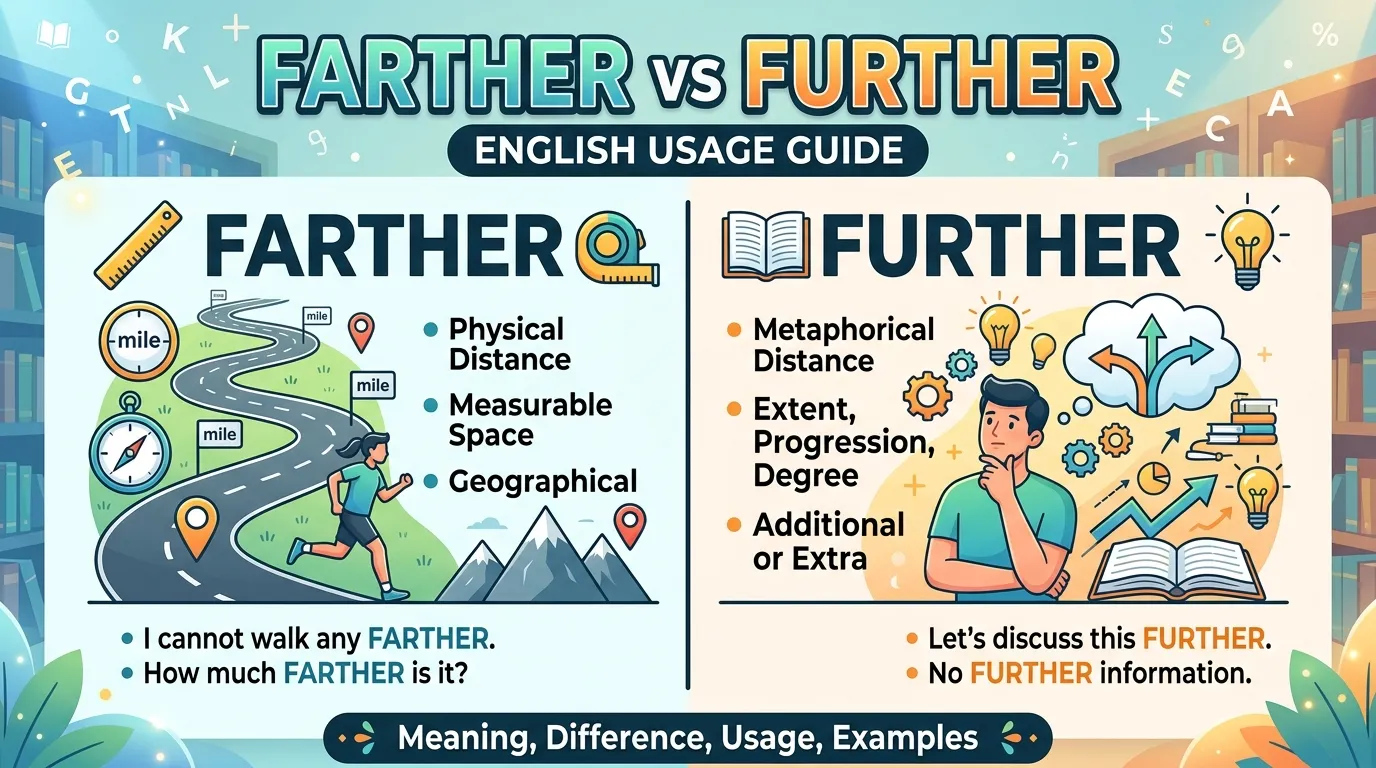
Farther is generally used for literal physical distance, while further is commonly used for figurative distance, additional information, degree, progress, or continuation. For example, you might say, “The store is farther down the road,” but “We need to discuss this further.”
However, real English usage is more flexible than this basic rule suggests. Further can also refer to physical distance, especially in formal, academic, and British English. That is why the two words sometimes overlap.
This guide explains farther vs further in detail, including their meanings, pronunciation, grammar, history, common expressions, regional differences, mistakes, and practical examples. By the end, you will know which word to choose in everyday American English and when either word can work.
Quick Answer: Farther vs Further
The easiest rule is:
- Farther = greater physical distance
- Further = greater figurative distance, additional amount, or more progress
Examples
The library is farther from my house than the school.
The distance is physical, so farther is the natural choice.
We need to investigate the matter further.
The investigation is not about physical distance. It means to a greater degree or to a greater extent.
Do you have any further questions?
Here, further means additional.
She walked farther than anyone else.
This refers to physical movement.
His research took the discussion further.
This refers to intellectual or figurative progress.
A useful memory trick is:
Farther = physical far.
Further = additional or figurative.
Are Farther and Further Both Correct?
Yes. Farther and further are both correct English words.
Neither spelling is a mistake. The difference lies mainly in meaning and context.
The confusion happens because both words developed from the same basic idea of far. They can both function as comparative forms, and their meanings have overlapped for centuries.
In modern American English, many editors and style guides recommend this practical distinction:
| Word | Most common meaning | Example |
|---|---|---|
| Farther | Physical distance | We drove farther north. |
| Further | Additional or figurative | We need further evidence. |
| Farther | Physical extent | The house is farther away. |
| Further | Progress or development | Let’s take the idea further. |
| Further | Additional information | For further details, contact us. |
There are situations where further can describe physical distance too. For example:
How much further do we have to walk?
This sentence is completely natural, particularly in conversational English.
So the physical-distance rule is a useful guideline, not an absolute law.
What Does Farther Mean?
Farther is usually an adjective or adverb that describes a greater physical distance.
Dictionary-style definition of farther
Farther means:
At or to a greater physical distance.
It is the comparative form associated with far.
Examples of farther
- The mountain is farther away than it looks.
- We walked farther than we planned.
- The airport is farther from downtown.
- Move the chair farther from the window.
- Which house is farther from the station?
- The runner went farther than his competitors.
- We need to drive farther south.
- The second store is farther down the street.
In each example, the word relates naturally to physical space or measurable distance.
What Does Further Mean?
Further has a broader range of meanings.
It can mean additional, to a greater extent, to a greater degree, beyond the current point, or to continue developing something.
Dictionary-style definition of further
Further can mean:
To a greater extent, degree, or point; additionally; or at a more advanced stage.
Examples of further
- We need further information.
- Let’s discuss the matter further.
- She wants to further her education.
- The evidence requires further investigation.
- Nothing could be further from the truth.
- The company plans to further improve its service.
- Please contact us for further details.
- The conversation did not go any further.
Notice that these examples do not primarily involve physical distance.
The Main Difference Between Farther and Further
The traditional distinction can be summarized as:
Farther concerns physical distance. Further concerns figurative distance or addition.
Compare these sentences:
We walked farther into the forest.
The movement involves physical space.
We explored the issue further.
The movement is conceptual. We are going deeper into an idea or subject.
Another pair:
The hotel is farther from the airport.
Physical distance.
The hotel needs further improvements.
Additional improvements.
This distinction is especially useful for careful writing because it gives you a reliable default choice.
Farther vs Further Comparison Table
| Feature | Farther | Further |
|---|---|---|
| Physical distance | Yes | Sometimes |
| Figurative distance | Less common | Yes |
| Additional meaning | No | Yes |
| Progress | Sometimes | Yes |
| Degree or extent | Limited | Yes |
| Additional information | No | Yes |
| Common in expressions | Yes | Yes |
| American English preference | Physical distance | Figurative/additional |
| British English | Physical distance | Often used broadly |
Farther as an Adverb
Farther is often used as an adverb to describe physical movement or distance.
We drove farther than expected.
She ran farther than I did.
Don’t walk farther without telling someone.
The boat traveled farther downstream.
It answers questions such as:
- How far?
- How much farther?
- To what physical distance?
Common collocations with farther
Some natural combinations include:
- farther away
- farther north
- farther south
- farther east
- farther west
- farther down the road
- farther along
- farther from home
- farther into the forest
- farther than expected
- farther than before
Further as an Adverb
Further is extremely common as an adverb.
It often means to a greater extent, additionally, or beyond a particular stage.
Examples
We should investigate further.
She pushed the project further.
The discussion went no further.
I don’t want to take this argument any further.
The company expanded further into international markets.
Here, further can describe progress, development, or continuation.
Further as an Adjective
Further is also commonly used as an adjective meaning additional or more.
We need further evidence.
Do you have any further questions?
The police conducted a further investigation.
No further action is required.
Please provide further details.
This adjective use is one of the clearest reasons you cannot simply replace further with farther.
You would not normally write:
Do you have any farther questions?
The natural choice is:
Do you have any further questions?
Further as a Verb
An important grammatical feature of further is that it can also function as a verb.
As a verb, further means to promote, advance, or help something develop.
Examples
The scholarship will further her education.
The campaign aims to further public awareness.
The research could further our understanding of the disease.
His actions did little to further the negotiations.
This use is impossible with farther.
You cannot say:
The scholarship will farther her education.
Instead:
The scholarship will further her education.
Pronunciation of Farther and Further
The two words sound different.
Farther
Farther is commonly pronounced approximately:
FAR-thər
The first syllable sounds like far, followed by a reduced thər sound.
Further
Further is commonly pronounced approximately:
FUR-thər
The first syllable has the vowel sound associated with fur.
The difference is therefore noticeable in careful speech:
- farther → FAR-thər
- further → FUR-thər
Both words contain the th sound.
Why Do People Confuse Farther and Further?
There are several reasons.
They both come from far
Both words are historically connected to the same basic concept of distance.
Their meanings overlap
English speakers have long used further for physical distance as well as figurative meanings.
For example:
How much further is the station?
This is common and natural despite referring to physical distance.
Further has a wider meaning
Further can refer to physical distance, figurative distance, progress, degree, and additional information.
That makes its range broader.
Everyday speech is flexible
Native speakers do not always follow the strict physical-versus-figurative distinction.
As a result, you may hear further in contexts where a traditional grammar guide would recommend farther.
Farther vs Further in American English
For American English, the safest practical guideline is:
Use farther when you clearly mean measurable physical distance.
Use further when you mean additional information, progress, degree, development, or a figurative extension.
American English examples
Chicago is farther from here than Detroit.
We need to look into this further.
How much farther is the trail?
For further information, visit the office.
The discussion needs to go further.
This distinction is particularly useful in professional and academic writing.
Farther vs Further in British English
British English tends to allow further more freely for physical distance.
A British speaker may naturally say:
The station is further down the road.
American speakers may also say this, but farther may be preferred when the writer wants to emphasize literal distance.
This does not mean that one version is always correct and the other always wrong.
English usage varies by region, style, and context.
Regional preference at a glance
| Context | American English | British English |
|---|---|---|
| Literal physical distance | Farther often preferred | Farther or further |
| Additional information | Further | Further |
| Figurative progress | Further | Further |
| Formal writing | Farther for physical distance | Further is common broadly |
| Conversation | Both may occur | Both may occur |
Farther or Further: Which Is More Formal?
Neither word is inherently formal or informal.
Further appears very frequently in formal writing because phrases such as further information, further research, and further consideration are standard professional expressions.
Farther is equally appropriate in formal writing when discussing physical distance.
Formal examples
Further research is required before a final conclusion can be reached.
The proposed site is farther from the city center than the existing facility.
Informal examples
We walked farther than I expected.
Let’s talk about it further later.
The important issue is accuracy and context, not formality alone.
Farther vs Further in Academic Writing
Academic writing frequently uses further.
Common expressions include:
- further research
- further analysis
- further investigation
- further discussion
- further evidence
- further study
- further examination
- further development
- further consideration
Examples
Further research may help explain the results.
The findings require further analysis.
This issue deserves further investigation.
When physical distance is involved, use farther when the distinction matters.
The sampling location was farther from the center of the study area.
Farther vs Further in Business Writing
Further is extremely common in business communication.
Examples include:
Please contact us if you require further assistance.
We need further information before approving the request.
Further discussion may be necessary.
The company hopes to further strengthen its customer service.
For physical locations:
The new warehouse is farther from the main office.
A useful business-writing rule is simple: additional = further.
Farther vs Further in Technical Writing
Technical writing often needs precise language.
If distance is measurable, farther can make the meaning clearer:
The sensor was placed farther from the heat source.
For development or advancement:
The update will further improve system reliability.
For additional analysis:
Further testing is required.
This distinction can prevent ambiguity in instructions, reports, and specifications.
Farther vs Further in Journalism
Journalists use both words according to context.
Physical distance
The storm moved farther inland overnight.
Additional development
Officials declined to provide further details.
Continuing investigation
Police said they would investigate the matter further.
These patterns are common in news writing.
Farther vs Further in Sports
Sports writing often uses farther for measurable physical performance.
The athlete threw the ball farther than his previous record.
She jumped farther than any other competitor.
Further appears when discussing progress or development:
The team advanced further in the tournament.
The coach wants to take the program further.
Important distinction
He kicked the ball farther.
Physical distance.
The team went further in the competition.
Progress or advancement.
Farther vs Further in Politics
Political writing often uses further in figurative contexts.
The proposal could further divide the parties.
The government announced further reforms.
The debate went further than expected.
For physical geography, farther can be appropriate:
The district is farther from the capital.
The key is whether distance is literal or conceptual.
Farther vs Further in Blogging and Content Writing
For blogs, websites, and general online content, clarity matters more than following an overly strict rule.
Use:
- farther for physical distance
- further for additional information
- further for deeper discussion
- further for progress or development
For example:
Read further to learn how the process works.
This means continue reading, not physically travel farther.
Another common phrase is:
For further information…
This is standard and natural.
Common Expressions With Further
Further appears in many fixed expressions.
Further information
Please contact the office for further information.
Further details
Further details will be announced soon.
Further notice
The event is canceled until further notice.
Further ado
The expression without further ado means without any more delay or discussion.
Without further ado, let’s begin.
Further consideration
The proposal requires further consideration.
Further action
No further action is needed.
Further research
Further research is necessary.
Further discussion
The matter can be addressed through further discussion.
Common Expressions With Farther
Farther is strongly associated with literal distance.
Farther away
The second store is farther away.
Farther down the road
There’s a gas station farther down the road.
Farther north
Temperatures drop farther north.
Farther south
The birds migrate farther south in winter.
How much farther?
How much farther do we have to go?
Go farther
You can go farther along the trail if you want.
Farther vs Further in the Phrase “Go Farther”
When someone physically travels a greater distance, go farther is the clearest choice.
We can go farther before stopping.
But go further can also be correct when the meaning is figurative.
We need to go further with our research.
The first sentence concerns physical movement. The second concerns intellectual progress.
Farther vs Further in the Phrase “Take It Further”
The phrase take it further almost always has a figurative meaning.
Let’s take this idea further.
It means develop the idea more.
You would not normally replace it with take it farther when discussing an abstract idea.
Farther vs Further in “Nothing Could Be Further From the Truth”
This is one of the most familiar expressions containing further.
Nothing could be further from the truth.
It means that a statement is completely untrue or very different from reality.
Here, further is figurative. It describes the greatest possible conceptual distance from the truth.
Farther vs Further in “Further Away”
You may encounter both:
The house is farther away.
and
The house is further away.
Both can occur in English.
If you are following the traditional American distinction and want to emphasize literal distance, farther away is the safest choice.
Further vs Farther: Common Mistakes
Mistake: Using farther for additional information
Incorrect:
Please contact us for farther information.
Better:
Please contact us for further information.
Mistake: Using farther for additional details
Incorrect:
We need farther details.
Better:
We need further details.
Mistake: Using farther for figurative progress
Less natural:
Let’s take the project farther.
Better:
Let’s take the project further.
Mistake: Using further when physical distance needs to be clear
Less precise in traditional American usage:
The second location is further from the airport.
Clearer:
The second location is farther from the airport.
Awkward vs Natural Examples
| Awkward or less preferred | Natural choice | Reason |
|---|---|---|
| farther information | further information | Additional information |
| farther research | further research | Additional research |
| farther details | further details | Additional details |
| further down the road | farther down the road | Physical distance in careful American usage |
| farther investigation | further investigation | Additional investigation |
| farther discussion | further discussion | More discussion |
| farther away from the city | farther away from the city | Literal distance |
| further our understanding | further our understanding | Advance understanding |
Remember that some of the “less preferred” examples may still appear in real-world English because usage is not completely rigid.
A Simple Memory Trick for Farther vs Further
Try remembering:
Farther has FAR in it
FARther = physical distance
Imagine a road:
The house is farther down the road.
Further means MORE
Think:
Further = more or additional
I need further information.
Let’s discuss it further.
Further research is needed.
This memory trick will handle most everyday situations.
Synonyms for Farther
Depending on context, synonyms for farther include:
- more distant
- more remote
- beyond
- at a greater distance
- farther away
- more removed
Example:
The village is more distant than the town.
Synonyms for Further
Depending on meaning, synonyms for further include:
- additional
- more
- extra
- continued
- deeper
- beyond
- advance
- develop
- promote
- extend
The correct synonym depends on the grammatical role.
For example:
Further information
can become:
Additional information
But:
Further the cause
means something closer to:
Advance the cause.
Antonyms of Farther and Further
The exact opposite depends on context.
For farther, possible opposites include:
- nearer
- closer
- nearby
- less distant
For further, possible opposites include:
- less
- earlier
- previous
- closer
- reduced
There is no single antonym that works in every sentence.
Related Words
The word family surrounding farther and further includes:
- far
- farther
- further
- farthest
- furthest
- distance
- distant
- remotely
- additional
- advance
- extension
- progress
The superlative forms create another common comparison.
The cabin is the farthest building on the road.
This is the furthest we’ve progressed in the project.
As with farther/further, farthest/furthest can overlap in actual usage.
Farther vs Farthest
Farther is comparative.
My house is farther away.
Farthest is superlative.
My house is the farthest away.
Use farther when comparing two or more things.
Use farthest when identifying the greatest distance in a group or range.
Further vs Furthest
Further is comparative or general.
We need further evidence.
Furthest is the superlative form.
That was the furthest point we reached.
In formal American writing, furthest is often used for figurative or abstract meanings:
This argument is furthest from the original idea.
However, actual usage can vary.
Are Farther and Further Interchangeable?
Sometimes, but not always.
They are interchangeable in some contexts involving distance:
How much farther do we need to go?
How much further do we need to go?
Both can be heard in everyday English.
They are not interchangeable when further means additional:
further information
Not:
farther information
They are also not interchangeable when further functions as a verb:
further the cause
Not:
farther the cause
So the best approach is not to treat them as complete synonyms.
Can Further Mean Physical Distance?
Yes.
This is an important point because the simplified rule is sometimes taught too strictly.
For example:
How much further is the beach?
This is common English.
We walked further down the trail.
Also common.
In these cases, further refers to physical distance.
For careful American English, especially when precision matters, farther is often preferred for clearly measurable physical distance. But using further does not automatically make the sentence incorrect.
Can Farther Mean Figurative Distance?
Historically and in actual usage, farther has sometimes been used more broadly than the modern distinction suggests.
However, contemporary standard usage strongly favors further for abstract meanings.
Instead of:
We need to examine the problem farther.
Use:
We need to examine the problem further.
Instead of:
This could farther improve the system.
Use:
This could further improve the system.
For modern American English, further is the better choice for figurative extension and advancement.
How to Choose Between Farther and Further
When you are unsure, ask one question:
Am I talking about physical distance?
If yes, choose farther as your default in careful American English.
The store is farther away.
If no, consider further.
We need further discussion.
Then ask:
Does further mean additional, more, or continued?
If yes, further is correct.
We need further information.
Practical Recommendations by Writing Situation
American everyday writing
Use farther for clear physical distance and further for abstract meanings.
British English
Be comfortable with further for physical distance because it is widely accepted.
Academic writing
Use further for additional research, discussion, evidence, and analysis. Use farther for literal distance when useful.
Business writing
Use further for additional requests, information, assistance, and discussion.
Technical writing
Prefer farther when a measurable physical distance is important to the meaning.
Journalism
Follow the same basic distinction, while recognizing established expressions and normal editorial usage.
Sports writing
Use farther for measurable physical performance and further for advancement or progress.
Blogging
Choose the word that makes the intended meaning clearest. Do not force the distinction where natural English uses further.
Casual conversation
Both may occur naturally, particularly when discussing physical distance.
Quick Decision Guide
Use this checklist before choosing the word:
Use FARTHER when:
- You are talking about physical distance.
- Something is geographically more distant.
- Someone travels a greater distance.
- A measurable physical space is involved.
Use FURTHER when:
- You mean additional.
- You mean more.
- You mean to a greater degree.
- You mean continued progress.
- You are discussing an abstract idea.
- You mean to advance or promote something.
- You are referring to further information or research.
Word History and Etymology
Both farther and further developed from the older English word associated with far.
Far itself has very old Germanic roots and has long expressed the idea of distance.
The history of further is especially interesting because it became associated not only with physical distance but also with the broader concept of advancement or continuation.
Over time, English speakers extended the idea of physical distance into abstract contexts.
For example:
Physical:
We went farther.
Abstract:
We went further into the problem.
The second sentence treats understanding as if it were a journey. This type of metaphor is common throughout English.
That historical development helps explain why the distinction between farther and further is not perfectly rigid.
Why Further Became So Broad
The meaning of further expanded naturally from the idea of going beyond a point.
If you go beyond a physical point, you can also go beyond:
- an idea
- an argument
- a discussion
- a process
- a level of understanding
- a stage of development
This is why we can say:
Let’s take the discussion further.
There is no physical road. The “distance” is conceptual.
Final Usage Checklist
Before publishing or submitting your writing, check these patterns:
| Meaning | Preferred word |
|---|---|
| Physical distance | Farther |
| Additional information | Further |
| More research | Further |
| More discussion | Further |
| Greater physical distance | Farther |
| Greater progress | Further |
| Advance a cause | Further |
| Continue an argument | Further |
| Literal travel | Farther |
| “Without ___ ado” | Further |
| “___ information” | Further |
| “How much ___?” referring to distance | Farther in careful American usage |
Frequently Asked Questions About Farther vs Further
Is farther or further correct?
Both farther and further are correct. In standard American English, farther is generally preferred for literal physical distance, while further is preferred for figurative distance, additional information, degree, progress, and continuation.
What is the easiest way to remember farther vs further?
Remember FARther = physical distance. Use further when you mean additional, more, or continued progress. For example, “We walked farther” but “We need further information.”
Is further used for physical distance?
Yes. Further is commonly used for physical distance, especially in conversation and British English. In careful American English, farther is often preferred when the distance is clearly physical.
Should I say farther or further down the road?
For literal physical distance, farther down the road is the traditional choice in American English. However, further down the road is also widely used and can be natural in both American and British English.
Is it further information or farther information?
The correct standard expression is further information. Here, further means additional.
Please contact us for further information.
Is it further research or farther research?
Use further research. It means additional or continued research.
Further research is needed to confirm the results.
Is “go further” grammatically correct?
Yes. Go further is completely correct. It can refer to physical distance or figurative progress depending on context. In traditional American usage, go farther is often preferred when the movement is clearly physical.
What is the difference between farther and further in American English?
In American English, farther is traditionally associated with physical distance, while further is associated with additional amounts, abstract distance, progress, and continuation. Modern usage allows some overlap, especially with physical distance.
Can farther and further be used interchangeably?
Not in every situation. They can overlap when referring to distance, but further is required for many expressions involving addition or advancement, such as further information, further research, and further discussion.
Which word should I use in formal writing?
For formal American writing, use farther for clearly physical distance and further for figurative meanings, additional information, research, discussion, and advancement. This distinction is clear, practical, and widely understood.
Conclusion: Farther vs Further
The difference between farther vs further is easier once you focus on the type of distance involved.
Use farther as your default for literal physical distance:
The next town is farther away.
Use further for additional information, abstract distance, progress, development, or continuation:
We need further information.
Let’s discuss the issue further.
The program will further improve performance.
The distinction is not completely rigid because further can also describe physical distance, especially in British English and everyday conversation. Still, the physical-versus-figurative rule is an excellent guide for American English, particularly in careful, academic, business, technical, and professional writing.
When in doubt, remember FARther = physical distance and FURther = additional or more. Most importantly, pay attention to the meaning of the sentence rather than simply memorizing the spelling.