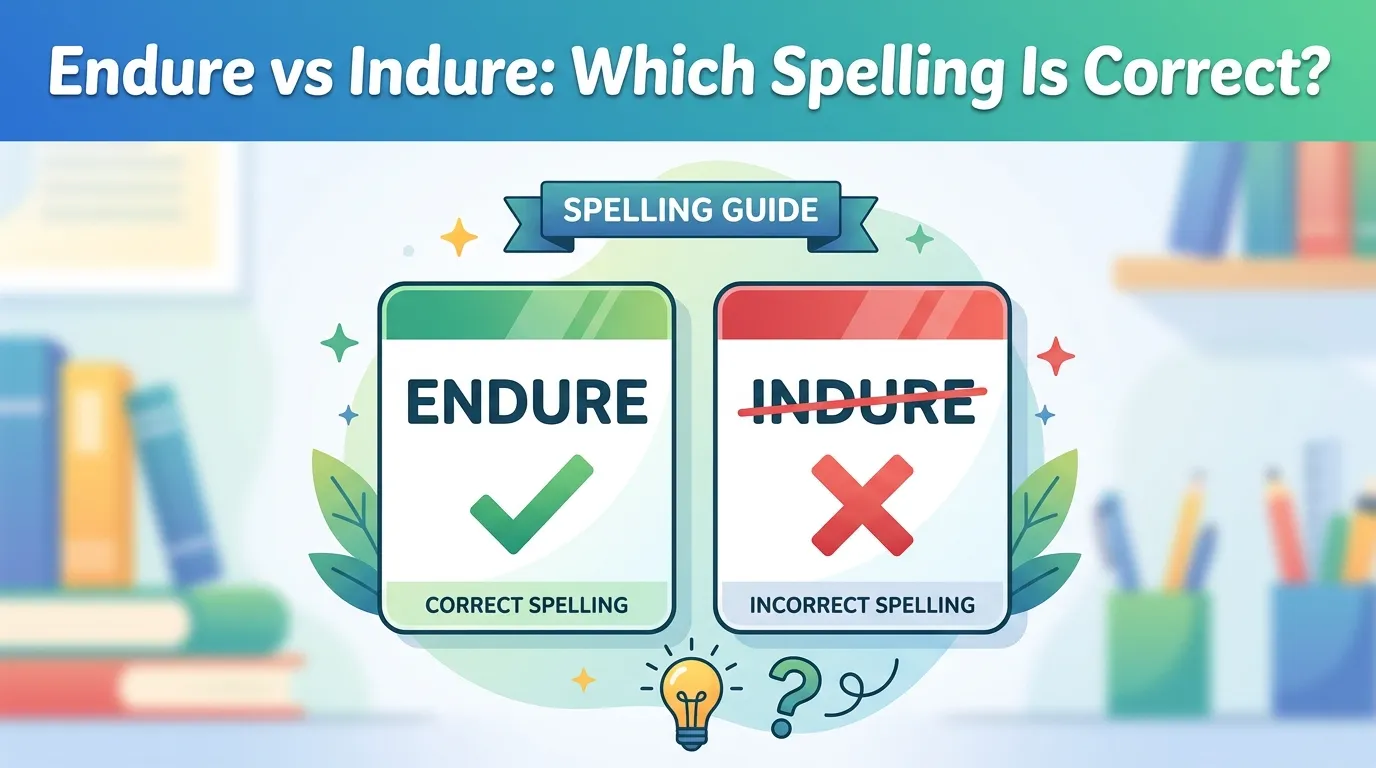
If you are wondering whether endure or indure is the correct spelling, the answer is straightforward: endure is the standard and correct spelling in modern English. The word indure is generally considered an obsolete or archaic variant and is not normally used in contemporary American or British English.
Both forms have historical connections, which helps explain why the confusion exists. Today, however, if you mean to suffer something patiently, continue through difficulty, or remain in existence despite hardship, you should write endure.
This guide explains endure vs indure, including their meanings, pronunciation, history, grammatical uses, synonyms, common mistakes, examples, regional differences, and practical writing advice.
Quick Answer: Endure or Indure?
Endure is the correct spelling for modern English.
- ✅ Endure — standard modern English spelling
- ❌ Indure — obsolete or archaic variant in most modern dictionaries and contexts
Examples
- ✅ She had to endure months of physical therapy.
- ✅ The building was designed to endure harsh weather.
- ✅ He learned to endure criticism without losing confidence.
- ❌ She had to indure months of physical therapy.
If you are writing an email, essay, article, report, business document, academic paper, or social media post, use endure.
What Does Endure Mean?
Endure is a verb meaning to experience something difficult or unpleasant and continue despite it.
It can describe physical pain, emotional hardship, difficult conditions, criticism, delays, or other unpleasant experiences.
For example:
The hikers had to endure freezing temperatures.
Here, endure means that the hikers experienced the difficult temperatures and continued despite them.
The word can also mean to last or remain in existence for a long time.
For example:
Their friendship has endured for decades.
In this sentence, endured means continued or survived over a long period.
Main meanings of endure
Endure commonly has two related meanings:
- To suffer or tolerate something difficult
- She endured severe pain.
- We endured a long delay.
- To continue or last despite difficulties
- The tradition has endured for centuries.
- Their partnership endured despite disagreements.
The exact meaning depends on context.
Is Indure a Correct Word?
Indure exists as a historical or obsolete spelling, but it is not the normal spelling in modern English.
You may encounter indure in older texts, historical documents, or discussions of archaic English. It has been used historically with meanings closely related to endure.
However, modern readers generally expect endure.
That distinction is important because a word can exist in the history of English without being an appropriate choice for contemporary writing.
Modern usage
For ordinary modern communication:
Use endure.
Avoid indure unless you are deliberately reproducing historical language or discussing an older text.
Endure vs Indure: Key Differences
| Feature | Endure | Indure |
|---|---|---|
| Modern standard spelling | Yes | No |
| Common in modern English | Yes | No |
| Standard American English | Yes | No |
| Standard British English | Yes | No |
| Verb | Yes | Historical/obsolete verb |
| Meaning | Suffer, tolerate, or last | Historically similar to endure |
| Appropriate for academic writing | Yes | Generally no |
| Appropriate for business writing | Yes | No |
| Appropriate for casual writing | Yes | No |
| Historical usage | Yes | Yes |
| Recommended today | Yes | No |
The practical difference is therefore simple: endure belongs to modern English; indure is mainly historical.
Why Do People Confuse Endure and Indure?
The confusion usually comes from pronunciation, word formation, and historical spelling.
Similar pronunciation patterns
English contains many words beginning with en- and in-, and these prefixes can sometimes sound similar in connected speech.
For example:
- endure
- ensure
- insure
- induce
- include
- endure
A learner may hear the beginning of endure and assume that it begins with in-.
But spelling must be learned independently from pronunciation.
The word resembles other “in-” words
English has many common words beginning with in-, such as:
- include
- increase
- indicate
- influence
- insist
- invent
This may encourage someone to write indure by analogy.
However, the standard spelling is endure.
Historical English adds confusion
Older forms of English were less standardized than modern English. Historical texts sometimes contain spellings that differ from those expected today.
Because indure has appeared historically, it is not simply a random misspelling invented recently. It has a genuine history, but that does not make it the preferred modern spelling.
Endure: Dictionary-Style Definition
Endure
Part of speech: Verb
Definition 1
To experience something unpleasant or difficult without giving up or stopping.
Example:
The athlete endured intense training before the competition.
Definition 2
To tolerate something unpleasant.
Example:
I cannot endure that constant noise.
Definition 3
To continue to exist or remain effective for a long time.
Example:
The novel has endured as a classic of American literature.
Simple definition
Endure means to suffer, tolerate, survive, or continue through something difficult.
How to Pronounce Endure
The standard pronunciation of endure is:
/ɪnˈdʊr/ in many American English pronunciations.
It can be broken approximately into:
en-DURE
The stress falls on the second syllable.
Example
She had to en-DURE the pain.
The final part sounds like dure in the verb.
Pronunciation can vary somewhat across English dialects, particularly in the vowel used in the final syllable.
Is Endure a Verb?
Yes. Endure is a verb.
It can describe either experiencing something difficult or continuing over time.
Endure as a transitive verb
A transitive verb takes an object.
She endured the pain.
Here:
- She = subject
- endured = verb
- the pain = object
Other examples:
- He endured the criticism.
- They endured the difficult journey.
- We endured several hours of traffic.
- The workers endured uncomfortable conditions.
Endure without a direct object
Endure can also be used in ways where the emphasis is on continuing or surviving.
Their friendship endured.
Here, endured means continued to exist.
Endure in Different Tenses
Because endure is a regular verb, its past tense is formed with -ed.
| Tense | Example |
|---|---|
| Present | I endure difficult situations. |
| Third-person present | She endures criticism well. |
| Past | He endured the pain. |
| Present participle | They are enduring difficult conditions. |
| Past participle | She has endured many challenges. |
Common forms
- endure
- endures
- endured
- enduring
There is no irregular past form such as endured → endured; the verb follows the regular pattern.
Endure vs Enduring vs Endurance
These words are closely related but serve different grammatical functions.
Endure
Endure is the verb.
She had to endure the difficult journey.
Enduring
Enduring can function as a present participle or adjective.
They showed enduring patience.
As an adjective, enduring can mean lasting for a long time.
Endurance
Endurance is a noun referring to the ability to continue despite difficulty.
Running a marathon requires endurance.
Related word family
- endure — verb
- endured — past tense/past participle
- enduring — participle/adjective
- endurance — noun
These forms are useful in both everyday and professional English.
Endure vs Tolerate
These words overlap, but they are not always interchangeable.
Tolerate generally means allowing or accepting something unpleasant, annoying, or different without reacting strongly against it.
I tolerate loud music during parties.
Endure often suggests that something is genuinely difficult, painful, or unpleasant to experience.
She endured months of treatment.
Compare:
I tolerate his jokes.
with:
I endured his constant insults.
The second sentence sounds much stronger.
Easy distinction
Tolerate = put up with something.
Endure = suffer through something difficult or continue despite hardship.
Endure vs Survive
These words are also related.
Survive emphasizes remaining alive or continuing to exist after danger or difficulty.
The plant survived the winter.
Endure emphasizes experiencing difficulty over a period of time or continuing despite it.
The plant endured months of extreme cold.
Sometimes either word may work, but the emphasis changes.
Endure vs Withstand
Withstand means successfully resisting something that acts against you.
The bridge can withstand strong winds.
Endure can mean continuing despite experiencing something difficult.
The bridge has endured decades of severe weather.
A useful distinction is:
- Withstand → resist successfully
- Endure → experience or continue through difficulty
Endure vs Bear
Bear can mean tolerate or carry something difficult.
I cannot bear the noise.
Endure has a similar meaning:
I cannot endure the noise.
Both are correct, but bear is often more conversational, while endure can sound more formal or serious.
Endure in Formal and Informal English
Endure works in almost every register, but its tone can vary depending on the context.
Casual English
I can’t endure another meeting like that.
This is grammatically correct, although put up with or stand might sound more conversational.
I can’t stand another meeting like that.
Formal English
The organization endured significant financial pressure during the recession.
This sounds natural in professional writing.
Academic English
The species has endured substantial environmental changes over time.
This is also appropriate in academic contexts.
Endure in American English
Endure is standard in American English.
American writers use it in:
- everyday conversation
- journalism
- business
- academic writing
- sports
- literature
- technical writing
- historical writing
Examples:
The company endured several difficult years.
The player endured a painful injury but returned to competition.
The material is designed to endure extreme temperatures.
There is no American spelling change from endure to indure.
Endure in British English
British English also uses endure as the standard spelling.
For example:
The old building has endured for more than two hundred years.
Although British and American English differ in spellings such as colour/color and organise/organize, they do not normally differ on endure.
American and British comparison
| Meaning | American English | British English |
|---|---|---|
| Suffer through difficulty | endure | endure |
| Tolerate | endure | endure |
| Continue to exist | endure | endure |
| Historical variant | indure may appear in old texts | indure may appear in old texts |
So if you are writing for an international audience, endure is the safe choice.
Endure in Academic Writing
Endure can be useful in academic writing when discussing persistence, hardship, historical change, or long-term survival.
Examples
Ancient communities endured periods of drought and famine.
The cultural practice endured despite political changes.
Certain materials can endure repeated exposure to heat.
However, academic writers should choose the word according to the exact meaning.
If you mean continue to exist, consider:
- persist
- remain
- continue
- survive
If you mean experience hardship, consider:
- endure
- tolerate
- withstand
- experience
Endure in Business Writing
The word can be effective in business contexts when discussing resilience.
The company endured several years of market uncertainty.
Businesses must adapt if they are to endure long-term economic changes.
However, in a straightforward business report, alternatives such as remain stable, continue operating, or survive may sometimes be more precise.
For example:
Instead of:
The company endured in the market.
Use:
The company remained competitive in the market.
The second sentence gives the reader more specific information.
Endure in Sports
Endure is common in sports writing.
It may describe physical pain, demanding conditions, or a long competition.
The runner endured extreme heat during the race.
The team endured a difficult second half.
The boxer endured several powerful attacks.
Sports journalists often use endure because it communicates persistence under pressure.
Endure in Technical Writing
In technical and engineering contexts, endure can describe a material’s ability to remain functional under stress or exposure.
For example:
The coating must endure prolonged exposure to moisture.
The device is designed to endure repeated temperature changes.
However, technical writing often benefits from more precise terms such as:
- withstand
- resist
- tolerate
- maintain performance
- remain operational
Instead of saying:
The machine can endure high temperatures.
A technical specification might say:
The machine can operate continuously at temperatures up to 120°C.
The second version is more measurable.
Endure in Literature and Journalism
Endure is especially useful when writing about long-lasting ideas, traditions, relationships, institutions, and works of art.
Literary example
The poem has endured because its central themes remain relevant.
Journalism example
The community endured months of disruption after the storm.
Historical example
The tradition endured despite generations of social change.
The word often carries a sense of resilience.
Common Collocations With Endure
A collocation is a combination of words that commonly occur together.
Some natural combinations with endure include:
- endure pain
- endure suffering
- endure hardship
- endure difficulties
- endure criticism
- endure pressure
- endure stress
- endure challenges
- endure adversity
- endure changes
- endure uncertainty
- endure years of hardship
- endure harsh conditions
- endure extreme temperatures
- endure difficult circumstances
Examples
She endured years of hardship before achieving her goal.
The structure must endure harsh environmental conditions.
He endured intense criticism after the decision.
These combinations sound natural in modern English.
Common Phrases Using Endure
Some useful expressions include:
Endure hardship
The family endured considerable hardship during the crisis.
Endure pain
The patient endured significant pain during recovery.
Endure suffering
The community endured years of suffering.
Endure criticism
Public figures often have to endure criticism.
Endure over time
Strong traditions can endure over time.
Endure for centuries
Some cultural practices have endured for centuries.
Synonyms for Endure
The best synonym depends on the meaning.
When endure means tolerate
- tolerate
- bear
- stand
- put up with
- suffer
- accept
Example:
She could not endure the noise.
Possible alternatives:
She could not tolerate the noise.
She could not stand the noise.
When endure means survive
- survive
- persist
- continue
- remain
- last
- withstand
- prevail
Example:
The tradition endured for generations.
Possible alternatives:
The tradition persisted for generations.
The tradition survived for generations.
Antonyms of Endure
There is no single opposite for every use of endure.
Depending on the context, possible opposites include:
- give up
- quit
- abandon
- surrender
- disappear
- cease
- collapse
- fail
- reject
- avoid
For example:
The tradition endured.
The opposite might be:
The tradition disappeared.
But:
She endured the pain.
The opposite might be:
She avoided the pain.
Context determines the best antonym.
Memory Trick: How to Remember Endure
A simple way to remember the spelling is:
Endure begins with EN-, not IN-.
Think:
EN + DURE = ENDURE
You can also connect it with endurance:
endure → endurance
If you know that endurance begins with end-, it becomes easier to remember the spelling of endure.
Quick memory sentence
You endure a difficult ENDless challenge.
The visual association between END and ENDURE can help reinforce the spelling.
Common Mistakes With Endure and Indure
Mistake: Using indure in modern writing
❌ He had to indure the pain.
✅ He had to endure the pain.
Mistake: Assuming indure is the American form
❌ American English uses indure.
✅ American English uses endure.
Mistake: Thinking pronunciation determines spelling
A learner may hear a sound resembling in- and write indure.
The standard written form is still endure.
Mistake: Using endure when a more precise verb is needed
The material endures temperatures of 500°C.
This may be understandable, but technical documentation might be clearer as:
The material withstands temperatures of 500°C.
Or:
The material remains stable at temperatures up to 500°C.
The issue here is not spelling but precision.
Awkward vs Natural Examples
Example 1
Awkward:
The patient indured the treatment.
Natural:
The patient endured the treatment.
Example 2
Awkward:
The old tradition indured for many years.
Natural:
The old tradition endured for many years.
Example 3
Less precise:
The machine endured high temperatures.
More technical:
The machine withstood high temperatures.
Example 4
Natural:
She endured months of uncertainty while waiting for an answer.
Example 5
Natural:
Their friendship endured despite years of separation.
Is Indure Ever Appropriate?
There are limited situations where indure may appear legitimately.
Historical texts
If you are quoting or analyzing an old text, you may encounter the spelling indure.
Historical linguistics
A linguist may discuss indure as an older spelling or variant.
Reproducing historical language
A novelist writing deliberately archaic dialogue may choose an old spelling for stylistic reasons, although this should be intentional.
Outside those specialized situations, indure is likely to be interpreted as a spelling mistake.
Does Indure Mean Something Different From Endure?
Historically, indure has been used with meanings related to endure, including the ideas of tolerating, suffering, or continuing.
Modern English does not generally maintain a useful everyday distinction between the two spellings.
Therefore, it would be misleading to tell learners that endure and indure are two modern words with different meanings.
For contemporary writing, simply use endure.
Endure vs Indure in Different Types of Writing
| Writing type | Recommended form |
|---|---|
| American English | endure |
| British English | endure |
| International English | endure |
| Academic writing | endure |
| Business writing | endure |
| Journalism | endure |
| Technical writing | endure, or a more precise synonym |
| Sports writing | endure |
| Blogging | endure |
| Casual writing | endure |
| Social media | endure |
| Historical quotation | indure may appear if historically accurate |
The rule is remarkably consistent.
How to Choose Between Endure and Other Similar Words
Ask yourself what you really mean.
Do you mean experience something difficult?
Use endure.
She endured months of pain.
Do you mean allow something annoying?
Use tolerate.
He tolerates background noise while working.
Do you mean resist physical force?
Use withstand.
The wall can withstand strong winds.
Do you mean remain alive?
Use survive.
The plant survived the winter.
Do you mean continue to exist?
Use persist or endure.
The tradition persisted for centuries.
Do you mean dislike something strongly?
Use cannot stand.
I cannot stand that smell.
This approach produces more natural and precise writing than choosing words based only on their dictionary similarity.
Real-World Examples of Endure
Here are examples across several contexts.
Everyday life
I don’t know how she endured that long commute every day.
Family
The family endured a difficult period after moving to a new city.
Education
Students sometimes endure considerable pressure during final exams.
Work
The employees endured weeks of uncertainty during the restructuring.
Business
The company endured a difficult financial period and eventually recovered.
Sports
The cyclist endured the steep final climb.
Nature
Some plants can endure long periods without rainfall.
Technology
The protective case is designed to endure repeated impacts.
History
The custom endured despite major political changes.
Relationships
Their friendship endured through years of separation.
Endure in Figurative Language
Endure is frequently used figuratively.
For example:
Their love endured.
Love cannot literally be touched or physically damaged in the same way as an object, but endured communicates that the relationship continued despite difficulties.
Other figurative examples include:
The idea endured.
His influence endured.
The memory endured.
The legend endured.
The tradition endured.
In each case, the word communicates persistence over time.
Endure and the Idea of Resilience
One reason endure is powerful is that it often implies resilience.
Compare:
The company continued.
with:
The company endured.
The second sentence can suggest that the company faced serious obstacles but remained in existence.
Likewise:
She lived through the experience.
is relatively neutral.
She endured the experience.
emphasizes the difficulty of what she experienced.
This makes endure particularly useful when writing about perseverance, hardship, survival, and long-term persistence.
Frequently Asked Questions
Is endure the correct spelling?
Yes. Endure is the standard spelling in modern English. It means to tolerate or suffer something difficult, or to continue to exist despite challenges.
Is indure a word?
Indure has historical and obsolete usage, but it is not the standard spelling in contemporary English. Modern writers should normally use endure.
Are endure and indure pronounced the same?
Historically related forms can have pronunciation differences depending on period and dialect, but in modern usage the important point is that endure is the standard word. Indure is not normally used in contemporary English.
Should I use endure in American English?
Yes. Endure is the normal American English spelling.
Is endure also correct in British English?
Yes. Endure is standard in both British and American English.
What is the difference between endure and tolerate?
Endure often emphasizes suffering through or continuing despite something difficult. Tolerate often emphasizes allowing or putting up with something unpleasant.
What is the noun form of endure?
The main noun is endurance.
For example:
Marathon running requires considerable endurance.
What is the adjective form related to endure?
Enduring is commonly used as an adjective.
For example:
They developed an enduring friendship.
Can endure mean survive?
Yes. In some contexts, endure means to continue to exist or remain despite difficulties, which can overlap with survive.
Why do people spell endure as indure?
The confusion may come from pronunciation, the productive in- pattern found in many English words, and historical forms of English in which indure appeared. However, modern standard spelling is endure.
Final Verdict
When choosing between endure and indure, the modern English answer is clear:
Use endure.
Endure is the standard spelling in American English, British English, academic writing, journalism, business communication, technical contexts, blogging, and everyday conversation.
It can mean to suffer or tolerate something difficult, as in:
She endured years of hardship.
It can also mean to continue or remain despite difficulties, as in:
Their tradition has endured for generations.
Indure, although found in historical English, is obsolete or archaic for normal modern usage. Using it in contemporary writing will usually look like a spelling error.
The easiest rule to remember is:
Endure is the modern spelling. Indure belongs mainly to historical or archaic contexts.
So if your goal is clear, professional, natural English, choose endure every time unless you have a specific historical reason to reproduce the older form.