If you have ever written “ect.” at the end of a sentence, you are not alone. Many people use ect when they actually mean etc. The two forms look almost identical, sound similar in casual speech, and are often confused in texting, schoolwork, emails, and everyday writing.
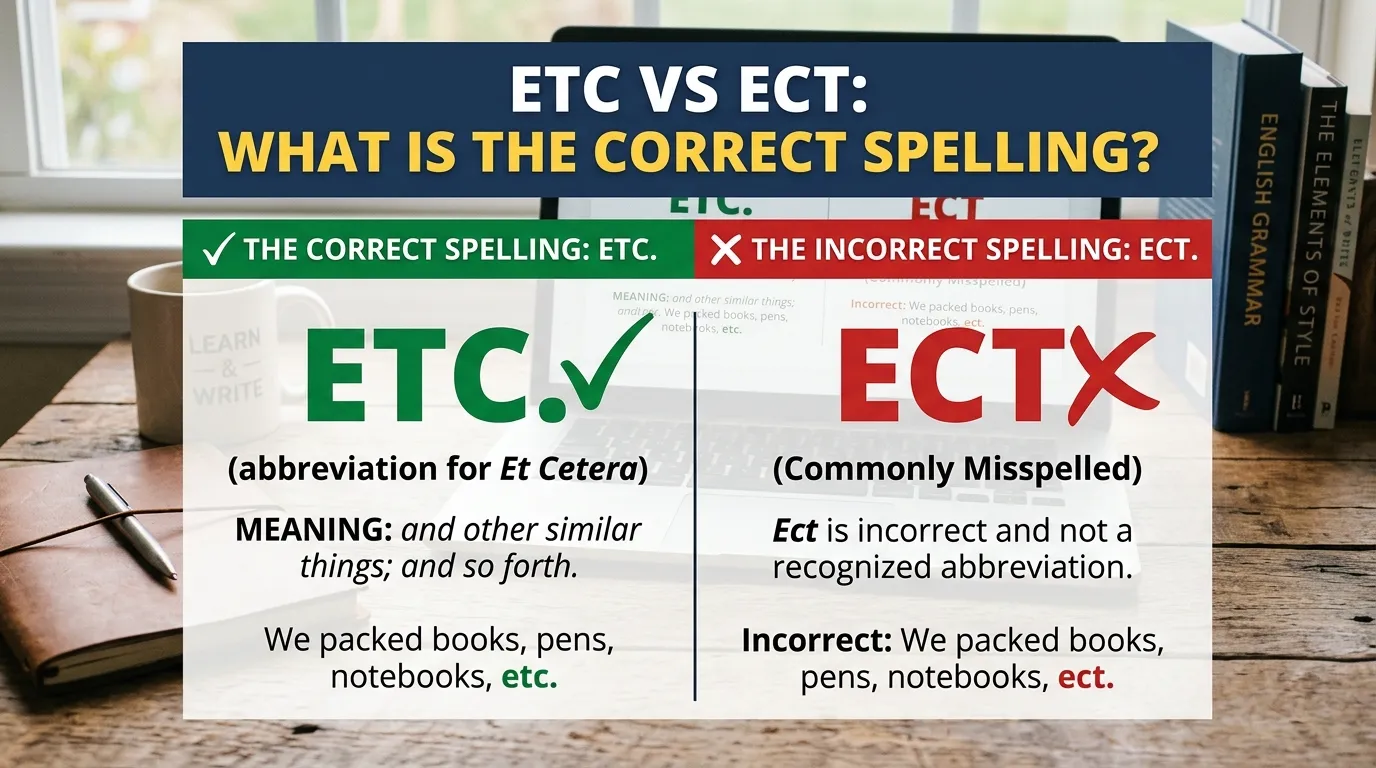
But there is an important difference: etc. is the correct standard abbreviation, while ect. is a common spelling mistake when it is intended to mean etc.
Etc. comes from the Latin phrase et cetera, meaning “and other things,” “and so on,” or “and the rest.” It is used when you give a list and want to show that the list continues without naming every item.
In this guide, you will learn exactly why etc. is correct, why ect. is incorrect in this context, how to pronounce etc., when to use it, when to avoid it, and what alternatives work better in formal writing.
Quick Answer: Is It Etc or Ect?
The correct spelling is etc.
Ect. is not the standard abbreviation of et cetera. It is usually a spelling error caused by the way people pronounce or remember the word.
| Form | Correct? | Meaning |
|---|---|---|
| etc. | ✅ Yes | And so on; and other things |
| ect. | ❌ No | Common misspelling of etc. |
| et cetera | ✅ Yes | Full Latin expression |
| etcetera | Sometimes seen | Less preferred than et cetera in careful writing |
Example
Correct:
Bring notebooks, pens, pencils, etc.
Incorrect:
Bring notebooks, pens, pencils, ect.
The easiest rule is:
Remember “ETC,” not “ECT.”
The abbreviation follows the first three letters of et cetera: ET + C.
What Does Etc. Mean?
Etc. is an abbreviation of the Latin expression et cetera.
The phrase literally means “and the rest” or “and other things.” In modern English, it commonly means:
- and so on
- and so forth
- and other similar things
- and other things of the same type
- and the rest
For example:
We bought apples, oranges, bananas, etc.
This means the speaker bought apples, oranges, bananas, and other similar items.
The writer does not need to list every fruit.
Another example
The course covers grammar, vocabulary, pronunciation, etc.
The sentence suggests that the course covers grammar, vocabulary, pronunciation, and other related subjects.
Why Do People Write Ect Instead of Etc?
The confusion between etc. vs ect. is extremely common because the letters are easy to mix up.
There are several reasons.
1. People Hear the Word Instead of Seeing It
When people say etcetera, the middle sounds can make the spelling less obvious.
Someone who frequently hears the expression but rarely sees it written may remember the sound incorrectly.
They may write:
ect.
instead of:
etc.
This is similar to other English spelling mistakes where pronunciation does not clearly reveal the written form.
2. The Letters Are Very Similar
The difference is only the position of two letters:
ETC
versus
ECT
That makes the mistake easy to make while typing quickly.
3. Casual Digital Writing Encourages Mistakes
Text messages, social media posts, comments, and informal chats often contain shortened or misspelled forms.
Someone may type ect without realizing that it is incorrect.
Autocorrect does not always catch every spelling error, especially when the incorrect form resembles another possible word or abbreviation.
4. The Full Expression Is Unfamiliar to Some Writers
Understanding the origin of etc. makes the spelling easier to remember.
It comes from:
et cetera
The beginning is:
ET C…
Therefore:
ETC.
Not:
ECT.
Etc. vs Ect: Key Difference
The main difference is simple.
Etc.
Etc. is the standard English abbreviation for et cetera.
It is used to indicate that a list continues.
We need chairs, tables, decorations, etc.
Ect.
Ect. is generally incorrect when you intend to write et cetera.
We need chairs, tables, decorations, ect.
❌ Incorrect.
The memory rule
Think:
ET + CETERA = ETC.
The T comes before the C.
Etc. Dictionary-Style Definition
Etc.
Part of speech: Abbreviation
Full form: et cetera
Origin: Latin
Basic meaning: And other things; and so on; and the rest
Typical function: Indicates that a list or series continues
Pronunciation: Commonly pronounced et SET-er-uh in American English
Example
The store sells shirts, jackets, shoes, hats, etc.
Here, etc. tells the reader that the store sells additional items that are not listed.
What Does Et Cetera Literally Mean?
The Latin expression et cetera can be understood as “and the rest” or “and other things.”
The word et means “and.”
Cetera refers to the other things or the rest.
English adopted the expression as a convenient way to avoid writing a long list.
Instead of saying:
The box contains pencils, pens, erasers, rulers, markers, notebooks, folders, paper, scissors, and many other things.
You could write:
The box contains pencils, pens, erasers, rulers, markers, notebooks, etc.
The abbreviation makes the sentence shorter while preserving the basic meaning.
How Do You Pronounce Etc.?
Etc. is commonly pronounced:
et SET-er-uh
The pronunciation comes from the full expression et cetera.
In fast conversation, speakers may shorten or blur the sounds.
That may partly explain why some people spell it ect.
However, pronunciation should not change the standard spelling.
Correct
etc.
Incorrect
ect.
Is Etc. a Word or an Abbreviation?
Etc. is an abbreviation, not simply an ordinary English word.
It is derived from the Latin phrase et cetera.
Although English speakers have used it for centuries, the written form remains an abbreviation in standard usage.
The period after etc. traditionally indicates that the expression has been abbreviated.
In some modern style systems, punctuation rules can vary depending on the publication’s preferences, but etc. remains the familiar standard form.
How to Use Etc. Correctly
Use etc. when you are listing several examples and want to indicate that other similar examples exist.
Example 1: Objects
Pack your clothes, shoes, toiletries, etc.
Example 2: School subjects
Students study math, science, history, English, etc.
Example 3: Activities
We enjoy hiking, swimming, cycling, etc.
Example 4: Business
The company sells computers, monitors, keyboards, etc.
Example 5: Food
The restaurant serves burgers, sandwiches, salads, desserts, etc.
In each example, the reader can reasonably understand that the list continues.
When Should You Not Use Etc.?
Although etc. is correct, it is not appropriate in every sentence.
Avoid Etc. When the List Is Supposed to Be Complete
If you are giving a complete list, etc. is unnecessary.
For example:
The three colors are red, blue, and green.
If those are the only three colors being discussed, adding etc. would be misleading.
Avoid Etc. When the Missing Items Matter
If readers need to know exactly what is included, do not hide important information behind etc.
Instead of:
Submit your identification, financial documents, tax forms, etc.
A professional document should specify exactly which documents are required.
For example:
Submit your identification, bank statement, tax return, and proof of address.
Specific writing is clearer.
Etc. vs And So On
Etc. and and so on often communicate a similar idea.
Etc.
We sell books, magazines, notebooks, etc.
And so on
We sell books, magazines, notebooks, and so on.
Both indicate that the list continues.
However, and so on can sound more natural in conversational writing.
Etc. is compact and especially common in lists, notes, descriptions, and practical writing.
Etc. vs And So Forth
Another alternative is and so forth.
The meeting covered budgets, staffing, schedules, and so forth.
This is grammatically acceptable, but it can sound slightly more formal or old-fashioned than and so on in some contexts.
Comparison
| Expression | Meaning | Typical tone |
|---|---|---|
| etc. | And other similar things | Neutral |
| and so on | And other similar things | Conversational |
| and so forth | And other similar things | Neutral/formal |
| and the like | And similar things | Formal |
| and others | Additional people/items | Context-dependent |
Can You Use Etc. for People?
Yes, but usually not when referring to people directly.
For people, expressions such as and others are often clearer.
Less natural
John, Sarah, Michael, etc.
If you mean other people, this can sound vague.
Better
John, Sarah, Michael, and others.
Or:
John, Sarah, Michael, and other team members.
Etc. is traditionally associated with things or concepts, while et al. is used for people or authors.
Etc. vs Et Al.
These abbreviations are sometimes confused.
They do not mean the same thing.
Etc.
Etc. means:
and other things
Example:
Books, journals, newspapers, etc.
Et Al.
Et al. is a Latin abbreviation meaning roughly:
and others
It is commonly used when referring to multiple authors or people.
Example:
Smith et al. examined the relationship between sleep and memory.
Simple distinction
Etc. → things
Et al. → people/authors
Can Etc. Be Used in Academic Writing?
Yes, but use it carefully.
Academic writing usually values specificity and precision. If the exact items matter to your argument, list them rather than relying on etc.
Less precise
The researchers considered age, gender, income, etc.
More precise
The researchers considered age, gender, income, education level, and employment status.
The second sentence gives the reader useful information.
Etc. is acceptable when the omitted examples are not important to the argument.
Etc. in Business Writing
In emails and internal communication, etc. is common.
For example:
Please bring your laptop, charger, notebook, etc.
However, in contracts, policies, instructions, and legal documents, vague wording can cause problems.
Instead of:
Employees must submit identification, forms, etc.
A formal policy should specify exactly what employees must submit.
General rule
Use etc. when brevity helps.
Avoid it when precision is important.
Etc. in Casual Writing and Text Messages
In texting, people may use:
- etc.
- etc
- ect
- and so on
- and stuff
- and things like that
Of these, ect remains a spelling error when it is intended as et cetera.
A casual environment may tolerate missing punctuation, such as:
Bring snacks, drinks, etc
But the spelling should still be:
etc
not:
ect
Is “Etc” Without a Period Correct?
This depends on the style guide or writing system being followed.
Traditional American English commonly writes:
etc.
Some modern styles may omit the period in certain contexts or use punctuation according to their abbreviation rules.
For general American writing, etc. is the safest and most familiar form.
Recommended
Books, pens, notebooks, etc.
Common but style-dependent
Books, pens, notebooks, etc
Incorrect spelling
Books, pens, notebooks, ect.
The key issue in the etc vs ect question is the letter order, not merely the punctuation.
Can Etc. Appear at the Beginning of a Sentence?
It is technically possible, but usually awkward.
For example:
Etc. can be used to shorten a list.
This sentence is grammatically understandable, but it is more natural to write:
The abbreviation etc. can be used to shorten a list.
Using the full word or a descriptive phrase often produces smoother prose.
Can You Use Etc. at the End of a Sentence?
Yes.
If etc. ends the sentence, you normally do not need to add another period.
Correct
We bought food, drinks, plates, etc.
The period after etc. serves as the sentence-ending period as well.
Do not normally write:
We bought food, drinks, plates, etc..
That creates unnecessary punctuation.
Should You Put a Comma Before Etc.?
In many standard sentences, etc. is preceded by a comma.
Example
We need pens, pencils, paper, etc.
The comma separates the final listed item from the abbreviation.
However, punctuation can depend on the grammatical structure and style being used.
For straightforward lists, the simple pattern is:
item, item, item, etc.
Can You Say “Etcetera” Instead of “Etc.”?
Yes.
Et cetera is the full expression.
For example:
The store sells clothing, accessories, shoes, and et cetera.
However, that sentence sounds unnatural because and is unnecessary before et cetera.
A better construction is:
The store sells clothing, accessories, shoes, et cetera.
In most everyday writing, etc. is more concise.
Common Mistakes With Etc.
Mistake 1: Writing Ect.
❌
Books, pens, paper, ect.
✅
Books, pens, paper, etc.
Mistake 2: Writing Etcetera Incorrectly
❌
ectetera
❌
et cetra
❌
et cetera.
The correct full expression is:
✅ et cetera
Mistake 3: Using “And Etc.”
Avoid writing and etc.
For example:
❌
We bought apples, oranges, bananas, and etc.
Why?
Because et cetera already contains the meaning of “and other things.”
Better:
We bought apples, oranges, bananas, etc.
Awkward vs Natural Examples
Awkward
She likes apples, oranges, bananas, and etc.
Natural
She likes apples, oranges, bananas, etc.
Awkward
The course includes grammar, reading, writing, ect.
Natural
The course includes grammar, reading, writing, etc.
Too vague for a formal document
Bring your passport, ID, documents, etc.
More precise
Bring your passport, government-issued ID, and proof of address.
Conversational alternative
Bring your passport, ID, and other documents.
Etc. vs Other Similar Expressions
| Expression | Meaning | Best use |
|---|---|---|
| etc. | And other things | Lists |
| and so on | And similar things | Conversational writing |
| and so forth | And similar things | Neutral/formal writing |
| and the like | And similar examples | Formal writing |
| et al. | And others | People/authors |
| and others | Additional people/things | People or groups |
| including | Gives examples without necessarily limiting the list | Formal writing |
| such as | Introduces examples | Academic/professional writing |
Memory Tricks for Remembering Etc.
If you frequently confuse etc. and ect., try one of these memory tricks.
Trick 1: Think “ET Comes First”
The full expression starts:
ET CETERA
So the abbreviation starts:
ETC
Trick 2: Remember the Phrase
Say:
ET plus CETERA
That gives you:
ETC
Trick 3: ECT Has the Letters in the Wrong Order
If you see:
ECT
ask yourself:
Does “et cetera” start with E-T-C?
Yes.
Therefore:
ETC.
What Are the Synonyms of Etc.?
Depending on context, alternatives include:
- and so on
- and so forth
- and the rest
- and others
- and similar things
- and similar items
- and the like
- among other things
- including other examples
The best alternative depends on what you are describing.
Things
Books, magazines, newspapers, and other publications.
People
John, Maria, David, and others.
Examples
The study considers age, income, education, and other factors.
What Are the Antonyms of Etc.?
There is no perfect direct antonym for etc.
However, the opposite idea would be to indicate that a list is complete, exhaustive, or limited.
Words and phrases that can communicate this idea include:
- only
- exactly
- exclusively
- the following
- these are the complete list
- no others
- specifically
For example:
The approved colors are only black, white, and gray.
This tells the reader that no additional examples are intended.
Common Collocations With Etc.
You may commonly see etc. after lists involving:
Objects
books, pens, notebooks, etc.
Activities
running, swimming, cycling, etc.
Categories
mammals, reptiles, birds, etc.
Documents
forms, records, reports, etc.
Food
bread, rice, vegetables, etc.
Technology
computers, phones, tablets, etc.
Academic topics
grammar, syntax, vocabulary, etc.
The abbreviation works best when the omitted items are obvious from the category already established by the list.
When “Etc.” Becomes Too Vague
One important writing principle is reader expectations.
If you write:
The company has several requirements, etc.
the reader does not know what etc. refers to.
That is too vague.
But:
The company requires a resume, cover letter, references, etc.
is easier to understand because the category is clear.
Good use
The kitchen sells plates, bowls, cups, utensils, etc.
Weak use
The company has many important rules, etc.
In the second example, the reader needs more information.
Etc. in American vs British English
The abbreviation etc. is widely understood in both American and British English.
There is no major regional difference in its basic meaning.
American English
Bring your ID, passport, tickets, etc.
British English
Bring your ID, passport, tickets, etc.
The main differences you may encounter involve punctuation and individual style guides rather than the basic spelling.
For international English, etc. is universally recognizable and generally safe.
Formal vs Informal Alternatives to Etc.
Your choice can depend on the audience.
| Situation | Good choice |
|---|---|
| Text message | etc. / and so on |
| Personal email | etc. / and so on |
| Business email | etc. / and other relevant items |
| Academic paper | specific list / such as |
| Research report | specific examples |
| Legal document | exact wording |
| Technical documentation | exact list where possible |
| Blog post | etc. / and so on |
| Casual conversation | and so on |
| Formal presentation | and other similar examples |
In high-stakes writing, specificity usually beats abbreviation.
Is Etc. Professional?
Yes. Etc. is a legitimate and professional abbreviation.
The problem is not using etc.
The problem is using it:
- too frequently
- when a complete list is needed
- when the missing information matters
- without a clear category
- incorrectly as ect.
For example:
The report covers sales, expenses, staffing, etc.
can be perfectly professional.
But if the report is supposed to identify every category, provide the full list instead.
Is Ect Ever Correct?
There are contexts in which ect could theoretically appear as part of a different word, name, acronym, abbreviation, or specialized notation.
But if your intended meaning is “and so on,” then ect. is not correct.
When you mean et cetera, use:
etc.
This distinction is important because someone might encounter the letters ECT in another context and assume it is always a spelling mistake. The abbreviation ECT can have other meanings in specialized fields. That does not make ect. a valid substitute for etc.
How to Correct Etc. in Your Writing
If you find ect in a document, simply replace it with etc. when the intended meaning is et cetera.
Before
We offer books, magazines, newspapers, ect.
After
We offer books, magazines, newspapers, etc.
But do not automatically replace every occurrence of ect without checking the context. If ECT is being used as a legitimate acronym, it may need to remain unchanged.
A Simple Rule for Writers
When you mean:
and other things
write:
etc.
When you mean:
and other people
consider:
and others
When you mean:
and other authors
use:
et al.
When you can give the exact information, consider giving it instead of using an abbreviation.
This simple system eliminates most confusion.
Practical Writing Recommendations
Here are the most useful recommendations for everyday writers.
For students
Use etc., not ect. Pay attention to whether your teacher or style guide prefers a specific punctuation format.
For bloggers
Etc. is fine, but avoid using it repeatedly. Specific examples make content more useful and engaging.
For business writers
Use etc. when the omitted items are obvious. In policies, contracts, instructions, and requirements, be specific.
For academic writers
Use it sparingly. If the omitted examples are important to your argument, name them.
For journalists
Prefer precise descriptions when the details matter. Etc. can be useful for straightforward, nonessential lists.
For technical writers
Avoid ambiguity. If users need to know exactly what is included, provide the complete list.
For casual writers
Etc. is perfectly acceptable.
Quick Comparison: Etc. vs Ect.
| Feature | Etc. | Ect. |
|---|---|---|
| Standard spelling for et cetera | ✅ | ❌ |
| Means “and so on” | ✅ | ❌ |
| Derived from et cetera | ✅ | ❌ |
| Appropriate in formal writing | ✅ | ❌ |
| Common typing error | No | ✅ |
| Recommended | Yes | No |
Frequently Asked Questions
1. Is it etc or ect?
The correct form is etc. It is the standard abbreviation of the Latin phrase et cetera, meaning “and so on” or “and other things.” Ect. is normally a misspelling when used with this meaning.
2. What does etc. stand for?
Etc. stands for et cetera, a Latin expression meaning “and other things” or “and so on.”
3. Why do people spell etc. as ect.?
People often write ect. because the pronunciation of et cetera can make the letter order difficult to remember. Fast typing and familiarity with the spoken expression can also contribute to the mistake.
4. Is ect a word?
Ect is not the standard spelling of et cetera. However, the letters ECT can appear as an acronym or abbreviation in unrelated contexts. When you mean “and so on,” use etc.
5. Is etc. formal or informal?
Etc. is neutral and can be used in both formal and informal writing. However, highly formal, academic, legal, or technical writing may benefit from replacing it with a more specific list.
6. Can I write “and etc.”?
Usually, no. Etc. already communicates the idea of “and other things,” so “and etc.” is redundant. Write “items, etc.” rather than “items, and etc.”
7. What is the difference between etc. and et al.?
Etc. means “and other things,” while et al. means “and others” and is commonly used for people or authors. For example, books, articles, etc. refers to things, while Smith et al. refers to Smith and other authors.
8. Does etc. need a period?
In traditional American English, etc. is normally written with a period because it is an abbreviation. Some style systems may have different punctuation conventions, but etc. is the safest general form.
9. Can etc. be used for people?
It can sometimes be understood when people are included in a list, but and others or et al. is often clearer when specifically referring to people. Choose the expression that makes the intended meaning easiest to understand.
10. How can I remember whether it is etc. or ect.?
Remember the full expression: et cetera. Its first three letters are E-T-C, giving you etc. A simple memory trick is: “ET comes before C.”
Conclusion
The answer to “etc vs ect” is straightforward: etc. is the correct standard abbreviation when you mean “et cetera,” while ect. is generally a spelling mistake.
Etc. comes from the Latin expression et cetera, meaning “and other things,” “and so on,” or “and the rest.” It is useful when a list continues but the remaining items are obvious or unimportant to name individually.
Remember these key rules:
- Use “etc.”, not “ect.”
- Etc. means “and other things” or “and so on.”
- Avoid “and etc.” because it is redundant.
- Use et al. when referring to multiple people or authors.
- Do not use etc. when readers need a complete list.
- In formal and technical writing, favor precise information when the details matter.
- In ordinary American and international English, etc. is widely understood and accepted.
The simplest memory trick is also the best one:
ET CETERA → ETC.
So the next time you are unsure whether to type etc. or ect., choose etc.