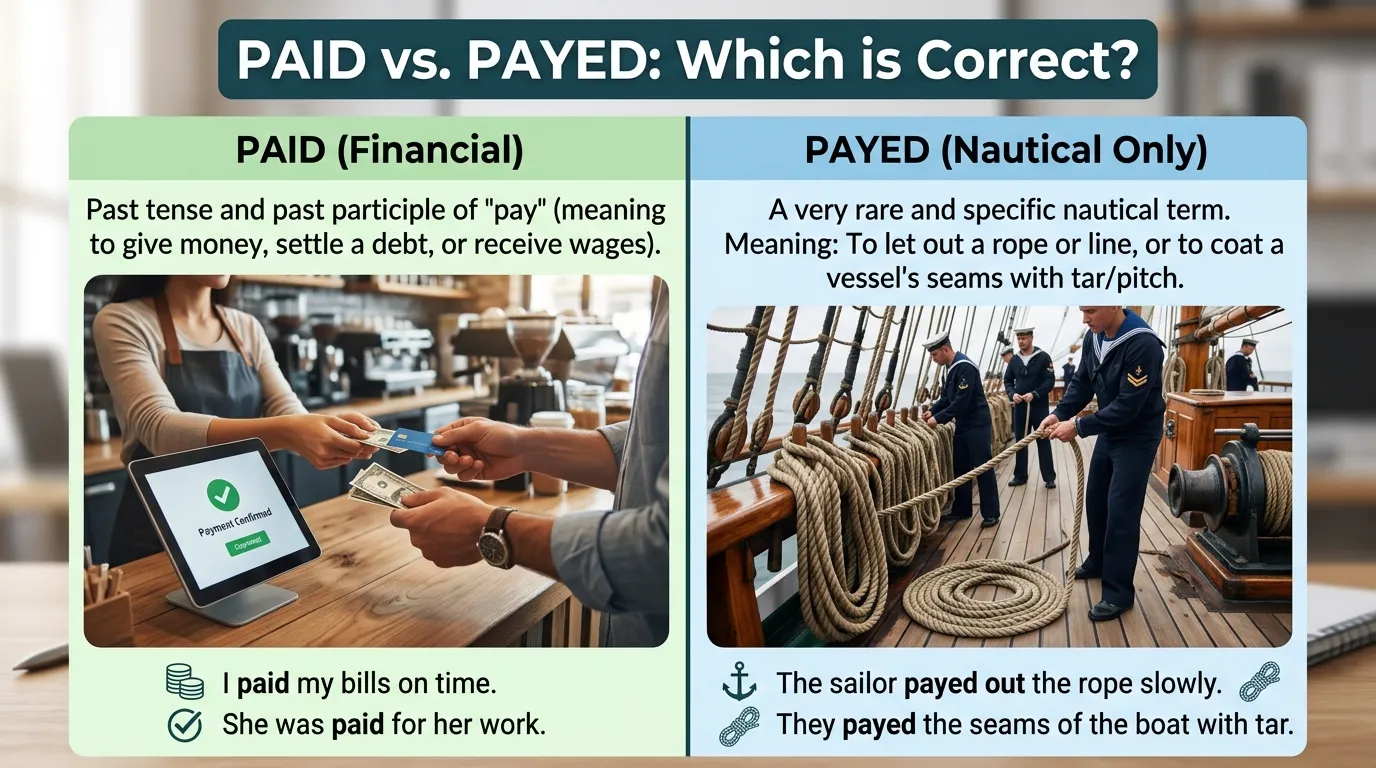
If you are unsure whether to write paid or payed, you are not alone. Both forms exist in English, but they are not interchangeable. In most everyday situations, the correct word is paid. It is the past tense and past participle of pay when you are talking about money, bills, wages, debts, prices, or similar transactions.
Payed is a much rarer word. It is mainly used in nautical language, where it can mean letting out or slackening a rope, cable, or chain. For example, a sailor might pay out a rope.
So, if you mean that someone gave money, use paid:
- I paid the bill.
- She paid for dinner.
- They paid their employees on Friday.
This guide explains paid vs payed, including their meanings, grammar, pronunciation, history, regional usage, common mistakes, collocations, and practical examples.
Quick Answer: Paid or Payed?
Paid is the correct past tense of pay when you mean giving money or settling a financial obligation.
Payed is a specialized word that is mainly associated with nautical terminology.
| Word | Correct? | Main meaning | Example |
|---|---|---|---|
| Paid | ✅ Yes | Gave money, settled a debt, compensated someone | I paid the bill. |
| Payed | ✅ Yes, but uncommon | Let out or slackened a rope, cable, or chain | The crew payed out the cable. |
The easiest rule
Money → paid.
Nautical rope/cable → payed.
If you are writing an email, essay, text message, business document, article, or social media post about money, paid is almost certainly the word you need.
Is Paid or Payed Correct?
Both paid and payed are legitimate English words, but they have different uses.
The confusion comes from the fact that pay looks like a regular verb. Many learners expect its past tense to follow a familiar pattern:
- play → played
- stay → stayed
- delay → delayed
- pay → payed
However, English has many irregular verbs, and pay is one of them in its most common sense.
When pay means to give money or settle an amount owed, its forms are:
- Present: pay
- Past: paid
- Past participle: paid
- -ing form: paying
For example:
I pay my rent every month.
I paid my rent yesterday.
I have paid my rent already.
You should not use payed for these meanings.
What Does Paid Mean?
Paid is the past tense and past participle of pay in its ordinary financial and figurative senses.
Dictionary-style definition of paid
Paid can mean:
- gave money in exchange for something
- settled an amount owed
- provided compensation
- gave someone wages or a salary
- suffered a cost or consequence
- provided something in exchange for a service or benefit
The word is used in many contexts.
Financial examples
- I paid the electricity bill.
- He paid $50 for the shirt.
- We paid the restaurant by credit card.
- She paid her loan early.
- The company paid its workers on time.
Compensation examples
- The contractor was paid after completing the work.
- She was paid a monthly salary.
- The athletes were paid to participate in the event.
Figurative examples
Paid does not always refer directly to money.
Consider:
He paid the price for his mistake.
Here, paid is part of a figurative expression. It means that he suffered consequences.
Another example is:
She paid attention during the lecture.
This does not mean she gave someone money. Pay attention is an established expression meaning to focus or listen carefully.
What Does Payed Mean?
Payed is a real word, but it has a much narrower use.
It traditionally appears in nautical terminology and relates to handling a rope, cable, chain, or similar line.
For example:
The sailors payed out the rope.
Here, payed out means that the sailors allowed the rope to run out or become longer.
The word is particularly associated with expressions such as:
- pay out a rope
- pay out a cable
- payed out the line
- payed out the anchor cable
Because this use is specialized, most people will rarely encounter payed in ordinary writing.
Why does this word exist?
English developed different forms of pay for different historical meanings. The financial verb developed the familiar irregular past form paid, while the nautical sense developed or retained the specialized form payed.
Therefore, seeing payed does not automatically mean that someone made a spelling mistake. Context matters.
Paid vs Payed: The Key Difference
The simplest distinction is based on meaning.
Use paid for money and ordinary figurative expressions
Use paid when someone:
- gives money
- receives wages
- settles a bill
- repays a debt
- pays a price
- pays attention
- pays respect
- pays a fee
- pays a fine
- pays a subscription
- pays for a service
Examples:
- We paid for the tickets.
- He paid the fine.
- She paid attention.
- The business paid its employees.
- They paid their respects.
Use payed for certain nautical actions
Use payed when referring to the specialized nautical sense of letting out a rope, cable, or line.
Example:
The crew payed out the anchor cable.
This is not the same as:
The crew paid for the anchor cable.
The first describes handling a cable. The second describes a financial transaction.
Paid vs Payed Comparison Table
| Feature | Paid | Payed |
|---|---|---|
| Base verb | Pay | Pay |
| Common past tense | Yes | No |
| Common past participle | Yes | No |
| Financial meaning | ✅ | ❌ |
| Paying a bill | ✅ | ❌ |
| Receiving wages | ✅ | ❌ |
| Paying attention | ✅ | ❌ |
| Paying a price | ✅ | ❌ |
| Nautical rope/cable meaning | Sometimes in broader historical usage, but payed is the specialized form | ✅ |
| Frequency | Very common | Rare |
| Everyday English | ✅ | Usually no |
| Business writing | ✅ | Rare/specialized |
| Academic writing | ✅ | Specialized nautical contexts |
| Casual writing | ✅ | Usually inappropriate unless discussing sailing |
Why Do People Confuse Paid and Payed?
There are several reasons for this common spelling confusion.
Pay looks like a regular verb
Many verbs ending in a vowel sound use -ed in the past:
- play → played
- stay → stayed
- obey → obeyed
That makes payed look reasonable.
But pay behaves differently in its common meaning:
pay → paid
English contains many irregular verbs:
- say → said
- lay → laid
- make → made
- buy → bought
- bring → brought
So memorizing the common form pay → paid is important.
Payed actually exists
The confusion becomes stronger because payed is not completely imaginary. It is a legitimate specialized form.
Someone may see payed in a nautical text and assume it is simply an alternative spelling of paid.
It is not.
The two forms developed distinct uses.
Paid as a Verb
Paid can function as the simple past tense of pay.
I paid yesterday.
It can also function as a past participle.
I have paid already.
The workers were paid on Friday.
Common verb patterns with paid
Paid + amount
She paid $100.
Paid + person
We paid the driver.
Paid + for + thing
He paid for the meal.
Paid + bill/debt/fee
They paid the bill.
Paid + attention/respect
Please pay attention.
They paid their respects.
Paid as an Adjective
Paid can also function as an adjective.
For example:
She is a paid employee.
The article is behind a paid subscription.
He works as a paid consultant.
The adjective generally indicates that money is involved as compensation or payment.
Paid vs unpaid
One common contrast is:
- paid work
- unpaid work
Examples:
She completed a three-month paid internship.
He volunteered for an unpaid position.
Payed in Nautical English
The most important use of payed is in nautical vocabulary.
The expression pay out means to let out a rope, cable, chain, or line.
Past tense:
The crew payed out the line.
Past participle:
The line had been payed out carefully.
You may see this form in writing about:
- ships
- sailing
- anchors
- ropes
- cables
- maritime operations
- naval history
- marine engineering
This specialized use explains why payed can appear in dictionaries even though most people should use paid in ordinary writing.
Pronunciation of Paid and Payed
Interestingly, paid and payed are normally pronounced the same way.
IPA pronunciation
Paid: /peɪd/
Payed: /peɪd/
Both rhyme with words such as:
- made
- trade
- shade
- grade
This creates another reason for confusion: you cannot normally hear the difference.
For example:
I paid the bill.
and
The sailors payed out the rope.
The pronunciation does not tell you which spelling to choose. Meaning and context do.
Paid vs Payed in American English
In American English, paid is overwhelmingly the normal form for financial meanings.
Use:
- paid taxes
- paid rent
- paid cash
- paid online
- paid employees
- paid a fee
- paid for lunch
- paid a debt
- paid attention
Payed is generally reserved for specialized nautical writing.
For everyday American English, choosing payed when you mean money will almost always be considered a spelling or grammar error.
American examples
Incorrect:
I payed my credit card bill.
Correct:
I paid my credit card bill.
Incorrect:
She payed $25 for the book.
Correct:
She paid $25 for the book.
Paid vs Payed in British English
British English follows essentially the same distinction.
For ordinary financial meanings:
I paid for the tickets.
For specialized nautical terminology:
The crew payed out the cable.
Therefore, this is not primarily an American-versus-British spelling difference.
Unlike pairs such as color/colour or center/centre, paid/payed does not represent a standard US/UK spelling distinction.
Is Payed Ever Correct in Everyday English?
Usually, no.
If you are writing about a normal payment, paid is the correct choice.
For example:
- paid rent
- paid tuition
- paid taxes
- paid a bill
- paid a fee
- paid for coffee
- paid someone
- paid attention
Using payed in these situations will make your writing look incorrect.
The exception is when the word has its specialized nautical meaning.
Common Expressions With Paid
Paid appears in many common English phrases.
Paid in full
Meaning: an amount has been completely paid.
Your balance has been paid in full.
Paid off
Meaning: a debt has been completely settled.
She finally paid off her student loan.
Paid for
Meaning: someone gave money for something.
I paid for the groceries.
Paid attention
Meaning: listened or focused carefully.
The students paid attention to the teacher.
Paid the price
Meaning: suffered consequences.
He paid the price for ignoring the warning.
Paid tribute
Meaning: showed respect or admiration.
The community paid tribute to the firefighters.
Paid respects
Meaning: showed respect, often toward someone who has died.
The family visited the memorial to pay their respects.
Paid leave
Meaning: time away from work during which an employee continues receiving pay.
Employees receive two weeks of paid leave.
Paid subscription
Meaning: a subscription that requires payment.
The app offers both a free plan and a paid subscription.
Common Collocations With Paid
A collocation is a group of words that naturally occur together.
Some common collocations with paid include:
- paid bill
- paid debt
- paid fee
- paid tax
- paid salary
- paid wages
- paid employee
- paid worker
- paid internship
- paid vacation
- paid leave
- paid advertisement
- paid promotion
- paid subscription
- paid service
- paid membership
- paid account
- paid position
- paid in advance
- paid in full
- paid on time
- paid cash
- paid online
- paid by card
Learning these combinations can help you use paid naturally.
Paid vs Payed in Business Writing
Business writing almost always requires paid when discussing financial transactions.
Examples:
The invoice was paid on time.
The customer paid the outstanding balance.
Employees are paid every two weeks.
The company paid its suppliers.
We have already paid the deposit.
More formal alternatives
Depending on context, you might also use:
- settled
- compensated
- reimbursed
- remitted
- transferred
- disbursed
For example:
The invoice was settled yesterday.
However, paid is usually clearer and more natural.
Paid vs Payed in Academic Writing
Academic writers should use paid when describing financial activity.
Participants were paid for their time.
The researchers paid a fee to access the database.
The organization paid the participants.
Payed should only appear when the subject requires the specialized nautical meaning.
Paid vs Payed in Journalism
News writing follows the same general rule.
Correct:
The company paid a $2 million fine.
Correct:
The athlete was paid for the appearance.
Incorrect in a financial context:
The company payed the fine.
Journalistic writing values familiar, precise language, so paid is the natural choice.
Paid vs Payed in Sports
Sports writing often uses paid in financial contexts.
The team paid the player a large salary.
The club paid a transfer fee.
The athlete was paid for the endorsement.
It can also appear in figurative expressions:
The team paid the price for its defensive mistakes.
Again, payed would not be appropriate in these contexts.
Paid vs Payed in Technical Writing
Technical writing requires attention to context.
If the topic involves:
- software subscriptions
- engineering services
- invoices
- licenses
- contracts
- wages
- fees
use paid.
If the technical document concerns maritime equipment and the handling of cables or lines, payed may be appropriate.
The subject matter determines the spelling.
Paid vs Payed in Blogging and Content Writing
For blogs, websites, product pages, and digital marketing content, paid is almost always the correct choice.
Examples:
- paid advertising
- paid traffic
- paid search
- paid membership
- paid newsletter
- paid course
- paid partnership
- paid promotion
- paid subscription
For example:
The brand invested in paid advertising to reach new customers.
Using payed advertising would be incorrect.
Paid vs Payed: Awkward and Natural Examples
Paying a bill
❌ Awkward:
I payed my phone bill yesterday.
✅ Natural:
I paid my phone bill yesterday.
Buying something
❌ Incorrect:
She payed $40 for the shoes.
✅ Correct:
She paid $40 for the shoes.
Salary
❌ Incorrect:
The company payed its employees.
✅ Correct:
The company paid its employees.
Attention
❌ Incorrect:
He didn’t payed attention.
✅ Correct:
He didn’t pay attention.
Notice something important here: after didn’t, use the base form pay, not paid.
Present perfect
❌ Incorrect:
I have payed the bill.
✅ Correct:
I have paid the bill.
Nautical context
✅ Correct:
The sailors payed out the cable.
Here, payed is appropriate because the sentence uses the specialized nautical sense.
Common Grammar Mistakes With Paid
Mistake: Using payed for money
❌ I payed the rent.
✅ I paid the rent.
Mistake: Using paid after did
❌ Did you paid the bill?
✅ Did you pay the bill?
The auxiliary did already marks the past tense.
Mistake: Using paid after will
❌ I will paid tomorrow.
✅ I will pay tomorrow.
After will, use the base verb.
Mistake: Using payed after have
❌ I have payed the fee.
✅ I have paid the fee.
Mistake: Confusing paid with payed in fixed phrases
❌ She payed attention.
✅ She paid attention.
Paid, Pay, and Paying: How Are They Different?
These three forms have different grammatical roles.
| Form | Function | Example |
|---|---|---|
| Pay | Present/base form | I pay the bill. |
| Paid | Past tense/past participle | I paid the bill. |
| Paying | Present participle/gerund | I am paying the bill. |
Examples:
I pay my rent every month.
I paid my rent yesterday.
I am paying my rent now.
I have paid my rent already.
The form payed does not belong in this ordinary sequence.
Word History and Etymology of Pay
The verb pay has a long history in English and is related to words that developed through French and Latin.
It ultimately traces back to Latin pacare, meaning to pacify or satisfy, through Old French forms associated with payment and settling an obligation.
The financial meaning developed around the idea of satisfying a debt or obligation.
Over time, pay developed many related meanings, including:
- give money
- settle a debt
- provide compensation
- suffer a consequence
- give attention
- show respect
The irregular form paid became established as the ordinary past form.
The specialized form payed survives particularly in nautical usage.
This is a good example of how English can preserve different forms of a word because of different historical meanings.
Synonyms for Paid
Depending on context, synonyms for paid include:
Financial synonyms
- settled
- compensated
- reimbursed
- funded
- financed
- remitted
- transferred
- covered
However, these words are not always exact replacements.
For example:
I paid the bill.
is simple and natural.
I remitted the bill.
sounds much more formal and may not mean exactly the same thing in every context.
Figurative alternatives
For paid the price, alternatives include:
- suffered consequences
- faced the consequences
- bore the cost
- endured the result
Antonyms of Paid
Possible opposites depend on context.
For financial payment:
- unpaid
- owing
- outstanding
- overdue
- unsettled
Examples:
The invoice remains unpaid.
The account is still outstanding.
The bill is overdue.
These words describe a payment that has not yet been completed.
Memory Trick for Paid vs Payed
Use this simple trick:
Paid = Payment
Both paid and payment begin with pai.
Think:
Money → PAID → PAYMENT
If you are talking about cash, a bill, a salary, a debt, a fee, or a purchase, choose paid.
For the rare nautical meaning, remember:
Payed → rope or cable
So:
Paid = money
Payed = nautical line
This is not a perfect etymological rule, but it is an excellent practical memory aid.
How to Choose the Correct Word
When you encounter a sentence containing paid/payed, ask one question:
Is money involved?
If yes, choose paid.
She paid for the meal.
If the sentence describes letting out a rope, cable, or similar nautical line, payed may be correct.
The sailors payed out the cable.
If neither meaning applies, paid is almost certainly the form you want in ordinary English.
Paid vs Payed: Real-World Examples
Everyday conversation
I already paid.
Who paid for dinner?
She paid with her phone.
Workplace
The company paid my salary yesterday.
Have you paid the invoice?
The contractor has been paid.
School
We paid the registration fee.
My parents paid my tuition.
Online shopping
I paid for the order online.
The payment has already been paid.
A more natural version of the last sentence would often be:
The order has already been paid for.
Digital services
I paid for the premium plan.
She has a paid subscription.
Maritime context
The crew payed out the anchor cable.
This is the specialized situation where payed makes sense.
Formal vs Informal Usage
Paid works across nearly every level of English.
Casual
I paid already.
Neutral
I paid the bill yesterday.
Formal
The outstanding balance has been paid in full.
The word remains the same. The surrounding vocabulary changes depending on the level of formality.
Payed, by contrast, is specialized rather than simply formal.
It would be incorrect to think:
paid = casual
payed = formal
That is not how the distinction works.
Is Paid More Common Than Payed?
Yes, by a very large margin.
Paid is a common everyday English word. You will see it in conversations, books, newspapers, contracts, websites, emails, financial documents, and advertisements.
Payed is comparatively rare and usually appears in specialized maritime contexts.
This frequency difference is useful when editing your writing. If you have written payed and you are not discussing a nautical rope or cable, check the sentence carefully. You probably need paid.
Do Paid and Payed Mean the Same Thing?
No.
They can both be connected historically to the verb pay, but their modern uses differ.
Paid generally means:
gave money, settled an obligation, compensated someone, or experienced a figurative cost.
Payed generally means:
let out or slackened a rope, cable, or line in nautical terminology.
They are therefore homophones in common pronunciation but not interchangeable spellings.
Paid vs Payed vs Payed Out
The phrase payed out deserves special attention.
In nautical English:
The crew payed out the rope.
This means the crew allowed the rope to run out or gave it more slack.
Compare:
The company paid out $10,000 in bonuses.
Here, paid out refers to distributing money.
The spelling changes because the meanings differ:
- paid out → money distributed
- payed out → rope, cable, or line released/slackened in nautical use
This is one of the clearest examples of why context matters.
A Practical Editing Checklist
Before publishing an article, email, essay, report, or business document, check your use of paid and payed.
Ask:
- Am I talking about money?
- Am I talking about a bill or debt?
- Am I talking about wages or salary?
- Am I talking about a fee or price?
- Am I using an expression such as pay attention?
- Am I describing compensation?
- Am I discussing a figurative cost or consequence?
If the answer is yes, use paid.
Only consider payed if the context specifically involves the nautical handling of a rope, cable, chain, or line.
Paid vs Payed: At-a-Glance Guide
| If you mean… | Use |
|---|---|
| Gave someone money | paid |
| Settled a bill | paid |
| Paid a debt | paid |
| Received wages | paid |
| Paid a fee | paid |
| Bought something | paid |
| Paid attention | paid |
| Paid respect | paid |
| Suffered consequences | paid |
| Paid a price | paid |
| Released a nautical rope/cable | payed |
| Let out a nautical line | payed |
Frequently Asked Questions
Is paid or payed correct?
Paid is correct for the ordinary past tense and past participle of pay, especially when discussing money. Payed is a specialized form mainly used in nautical contexts involving ropes, cables, or lines.
Is it paid or payed for something?
The correct expression is paid for something.
She paid for the meal.
Not:
She payed for the meal.
Is it paid or payed a bill?
The correct phrase is paid a bill.
I paid the bill yesterday.
Is payed a real word?
Yes. Payed is a real English word, but it is uncommon. It is primarily used in specialized nautical contexts, especially when describing letting out a rope, cable, or line.
Why is paid not payed?
Because pay has an irregular past form in its common financial sense. The standard forms are pay, paid, paid. English does not always form past tense by simply adding -ed.
Do paid and payed sound the same?
Yes. In standard pronunciation, both are generally pronounced /peɪd/. The difference is visible in spelling and meaning rather than pronunciation.
Is it paid attention or payed attention?
It is paid attention.
The students paid attention during the lesson.
Payed attention is incorrect.
Is it paid off or payed off?
For money or debt, the correct expression is paid off.
She paid off her credit card.
Is paid or payed used in British English?
British English normally uses paid for ordinary financial meanings as well. Payed remains a specialized nautical form, so this is not a normal US-versus-UK spelling difference.
How can I remember paid vs payed?
Remember: money = paid. If you are talking about a bill, salary, fee, purchase, debt, or price, use paid. Think of payed as the rare nautical form connected with letting out a rope or cable.
Conclusion
The difference between paid and payed is simple once you focus on meaning.
Use paid for almost every ordinary situation involving the verb pay:
- paid a bill
- paid for dinner
- paid employees
- paid a fee
- paid a debt
- paid attention
- paid the price
Use payed only in specialized nautical contexts, especially when describing the act of letting out or slackening a rope, cable, or line.
Although the two words are pronounced the same, they are not interchangeable. For everyday American English, business writing, academic work, journalism, blogging, texting, and most professional communication, paid is the form you should choose.
The easiest rule to remember is:
If money is involved, use PAID. If a nautical rope or cable is being let out, PAYED may be correct.
Once you learn that distinction, you can confidently choose the right spelling whenever paid vs payed comes up.