If you have ever written “Whoa!” and wondered whether it should actually be “Woah!”, you are not alone. Both spellings appear frequently in texts, social media posts, books, movies, song titles, and everyday conversations.
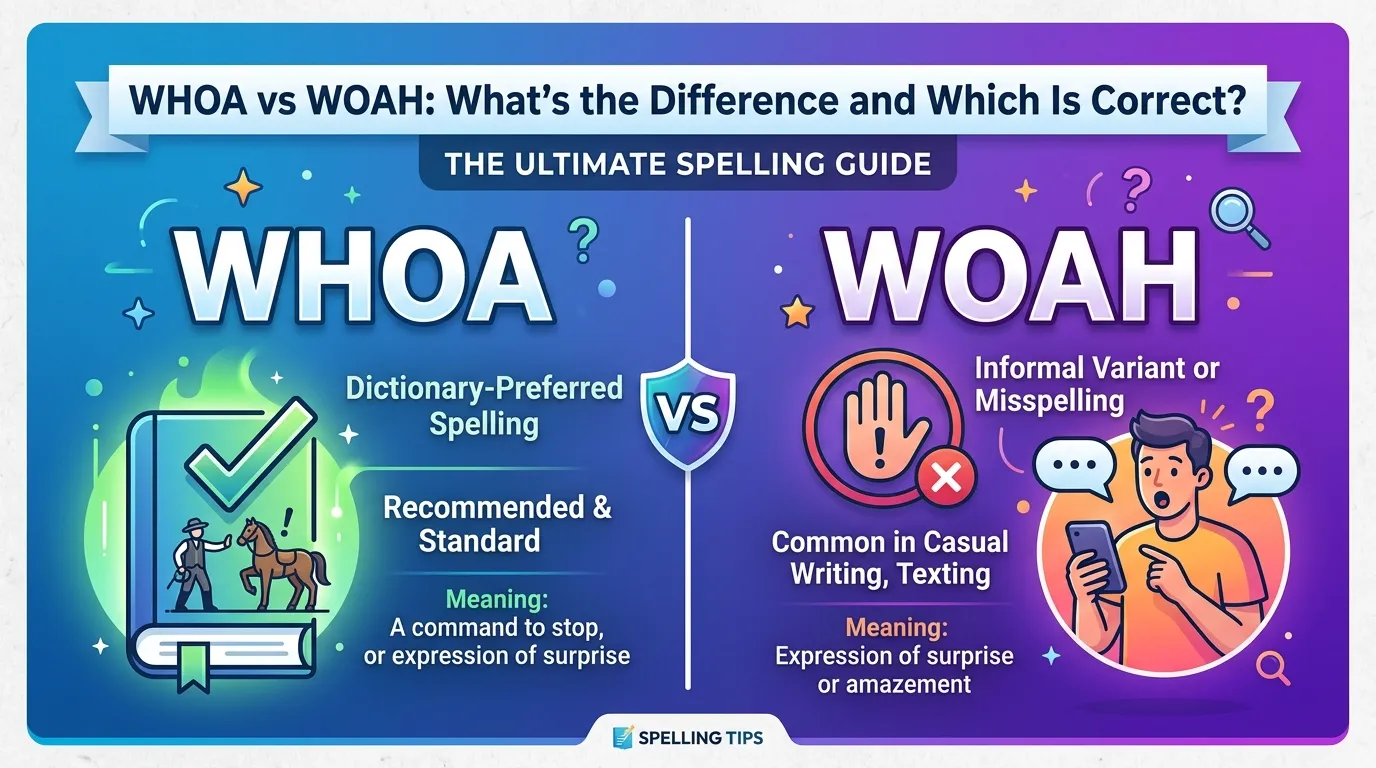
The good news is that whoa and woah are generally used to express the same reaction. They can show surprise, excitement, disbelief, amazement, or a request to slow down or stop. However, there is an important difference in standard usage and spelling preference.
In American English, whoa is the traditional and generally preferred spelling, especially in edited or formal writing. Woah is a common modern variant that readers understand immediately, particularly in informal digital communication.
This guide explains whoa vs woah in detail, including their meanings, pronunciation, history, grammatical role, tone, regional usage, examples, common mistakes, and the best spelling to choose in different situations.
Quick Answer: Whoa vs Woah
Whoa and woah usually mean the same thing. Both are interjections used to express a strong reaction or to tell someone to slow down or stop.
| Word | Meaning | Standard preference | Common use |
|---|---|---|---|
| Whoa | Surprise, amazement, or a command to slow down | Preferred | American English, edited writing |
| Woah | Same basic meaning as “whoa” | Common variant | Informal writing, texting, social media |
Which spelling should you use?
If you want the safest spelling, use whoa.
For example:
Whoa, that was amazing!
Whoa, slow down!
Whoa, I didn’t expect that.
Woah is not usually misunderstood or treated as a completely different word. It is widely recognized as a variant spelling, but whoa remains the better choice when you want conventional or standard English.
What Does “Whoa” Mean?
Whoa is an interjection used to express a sudden or strong reaction.
It can communicate:
- Surprise
- Shock
- Amazement
- Excitement
- Disbelief
- Concern
- Admiration
- A request to stop
- A request to slow down
The exact meaning depends on the context and tone.
Example of surprise
Whoa! You actually won the competition?
Here, whoa expresses surprise.
Example of amazement
Whoa, this view is incredible!
Here, it shows admiration or amazement.
Example of stopping someone
Whoa, hold on. That’s not what I said.
Here, the speaker is asking someone to stop or pause.
Example of slowing down
Whoa, you’re driving too fast!
In this sentence, whoa communicates concern and functions almost like a command to slow down.
What Does “Woah” Mean?
Woah generally carries the same meaning as whoa.
It can express surprise, excitement, disbelief, amazement, or a request to pause.
For example:
Woah, that’s a huge house!
Woah! What just happened?
Woah, wait a minute.
The main distinction is not meaning. It is spelling and usage preference.
In contemporary informal communication, people often type woah because it reflects the way the word sounds to them.
Whoa vs Woah: The Main Difference
The simplest way to understand whoa vs woah is this:
Whoa is the traditional and more widely preferred spelling, while woah is a common alternative spelling.
There is generally no major difference in pronunciation or basic meaning.
Consider:
Whoa, that was close!
and
Woah, that was close!
Most readers interpret both sentences in exactly the same way.
The important distinction
The difference becomes more noticeable when you consider writing context.
Whoa works well in:
- Edited articles
- Books
- Journalism
- Professional writing
- Academic discussion of language
- Standard American English
- Formal proofreading
Woah is especially common in:
- Text messages
- Social media
- Online comments
- Casual conversations
- Informal blogs
- Fan communities
- Internet culture
This does not mean that woah is always wrong. It simply means that whoa is usually the safer standard choice.
Is “Whoa” Correct?
Yes. Whoa is a correct English word.
It has a long history of use and is recognized in dictionaries as an interjection.
It can express an emotional reaction:
Whoa! That’s unbelievable.
It can also be used as a command:
Whoa, boy!
Historically, the word was strongly associated with telling a horse to stop or slow down. That sense still exists, although modern speakers frequently use whoa figuratively.
For example:
Whoa, let’s slow down and think about this.
The speaker is not talking to a horse. Instead, the word is being used metaphorically to tell someone to pause.
Is “Woah” Correct?
Woah is widely recognized as a spelling variant of whoa, particularly in informal modern English.
However, if your goal is to follow conventional American English spelling, whoa is usually the better choice.
This distinction is similar to many cases where an alternative spelling becomes popular through speech, music, entertainment, or online communication.
A person writing:
Woah, that’s confused!
will almost certainly be understood.
But a professional editor might change it to:
Whoa, that’s confused!
The change does not alter the meaning. It simply follows the more established spelling.
Why Do People Confuse Whoa and Woah?
The confusion largely comes from pronunciation.
When people say the word aloud, the pronunciation does not clearly reveal whether the spelling should begin with wh or w and whether the vowel sequence should be oa or oa after the initial consonant.
Both forms visually represent approximately the same spoken expression.
There is also a strong influence from informal communication.
People often spell interjections according to how they think they sound:
- Whoa
- Woah
- Wow
- Whoah
Of these, whoa is the conventional spelling for the interjection in question.
Digital communication makes the confusion stronger
Social media and texting encourage creative spelling.
People may write:
Woooah!
Woahhh!
Whoa!!!
These versions communicate emotion rather than following strict spelling conventions.
The extra letters are usually intentional. They stretch the word to show a stronger reaction.
Whoa vs Woah Pronunciation
In ordinary American English, whoa and woah are generally pronounced the same way.
A common pronunciation is approximately:
/woʊ/
It sounds similar to the beginning of the word “woe”, although the exact pronunciation can vary slightly depending on accent and context.
Does the spelling change the pronunciation?
Usually, no.
For most speakers:
Whoa = woah
The spelling does not normally signal a meaningful difference in pronunciation.
Is Whoa an Interjection?
Yes. Whoa is primarily an interjection.
An interjection is a word or expression that communicates a sudden emotion, reaction, or response.
Other common English interjections include:
- Wow!
- Oh!
- Hey!
- Ouch!
- Yikes!
- Oops!
- Ah!
- Huh?
Like these words, whoa can stand alone.
Whoa!
It can also appear inside a larger sentence.
Whoa, that’s a lot of money.
Whoa, I need a second to process that.
Can “Whoa” Be a Command?
Yes.
One of the oldest and most recognizable uses of whoa is as a command to a horse to stop or slow down.
For example:
Whoa, boy!
The same idea can be applied figuratively to people or situations.
Whoa, let’s not make a decision yet.
Whoa, slow down. You’re getting ahead of yourself.
Whoa, back up. What happened?
In these examples, whoa means something like:
- Stop.
- Slow down.
- Wait.
- Hold on.
- Pause.
Whoa as an Expression of Surprise
This is one of the most common modern uses.
Whoa, you bought a new car?
Whoa! I didn’t see that coming.
Whoa, that’s a massive improvement.
The word signals that something has caught the speaker’s attention.
The emotion can be positive, negative, or neutral.
Positive surprise
Whoa, this cake is incredible!
Negative surprise
Whoa, that’s a lot of damage.
Neutral surprise
Whoa, I didn’t know you lived here.
Whoa as an Expression of Amazement
Whoa can also mean something like “That is impressive!”
For example:
Whoa, look at that sunset.
Whoa, your drawing is amazing.
Whoa, you finished all of that already?
In these cases, the word communicates admiration or amazement.
It is often stronger than simply saying “Oh.”
Whoa as a Way to Express Disbelief
People frequently use whoa when something seems difficult to believe.
Whoa, you’re telling me he did all of that himself?
Whoa. Seriously?
Whoa, I can’t believe that happened.
Depending on tone, it can express skepticism, shock, or excitement.
Whoa vs Wow
Whoa and wow are closely related, but they are not always interchangeable.
Wow
Wow generally emphasizes admiration, surprise, or amazement.
Wow, that’s beautiful.
Whoa
Whoa can express surprise and amazement, but it also has a stronger sense of stopping, slowing down, or pausing.
Whoa, slow down.
You would not normally replace this with:
Wow, slow down.
The second sentence sounds different and does not naturally communicate the same command.
Comparison
| Expression | Main function |
|---|---|
| Wow | Amazement or admiration |
| Whoa | Surprise, amazement, pause, or stop |
| Woah | Informal variant of whoa |
Whoa vs Oh
These words can both signal a reaction, but their emotional force differs.
Oh, I understand.
This often communicates realization.
Whoa, I didn’t expect that.
This suggests a stronger reaction.
Oh can be mild and conversational.
Whoa often feels more energetic or dramatic.
Whoa vs Wow vs Woah
Here is a quick comparison:
| Word | Meaning | Standard? | Typical tone |
|---|---|---|---|
| Whoa | Surprise, amazement, stop, slow down | Yes | Informal to conversational |
| Woah | Same basic meaning as whoa | Common variant | Very informal |
| Wow | Surprise, admiration, amazement | Yes | Informal to conversational |
Examples
Whoa:
Whoa, that’s fast!
Woah:
Woah, that’s fast!
Wow:
Wow, that’s fast!
All three can express surprise, but whoa has an additional “slow down/stop” sense.
Is “Whoah” Correct?
You may occasionally see:
Whoah!
This spelling appears in informal writing, but it is generally considered a less standard variant.
If you are deciding between:
- Whoa
- Woah
- Whoah
the safest choice is:
Whoa
For polished writing, stick with the conventional form.
Whoa vs Woah in American English
In American English, whoa is the spelling you should normally choose in edited writing.
For example:
Whoa, that was unexpected.
This looks natural in American English.
Woah is also familiar to American readers, especially online, but it tends to feel more casual.
Recommended American English usage
Use whoa for:
- Websites
- Articles
- News writing
- Business blogs
- Educational content
- Professional communication
- Edited publications
Use woah when:
- Reproducing someone’s informal wording
- Writing casual dialogue
- Creating social media content
- Deliberately using internet-style language
Whoa vs Woah in British English
British English speakers also recognize whoa and woah.
Usage can vary by individual, publication, age group, and context.
The important point is that neither spelling represents a completely different concept.
If you are writing for an international audience and want maximum consistency, whoa is the safest option.
Whoa vs Woah in Formal Writing
Interjections are naturally more common in informal writing.
In a formal report, instead of:
Whoa, this result is surprising.
you might write:
This result is unexpected.
Or:
The result is considerably higher than anticipated.
Formal alternatives to whoa
Depending on the context, you could use:
- Remarkably
- Surprisingly
- Unexpectedly
- Interestingly
- Significantly
- This is surprising
- This is unexpected
Whoa is not necessarily grammatically incorrect in formal writing, but it can sound too conversational.
Whoa vs Woah in Text Messages
Both forms are perfectly understandable in casual texting.
Someone might write:
Whoa 😳
or:
Woah 😳
The choice is often personal.
Texting also allows exaggerated spellings:
Whoa!!!
Woahhhh!
Woooah!
These spellings add emotional intensity.
For a casual text, there is usually little practical difference between whoa and woah.
Whoa vs Woah on Social Media
Social media strongly favors expressive language.
You may see:
WOAH 😱
WHOA!
woahhh
whoaaa
Capitalization and repeated letters are often used to increase emotional impact.
For example:
WHOA. That ending.
feels much more dramatic than:
Whoa, that ending.
The spelling is therefore partly about tone and style rather than dictionary meaning.
Whoa vs Woah in Dialogue
Writers often use whoa in dialogue to make speech sound natural.
“Whoa, wait a second,” Maya said.
“Whoa! You scared me.”
“Whoa, that’s not what I meant.”
Woah can also be used when a writer wants to preserve a character’s informal or distinctive voice.
However, consistency matters.
If one character uses whoa throughout a novel, suddenly changing to woah without a stylistic reason can look like an editing mistake.
Whoa vs Woah in Journalism
Journalistic writing generally favors conventional spelling and controlled tone.
Instead of:
Woah! Local team wins championship
a professional news headline might simply say:
Local Team Wins Championship in Stunning Finish
However, whoa can appear in quotations or deliberately conversational headlines.
For example:
The player said, “Whoa, I can’t believe we won.”
In that situation, the spelling represents the speaker’s actual wording or the publication’s chosen style.
Whoa vs Woah in Academic Writing
Academic writing normally avoids conversational interjections.
Instead of:
Whoa, the findings are surprising.
write:
The findings are surprising.
or:
The findings are particularly noteworthy.
If you are studying language, however, whoa itself can absolutely be discussed in academic writing.
Whoa vs Woah in Business Writing
Professional communication usually benefits from a neutral tone.
Instead of:
Whoa, that’s a huge increase!
consider:
That’s a substantial increase.
Or:
The increase is significant.
However, in a casual team chat, whoa may sound perfectly natural:
Whoa, we hit our target already!
The correct choice depends on the relationship between the writers and readers.
Whoa vs Woah in Sports
Sports commentary and fan communication often use expressive language.
Examples include:
Whoa! What a finish!
Whoa, what a catch!
Woah, that was close!
Both forms work in casual sports discussion.
In polished sports journalism, whoa is generally the better spelling if the interjection is retained.
Literal and Figurative Uses of Whoa
The word has both a literal and figurative use.
Literal
A rider tells a horse to stop:
Whoa!
Figurative
A person asks someone to slow down:
Whoa, let’s think about this first.
The figurative meaning developed naturally from the original command.
Today, the emotional reaction is so common that many speakers may use whoa without thinking about its connection to horses.
The History of “Whoa”
The word whoa has a long history in English.
It became associated with controlling horses and telling them to stop or slow down. Over time, that physical command developed broader conversational meanings.
People began using the word metaphorically to communicate:
- Stop
- Wait
- Slow down
- Hold on
- That’s surprising
- That’s impressive
Modern English therefore uses whoa in ways that go far beyond its original equestrian context.
How “Whoa” Became an Emotional Expression
Imagine someone suddenly seeing something unexpected.
Instead of immediately forming a complete sentence, they might react:
Whoa!
That short reaction communicates emotion before explanation.
This is one reason interjections are so useful in spoken language. They allow speakers to express an immediate response without constructing a full grammatical sentence.
For example:
Whoa! That’s enormous.
The first word communicates the initial emotional reaction. The second sentence explains it.
Common Collocations With Whoa
Because whoa is an interjection, it does not behave like a typical noun or verb. Still, certain phrases frequently appear with it.
Common expressions
- Whoa, wait
- Whoa, hold on
- Whoa, slow down
- Whoa there
- Whoa, seriously?
- Whoa, what?
- Whoa, that’s confused
- Whoa, no way
- Whoa, look at that
- Whoa, I didn’t expect that
Examples
Whoa, hold on. Let’s check the facts first.
Whoa there, you’re moving too quickly.
Whoa, no way! You met her?
“Whoa There” Meaning
Whoa there is a common expression used to tell someone to slow down, stop, or reconsider what they are doing.
For example:
Whoa there, let’s not jump to conclusions.
It can be serious or playful.
Serious
Whoa there. You’re getting angry.
Playful
Whoa there, cowboy!
The second example humorously compares someone to a rider moving too quickly.
“Whoa, Hold On” Meaning
Whoa, hold on means something like:
Wait a moment.
or:
Stop for a second.
Example:
Whoa, hold on. I never agreed to that.
This expression is particularly useful when someone has misunderstood something or moved too quickly.
“Whoa, Slow Down” Meaning
This is one of the clearest figurative uses.
Whoa, slow down. We haven’t made a decision yet.
The speaker wants the other person to pause.
It can refer to physical speed:
Whoa, slow down! You’re driving too fast.
Or mental/social speed:
Whoa, slow down. You’re already planning the wedding?
Common Mistakes With Whoa and Woah
Mistake 1: Assuming They Have Different Meanings
Incorrect assumption:
Whoa means surprise, while woah means excitement.
There is no reliable standard distinction like this.
Both spellings can express surprise, excitement, amazement, or disbelief.
Better understanding
Treat woah as a common variant spelling of whoa.
Mistake 2: Using “Woah” in Every Professional Context
While woah is widely understood, whoa is generally the safer spelling in polished English.
Less conventional
Woah, the results are remarkable.
Better for edited writing
Whoa, the results are remarkable.
Or, even more formally:
The results are remarkable.
Mistake 3: Writing “Whoah”
Whoah is a less standard spelling.
If you are unsure, choose:
Whoa
Mistake 4: Confusing Whoa With Wow
Although they overlap, they are not identical.
Wow mainly expresses amazement or admiration.
Whoa can additionally tell someone to stop or slow down.
Whoa, stop!
is natural.
Wow, stop!
does not normally have the same meaning.
Awkward vs Natural Examples
| Awkward | More natural |
|---|---|
| Woah, please reduce your speed. | Whoa, slow down. |
| Whoah! That was amazing. | Whoa! That was amazing. |
| Wow, stop moving so fast! | Whoa, slow down! |
| Woah, please wait for a moment. | Whoa, hold on. |
| Whoa means something completely different from woah. | Woah is a common variant of whoa. |
Remember that woah itself is not necessarily incomprehensible or unusable. The issue is mainly one of conventional spelling and context.
How to Choose Between Whoa and Woah
Use this simple rule:
Choose “whoa” when:
- You are writing an article.
- You are writing professionally.
- You want standard American English.
- You are writing for an educational audience.
- You are proofreading content.
- You want the safest conventional spelling.
Choose “woah” when:
- You are texting casually.
- You are writing informal social media content.
- You are reproducing someone’s exact wording.
- You want a deliberately informal internet style.
- Your audience commonly uses that spelling.
A Simple Memory Trick for Whoa
Remember:
WHOA = the standard “Whoa!”
Think of whoa as the version you would most likely want an editor to leave in a polished article.
You can also associate it with the traditional command to a horse:
WHOA, stop!
If you are ever uncertain, choose whoa.
Whoa vs Woah: At-a-Glance Comparison
| Feature | Whoa | Woah |
|---|---|---|
| Basic meaning | Surprise, amazement, stop | Same |
| Pronunciation | Usually /woʊ/ | Usually /woʊ/ |
| Part of speech | Interjection | Interjection/variant spelling |
| Standard spelling | Preferred | Common variant |
| American English | Very common | Common, especially informal |
| British English | Recognized | Recognized |
| Formal writing | Better choice | Usually avoid |
| Texting | Natural | Very natural |
| Social media | Natural | Very common |
| Dialogue | Natural | Possible |
| Horse command | Yes | Rare/variant |
| Figurative “stop” | Yes | Yes |
| Surprise | Yes | Yes |
| Amazement | Yes | Yes |
What Should SEO Writers Use: Whoa or Woah?
For SEO content, whoa is usually the better primary spelling when writing standard American English.
However, if users commonly search for both spellings, an article can naturally mention both.
For example, a heading such as:
Whoa vs Woah: Which Spelling Is Correct?
can satisfy readers searching for either variation.
You can also naturally include related phrases such as:
- whoa meaning
- woah meaning
- whoa vs woah difference
- is woah a word
- is whoa correct
- whoa definition
- woah definition
- how to spell whoa
- how do you spell woah
- whoa meaning in text
- woah meaning in texting
- whoa pronunciation
- whoa spelling
- correct spelling of whoa
The key is to use these terms naturally rather than repeating them excessively.
Which One Should You Use in Everyday Writing?
For most situations, simply choose:
Whoa
It is familiar, conventional, and widely accepted.
For example:
Whoa, that’s incredible!
Whoa, wait a minute.
Whoa, I wasn’t expecting that.
If you type woah in a text message, nobody is likely to misunderstand you.
So the practical distinction is:
Whoa = safest standard choice.
Woah = common informal variant.
Frequently Asked Questions
Is “whoa” or “woah” correct?
Whoa is the traditional and generally preferred spelling. Woah is a common variant spelling that is widely understood, especially in informal communication.
Is “woah” a real word?
Yes. Woah is widely used as a variant spelling of whoa. It is especially common in casual digital communication, although whoa is generally preferred in standard edited writing.
Do whoa and woah mean the same thing?
Yes, in normal usage they have essentially the same meaning. Both can express surprise, amazement, excitement, disbelief, or a request to stop or slow down.
How do you spell whoa correctly?
The conventional spelling is whoa: W-H-O-A.
Is whoa formal or informal?
Whoa is an informal interjection. Although the spelling itself is standard, the word expresses conversational emotion, so formal writing often uses a more neutral phrase instead.
Is woah better than whoa?
Usually, no. If you want the conventional spelling, whoa is the safer choice. Woah is perfectly understandable and common in informal writing.
Why do people spell whoa as woah?
The spelling woah likely feels natural to many people because it closely reflects how the word sounds. Internet communication, music, entertainment, and informal writing have also helped make the variant widely visible.
Can whoa mean “stop”?
Yes. Whoa can literally be used as a command to a horse to stop or slow down. In modern speech, it can also figuratively mean stop, wait, or slow down.
Can I use whoa in professional writing?
You can, but it depends on the context. In a formal report or business document, a neutral expression such as “This is surprising” may be more appropriate. In casual professional communication, whoa can be perfectly natural.
Which spelling is best for American English?
For standard American English, whoa is the best default choice. Use woah when you intentionally want a casual or informal spelling.
Conclusion
The difference between whoa vs woah is much simpler than it first appears.
Both spellings are used to express surprise, amazement, excitement, disbelief, or a request to stop or slow down. They are normally pronounced the same and understood in the same way.
The main difference is spelling preference and context.
Whoa is the conventional spelling and the best default choice for American English, edited content, professional writing, educational material, and SEO articles.
Woah is a widely recognized variant. It appears frequently in texts, social media, online conversations, entertainment, and other informal settings.
If you are unsure which one to use, remember one simple rule:
When in doubt, choose “whoa.”
Use woah when the casual style is intentional. Most importantly, stay consistent with your chosen spelling within the same piece of writing.
So, whoa and woah are not two words with completely different meanings. They are two spellings of the same expressive interjection, with “whoa” being the safer standard choice.