Have you ever written anyway and wondered whether anyways would sound better? You are not alone. These two forms look almost identical, and both appear frequently in everyday conversations, texts, social media posts, and informal speech. However, they do not have exactly the same status or usage.
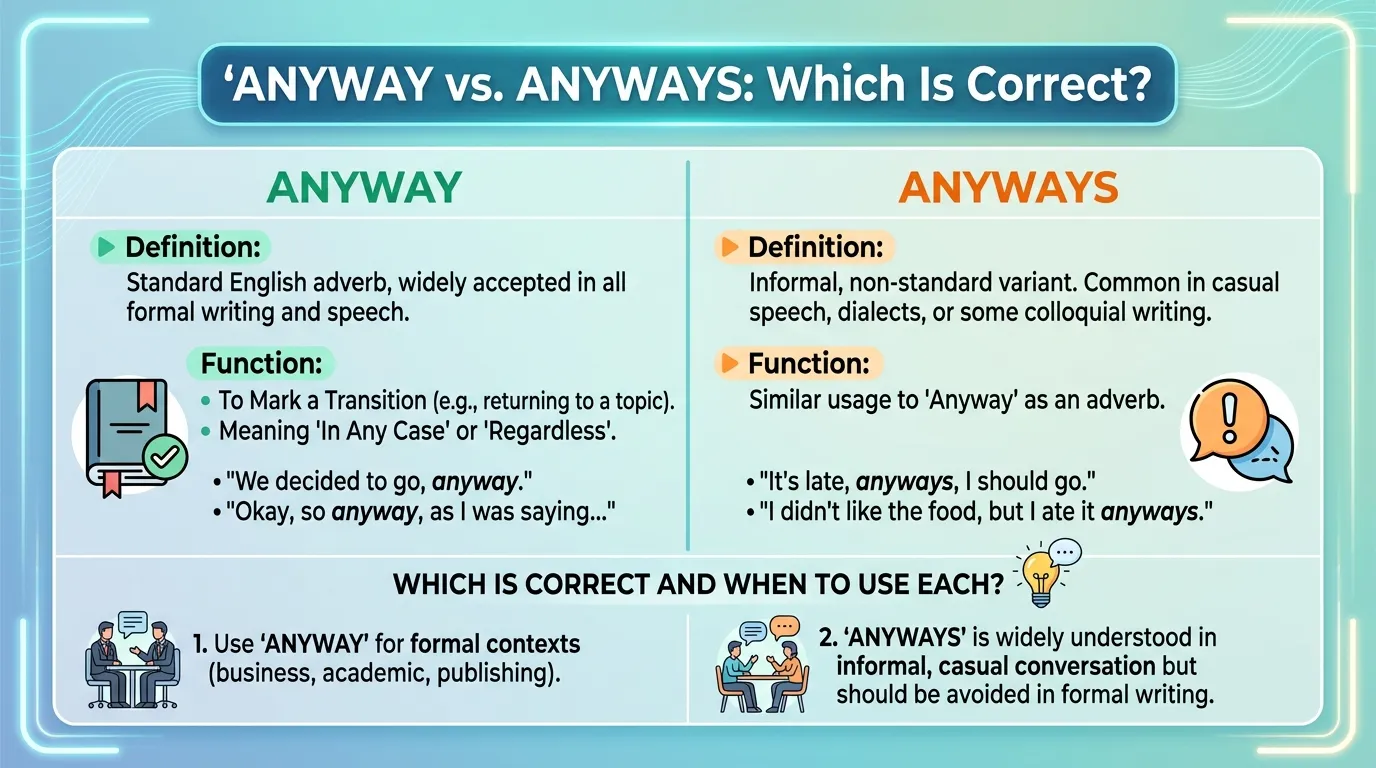
The short answer is simple: anyway is the standard form, while anyways is generally considered informal and nonstandard in edited English, especially in American English. You will hear anyways often in casual conversation, but anyway is the safer choice for school, work, professional writing, academic papers, journalism, and formal communication.
This guide explains the difference between anyway vs anyways, including their meanings, grammar, pronunciation, history, tone, regional use, common expressions, and practical examples. By the end, you will know exactly when to use anyway, when anyways may appear naturally, and which form is best for your writing.
Quick Answer: Anyway vs Anyways
Anyway is the standard English word. It can mean regardless, in any case, nevertheless, or to return to a previous subject.
Anyways is an informal variant of anyway. It is common in casual speech, texting, and some regional varieties of English, but it is usually avoided in formal or edited writing.
| Word | Standard? | Common Use | Formal Writing |
|---|---|---|---|
| anyway | Yes | Spoken and written English | Recommended |
| anyways | Informal/nonstandard in edited English | Casual speech, texting | Usually avoid |
The safest rule
If you are unsure, choose anyway.
- Anyway, let’s get started. ✓
- I didn’t want to go anyway. ✓
- Anyway, what were you saying? ✓
- Anyways, let’s get started. Informal
- I didn’t want to go anyways. Informal
The difference is usually not about meaning. It is primarily about standardness, register, and style.
What Does Anyway Mean?
Anyway is an adverb with several closely related uses.
The word can indicate that something is true despite another fact, that something happens regardless of circumstances, or that a speaker wants to move a conversation back to a previous point.
Dictionary-style definition
Anyway: an adverb meaning in any case, regardless, nevertheless, or despite what has been said or happened.
Consider these examples:
- It was raining, but we went anyway.
- I wasn’t sure about the plan, but I agreed anyway.
- Anyway, let’s discuss the main problem.
- She didn’t invite me, but I went anyway.
In each case, anyway connects an action or statement with something that might seem to prevent or change it.
What Does Anyways Mean?
Anyways generally carries the same basic meaning as anyway, but it has a different stylistic status.
It is widely used in informal speech and writing, particularly in casual American English. Some speakers use it naturally without considering it incorrect.
For example:
- Anyways, what are you doing tonight?
- I didn’t like the movie anyways.
- Anyways, we should probably leave now.
These sentences are easy to understand and common in informal communication.
However, many style guides, editors, teachers, and professional writers prefer anyway because it is the established standard form.
This distinction is important:
Anyways is not usually a spelling mistake. It is an informal variant whose acceptability depends on context and dialect.
That means calling anyways simply “wrong” can be too simplistic. It exists in real English usage, but anyway is the better choice when standard English is expected.
Anyway vs Anyways: The Main Difference
The biggest difference is register, not basic meaning.
Register refers to the level or style of language appropriate for a particular situation.
Anyway
Anyway works comfortably in:
- Academic writing
- Business emails
- Professional reports
- Journalism
- Essays
- Formal correspondence
- Technical writing
- Casual conversations
- Text messages
- Social media
Anyways
Anyways is most appropriate when you intentionally want an informal or conversational tone.
It can appear in:
- Text messages
- Casual conversations
- Social media
- Personal blogs
- Informal dialogue
- Character speech
- Regional varieties of English
Compare:
Professional:
Anyway, I have attached the revised report.
Casual:
Anyways, I’ll send it later.
The first sounds neutral and professional. The second sounds more conversational.
Is Anyways a Correct Word?
Yes, anyways is an established English word, but its status differs from anyway.
In contemporary English, dictionaries may record anyways as an informal form or variant of anyway. Its presence in dictionaries does not mean it is equally appropriate in every context.
Language has different levels of formality. A word can be perfectly understandable and widely used while still being less suitable for formal writing.
For example, gonna and wanna occur frequently in natural speech, but most formal writing uses going to and want to.
The same general principle applies here.
Better choice for standard English
Use:
Anyway
Acceptable in casual speech
You may hear or use:
Anyways
Best choice for formal writing
Anyway
If your teacher, employer, editor, client, or publication expects standard edited English, choose anyway.
Why Do People Confuse Anyway and Anyways?
There are several reasons.
The words have the same basic meaning
Because anyways can replace anyway in many informal sentences, speakers may assume the two forms are completely interchangeable.
Many English adverbs end in -s
Words such as:
- Sometimes
- Always
- Afterwards
- Besides
- Elsewhere
already contain endings that make anyways look perfectly natural.
Speech influences writing
People often write the way they talk. If someone regularly hears anyways, they may naturally use it in texts and other informal writing.
Regional English varies
English is not a single uniform system. Vocabulary, pronunciation, grammar, and preferred expressions can vary between communities and regions.
Anyway as a Conversation Marker
One of the most common uses of anyway is as a conversational marker.
A conversational marker helps organize speech. It can signal that the speaker wants to change direction, return to an earlier point, or bring a discussion to a conclusion.
For example:
Anyway, what were we talking about?
Here, anyway does not mean simply “regardless.” Instead, it helps move the conversation forward.
Other examples include:
- Anyway, let’s get back to work.
- Anyway, I wanted to ask you something.
- Anyway, where were we?
- Anyway, that’s all I wanted to say.
- Anyway, let’s not worry about it.
This conversational use is extremely common in American English.
Anyway Meaning Regardless
Another important use of anyway is regardless.
Examples
- I was tired, but I finished the project anyway.
- She knew it might be difficult, but she tried anyway.
- It may take longer, but we’ll do it anyway.
- He disagreed with us but came along anyway.
In these sentences, anyway means something like despite that fact or regardless.
Compare
It was expensive, but I bought it anyway.
This means:
It was expensive, but I bought it regardless.
The word emphasizes that the previous circumstance did not change the final action.
Anyway Meaning In Any Case
Anyway can also mean in any case.
For example:
Anyway, we need to make a decision.
This suggests that whatever has been discussed before, the main point remains the same.
Other examples:
- Anyway, we need to leave by six.
- I don’t know whether she’ll come. Anyway, we should be ready.
- The weather may change. Anyway, we’ll continue with the event.
This use is particularly common in conversation.
Anyway to Change the Subject
Sometimes anyway helps a speaker transition from one topic to another.
For example:
Anyway, how was your trip?
The speaker may have been discussing something unrelated and now wants to introduce a new topic.
You can also say:
- Anyway, moving on…
- Anyway, let’s talk about something else.
- Anyway, I wanted to tell you about my new job.
In these examples, anyway functions as a discourse marker rather than carrying a strong literal meaning.
Anyway to Return to an Earlier Topic
Suppose two friends are talking:
We spent an hour discussing the restaurant. Anyway, you were telling me about your new job.
Here, anyway signals a return to an earlier conversational thread.
This is one reason the word is so useful in everyday English.
Anyway vs Anyways in American English
In American English, anyway is the standard form.
You will still hear anyways frequently, especially in informal conversation and online communication.
For most Americans, however, anyway works in virtually every context.
That makes it the more flexible choice.
American English examples
Neutral:
Anyway, I’ll call you tomorrow.
Informal:
Anyways, I’ll call you tomorrow.
Both are understandable, but the first is more standard.
For professional American English, use anyway.
Anyway vs Anyways in British English
British English also uses anyway as the standard form.
Anyways occurs in informal speech and some regional varieties, but it is generally less appropriate in formal writing.
So there is no simple rule such as:
America = anyways
Britain = anyway
That would be inaccurate.
Both major varieties use anyway, while anyways can appear in informal or dialectal contexts.
Pronunciation of Anyway and Anyways
Anyway
Pronunciation: /ˈeniweɪ/
It is commonly pronounced approximately like:
EN-ee-way
The stress generally falls on the first syllable.
Anyways
Pronunciation: /ˈeniweɪz/
It sounds like:
EN-ee-wayz
The difference is simply the final z sound.
| Word | IPA | Approximate pronunciation |
|---|---|---|
| Anyway | /ˈeniweɪ/ | EN-ee-way |
| Anyways | /ˈeniweɪz/ | EN-ee-wayz |
Is Anyway One Word?
Yes.
Anyway is normally written as one word.
Correct:
Anyway, let’s continue.
Incorrect:
Any way, let’s continue.
However, any way can be correct when any modifies the noun way.
Compare:
Is there any way to solve this problem?
Here, way is a noun.
But:
Anyway, let’s continue.
Here, anyway is an adverb.
This distinction is important because anyway and any way are not always interchangeable.
Anyway vs Any Way
Anyway
Usually means:
- Regardless
- In any case
- Nevertheless
- Returning to the subject
Example:
I wasn’t interested anyway.
Any way
Means any possible method or manner.
Example:
Is there any way I can help?
Compare:
Anyway, we need to leave.
with:
Is there any way we can leave earlier?
The first is an adverb. The second contains a determiner, adjective, and noun.
Common Expressions With Anyway
Several natural English expressions use anyway.
Anyway, let’s…
Anyway, let’s get started.
…anyway
I wasn’t going to go anyway.
But anyway…
But anyway, let’s focus on the important issue.
Anyway, what…
Anyway, what happened next?
Anyway, as I was saying…
Anyway, as I was saying, the meeting begins at nine.
Thanks anyway
This expression is particularly common.
I couldn’t find the information, but thanks anyway.
Here, anyway means something close to despite that or even so.
Common Collocations With Anyway
A collocation is a combination of words that frequently occur together.
Common combinations include:
- Anyway, let’s…
- Anyway, I…
- But anyway…
- Thanks anyway
- I went anyway
- We did it anyway
- It doesn’t matter anyway
- I didn’t want it anyway
- What was I saying anyway?
- Why did I agree anyway?
These patterns can help English learners develop natural sentence rhythm.
Synonyms for Anyway
The best synonym depends on context.
When anyway means regardless
Possible alternatives include:
- Regardless
- Nevertheless
- Nonetheless
- Even so
- Despite that
- In spite of that
Example:
It was difficult, but we continued anyway.
Possible replacement:
It was difficult, but we continued regardless.
When anyway changes the subject
Possible alternatives include:
- In any case
- Well
- Moving on
- At any rate
- So
Example:
Anyway, let’s discuss the next issue.
Possible alternative:
In any case, let’s discuss the next issue.
These alternatives are not always perfectly interchangeable, so context matters.
Antonyms of Anyway
There is no single exact antonym for anyway because the word has several meanings.
Depending on context, contrasting expressions might include:
- Because of that
- As a result
- Therefore
- For that reason
- Under those circumstances
For example:
It was raining, but we went anyway.
A contrasting idea could be:
It was raining, so we stayed home.
The relationship between the ideas changes rather than simply replacing anyway with one opposite word.
Anyway in Formal Writing
Anyway is perfectly acceptable in formal writing when used appropriately.
However, that does not mean it should appear everywhere.
For example:
Anyway, the results demonstrate a significant change.
This is grammatically correct, but in highly formal academic writing, a more precise transition might be better:
Nevertheless, the results demonstrate a significant change.
Or:
In any case, the results demonstrate a significant change.
The choice depends on tone and purpose.
In academic writing
Prefer more precise transitions when appropriate:
- Nevertheless
- Nonetheless
- In any case
- Regardless
- Furthermore
- Therefore
But there is no grammatical rule banning anyway from academic writing.
Anyway in Business Writing
In business communication, anyway is generally preferable to anyways.
For example:
Anyway, please let me know if you have any questions.
This is acceptable, although a more polished email might say:
In any case, please let me know if you have any questions.
For a professional report:
The initial approach was unsuccessful. Nevertheless, the team continued testing.
This sounds more formal and precise.
Anyway in Journalism
Journalistic writing generally favors anyway over anyways.
Depending on the publication’s style, writers may also choose:
- Nevertheless
- Nonetheless
- In any case
- Regardless
- At any rate
However, direct quotations may preserve anyways if that is how the speaker actually said it.
For example, a journalist might write:
The athlete said he was tired but would compete anyways.
In a direct quotation, preserving the speaker’s wording can be intentional.
Anyway in Technical Writing
Technical writing values precision and clarity.
Anyway can be grammatical, but it may sometimes be too conversational.
Instead of:
Anyway, we tested the device again.
A technical report might say:
The device was tested again.
Or:
Nevertheless, the device was tested again.
In technical documentation, remove conversational markers when they do not add useful information.
Anyway in Blogging and Online Writing
Blogs occupy a broad middle ground between formal and informal English.
Anyway works naturally in most blog styles:
Anyway, let’s look at the three biggest differences.
Anyways can work when a deliberately casual voice is part of the brand.
For example:
Anyways, let’s get into today’s tips!
That style can sound friendly and personal, but it is less polished than anyway.
Consistency matters more than trying to sound artificially casual.
Anyway in Texting and Social Media
Texting is where anyways is most likely to appear naturally.
Examples:
Anyways, what are you doing?
I didn’t need it anyways 😂
Anyways, I’m heading home.
In these situations, most readers will understand the meaning immediately.
If you are chatting with friends, anyways is unlikely to cause confusion.
If you are posting professional content on LinkedIn or writing for a business audience, anyway is safer.
Is Anyways Slang?
Anyways is not necessarily slang.
It is better described as an informal variant or nonstandard form in many edited-English contexts.
Slang usually involves highly informal vocabulary associated with a particular social group or culture. Anyways is different because it has the same basic meaning as the standard word anyway.
Calling it “slang” can therefore be misleading.
Is Anyways Grammatically Wrong?
The answer depends on what you mean by “wrong.”
If you mean standard edited English, anyways is usually considered nonstandard or informal.
If you mean does the word exist and do native speakers use it?, yes.
It appears in real speech and writing, and dictionaries may recognize it as an informal variant.
Therefore:
Formal standard English: Use anyway.
Casual conversation: Anyways may occur naturally.
This distinction gives a much more accurate picture of modern English.
Common Mistakes With Anyway and Anyways
Mistake: Using anyways in a formal essay
Less appropriate:
Anyways, the experiment produced different results.
Better:
Anyway, the experiment produced different results.
Even better, depending on context:
Nevertheless, the experiment produced different results.
Mistake: Assuming anyways is always incorrect
This is also an oversimplification.
If someone writes:
Anyways, what are we doing tonight?
in a casual text, the sentence is perfectly understandable and reflects real informal usage.
The issue is appropriateness, not basic comprehension.
Mistake: Confusing anyway with any way
Incorrect for the intended meaning:
Any way, I decided to stay.
Correct:
Anyway, I decided to stay.
But:
Is there any way to fix this?
is also correct.
The meaning determines whether you need one word or two.
Awkward vs Natural Examples
Subject change
Awkward or unnecessarily formal:
Regardless, what did you eat for lunch?
Natural:
Anyway, what did you eat for lunch?
Professional context
Informal:
Anyways, I’ll send the document tomorrow.
Standard:
Anyway, I’ll send the document tomorrow.
More formal:
I will send the document tomorrow.
Expressing regardless
Natural:
I knew it would be difficult, but I tried anyway.
Less natural:
I knew it would be difficult, but I tried anyways.
The second is understandable, but anyway is the cleaner standard choice.
Formal vs Informal Alternatives
| Situation | Recommended wording |
|---|---|
| Academic essay | Nevertheless / In any case / Regardless |
| Business email | Anyway / In any case |
| Formal report | Nevertheless / Regardless |
| Newspaper article | Anyway / Nevertheless |
| Technical documentation | Precise transition or no marker |
| Blog | Anyway |
| Personal blog | Anyway / Anyways |
| Text message | Anyway / Anyways |
| Casual conversation | Anyway / Anyways |
| Professional presentation | Anyway / In any case |
Memory Trick for Anyway vs Anyways
Use this simple rule:
When in doubt, drop the S.
Think of anyway as the default English form.
If you’re writing something that could be:
- graded,
- published,
- sent to a client,
- submitted to a manager,
- included in a report, or
- read by a professional audience,
choose anyway.
If you’re intentionally writing casual dialogue or reproducing natural informal speech, anyways may fit.
A Simple Test
Ask yourself:
Would I use this in a formal email?
If the answer is yes, use:
Anyway
If you are writing dialogue between friends, either form may reflect the intended voice, although anyway remains universally safe.
Examples in Everyday English
Here are natural examples using anyway:
- Anyway, I’ll see you tomorrow.
- We were tired, but we finished anyway.
- I didn’t like the color anyway.
- Anyway, what happened after that?
- Thanks anyway!
- It doesn’t matter anyway.
- Anyway, let’s move on.
- I was going to call you anyway.
- She knew the risks but did it anyway.
- What were you saying anyway?
Informal examples with anyways:
- Anyways, I’m going home.
- I didn’t want it anyways.
- Anyways, what do you think?
- We can try again anyways.
- Anyways, I’ll text you later.
Anyway vs Anyways: Complete Comparison
| Feature | Anyway | Anyways |
|---|---|---|
| Basic meaning | In any case, regardless | Usually same |
| Standard English | Yes | Usually not preferred |
| Informal speech | Common | Common in some varieties |
| Formal writing | Recommended | Usually avoid |
| Academic writing | Acceptable, context-dependent | Avoid |
| Business writing | Recommended | Avoid |
| Texting | Very common | Very common |
| Social media | Common | Common |
| British English | Standard | Informal/regional |
| American English | Standard | Informal |
| Pronunciation | /ˈeniweɪ/ | /ˈeniweɪz/ |
| Grammatical role | Adverb | Informal adverbial variant |
| Meaning difference | Usually none | Usually none |
| Best default choice | Yes | No |
Regional and Social Variation
English changes across regions and communities.
Some speakers naturally say anyways, while others strongly prefer anyway. Age, geography, social group, media exposure, and personal speech habits can all influence word choice.
This is why you may hear:
Anyways, let’s go.
from one speaker and:
Anyway, let’s go.
from another.
Neither sentence creates a major communication problem.
The important point is that standard written English has traditionally favored anyway.
Does Anyways Sound Unprofessional?
It can.
In a casual conversation, anyways may sound friendly and relaxed. In a business email, however, it may sound less polished.
Compare:
Anyways, I wanted to follow up about the proposal.
with:
Anyway, I wanted to follow up about the proposal.
The second is more appropriate for most professional communication.
Even better, if anyway does not add meaning:
I wanted to follow up about the proposal.
Good professional writing often becomes stronger when unnecessary conversational fillers are removed.
Is Anyway Better Than Anyways?
For most situations, yes.
This does not mean anyways has no place in English. It means that anyway is more versatile.
You can use anyway in:
- Formal writing
- Informal writing
- Professional communication
- Academic contexts
- Conversation
- Texting
- Journalism
- Blogging
You cannot make the same claim for anyways.
Therefore, anyway is the safest and most useful form to learn first.
Quick Editing Checklist
Before publishing or submitting your writing, ask:
- Am I using anyway or anyways?
- Is the context formal or informal?
- Would nevertheless or regardless be more precise?
- Am I using any way when I actually need anyway?
- Am I using anyway as a useful transition or simply as filler?
- Does my chosen style remain consistent?
For most professional writing, replacing anyways with anyway is a simple improvement.
FAQs About Anyway vs Anyways
Is anyway or anyways correct?
Anyway is the standard form and is correct in both formal and informal English. Anyways is an informal variant commonly heard in casual speech and seen in informal writing.
Is anyways grammatically correct?
Anyways is widely used and recognized as an informal variant, but it is generally not preferred in standard edited English. For formal writing, use anyway.
Is anyways a real word?
Yes. Anyways is a real English word used by many speakers, particularly in informal contexts. Its existence does not mean it is the preferred form for formal writing.
Which is better, anyway or anyways?
Anyway is better as the general-purpose choice. It works in formal writing, professional communication, academic contexts, and casual conversation.
Can I use anyways in a text message?
Yes. Text messages are informal, so anyways can sound natural depending on your personal style and dialect. Anyway is also completely natural.
Is anyways American English?
Anyways occurs in American English, particularly in informal speech, but it is not exclusively American. It also appears in other varieties and regional forms of English.
What is the difference between anyway and any way?
Anyway is an adverb meaning regardless or in any case. Any way refers to any possible method or manner.
Example:
I wasn’t interested anyway.
But:
Is there any way to solve it?
Is anyway formal or informal?
Anyway is neutral. It can be used in both informal and formal contexts, although highly formal writing may favor more precise transitions such as nevertheless or in any case.
Should I use anyway in an academic essay?
Usually, anyway is grammatically acceptable, but academic writing often benefits from more precise transitions. Depending on the sentence, nevertheless, regardless, or in any case may be a stronger choice.
Conclusion: Anyway vs Anyways
The difference between anyway vs anyways is mainly a matter of standardness and formality, rather than meaning.
Anyway is the standard English form. It means in any case, regardless, nevertheless, or can help a speaker return to a topic or change direction. It is appropriate in virtually every setting, from casual conversations to professional and academic writing.
Anyways has the same basic meaning but is generally more informal. It is common in casual speech, texting, social media, and some regional varieties of English. It can sound natural in relaxed conversation, but it is usually best avoided in formal or edited writing.
The easiest rule is:
When you are unsure, use anyway.
Choose anyways only when the informal tone is intentional or when you are representing natural speech. And remember that anyway and any way can have completely different grammatical functions.
For students, professionals, ESL learners, bloggers, and anyone who wants reliable standard English, anyway is the safest choice.