If you have ever wondered whether well-being or wellbeing is the correct spelling, you are not alone. Both forms are widely used, and the difference is mainly a matter of spelling convention, regional preference, and style rather than meaning.
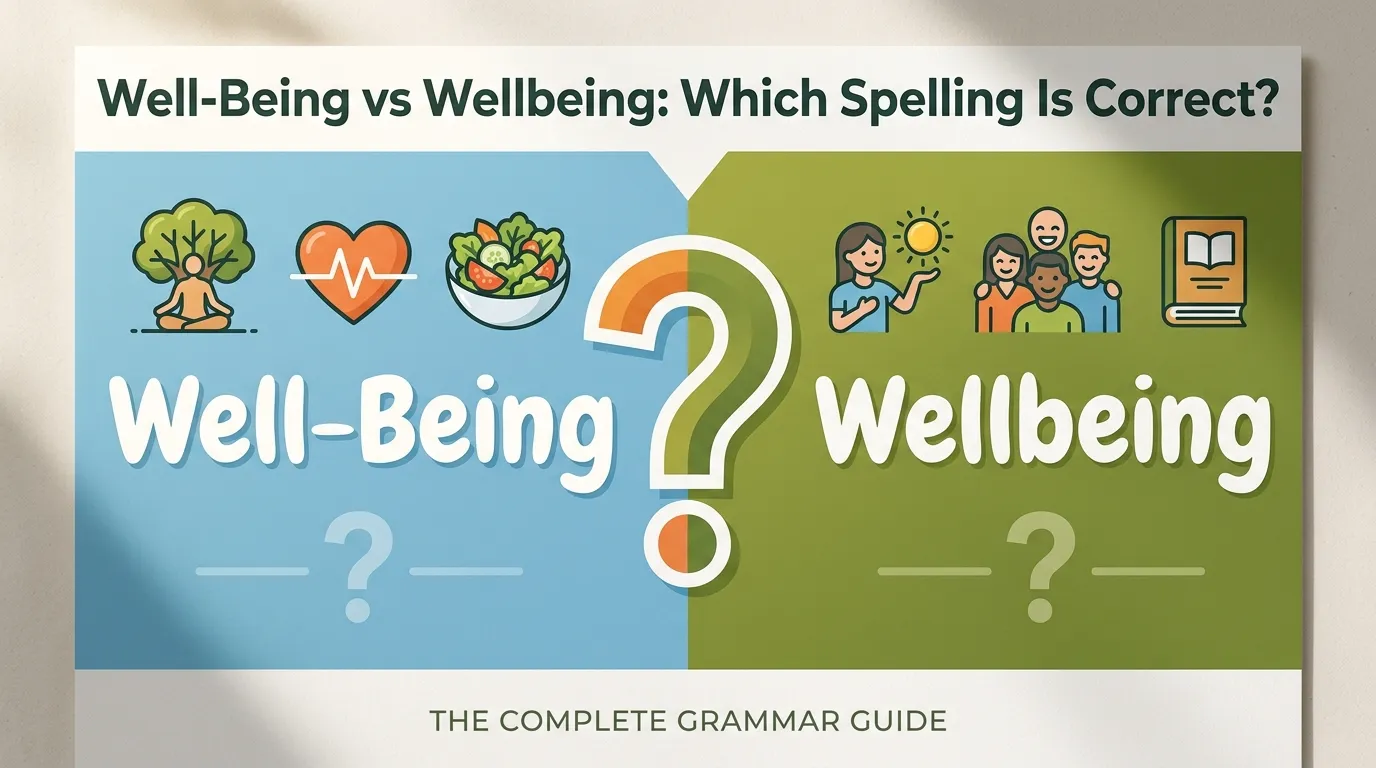
The short answer is simple: both well-being and wellbeing are correct. In American English, well-being is traditionally the more established spelling, especially in formal and edited writing. Wellbeing, written as one word, is also increasingly common and is especially frequent in British English and international usage.
Both forms refer to a person’s overall state of being healthy, comfortable, happy, and emotionally or mentally balanced. You might talk about someone’s physical well-being, employee wellbeing, emotional wellbeing, or the general well-being of a community.
In this guide, you will learn the difference between well-being vs wellbeing, when to use each spelling, how the word is pronounced, where the term came from, which version is preferred in American and British English, common mistakes to avoid, and how to choose the best spelling for academic, business, professional, journalistic, and casual writing.
Quick Answer: Well-Being or Wellbeing?
Both spellings are correct.
| Spelling | Correct? | Common usage |
|---|---|---|
| well-being | Yes | Traditional American English; formal writing |
| wellbeing | Yes | British English and increasingly international usage |
| well being | Usually no | Generally not preferred as the noun |
The easiest rule
If you are writing in American English, well-being is a safe and traditional choice.
If you are writing in British English, wellbeing is very common and often preferred.
However, there is no major difference in meaning between the two spellings.
For example:
- Regular exercise can improve your well-being.
- Regular exercise can improve your wellbeing.
Both sentences mean the same thing.
The most important point is consistency. If you choose one spelling for an article, report, website, or publication, use that spelling consistently unless you are following a specific organization’s house style.
What Does Well-Being Mean?

Well-being is a noun that describes a person’s general condition of being healthy, comfortable, happy, and functioning well physically, mentally, emotionally, or socially.
A dictionary-style definition would be:
Well-being: the state of being healthy, happy, comfortable, or satisfied.
The term is broader than simply being free from illness.
For example, someone may have good physical health but struggle emotionally. In that case, their overall well-being may not be strong.
Well-being can include several areas:
- Physical health
- Mental health
- Emotional balance
- Social connection
- Financial security
- Personal satisfaction
- Workplace satisfaction
- Sense of purpose
- Safety and comfort
- Quality of life
Examples of well-being
- Getting enough sleep is important for your well-being.
- The company introduced a new program to support employee well-being.
- Spending time with family can improve emotional well-being.
- Financial stability can affect a person’s overall well-being.
- The coach was concerned about the players’ physical well-being.
What Does Wellbeing Mean?
Wellbeing has the same basic meaning as well-being.
It describes a person’s overall health, happiness, comfort, or quality of life.
For example:
- Exercise can improve your wellbeing.
- The school takes student wellbeing seriously.
- Social relationships play an important role in emotional wellbeing.
There is no meaningful semantic distinction between well-being and wellbeing in these examples.
The difference is primarily orthographic: one form contains a hyphen, while the other does not.
Well-Being vs Wellbeing: The Key Difference
The central difference is the hyphen.
Well-being consists of two words joined with a hyphen:
well + being → well-being
Wellbeing combines the two elements into a single word:
well + being → wellbeing
The meaning remains essentially unchanged.
Side-by-side comparison
| Feature | Well-being | Wellbeing |
|---|---|---|
| Meaning | Overall health, happiness, and welfare | Overall health, happiness, and welfare |
| Part of speech | Noun | Noun |
| Pronunciation | Same | Same |
| Spelling | Hyphenated | Closed compound |
| American English | Very established | Increasingly used |
| British English | Correct | Very common |
| Formal writing | Safe choice | Also acceptable depending on style |
| Informal writing | Common | Common |
| Meaning difference | None | None |
Is Well-Being One Word or Two Words?
This question can be confusing because well-being is technically a compound noun made from two elements, but the hyphen connects them into one lexical unit.
You may see the term described as:
- A hyphenated compound
- A compound noun
- A noun formed from well and being
The spelling well being, without a hyphen and with a space, is generally less preferred when the word is functioning as the established noun meaning overall welfare or health.
For most modern writing, choose either:
well-being
or
wellbeing
rather than:
well being
Compare these examples
Natural:
- Exercise supports your well-being.
- Exercise supports your wellbeing.
Less natural when intended as the established noun:
- Exercise supports your well being.
The hyphen or closed form makes the compound relationship clearer.
Why Do People Confuse Well-Being and Wellbeing?
The confusion exists because English frequently changes compound words over time.
Many English compounds have moved through stages such as:
two separate words → hyphenated compound → one word
For example, a term may begin as two independent words and later become hyphenated or closed as usage becomes established.
This process is not always uniform. Different dictionaries, publishers, countries, and style guides may adopt different conventions.
That is why you can encounter both well-being and wellbeing in high-quality publications.
Another reason is regional English.
British English has increasingly favored the closed spelling wellbeing, while American English has traditionally used well-being more often.
Well-Being in American English
For American English, well-being is a particularly safe choice.
It appears naturally in:
- Healthcare writing
- Psychology
- Education
- Workplace communication
- Government writing
- Academic writing
- Journalism
- General nonfiction
Examples:
- The program focuses on children’s well-being.
- Employers are paying more attention to employee well-being.
- Sleep is essential for physical and mental well-being.
- The policy was designed to protect public well-being.
That said, wellbeing is not an incorrect American spelling. It is increasingly visible, especially in organizations and professional fields influenced by international English.
Wellbeing in British English
Wellbeing is especially common in British English.
British publications and organizations frequently write:
- Mental wellbeing
- Physical wellbeing
- Workplace wellbeing
- Employee wellbeing
- Student wellbeing
- Community wellbeing
For example:
- The school has introduced a new wellbeing program.
- Staff wellbeing remains a major priority.
- Exercise can have positive effects on mental wellbeing.
The hyphenated form well-being is still understandable and acceptable in British English, but wellbeing is a very familiar modern spelling.
Which Is More Formal: Well-Being or Wellbeing?
Neither spelling is inherently more formal.
The hyphen does not make the word more sophisticated or professional.
Instead, formality depends on the context and the publication’s style.
For example, both of these can appear in professional writing:
- Employee well-being is central to our workplace strategy.
- Employee wellbeing is central to our workplace strategy.
If your company style guide uses wellbeing, changing every occurrence to well-being simply because it looks more formal is unnecessary.
Best practice
Choose the spelling that matches:
- Your variety of English
- Your publication’s style guide
- Your audience
- Your existing terminology
- The spelling used by an organization you are discussing
Most importantly, remain consistent.
Well-Being Pronunciation
Both spellings are pronounced the same way.
IPA pronunciation
well-being: /ˌwel ˈbiːɪŋ/
wellbeing: /ˌwel ˈbiːɪŋ/
The word generally sounds like:
well-BEE-ing
The first part sounds like well.
The second part sounds like being.
Example
In the sentence:
Exercise is good for your well-being.
You pronounce the term as:
well-BEE-ing
The spelling difference does not create a pronunciation difference.
Is Well-Being a Noun?
Yes.
Well-being is a noun, as is wellbeing.
It commonly refers to a general condition or state.
Examples:
- Her well-being is important.
- The patient’s well-being improved.
- We care about employee wellbeing.
- His emotional well-being suffered during the stressful period.
The word can be modified by adjectives such as:
- Physical well-being
- Emotional well-being
- Mental well-being
- Psychological well-being
- Social well-being
- Financial well-being
- Personal well-being
- Spiritual well-being
- Overall well-being
- General well-being
Common Collocations With Well-Being and Wellbeing
A collocation is a group of words that commonly appear together.
Knowing common collocations can help you use the term naturally.
Physical well-being
Refers to the condition of someone’s physical health and bodily functioning.
Regular movement supports physical well-being.
Mental well-being
Refers to psychological and emotional health.
A supportive environment can promote mental well-being.
Emotional well-being
Focuses on emotional stability, satisfaction, and resilience.
Strong friendships can contribute to emotional well-being.
Employee well-being
Refers to the health and quality of life of employees.
Employee well-being has become an important workplace issue.
Child well-being
Refers to children’s overall health, safety, development, and quality of life.
The organization works to protect child well-being.
Community well-being
Describes the overall welfare of people within a community.
Parks can contribute to community well-being.
Overall well-being
This is one of the most common expressions.
Sleep, nutrition, and social relationships all affect your overall well-being.
Common Phrases With Well-Being
Some natural expressions include:
- Improve well-being
- Promote well-being
- Support well-being
- Protect well-being
- Enhance well-being
- Affect well-being
- Overall well-being
- Physical well-being
- Mental well-being
- Emotional well-being
- Personal well-being
- Workplace well-being
- Employee well-being
- Public well-being
- Children’s well-being
The same expressions work with wellbeing.
For example:
The program aims to promote student wellbeing.
Well-Being vs Welfare
These words are related, but they are not always interchangeable.
Well-being usually focuses on someone’s overall state of health, happiness, comfort, and quality of life.
Welfare can also mean health and happiness, but it often has additional meanings related to assistance, protection, or social support.
Compare:
The organization is concerned about the emotional well-being of its members.
and:
The government created a welfare program to assist low-income families.
The first emphasizes a person’s condition. The second refers to a social support system.
Well-Being vs Wellness
Wellness and well-being overlap, but they are not exactly identical.
Wellness often refers to an active approach to maintaining or improving health.
It is commonly associated with:
- Exercise
- Nutrition
- Healthy habits
- Stress management
- Lifestyle choices
Well-being is broader and describes the resulting or overall state of being healthy and satisfied.
For example:
Yoga is part of her wellness routine.
Yoga contributes to her overall well-being.
Well-Being vs Quality of Life
These terms are also closely related.
Quality of life generally describes how good or satisfactory someone’s life is.
Well-being can include quality of life but also emphasizes health, emotional state, social relationships, and other dimensions of human welfare.
A person’s quality of life may be affected by:
- Health
- Income
- Housing
- Relationships
- Safety
- Work
- Environment
- Access to services
These factors can also influence overall well-being.
Word History and Etymology
The word well-being is formed from well and being.
The adjective and adverb well has a long history in English and is associated with ideas such as being in good health or in a satisfactory condition.
Being comes from the verb be, which refers broadly to existence or a state of existence.
Together, the compound developed the sense of a person’s state of being well.
The hyphen helped show that the two elements function together as a compound noun.
Over time, compounds in English often become more closely integrated in spelling. This helps explain why wellbeing has become increasingly common.
Is Well Being Without a Hyphen Correct?
It is possible to encounter well being, but it is generally not the preferred spelling when you mean the established noun.
Use:
well-being
or:
wellbeing
For example:
Exercise improves your well-being.
Exercise improves your wellbeing.
Both are natural.
The spaced form can sometimes occur when the words have a different grammatical relationship, but for the standard noun, the hyphenated or closed spelling is much clearer.
Common Mistakes With Well-Being
Mistake: Treating wellbeing as incorrect
Some writers believe that wellbeing is always a spelling mistake.
That is not true.
Wellbeing is an established spelling, particularly common in British and international English.
Mistake: Assuming well-being is outdated
The opposite assumption is also incorrect.
Well-being remains a standard and widely accepted spelling, particularly in American English.
Mistake: Switching spellings randomly
Avoid using both forms within the same article.
For example, this looks inconsistent:
Employee well-being is important. Our employee wellbeing policy supports staff.
If there is no reason for the change, select one spelling and maintain it.
Better:
Employee well-being is important. Our employee well-being policy supports staff.
Or:
Employee wellbeing is important. Our employee wellbeing policy supports staff.
Awkward vs Natural Examples
Awkward
The company cares about the well being of workers.
Natural
The company cares about the well-being of workers.
or:
The company cares about the wellbeing of workers.
Awkward
Exercise is important for your well being.
Natural
Exercise is important for your well-being.
or:
Exercise is important for your wellbeing.
Awkward
We offer services designed to increase employee well-being and wellbeing.
Natural
We offer services designed to improve employee well-being.
The key issue here is unnecessary variation.
Formal vs Casual Usage
Both forms can be used in formal and informal contexts.
Academic writing
For academic work, follow the spelling convention preferred by your institution, instructor, publisher, or style guide.
Example:
The study examined factors affecting adolescent well-being.
Business writing
Either form can work.
Employee well-being is a major component of our workplace strategy.
Journalism
Follow the publication’s house style.
The report examined the well-being of local residents.
Blogging
Either spelling is acceptable.
Choose one and use it consistently throughout the post.
Casual writing
Both forms are perfectly understandable.
I’m trying to focus more on my wellbeing.
Which Spelling Should You Use?
There is no universal rule requiring everyone to choose the same spelling.
Instead, use the following practical guide.
| Audience | Recommended choice |
|---|---|
| American readers | well-being |
| British readers | wellbeing |
| International audience | Either; stay consistent |
| Academic writing | Follow the required style |
| American business writing | well-being is a safe choice |
| British business writing | wellbeing is common |
| Journalism | Follow house style |
| Website/blog | Either |
| Casual social media | Either |
If you are unsure and your audience is primarily American, well-being is an excellent default.
Memory Trick for Well-Being vs Wellbeing
A simple way to remember the distinction is:
American English → well-being
Think of the hyphen as the traditional American choice.
For British English, remember:
British English → wellbeing
This is not an absolute rule, but it is a useful practical guideline.
Another memory trick is:
The meaning stays well, even when the spelling changes.
Whether you write well-being or wellbeing, you are talking about a person’s overall state of being well.
Synonyms for Well-Being
Depending on the context, possible synonyms include:
- Welfare
- Health
- Wellness
- Happiness
- Prosperity
- Comfort
- Contentment
- Quality of life
- Flourishing
- Good health
- Life satisfaction
However, these words are not perfect substitutes in every sentence.
For example, happiness focuses more strongly on positive emotion, while well-being covers a wider range of physical, mental, emotional, and social factors.
Antonyms and Contrasting Terms
There is no single perfect antonym for well-being, but depending on the context, contrasting terms include:
- Illness
- Distress
- Suffering
- Unhappiness
- Poor health
- Discomfort
- Hardship
- Malaise
- Dysfunction
- Poor quality of life
The appropriate opposite depends on what aspect of well-being you are discussing.
Related Words
The word belongs to a larger group of health and welfare vocabulary.
Related terms include:
- Wellness
- Welfare
- Health
- Fitness
- Happiness
- Mental health
- Emotional health
- Resilience
- Self-care
- Life satisfaction
- Flourishing
- Quality of life
- Work-life balance
- Psychological health
These terms often appear alongside well-being in health, education, psychology, business, and lifestyle writing.
Well-Being in the Workplace
The phrase employee well-being is especially common in modern business writing.
It can refer to several areas of working life, including:
- Physical health
- Mental health
- Workplace safety
- Work-life balance
- Job satisfaction
- Social relationships
- Financial security
- Work environment
For example:
The company introduced flexible schedules to support employee well-being.
The closed form is equally possible:
The company introduced flexible schedules to support employee wellbeing.
Neither sentence changes the underlying meaning.
Well-Being in Healthcare
Healthcare professionals may use well-being to describe more than the absence of disease.
A person’s well-being may involve:
- Physical health
- Mental health
- Emotional health
- Social relationships
- Independence
- Comfort
- Daily functioning
- Quality of life
For example:
Treatment decisions should consider the patient’s overall well-being.
This broader meaning is one reason the term is so common in healthcare communication.
Well-Being in Education
Schools and universities often discuss:
- Student well-being
- Teacher well-being
- Mental well-being
- Emotional well-being
- Social well-being
Example:
The school created a quiet space to support student well-being.
British institutions may more commonly write:
The school created a quiet space to support student wellbeing.
Again, the spelling changes, but the meaning does not.
Well-Being in Sports
In sports, well-being can refer to an athlete’s physical and mental condition.
Examples include:
- Athlete well-being
- Player well-being
- Physical well-being
- Mental well-being
- Recovery and well-being
Example:
The coach prioritized player well-being during the demanding training schedule.
In professional sports, the concept can include injury prevention, recovery, sleep, mental health, nutrition, and workload management.
Technical and Professional Usage
The term appears in many specialized fields.
Psychology
Psychologists may discuss subjective well-being, emotional well-being, psychological well-being, and life satisfaction.
Public health
Researchers may examine population well-being and health-related quality of life.
Economics
Economists may discuss social welfare, living standards, and measures of human well-being.
Education
Researchers may study student well-being and school environments.
Human resources
Businesses may focus on employee well-being, workplace wellness, and work-life balance.
The spelling convention may vary according to the field and publication.
Is Wellbeing Slang?
No.
Wellbeing is not slang.
It is a standard English noun.
The same is true of well-being.
Although the word appears frequently in casual lifestyle content and social media, its meaning remains standard and formal enough for academic, professional, and journalistic writing.
Is Well-Being Hyphenated?
Yes, well-being is the traditional hyphenated spelling.
However, wellbeing is also an accepted closed form.
The important distinction is that the noun is generally written either:
well-being
or:
wellbeing
rather than simply treating the words as unrelated words.
Does Wellbeing Mean Mental Health?
Not exactly.
Mental health is one component of well-being.
Well-being is broader.
It can include:
- Physical health
- Mental health
- Emotional health
- Social relationships
- Financial stability
- Safety
- Personal fulfillment
- Quality of life
Therefore, saying that well-being means only mental health is too narrow.
For example:
Financial problems can affect overall well-being.
This does not necessarily mean the person has a mental health disorder. It means their broader quality of life or sense of stability may be affected.
Real-World Examples
Here are natural examples using both spellings.
American English examples
- The program was designed to improve employee well-being.
- Sleep plays a major role in physical well-being.
- The doctor asked about the patient’s overall well-being.
- Social connections are important for emotional well-being.
- The policy aims to protect public well-being.
British English examples
- The school places student wellbeing at the center of its policies.
- Staff wellbeing is a major priority.
- Exercise can improve physical wellbeing.
- The organization promotes mental wellbeing.
- Community wellbeing depends on many factors.
What About Well-Being in Compound Modifiers?
The word can appear in phrases that modify another noun.
For example:
a well-being program
or:
a wellbeing program
In these cases, the exact punctuation can depend on the publication’s style.
When writing professionally, check your organization’s preferred style, particularly if the term appears frequently in a report or brand name.
Should You Use Well-Being or Wellbeing for SEO?
From an SEO perspective, both forms can be relevant because search engines generally understand that they refer to the same concept.
You should not repeatedly alternate spellings simply to target both keywords.
Instead:
- Choose the primary spelling appropriate to your audience.
- Use it naturally in headings and body text.
- Mention the alternative spelling where it helps answer the user’s question.
- Include natural related phrases.
- Prioritize readability over keyword repetition.
For an American-English website, well-being is a sensible primary form.
You can naturally mention wellbeing in a section discussing British English and spelling differences.
Frequently Asked Questions
Is well-being or wellbeing correct?
Both well-being and wellbeing are correct spellings. They have the same meaning and function as nouns. Well-being is traditionally common in American English, while wellbeing is especially common in British English and increasingly widespread internationally.
Is wellbeing one word or two words?
Wellbeing is one word. The alternative spelling well-being is a hyphenated compound. The form well being, written as two separate words, is generally not the preferred spelling when referring to the established noun meaning health, happiness, and overall welfare.
Is well-being more correct than wellbeing?
No. Well-being is not inherently more correct than wellbeing. Both are established forms. The best choice depends on regional English, editorial style, and audience.
Do well-being and wellbeing have different meanings?
No. In ordinary modern usage, well-being and wellbeing have the same meaning. Both refer to a person’s overall state of health, happiness, comfort, welfare, or quality of life.
Which spelling is preferred in American English?
Well-being is a traditional and widely accepted choice in American English. Wellbeing is also used, but writers targeting a primarily American audience may prefer the hyphenated form for consistency with established American usage.
Which spelling is preferred in British English?
Wellbeing is particularly common in British English. However, well-being is also recognizable and acceptable. Individual publishers and organizations may have their own style preferences.
Is well-being hyphenated?
Yes, well-being is the hyphenated spelling. However, the closed spelling wellbeing is also correct. Both forms are used in modern English.
Is well-being formal or informal?
Well-being is suitable for both formal and informal writing. It is commonly used in academic research, healthcare, business, journalism, education, government communication, and everyday conversation.
What is the difference between well-being and wellness?
Well-being describes an overall state of health, happiness, and quality of life. Wellness often emphasizes the active pursuit of healthy habits and lifestyle choices. The two terms overlap but are not exact synonyms.
Final Verdict
So, which should you use: well-being or wellbeing?
The answer is that both are correct.
The difference is mainly a matter of spelling convention rather than meaning.
If you write primarily for an American audience, well-being is a reliable traditional choice. If you write for a British audience, wellbeing is especially common. For international readers, either form works as long as you use it consistently.
Remember these key points:
- Well-being is correct.
- Wellbeing is also correct.
- Both forms are nouns.
- Both have the same basic meaning.
- Both are pronounced essentially the same way.
- American English traditionally favors well-being.
- British English commonly uses wellbeing.
- Neither spelling is slang.
- Neither spelling is inherently more formal.
- Avoid switching randomly between the two.
- Follow your publisher, employer, school, or style guide when one exists.
For most American-English writing, the safest default is well-being. But if you encounter wellbeing in a British publication, professional document, or international website, there is no need to treat it as a spelling error.
Ultimately, the goal is not to choose the spelling that looks more sophisticated. The goal is to choose the form that fits your audience, regional variety, and editorial style—and then use it consistently.