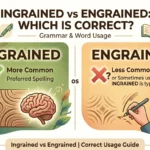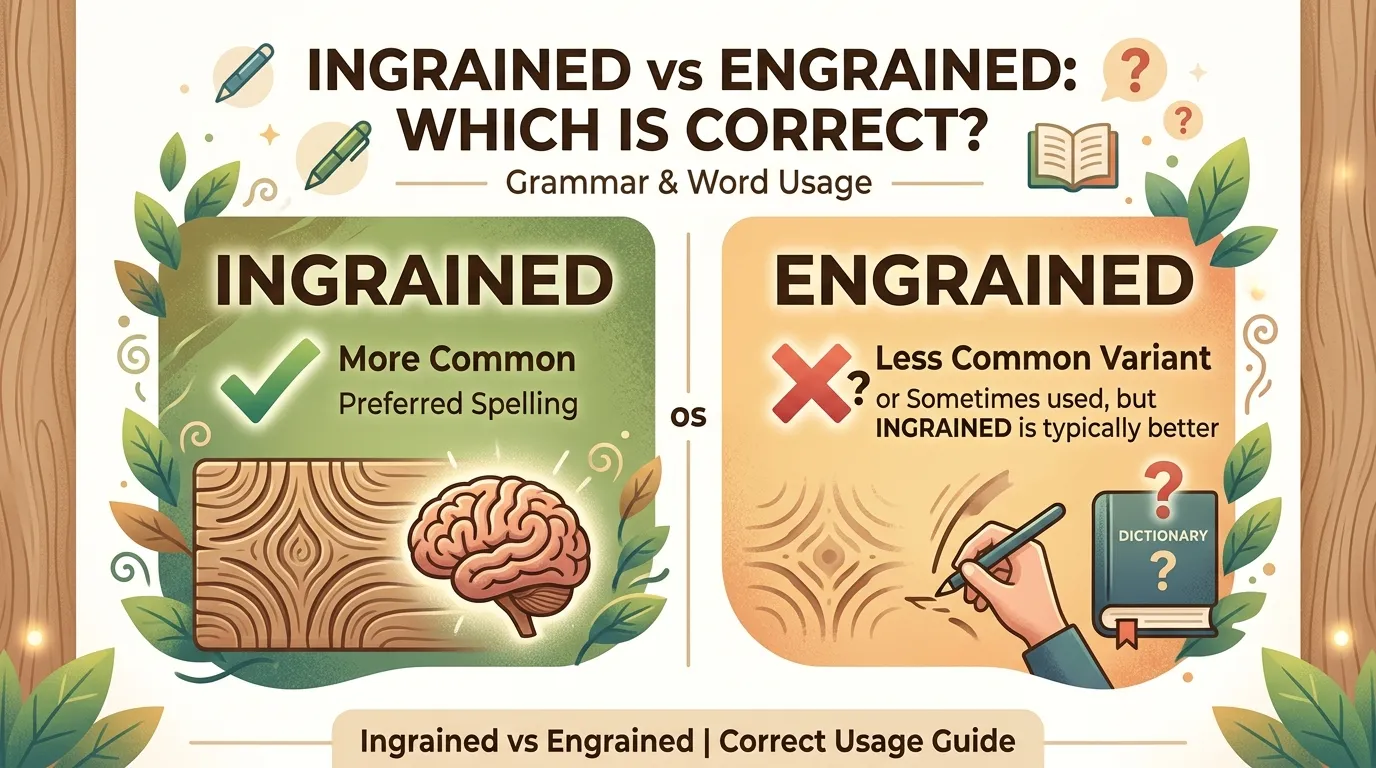
If you are wondering about “ingrained vs engrained,” the short answer is simple: both spellings exist, but “ingrained” is the standard and much more widely preferred form in modern American English.
The word ingrained usually describes something that is deeply established, firmly fixed, or difficult to change, such as a habit, belief, attitude, behavior, or tradition.
For example:
Her habit of checking her work twice is deeply ingrained.
Engrained is also a real word, but it is less common in contemporary usage. It can function as a variant of ingrained, although many editors, teachers, and style-conscious writers prefer ingrained.
This guide explains the difference between ingrained and engrained, their meanings, pronunciation, history, grammar, regional usage, common mistakes, synonyms, collocations, and the situations in which each spelling works best.
Quick Answer: Ingrained or Engrained?
Ingrained is the best choice for most modern writing, especially in American English.
| Word | Correct? | Commonness | Best Use |
|---|---|---|---|
| ingrained | Yes | Very common | Standard modern English |
| engrained | Yes, as a variant | Less common | Variant or regional usage |
| ingrain | Yes | Common | Verb |
| engrain | Yes | Less common | Verb/variant |
The safest rule
When you mean deeply fixed, established, or difficult to change, use ingrained.
- Correct and natural: The belief is ingrained in the culture.
- Possible but less common: The belief is engrained in the culture.
If you are writing for an American audience, ingrained should be your default spelling.
What Does Ingrained Mean?
Ingrained is an adjective that describes something deeply fixed in a person’s mind, behavior, character, habits, or culture.
It can refer to something that has developed gradually and become difficult to remove or change.
Dictionary-style definition
Ingrained: deeply established or firmly fixed through repeated experience, habit, teaching, or long exposure.
The word can describe:
- habits
- beliefs
- attitudes
- behaviors
- traditions
- opinions
- values
- fears
- assumptions
- cultural practices
- personal characteristics
Examples
- Her ingrained habit of arriving early helped her at work.
- Fear of failure was ingrained in him from childhood.
- The tradition is ingrained in the community.
- Good manners were ingrained in the children from an early age.
- The company has an ingrained culture of innovation.
The central idea is deepness. Something ingrained is not simply present. It has become firmly established.
What Does Engrained Mean?
Engrained is an established spelling, but it is considerably less common than ingrained in present-day standard usage.
It can be used with essentially the same figurative meaning:
deeply established, fixed, or embedded.
For example:
- The tradition is engrained in the community.
- His beliefs were engrained through years of experience.
However, these sentences sound more natural to most American English readers with ingrained:
- The tradition is ingrained in the community.
- His beliefs were ingrained through years of experience.
This difference is important. Engrained is not simply a misspelling that has never existed. It has a legitimate history and usage. Nevertheless, ingrained is the dominant modern form for the figurative sense most people intend.
Ingrained vs Engrained: The Key Difference
The biggest difference is frequency and standard preference, rather than meaning.
Ingrained
Ingrained is the normal modern spelling.
Use it when you mean:
deeply fixed, established, or embedded in someone’s mind, behavior, or culture.
Examples:
- an ingrained habit
- an ingrained belief
- an ingrained attitude
- an ingrained prejudice
- an ingrained tradition
- an ingrained response
Engrained
Engrained is a less common variant.
It may be encountered in British, international, historical, or individual usage, but it is not generally the first choice for contemporary American writing.
Simple comparison
| Feature | Ingrained | Engrained |
|---|---|---|
| Standard spelling | Yes | Variant |
| Common in American English | Yes | Less common |
| Means deeply established | Yes | Yes |
| Appropriate in formal writing | Yes | Usually better replaced by ingrained |
| Common in everyday writing | Yes | Uncommon |
| Safe choice for SEO content | Yes | Use mainly when discussing the variant |
So if you have to choose one, choose ingrained.
Why Do People Confuse Ingrained and Engrained?
The confusion is understandable because English contains several related-looking words:
- engrave
- engraved
- engrained
- grain
- ingrain
- ingrained
The spelling engrained looks logical because English speakers already know engrave and engraved.
There is also the noun grain, which is important to the history of both forms.
Another reason for the confusion is pronunciation. In ordinary speech, the difference between the initial sounds can be easy to overlook.
People may also encounter engrained in older texts or from writers who use it as a variant. Once both spellings appear in print, it becomes difficult to know which one is preferred.
The practical solution is easy:
For modern American English, remember “ingrained.”
Is Ingrained a Verb or an Adjective?
This is an important grammar point.
Ingrained can be the past participle of the verb ingrain, but it is very commonly used as an adjective.
As an adjective
His habits are ingrained.
Here, ingrained describes his habits.
As part of a passive construction
The training was ingrained through years of practice.
Here, the word can be interpreted as a past participle in a passive construction.
The verb: ingrain
The verb ingrain means to establish something deeply or firmly.
For example:
Years of practice ingrained the technique in her memory.
The verb can also appear in the passive:
The technique became ingrained through years of practice.
Ingrained Pronunciation
Ingrained is pronounced with two syllables.
The pronunciation is essentially the same as the word grained with the prefix in-.
The stress falls on the second syllable.
Pronunciation tips
The important sound is the long “a” sound in the second syllable, as in words such as:
- grain
- brain
- train
- plain
The word ends with a d sound.
What about engrained?
Engrained is pronounced similarly, with the beginning sounding like en- rather than in-.
Because the two forms are so similar in sound, spelling is often the bigger issue.
Ingrained vs Engrained in American English
For American English, the recommendation is particularly straightforward.
Use ingrained in:
- academic writing
- business writing
- journalism
- website content
- professional emails
- reports
- essays
- books
- educational materials
- technical documentation
- marketing copy
American English examples
- Distrust of the system became ingrained.
- She has an ingrained habit of taking notes.
- The company has an ingrained commitment to quality.
- These ideas are deeply ingrained in popular culture.
Engrained may still be understood, but it can look unusual or less polished to American readers.
If consistency and conventional usage matter, ingrained is the better choice.
Ingrained vs Engrained in British English
British English can be more flexible about engrained, and the variant may appear in British and international writing.
However, ingrained remains a well-established and widely recognized form.
This means you should not assume that engrained is automatically wrong simply because you see it in British English.
Instead, think of the relationship this way:
Ingrained = dominant standard form
Engrained = legitimate but less common variant
For an international audience, ingrained is still the clearest choice because it is immediately recognizable across English varieties.
Literal and Figurative Meanings
The modern use of ingrained is mostly figurative.
Figurative meaning
It describes something deeply established in a person’s mind, personality, behavior, or society.
Respect for education was ingrained in the family.
The idea is that the belief has become deeply rooted.
Literal or historical sense
The word has a connection to grain and the historical idea of introducing a color or substance deeply into a material.
That older sense helps explain why the figurative meaning developed around something being deeply fixed or embedded.
This is different from engraved, which normally suggests something physically carved, cut, or impressed into a surface.
Compare:
- The words were engraved on the stone.
- The habit was ingrained in her personality.
These words may sound somewhat similar, but their meanings are different.
Ingrained vs Engrained vs Engraved
These three words are easy to mix up.
| Word | Meaning | Example |
|---|---|---|
| ingrained | deeply established | An ingrained habit |
| engrained | variant of ingrained | An engrained habit |
| engraved | carved or impressed into a surface | An engraved name |
Easy distinction
Think:
Ingrained = deeply fixed
Engraved = physically carved
For example:
His love of reading was ingrained.
But:
His name was engraved on the trophy.
Do not use engraved when you mean a deeply established habit or belief.
Common Collocations With Ingrained
Ingrained frequently appears with nouns related to behavior, thinking, culture, and attitudes.
Some of the most natural combinations include:
Ingrained habits
She has an ingrained habit of checking every detail.
Ingrained beliefs
The community has several ingrained beliefs about education.
Ingrained attitudes
Changing ingrained attitudes can take time.
Ingrained behavior
The behavior had become ingrained over many years.
Ingrained culture
The organization has an ingrained culture of teamwork.
Ingrained traditions
The festival reflects ingrained traditions passed from one generation to another.
Ingrained assumptions
The study challenges several ingrained assumptions.
Ingrained response
Her first reaction was almost ingrained after years of training.
Other useful combinations include:
- deeply ingrained
- culturally ingrained
- socially ingrained
- psychologically ingrained
- firmly ingrained
- historically ingrained
- culturally ingrained beliefs
- deeply ingrained habits
- deeply ingrained attitudes
- deeply ingrained patterns
Of these, deeply ingrained is especially common and natural.
Why Do We Say “Deeply Ingrained”?
The phrase deeply ingrained is common because the word already carries the idea of something being firmly established.
For example:
The belief is deeply ingrained in society.
The word deeply emphasizes just how firmly established the belief is.
Although ingrained already suggests depth, the combination sounds natural because English frequently uses intensifiers with adjectives.
Other examples include:
- deeply rooted
- firmly established
- strongly held
- deeply embedded
- firmly fixed
Is “deeply ingrained” redundant?
Not in normal English.
It is a conventional and natural collocation.
Ingrained vs Embedded vs Deep-Seated
These words are related, but they are not always interchangeable.
| Word | Main idea |
|---|---|
| ingrained | deeply established through habit or repeated exposure |
| embedded | firmly placed within something |
| deep-seated | strongly established, especially a feeling, belief, or problem |
| rooted | connected deeply to an origin, place, belief, or tradition |
| entrenched | firmly established and often difficult to change |
Ingrained
His habit of planning ahead is ingrained.
Embedded
The safety feature is embedded in the software.
Deep-seated
She had a deep-seated fear of failure.
Rooted
The tradition is rooted in local history.
Entrenched
The organization has entrenched procedures.
These words overlap, but ingrained is especially useful when repeated behavior, learning, or experience has made something difficult to change.
Synonyms for Ingrained
Depending on context, useful synonyms include:
- deeply established
- deeply rooted
- fixed
- embedded
- entrenched
- habitual
- established
- rooted
- persistent
- firmly established
- deep-seated
- firmly fixed
- internalized
Example
Original:
Her habit was ingrained.
Possible alternatives:
Her habit was deeply rooted.
Her habit was firmly established.
Her habit had become deeply embedded.
The best synonym depends on the exact context.
Antonyms for Ingrained
Possible opposites include:
- temporary
- changeable
- flexible
- new
- unfamiliar
- undeveloped
- superficial
- unestablished
- removable
For example:
His reaction was not ingrained; it was temporary.
Or:
The behavior was still new rather than ingrained.
Ingrained in Different Contexts
The word appears across many areas of modern writing.
Psychology and behavior
Repeated experiences can create ingrained patterns of behavior.
Here, the word describes patterns that have become firmly established.
Education
Critical thinking should become an ingrained part of learning.
Business
The company has an ingrained focus on customer service.
Sports
Years of practice made the movement ingrained.
Politics
The word can describe long-standing political beliefs or attitudes without itself being a political term.
The debate exposed several ingrained political assumptions.
Culture
The custom is deeply ingrained in the local culture.
Technology
Security should become an ingrained part of software development.
Journalism
The investigation revealed ingrained problems within the organization.
Academic writing
The research examines how social expectations become ingrained over time.
In each case, the central meaning remains the same: something has become deeply established.
Common Mistakes With Ingrained and Engrained
Mistake 1: Assuming engrained is always incorrect
Incorrect assumption:
“Engrained is not a real word.”
That is too absolute.
Better understanding:
Engrained exists as a variant, but ingrained is the standard modern choice for most writing.
Mistake 2: Using engraved instead of ingrained
Awkward:
His fear was engraved in his personality.
Natural:
His fear was ingrained in his personality.
Engraved generally refers to something physically carved or marked.
Mistake 3: Writing “ingraineded”
Never add another -ed.
Incorrect:
The habit was ingraineded.
Correct:
The habit was ingrained.
Mistake 4: Using “ingrained into” when “ingrained in” is more natural
You may occasionally encounter different prepositions, but ingrained in is especially natural when discussing beliefs, habits, cultures, and attitudes.
The belief is ingrained in the culture.
The habit is ingrained in his daily routine.
Awkward vs Natural Examples
Example 1
Awkward:
Her habit was engrained deeply into her behavior.
More natural:
Her habit was deeply ingrained in her behavior.
Example 2
Awkward:
The idea became engraved in society.
Natural:
The idea became ingrained in society.
Example 3
Less conventional:
He has an engrained habit of waking early.
Preferred:
He has an ingrained habit of waking early.
Example 4
Natural:
Years of training created an ingrained response.
Example 5
Natural:
The practice is deeply ingrained in the team’s culture.
Formal vs Informal Usage
Ingrained works well in both formal and informal English.
Formal
The report examines the ingrained assumptions that influence decision-making.
Professional
The organization is working to change ingrained workplace habits.
Academic
These attitudes may become ingrained through repeated social experiences.
Casual
Waking up early is just ingrained in me now.
The word is flexible enough for nearly any register.
Ingrained vs Engrained: Which Should You Use?
Use this practical guide.
Choose “ingrained” when:
- writing for an American audience
- writing an academic paper
- publishing a blog
- creating business content
- writing a news article
- preparing professional documents
- writing educational material
- optimizing web content for clarity
- you want the most familiar spelling
Consider “engrained” only when:
- discussing the spelling itself
- quoting or analyzing historical usage
- preserving an author’s original wording
- discussing regional or variant English
- a particular publication or style guide specifically uses it
For general writing, there is little reason to prefer engrained over ingrained.
A Simple Memory Trick
Here is an easy way to remember the preferred spelling:
Ingrained = IN the grain = deeply fixed inside.
Imagine a habit going in so deeply that it becomes difficult to remove.
Another useful connection is:
Grain → ingrained
Think of something becoming deeply established in something else.
You can also remember:
Ingrained habits are “in” you.
This is not the historical definition, but it is a useful memory device for spelling.
Ingrained vs Engrained in SEO and Content Writing
If you are writing online, consistency matters.
Suppose your article targets the phrase “ingrained vs engrained.” You should naturally discuss both spellings. However, when giving examples of standard usage, use ingrained unless the context specifically requires engrained.
Avoid repeatedly inserting both spellings simply to target a keyword.
Instead, answer the user’s actual question:
Is engrained correct?
Yes, it exists.
Is ingrained more common?
Yes.
Which should I use?
For modern American English, ingrained.
This approach gives readers a clear answer while keeping the content natural and useful.
Quick Comparison: Ingrained vs Engrained
| Question | Answer |
|---|---|
| Is ingrained correct? | Yes. |
| Is engrained correct? | Yes, as a less common variant. |
| Which is more common? | Ingrained. |
| Which is preferred in American English? | Ingrained. |
| Can engrained mean deeply established? | Yes. |
| Is engrained a synonym for engraved? | No. |
| Does ingrained describe habits? | Yes. |
| Does ingrained describe beliefs? | Yes. |
| Can ingrained describe culture? | Yes. |
| Is “deeply ingrained” natural? | Yes. |
| Should students generally use ingrained? | Yes. |
| Should professional writers generally use ingrained? | Yes. |
Everyday Examples of Ingrained
Here are additional examples showing how naturally the word works in ordinary English:
- Checking the door twice had become an ingrained habit.
- Her love of books was ingrained from childhood.
- The team’s commitment to practice was ingrained.
- Respect for elders was ingrained in the family.
- His first reaction was almost ingrained after years of experience.
- The company has an ingrained culture of collaboration.
- These traditions are deeply ingrained in the community.
- The belief became ingrained over time.
- Good communication should become an ingrained part of leadership.
- Years of training made the technique ingrained.
Notice that the word works especially well with concepts that develop gradually.
When Ingrained Is Not the Best Word
Although ingrained is useful, it should not replace every word meaning “deep.”
For example, if something is physically built into a device, embedded may be better:
The security chip is embedded in the device.
If a name is carved into stone, use engraved:
Her name was engraved on the plaque.
If a tradition comes from a historical source, rooted may be more precise:
The tradition is rooted in ancient history.
If an attitude is extremely difficult to change, entrenched may communicate that idea more strongly:
The organization has entrenched policies.
Good writing is not only about choosing a correct word. It is about choosing the most precise word for the context.
Word History and Etymology
The history of ingrained helps explain the spelling.
The word is related to grain, which historically had connections with coloring or dyeing material deeply into its substance. The idea of something being fixed deeply eventually developed into the figurative sense we commonly use today.
The verb ingrain came to be used for putting something deeply into a material and later for establishing something deeply in the mind or character.
The figurative meaning is therefore closely connected to the idea of something becoming deeply fixed.
Engrain has also existed as a variant form, which helps explain why engrained can be found in dictionaries and published writing.
This history is one reason it would be inaccurate to call every occurrence of engrained an accidental spelling mistake.
Still, historical legitimacy does not mean equal modern frequency.
That is why ingrained remains the safest and most conventional choice today.
What Is the Best Choice for Students?
Students should normally use ingrained.
For essays, exams, assignments, research papers, and school projects, ingrained is the clearest choice.
For example:
Social expectations can become deeply ingrained during childhood.
This sounds natural, precise, and appropriate for academic writing.
If you write engrained, your meaning may still be understood, but ingrained avoids unnecessary questions about spelling or regional preference.
What Is the Best Choice for Professional Writers?
Professional writers should also generally choose ingrained.
That includes:
- copywriters
- journalists
- bloggers
- editors
- marketers
- technical writers
- business writers
- authors
- teachers
- content creators
When an established spelling is significantly more common, choosing it usually improves readability.
For a broad audience, the simplest rule is:
Use ingrained unless you have a specific reason to use engrained.
Final Rule for Ingrained vs Engrained
If you remember only one thing from this guide, remember this:
Ingrained is the standard, preferred spelling in modern American English.
Engrained is a legitimate but less common variant.
Both can communicate the idea of something being deeply established, especially a habit, belief, attitude, behavior, or tradition.
But when you are writing an essay, article, email, report, website, business document, or professional publication, ingrained is almost always the better default.
Frequently Asked Questions
1. Is “ingrained” or “engrained” correct?
Both spellings exist, but ingrained is the standard and much more common spelling in modern English, particularly American English. Use ingrained when you mean deeply established, fixed, or difficult to change.
2. Is “engrained” a misspelling of “ingrained”?
Not necessarily. Engrained is an established variant, although it is less common. Because ingrained is the dominant modern form, many readers may assume engrained is a spelling error.
3. Which is preferred in American English: ingrained or engrained?
Ingrained is preferred. American writers should generally use ingrained in formal, professional, academic, journalistic, and everyday writing.
4. Does ingrained mean deeply rooted?
Yes. Ingrained can mean deeply rooted, firmly established, or difficult to change, especially when describing habits, beliefs, attitudes, behaviors, and traditions.
For example:
She has an ingrained habit of planning ahead.
5. Is “deeply ingrained” grammatically correct?
Yes. Deeply ingrained is a very common and natural expression.
For example:
The tradition is deeply ingrained in the community.
The word deeply emphasizes how firmly something has become established.
6. What is the difference between ingrained and engraved?
Ingrained usually means deeply established in the mind, behavior, culture, or character.
Engraved usually means physically carved, cut, or impressed into a surface.
Compare:
Her fear was ingrained.
Her name was engraved on the award.
7. Can I use engrained in an academic paper?
You can encounter engrained in legitimate English usage, but ingrained is the safer and more conventional choice for an academic paper. Unless you are discussing a particular source or variant spelling, use ingrained.
8. Is ingrained an adjective?
Yes. Ingrained is very commonly used as an adjective.
Examples include:
- ingrained habit
- ingrained belief
- ingrained attitude
- ingrained behavior
- ingrained tradition
It can also function as the past participle of the verb ingrain.
9. What are the best synonyms for ingrained?
Depending on the context, synonyms include deeply rooted, deeply established, embedded, entrenched, fixed, habitual, deep-seated, and firmly established.
The best synonym depends on whether you are describing a habit, belief, cultural practice, feeling, system, or physical feature.
10. How can I remember the spelling of ingrained?
A simple memory trick is:
Ingrained = something deeply “in” you.
Think of an ingrained habit as a habit that has become so deeply established that changing it is difficult.
Conclusion
The difference between ingrained and engrained is mainly one of modern preference and frequency, not a complete difference in meaning.
Ingrained is the standard and strongly preferred form in contemporary American English. It describes something that has become deeply established, firmly fixed, or difficult to change, especially a habit, belief, attitude, behavior, or tradition.
Engrained is also an established variant, so calling it universally incorrect would be misleading. However, it is much less common and can look unusual to modern readers.
For everyday, academic, professional, business, journalistic, technical, and online writing, the best practical rule is simple:
When in doubt, use “ingrained.”
Use engrained mainly when you are discussing the variant itself, preserving a particular source’s wording, or working within a context where that spelling is established.
In short:
Ingrained = preferred standard form.
Engrained = legitimate but less common variant.
Engraved = different word, usually referring to something physically carved or marked.
Choosing ingrained will give your writing the most familiar, natural, and broadly accepted form.