The difference between anytime and any time is small, but it can cause surprisingly common grammar and spelling mistakes. Both forms are correct, but they do not always work in the same grammatical situations.
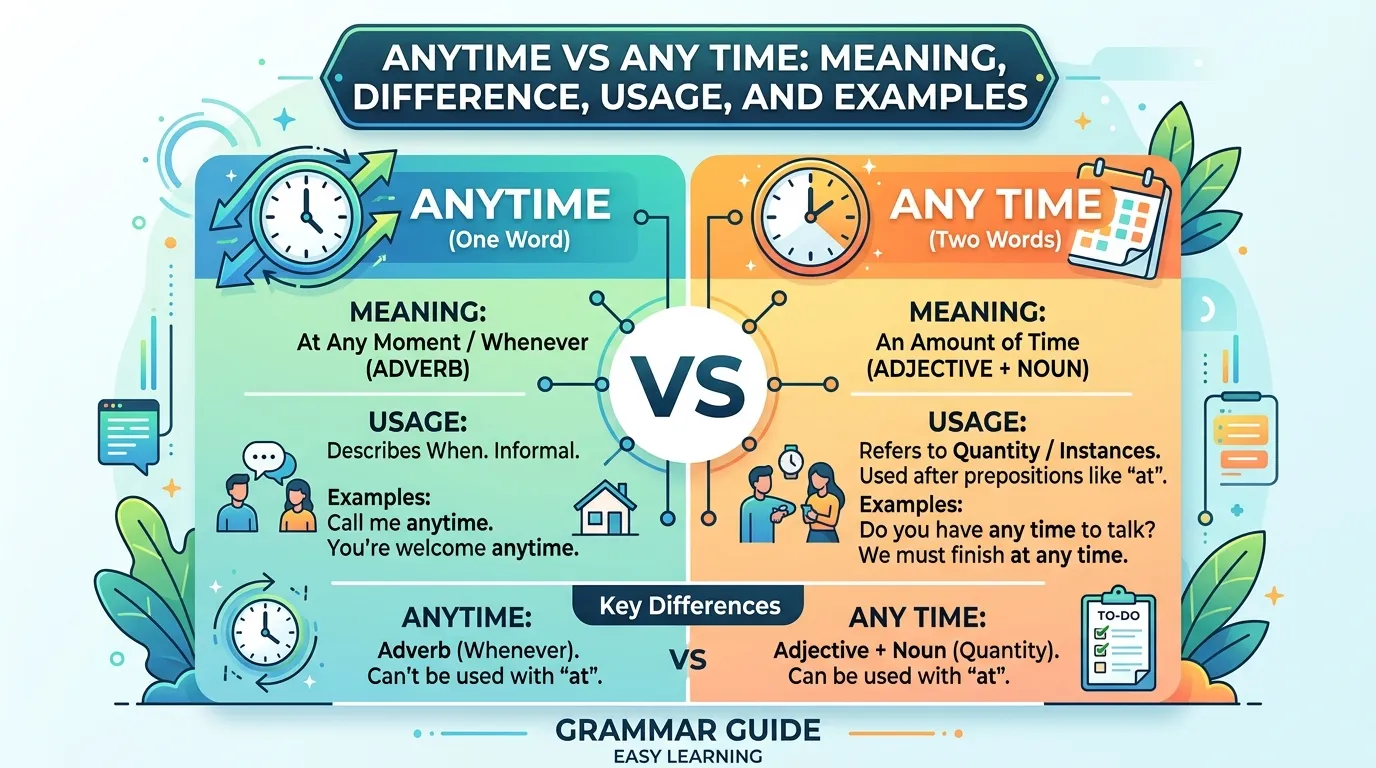
In general, anytime is an adverb meaning at any time or whenever, while any time is usually a two-word phrase that refers to an unspecified amount or point of time. For example, you can write, “Call me anytime,” but “Do you have any time to talk today?” In the first sentence, the word functions as an adverb. In the second, any modifies the noun time.
The distinction becomes especially useful when you are deciding whether to write anytime you need help, any time you need help, or at any time. This guide explains the difference clearly, including grammar, pronunciation, formality, American and British usage, common mistakes, examples, and easy memory tricks.
Quick Answer: Anytime vs Any Time
Anytime and any time are both correct, but their grammatical uses differ.
| Form | Main use | Example |
|---|---|---|
| anytime | Adverb meaning at any time | Call me anytime. |
| any time | Any unspecified period or point of time | Do you have any time today? |
| at any time | Prepositional phrase meaning whenever | You may leave at any time. |
A simple rule is:
Use “anytime” when it means “whenever” or “at any time.” Use “any time” when “time” is being used as a noun.
There is one important nuance: anytime is widely accepted in American English, especially in informal and general writing. However, any time remains necessary in many constructions, particularly after a preposition such as at.
For example:
- Call me anytime. ✓
- Call me any time. ✓
- You can call me at any time. ✓
- You can call me at anytime. ✗
What Does Anytime Mean?
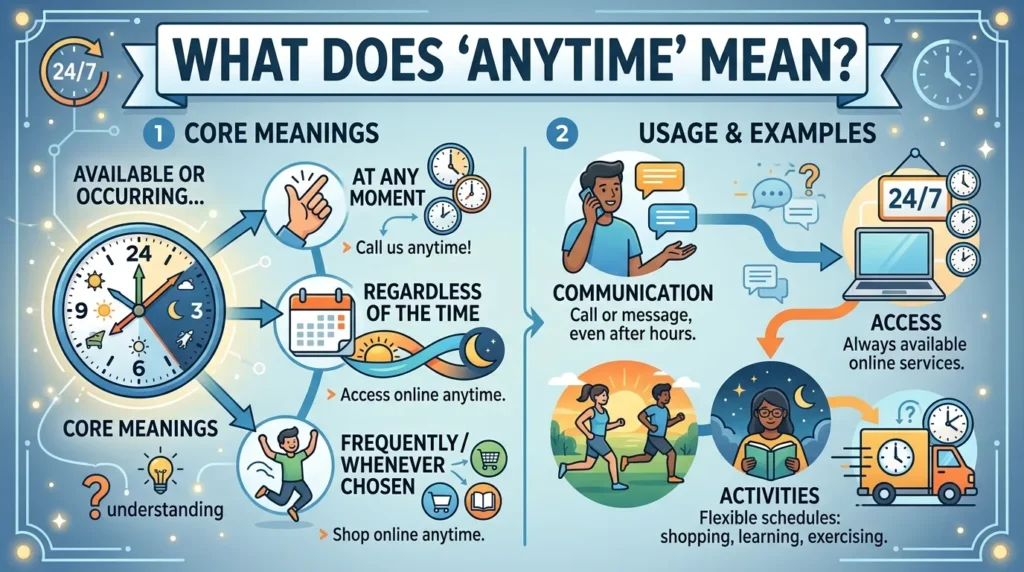
Anytime is an adverb. It generally means at any time, whenever, or whenever it is convenient.
It is commonly used when there is no specific time restriction.
Examples of Anytime
- You can visit anytime.
- Call me anytime you need help.
- I can meet you anytime tomorrow.
- Come over anytime this weekend.
- You can email us anytime.
- She said I could contact her anytime.
- Feel free to ask questions anytime.
In each example, anytime describes when something can happen.
Anytime as an Adverb
Consider this sentence:
You can call me anytime.
The word anytime tells us when the person can call. Therefore, it functions as an adverb.
You can often replace it with:
- whenever
- at any time
- whenever you want
- whenever necessary
For example:
Call me anytime.
can become:
Call me whenever you want.
The meaning remains nearly the same.
What Does Any Time Mean?
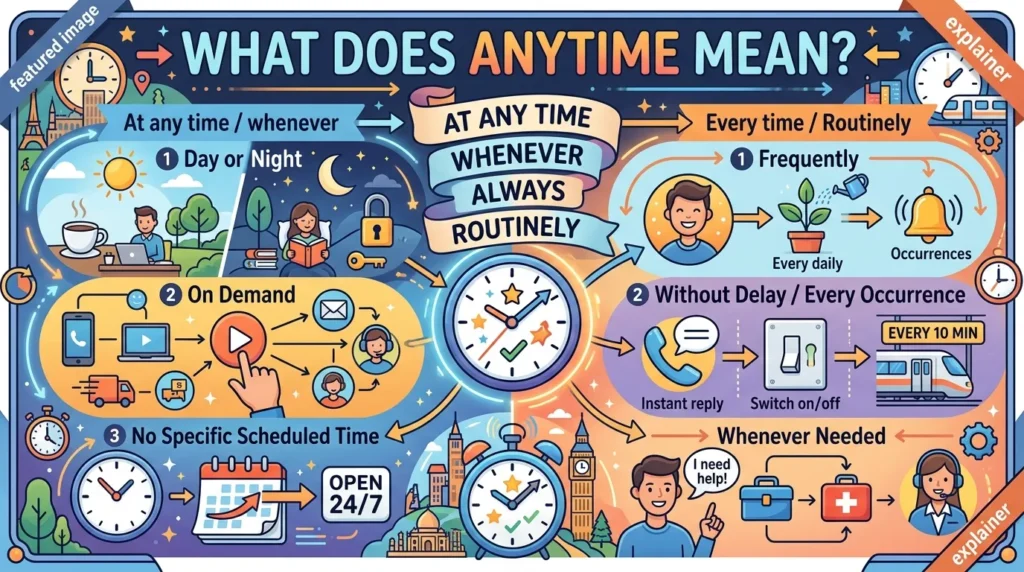
Any time consists of two separate words:
- any = an indefinite determiner
- time = a noun
Together, they usually refer to any amount, period, or point of time.
Examples include:
- Do you have any time for lunch?
- I don’t have any time today.
- Did you spend any time studying?
- We don’t have any time to waste.
- Is there any time available this afternoon?
- I haven’t had any time to finish the report.
Here, time is clearly acting as a noun.
Any Time With a Noun
A useful clue is that any time can often be followed by a phrase that describes the noun.
For example:
- Do you have any time available?
- We need any time possible.
- I don’t have any time left.
- She didn’t have any time to prepare.
Because time is a noun in these examples, the two-word form is appropriate.
The Key Difference Between Anytime and Any Time
The main difference is grammatical function.
Anytime functions as an adverb.
Any time contains the noun time and functions as a noun phrase.
Compare these sentences:
You can call me anytime.
Here, anytime means “whenever.”
Now compare:
Do you have any time to talk?
Here, time refers to an amount or opportunity for time.
This distinction makes the choice easier.
Compare the Meaning
| Sentence | Meaning |
|---|---|
| Call me anytime. | Call whenever you want. |
| Do you have any time? | Do you have some time available? |
| Come by anytime tomorrow. | Come whenever you want tomorrow. |
| Do you have any time tomorrow? | Do you have a period available tomorrow? |
The words look almost identical, but their grammatical roles are different.
When Should You Use Anytime?
Use anytime when it works as an adverb meaning whenever or at any time.
Common examples include:
Invitations
- You can stop by anytime.
- Come and see us anytime.
- You’re welcome here anytime.
- Visit us anytime this week.
Offers of Help
- Call me anytime you need assistance.
- You can ask me anytime.
- Let me know anytime if you need anything.
- Feel free to contact our team anytime.
Flexible Schedules
- I’m available anytime tomorrow.
- We can meet anytime after lunch.
- The manager can speak with you anytime this afternoon.
Digital and Online Communication
- Send us a message anytime.
- You can access your account anytime.
- Customers can submit questions anytime.
These uses are especially common in everyday American English.
When Should You Use Any Time?
Use any time when time is functioning as a noun.
A good test is to ask whether you are talking about an amount, period, or availability of time.
Examples:
- Do you have any time this morning?
- I don’t have any time to finish it.
- We need any time we can get.
- She didn’t spend any time on the project.
- Have you had any time to think about it?
In these sentences, time represents something that can be:
- available
- used
- spent
- wasted
- saved
- needed
- given
- found
That is a strong signal that you need any time.
Anytime vs Any Time After “At”
This is one of the most important rules.
After the preposition at, use any time, not anytime.
Correct:
You can contact us at any time.
Incorrect in standard usage:
You can contact us at anytime.
Why?
Because the established expression is at any time.
The same pattern applies to sentences such as:
- The rules may change at any time.
- You may cancel your subscription at any time.
- The weather can change at any time.
- The alarm could go off at any time.
- Employees may request assistance at any time.
A Simple Memory Trick
Remember:
At + any time
The preposition at keeps any time as two words.
If there is no at, anytime may be appropriate when it means “whenever.”
Compare:
- Call me anytime.
- Call me at any time.
Both communicate almost the same idea, but the grammar is different.
Anytime You Need Help vs Any Time You Need Help
This construction causes frequent confusion.
Both forms can appear in English, but anytime you need help is common in American English when anytime means whenever.
For example:
Call me anytime you need help.
This means:
Call me whenever you need help.
Because anytime can be replaced by whenever, the one-word form works naturally.
However, any time you need help can also be found, especially where the writer wants to emphasize any time as a noun phrase.
For formal or carefully edited writing, whenever you need help is often the clearest alternative because it removes the ambiguity completely.
Anytime vs Any Time in American English
In modern American English, anytime is well established as an adverb.
You will commonly see:
- Call anytime.
- Visit anytime.
- Come anytime.
- Contact me anytime.
- Use the service anytime.
American English also freely uses any time when time is functioning as a noun.
Therefore, American English does not treat one spelling as universally correct and the other as universally incorrect.
The choice depends primarily on grammar and sentence structure.
Anytime vs Any Time in British English
British English also uses both forms, although usage preferences can differ depending on context and style guide.
Any time remains very common, particularly in constructions where time clearly functions as a noun.
For example:
You can contact me at any time.
British writers may also use any time in places where American writers commonly use anytime, especially in more formal or conservative styles.
For international writing, the safest approach is to consider your audience and maintain consistency.
If you are writing specifically for an American audience, anytime is perfectly natural when it functions as an adverb.
Is Anytime One Word or Two Words?
The answer is: both forms are correct.
The one-word form is anytime.
The two-word form is any time.
They are not simply interchangeable in every sentence.
Correct Examples
Anytime
You can call me anytime.
Any time
Do you have any time to talk?
At any time
You can cancel at any time.
Incorrect Example
You can cancel at anytime.
In standard edited English, write:
You can cancel at any time.
Pronunciation of Anytime and Any Time
The pronunciation is essentially the same.
Anytime: /ˈɛniˌtaɪm/
Any time: /ˈɛni taɪm/
Both are pronounced roughly like:
EN-ee-time
The difference is primarily grammatical and written, not a major difference in pronunciation.
This is why speakers may never notice the distinction until they have to write the expression.
Formality and Tone
Anytime generally has a natural, conversational tone.
Examples:
- Call me anytime.
- Come over anytime.
- Message me anytime.
These sound friendly and relaxed.
For formal writing, you may prefer:
- at any time
- whenever appropriate
- whenever necessary
- at your convenience
For example:
Casual:
You can call me anytime.
Professional:
You may contact me at any time.
Professional and polite:
Please contact me at your convenience.
The choice is not always about correctness. Sometimes it is about tone and register.
Formal vs Informal Alternatives
| Casual | Neutral | Formal |
|---|---|---|
| Call me anytime. | Call me at any time. | Please contact me at your convenience. |
| Come anytime. | Come whenever you like. | You may visit at a convenient time. |
| Ask anytime. | Ask whenever necessary. | Please feel free to inquire at any time. |
| Message me anytime. | Contact me at any time. | Please contact our office at your convenience. |
For everyday conversation, anytime is usually natural.
For formal business documents, at any time or at your convenience may sound more polished.
Anytime vs Any Time in Business Writing
Business writing often requires clarity more than conversational brevity.
Consider:
Customers may cancel their membership anytime.
This is understandable and common.
A more formal version is:
Customers may cancel their membership at any time.
The second version sounds more traditional and precise.
For policies, contracts, terms of service, and official notices, at any time is often the safest choice.
Examples:
- The company reserves the right to modify these terms at any time.
- Employees may request assistance at any time.
- Customers can update their information at any time.
- The service may be temporarily unavailable at any time.
Anytime vs Any Time in Academic Writing
Academic writing generally favors precision and formal structures.
Instead of:
Students can contact the professor anytime.
A more formal version might be:
Students can contact the professor at any time.
Or:
Students may contact the professor whenever they have questions.
The choice depends on the discipline and context, but at any time tends to fit formal academic prose better.
Anytime vs Any Time in Journalism
Journalists usually choose the clearest construction for the audience.
Examples:
Officials warned that conditions could change at any time.
Here, at any time is the natural choice.
For a conversational quotation, however, anytime may appear:
“You can call me anytime,” she said.
Good editing preserves the distinction between formal narrative language and natural spoken language.
Anytime vs Any Time in Technical Writing
Technical documentation often uses at any time because it is precise and formal.
Examples:
- Users can reset the device at any time.
- The administrator can disable the feature at any time.
- Data may be exported at any time.
- The connection may terminate at any time.
In user interfaces, advertisements, and short help messages, anytime can sound more approachable:
Access your files anytime.
Both styles can be appropriate depending on the purpose.
Anytime in Sports and Everyday Conversation
There is nothing special about sports grammar. The same distinction applies.
Examples:
- You can join the team anytime.
- The coach can call a timeout at any time.
- We can practice anytime this weekend.
- The score could change at any time.
The first and third examples use anytime as an adverb.
The second and fourth use the phrase at any time.
Is Anytime an Adverb?
Yes.
When anytime means whenever or at any time, it functions as an adverb.
Example:
You can leave anytime.
It modifies the verb phrase can leave by explaining when the action may happen.
Another example:
Call anytime.
Here, anytime tells us when the action call may occur.
Is Any Time a Noun Phrase?
Usually, yes.
In any time, the word time is a noun and any determines or modifies it.
Example:
Do you have any time?
Here, time refers to an amount or period that might be available.
This is the central grammatical difference between the two forms.
Common Collocations With Anytime
Natural expressions include:
- call anytime
- contact me anytime
- visit anytime
- come anytime
- ask anytime
- stop by anytime
- message me anytime
- email me anytime
- use it anytime
- access it anytime
- join anytime
- leave anytime
Examples:
Feel free to contact me anytime.
You can stop by anytime.
Members can access the service anytime.
Common Collocations With Any Time
Common expressions include:
- have any time
- spend any time
- waste any time
- save any time
- find any time
- need any time
- take any time
- give any time
- have any time available
- have any time left
- have any time to spare
Examples:
Do you have any time to spare?
I didn’t have any time to prepare.
We shouldn’t waste any time.
Common Mistakes and Corrections
Mistake: Using Anytime After At
Incorrect:
Contact us at anytime.
Correct:
Contact us at any time.
Mistake: Using Any Time When You Mean Whenever
Awkward:
Call me any time you need help.
Better and more direct:
Call me anytime you need help.
Also possible:
Call me whenever you need help.
Mistake: Assuming One Form Is Always Correct
It is incorrect to think that anytime is always right or that any time is always right.
The sentence determines the correct form.
Compare:
I don’t have any time.
with:
Call me anytime.
Both are correct.
Awkward vs Natural Examples
Example One
Awkward:
I don’t have anytime today.
Natural:
I don’t have any time today.
Why? Time is a noun referring to an amount of available time.
Example Two
Natural:
Call me anytime.
Why? Anytime means whenever.
Example Three
Incorrect in standard edited usage:
You may leave at anytime.
Correct:
You may leave at any time.
Example Four
Natural:
Do you have any time tomorrow?
Here, the speaker asks whether the listener has an available period.
Example Five
Natural:
We can meet anytime tomorrow.
Here, the speaker means whenever tomorrow is convenient.
A Useful Substitution Test
When you are unsure, try replacing anytime with whenever.
If the sentence still makes sense, anytime may be the right choice.
Call me anytime.
→ Call me whenever.
Works.
I don’t have any time.
→ I don’t have whenever.
Does not work.
Therefore, the two-word form is necessary.
Another test is to replace the expression with at any time.
You can visit anytime.
→ You can visit at any time.
Works.
This confirms the adverbial meaning.
But:
I don’t have any time.
→ I don’t have at any time.
Does not work.
Here, any time is functioning as a noun phrase.
Memory Trick for Anytime vs Any Time
Use this simple rule:
Anytime = whenever
Any time = any amount or period of time
Remember these two examples:
Call me anytime.
Do you have any time?
If you can substitute whenever, choose anytime.
If you are talking about having, spending, using, needing, or finding time, choose any time.
And if you see at, remember:
at any time
Synonyms for Anytime
Depending on the sentence, synonyms include:
- whenever
- at any time
- whenever you want
- whenever convenient
- whenever necessary
- whenever possible
Example:
You can call me anytime.
Possible alternatives:
You can call me whenever you want.
You can call me at any time.
You can call me whenever convenient.
Synonyms for Any Time
When any time refers to an amount or period of time, possible alternatives include:
- any amount of time
- some time
- time available
- a moment
- a period
- an opportunity
For example:
Do you have any time to talk?
can become:
Do you have some time to talk?
or:
Do you have a moment to talk?
The best synonym depends on the exact meaning.
Related Words and Expressions
Several expressions are related to anytime and any time:
Anytime Soon
Anytime soon means within the near future.
Do you think the package will arrive anytime soon?
At Any Time
This means whenever or at an unspecified point.
The situation could change at any time.
Any Time Now
This means something is expected very soon.
The bus should arrive any time now.
Notice that any time now is written as two words.
Any Time You Want
This means whenever you want.
You can visit any time you want.
In this construction, any time is traditionally written as two words because it is followed by the clause you want. However, anytime you want is also widely used in American English when the expression functions adverbially.
For maximum clarity in formal writing, whenever you want is an excellent alternative.
Can Anytime Start a Sentence?
Yes.
Examples:
Anytime, just give me a call.
Anytime you need help, let me know.
However, punctuation and style can vary depending on the construction.
In formal writing, whenever or at any time may sometimes provide greater clarity.
Can You Say “Anytime” in Formal Writing?
Yes. Anytime is not inherently incorrect or slang.
However, formal writing may prefer at any time because it can sound more traditional and precise.
For example:
Casual:
Feel free to email me anytime.
Formal:
Please feel free to contact me at any time.
Neither is grammatically wrong when used appropriately.
Is “Anytime” a Slang Word?
No. Anytime is not slang.
It is a standard English adverb.
It is especially common in conversational and informal writing, but it can also appear in edited prose.
The related phrase anytime soon is also standard English.
Does Anytime Mean “Immediately”?
Not necessarily.
This is an important distinction.
Anytime means at any time, not necessarily right now.
For example:
You can call me anytime.
means you may call whenever you choose.
It does not mean:
Call me immediately.
Similarly:
I don’t expect the package anytime soon.
means the package is not expected in the near future.
Does Anytime Mean “Whenever”?
Yes.
In many sentences, anytime can be replaced with whenever.
For example:
Come anytime.
means:
Come whenever you want.
This is one of the easiest ways to understand the word.
Quick Comparison Table
| Feature | Anytime | Any time |
|---|---|---|
| Number of words | One | Two |
| Main grammatical role | Adverb | Noun phrase |
| Basic meaning | Whenever | Any period or amount of time |
| Can mean “whenever”? | Yes | Sometimes in certain constructions |
| Used after “at”? | No | Yes |
| Example | Call me anytime. | Do you have any time? |
| Common in casual writing | Very common | Very common |
| Appropriate in formal writing | Yes | Yes |
| Pronunciation | Same | Same |
Practical Recommendations for Writers
If you are writing for an American audience, use these guidelines:
Use “anytime” when it means:
- whenever
- at any time
- whenever you want
- whenever convenient
Example:
You can contact me anytime.
Use “any time” when time is a noun referring to an amount or period.
Example:
I don’t have any time today.
Use “at any time” after the preposition at.
Example:
The policy may change at any time.
For formal writing, especially contracts, academic papers, policies, and official documents, at any time is often the clearest option.
Final Rule to Remember
The easiest way to remember anytime vs any time is to focus on meaning rather than appearance.
If anytime means whenever, use the one-word form:
Call me anytime.
If time is a noun representing an amount or period, use two words:
I don’t have any time.
After at, always write:
at any time
Once you recognize the grammatical role of time, the distinction becomes much easier.
Frequently Asked Questions
Is anytime or any time correct?
Both are correct. Use anytime as an adverb meaning “whenever,” and use any time when time functions as a noun. After at, use at any time.
Is it correct to say “call me anytime”?
Yes. Call me anytime is standard and natural, especially in American English. It means call me whenever you want or whenever necessary.
Is “at anytime” grammatically correct?
In standard edited English, use at any time, not at anytime.
Correct:
You may contact us at any time.
What is the difference between “anytime” and “any time”?
Anytime is an adverb meaning whenever or at any time. Any time generally refers to an unspecified amount or period of time.
Compare:
Call me anytime.
Do you have any time to talk?
Is “anytime” one word in American English?
Yes. Anytime is a standard American English adverb and is widely used in sentences such as Call me anytime and Come over anytime.
Should I write “anytime soon” or “any time soon”?
Anytime soon is very common in American English.
Example:
Do you think it will happen anytime soon?
The expression means in the near future.
Is “anytime you need help” correct?
Yes. Anytime you need help is common in American English and means whenever you need help.
Example:
Call me anytime you need help.
For maximum clarity in formal writing, you can also write:
Call me whenever you need help.
Which is more formal, “anytime” or “at any time”?
At any time generally has a more formal or traditional tone.
For example:
Customers may cancel at any time.
In casual communication, Customers can cancel anytime sounds more conversational.
Can “any time” be used instead of “anytime”?
Sometimes, but not in every sentence.
For example:
Do you have any time today?
requires the two-word form because time is a noun.
In:
Call me anytime.
the one-word form is natural because it functions as an adverb. In some contexts, any time may also appear, but the grammatical structure and style should guide your choice.
Conclusion
The difference between anytime and any time is mainly a matter of grammar and function.
Use anytime when it means whenever or at any time:
You can call me anytime.
Use any time when time is functioning as a noun and refers to an amount or period:
Do you have any time available?
When the expression follows at, write at any time:
You may contact us at any time.
For American English, anytime is completely standard when used as an adverb. Any time remains essential in noun constructions, so neither spelling should be treated as universally correct.
The best strategy is to look at the job the words are doing in the sentence. If you can replace anytime with whenever, the one-word form is usually appropriate. If you are talking about having, spending, using, needing, or finding time, use two words. When you write with that distinction in mind, choosing between anytime and any time becomes simple and reliable.