Began and begun are both correct forms of the verb begin, but they cannot usually be used in the same grammatical situations.
The simplest rule is this:
Began is the simple past form of begin.
Begun is the past participle of begin and normally needs an auxiliary verb such as has, have, or had.
For example:
- The meeting began at 9 a.m.
- The meeting has begun.
- The meeting had begun before I arrived.
This small difference causes many common grammar mistakes because began and begun describe the same basic action: starting something. The difference is not mainly about meaning. It is about verb tense and grammatical structure.
In this guide, you will learn exactly when to use began and begun, how they differ from begin, how to recognize the correct form quickly, how they sound when spoken, and how they work in everyday, academic, business, journalistic, technical, and casual English.
You will also see practical examples, comparison tables, memory tricks, common errors, natural alternatives, and answers to frequently asked questions about began vs. begun.
Quick Answer: Began vs. Begun
Began is the simple past tense of begin.
- I began my homework after dinner.
- She began working at eight.
- The movie began at 7:30.
Begun is the past participle of begin.
It normally appears with an auxiliary verb:
- I have begun my homework.
- She has begun working.
- The movie had begun when we arrived.
The easiest rule
Use:
begin → present
began → simple past
begun → past participle
Think of the three forms this way:
| Form | Verb | Example |
|---|---|---|
| Present | begin | I begin work at nine. |
| Simple past | began | I began work at nine yesterday. |
| Past participle | begun | I have begun work. |
If you remember only one thing, remember:
Began can stand alone as a past-tense verb. Begun usually needs a helping verb.
What Does “Began” Mean?
Began is the simple past form of begin.
It means that something started at a particular time or during a completed past situation.
Examples
- The class began at 10 a.m.
- He began writing the report yesterday.
- The rain began during the afternoon.
- She began learning Spanish last year.
- The game began shortly after sunset.
In each sentence, the action of starting happened in the past.
Dictionary-style definition
Began: the simple past tense of begin, meaning started or commenced at a past time.
When should you use “began”?
Use began when you are simply telling someone that something started in the past.
For example:
The company began operations in 2015.
The sentence describes a completed past starting point. No auxiliary verb is required.
What Does “Begun” Mean?
Begun is the past participle of begin.
Unlike began, it generally cannot function as the main verb by itself in a standard English sentence.
It usually follows an auxiliary verb such as:
- has
- have
- had
- will have
- may have
- might have
- could have
- should have
Examples
- The show has begun.
- The students have begun their projects.
- The storm had begun before we left.
- The company has begun a new campaign.
- The construction will have begun by next week.
Dictionary-style definition
Begun: the past participle of begin, used with auxiliary verbs to form perfect tenses and certain other verb constructions.
The key difference is grammatical rather than semantic.
Began vs. Begun: The Main Difference
The most important distinction is verb form.
| Feature | Began | Begun |
|---|---|---|
| Base verb | Begin | Begin |
| Verb form | Simple past | Past participle |
| Can usually stand alone? | Yes | No |
| Common helpers | Not required | Has, have, had, etc. |
| Example | She began work. | She has begun work. |
| Main use | Past event | Perfect construction |
Compare these sentences:
The concert began at eight.
This tells us when the concert started.
The concert has begun.
This tells us that the concert has started, with a connection to the present.
The concert had begun before we arrived.
This tells us that the concert started before another past event.
The words describe the same basic action, but their grammatical jobs are different.
Why Do People Confuse Began and Begun?
There are several reasons.
1. Both come from “begin”
The verb begin is irregular:
begin → began → begun
Unlike regular verbs such as:
walk → walked → walked
the three forms of begin look different.
2. They have similar meanings
Both forms communicate the idea of starting something.
That makes it easy to choose the wrong form when writing quickly.
3. “Begun” sounds like a past-tense word
Learners sometimes assume that because begun describes something that happened, it can be used alone as the past tense.
It cannot normally be used that way.
Incorrect:
She begun the project yesterday.
Correct:
She began the project yesterday.
Or:
She has begun the project.
4. English uses auxiliary verbs in perfect tenses
The distinction becomes clearer when you understand the perfect tenses.
- has begun = present perfect
- have begun = present perfect
- had begun = past perfect
- will have begun = future perfect
The Grammar Behind Began and Begun
Understanding verb forms makes the difference much easier.
The verb begin has three main forms:
- Begin — base form
- Began — simple past
- Begun — past participle
Present
I begin work at eight.
Simple past
I began work at eight yesterday.
Present perfect
I have begun work.
Past perfect
I had begun work before she called.
Future perfect
I will have begun work by eight.
The important point is that begun does not normally replace began.
When to Use Began
Use began when you are describing a completed action in the past.
With a specific past time
- The meeting began at noon.
- The lecture began at 2 p.m.
- The match began yesterday.
- The festival began on Friday.
With a past sequence
- She opened her notebook and began writing.
- He entered the room and began speaking.
- The teacher arrived and began the lesson.
With historical events
- The Industrial Revolution began in Britain.
- The campaign began several years ago.
- The project began as a small experiment.
In storytelling
Began is particularly common in narratives:
The sun disappeared behind the hills, and the wind began to rise.
Here, the writer is describing events that occurred in the past.
When to Use Begun
Use begun when the grammar requires a past participle.
The most common pattern is:
has/have/had + begun
Present perfect
Use has begun or have begun when a past action has a connection to the present.
- The meeting has begun.
- The students have begun their exams.
- The company has begun hiring.
- We have begun planning the event.
Past perfect
Use had begun when one past event happened before another past event.
- The movie had begun before we entered.
- The rain had begun when I left home.
- The team had begun training before the new coach arrived.
Future perfect
Use will have begun when an action will already be underway or started by a future point.
- By Monday, construction will have begun.
- By next month, the company will have begun its expansion.
Began vs. Begun in Everyday Sentences
Here are some natural examples.
| Incorrect | Correct | Why |
|---|---|---|
| She begun the lesson yesterday. | She began the lesson yesterday. | Simple past needs began. |
| They began already. | They have begun already. | Perfect construction needs begun. |
| He has began the work. | He has begun the work. | Has requires the past participle. |
| We had began eating. | We had begun eating. | Had requires the past participle. |
| The show begun at 8. | The show began at 8. | Simple past uses began. |
Began vs. Begun With “Has,” “Have,” and “Had”
This is one of the easiest ways to choose correctly.
Has + begun
Use with a singular third-person subject.
- She has begun studying.
- The company has begun construction.
- The game has begun.
Have + begun
Use with I, you, we, they and plural subjects.
- I have begun reading.
- We have begun the process.
- They have begun negotiations.
Had + begun
Use for the past perfect.
- I had begun eating before she arrived.
- They had begun the meeting when we entered.
- The storm had begun before sunrise.
A useful formula
has/have/had + begun
If you see one of these helping verbs, begun is usually the form you need.
Began vs. Begun Pronunciation
Although the words are closely related, their vowel sounds are different in standard American English.
Began has two syllables.
Begun also has two syllables.
The main difference is in the final vowel sound.
When speaking, place natural stress on the second syllable of both forms.
Pronunciation matters because learners sometimes pronounce begun as if it were spelled like began.
The safest way to remember the difference is to associate the words with their grammatical roles rather than relying only on spelling or sound.
Is “Begun” Ever Correct Without “Has,” “Have,” or “Had”?
Yes, but this requires a little more explanation.
Begun is a past participle, so it can appear in constructions other than the basic perfect tense.
For example:
Work begun before the deadline must be completed carefully.
Here, begun is part of a reduced or participial construction.
Another example:
The project, begun several years ago, is finally complete.
In ordinary everyday sentences, however, the most common pattern is:
has/have/had + begun
So if you are deciding between:
She begun the project.
and
She began the project.
choose began.
If you want to use begun, add an appropriate auxiliary:
She has begun the project.
Began vs. Begun in Formal Writing
Both forms are completely standard in formal American English.
The choice depends on the grammar of the sentence, not the level of formality.
Academic writing
The study began in 2020.
Researchers have begun examining the results.
Business writing
The company began operations in January.
The company has begun expanding into new markets.
Journalism
The investigation began last month.
Authorities have begun reviewing the evidence.
Technical writing
The testing process began after installation.
The system has begun generating diagnostic reports.
There is no need to avoid either word in professional writing.
Began vs. Begun in American and British English
The distinction between began and begun is essentially the same in American and British English.
American English:
The meeting began at nine.
The meeting has begun.
British English:
The meeting began at nine.
The meeting has begun.
Regional differences in English may affect vocabulary, spelling, pronunciation, or certain grammatical preferences, but began vs. begun follows the same basic rule in both major varieties.
The important issue is tense and grammatical structure, not geography.
Began vs. Begun in Academic Writing
Academic writers frequently use both forms.
Use “began” for a past research event
The experiment began in March.
Use “begun” for an ongoing development
Researchers have begun investigating the relationship.
This distinction can subtly change the meaning.
The researchers began the study in 2022.
This emphasizes a past starting point.
The researchers have begun the study.
This emphasizes that the study has now started and is relevant to the present.
Began vs. Begun in Business Writing
Business communication often uses both forms when discussing projects, campaigns, hiring, negotiations, and operations.
Past event
The company began operations in 2018.
Recent development
The company has begun expanding its regional offices.
Earlier past event
The company had begun restructuring before the new CEO arrived.
A useful business-writing tip is to avoid changing the tense unnecessarily.
If you are reporting a completed historical event, began is often appropriate.
If you are emphasizing a recently started action with present relevance, has begun is often better.
Began vs. Begun in Sports Writing
Sports reporting uses both forms naturally.
Began
The game began at 7 p.m.
The team began the season with a victory.
Begun
The second half has begun.
The team has begun preparing for its next opponent.
Past perfect
The match had begun before the television broadcast started.
Again, the grammar determines the choice.
Began vs. Begun in News and Journalism
Journalists often use began for historical or completed events.
The investigation began in January.
They use has begun when reporting a development that remains relevant.
Officials have begun reviewing the documents.
The distinction can help readers understand whether the writer is focusing on when something started or the fact that it has now started.
Began vs. Begun in Casual Conversation
In everyday speech, both are common.
Began
We began talking after class.
Begun
We have begun talking about the problem.
In very casual American conversation, people may often choose simpler constructions such as:
We started talking.
instead of:
We began talking.
Started is usually more conversational, while began can sound slightly more formal or literary.
However, began is perfectly natural in everyday English.
Began vs. Started
Because began and started are close synonyms, many sentences can use either one.
Natural
The meeting began at nine.
The meeting started at nine.
Both are correct.
With present perfect
The meeting has begun.
The meeting has started.
Again, both are correct.
However, begun and started are not interchangeable from a grammatical-form perspective.
You cannot replace:
She began the project.
with:
She begun the project.
But you can replace began with started:
She started the project.
Synonyms for Began and Begun
The best synonym depends on the context.
Common synonyms
- started
- commenced
- initiated
- launched
- opened
- originated
- introduced
- embarked on
- set in motion
More formal alternatives
Commenced and initiated are more formal.
The investigation commenced in June.
The organization initiated a new program.
Business contexts
Launched is often better when discussing a product, campaign, service, or business initiative.
The company launched a new service.
Everyday contexts
Started is usually the most natural choice.
I started my homework at seven.
Antonyms of Begin
Common opposites include:
- end
- finish
- conclude
- stop
- terminate
- complete
- cease
For example:
The meeting began at nine and ended at ten.
The project began in May and was completed in August.
Related Words and Word Family
The word begin belongs to a useful family of related terms.
| Word | Meaning |
|---|---|
| Begin | Start something |
| Began | Simple past of begin |
| Begun | Past participle of begin |
| Beginning | The starting point or act of starting |
| Beginner | A person who is new to something |
| Beginnings | Early stages or origins |
| Beginner-level | Designed for someone with little experience |
Examples
- The beginning of the book was exciting.
- She is a beginner in French.
- Every project has its beginnings.
Common Collocations With Began
Certain words frequently appear with began.
Began to
- began to rain
- began to laugh
- began to change
- began to grow
- began to understand
- began to improve
Examples:
The weather began to change.
She began to understand the problem.
Began working
He began working at the company in 2024.
Began studying
She began studying English last year.
Began speaking
The speaker began speaking after the introduction.
Common Collocations With Begun
Has begun
- has begun working
- has begun growing
- has begun changing
- has begun improving
- has begun expanding
Have begun
- have begun negotiations
- have begun construction
- have begun discussions
- have begun preparing
- have begun testing
Had begun
- had begun earlier
- had begun before
- had begun working
- had begun developing
- had begun preparing
Common Mistakes With Began and Begun
Mistake 1: “I have began”
Incorrect:
I have began the project.
Correct:
I have begun the project.
Why?
Have requires the past participle.
Mistake 2: “She begun yesterday”
Incorrect:
She begun the work yesterday.
Correct:
She began the work yesterday.
Why?
There is no auxiliary verb, and the sentence describes a simple past event.
Mistake 3: “They had began”
Incorrect:
They had began the meeting.
Correct:
They had begun the meeting.
Why?
Had + past participle creates the past perfect.
Mistake 4: “The movie has began”
Incorrect:
The movie has began.
Correct:
The movie has begun.
Mistake 5: Using “begun” as the simple past
Incorrect:
We begun the process last week.
Correct:
We began the process last week.
Awkward vs. Natural Examples
Awkward
The project begun last year is still unfinished.
This is not necessarily impossible grammatically, but it can sound compressed and formal.
More natural
The project that began last year is still unfinished.
Or:
The project, begun last year, is still unfinished.
The second version uses a participial construction and works well in formal writing.
Awkward
The team begun training yesterday.
Natural
The team began training yesterday.
Awkward
The team has began training.
Natural
The team has begun training.
A Simple Memory Trick for Began vs. Begun
Try this:
Began = back then
If the action happened at a specific completed point in the past, use began.
She began the job last year.
Begun = helper needed
If you see has, have, or had, think begun.
She has begun the job.
She had begun the job.
This is not a rule for every possible grammatical construction, but it is an excellent shortcut for everyday writing.
A Three-Step Test for Choosing the Correct Word
When you are unsure, follow these steps.
Step 1: Find the subject and verb
Ask what action is being described.
The students ___ their assignment.
Step 2: Look for a helping verb
Is there has, have, or had?
If yes, begun is usually correct.
The students have begun their assignment.
Step 3: If there is no helping verb, ask whether the action happened in the past
If yes, use began.
The students began their assignment yesterday.
Began vs. Begun: A Detailed Comparison
| Question | Began | Begun |
|---|---|---|
| Is it a correct English word? | Yes | Yes |
| Is it a form of begin? | Yes | Yes |
| Simple past? | Yes | No |
| Past participle? | No | Yes |
| Works after “has”? | No | Yes |
| Works after “have”? | No | Yes |
| Works after “had”? | No | Yes |
| Can describe a past starting event? | Yes | Yes, within a participial/perfect construction |
| Common in storytelling? | Yes | Less common |
| Common in perfect tenses? | No | Yes |
| Common in formal English? | Yes | Yes |
| Used in American English? | Yes | Yes |
| Used in British English? | Yes | Yes |
Began vs. Begun in Different Writing Contexts
American English
Both are standard.
Past event:
The program began in 2023.
Current development:
The program has begun expanding.
British English
The same basic distinction applies.
The program began in 2023.
The program has begun expanding.
Academic writing
Use the form required by the tense.
The study began in January.
Researchers have begun collecting data.
Business writing
The company began operations last year.
The company has begun hiring new employees.
Journalism
The investigation began last month.
Investigators have begun reviewing the case.
Technical writing
The process began after initialization.
The system has begun processing the request.
Blogging
Both work naturally:
My journey began with a simple idea.
I have begun exploring new ways to improve my writing.
Casual writing
Started may sound more conversational:
We started talking.
But began remains completely correct:
We began talking.
Can You Say “Has Began”?
No, not in standard English.
Use:
has begun
Not:
has began
The reason is simple:
has + past participle
Since begun is the past participle, it follows has.
The same applies to:
- have begun
- had begun
- will have begun
- may have begun
- might have begun
- could have begun
Can You Say “Had Begun”?
Yes.
Had begun is completely correct.
It is the past perfect form.
Example:
The meeting had begun before I arrived.
This means the meeting started first, and your arrival happened later.
Timeline:
Meeting began → You arrived
Another example:
The rain had begun before we left.
Timeline:
Rain began → We left
Can You Say “Began to”?
Yes. This is a very common construction.
Examples:
- She began to cry.
- He began to laugh.
- The weather began to improve.
- They began to understand.
- The child began to walk.
You can often also use the -ing form:
She began crying.
He began laughing.
Both patterns are standard.
Can You Say “Began + -ing”?
Yes.
Examples:
- She began working.
- They began talking.
- He began studying.
- We began planning.
- The machine began operating.
Both of these are usually acceptable:
She began to work.
She began working.
The choice can depend on style and context, but neither is inherently wrong.
Began vs. Begun vs. Beginning
These three forms are often confused.
Began
Simple past:
She began reading.
Begun
Past participle:
She has begun reading.
Beginning
Present participle or gerund:
She is beginning to read.
Or:
The beginning of the book was interesting.
Understanding these forms helps prevent many verb errors.
Etymology and Word History
The verb begin has a long history in English and comes from an old Germanic verb family.
Its unusual forms developed through historical changes in English rather than through a modern spelling rule.
The pattern:
begin → began → begun
is therefore an example of an irregular verb.
The vowel changes are part of a broader historical pattern found in many English irregular verbs.
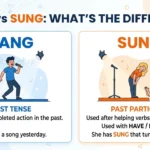
Compare:
- sing → sang → sung
- ring → rang → rung
- drink → drank → drunk
- begin → began → begun
These patterns can help learners recognize why began and begun look so different even though they belong to the same verb.
Why “Began” and “Begun” Are Both Correct
A common misconception is that one must be correct and the other incorrect.
That is not true.
Both began and begun are completely correct English words.
The question is not:
Which spelling is correct?
The better question is:
Which verb form does this sentence require?
Use began for the simple past.
Use begun as the past participle.
That distinction solves most usage questions.
Practical Recommendations for Better Writing
When writing, use these guidelines:
- Use “began” for a straightforward past event.
- The meeting began at nine.
- Use “begun” after has, have, or had.
- The meeting has begun.
- Do not use “begun” as a replacement for “began.”
- Incorrect: She begun yesterday.
- Correct: She began yesterday.
- Check the auxiliary verb.
- Has + begun
- Have + begun
- Had + begun
- Use “started” when you want a more conversational alternative.
- The meeting started at nine.
- Keep tense consistent within a paragraph.
Avoid switching between past and present perfect without a reason.
Quick Practice: Began or Begun?
Choose the correct form.
1. The movie ___ at 8 p.m.
Answer: began
The movie began at 8 p.m.
2. The movie has ___.
Answer: begun
The movie has begun.
3. We ___ the project last Monday.
Answer: began
We began the project last Monday.
4. We have ___ the project.
Answer: begun
We have begun the project.
5. They had ___ before we arrived.
Answer: begun
They had begun before we arrived.
6. She ___ studying English in 2022.
Answer: began
She began studying English in 2022.
7. She has ___ studying English.
Answer: begun
She has begun studying English.
Common Questions
Is “began” or “begun” correct?
Both are correct. They are different forms of the irregular verb begin. Began is the simple past form, while begun is the past participle.
Is it “I began” or “I begun”?
Use I began when speaking about a simple past action.
I began the assignment yesterday.
Use I have begun when using the present perfect.
I have begun the assignment.
“I begun” by itself is not standard English.
Is “has began” correct?
No. The standard form is has begun.
Correct: She has begun working.
Incorrect: She has began working.
Is “had began” correct?
No. Use had begun.
Correct: They had begun the meeting.
Incorrect: They had began the meeting.
What is the past tense of begin?
The simple past tense of begin is began.
Yesterday, I began reading the book.
What is the past participle of begin?
The past participle is begun.
I have begun reading the book.
Can “begun” be used alone?
Usually, no. In standard everyday English, begun normally appears with an auxiliary verb such as has, have, or had.
However, participial constructions can use begun without an auxiliary:
The project, begun last year, is nearly finished.
Is “began” more formal than “started”?
Began can sound slightly more formal or literary than started, but both are standard. In casual conversation, started is often more common.
Is “began to” correct?
Yes.
She began to laugh.
You can also say:
She began laughing.
Both constructions are standard.
Final Comparison
The difference between began and begun becomes simple once you focus on grammar instead of meaning.
Began is the simple past tense:
The class began at nine.
Begun is the past participle:
The class has begun.
The most useful pattern to memorize is:
Begin → Began → Begun
And the practical rule is:
Use “began” for a simple past event. Use “begun” when the grammar calls for a past participle, especially after has, have, or had.
When you are unsure, look for the helping verb. If the sentence contains has, have, or had, begun is usually the correct choice.
If there is no helping verb and you are simply describing something that started in the past, began is usually the right form.
For American English, British English, academic writing, business communication, journalism, technical writing, sports reporting, blogging, and everyday conversation, the same fundamental distinction applies.
So:
The meeting began. ✅
The meeting has begun. ✅
The meeting had begun. ✅
The meeting has began. ❌
Once you learn this pattern, began vs. begun is no longer a difficult choice. The words are both correct; they simply belong to different parts of the English verb system.