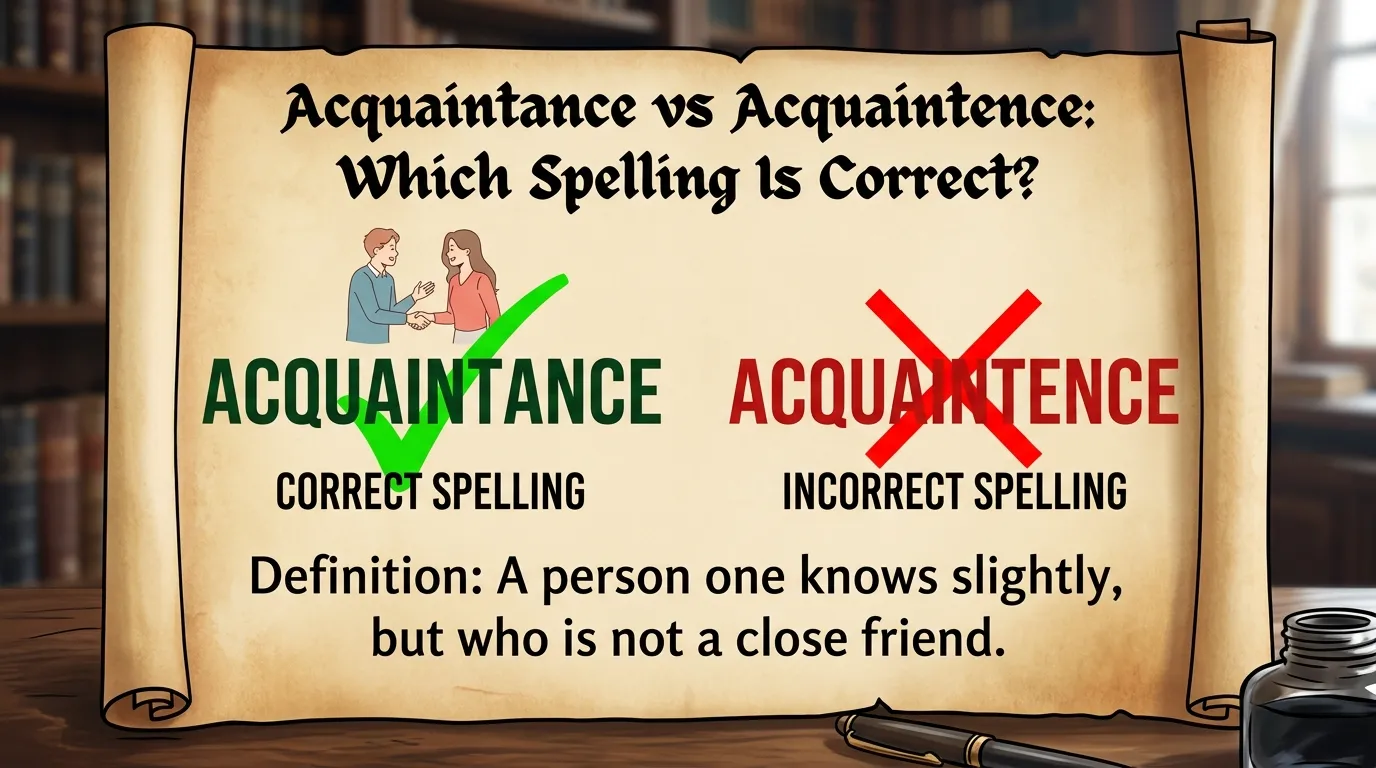
If you’ve searched for acquaintance vs acquaintence, you’re probably wondering which spelling is correct. The short answer is simple: acquaintance is the correct spelling, while acquaintence is a common misspelling.
Even native English speakers often confuse these spellings because the word’s pronunciation doesn’t clearly reveal how it’s spelled. Spell-checkers frequently catch the mistake, but understanding why it happens can help you avoid it permanently.
In this complete guide, you’ll learn:
- Which spelling is correct
- Why acquaintence is incorrect
- The meaning of acquaintance
- How to pronounce and use the word correctly
- Grammar rules and word forms
- Common mistakes to avoid
- Easy memory tricks
- Real-life examples
- Formal and informal usage
- Synonyms, antonyms, collocations, and idioms
- Frequently asked questions
By the end of this guide, you’ll confidently know when and how to use acquaintance correctly in every type of writing.
Quick Answer
| Question | Answer |
|---|---|
| Is acquaintance correct? | ✅ Yes |
| Is acquaintence correct? | ❌ No |
| Which spelling should you use? | Acquaintance |
| American English | Acquaintance |
| British English | Acquaintance |
| Formal writing | Acquaintance |
| Informal writing | Acquaintance |
Always use “acquaintance.”
Acquaintance vs Acquaintence: The Main Difference
The difference is surprisingly simple.
| Word | Correct? | Meaning |
|---|---|---|
| Acquaintance | ✅ Correct | Someone you know but are not close friends with |
| Acquaintence | ❌ Incorrect | Misspelling |
Only acquaintance appears in English dictionaries.
The spelling acquaintence is an error caused by confusion over the ending.
Is “Acquaintence” Ever Correct?
No.
Acquaintence is never considered correct English.
Whether you’re writing:
- Emails
- Essays
- Books
- Newspapers
- Business reports
- Social media posts
- Academic papers
…the correct spelling is always:
acquaintance
Dictionary Definition of Acquaintance
Noun
Acquaintance
A person whom someone knows but who is not a close friend.
Secondary Meaning
Knowledge or familiarity with something.
Examples:
- She has an acquaintance with French literature.
- His acquaintance with computer programming helped him get the job.
Why Do People Misspell Acquaintance?
Several reasons contribute to this common mistake.
1. Pronunciation Is Misleading
When spoken quickly, many people hear:
acquaint-ence
instead of
acquaint-ance
That causes them to spell it incorrectly.
2. English Has Many “-ence” Words
English contains words like:
- difference
- confidence
- existence
- dependence
- competence
Because these end in -ence, writers naturally assume acquaintence follows the same pattern.
It doesn’t.
3. The Ending Isn’t Pronounced Clearly
In normal speech:
acquaintance
sounds almost like
acquaintence
That’s why spelling mistakes happen frequently.
Meaning of Acquaintance
An acquaintance is someone you know casually.
They are not:
- your best friend
- a close family member
- your spouse
- someone with whom you have a deep relationship
Instead, they’re someone you’ve met and recognize.
Examples include:
- a neighbor
- a coworker
- a former classmate
- someone from church
- a fellow gym member
Different Meanings of Acquaintance
1. A Person You Know
Example:
Sarah is an acquaintance from college.
2. Familiarity With Something
Example:
His acquaintance with local laws impressed everyone.
3. Knowledge Through Experience
Example:
She has little acquaintance with rural life.
Pronunciation
Acquaintance
Pronounced approximately as:
uh-KWAYN-tuhns
The ending sounds soft, which explains why people often spell it incorrectly.
Grammar
Acquaintance is a noun.
Examples:
Correct:
- My acquaintance lives nearby.
- We became acquaintances years ago.
- I made several new acquaintances.
Incorrect:
- She is acquaintence.
- He is my acquaintence.
Word Forms
| Form | Example |
|---|---|
| acquaint (verb) | I became acquainted with him. |
| acquainted (adjective) | We are acquainted. |
| acquaintance (noun) | She’s my acquaintance. |
| acquaintances (plural noun) | I invited several acquaintances. |
Etymology
The word comes from Old French and ultimately from Latin roots relating to becoming known or recognized.
The verb acquaint appeared first.
Later, English developed the noun:
acquaintance
This explains why the spelling doesn’t follow many modern “-ence” patterns.
Regional Variations
Good news:
There are no spelling differences between major English varieties.
| Region | Preferred Spelling |
|---|---|
| United States | acquaintance |
| United Kingdom | acquaintance |
| Canada | acquaintance |
| Australia | acquaintance |
| New Zealand | acquaintance |
| International English | acquaintance |
Everyone uses the same spelling.
Formal vs Informal Usage
Formal
- professional emails
- legal writing
- journalism
- academic papers
- official reports
Example:
The witness was merely an acquaintance of the defendant.
Informal
Example:
He’s just an acquaintance from work.
The word works perfectly in both formal and casual situations.
Tone
Compared to “friend,” acquaintance sounds more distant.
Compare:
Friend
Lisa is my friend.
Acquaintance
Lisa is an acquaintance.
The second sentence suggests they know each other but aren’t especially close.
Contextual Differences
Social Relationships
Example:
Most of my acquaintances live nearby.
Business
Example:
The client was introduced through a mutual acquaintance.
Academic
Example:
Students gained acquaintance with research methods.
Journalism
Example:
Police interviewed several acquaintances of the suspect.
Professional Writing
Example:
Professional acquaintances often become valuable networking contacts.
Usage Comparison
| Situation | Friend | Acquaintance |
|---|---|---|
| Close relationship | ✅ | ❌ |
| Casual relationship | ❌ | ✅ |
| Family member | Usually | No |
| Coworker | Sometimes | Often |
| Neighbor | Sometimes | Often |
Common Collocations
Native speakers often say:
- close acquaintance
- mutual acquaintance
- casual acquaintance
- business acquaintance
- longtime acquaintance
- former acquaintance
- social acquaintance
- professional acquaintance
- passing acquaintance
- personal acquaintance
Examples:
We met through a mutual acquaintance.
She’s a longtime acquaintance.
Common Expressions
- make someone’s acquaintance
- renew an acquaintance
- casual acquaintance
- mutual acquaintance
- slight acquaintance
Example:
It was a pleasure to make your acquaintance.
Related Words
- friend
- colleague
- neighbor
- coworker
- associate
- companion
- contact
- classmate
- peer
- connection
Synonyms
Depending on context:
- associate
- contact
- colleague
- connection
- peer
- coworker
- companion
- ally
- associate
- familiar person
Antonyms
- stranger
- enemy
- opponent
- rival
- unknown person
Acquaintance vs Friend
| Friend | Acquaintance |
|---|---|
| Close relationship | Casual relationship |
| Emotional bond | Limited connection |
| Frequent interaction | Occasional interaction |
| Trust | Basic familiarity |
| Personal support | Recognition only |
Example:
Mark is my friend.
versus
Mark is an acquaintance.
These sentences communicate very different relationships.
Acquaintance vs Associate
| Acquaintance | Associate |
|---|---|
| Personal familiarity | Professional relationship |
| Casual | Often work-related |
| Social | Business-oriented |
Acquaintance vs Colleague
A colleague is someone you work with.
An acquaintance is simply someone you know.
Sometimes a colleague becomes an acquaintance—or eventually a friend.
Common Mistakes
Incorrect
She is my acquaintence.
Correct
She is my acquaintance.
Incorrect
We became acquaintences.
Correct
We became acquaintances.
Incorrect
I have many acquaintences.
Correct
I have many acquaintances.
Awkward vs Natural Examples
Awkward
He is one of my acquaintence.
Natural
He is one of my acquaintances.
Awkward
She’s more than an acquaintance but less than a friend.
Natural
She’s somewhere between an acquaintance and a close friend.
Everyday Examples
- I met an acquaintance at the grocery store.
- He’s only a business acquaintance.
- We share a mutual acquaintance.
- She introduced me to one of her acquaintances.
- I recognized him as an old acquaintance.
- Our acquaintance began years ago.
- They remained casual acquaintances.
- She has little acquaintance with city life.
- We renewed our acquaintance after ten years.
- He’s more of an acquaintance than a friend.
Academic Writing Examples
- The participants had prior acquaintance with the research topic.
- Students gained acquaintance with laboratory procedures.
- The author demonstrates deep acquaintance with medieval history.
Business Writing Examples
- We met through a mutual business acquaintance.
- Please contact your acquaintance at the regional office.
- Several professional acquaintances attended the conference.
Journalism Examples
- Police interviewed acquaintances of the victim.
- According to acquaintances, he recently moved.
- Friends and acquaintances gathered to remember her.
Blogging Examples
- Every acquaintance has a story worth hearing.
- Sometimes an acquaintance becomes your closest friend.
Technical Usage
The word is uncommon in highly technical fields but may appear when describing someone’s familiarity with a subject.
Example:
Engineers should have acquaintance with industry standards.
Sports Usage
Example:
My acquaintance from the local soccer club invited me to join the team.
Sports writers generally use the word in its ordinary social meaning.
Political Usage
Example:
The candidate denied any personal acquaintance with the lobbyist.
This usage often appears in news reports discussing relationships or associations.
Memory Tricks
Remember this simple phrase:
You make an acquaintance, not an acquaintence.
Another trick:
The word ends with:
ANCE
Just like:
- assistance
- acceptance
- performance
Think:
Acquaint + ance
Spelling Pattern
Correct:
- acquaintance
- appearance
- importance
- assistance
Not:
- acquaintence
The ending is always -ance.
Best Usage Recommendations
For every type of writing:
| Writing Style | Recommended Spelling |
|---|---|
| American English | acquaintance |
| British English | acquaintance |
| Academic | acquaintance |
| Journalism | acquaintance |
| Business | acquaintance |
| Technical | acquaintance |
| Legal | acquaintance |
| Blogging | acquaintance |
| Social Media | acquaintance |
| Casual Writing | acquaintance |
There are no exceptions.
Quick Comparison Table
| Feature | Acquaintance | Acquaintence |
|---|---|---|
| Correct spelling | ✅ | ❌ |
| Dictionary word | ✅ | ❌ |
| Used worldwide | ✅ | ❌ |
| Academic writing | ✅ | ❌ |
| Professional writing | ✅ | ❌ |
| Recommended | ✅ Always | ❌ Never |
Final Writing Tips
When proofreading:
- Look for the ending -ance.
- Never replace it with -ence.
- Use a spell checker, but also learn the correct spelling.
- Remember that pronunciation can be misleading.
- Think of acquaintance as a fixed dictionary word rather than sounding it out.
With practice, the correct spelling will become automatic.
Frequently Asked Questions
Is “acquaintence” a real English word?
No. Acquaintence is a misspelling. The only correct spelling is acquaintance.
Which spelling is correct: acquaintance or acquaintence?
Acquaintance is the correct spelling in all forms of English.
Why do people spell acquaintance incorrectly?
Many people hear the ending as “-ence” instead of “-ance,” and they compare it to other English words that end in “-ence.”
Does American English use “acquaintence”?
No. American English uses acquaintance, just like British English and other major varieties of English.
What does acquaintance mean?
An acquaintance is a person you know but are not closely connected to. The word can also mean familiarity or knowledge of a subject.
Is an acquaintance the same as a friend?
No. A friend is someone with whom you have a close relationship, while an acquaintance is someone you know casually.
Can “acquaintance” be used in formal writing?
Yes. It is appropriate for academic, legal, business, journalistic, and professional writing, as well as everyday conversation.
How do you remember the correct spelling of acquaintance?
Remember that the word ends in -ance, not -ence. Thinking of the phrase “make an acquaintance” and practicing the correct spelling can help reinforce it.
Can acquaintance refer to knowledge instead of a person?
Yes. Besides referring to a person, acquaintance can also mean familiarity or knowledge gained through experience, such as “an acquaintance with classical music.”
What is the plural of acquaintance?
The plural form is acquaintances. For example: “She invited several acquaintances to the networking event.”
Conclusion
When comparing acquaintance vs acquaintence, the answer is clear: acquaintance is the only correct spelling. It is recognized in dictionaries, accepted in American and British English, and appropriate for every type of writing—from casual conversations to academic papers and business reports. The spelling acquaintence is simply a common error caused by pronunciation and confusion with other -ence words.
Remember that an acquaintance is someone you know but are not especially close to, or it can describe familiarity with a subject. By learning the correct -ance ending, practicing common collocations like mutual acquaintance and make someone’s acquaintance, and recognizing the difference between an acquaintance and a friend, you’ll avoid this mistake with confidence. Consistent, accurate spelling improves clarity, professionalism, and credibility in every piece of writing.