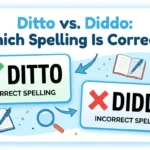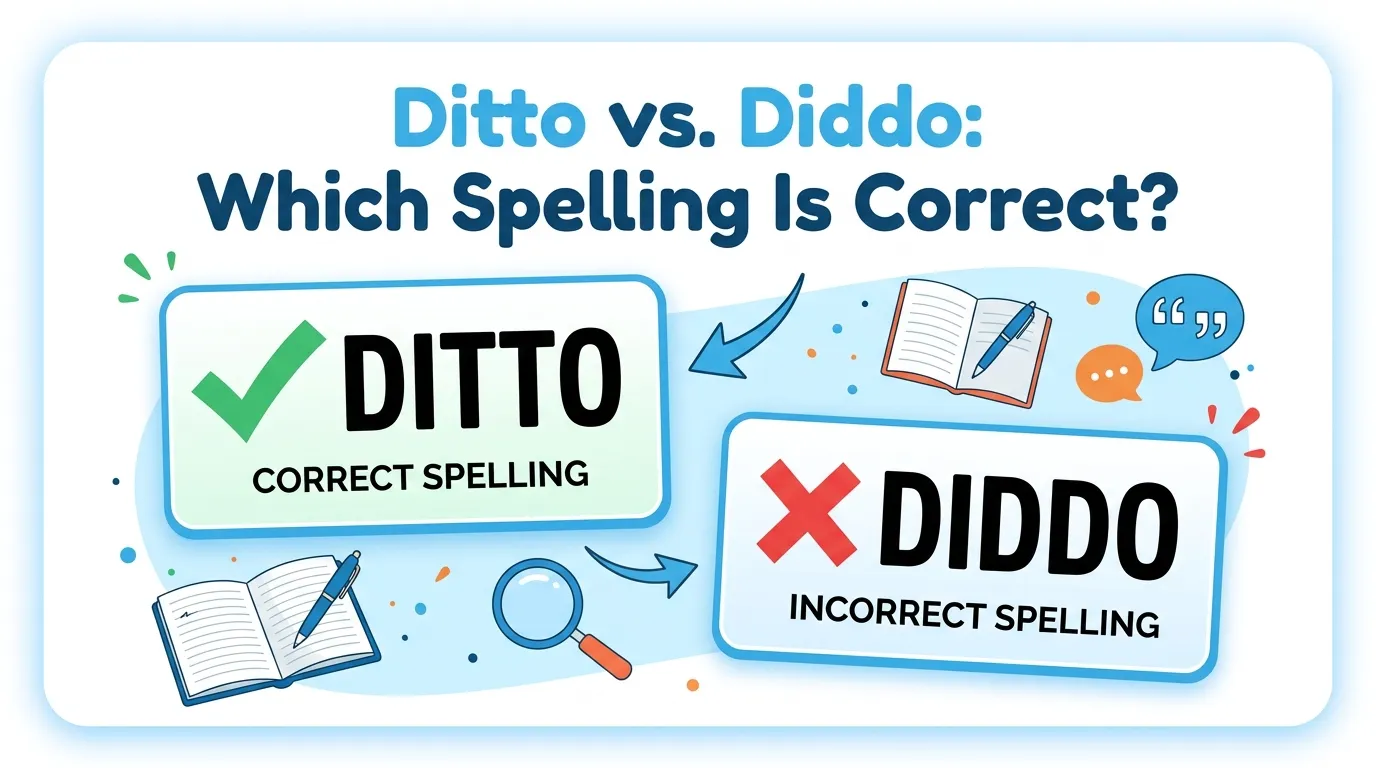
If you’re wondering about ditto vs diddo, the correct spelling is ditto. The word diddo is generally a misspelling of ditto and isn’t the standard spelling in modern English.
Ditto means the same, likewise, or I agree with what was just said. You can use it as a noun, verb, or informal response, depending on the sentence.
For example:
- “I love this movie.” — “Ditto!”
- “Please write your name in the first box and ditto in the second.”
- “She ordered the same meal as I did; ditto for her friend.”
So, if you’ve seen diddo, ditto is almost certainly the word you’re looking for.
This guide explains the difference between ditto and diddo, why people confuse the two, how to pronounce ditto, what ditto means in texting and conversation, and how to use it naturally in American and British English.
Quick Answer: Ditto or Diddo?
Ditto is correct. Diddo is usually incorrect.
| Word | Correct? | Meaning |
|---|---|---|
| Ditto | ✅ Yes | The same; likewise; repeat what was previously stated |
| Diddo | ❌ Usually no | Common misspelling of ditto |
The standard English word is ditto.
Example
Correct:
“I agree with you.” — “Ditto.”
Incorrect:
“I agree with you.” — “Diddo.”
If you’re writing an email, essay, article, report, message, or social media post, use ditto.
What Does Ditto Mean?
Ditto means the same as what was just mentioned.
It can express agreement, repetition, or similarity without requiring you to repeat the entire statement.
For example:
“I think this restaurant has the best pizza in town.”
Someone might reply:
“Ditto!”
Here, ditto means:
“I think the same thing.”
It can also mean repeat the information above.
For example, on an old list or form, someone might write ditto to indicate that the information in the previous line should be repeated.
Simple definition of ditto
Ditto: the same as previously stated, written, or mentioned.
Depending on context, it can mean:
- the same
- likewise
- same here
- I agree
- me too
- repeat the previous information
- copy the information above
What Does Diddo Mean?
Diddo is generally not the standard spelling of the English word.
People often write diddo because they hear ditto and assume the word contains dd or did.
This is a spelling mistake similar to other words that people spell based on how they think they sound.
For standard English writing, avoid diddo when you mean ditto.
Incorrect
“I feel exactly the same. Diddo.”
Correct
“I feel exactly the same. Ditto.”
The important point is simple:
Diddo isn’t the standard spelling of the word meaning “the same.”
Why Do People Confuse Ditto and Diddo?
The confusion usually comes from pronunciation and memory, rather than from two genuinely different English words.
When people hear ditto in quick conversation, the word can be easy to remember incorrectly.
The repeated d/t sounds may also make some speakers assume that the word is spelled diddo.
Another reason is that English spelling isn’t always perfectly predictable from pronunciation. Many words have spellings that learners can’t reliably guess just by hearing them.
For example:
- ditto
- little
- bottle
- middle
- fiddle
The sound patterns can make learners associate ditto with other words ending in -dle or containing a doubled consonant.
The best memory rule
Remember:
Ditto starts with “dit,” not “did.”
If you mean the same, write ditto.
Ditto vs Diddo: Key Differences
The biggest difference is that ditto is a standard English word, while diddo is normally a spelling error.
| Feature | Ditto | Diddo |
|---|---|---|
| Standard English word | ✅ Yes | ❌ No, in ordinary usage |
| Meaning “the same” | ✅ Yes | ❌ No |
| Used in conversation | ✅ Yes | ❌ Avoid |
| Used in formal writing | ✅ Sometimes | ❌ No |
| Used in dictionaries as the standard word | ✅ Yes | ❌ Not as the standard spelling |
| Common spelling mistake | No | Yes |
| Means “likewise” | ✅ Yes | ❌ No |
If you’re choosing between the two, choose ditto.
How Do You Pronounce Ditto?
The pronunciation of ditto is straightforward.
It has two syllables, with the stress on the first syllable.
The first syllable sounds like dit, while the second has a short oh sound.
Don’t let the spelling diddo influence your pronunciation. The standard word is ditto.
Is Ditto a Noun, Verb, or Adverb?
One interesting feature of ditto is that it can perform different grammatical roles.
Ditto as a noun
As a noun, ditto can refer to something that is the same as something previously mentioned.
Example:
“I bought the blue shirt, and my brother bought the ditto.”
This noun use is possible, although it isn’t the most common modern conversational construction.
Ditto as a verb
Ditto can also be used as a verb meaning to repeat or copy something.
Example:
“Please ditto the information from the previous section.”
This usage is less common in everyday modern English but has historical and practical uses.
Ditto as an informal response
This is one of the most familiar modern uses.
“I can’t wait for the weekend.”
“Ditto!”
Here, ditto functions as a short expression meaning:
“I feel the same way.”
In everyday conversation, this is probably the use you’re most likely to encounter.
Ditto Meaning in Texting and Chat
In texting, messaging, and online conversations, ditto usually means:
- same
- me too
- I agree
- same here
- I feel the same way
For example:
“I’m so tired today.”
“Ditto.”
This is short, casual, and easy to understand.
Another example:
“That was the best concert ever!”
“Ditto! I had so much fun.”
In this context, ditto doesn’t mean that someone wants you to copy text. It simply expresses agreement or shared feelings.
Ditto vs “same” in texting
These words can have similar meanings:
| Expression | Tone | Meaning |
|---|---|---|
| Ditto | Casual | I agree / same here |
| Same | Very casual | I feel the same |
| Me too | Casual | I feel the same |
| Likewise | Neutral/formal | The same applies to me |
| I agree | Neutral | I share your opinion |
For very casual texting, same is often more natural than ditto. But ditto is perfectly understandable and can sound playful.
Is Ditto Slang?
Ditto isn’t really slang.
It’s better described as an informal or conversational word in many modern uses.
When someone replies:
“Ditto!”
they’re using the word casually.
However, the word itself has a long history and isn’t limited to slang or internet culture.
That distinction matters.
Ditto is:
- a standard English word
- often informal in conversation
- useful for expressing agreement
- sometimes used in written records
- not simply modern internet slang
So, if you’re writing an article about ditto meaning slang, it’s more accurate to explain that ditto has an informal conversational use but isn’t exclusively slang.
Ditto Meaning in American English
In American English, ditto is widely understood to mean the same or I agree.
For example:
“I need a vacation.”
“Ditto.”
American speakers may also use it humorously.
“I don’t want to attend another two-hour meeting.”
“Ditto.”
The tone can range from neutral to playful depending on the context.
Is ditto common in American English?
Yes, although alternatives such as same, me too, and I agree may be more common in certain casual conversations.
Ditto often has a slightly playful or concise feel.
Ditto in British English
British English also uses ditto.
The basic meaning remains the same:
the same, likewise, or repeat the previous information.
For example:
“I enjoyed the first book.”
“Ditto.”
The word isn’t restricted to American English.
American vs British usage
There is no major meaning difference between American and British English for ditto.
| Variety | Use of ditto |
|---|---|
| American English | Commonly understood |
| British English | Commonly understood |
| Canadian English | Commonly understood |
| Australian English | Commonly understood |
| International English | Generally understood |
So you don’t need a different spelling for different English-speaking regions.
Ditto remains ditto.
The History and Etymology of Ditto
The word ditto has an interesting history.
It ultimately comes from Italian, particularly the expression detto, meaning said or the said.
The word entered English through the language of commerce and record keeping.
Historically, ditto was useful when people needed to repeat information in lists, accounts, and documents without writing the same information over and over again.
Imagine a handwritten list like this:
| Item | Color |
|---|---|
| Shirt | Blue |
| Pants | Blue |
| Shoes | Blue |
Instead of writing Blue repeatedly, someone might use ditto to indicate that the information was the same as above.
Over time, the word expanded beyond bookkeeping.
Today, you can use it to mean “same here” or “I agree.”
Ditto as a Way to Say “I Agree”
One of the easiest ways to understand ditto is to think of it as a shortcut for agreement.
Example 1
“I think this is the best option.”
“Ditto.”
Meaning:
“I think this is the best option too.”
Example 2
“I’m exhausted after that trip.”
“Ditto.”
Meaning:
“I’m exhausted too.”
Example 3
“She says we should leave early.”
“Ditto.”
Meaning:
“I agree with her.”
This makes ditto especially useful when repeating the original statement would feel unnecessary.
Ditto vs Same vs Likewise vs Me Too
Although these expressions overlap, they don’t always sound exactly the same.
| Expression | Typical meaning | Tone |
|---|---|---|
| Ditto | Same / I agree | Casual, sometimes playful |
| Same | I feel the same | Very casual |
| Me too | I also feel that way | Casual |
| Likewise | The same applies to me | Neutral/formal |
| I agree | I share your opinion | Direct |
| So do I | I have the same feeling/action | Neutral |
| Absolutely | Strong agreement | Conversational |
Example
Person A:
“I love this song.”
Possible responses:
“Ditto.”
“Same.”
“Me too.”
“So do I.”
All can work, but their tone differs slightly.
Formal vs Informal Alternatives to Ditto
Ditto is not always the best choice.
In a professional report or academic paper, you may want to use clearer language.
Informal
“I agree. Ditto.”
Neutral
“I agree as well.”
Formal
“The same conclusion applies here.”
Academic
“The same principle applies to the second case.”
Business
“We have reached the same conclusion.”
Choosing the right expression depends on your audience.
When Should You Use Ditto?
Use ditto when the reader or listener can easily understand what you’re referring to.
It’s especially useful when:
- agreeing with someone’s statement
- avoiding unnecessary repetition
- indicating that information is the same as above
- responding casually to another person’s opinion
- writing informal notes
- creating a playful or concise response
Natural examples
“I need coffee.”
“Ditto.”
“She chose the blue option, and I did ditto.”
“The second entry is ditto the first.”
“He said the movie was boring. Ditto.”
When Should You Avoid Ditto?
Avoid ditto when the meaning could be unclear.
For example, in a formal report:
“The results were significant. Ditto.”
A reader may wonder exactly what ditto refers to.
A clearer sentence would be:
“The results for the second group were also significant.”
In professional and academic writing, specific wording is usually better than shorthand.
Avoid it when:
- the reference is unclear
- you’re writing for a formal audience
- you’re explaining complex information
- the repeated idea could be misunderstood
- precision matters more than brevity
Common Mistakes With Ditto and Diddo
Mistake 1: Writing diddo
❌ “Diddo!”
✅ “Ditto!”
Mistake 2: Assuming ditto means “definitely”
Some people may misunderstand ditto as a general positive response.
Actually, it means the same or likewise.
“I think we should cancel the event.”
“Ditto.”
The second person agrees with the first person’s statement.
Mistake 3: Using ditto without a clear reference
❌ “Ditto was excellent.”
This sounds confusing unless the reader knows what ditto refers to.
Better:
“The second presentation was equally excellent.”
Mistake 4: Using ditto repeatedly in formal writing
A document full of ditto can become unclear.
Instead of:
“The same rule applies. Ditto for the next section.”
Use:
“The same rule applies to the next section.”
Awkward vs Natural Examples
Example 1
Awkward:
“I think this plan is too expensive.”
“Ditto, I think the same.”
The phrase unnecessarily explains ditto.
Natural:
“I think this plan is too expensive.”
“Ditto.”
Example 2
Awkward:
“Diddo, I agree with you.”
Natural:
“Ditto—I agree with you.”
Example 3
Awkward:
“She likes chocolate. Ditto likes chocolate.”
Natural:
“She likes chocolate, and I do too.”
Or:
“She likes chocolate. Ditto for me.”
Example 4
Awkward:
“Ditto is the same as the previous result.”
Natural:
“The same result applies here.”
Common Collocations With Ditto
A collocation is a combination of words that commonly appear together.
Some useful combinations include:
- ditto mark
- ditto machine
- ditto copy
- ditto for
- ditto that
- ditto the above
- ditto here
- ditto for me
- ditto on that
- simply ditto
Ditto for
The phrase ditto for is especially useful.
“The first group needs more time. Ditto for the second group.”
Meaning:
“The second group needs more time too.”
What Is a Ditto Mark?
A ditto mark is a symbol used to indicate that something is the same as information above it.
Historically, ditto marks were useful in handwritten and printed documents.
For example, a list might contain repeated information without requiring the writer to write the same word again.
This is one reason ditto became associated with repetition and copying.
Today, spreadsheets and digital forms make this much easier, so the traditional use is less important in everyday life.
Still, you’ll encounter the term in discussions of historical documents, typography, bookkeeping, and office practices.
Ditto in Business and Office Writing
In modern business communication, ditto can be understood, but it isn’t always the clearest option.
Casual workplace message
“I agree with Sarah’s recommendation.”
“Ditto.”
This is fine in an informal team chat.
Formal business writing
Instead of:
“Ditto for the second department.”
Write:
“The same recommendation applies to the second department.”
The second version is clearer and more professional.
Ditto in Academic Writing
Academic writing generally favors precision.
Although ditto is a real English word, it can sound too informal or vague in scholarly writing.
Instead of:
“The same pattern occurred in Group A. Ditto in Group B.”
Consider:
“The same pattern occurred in Group B.”
Or:
“Group B showed the same pattern.”
This removes ambiguity.
Best academic practice
Use specific nouns and verbs rather than relying on shorthand.
Ditto in Journalism and Professional Writing
Journalists usually avoid unnecessary ambiguity.
If the previous sentence says:
“The company reported record profits.”
Simply writing:
“Ditto.”
would be too vague in a news article.
A journalist might write:
“The company reported a similar result in the second quarter.”
In opinion writing, however, ditto may appear when the writer wants a conversational tone.
Ditto in Sports Writing
Sports writers and fans may use ditto informally to express agreement.
For example:
“The defense needs to improve.”
“Ditto for the offense.”
Here, ditto for the offense means:
“The same criticism applies to the offense.”
This construction is natural and easy to understand.
Ditto in Blogging and Social Media
Bloggers can use ditto when writing in a relaxed, personal voice.
For example:
“If you’re a fan of short weekend trips, ditto for me.”
Or:
“Everyone wants more free time. Ditto!”
However, if you’re writing SEO content, don’t force the word into sentences simply because it is a target keyword.
Good writing should prioritize clarity and natural language.
Synonyms for Ditto
Depending on context, useful synonyms include:
- same
- likewise
- similarly
- equally
- me too
- same here
- I agree
- I feel the same
- so do I
- so am I
- the same applies
- repeat
- copy
These aren’t perfect substitutes in every sentence.
For agreement
Use:
- same
- me too
- I agree
- likewise
- so do I
For repetition
Use:
- repeat
- copy
- the same
- as above
- duplicate
Antonyms of Ditto
There isn’t one perfect opposite of ditto, because the word can have different meanings.
Depending on context, possible contrasts include:
- different
- opposite
- unlike
- distinct
- unique
- separate
- disagree
- contrary
For example:
“The two answers aren’t ditto; they’re different.”
More naturally:
“The two answers aren’t the same; they’re different.”
Related Words and Expressions
Words related to the idea behind ditto include:
- same
- similarity
- likewise
- repetition
- duplication
- copy
- duplicate
- agreement
- repetition
- identical
- equivalent
- corresponding
Common expressions with similar meanings include:
- same here
- me too
- I agree
- likewise
- so do I
- same thing
- the same applies
- as above
A Simple Memory Trick for Ditto vs Diddo
Here’s an easy way to remember the correct spelling:
Think: DITTO = SAME
Both are short and easy to connect in your memory.
You can also remember:
DITTO has “IT” in the middle.
D-IT-TO
So if you’re unsure whether to write diddo or ditto, remember:
D-I-T-T-O = correct
D-I-D-D-O = usually incorrect
Quick Guide: Which Word Should You Use?
Use this simple guide:
If you mean “the same”
Use:
Ditto
If you mean “I agree”
Use:
Ditto, I agree, same, or me too
If you mean “the same applies”
Use:
Ditto for…
If you’re writing formally
Prefer:
The same applies…
If you’re texting a friend
You can use:
Ditto!
If you’re wondering about “diddo”
Don’t use it when you mean the same.
Use:
Ditto
20 Everyday Examples of Ditto
Here are natural examples you can use as a reference:
- “I love this song.” — “Ditto.”
- “I’m hungry.” — “Ditto.”
- “That movie was amazing.” — “Ditto!”
- “I agree with your point.” — “Ditto.”
- “She wants to leave early. Ditto for me.”
- “I need a break.” — “Ditto.”
- “He ordered coffee, and I did ditto.”
- “The same rule applies to the next section—ditto for the final section.”
- “I don’t like crowded places.” — “Ditto.”
- “She thinks the price is too high. Ditto.”
- “I’m excited about the trip.” — “Ditto!”
- “They chose the red design, and we chose ditto.”
- “I had the same reaction. Ditto.”
- “The first team struggled. Ditto for the second team.”
- “I agree completely. Ditto.”
- “He said the book was boring. Ditto.”
- “We need more time. Ditto for the other department.”
- “I feel exactly the same way. Ditto.”
- “The second result was ditto the first.”
- “She wants pizza tonight.” — “Ditto!”
10 Correct Examples vs Incorrect Examples
| Incorrect | Correct |
|---|---|
| Diddo! | Ditto! |
| I feel the same. Diddo. | I feel the same. Ditto. |
| Diddo for me. | Ditto for me. |
| I agree, diddo. | I agree, ditto. |
| Diddo applies here. | The same applies here. |
| He chose ditto? | He chose the same. |
| Diddo that! | Ditto that! |
| Diddo for the next group. | Ditto for the next group. |
| I think so too—diddo. | I think so too—ditto. |
| Ditdo | Ditto |
The safest rule is simple: if you’re using the word to mean “the same,” spell it D-I-T-T-O.
Is Ditto a Good Word to Use?
Yes, but context matters.
Ditto is useful because it’s short and expressive. It lets you agree without repeating an entire sentence.
However, it’s not always the clearest choice.
Use ditto when:
- the conversation is casual
- the reference is obvious
- you want a short response
- you’re expressing agreement
- you’re using a conversational writing style
Choose something else when:
- writing an academic paper
- preparing a formal business document
- explaining technical information
- the reference isn’t obvious
- precision is important
The goal isn’t simply to use the “correct” word. The goal is to use the clearest word for your audience.
Ditto vs Diddo: Final Comparison
Let’s bring everything together.
| Category | Ditto | Diddo |
|---|---|---|
| Standard spelling | ✅ | ❌ |
| Means “the same” | ✅ | ❌ |
| Means “likewise” | ✅ | ❌ |
| Can express agreement | ✅ | ❌ |
| Common in casual speech | ✅ | ❌ |
| Appropriate in standard writing | ✅ | ❌ |
| Historical word | ✅ | ❌ |
| Common misspelling | No | Yes |
| Recommended spelling | Yes | No |
There is really no contest between ditto vs diddo when you’re trying to write standard English.
Ditto is the correct choice.
FAQs
Is ditto or diddo correct?
Ditto is correct. Diddo is generally a misspelling when someone intends to use the English word meaning “the same” or “likewise.”
What does ditto mean?
Ditto means “the same,” “likewise,” or “I agree.” It can be used to avoid repeating information or to show that you share someone’s opinion or feeling.
Is diddo a real word?
Diddo isn’t the standard spelling of the common English word ditto. If you mean “the same” or “likewise,” use ditto.
Is ditto slang?
Ditto isn’t strictly slang. It’s a standard English word that is often used informally in conversation to mean “same” or “I agree.”
How do you use ditto in a sentence?
You can use ditto as a short response to agreement:
“I love this restaurant.” — “Ditto.”
You can also say:
“Ditto for the second group.”
This means that the same statement applies to the second group.
What is another word for ditto?
Depending on the context, alternatives include same, likewise, me too, same here, I agree, so do I, and the same applies.
Is ditto formal or informal?
Ditto can be used in both written and spoken English, but its agreement use is generally informal or conversational. In formal writing, clearer phrases such as the same applies or likewise may be better.
What is the difference between ditto and likewise?
Both can express similarity or agreement. Ditto often sounds more casual and conversational, while likewise can sound more polished or formal.
For example:
“I enjoyed the event.” — “Ditto.”
or:
“I enjoyed the event.” — “Likewise.”
Why do people spell ditto as diddo?
People may write diddo because they misunderstand the pronunciation or try to spell the word based on how it sounds. However, the standard spelling is ditto.
Does ditto mean “same here”?
Yes. In casual conversation, ditto can mean same here, me too, or I feel the same way.
Conclusion
The difference between ditto vs diddo is simple: ditto is the standard and correct spelling, while diddo is generally a misspelling.
Ditto means the same, likewise, or I agree. You can use it as a short conversational response, such as:
“I’m ready for the weekend.”
“Ditto!”
You can also use it in expressions such as ditto for me or ditto for the second group.
The word has a long history connected to repeating information, and its modern conversational meaning developed from that basic idea of sameness and repetition.
For casual conversation, texting, social media, and informal writing, ditto can be a quick and natural choice. In academic, technical, legal, or highly formal writing, it’s usually better to state the repeated idea clearly rather than rely on shorthand.
Most importantly, don’t let the spelling diddo confuse you.
When you mean the same, remember:
DITTO = correct.
So, whenever you’re deciding between ditto and diddo, choose ditto.